1 in stock
1 in stock
Add to Compare
Add to Wishlist
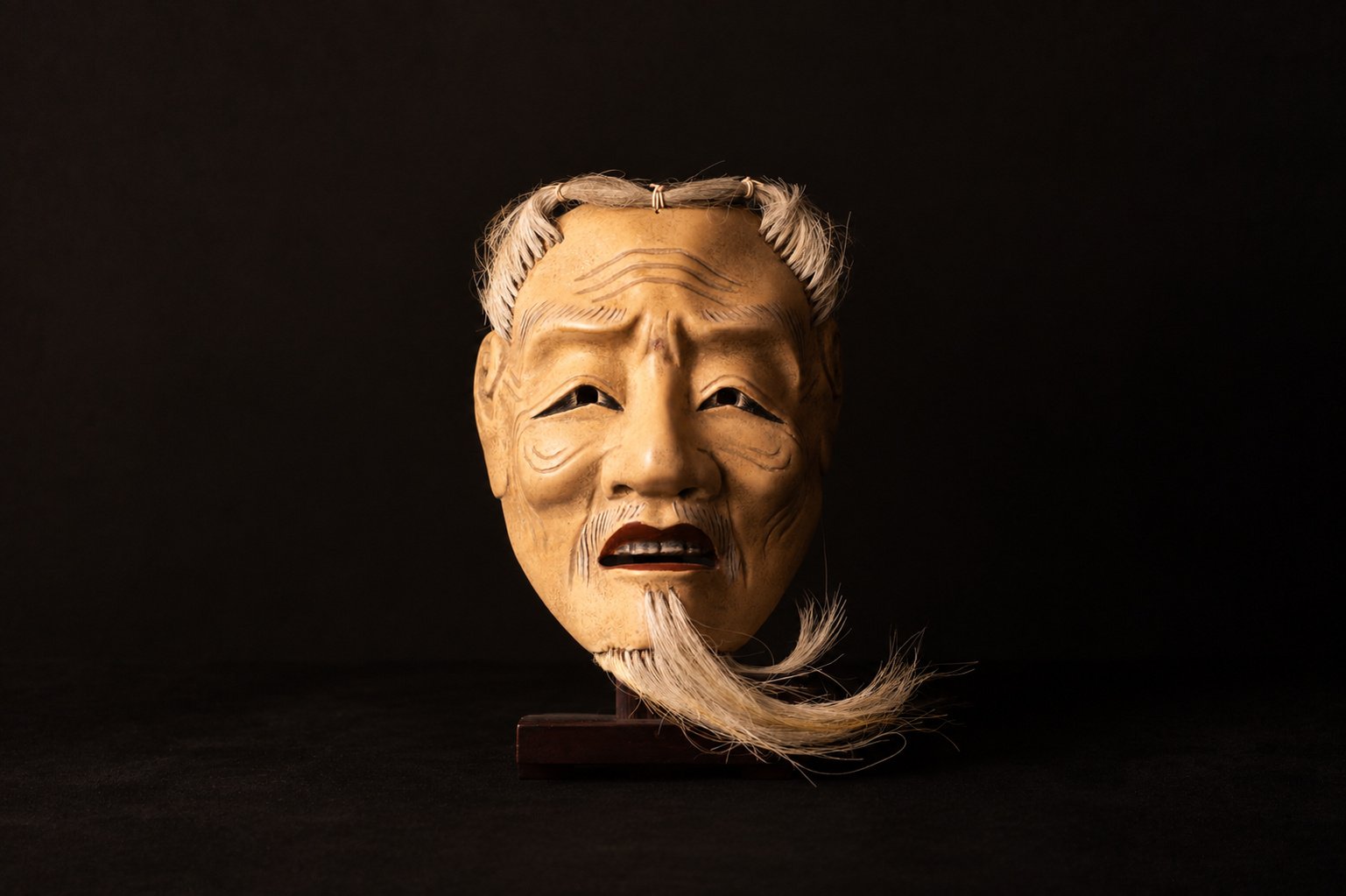
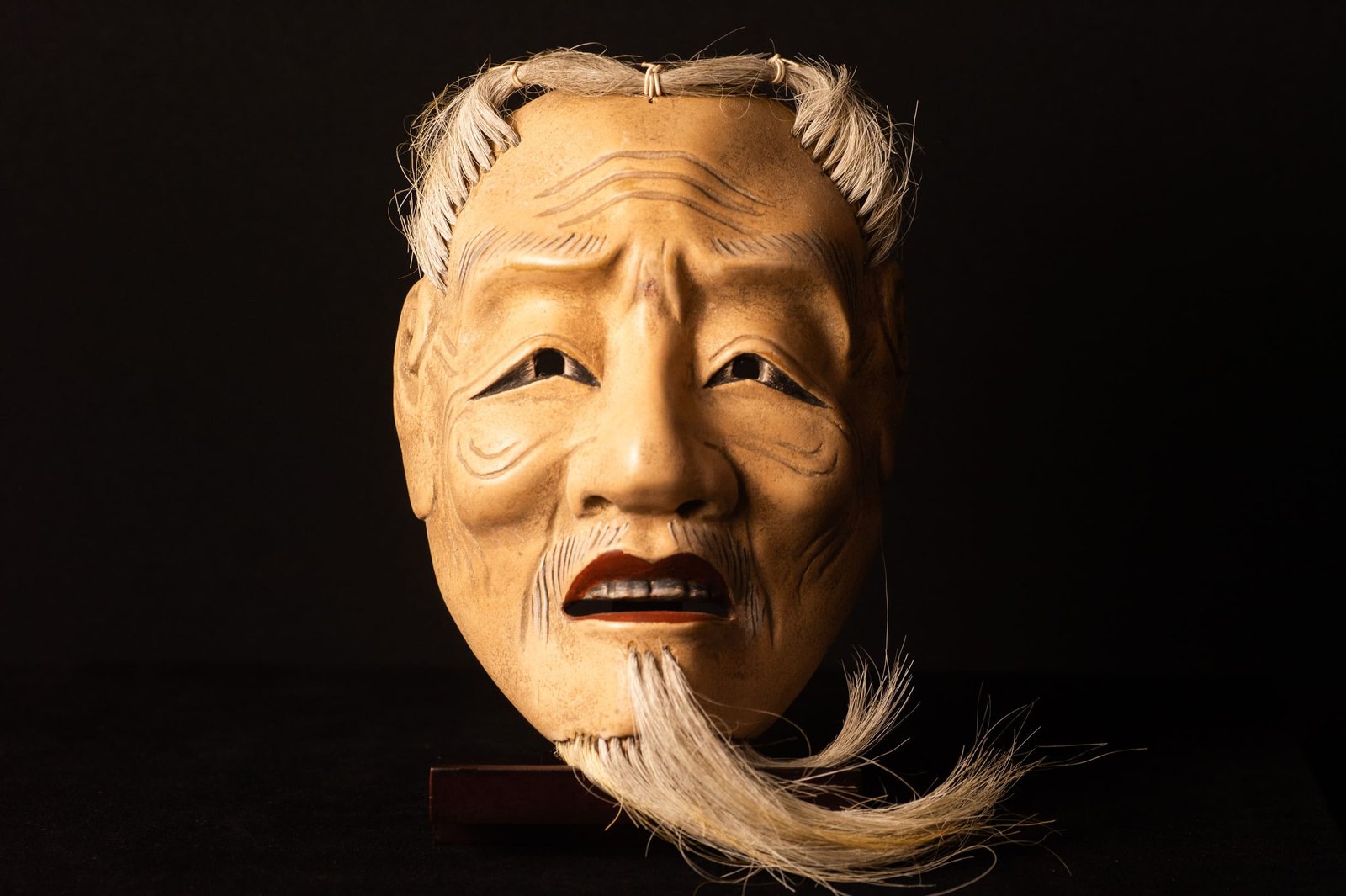
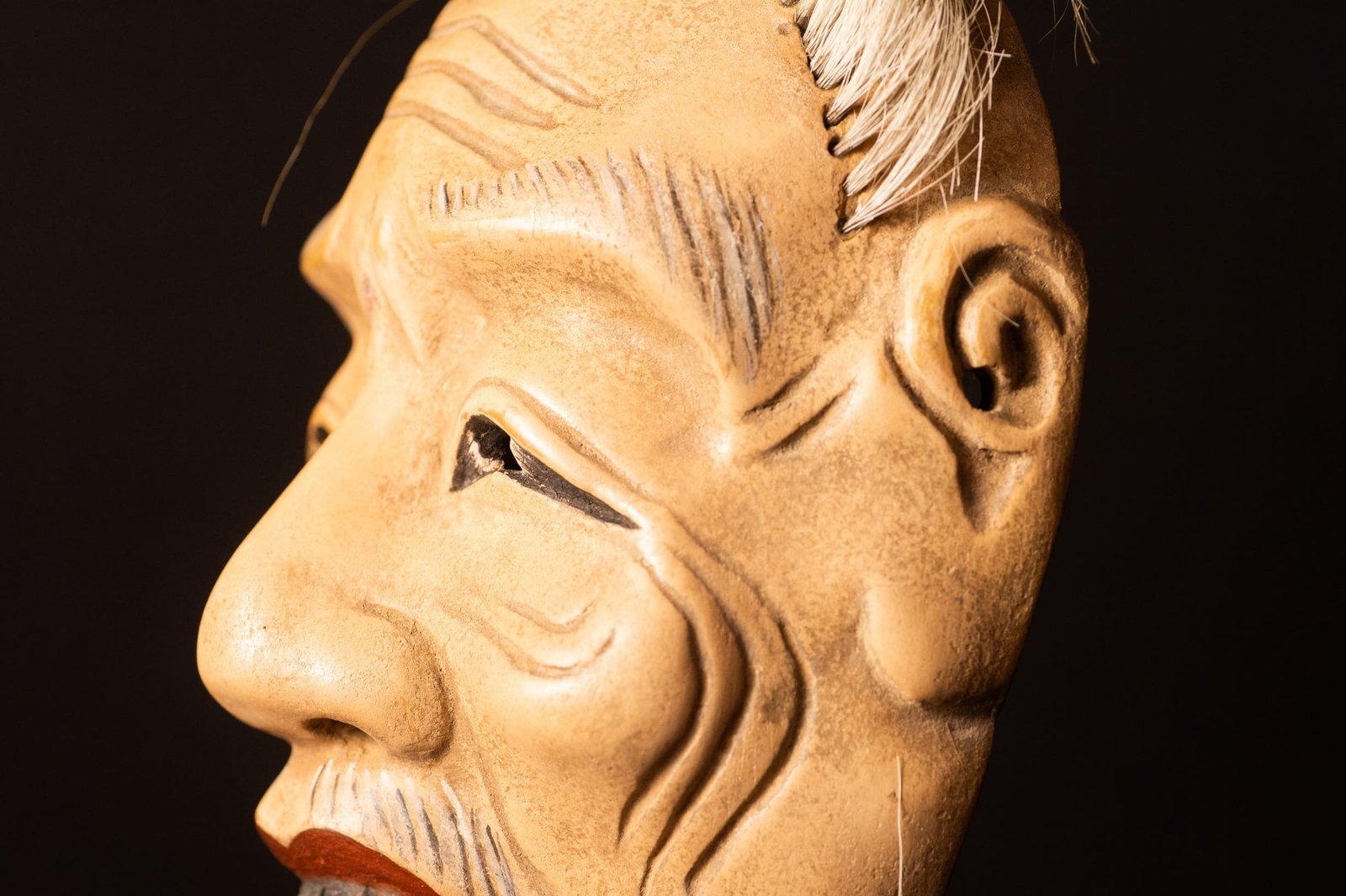
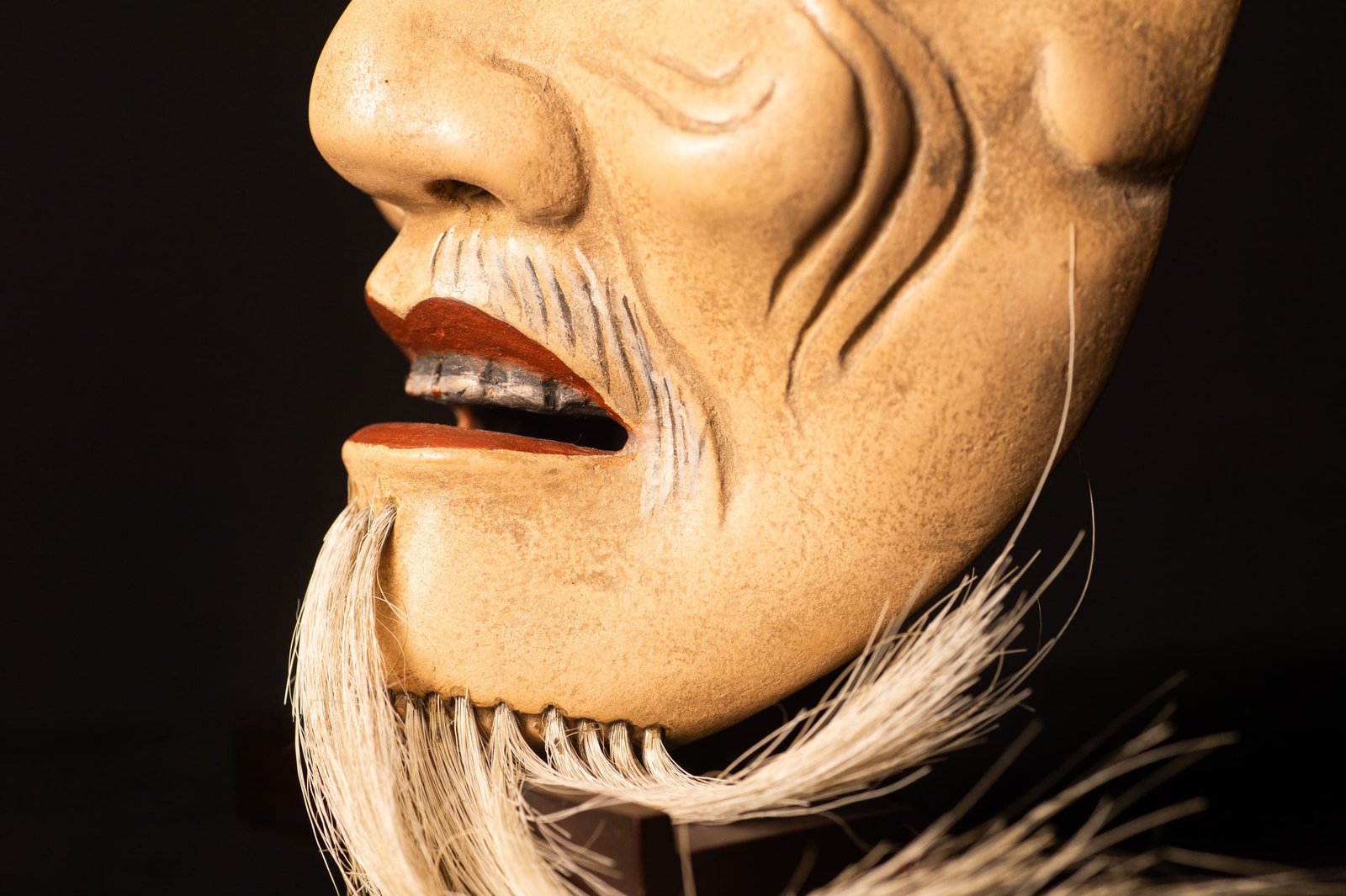
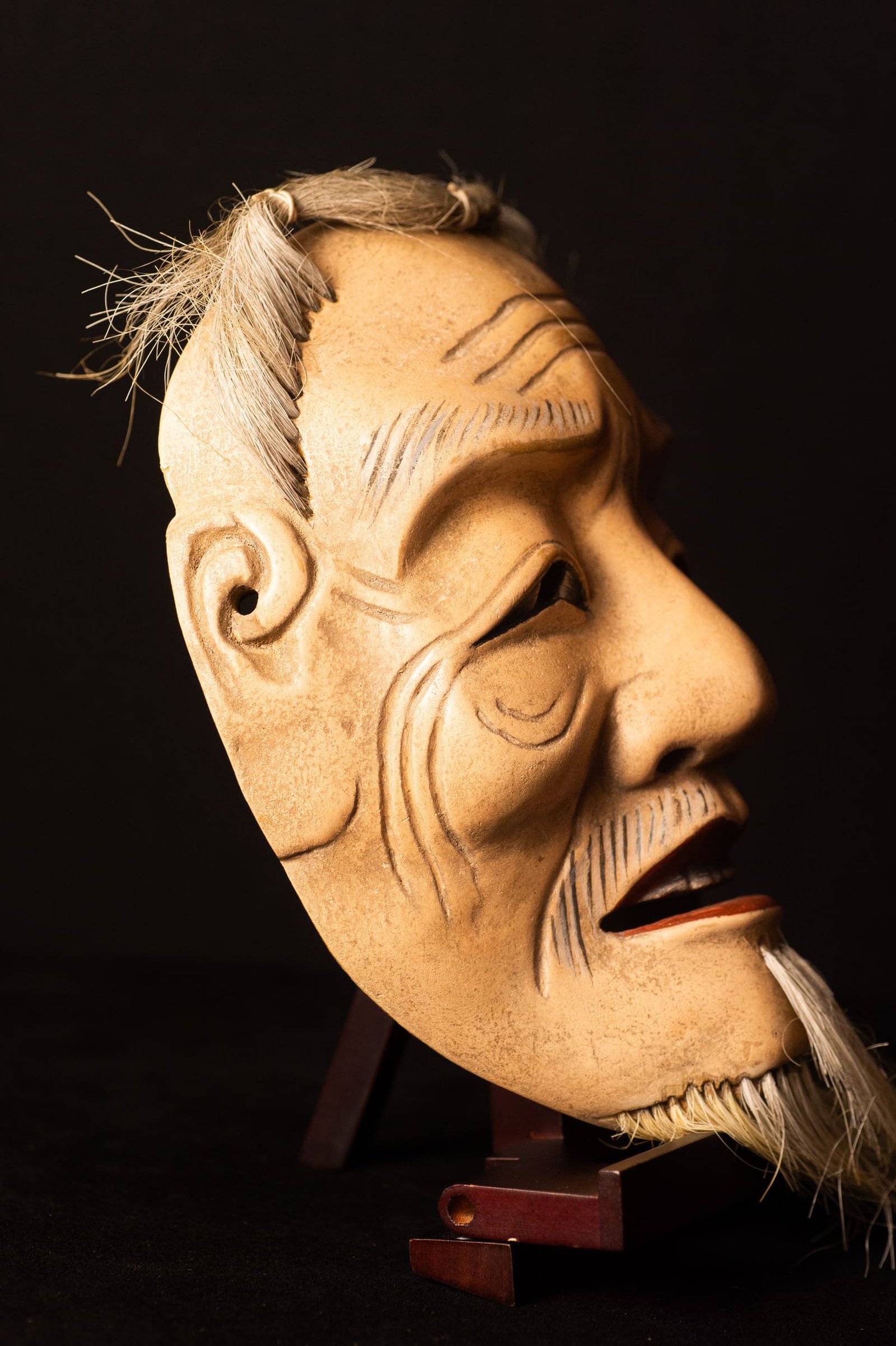
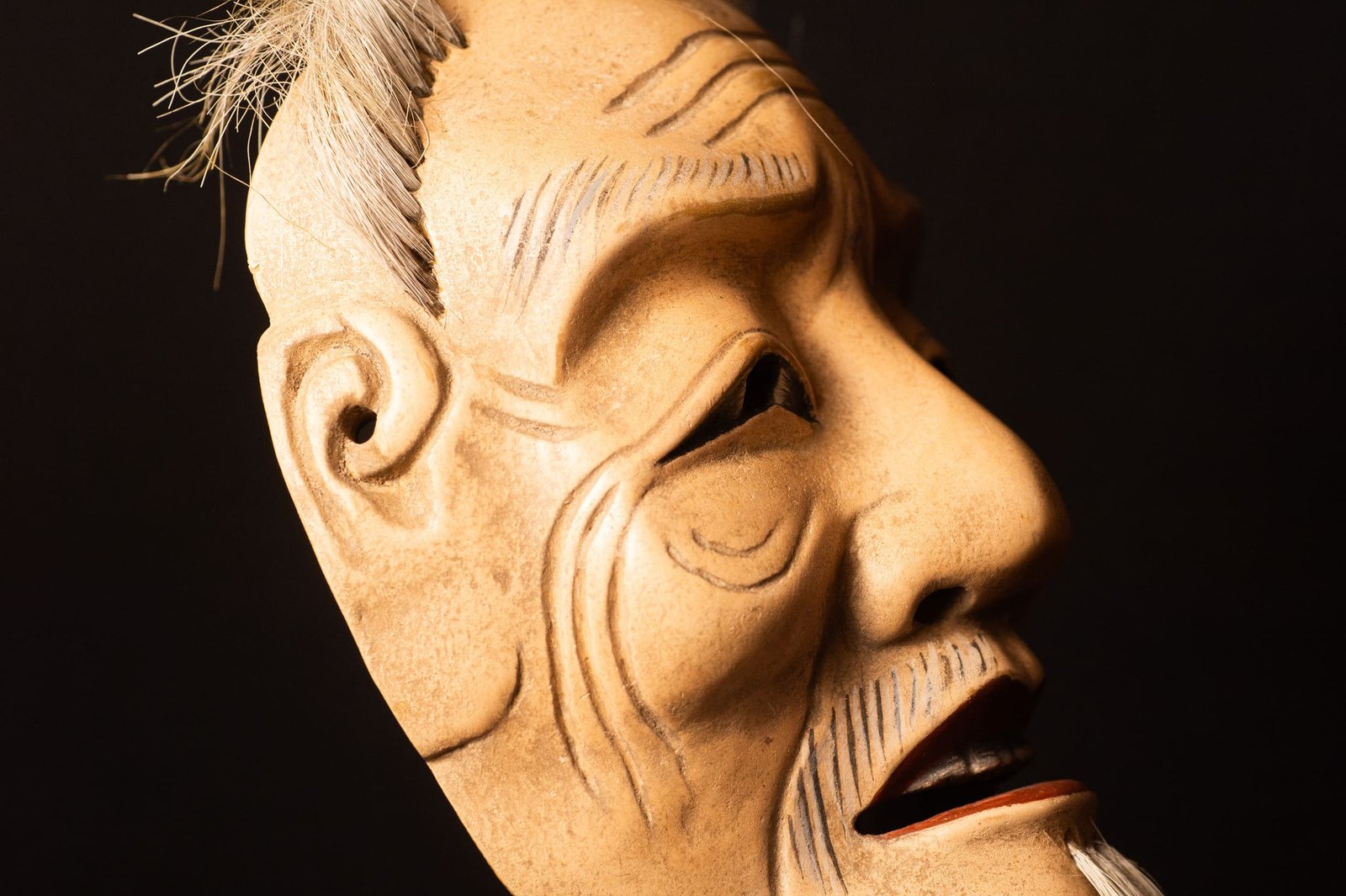
A finely carved Japanese Jō (尉) Noh mask representing an elderly man, made from a single block of hinoki cypress and retaining its applied white horsehair, painted details, dark lacquered reverse and an inscription on the interior.
Jō masks occupy an important place within the Noh repertoire. Their aged faces can represent ordinary elderly men, venerable figures and, in celebratory plays, divine beings temporarily appearing in human form. Unlike the dramatic expression of demon masks, their character is conveyed through restraint: the weight of age, quiet dignity and contemplative presence.
This example is particularly appealing for its full facial modeling, extensive carved detail and generously preserved horsehair, including the long sweeping beard and tied forelocks.
The term Jō (尉) refers to a broad family of old-man masks used in Japanese Noh theater. These masks are closely associated with plays concerning old age, memory, sacred places and supernatural revelation.
In the celebratory waki-noh tradition, an apparently ordinary old man may appear during the first act before revealing his true identity as a deity or supernatural being. The aged face therefore carries meanings beyond physical old age, including wisdom, longevity, spiritual authority and the boundary between the human and divine worlds.
The mask is carved from a single block of Japanese cypress (hinoki), the traditional material favored for high-quality Noh masks because of its fine grain, stability and suitability for precise carving.
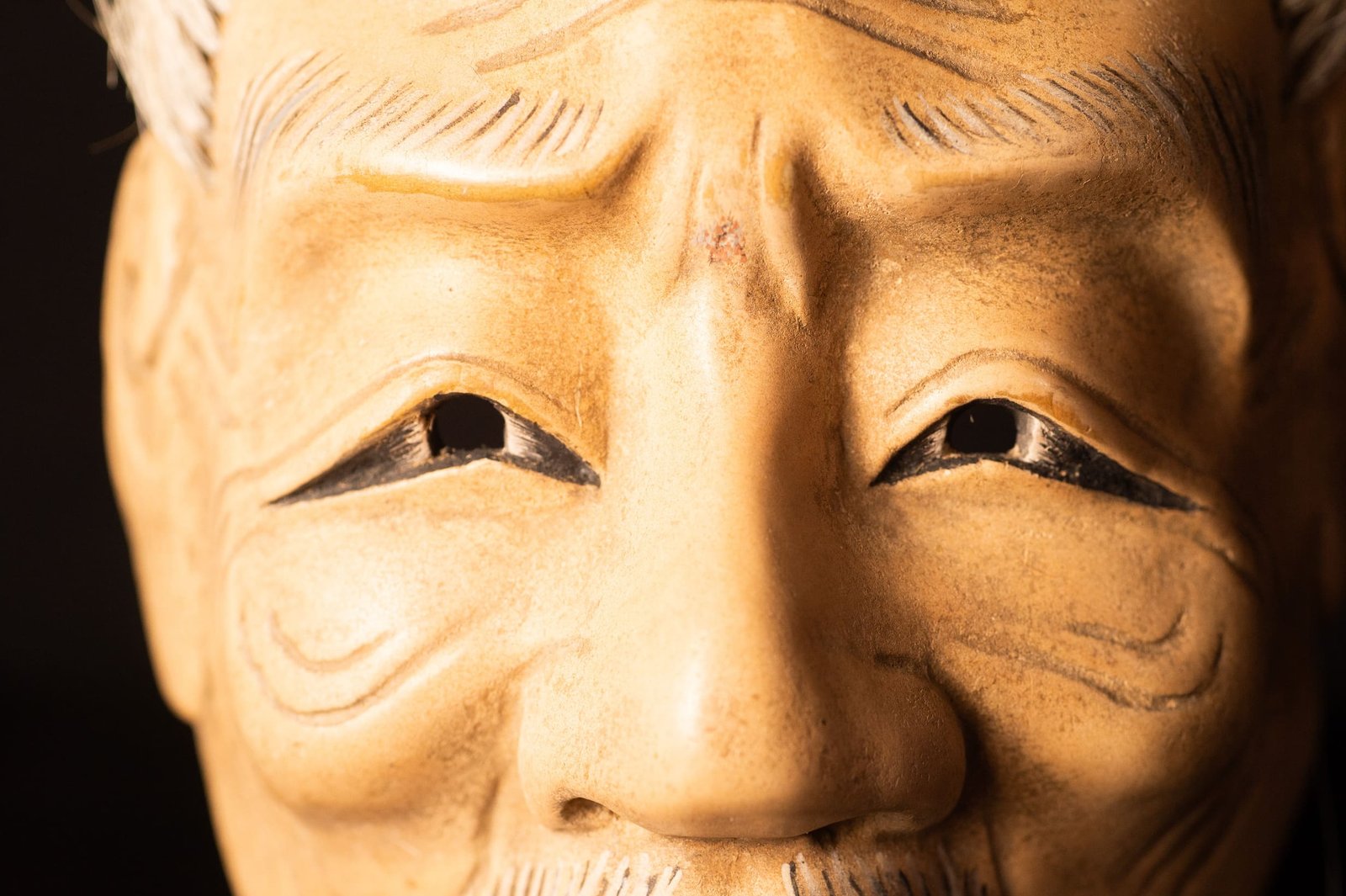
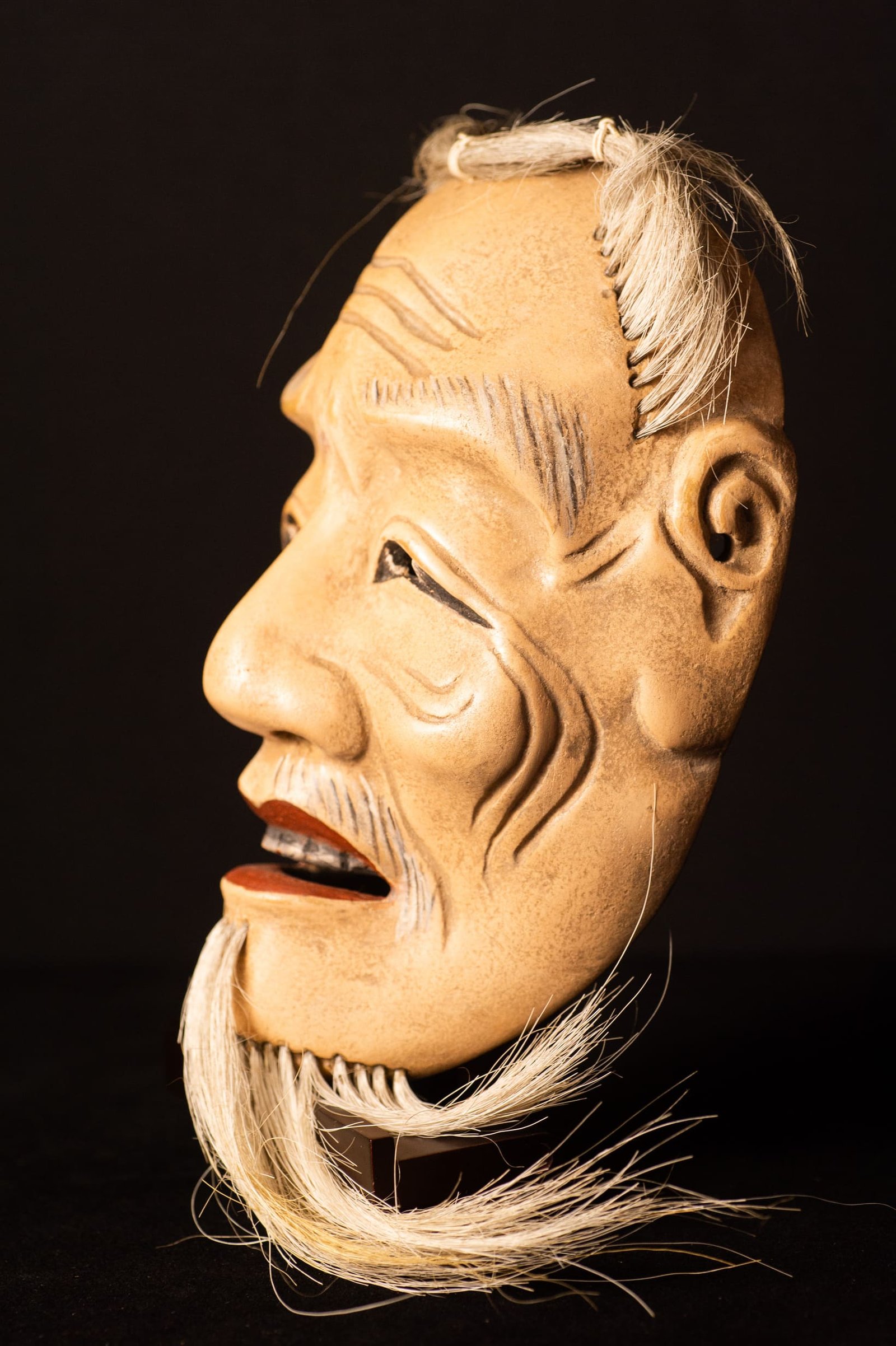
The face is broad and full rather than gaunt, with firm cheeks and a substantial, square jaw. The carving creates a dignified elderly expression without exaggerating the signs of age.
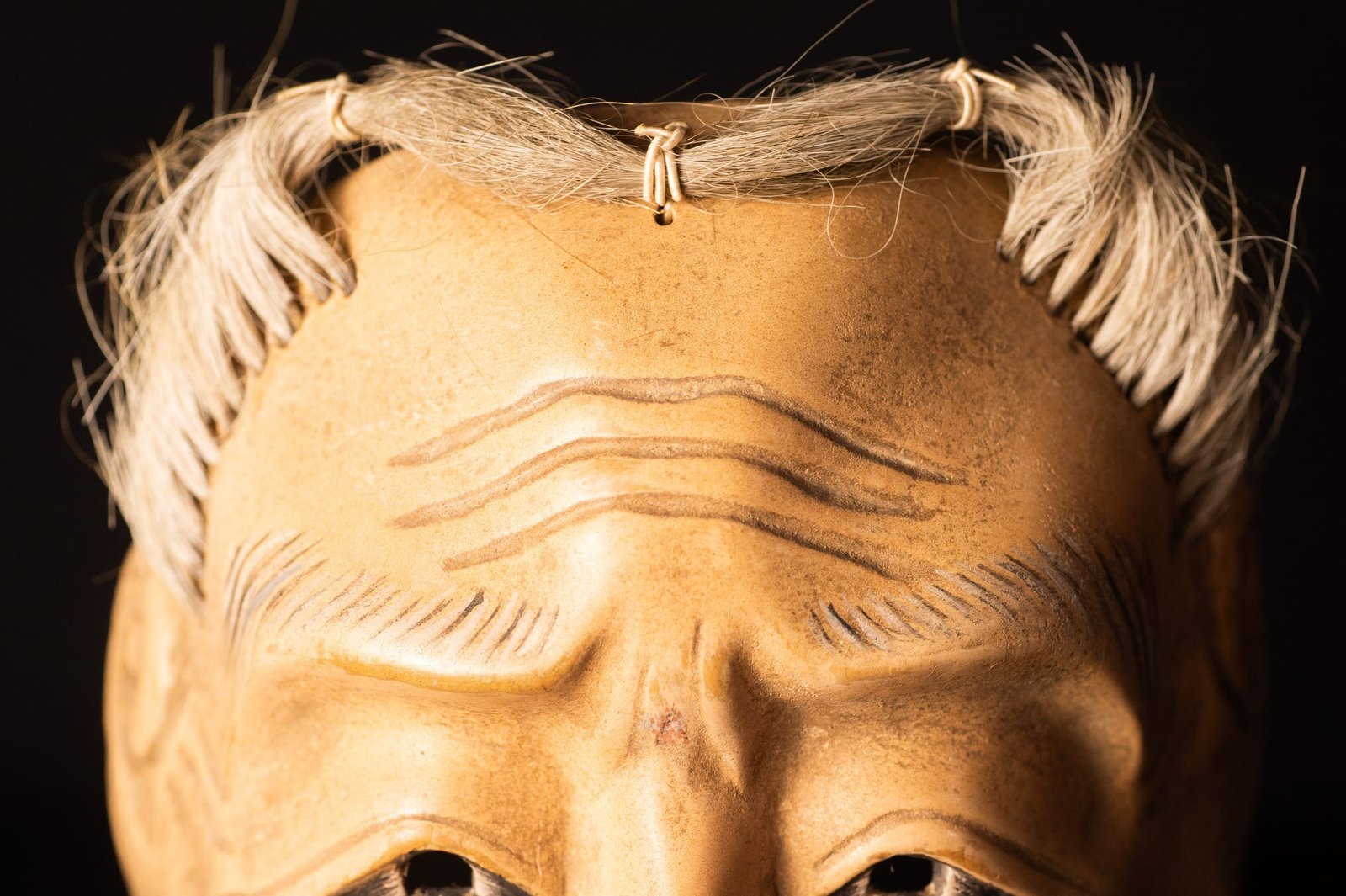
Three long incised furrows cross the forehead in shallow waves, accompanied by further lines above the brows. These carefully controlled incisions establish the aged character of the face while preserving the mask’s restrained expression.
At the outer corners of the eyes, carved crow’s-feet extend toward the ears in distinctive curling lines, adding further movement to the otherwise calm composition.
The eyes are pierced as narrow openings, with the upper lids emphasized in black. Their slightly elevated orientation gives the mask an attentive, upward-looking expression rather than the heavily hooded or downward gaze seen in some other old-man mask types.
The result is an expression combining mildness, age and alertness. As with traditional Noh masks generally, subtle changes in viewing angle and illumination can significantly alter the perceived emotion of the face.
The large, fleshy nose is strongly modeled, with the nostrils pierced through the mask. The ears are carved prominently in relief and show unusually detailed internal modeling, including deeply scrolled forms and pierced channels.
These details demonstrate the attention given not only to the frontal theatrical effect of the mask but also to its sculptural treatment as a complete object.
The complexion is finished in a warm ochre-buff tone over a traditional gofun ground. Rather than presenting the pale complexion associated with certain female Noh masks, the surface evokes aged, weathered skin.
Subtle tonal variation across the forehead, cheeks, nose and jaw gives the face considerable depth under directional light.
One of the most visually compelling features of this mask is its extensive applied white horsehair.
The hairline is pierced along its length, with groups of horsehair individually secured through the mask. The method of attachment remains visible around the temples and crown, providing an excellent view of the traditional construction.
Two substantial locks of white hair rise from the sides of the head and are drawn across the crown, where they are tied with fiber cord. This arrangement leaves the high central dome of the forehead exposed and strongly reinforces the elderly character represented by the mask.
The survival of this applied hair is especially important to the mask’s complete visual appearance.
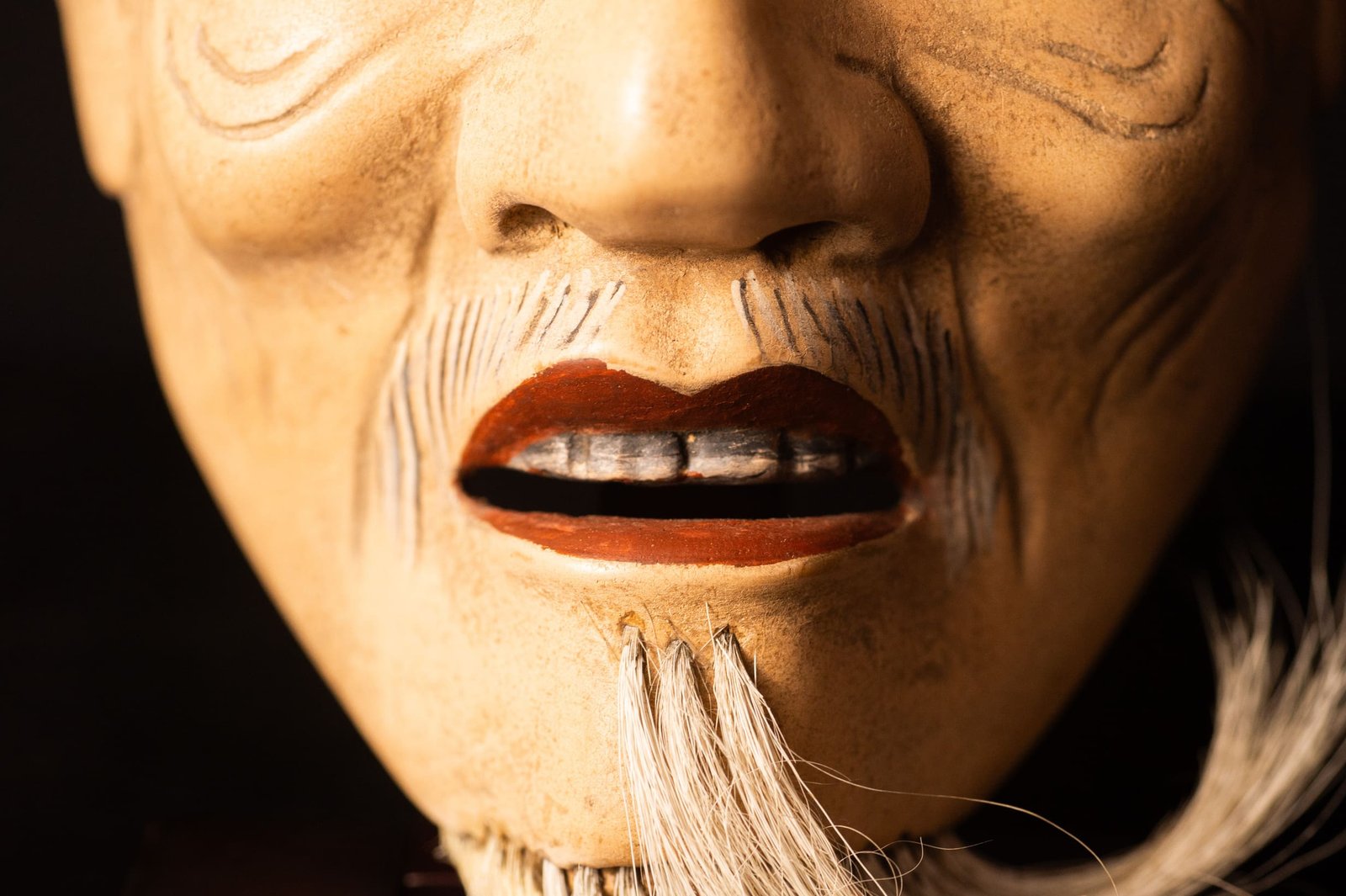
Applied horsehair also forms the mustache and the long beard beneath the chin. The beard extends well below the jaw and sweeps dramatically to one side, giving the mask considerable presence when displayed.
Fine ink lines supplement the applied hair around the brows, mustache roots and chin, creating a subtle transition between painted and physical hair.
The mouth is slightly open, forming a narrow aperture. The lips are painted in a deep iron-red tone, while the upper teeth form a continuous carved row finished in a muted gray-silver color.
The expression suggests an elderly man caught at the moment of speaking, an appropriate quality for a theatrical mask whose character is brought to life through movement, chant and performance.
Jō masks appear throughout the Noh repertoire, particularly in plays centered on deities, venerable men, sacred landscapes and the passage of time.
Old-man characters appear in celebrated works such as Takasago, Oimatsu, Yugyō Yanagi, Yōrō and Yumi Yawata, while related old-man mask traditions are also encountered in other dramatic contexts.
The Jō family includes a number of closely related forms, including ko-jō, asakura-jō, sankō-jō and warai-jō. Precise classification can depend on subtle differences in the cheeks, eyebrows, eyes and mouth, as well as on individual school and workshop conventions.
The broad cheeks, balanced mouth and gentle upward gaze of this example place its visual character within the more dignified and benevolent register of the Jō family rather than among the more gaunt or severely aged interpretations.
The restrained expression is particularly effective: the mask communicates age and authority without relying on theatrical exaggeration.
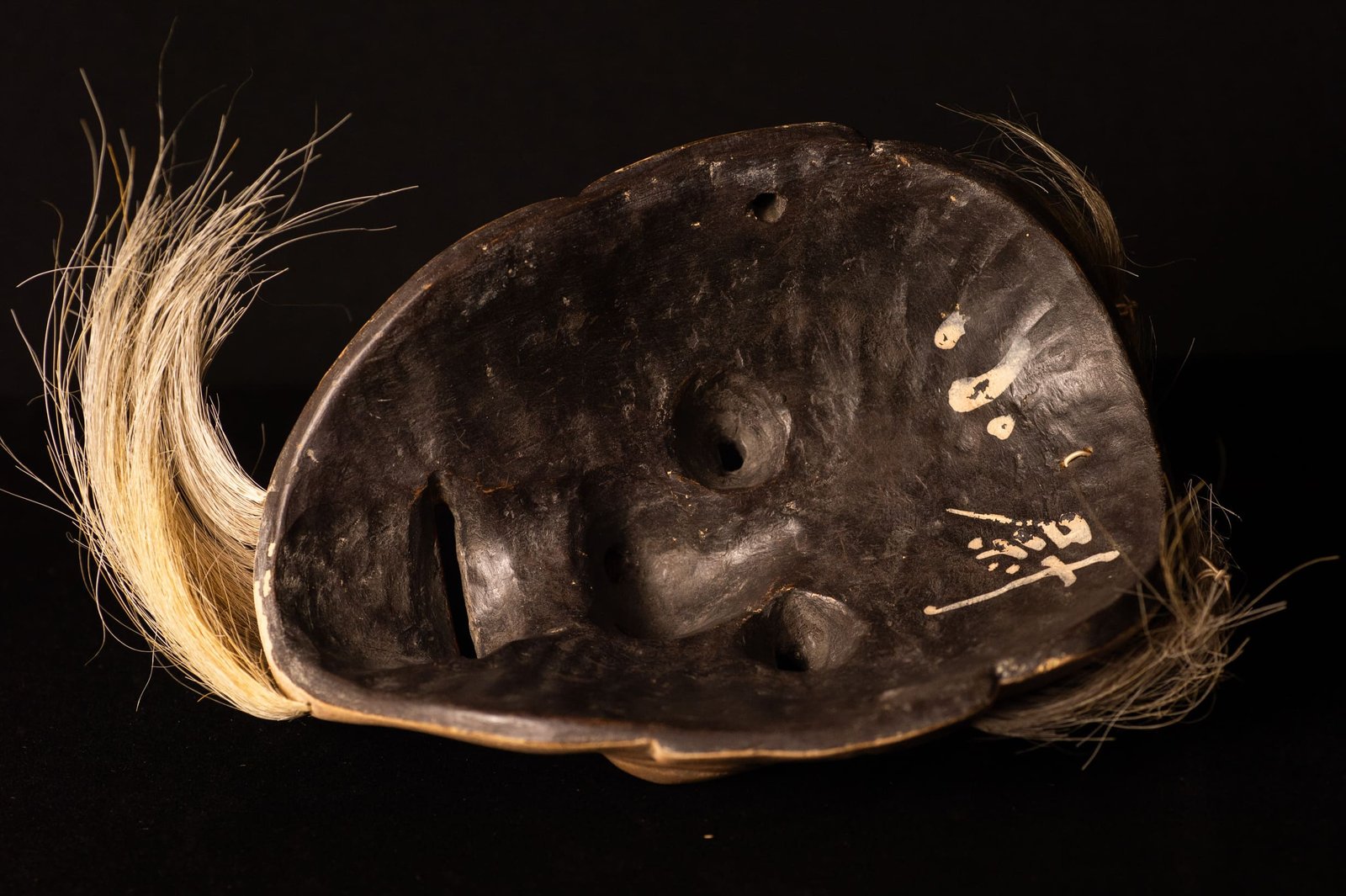
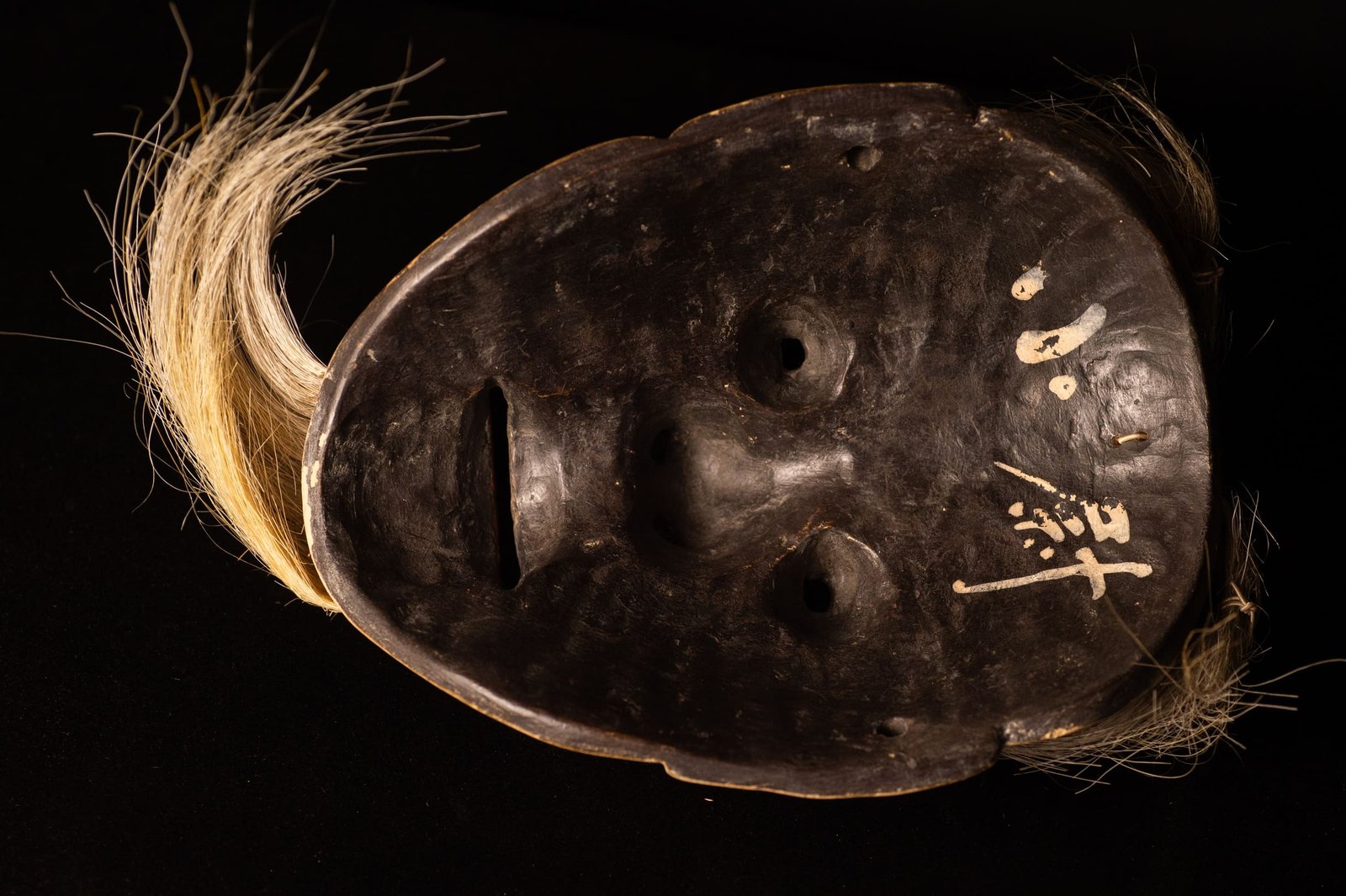
The reverse is finished in a traditional dark lacquer, now aged to a deep near-black surface with a soft sheen.
The interior has been carefully modeled behind the nose, eyes and mouth, allowing the mask to function as a wearable theatrical object rather than merely as a frontal carving.
Three cord holes are present — one at the crown and one at either side — allowing the mask to be secured for wear.
Wear around these areas, together with the aged interior surface, forms part of the mask’s physical history and is consistent with handling and use over time.
A white inscription is present on the lacquered interior, consisting of a smaller brushed mark above a larger character or cipher.
The inscription is preserved here as an observed feature and is not interpreted or attributed. Specialist examination of the inscription may potentially provide additional information regarding the maker, workshop, school or ownership history.
The mask is structurally sound, with no cracks, splits or restoration observed. The gofun and polychrome decoration remain stable and well preserved.
There is light age-related rubbing around exposed areas including the nose, brow and lower lip, together with small losses around the outer rim consistent with handling. The horsehair remains securely attached overall, showing natural separation and softening with a few loose strands around the crown.
The lacquered reverse displays even oxidation and handling wear appropriate to its age. Overall, the mask presents very well, retaining the character and surface expected from an authentic older theatrical object.
The combination of warm ochre coloring, white horsehair and a long sweeping beard gives the mask a particularly strong sculptural presence when displayed against a dark background.
It is presented on the display stand shown in the photographs, allowing the mask to be exhibited as a complete three-dimensional object while preserving the visibility of its distinctive hair and beard.
A finely preserved Japanese Jō Noh mask from the Taishō / Shōwa period, carved from hinoki cypress and distinguished by its warm gofun and polychrome surface, expressive aged features, intact applied horsehair and long sweeping beard. The dark lacquered reverse retains an intriguing white inscription, while the complete hair arrangement and restrained expression give the mask exceptional presence as both a theatrical object and a work of Japanese sculpture.
| Época | Showa |
|---|

Order above 1.000,00 € gets free shipping.

Secure and hassle-free payment process.

Certificate of authenticity included.

Have questions? Contact us via WhatsApp.
Contact