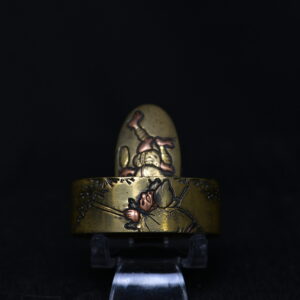
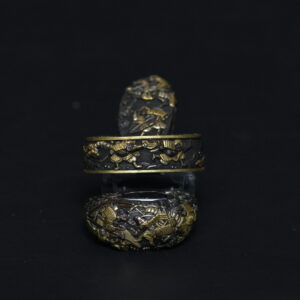
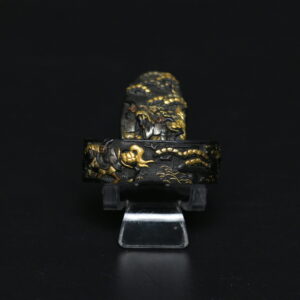
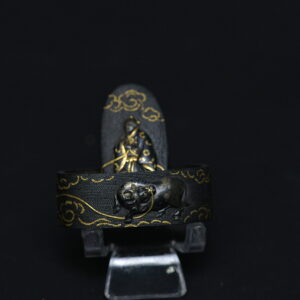
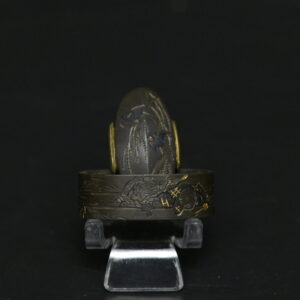
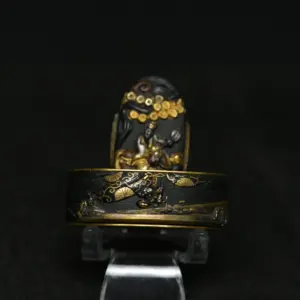
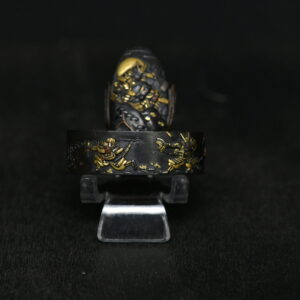
Among the many components that make up a traditional Japanese sword mounting (koshirae), few are as important or as artistically refined as the fuchi (縁) and kashira (頭). Together known as fuchi kashira, these fittings frame the handle of the sword and serve both structural and decorative purposes.
While small in size, they became one of the preferred canvases for Japan’s greatest metal artists, who transformed these functional elements into miniature masterpieces featuring intricate carvings, precious metals and symbolic imagery.
Today, antique fuchi kashira are highly prized by collectors of tosogu (Japanese sword fittings) and represent one of the most fascinating fields within Japanese decorative arts.
The fuchi is the metal collar mounted at the base of the sword handle, directly adjacent to the guard (tsuba).
The kashira is the decorative pommel cap fitted to the end of the handle.
Although separate components, they were almost always created as matching pairs and designed to complement the overall aesthetics of the sword.
Together they provided both structural reinforcement and artistic decoration, helping transform a practical weapon into a highly personal work of art.
Fuchi and kashira first appeared as practical structural fittings on Japanese swords. Their primary purpose was to reinforce the wooden tsuka (hilt), protect its ends from wear and help secure the handle wrapping.
As Japanese sword mountings evolved, these functional components gradually became increasingly decorative.
By the Momoyama and especially the Edo period, specialised metalworkers were producing highly refined fuchi kashira featuring elaborate carving, inlays and sophisticated metalworking techniques.
Over time, they became one of the most important artistic elements of Japanese sword mountings, valued both for their craftsmanship and their contribution to the overall harmony of the koshirae.
The earliest Japanese swords featured relatively simple fittings with limited decoration.
As the samurai class grew in influence and wealth, sword mountings became increasingly elaborate.
By the Momoyama and Edo periods, specialised metalworkers were creating highly sophisticated fuchi kashira featuring detailed carving, inlays and precious metal decoration.
These fittings gradually evolved into one of the most important artistic elements of the koshirae.
For many samurai, the quality of their fittings reflected their social status, education and personal taste.
Japanese craftsmen employed a remarkable variety of materials and alloys to create fuchi kashira.
One of the most prized materials in Japanese metalworking.
This copper alloy containing a small amount of gold develops a deep blue-black patina that provides a dramatic contrast with gold details.
A copper-silver alloy known for its subtle grey tones and refined appearance.
Widely used and often enhanced with gilding, silver overlays or engraved decoration.
Favoured for its strength and understated elegance, particularly among warriors who appreciated a more martial aesthetic.
Used extensively on luxury mountings commissioned by high-ranking samurai and wealthy patrons.
The finest examples often combine several metals within a single composition.
By the Edo Period, the creation of sword fittings had become an independent art form.
Master craftsmen developed highly sophisticated techniques including:
The finest artists could create astonishing levels of detail within a very small surface area.
Many examples rival contemporary sculpture in their artistic sophistication.
The decoration found on fuchi kashira reflects the rich visual culture of Japan.
Popular themes include:
These subjects often carried symbolic meanings relating to strength, prosperity, longevity, protection or military success.
Several schools became renowned for their exceptional sword fittings.
The most influential family of sword fitting artists in Japanese history.
The Goto masters specialised in refined gold work and classical themes that became the standard for elite samurai mountings.
Known for highly detailed narrative scenes and naturalistic compositions.
Celebrated for lively subjects inspired by everyday life, folklore and literature.
Produced bold and highly decorative fittings with exceptional carving.
Renowned for dynamic designs and innovative artistic approaches.
Today, identifying the school of a fuchi kashira set is an important aspect of collecting and scholarship.
The Edo Period (1603–1868) represents the golden age of Japanese sword fittings.
With peace established throughout Japan, the sword increasingly became a symbol of social status rather than a battlefield weapon.
This allowed artists to focus on aesthetics and craftsmanship.
Many of the most beautiful and technically accomplished fuchi kashira were created during this period, displaying levels of artistry that continue to impress collectors today.
A well-designed sword mounting required harmony between all components.
The fuchi kashira were typically designed to complement:
This unified approach created a coherent artistic composition that reflected the owner’s identity and aesthetic preferences.
Many collectors today appreciate complete matching sets because they preserve the original artistic vision of the craftsmen.
Fuchi kashira are among the most popular forms of Japanese sword fitting collecting.
Collectors value them for:
When evaluating a set, collectors generally consider:
Examples by important artists and schools can achieve significant value and are frequently found in museum collections.
Although originally designed as structural fittings, fuchi kashira eventually became independent works of art.
Their small size challenged craftsmen to create highly detailed compositions within a limited space, often resulting in extraordinary displays of technical mastery.
Today, many collectors appreciate these fittings separately from the swords they once adorned, recognising them as miniature sculptures that embody the highest traditions of Japanese metalworking.
Few objects better demonstrate the Japanese ability to unite utility and beauty.
What began as a practical reinforcement for the sword handle evolved into one of the most sophisticated forms of decorative metalwork in Japanese history.
Through their craftsmanship, symbolism and artistic refinement, antique fuchi kashira continue to preserve the spirit of the samurai and the remarkable creativity of Japan’s master artisans.
They remain among the most admired treasures of the tosogu tradition and an essential field of study for collectors of Japanese swords and decorative arts.
Contact