360,00 €
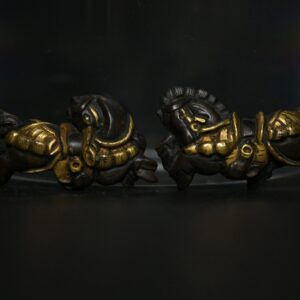
The menuki (目貫) is one of the most distinctive and artistic components of the Japanese sword mounting (koshirae). Positioned beneath the handle wrapping (tsuka-ito), these small decorative ornaments served both practical and aesthetic purposes, providing grip while transforming the sword into a personal expression of its owner.
Despite their modest size, menuki represent some of the finest achievements of Japanese metalworking. Master craftsmen created intricate designs depicting warriors, dragons, animals, flowers, mythological creatures and religious symbols, turning these miniature fittings into works of art in their own right.
Today, antique menuki are highly sought after by collectors of Japanese swords and tosogu (sword fittings), admired for their craftsmanship, symbolism and historical significance.
A menuki is a decorative metal ornament mounted beneath the silk wrapping of a Japanese sword handle.
Traditionally, a pair of menuki was installed on opposite sides of the tsuka (hilt), positioned to improve grip while also enhancing the appearance of the sword.
Although often hidden partially beneath the handle wrapping, menuki were carefully crafted and highly valued by samurai, reflecting both personal taste and artistic refinement.
The earliest menuki appeared more than a thousand years ago during the Heian Period (794–1185).
Originally, they were not decorative objects but practical fittings used to secure parts of the sword hilt construction.
As Japanese sword mountings evolved, these functional elements gradually became ornamental.
By the Kamakura and Muromachi periods, menuki had developed into independent decorative components, often crafted by specialised metalworkers.
Over time, their artistic importance grew, eventually making them one of the most celebrated elements of Japanese sword fittings.
Although primarily appreciated today for their artistic value, menuki originally served practical purposes.
Their placement beneath the handle wrapping helped:
The exact positioning varied depending on the mounting style and the preferences of the sword owner.
On katana, menuki were often arranged differently than on tachi, reflecting changes in how the sword was worn and used.
For samurai, a sword was far more than a weapon.
It represented honour, status, family tradition and personal identity.
Menuki provided an opportunity to customise a sword and communicate something about its owner.
Popular themes included:
The chosen subject often reflected personal values, military achievements or cultural interests.
Japanese craftsmen employed a remarkable variety of metals and alloys when creating menuki.
Reserved for the highest quality examples and frequently used by wealthy samurai and noble families.
A copper alloy containing a small percentage of gold.
When patinated, shakudo develops a deep blue-black surface that became one of the most prized finishes in Japanese metalwork.
An alloy of copper and silver known for its subtle grey tones and elegant appearance.
Widely used and often decorated with gilding, silver inlays or fine engraving.
Popular for highlighting details and creating striking visual contrasts.
Many menuki combine several metals within a single composition, demonstrating the extraordinary technical abilities of Japanese artisans.
Creating a menuki required exceptional skill.
Despite often measuring only a few centimetres in length, these fittings frequently display astonishing levels of detail.
Artists employed techniques such as:
The finest examples exhibit a remarkable sense of movement, realism and balance despite their miniature scale.
Many collectors compare them to small sculptures rather than simple sword fittings.
Over the centuries, specialised schools of metalworkers developed distinct artistic styles.
Perhaps the most famous and influential family of sword fitting makers.
The Goto masters produced luxurious menuki featuring gold relief work and refined classical themes.
Renowned for highly detailed pictorial compositions and naturalistic subjects.
Known for bold carving and elaborate decorative designs.
Celebrated for dynamic compositions and exceptional realism.
Produced highly artistic fittings inspired by everyday life, folklore and nature.
Today, identifying the school of a menuki is an important aspect of collecting and study.
The subjects depicted on menuki were rarely chosen at random.
Many carried symbolic meanings that would have been immediately understood by the samurai class.
Strength, wisdom and divine protection.
Courage, military power and determination.
Longevity and good fortune.
Discipline, focus and martial excellence.
Prosperity, nobility and wealth.
Protection against evil spirits.
These symbols transformed the sword into a deeply personal object that reflected the owner’s aspirations and beliefs.
The Edo Period (1603–1868) witnessed the greatest flowering of menuki artistry.
As Japan entered an era of peace, samurai increasingly expressed their status through the quality and refinement of their sword fittings.
Artists enjoyed greater freedom to experiment with new styles, materials and themes.
Many of the finest menuki available to collectors today originate from this period and demonstrate extraordinary craftsmanship.
Menuki are among the most rewarding areas of Japanese sword fitting collecting.
Collectors appreciate them because they combine:
When evaluating a pair of menuki, collectors typically consider:
High-quality examples by recognised schools are particularly desirable.
Although originally created for sword mountings, antique menuki are increasingly appreciated as independent works of art.
Many collectors display them in presentation boxes or alongside other examples of tosogu, allowing their craftsmanship to be appreciated without the handle wrapping that originally concealed much of their detail.
Their small size and extraordinary artistry make them ideal for collectors seeking museum-quality Japanese metalwork.
Few objects better demonstrate the Japanese ability to combine functionality with artistic beauty.
What began as a practical fitting evolved into one of the most sophisticated forms of miniature metal sculpture ever produced.
Today, antique menuki continue to fascinate collectors, historians and enthusiasts around the world, preserving centuries of craftsmanship, symbolism and samurai culture.
Though small in size, they represent a remarkable chapter in the history of Japanese art and remain among the most refined treasures of the sword fitting tradition.
Contact