35.000,00 €
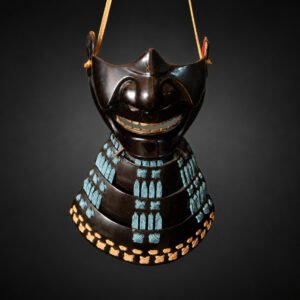
The kabuto (兜) is one of the most iconic symbols of the samurai. Instantly recognisable for its dramatic shapes, elaborate crests and extraordinary craftsmanship, the Japanese helmet was far more than simple battlefield protection. It served as a symbol of status, identity, military rank and spiritual belief.
Today, antique kabuto are among the most sought-after objects in the world of Japanese art and armour collecting. Their combination of engineering, artistry and historical significance makes them some of the most fascinating relics of the samurai era.
The earliest Japanese helmets appeared more than a thousand years ago and were influenced by military equipment imported from China and Korea.
As Japan developed its own warrior culture, armour makers began creating uniquely Japanese designs adapted to mounted warfare and the needs of the emerging samurai class.
By the Heian Period (794–1185), the kabuto had become an essential component of samurai armour, protecting the head while also displaying the prestige of its owner.
Over the centuries, helmet design evolved dramatically, resulting in some of the most spectacular military headgear ever created.
The primary purpose of the kabuto was protection.
A properly constructed helmet protected the wearer against:
However, Japanese armour makers understood that warfare was also psychological.
The appearance of a warrior on the battlefield could inspire allies and intimidate enemies. For this reason, kabuto often featured imposing shapes, dramatic crests and elaborate decorative elements.
A traditional kabuto is composed of several distinct parts, each serving both practical and decorative purposes.
The bowl of the helmet, usually constructed from multiple iron plates riveted together.
Depending on the period and style, the hachi could consist of dozens or even hundreds of individual plates carefully shaped and assembled by master armourers.
Located at the top of the helmet, this decorative metal fitting surrounds the opening known as the tehen.
Originally functional, it later became an important decorative element showcasing the skill of the armour maker.
The projecting visor at the front of the helmet.
The mabizashi protected the face from sunlight, rain and downward strikes while contributing to the overall appearance of the helmet.
The wing-like projections on either side of the helmet.
Often decorated with clan crests (mon), these provided additional protection while making the wearer more easily identifiable.
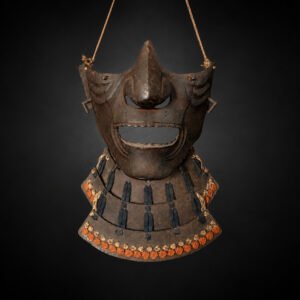
The neck guard formed by multiple horizontal lames connected with silk lacing.
The shikoro protected the neck and shoulders while maintaining flexibility and freedom of movement.
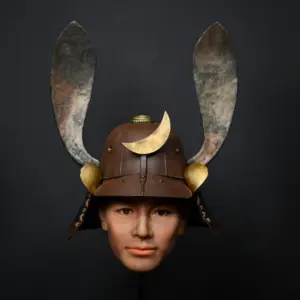
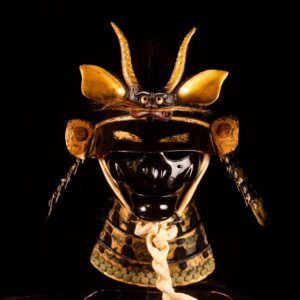
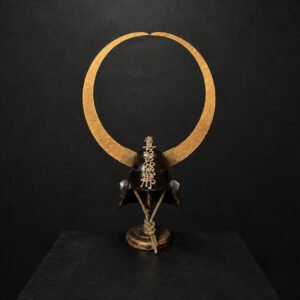
One of the most striking features of many kabuto is the maedate, the crest mounted on the front of the helmet.
These ornaments served several purposes:
Popular maedate designs included:
Some of the most famous samurai in Japanese history became associated with distinctive helmet crests that remain instantly recognisable today.
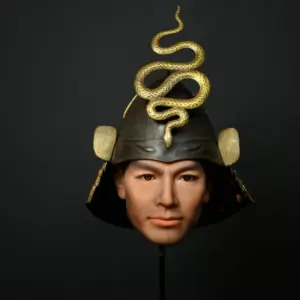
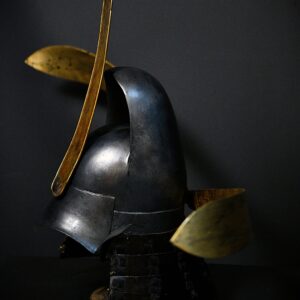
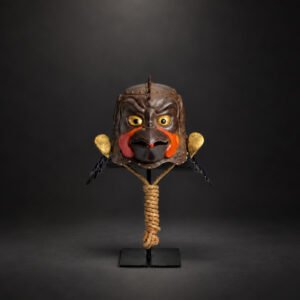
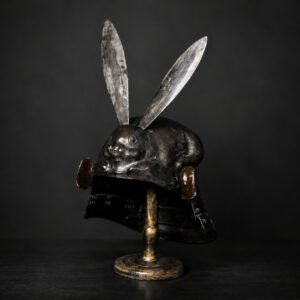
During the Momoyama and Edo periods, armour makers developed highly imaginative helmets known as kawari kabuto.
These “unusual helmets” transformed the kabuto into a work of sculpture.
Examples include helmets shaped as:
Today, kawari kabuto are among the rarest and most desirable forms of Japanese armour collecting.
The Sengoku Period (1467–1615) was an age of constant warfare.
Large armies clashed across Japan and armour evolved rapidly to meet the demands of battlefield combat.
Helmets became more robust and practical, while still maintaining their symbolic importance.
Many of the most influential helmet styles originated during this period and continued to be used for centuries.
With the establishment of peace under the Tokugawa Shogunate, the role of the kabuto gradually changed.
While armour remained important for ceremonial and official functions, large-scale warfare became rare.
As a result, many Edo-period helmets display increasingly refined workmanship and decorative sophistication.
Gold lacquer, elaborate maedate, fine silk lacing and high-quality fittings became more common as armour evolved into a symbol of status and heritage.
Many of the finest surviving kabuto available to collectors today date from the Edo Period.
Creating a kabuto required exceptional skill.
Master armour makers, known as katchūshi, spent years perfecting techniques involving:
A high-quality kabuto often represents hundreds of hours of labour and the collaboration of multiple craftsmen.
The result is a masterpiece that combines engineering, functionality and artistic expression.
Kabuto are among the most popular areas of Japanese armour collecting.
Collectors often focus on:
Factors influencing value include:
Exceptional kabuto can be found in museums and private collections throughout the world.
Few objects capture the spirit of the samurai as powerfully as the kabuto.
Its imposing form, symbolic decoration and extraordinary craftsmanship reflect centuries of Japanese military history and artistic achievement.
Whether adorned with a golden crescent moon, antlers, dragons or family crests, every kabuto tells the story of the warrior who once wore it and the craftsmen who brought it to life.
Today, antique kabuto remain among the most iconic and admired works of Japanese art, preserving the legacy of the samurai for future generations.
Contact