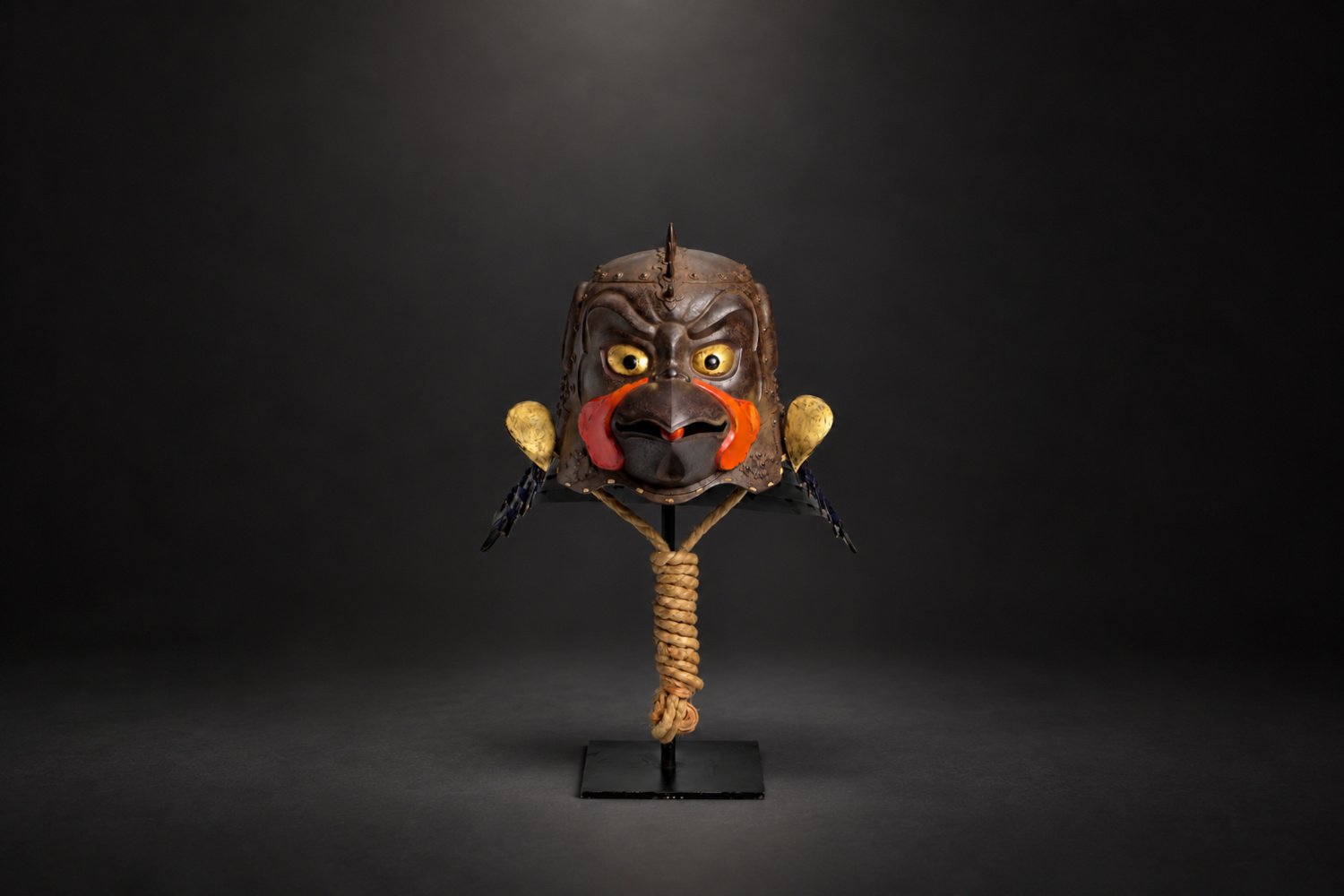
An exceptional Japanese kawari kabuto attributed to the Meiji period (1868–1912), sculpted in the form of Karura (迦楼羅), the Japanese manifestation of Garuda and one of the Hachibushū, the eight supernatural protectors of the Buddhist Dharma.
Constructed from five riveted plates of russet iron, the helmet is extensively modeled in dramatic high relief using the traditional uchidashi technique. Its powerful bird-like face combines a sharply hooked beak, deeply modeled brows, large gilt eyes with black-lacquered pupils and vivid red wattles, creating an extraordinary sculptural interpretation of Buddhist guardian imagery.
The interior bears the inscription Bamen Tomonori saku — “made by Bamen Tomonori” — connecting the helmet with the Bamen tradition of Japanese armor making.
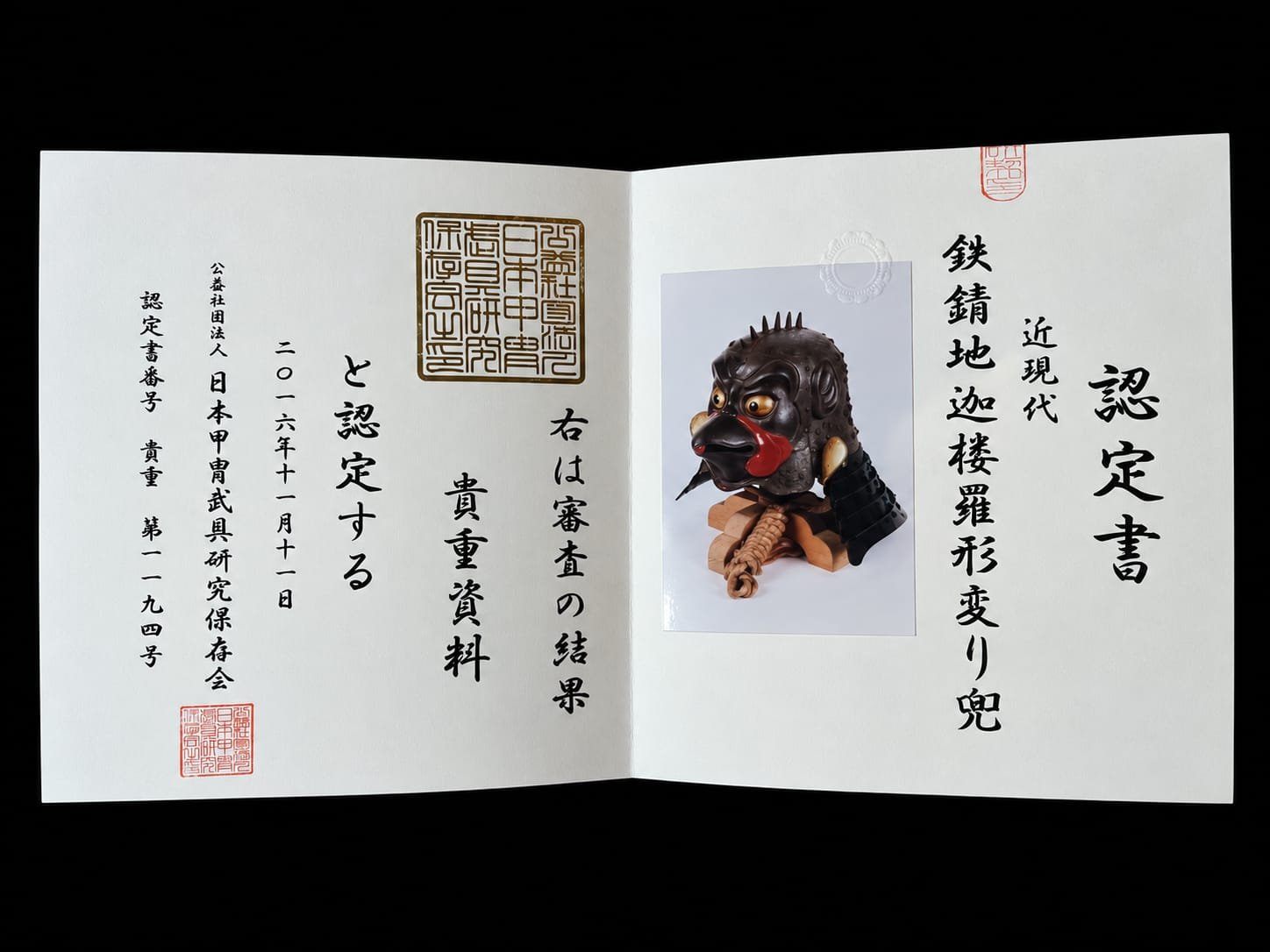
The kabuto is accompanied by NKBKHK Kichō Shiryō Certificate No. 1194, issued by the Nihon Katchū Bugu Kenkyū Hozonkai on November 13, 2016. The certificate identifies the object as a tetsu sabiji Karura-gata kawari kabuto and places it within the association’s Kin-gendai (近現代) classification while recognizing it as Kichō Shiryō — Important Material.
Karura (迦楼羅) is the Japanese form of Garuda, the great bird deity originating in Indian religious tradition and absorbed into Buddhism.
Within Japanese Buddhist iconography, Karura belongs to the Hachibushū, the eight classes of supernatural beings who protect the Buddhist Dharma.
Traditionally represented as a fierce bird-like divinity and associated with overcoming serpents and dragons, Karura provided an exceptionally powerful subject for a kawari kabuto.
Here, the deity has been transformed into sculptural armor. The sharply curved beak, projecting eyes and strongly furrowed brow create an intimidating supernatural expression while remaining fully integrated into the construction of the helmet.
The helmet is attributed to the Meiji period (1868–1912), a transformative era during which traditional Japanese armor-making skills continued even after the end of the samurai class as a formal military order.
Highly accomplished armorers continued to preserve and reinterpret established metalworking techniques, producing works that increasingly occupied the territory between functional armor, ceremonial object and sculptural art.
This Karura-form helmet belongs naturally within that context: technically rooted in traditional Japanese armor construction while displaying an unusually ambitious sculptural conception.
Its accompanying NKBKHK certificate categorizes the helmet as 近現代 (Kin-gendai), the broader classification used by the association for Japanese armor from the modern period onward.
The term kawari kabuto refers to unconventional or highly individualized Japanese helmets whose forms departed from more standard bowl designs.
Animals, religious imagery, natural forms and dramatically exaggerated silhouettes could all be incorporated into these helmets, transforming protective equipment into a powerful expression of identity, symbolism and craftsmanship.
In the present example, the helmet bowl itself becomes the head of Karura.
The visual impact therefore depends not merely upon applied decoration but upon the actual modeling and shaping of the iron structure.
The bowl is constructed from five riveted plates of russet iron (tetsu sabiji).
The dark iron surface retains its natural russet character rather than being concealed beneath a heavy overall lacquer coating.
This finish emphasizes both the material quality of the iron and the considerable depth of the sculptural metalwork.
The individual plates are carefully assembled into a coherent three-dimensional form while maintaining the structural logic of traditional kabuto construction.
The defining facial features are executed in uchidashi, a demanding metalworking technique in which iron is hammered from the reverse in order to raise sculptural forms in relief.
The brow, cheeks and strongly projecting hooked beak emerge from the worked metal rather than relying entirely upon separately attached decorative components.
This gives the helmet an exceptional sense of unity: the protective iron structure and the supernatural face effectively become one sculptural form.
The large projecting eyes are highlighted in gilt decoration and immediately dominate the expression of the helmet.
Black-lacquered pupils provide a dramatic contrast with the gold surfaces, giving Karura an intense forward gaze.
The use of gold also visually connects the eyes with the gilt side ornaments mounted on the helmet.
The center of the face is dominated by a strongly projecting hooked beak, sharply modeled and slightly open.
A small red detail remains visible within the mouth, while the large wattles on either side of the face are finished in vivid red pigment.
The combination of dark russet iron, brilliant gold and intense red produces much of the helmet’s dramatic visual character.
The avian imagery continues around the back of the helmet, where the iron is worked with a fan of feathers in high relief.
This feature is important to the overall conception of the object because the Karura imagery is not limited to the frontal mask-like face.
The entire helmet is treated as a three-dimensional representation of the supernatural bird guardian.
The visible fastening points are surrounded by decorative kiku-za, chrysanthemum-shaped rosettes that integrate the functional rivets into the ornamental program.
These refined fittings create a subtle decorative rhythm across the dark iron surface.
Applied cruciform floral arabesques decorate the side plates and cheek areas.
Their delicate ornamental character contrasts with the aggressive modeling of the Karura face and demonstrates the combination of sculptural and decorative metalworking throughout the helmet.
A row of forged iron spikes extends along the crown to create a pronounced central crest.
These elements strengthen the helmet’s distinctive silhouette and contribute to its transformation from conventional armor into the image of a supernatural creature.
A pair of gilt teardrop-shaped wakidate project from either side of the helmet.
Their bright surfaces echo the gilt eyes and stand out strongly against the dark russet iron.
Together with the central crest and feathered rear section, they create an exceptionally distinctive profile.
The helmet is fitted with a five-lame hineno-jikoro, protecting the neck while retaining the articulated construction characteristic of Japanese armor.
The lames are finished in dark lacquer and connected with deep blue silk lacing.
This restrained lower structure provides an effective visual counterpoint to the highly sculptural helmet bowl above.
The shinobi-no-o, used to secure the helmet, is made from natural hemp-colored cord.
Its subdued color complements the iron, lacquer and blue lacing while maintaining the functional vocabulary of traditional Japanese armor.
The interior bears the inscription:
Bamen Tomonori saku
“Made by Bamen Tomonori”
The Bamen name is associated with a tradition of armorers connected with Toyohara in Echizen Province, present-day Fukui Prefecture.
The inscription therefore forms an important part of the helmet’s identity and its connection to the historical continuation of Japanese armor-making traditions.
A particularly significant aspect of the helmet is its accompanying certification from the Nihon Katchū Bugu Kenkyū Hozonkai, the Japanese association dedicated to the study and preservation of armor and arms.
The certificate is numbered Kichō No. 1194 and dated November 13, 2016.
The object is described on the certificate as:
近現代 鉄錆地迦楼羅形変り兜
Kin-gendai tetsu sabiji Karura-gata kawari kabuto
“Modern-period russet-iron Karura-form kawari kabuto.”
Following examination, the helmet was certified as 貴重資料 (Kichō Shiryō), or Important Material.
This certification provides significant Japanese institutional documentation for the helmet and confirms its recognition as a noteworthy example within the study and preservation of Japanese armor.
The helmet survives in excellent condition for its age.
The russet iron displays an even, mature surface throughout.
The red pigment on the wattles shows small areas of natural wear and localized loss, while the gilt decoration, iron fittings, lacquer and lacing remain well preserved.
Minor surface wear is consistent with age and handling and does not detract from the overall visual impact of the piece.
Please examine the detailed photographs carefully, as they form an important part of the description and provide close views of the construction, inscription, decoration, surface and condition.
This remarkable helmet combines several qualities of particular interest to collectors of Japanese armor: an extraordinary religious subject, ambitious high-relief ironwork, traditional kabuto construction, the Bamen Tomonori inscription and formal Japanese certification.
The Meiji period represents an especially interesting moment in the history of Japanese armor. Traditional techniques survived beyond the end of the samurai era and were increasingly applied to works valued for craftsmanship, historical continuity and artistic achievement.
The Karura helmet exemplifies this transition particularly well. Its construction remains firmly rooted in Japanese armor-making practice, yet the entire object is conceived as an ambitious sculptural representation of a Buddhist guardian deity.
The accompanying Kichō Shiryō certification adds an important documentary dimension and places the helmet within the formal study and preservation of Japanese arms and armor in Japan.
An exceptional Japanese Karura-form kawari kabuto attributed to the Meiji period (1868–1912), constructed from five plates of russet iron and modeled in dramatic high-relief uchidashi. Gilt eyes, a sharply hooked beak, vivid red wattles, a feathered rear plate, forged iron crest and gilt wakidate create an extraordinary sculptural interpretation of Karura, the Buddhist bird guardian. The interior is inscribed Bamen Tomonori saku. Accompanied by NKBKHK Kichō Shiryō Certificate No. 1194, dated November 13, 2016, which identifies the helmet as a russet-iron Karura-form kawari kabuto within the association’s Kin-gendai classification and certifies it as Important Material.

Order above 1.000,00 € gets free shipping.

Secure and hassle-free payment process.

Certificate of authenticity included.

Have questions? Contact us via WhatsApp.
Contact