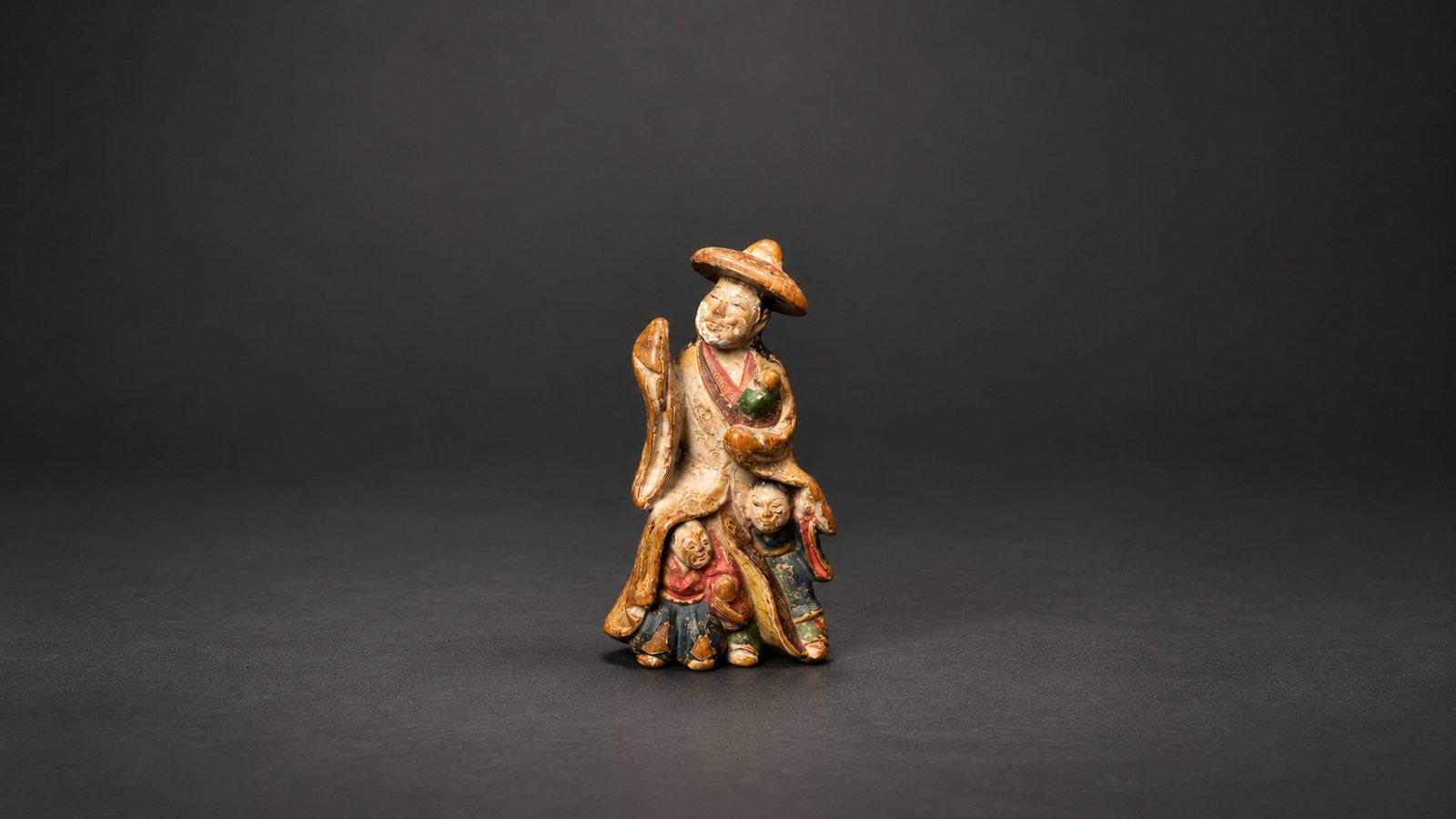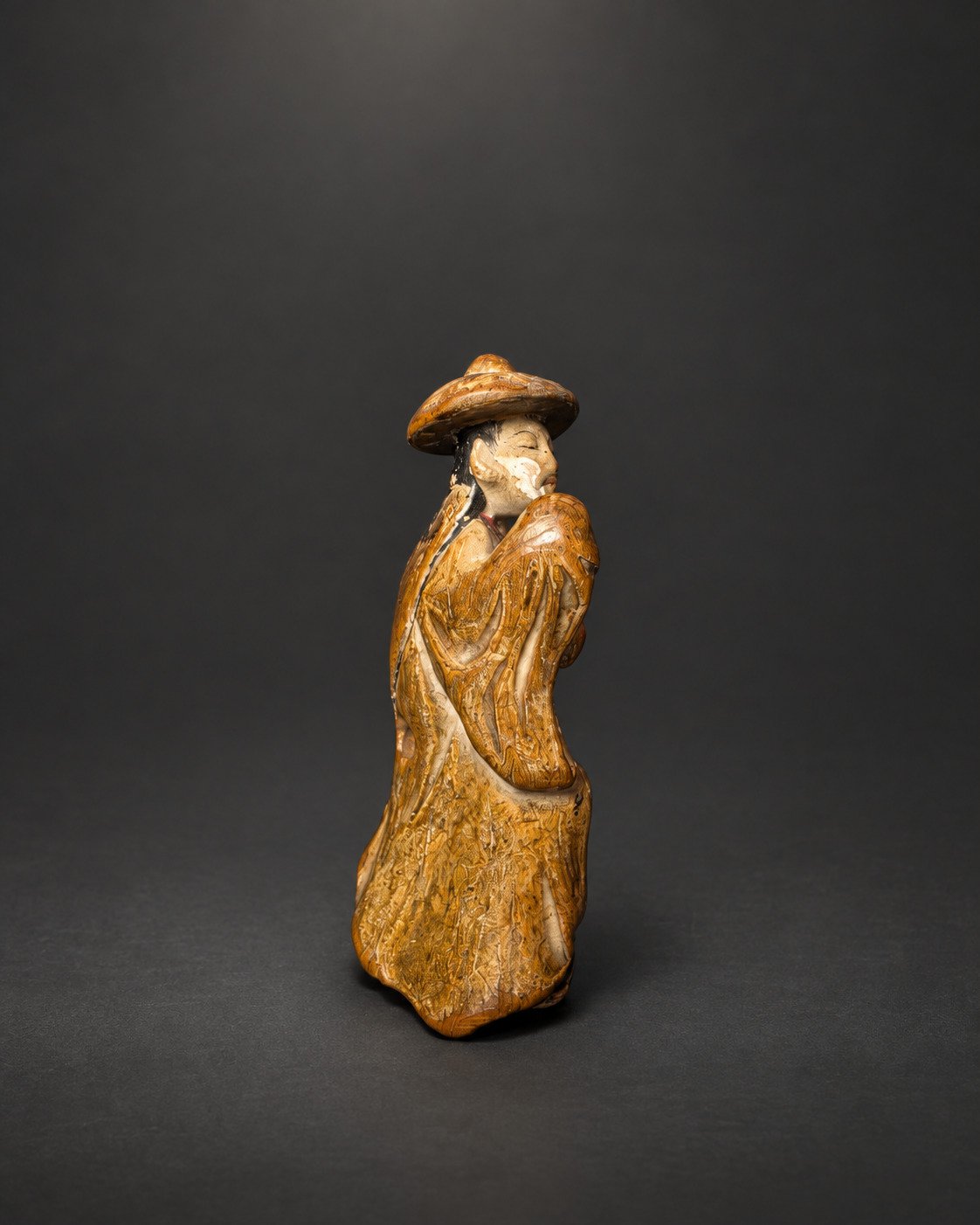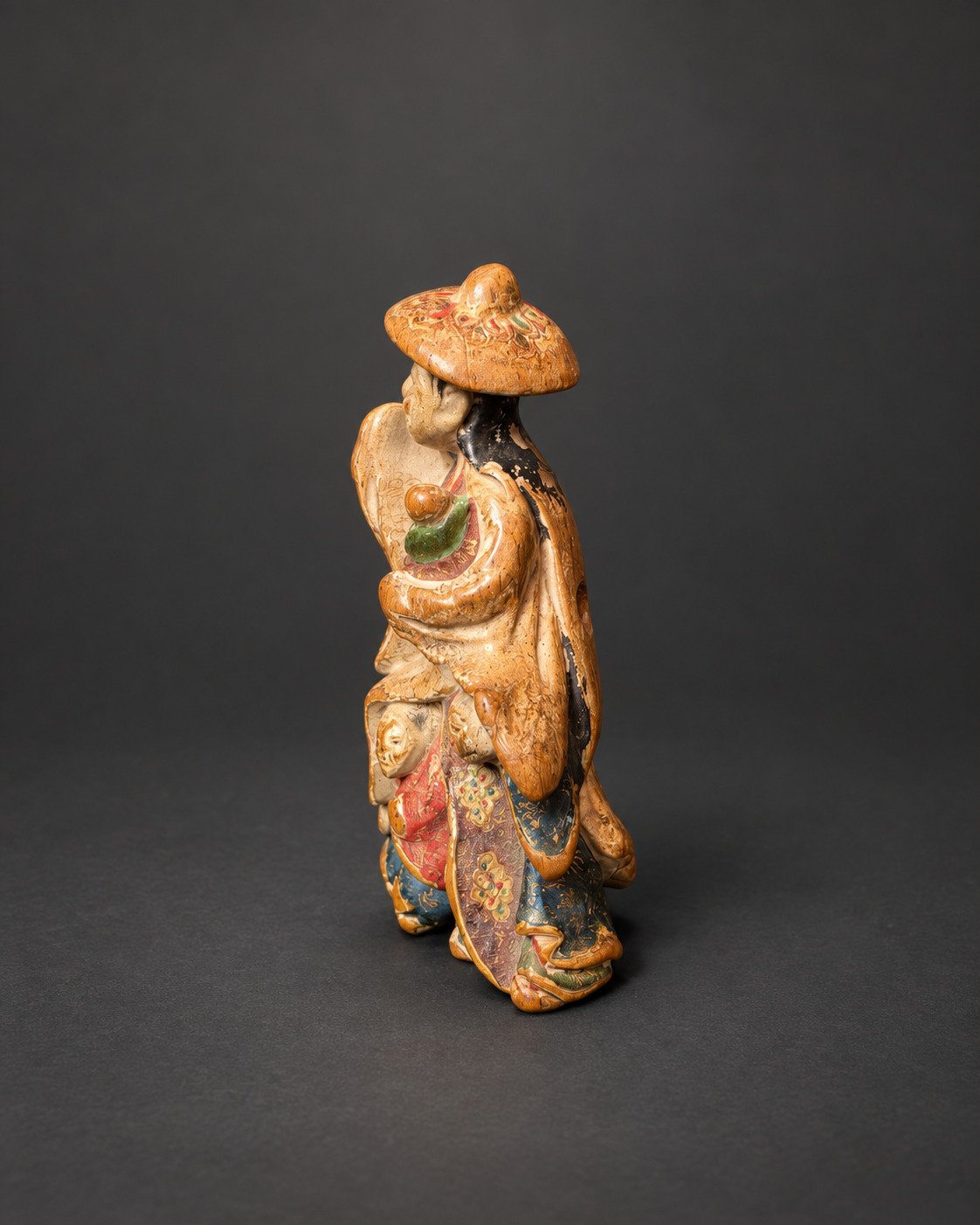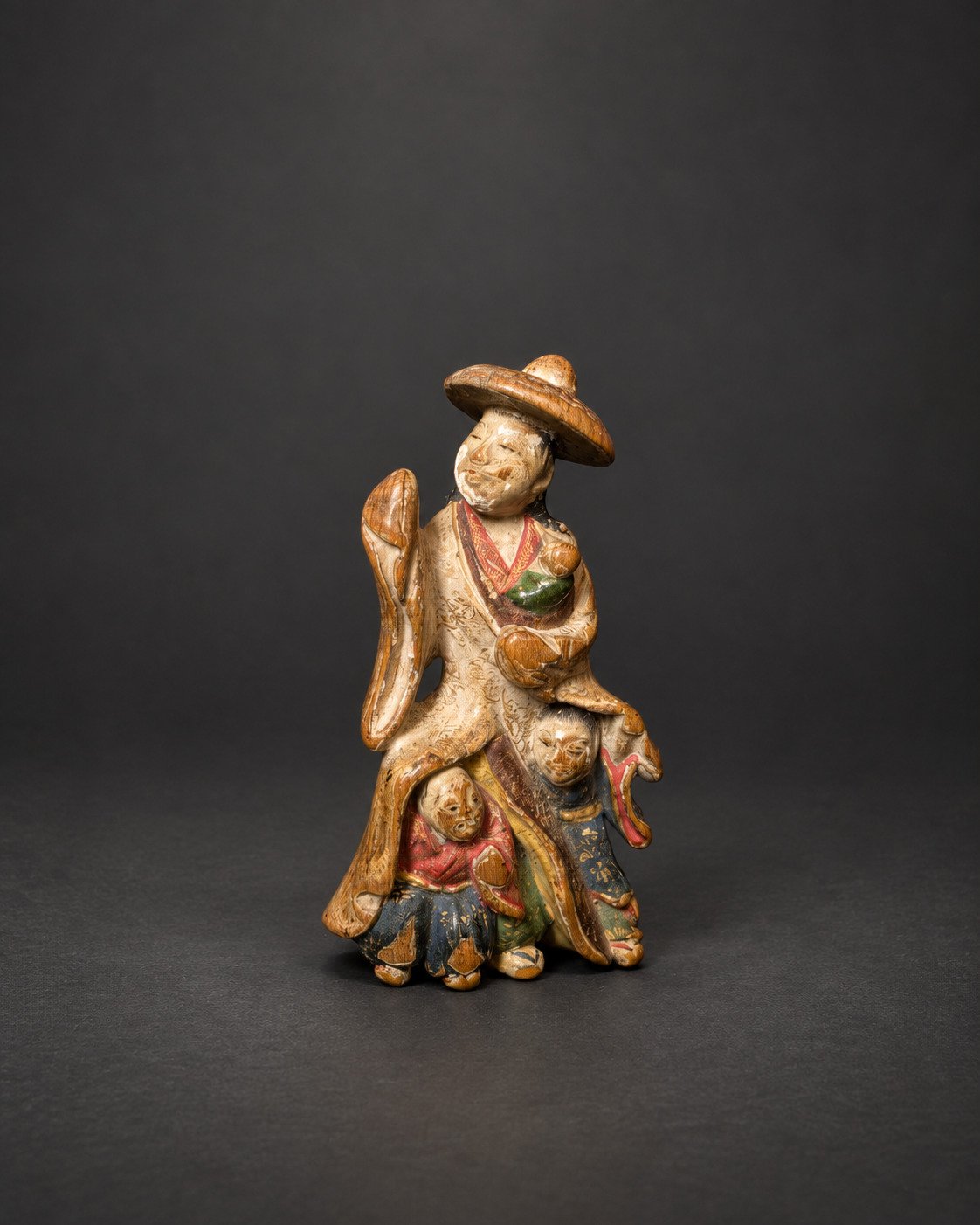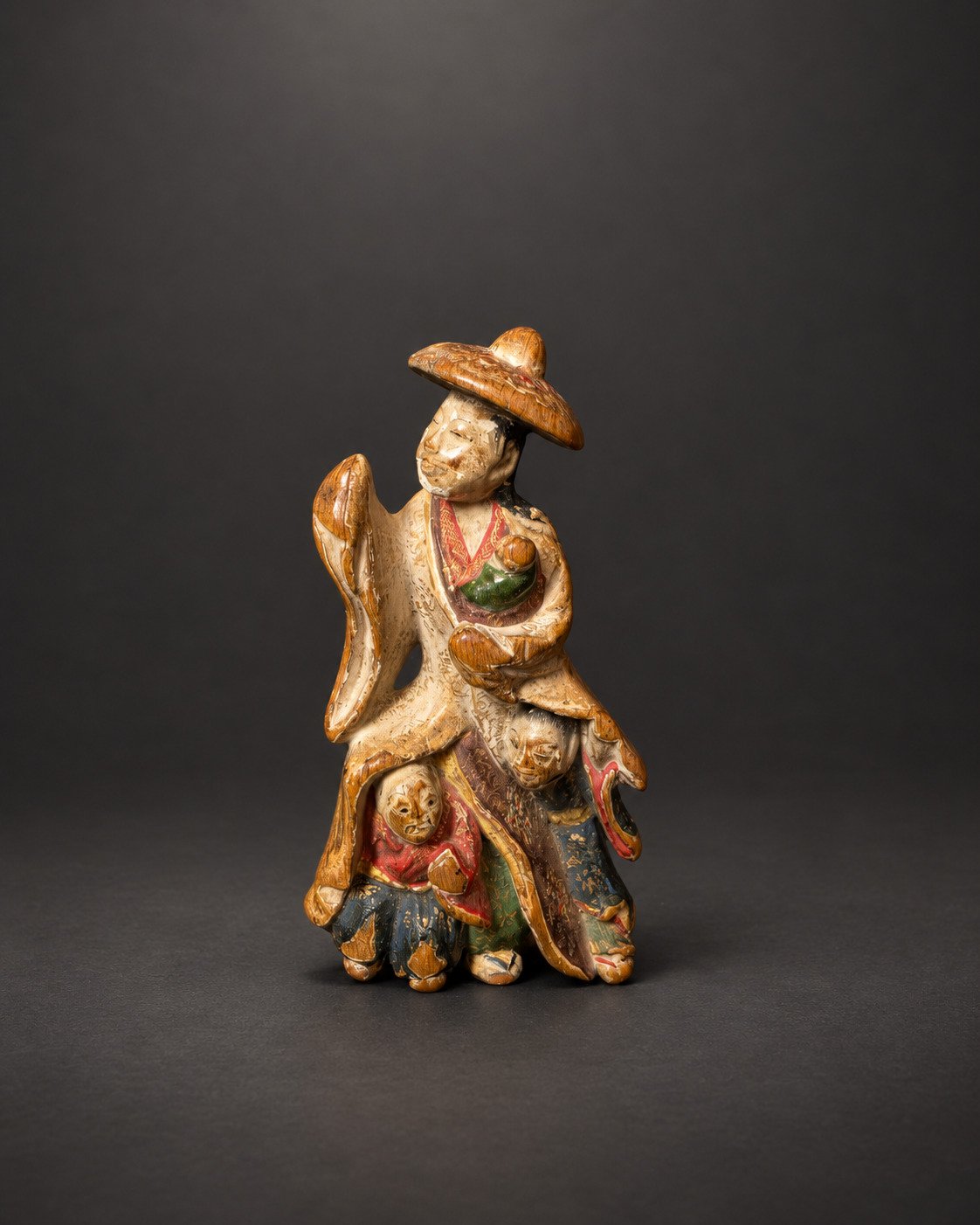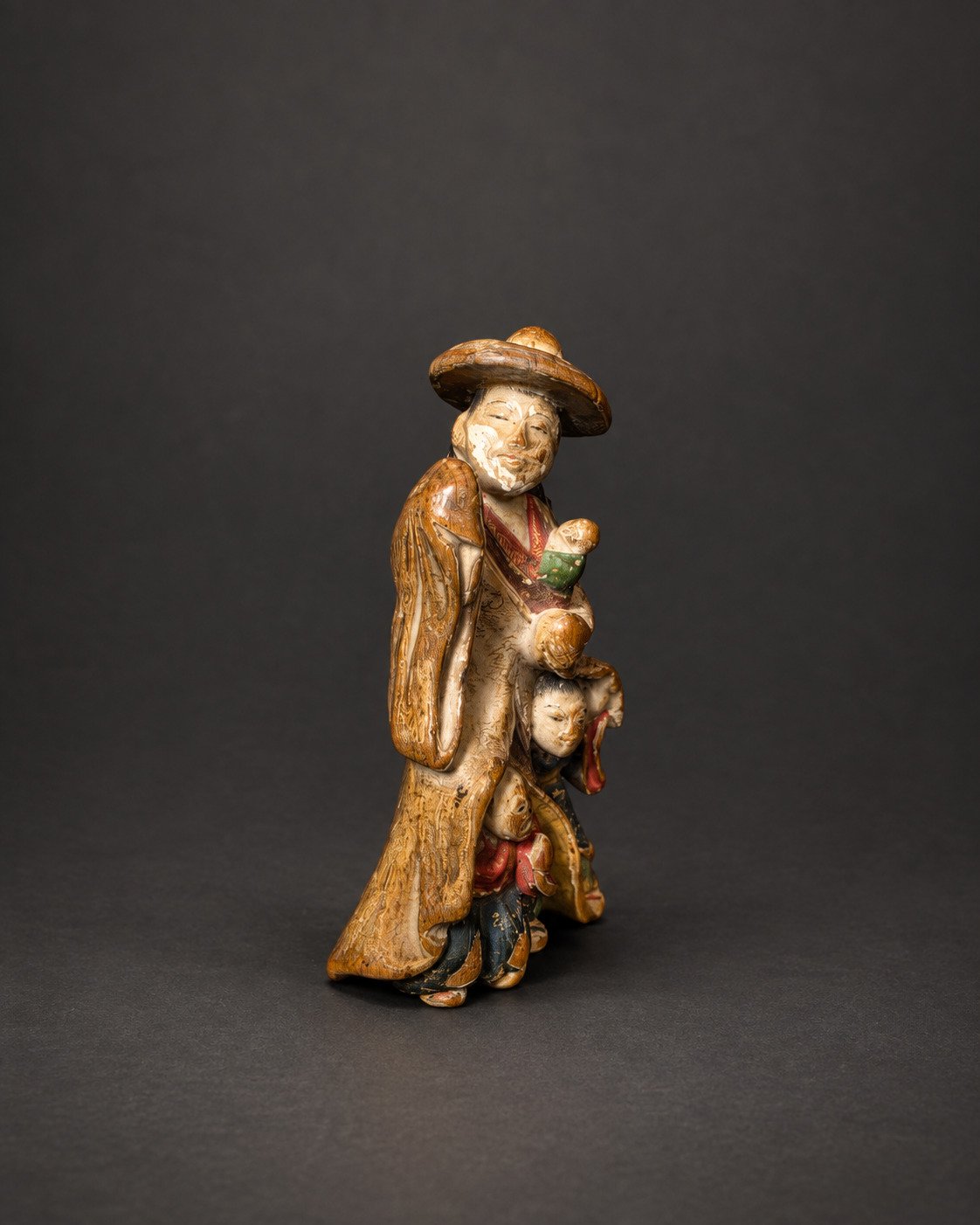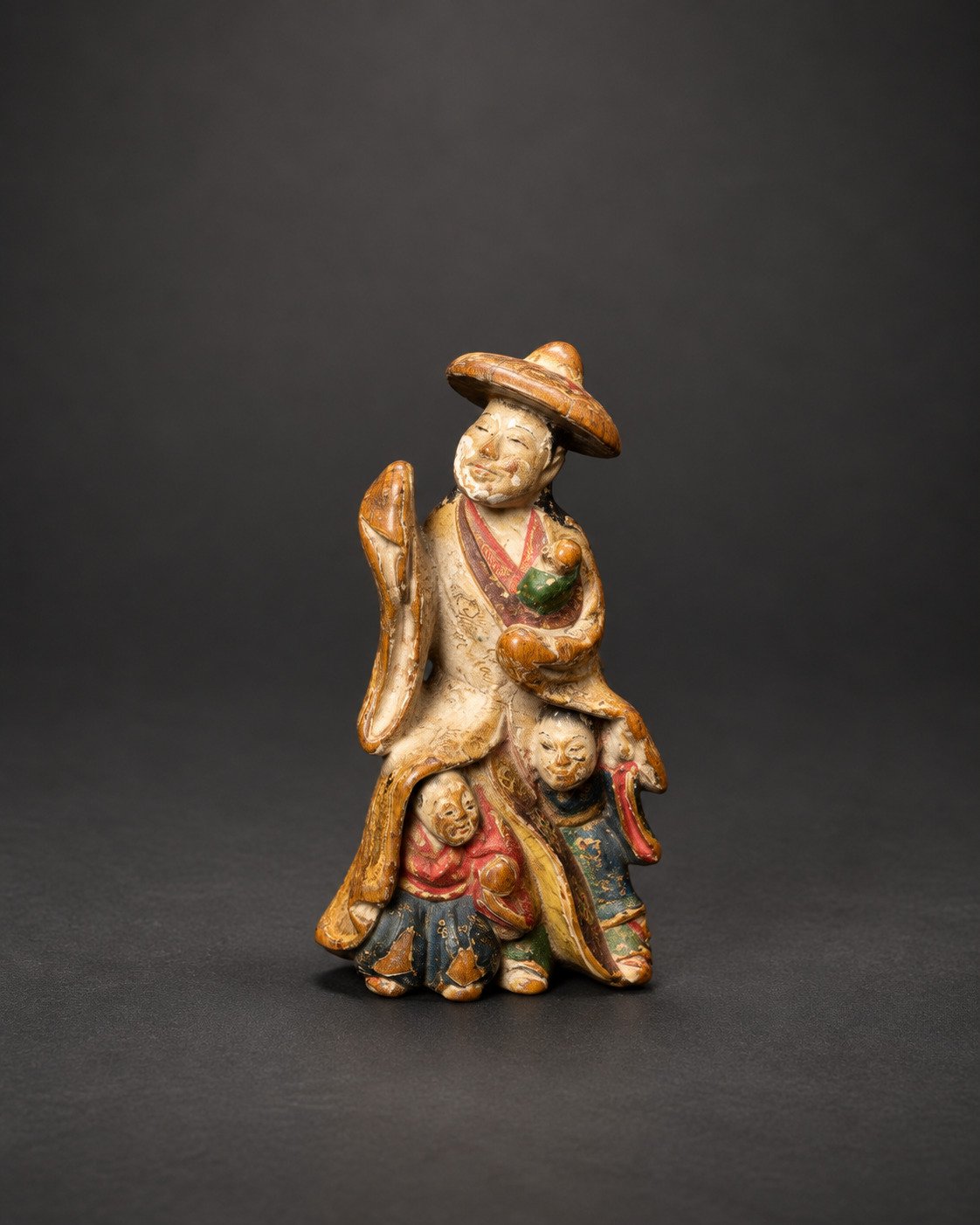
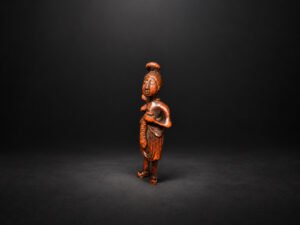
A finely composed antique Japanese saishiki netsuke carved in hinoki, or Japanese cypress, and painted in the manner associated with Yoshimura Shūzan and the Osaka school that followed him. The subject is Tokiwa Gozen, celebrated in Japanese history and legend as the mother of Minamoto no Yoshitsune, shown fleeing with her three sons during the winter of 1160 in the aftermath of the Heiji Rebellion.
The composition gathers Tokiwa and all three children into a remarkably compact vertical group.
Tokiwa stands beneath a broad traveling hat, one wide sleeve raised beside her while her other arm cradles the infant Ushiwakamaru, the future Yoshitsune, wrapped in green cloth.
Her two elder sons, Imawaka and Otowaka, take shelter within the folds of her robes.
One crouches close to the hem in a red jacket and indigo trousers, while the other emerges from behind the drapery wearing a blue robe decorated with gilt patterning.
The dense arrangement, deeply flowing folds and surviving polychrome decoration give this small carving considerable visual complexity.
The subject represents one of the best-known episodes associated with Tokiwa Gozen.
Following the Heiji Rebellion, she is traditionally remembered fleeing with her three young sons during the winter of 1160.
The youngest child in her arms is Ushiwakamaru, who would later become known as Minamoto no Yoshitsune.
The two older boys represented at her feet are Imawaka and Otowaka.
Rather than separating the figures into individual narrative elements, the carver has compressed the entire family into a single sculptural mass.
The children are almost absorbed into their mother’s clothing, reinforcing both the urgency of their journey and the sense of maternal protection that defines the composition.
Tokiwa dominates the upper portion of the netsuke.
She wears a broad traveling hat whose wide brim creates a strong horizontal element above the otherwise vertical composition.
The hat retains painted decoration in red and green, adding a vivid accent to the predominantly warm wooden surface.
Beneath it, Tokiwa’s small face is delicately carved with closed eyes and a calm, softly smiling expression.
Her features remain restrained despite the dramatic narrative context.
One sleeve rises prominently beside her body, producing a sweeping curve that balances the wide hat above.
The opposite arm holds the infant close to her chest.
This arrangement gives the figure both movement and stability, while preserving the compact proportions required of a netsuke.
The infant held against Tokiwa’s chest is Ushiwakamaru, the childhood name of the future Minamoto no Yoshitsune.
The child is wrapped in green cloth and enclosed securely within his mother’s arm.
Despite the extremely small scale, the infant is clearly differentiated from the surrounding robes through color and carving.
The green wrapping provides a strong visual contrast with the pale surface of Tokiwa’s garment and the reddish details around her neckline.
The child’s placement close to the center of the composition gives him particular visual importance while maintaining the protective relationship between mother and infant.
Tokiwa’s two elder sons are incorporated into the lower half of the carving.
One child crouches close to the hem of her robes, wearing a red jacket and indigo trousers.
The second appears from behind the folds of the drapery in a blue garment embellished with gilt patterning.
Their small faces are carefully carved and remain clearly distinguishable despite being partially enclosed within the surrounding clothing.
The positioning of the children is especially effective.
They do not stand independently beside their mother but appear to seek shelter within the fabric itself.
This allows the sculptor to maintain a compact netsuke form while strengthening the narrative of protection, movement and family unity.
One of the most accomplished features of the piece is the way the entire narrative is organized within a narrow vertical format.
Tokiwa’s hat forms the upper boundary.
Her raised sleeve extends outward on one side, while the cascading robes descend toward the two older children below.
The infant is positioned close to the center of the torso, creating a focal point within the upper half.
The elder sons occupy the base and visually support the figure above.
The result is a complex multi-figure scene resolved into a compact form suitable for use as a netsuke.
The deep robe folds separate individual figures while simultaneously binding the family into a single sculptural unit.
The carving is finished in saishiki, a polychrome painted technique that plays a central role in the visual character of the piece.
Red, indigo, green and gilt decoration remain visible across the figures and garments.
The children’s clothing preserves particularly clear areas of original color.
One child wears a red jacket over indigo trousers, while another is dressed in blue with surviving gilt ornament.
The infant’s wrapping is green.
Tokiwa’s clothing retains red-painted details around the neckline, and the traveling hat carries red and green decoration.
These colors break up the dense sculptural surface and allow individual figures to remain legible despite the compact arrangement.
The netsuke is carved in hinoki, Japanese cypress.
The wood provides the structural base for the deeply carved drapery, small facial features and painted surface.
In this example, the natural warm tone of the wood remains visible beneath and between the surviving areas of polychrome decoration.
The combination of carved texture and painted color is particularly effective across the robes, where fine patterns and flowing folds interact with the aged surface.
The material also contributes to the warm overall appearance of the object.
The piece is executed in the manner of Yoshimura Shūzan and the Osaka school associated with his painted-wood tradition.
Shūzan was a Kanō-school painter active in Osaka during the mid-18th century and is credited with introducing this distinctive painted treatment to netsuke carving.
He is recorded among the finest carvers of his day in the Sōken Kishō of 1781.
The present netsuke should be understood within that artistic tradition rather than presented as a signed work by Shūzan himself.
Its use of carved hinoki, dense multi-figure composition and surviving saishiki polychrome closely correspond to the visual language associated with the Shuzan school and its Osaka followers.
The robes are among the most visually complex elements of the carving.
Their surfaces are covered with a combination of engraved, painted and patterned detail.
Deep folds run vertically through the composition, creating shadow and separating the individual figures.
The broad exterior robe worn by Tokiwa retains a pale ground with fine decorative markings.
Beneath it, areas of red, green, indigo, blue and gilt remain visible on the clothing of the children.
This variety of surface treatment prevents the densely packed group from becoming visually confused.
Each figure remains readable while still forming part of the larger unified composition.
The faces are small and finely carved.
Tokiwa’s expression is composed and gentle, with closed or lowered eyes and a restrained smile.
The children’s faces are similarly compact and carefully integrated into the composition.
Their features do not dominate the carving.
Instead, they emerge from the surrounding folds and painted surfaces as intimate details intended for close viewing.
The calm expressions contrast with the hardship implied by the narrative of flight.
This restraint gives the scene a sense of dignity rather than overt drama.
Tokiwa’s clothing creates the primary structural framework of the netsuke.
The robes fall in deep, sweeping folds from the shoulders toward the children below.
One large sleeve rises prominently at the side, producing an elegant curved form.
The opposite side of the garment descends around the children and helps enclose the lower composition.
The sculptor uses these folds both decoratively and structurally.
They suggest movement and heavy fabric while simultaneously creating recesses in which the two elder sons can be placed.
The result is a remarkably economical solution to a complicated four-figure subject.
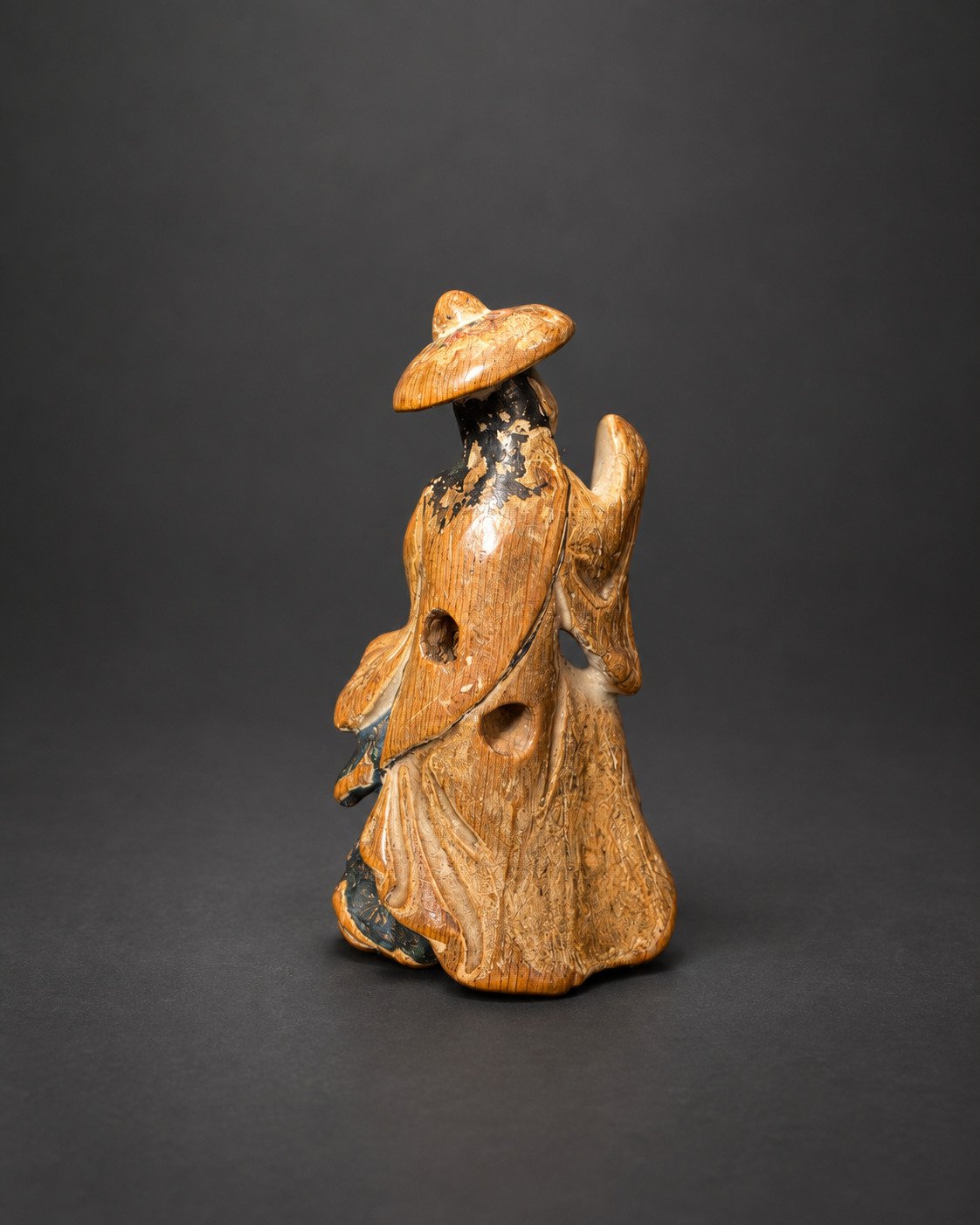
Two himotoshi are positioned on the back of the robe.
These cord holes are integral to the traditional function of the object as a netsuke.
Their placement on the reverse allows the front of the carving to remain uninterrupted by functional elements.
The inclusion of the two holes also confirms the sculptural design as one conceived to function as a netsuke rather than simply as a miniature decorative figure.
The surface displays clear signs of age consistent with the antique character of the piece.
Small losses of pigment are visible on the face, at the nape and along the edges of the robe.
A fine network of crackling is present across areas of the painted surface.
These changes reveal the relationship between the underlying carved wood and the surviving polychrome layers.
Importantly, substantial areas of the original decorative scheme remain legible.
Red, indigo, green and gilt details continue to define the figures and garments.
The age-related wear should therefore be understood as part of the present historical surface rather than concealed or interpreted as uniform damage.
The netsuke is described as dating from the 18th to early 19th century and shows honest age-related wear.
There are small pigment losses at the face, nape and edges of the robe, together with fine crackling across the painted areas.
The surviving colors remain clearly visible, particularly on the garments of the children and on the hat.
The supplied information does not mention restoration, replacement elements, a signature or additional documentation.
Prospective buyers should review all available photographs carefully when evaluating the exact condition and preservation of the polychrome surface.
This netsuke combines an important narrative subject with one of the most distinctive painted-wood traditions associated with 18th-century Osaka.
The story of Tokiwa Gozen and her children allows the carver to create a complex multi-figure composition while retaining the compact proportions required of a functional netsuke.
Its appeal lies particularly in the relationship between carving and surviving color.
The broad hat, raised sleeve, infant held at the chest and two children enclosed within the cascading robes form a highly unified sculptural design.
At the same time, the surviving red, indigo, green, blue and gilt decoration preserves much of the visual richness associated with saishiki work.
The attribution to the Shuzan school tradition further places the object within an important Osaka lineage of painted wooden netsuke.
For collectors of netsuke, Edo-period Japanese art, Shuzan-school carving or representations of Minamoto no Yoshitsune and the Genpei world, the piece offers a particularly rich combination of narrative, craftsmanship, color and historical character.
A finely composed antique Japanese saishiki netsuke of Tokiwa Gozen fleeing with her three sons after the Heiji Rebellion of 1160. Carved in hinoki and executed in the painted-wood tradition associated with Yoshimura Shūzan and the Osaka school, the composition gathers Tokiwa, the infant Ushiwakamaru and his elder brothers Imawaka and Otowaka into a compact vertical group beneath a broad traveling hat. Deeply carved robes, small finely modeled faces and surviving red, indigo, green, blue and gilt decoration give the piece exceptional narrative density. Two himotoshi are set into the reverse. The surface retains honest age, including small pigment losses and fine crackling, while substantial areas of the original polychrome decoration remain clearly legible.
| Época | Edo |
|---|

Order above 1.000,00 € gets free shipping.

Secure and hassle-free payment process.

Certificate of authenticity included.

Have questions? Contact us via WhatsApp.
Contact