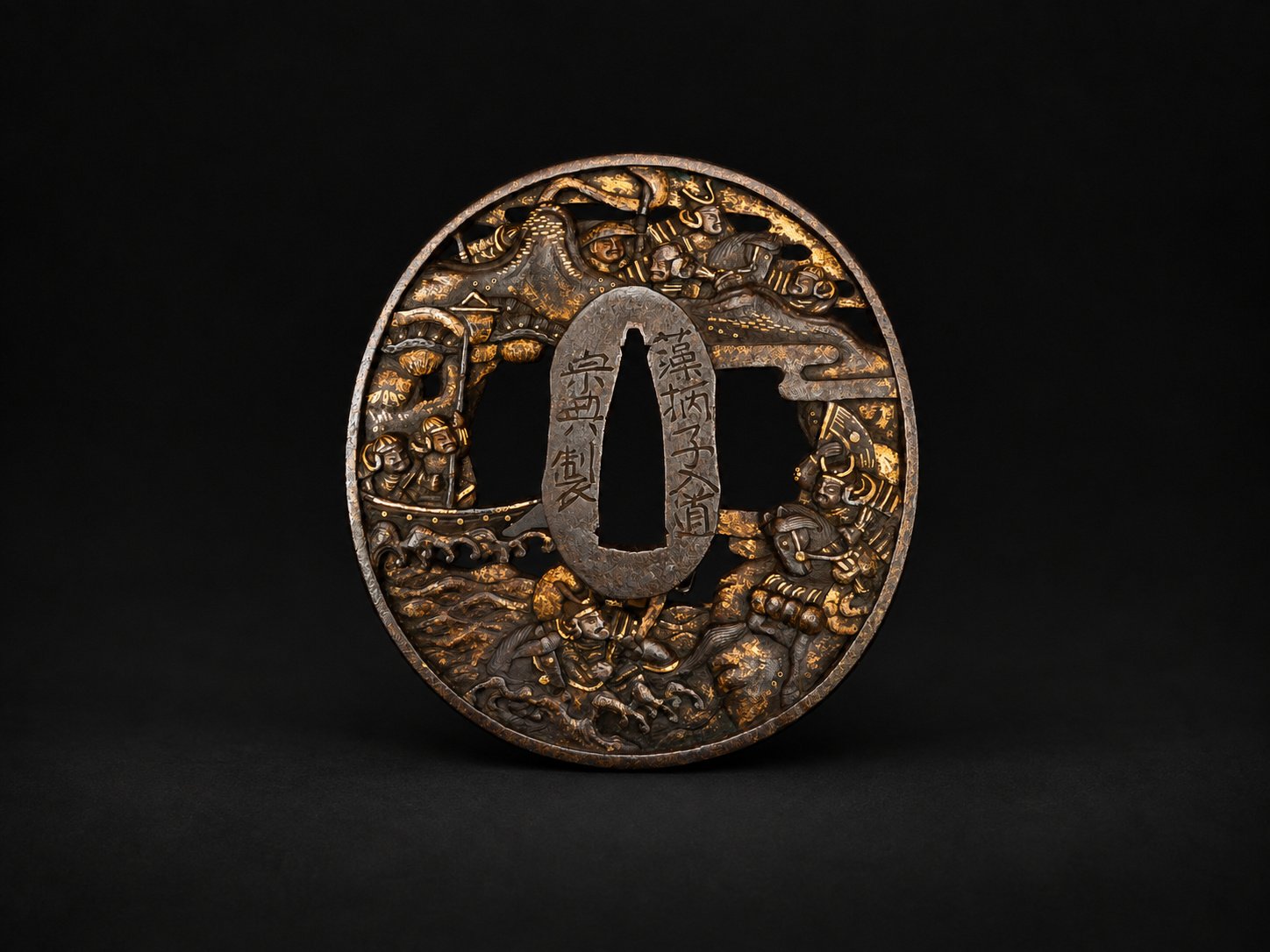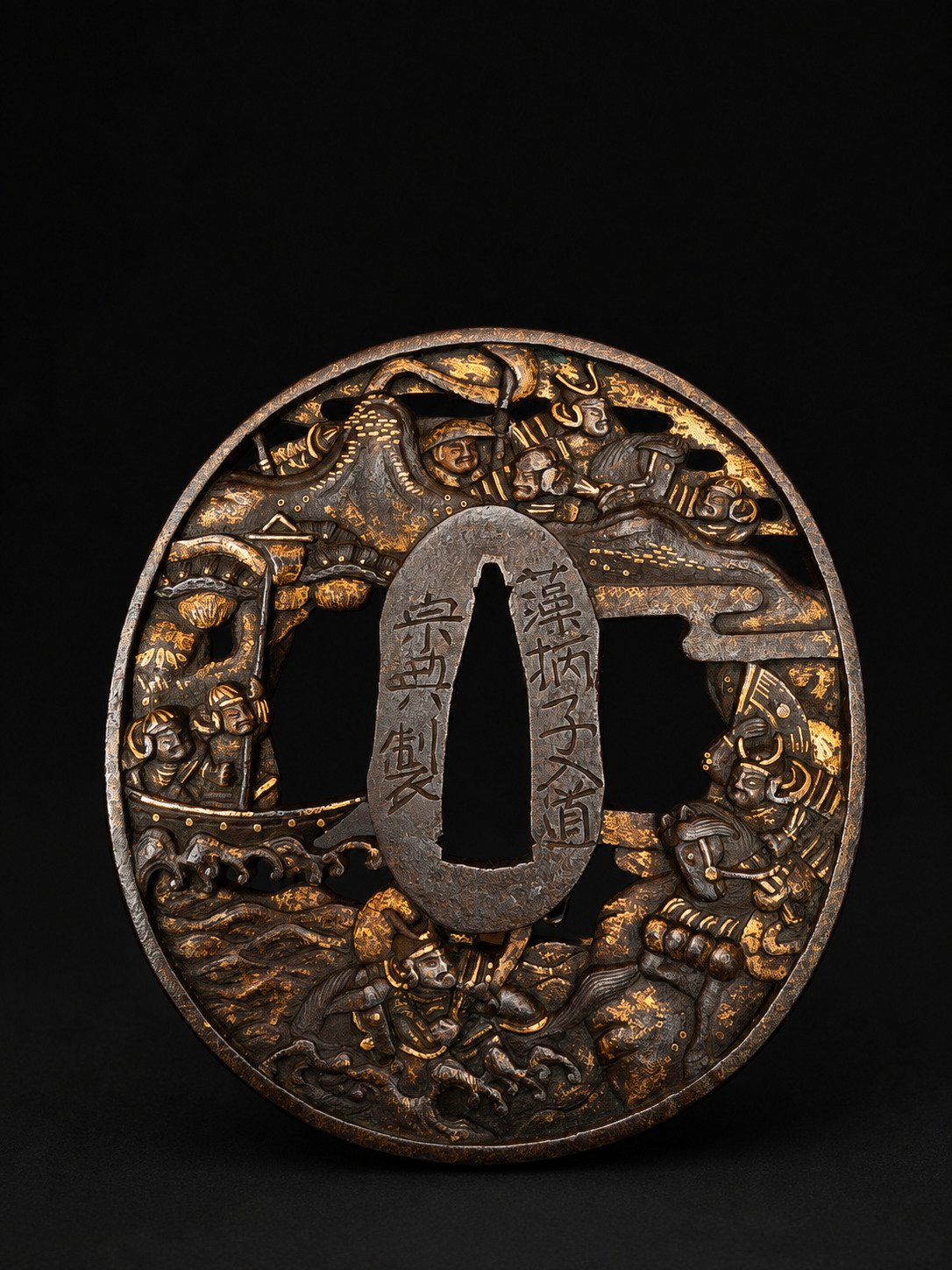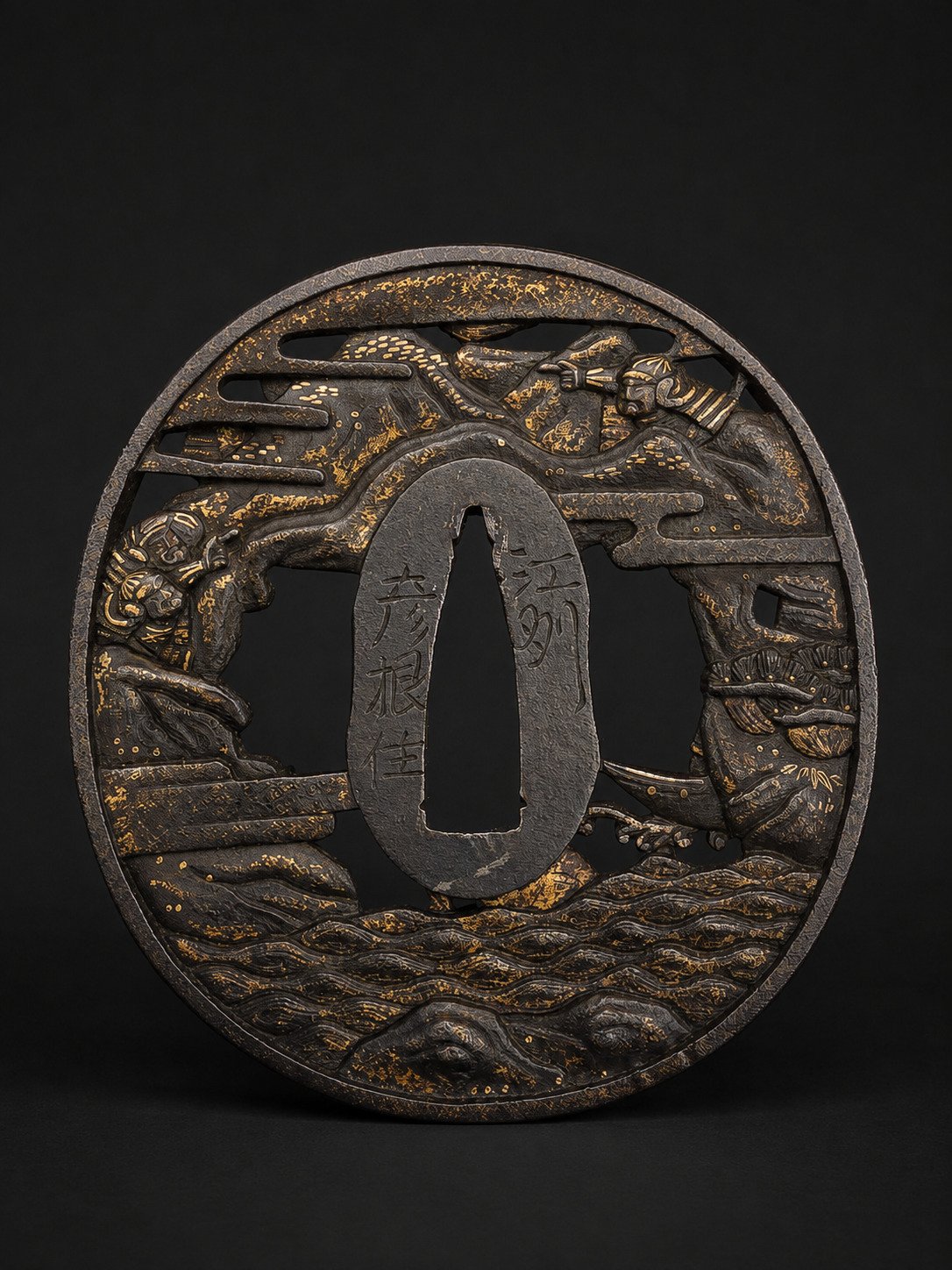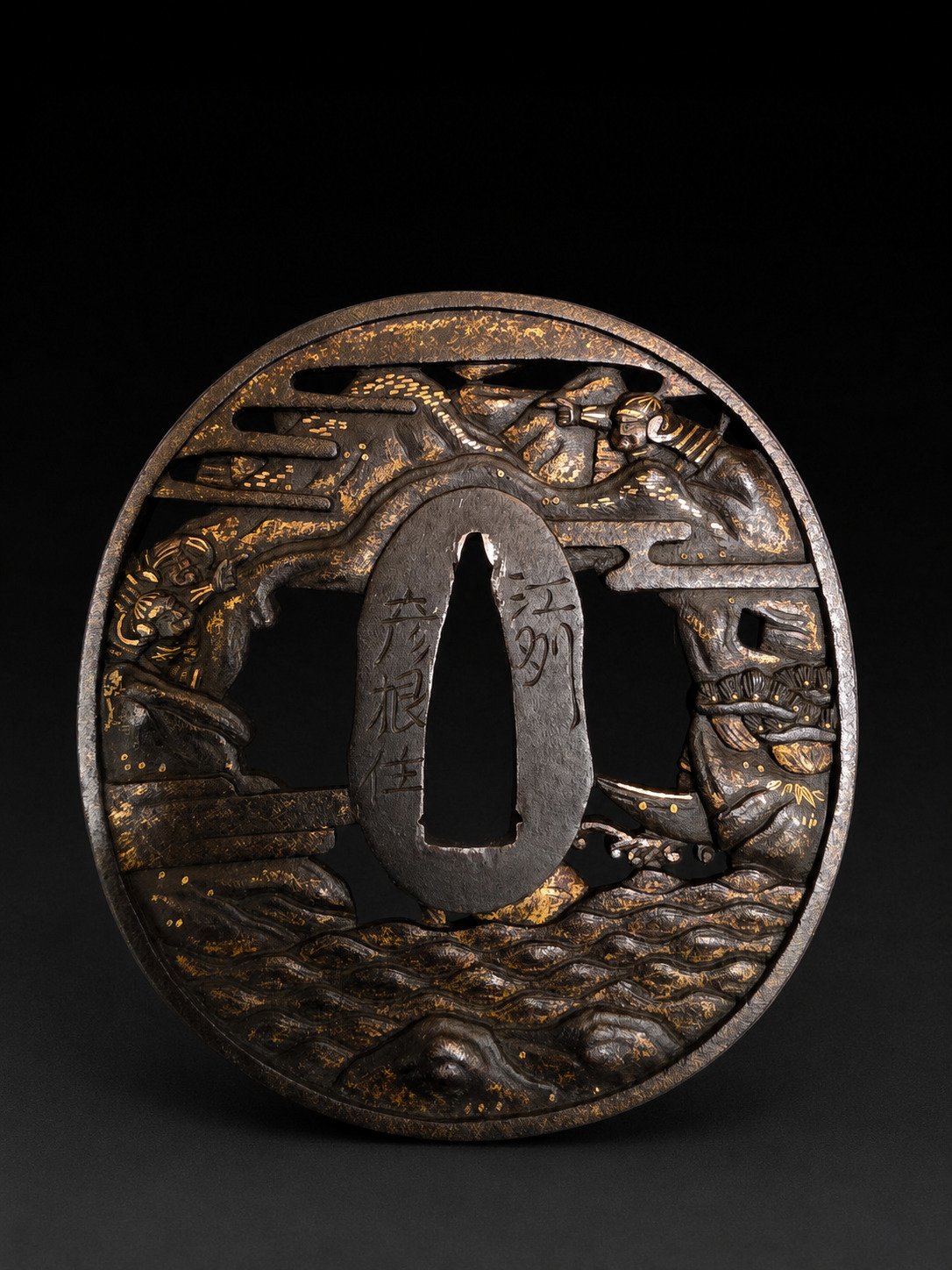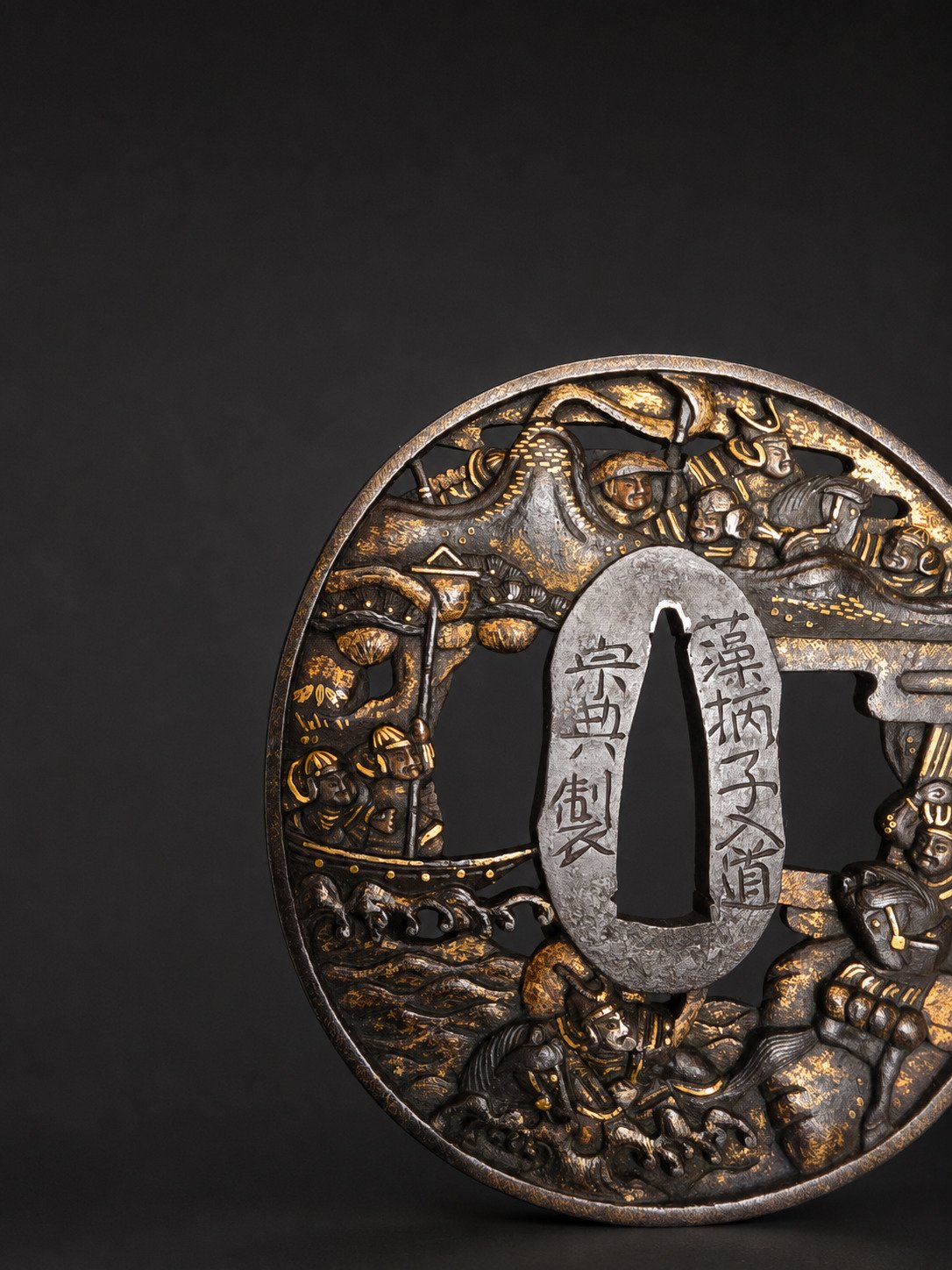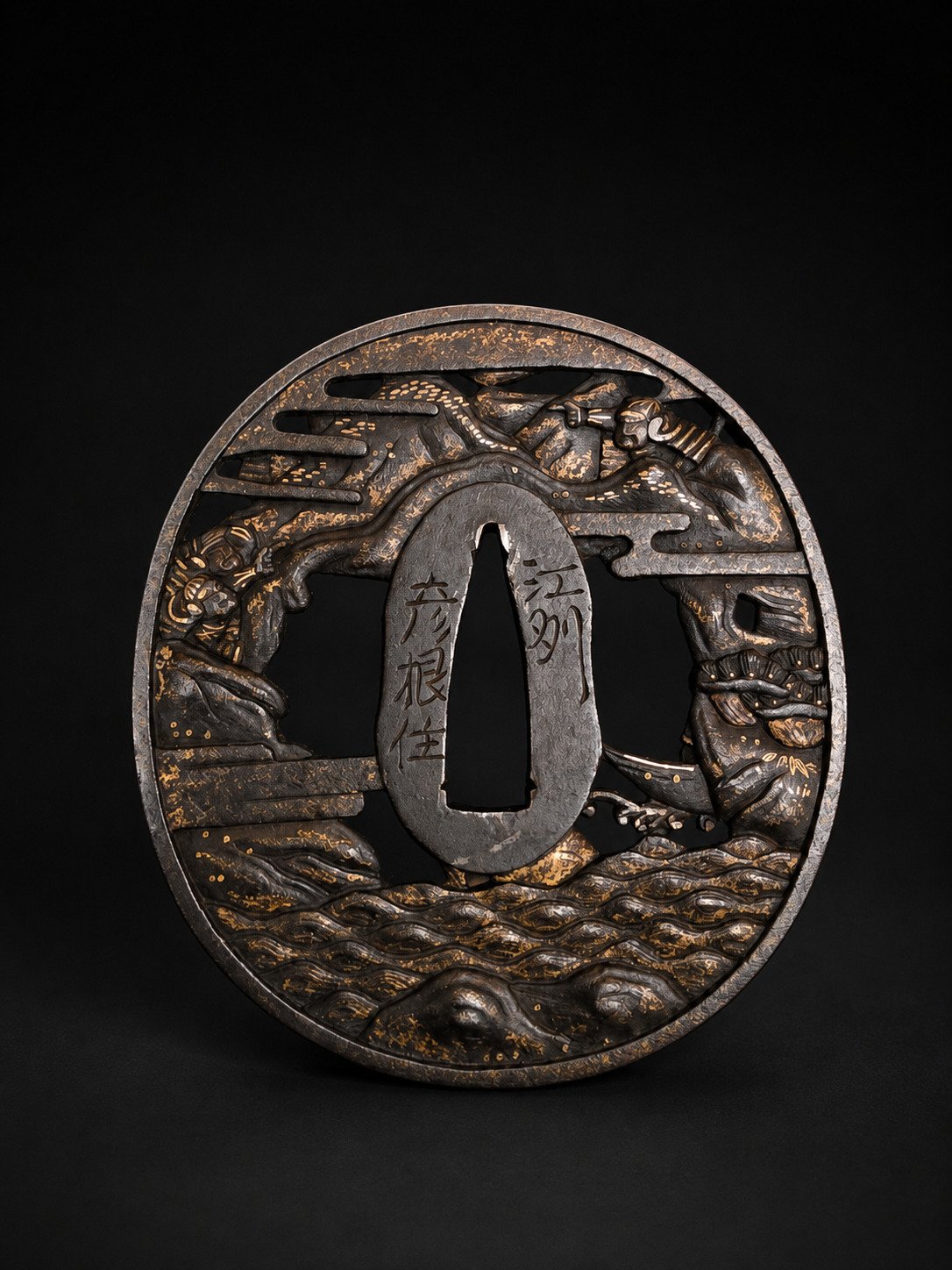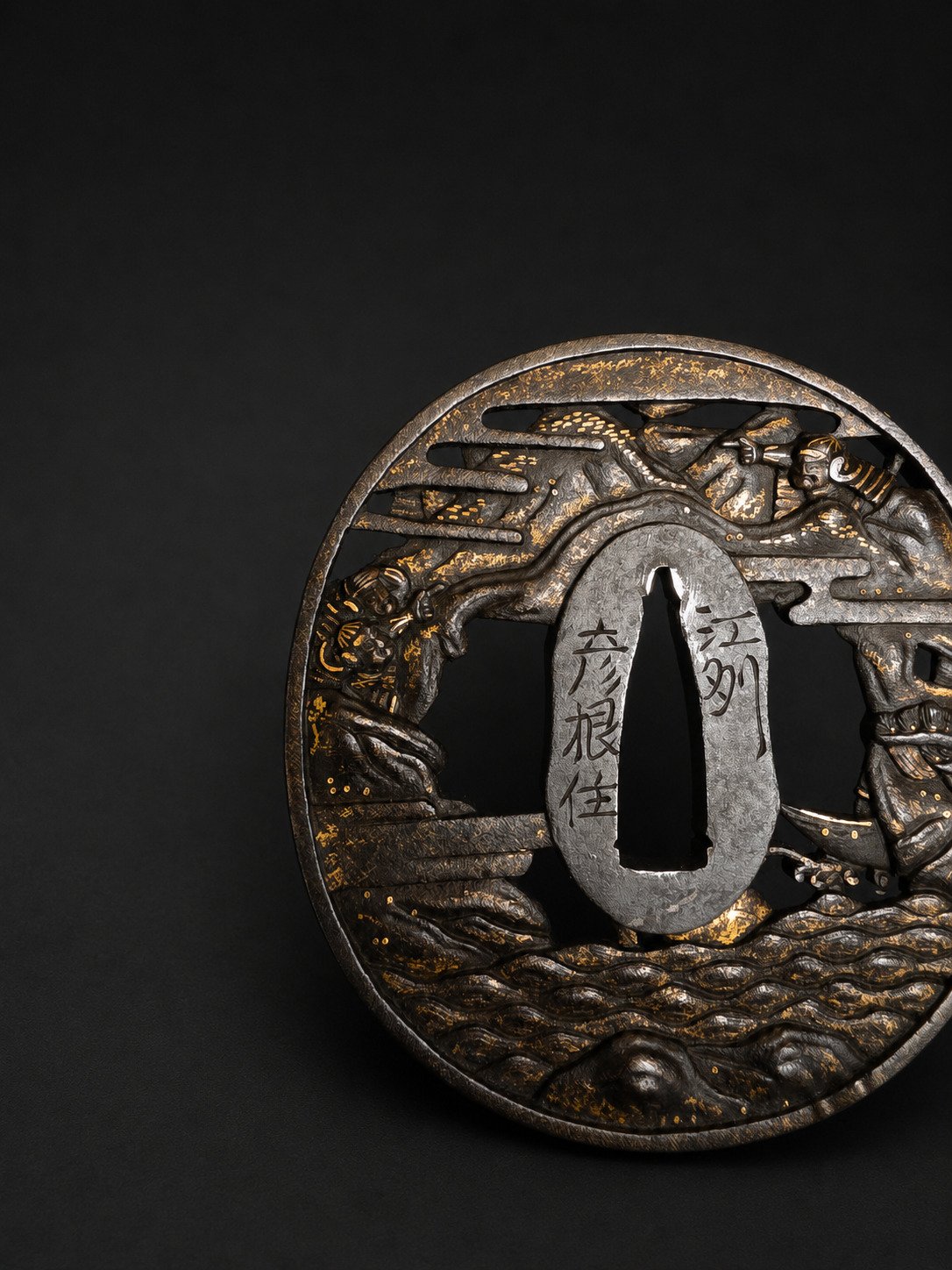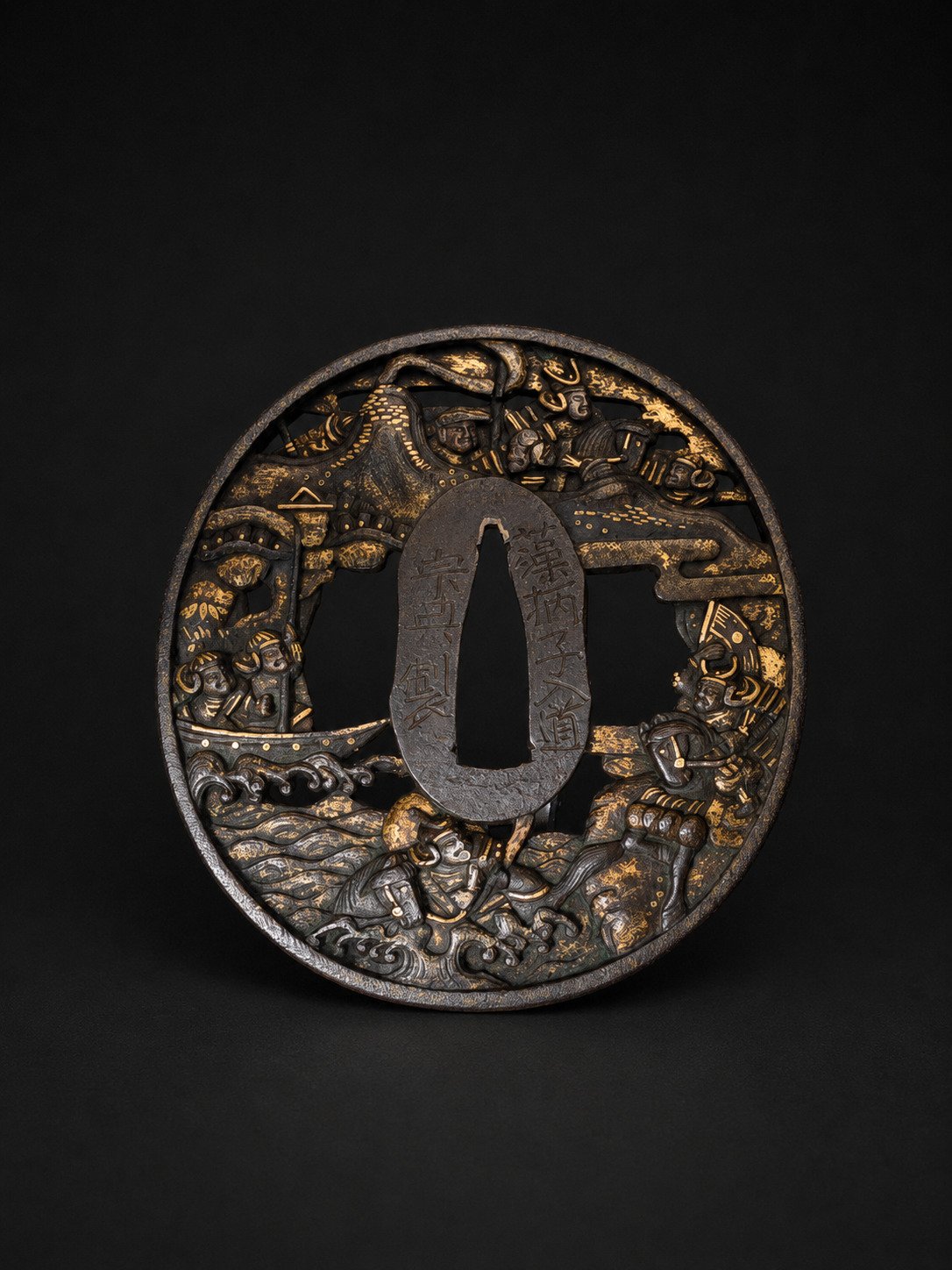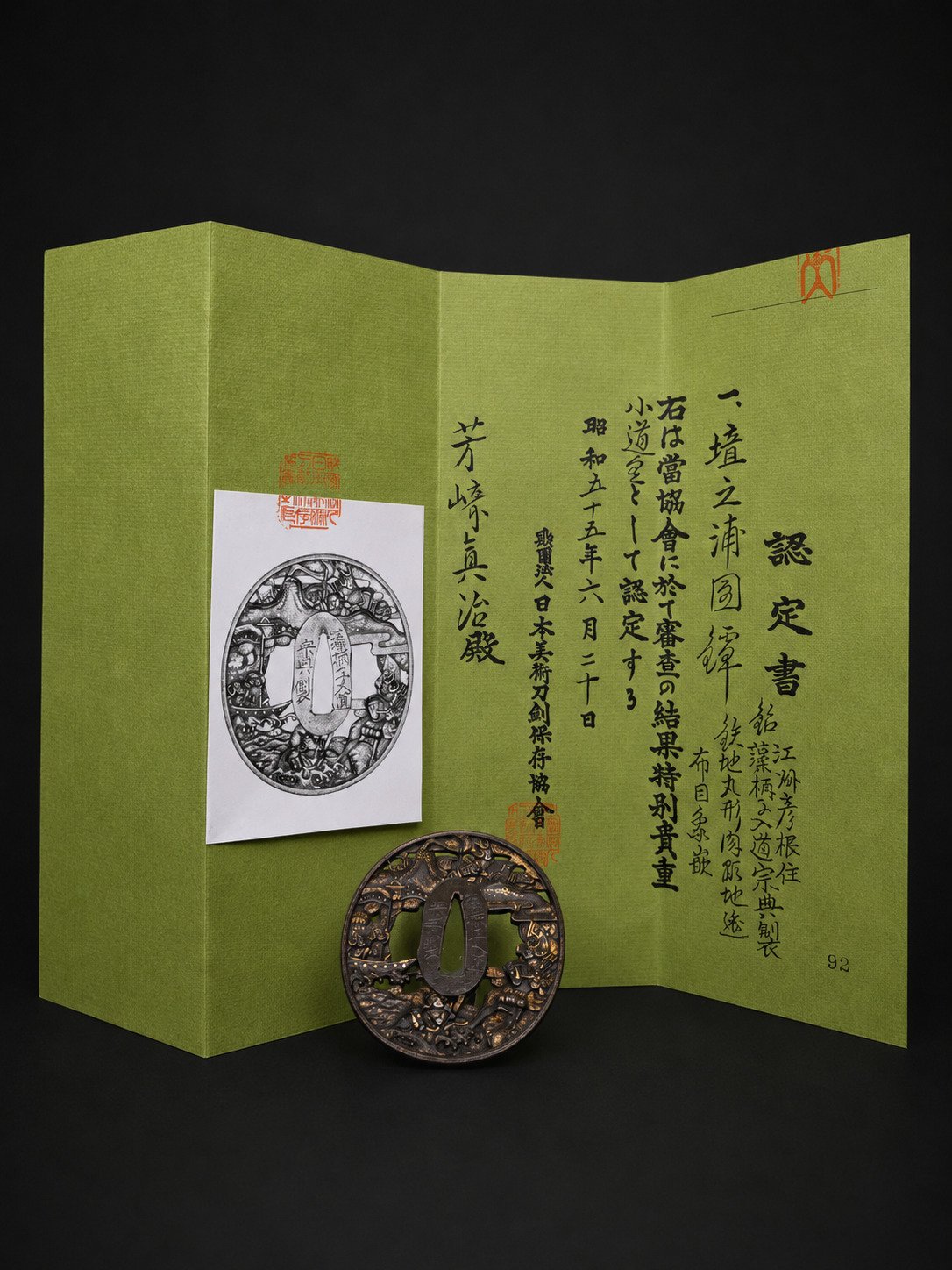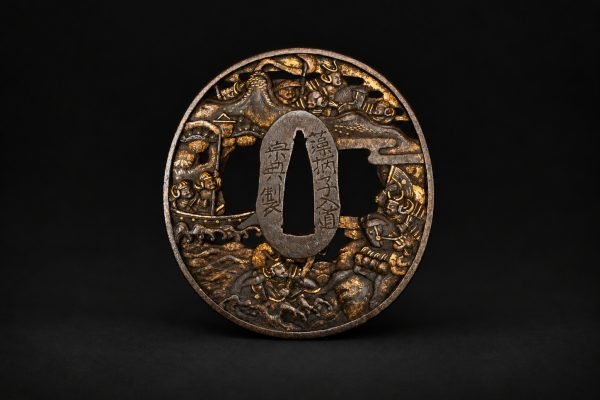
An exceptional Japanese iron tsuba from the Edo period, signed by Sōheishi Nyūdō Sōten (藻柄子入道宗典) of Hikone in Ōmi Province and depicting the celebrated Battle of Dan-no-ura (壇之浦の戦い), the decisive naval engagement that brought the Genpei War to its dramatic conclusion in 1185.
Worked on a dark tetsuji ground in elaborate nikubori ji-sukashi, the guard combines deeply modelled relief, extensive openwork and surviving gold and silver nunome-zōgan. Warriors, horses, boats, waves and mountainous terrain are compressed into a remarkably dense narrative composition surrounding the central nakago-ana.
The dark patinated iron creates a powerful background for the remaining gold and silver decoration, which highlights armor, helmets, clothing, weapons and details of the turbulent sea. The result is characteristic of the richly narrative metalwork associated with the Hikone Sōten tradition.
The subject is the Battle of Dan-no-ura, fought in 1185 between the rival Minamoto (Genji) and Taira (Heike) clans during the final phase of the Genpei War.
The naval confrontation ended in a decisive Minamoto victory and the destruction of Taira power. Among the most famous episodes associated with the battle is the death of the young Emperor Antoku, who drowned together with members of the Taira household as defeat became inevitable.
The battle subsequently became one of the great narrative subjects of Japanese warrior culture, immortalised in literature and visual art, particularly through the traditions surrounding the Heike Monogatari.
The entire surface of the tsuba functions almost like a miniature historical painting translated into metal.
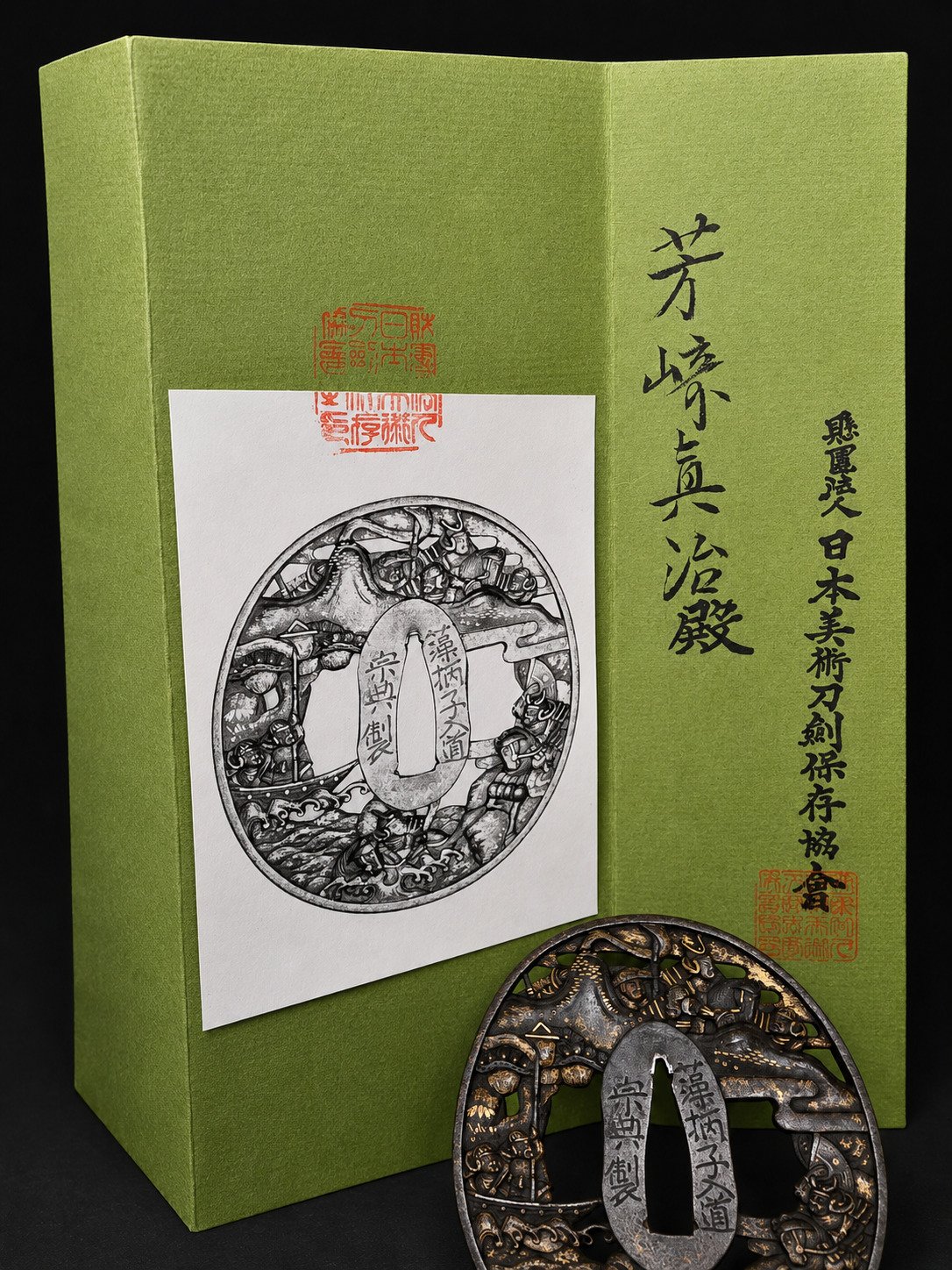
The composition unfolds around the central nakago-ana and across several interconnected planes. In the upper section, groups of armed warriors appear among elevated coastal terrain, their helmets and armor picked out with surviving gold decoration.
To the left, a boat carrying figures moves through the turbulent water, its occupants tightly integrated into the surrounding openwork. The vessel and waves establish the maritime setting immediately and connect the human drama directly with the sea.
On the right, a prominently modelled mounted samurai occupies a powerful diagonal position. Horse and rider are carved in substantial relief, providing a strong counterweight to the boat on the opposite side.
Along the lower edge, deeply worked waves extend across the composition. A further warrior appears among the water, reinforcing the chaos and danger of the naval battle.
The principal sculptural technique is nikubori ji-sukashi (肉彫地透), in which the surrounding iron is opened around substantial, volumetrically carved elements.
Rather than decorating a flat plate, the artist has transformed the iron into an interconnected network of figures, landscape forms, horses, boats and waves. Large areas are completely pierced, allowing light to pass through the composition and greatly increasing its sense of depth.
The technique is particularly effective in a complex battle scene: some warriors project strongly toward the viewer, while others recede behind armor, terrain or waves, creating multiple visual planes within the relatively small dimensions of the guard.
The iron surface is enriched with extensive gold and silver nunome-zōgan, a technique in which the iron ground is prepared with extremely fine cross-hatched incisions before thin precious-metal foil is mechanically bonded to the surface.
Traces of this decoration remain especially visible on helmets, armor components, garments, weapons and sections of the landscape and waves.
The contrast between the warm gold, cooler metallic accents and darkened iron ground gives the composition much of its visual intensity. Even where parts of the original inlay have naturally worn with age, the surviving decoration continues to articulate individual warriors and details within the dense narrative scene.
The tsuba bears the inscription:
江州彦根住 藻柄子入道宗典 製
Gōshū Hikone-jū Sōheishi Nyūdō Sōten sei
“Made by Sōheishi Nyūdō Sōten, resident of Hikone, Ōmi Province.”
Sōten (宗典) is closely associated with the celebrated Hikone tradition of sword fittings from Ōmi Province. Works associated with this school are particularly recognisable for their elaborate narrative scenes, densely carved iron, extensive openwork and contrasting inlays of precious and coloured metals.
Historical battles, legendary warriors, Chinese sages and complex figure-filled landscapes were especially suited to this highly sculptural approach.
The present tsuba displays these defining characteristics with unusual richness: multiple human figures, a mounted warrior, boat, sea and landscape are integrated into a single continuous sculptural structure.
The signature is prominently cut into the iron surrounding the nakago-ana, making it a major visual element of the composition rather than a discreet inscription on the reverse.
The inscription identifies Hikone in Ōmi Province and uses the name Sōheishi Nyūdō Sōten, a form closely associated with the Hikone Sōten tradition.
The accompanying NBTHK documentation likewise records the piece as a Dan-no-ura design bearing a Sōten signature.
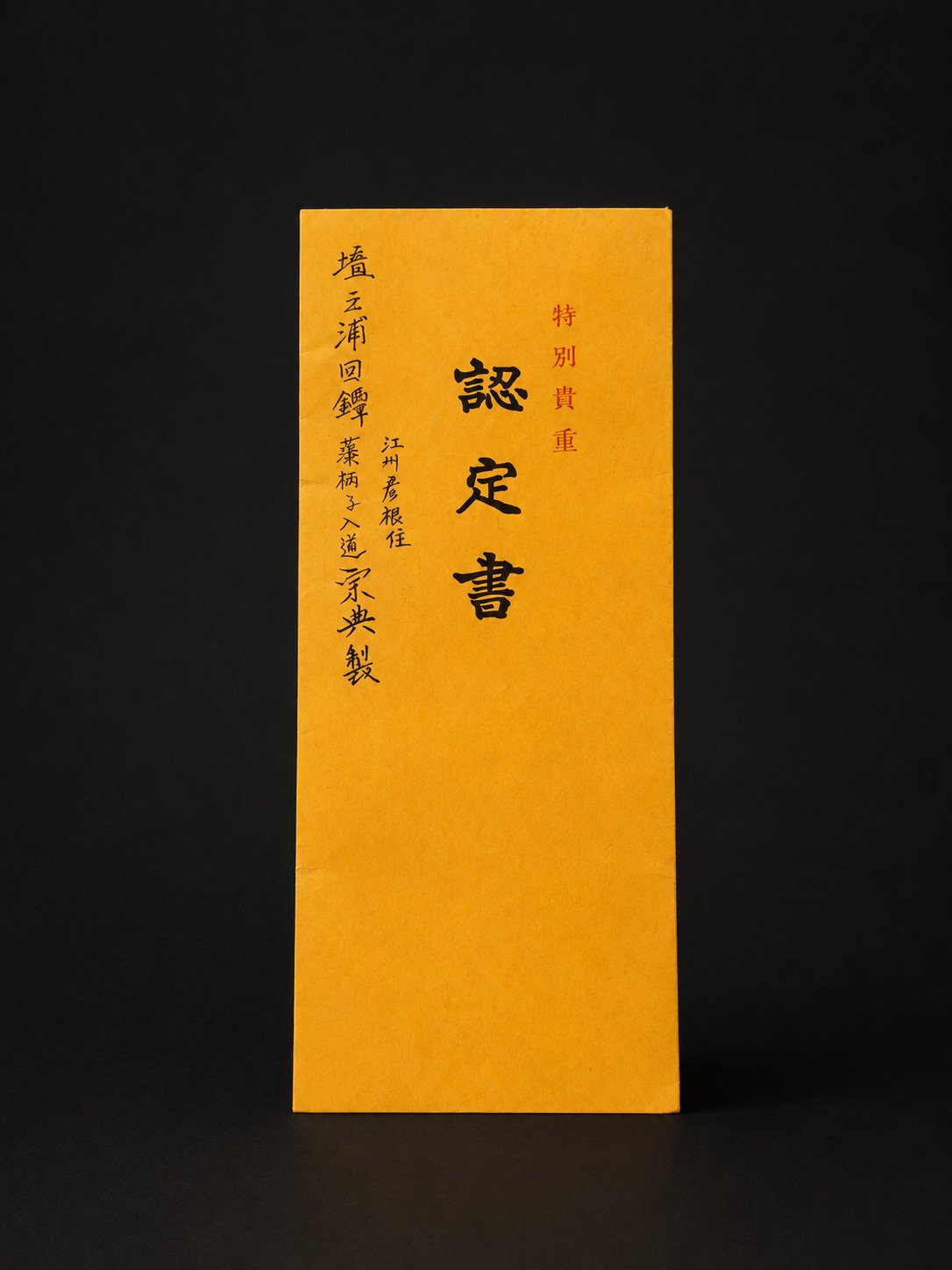
The tsuba is accompanied by an old-system Tokubetsu Kichō (特別貴重) Ninteisho issued by the Nihon Bijutsu Tōken Hozon Kyōkai (NBTHK).
The certificate is dated June 20, Shōwa 55 (1980) and belongs to the historical NBTHK certification system that preceded the present Hozon and Tokubetsu Hozon classifications.
Tokubetsu Kichō, commonly associated with the historic “green paper”, designated an object considered especially valuable within that former system.
The certificate records the work as:
Dan-no-ura zu tsuba, mei: Gōshū Hikone-jū Sōheishi Nyūdō Sōten saku — tetsuji, marugata, nikubori ji-sukashi, nunome-zōgan.
In English:
“Tsuba depicting Dan-no-ura, signed Sōheishi Nyūdō Sōten, resident of Hikone in Ōmi Province; iron ground, round form, relief openwork carving and nunome inlay.”
The document therefore provides important historical support for both the identification of the subject and the attribution recorded on the signed piece.
The certificate’s date of 1980 places it within the final years of the historic NBTHK Kichō certification system, before the introduction of the modern Hozon and Tokubetsu Hozon classifications in 1982.
This gives the accompanying paper additional documentary interest as an example of the earlier NBTHK appraisal system.
1980 was also an important year in the history of NBTHK overseas appraisal, as a notable shinsa was conducted in the United States during that year, where Tokubetsu Kichō represented the highest level awarded. Unless further documentation directly connects this particular certificate with that specific overseas session, however, its significance is best presented as an original 1980 Tokubetsu Kichō document rather than attributed specifically to the American shinsa.
This tsuba brings together several particularly desirable aspects of Japanese sword-fitting collecting: an important historical battle subject, a signed Hikone Sōten inscription, highly developed relief and openwork, extensive surviving precious-metal decoration and an old NBTHK Tokubetsu Kichō paper.
The scene rewards prolonged examination. Individual warriors initially dominate the eye, but closer inspection gradually reveals the boat, mounted combatants, partially concealed figures, swirling water and the extensive network of small gold and silver details.
At only a few centimetres across, the artist has created a remarkably ambitious narrative image, transforming a functional sword guard into a miniature representation of one of the defining episodes of medieval Japanese military history.
An exceptional Edo-period iron tsuba depicting the Battle of Dan-no-ura, signed Gōshū Hikone-jū Sōheishi Nyūdō Sōten sei. Warriors, mounted samurai, boats and turbulent waves are carved in elaborate nikubori ji-sukashi and enriched with surviving gold and silver nunome-zōgan against the dark iron ground. Accompanied by an NBTHK Tokubetsu Kichō certificate dated 1980, the piece combines dramatic historical narrative, sophisticated Hikone metalwork and significant documentary interest.

Order above 1.000,00 € gets free shipping.

Secure and hassle-free payment process.

Certificate of authenticity included.

Have questions? Contact us via WhatsApp.
Contact