1.780,00 €
The inro (印籠) is one of the most refined and recognisable forms of Japanese decorative art. Originally created as practical containers for carrying medicines, seals and personal items, inro evolved into highly sophisticated works of art that showcased the skill of Japan’s finest lacquer masters.
Today, antique inro are among the most sought-after Japanese collectibles, admired for their exquisite lacquerwork, intricate decoration and historical significance. Combining functionality with extraordinary craftsmanship, they represent the elegance and sophistication of Japanese culture during the Edo and Meiji periods.
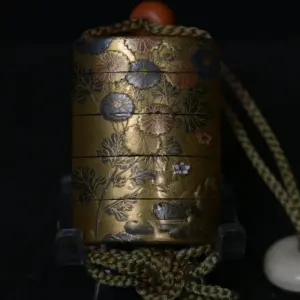
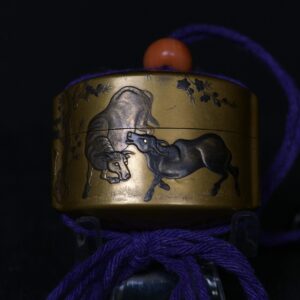
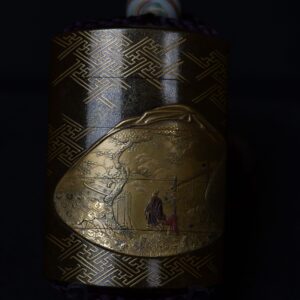
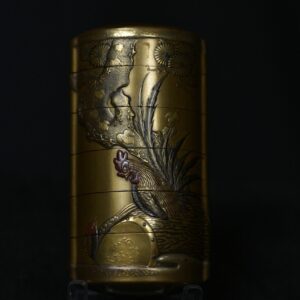
An inro is a small portable case consisting of several nested compartments stacked vertically and held together by a cord.
Traditional Japanese clothing lacked pockets, making it necessary to carry personal belongings externally. The inro was suspended from the obi (sash) and secured by a netsuke, which acted as a toggle to prevent it from slipping.
A sliding bead known as an ojime held the compartments tightly together.
Together, the inro, netsuke and ojime formed one of the most elegant and distinctive accessories of traditional Japanese dress.
The earliest inro appeared during the Sengoku Period (1467–1615) and were originally used by samurai and military commanders to carry seals, medicines and other essential items.
The name inro literally means “seal container,” reflecting their original purpose.
During the Edo Period (1603–1868), Japan experienced unprecedented peace and economic growth. As a result, personal accessories became increasingly important as symbols of taste, refinement and social status.
The inro gradually evolved from a practical object into an artistic masterpiece.
As Japanese society became more prosperous, wealthy merchants and samurai began commissioning increasingly elaborate inro.
Artists decorated them with:
By the eighteenth century, the finest inro had become luxury objects comparable to jewellery or miniature paintings.
Many examples were created specifically to display wealth, education and artistic appreciation.
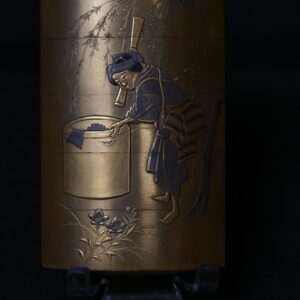
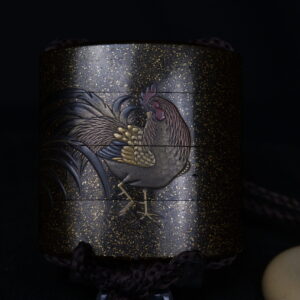
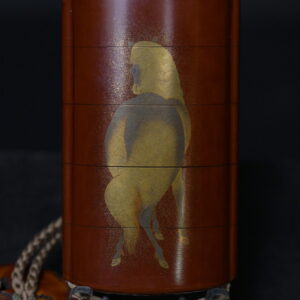
The beauty of an inro lies primarily in its lacquer decoration.
Japanese lacquer, known as urushi, is derived from the sap of the lacquer tree and has been used for centuries to create durable and highly decorative surfaces.
Applying lacquer is an extraordinarily demanding process.
Each layer must be carefully applied, cured and polished before the next can be added.
A high-quality inro may require dozens of layers and many months of work before completion.
One of the most celebrated decorative techniques used on inro is maki-e.
This process involves sprinkling gold or silver powder onto wet lacquer to create intricate designs and pictorial scenes.
Several forms of maki-e developed over time:
A flat decorative technique producing elegant surface designs.
A raised lacquer technique creating depth and relief.
A highly sophisticated process in which the design is embedded beneath additional layers of lacquer and later revealed through polishing.
The finest examples combine multiple techniques to achieve extraordinary visual effects.
During the late Edo and Meiji periods, artists experimented with increasingly elaborate decorative styles.
One of the most famous is Shibayama work, which incorporates:
These inro often display remarkable realism and exceptional attention to detail.
Other techniques include:
The decoration of an inro often reflected the interests, beliefs and cultural knowledge of its owner.
Popular themes include:
Many designs contain hidden symbolism and references to classical literature, making them highly rewarding to study.
The Edo Period represents the golden age of inro production.
As peace and prosperity spread throughout Japan, demand for luxury accessories increased significantly.
Master lacquer artists competed to create increasingly sophisticated works that demonstrated technical mastery and artistic innovation.
Many of the greatest names in Japanese lacquer art worked during this period, producing examples that remain highly prized by collectors today.
The Meiji Restoration of 1868 transformed Japanese society and introduced Western fashions.
As traditional clothing gradually declined, the practical function of the inro disappeared.
However, international interest in Japanese art grew rapidly.
Artists began creating inro specifically for collectors and export markets, often reaching astonishing levels of technical complexity and refinement.
Many Meiji-period inro are considered among the most spectacular examples ever produced.
An inro was rarely used alone.
A complete set typically consisted of:
The lacquer case itself.
The carved toggle securing the cord above the obi.
The decorative sliding bead that held the compartments together.
Collectors often seek complete ensembles because they provide a fascinating insight into the aesthetics and craftsmanship of traditional Japanese dress accessories.
Today, antique inro are among the most prestigious categories of Japanese art collecting.
Collectors appreciate them for:
When evaluating an inro, collectors generally consider:
Examples signed by important lacquer masters are particularly desirable.
Although originally created as practical objects, inro are now recognised as miniature masterpieces of Japanese art.
Their small size conceals an extraordinary level of technical skill and artistic sophistication.
Within a surface measuring only a few centimetres, artists created entire landscapes, historical scenes and mythological narratives using techniques that remain among the most advanced in the history of decorative arts.
Few objects embody the refinement and elegance of Japanese craftsmanship as completely as the inro.
What began as a simple medicine container evolved into one of the most sophisticated forms of lacquer art ever created.
Today, antique inro continue to captivate collectors, museums and art lovers around the world, preserving a remarkable tradition that combines beauty, functionality and cultural history.
More than a container, an inro is a miniature work of art that reflects the creativity, skill and aesthetic ideals of Japan’s master craftsmen.
Contact