1 in stock
1 in stock
Add to Compare
Add to Wishlist
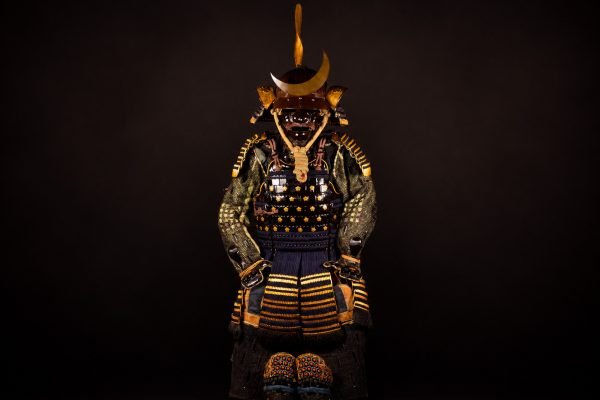
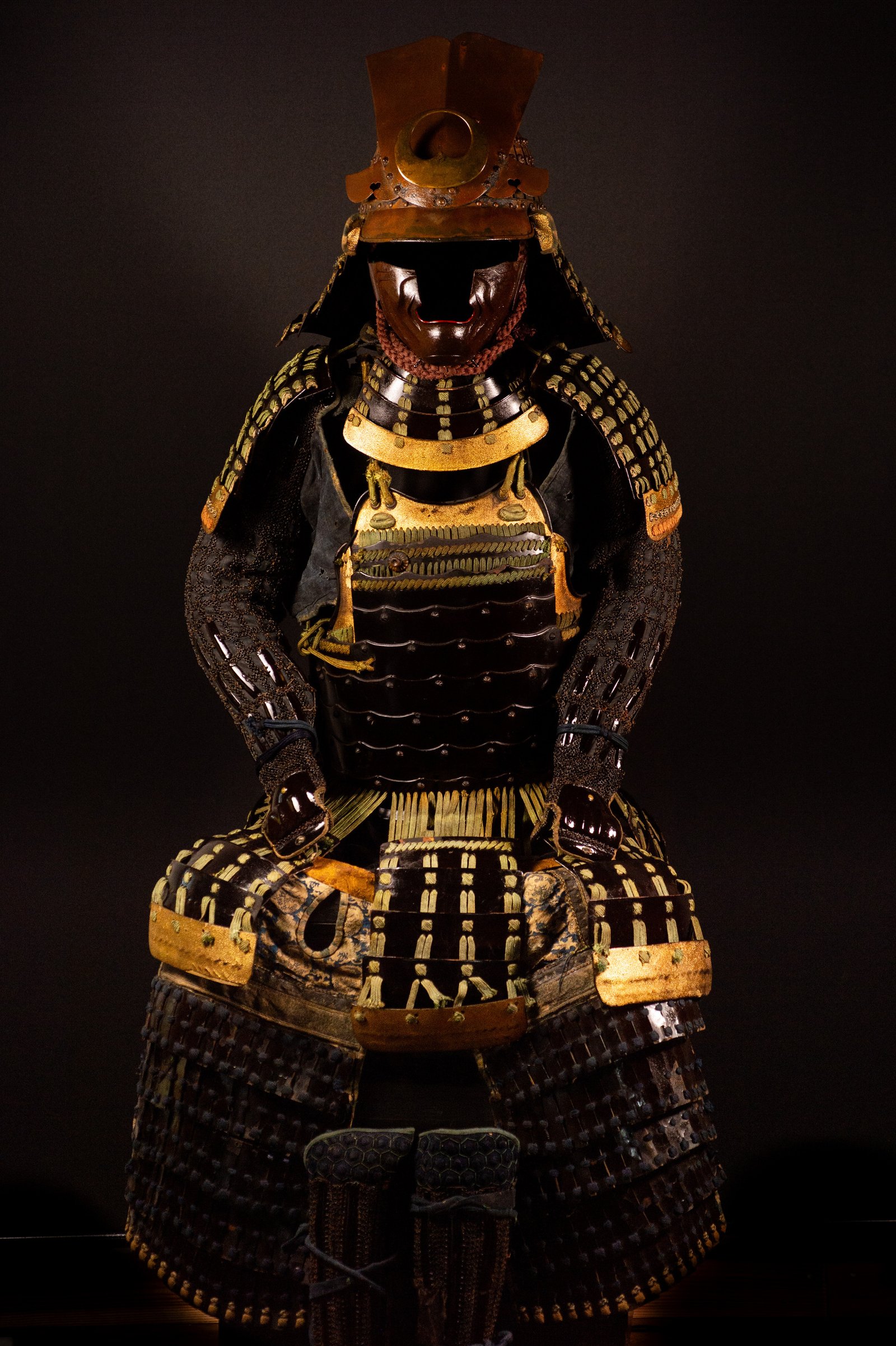
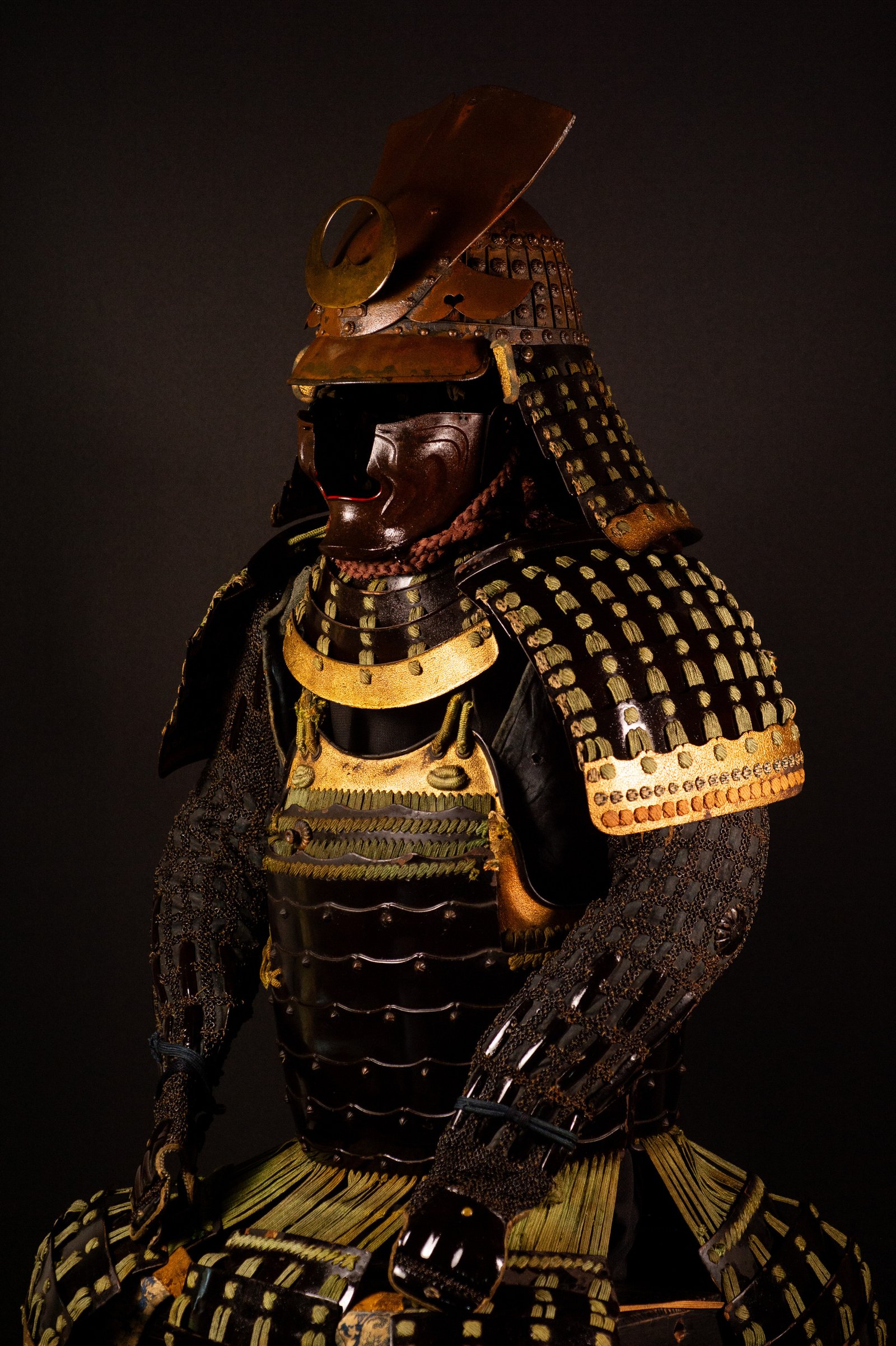
A striking and complete Japanese samurai armor (gusoku) dating to the mid-Edo period, acquired directly at a Tokyo dealer auction. The ensemble presents a strong and cohesive appearance, combining russet iron, black-lacquered lamellar construction, distinctive moss and olive-green odoshi lacing, gilt details and indigo textiles.
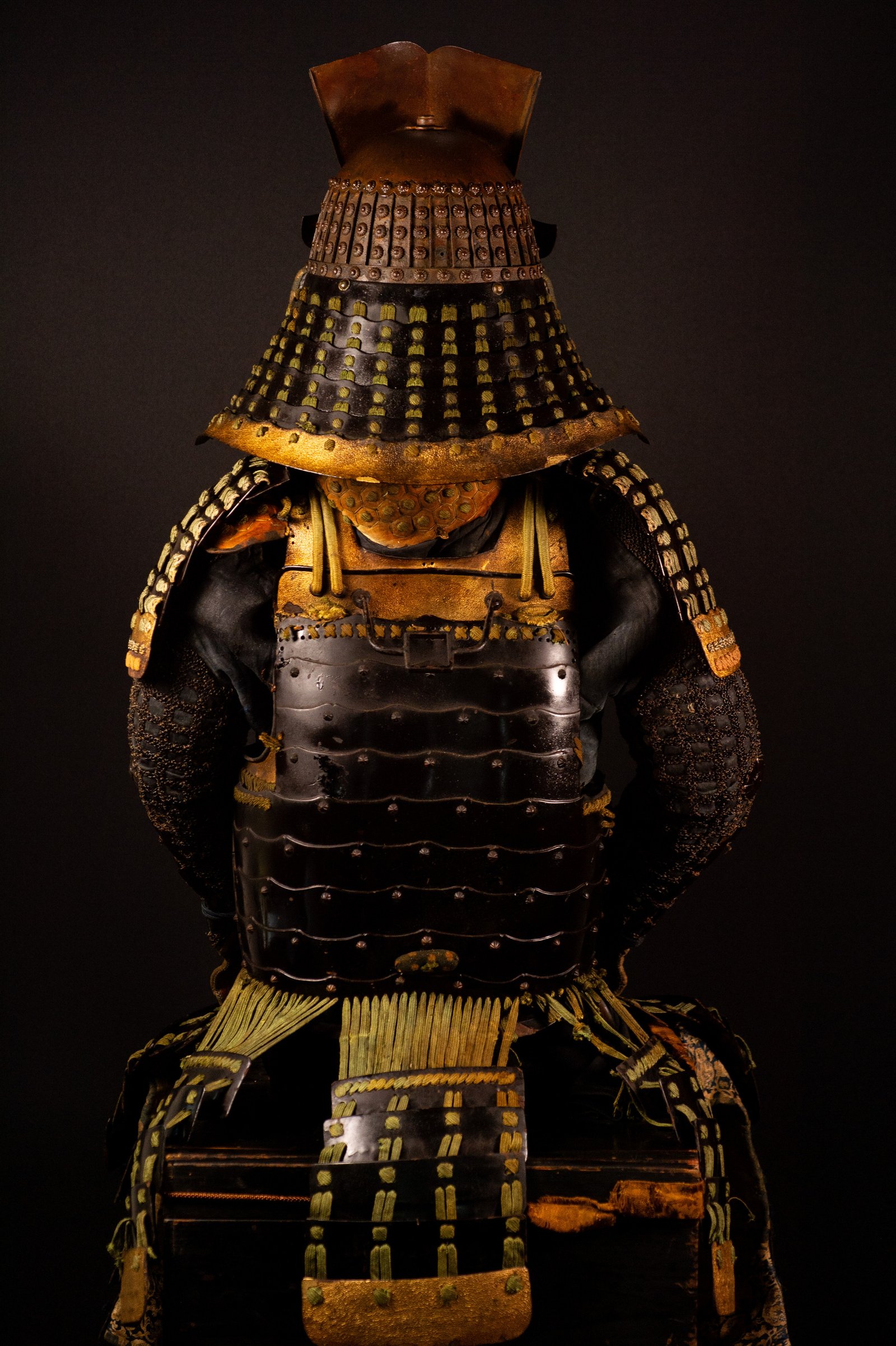
The armor retains all of its major components, including the kabuto, facial armor, dō, sode, kote, kusazuri and haidate. Its restrained palette of dark iron and black lacquer is enlivened by olive-green lacing, gilt borders and a commanding gilt-metal maedate, producing a visually coherent complete suit characteristic of samurai armor from the Edo period.
Acquired as part of a dealer auction lot in Tokyo, the armor is preserved as a complete historical ensemble. It is offered without certificate or formal attribution.
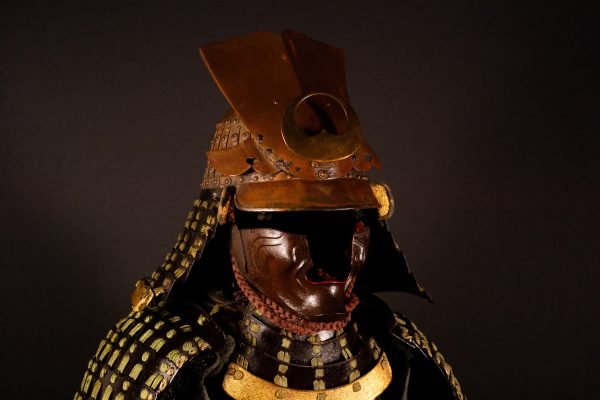
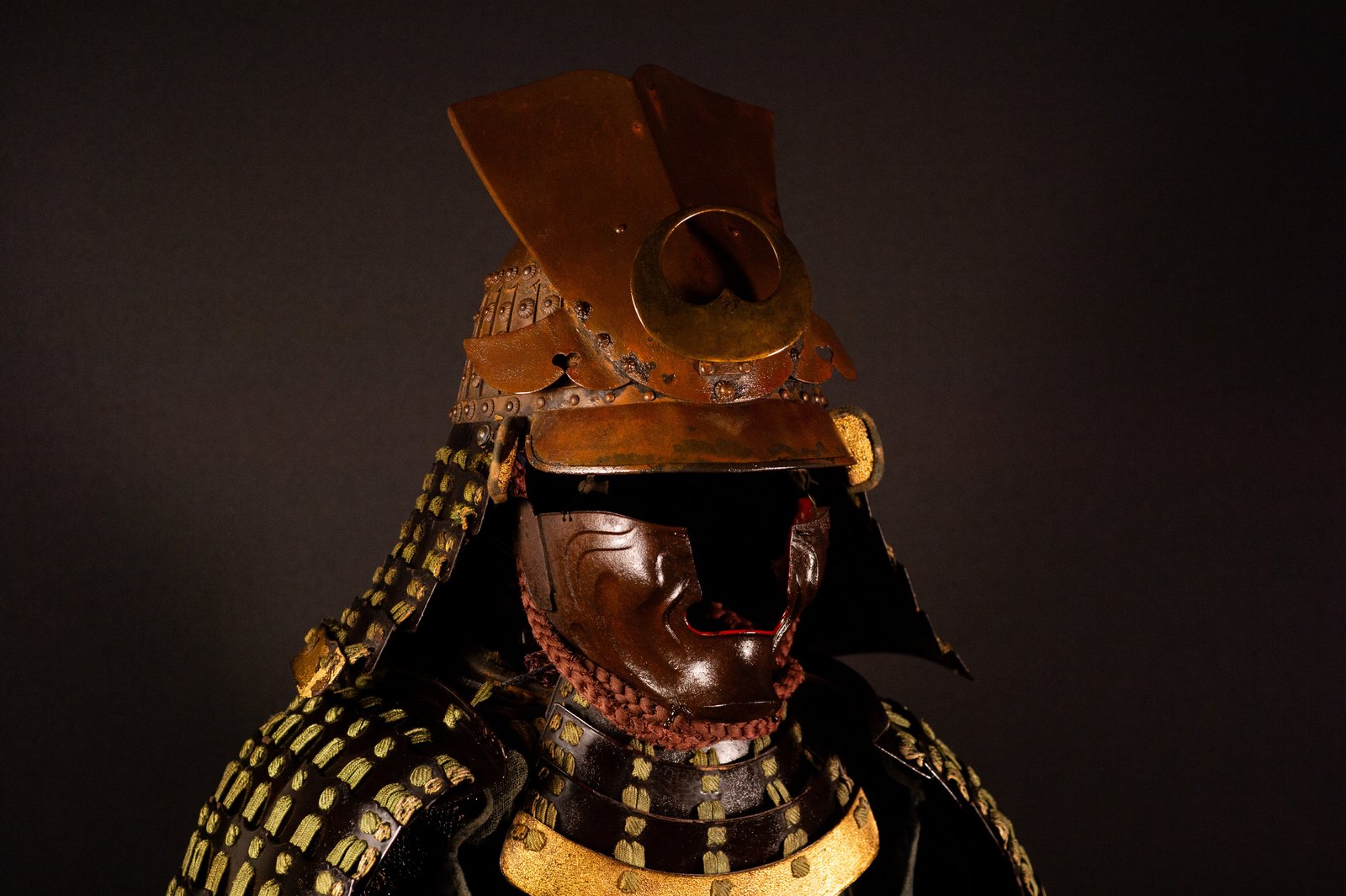
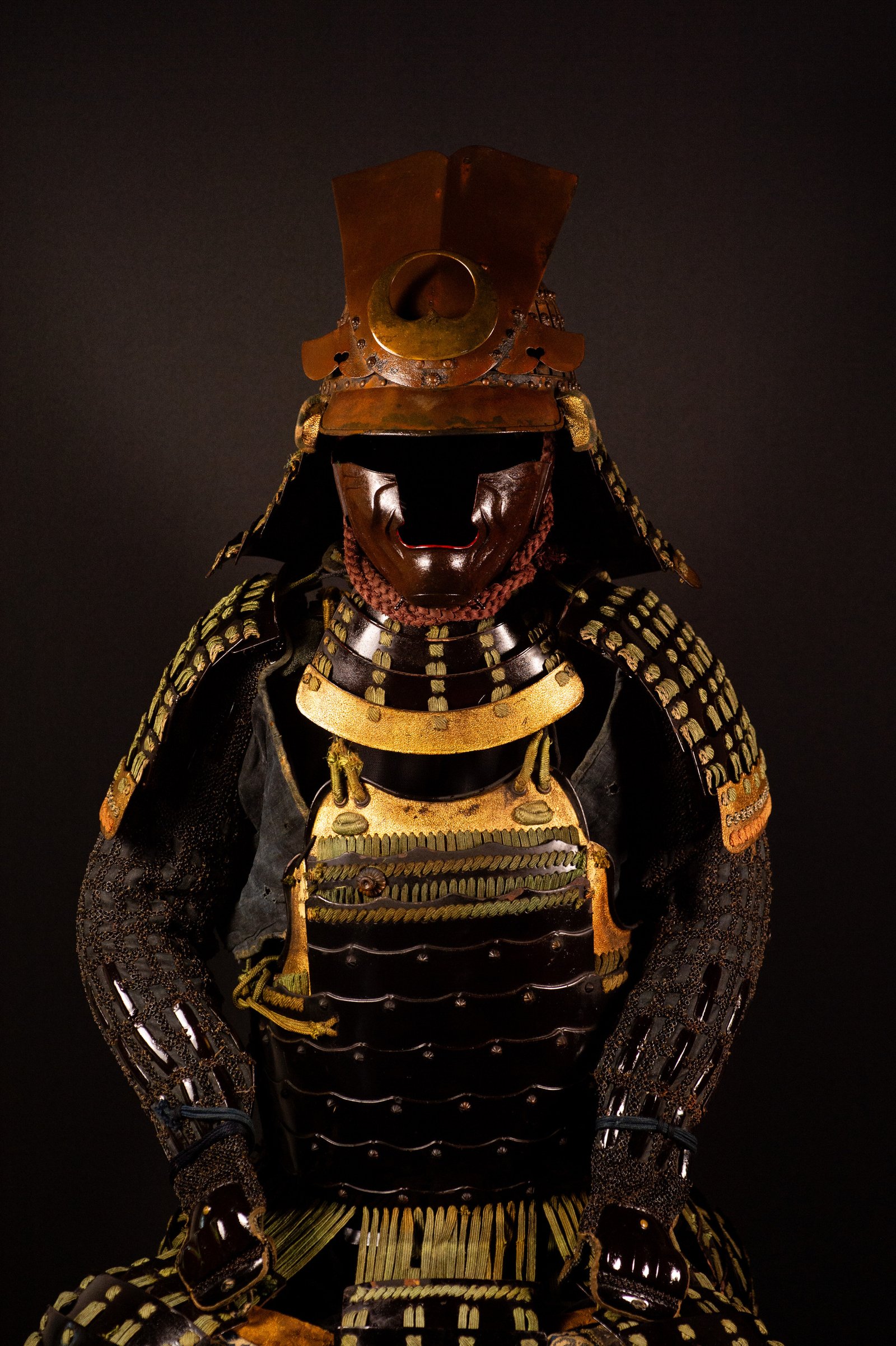
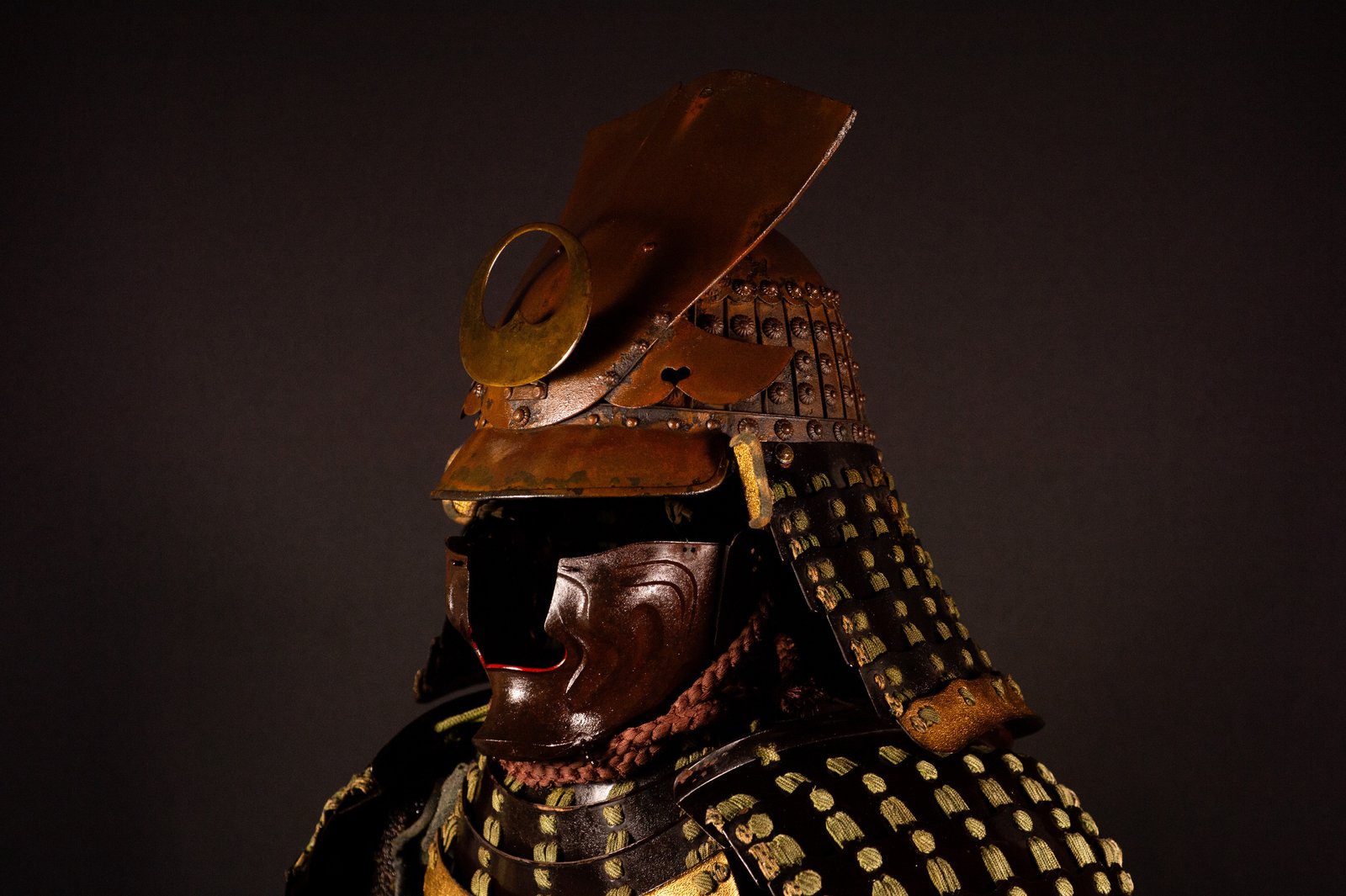
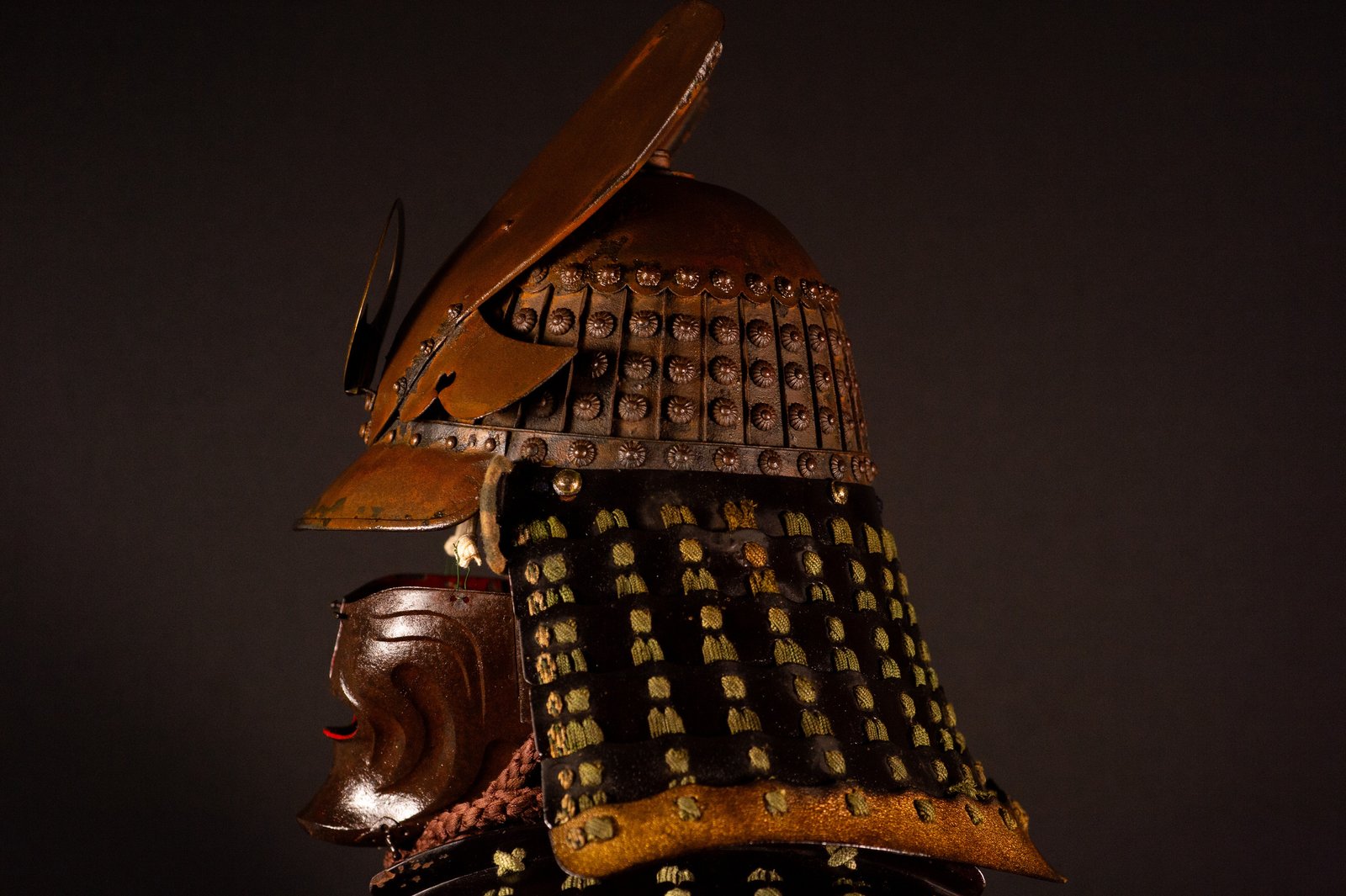
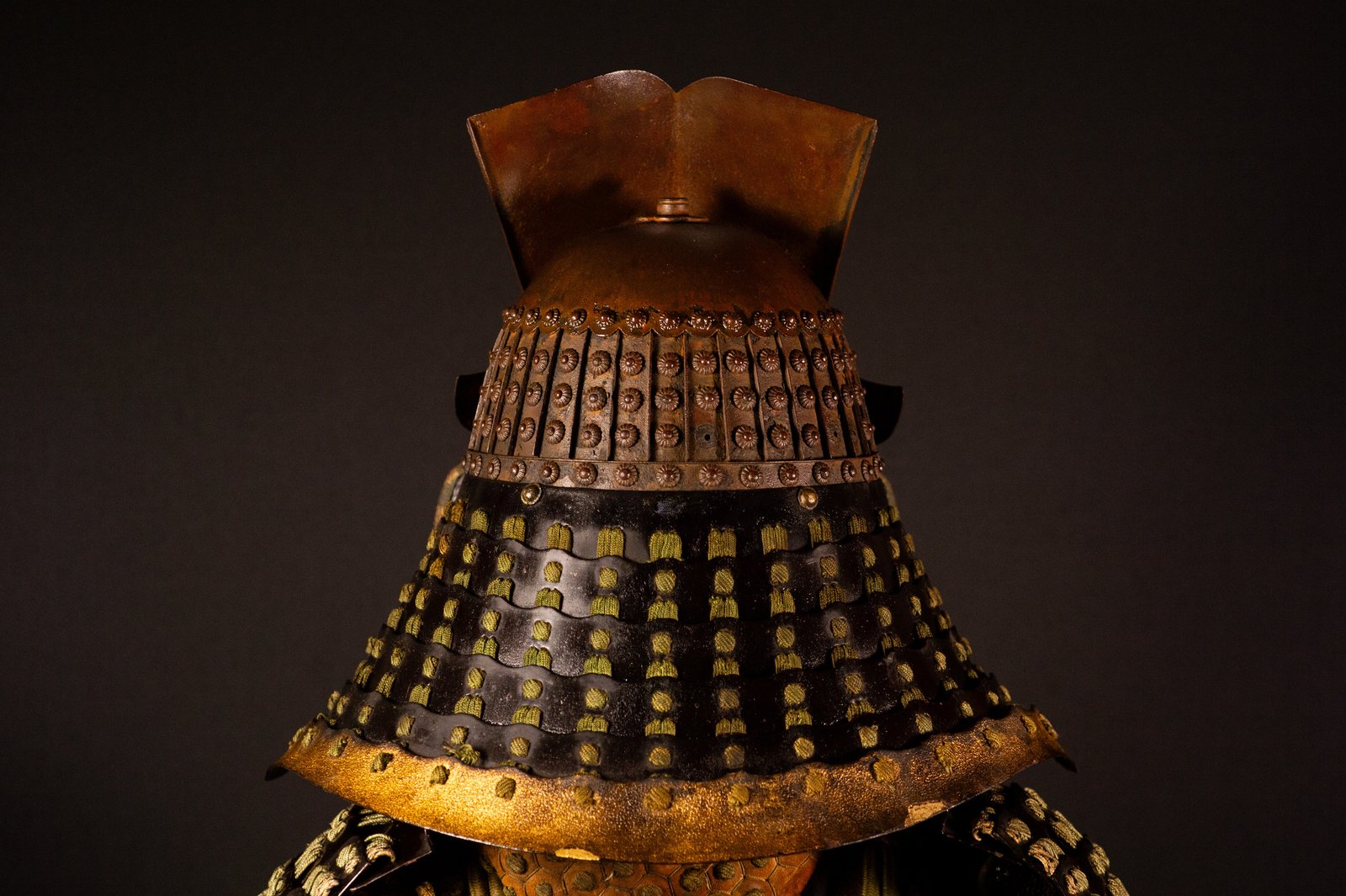
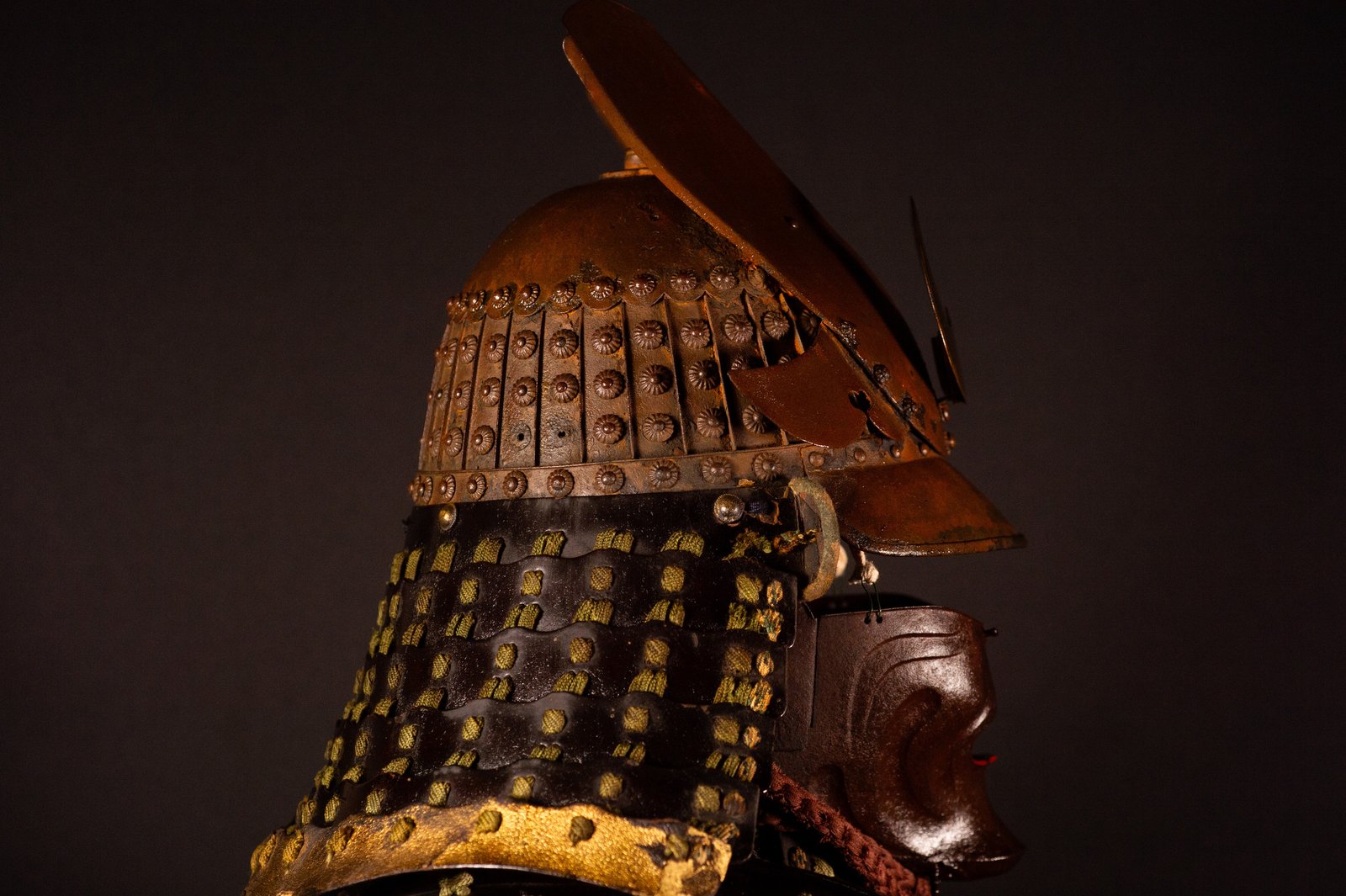
The kabuto features a suji-bachi helmet bowl constructed in russet iron with an unlacquered finish.
The visible ribs of the plate construction give the bowl its characteristic structured appearance, while the natural russet surface of the iron provides a restrained contrast with the more decorative gilt elements.
The mabizashi, or peak, together with the lower band of the helmet bowl, is decorated with a row of small domed rivets, a construction detail consistent with traditional plate-riveted bachi work.
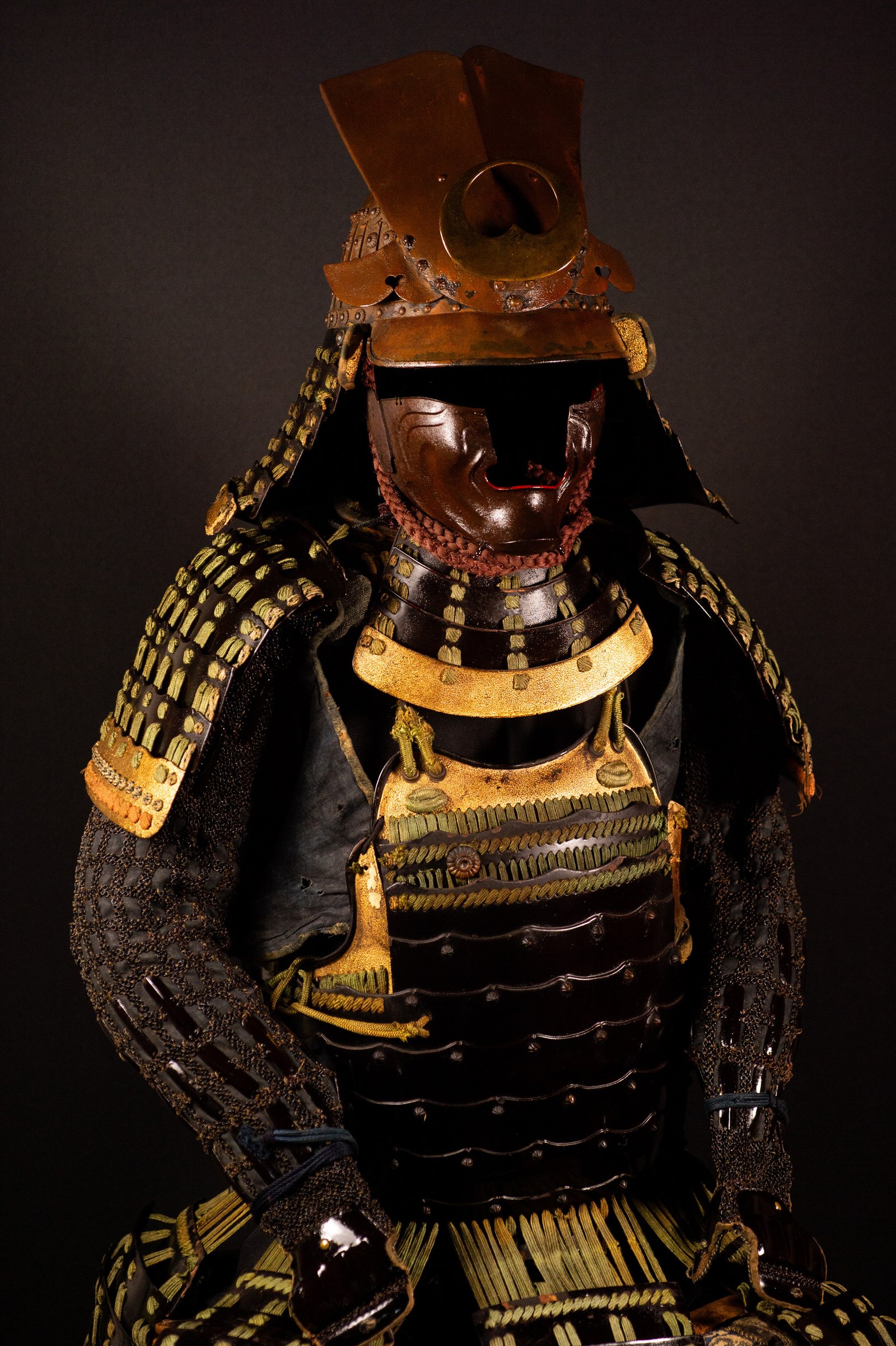
Large fukigaeshi in gilt copper extend from the sides, adding a particularly prominent decorative element to the helmet.
Dominating the front of the helmet is a bold circular or crescent-shaped maedate executed in gilt metal.
Its large scale and simple geometric form create a commanding focal point when the armor is viewed from the front.
The prominent crest reflects the Edo-period taste for highly visible personal and heraldic display, providing a striking contrast against the darker russet-iron helmet bowl.
The facial armor is finished in a deep brown-black lacquer and displays strongly modelled features.
The face presents a defined nose and cheeks together with an open mouth, whose interior is finished in contrasting red lacquer.
Below the mask is an attached yodare-kake, protecting the throat area and connected to the facial armor by a braided maroon cord.
The combination of dark exterior lacquer and red interior detailing gives the facial protection a particularly expressive appearance.
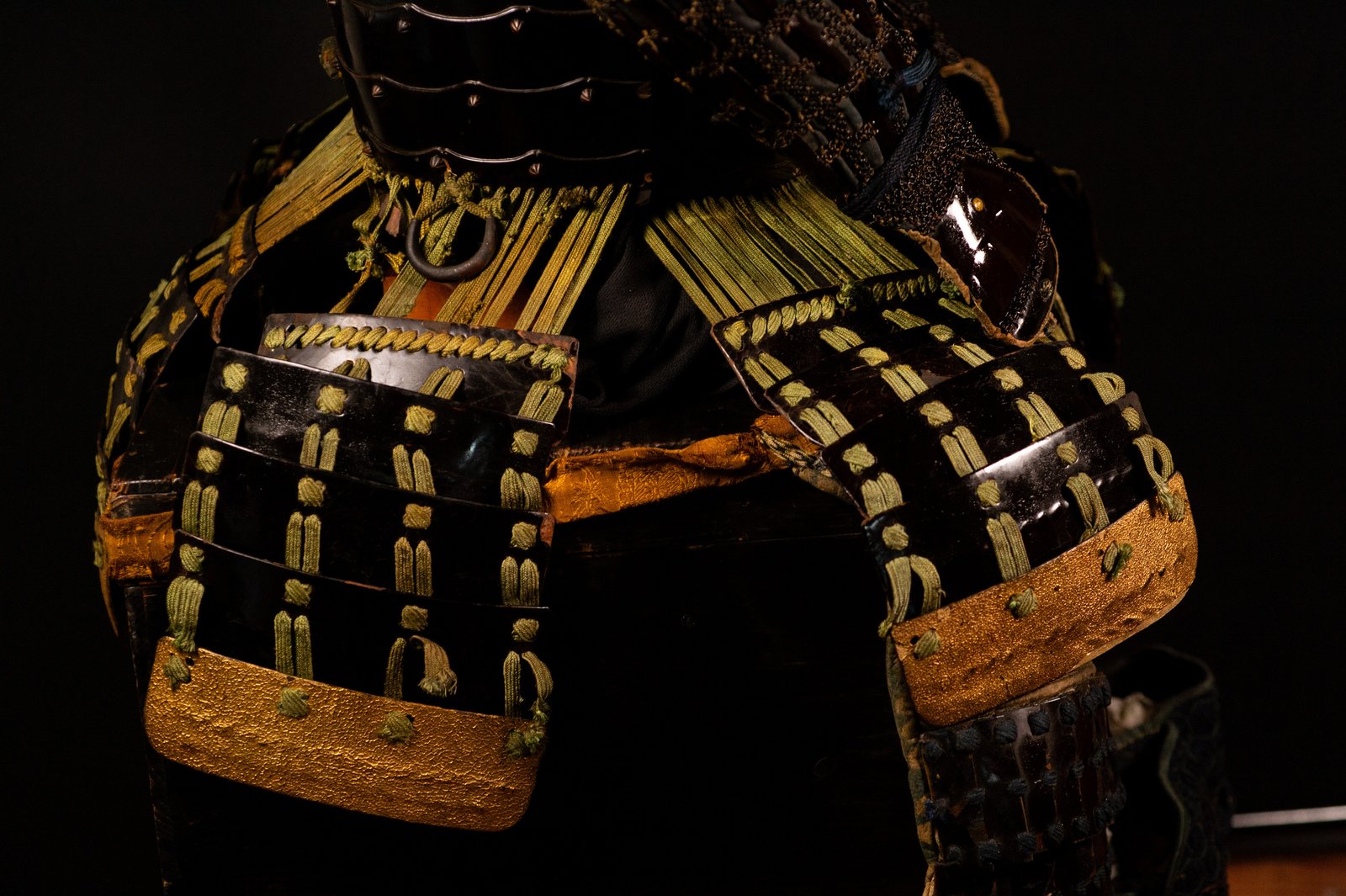
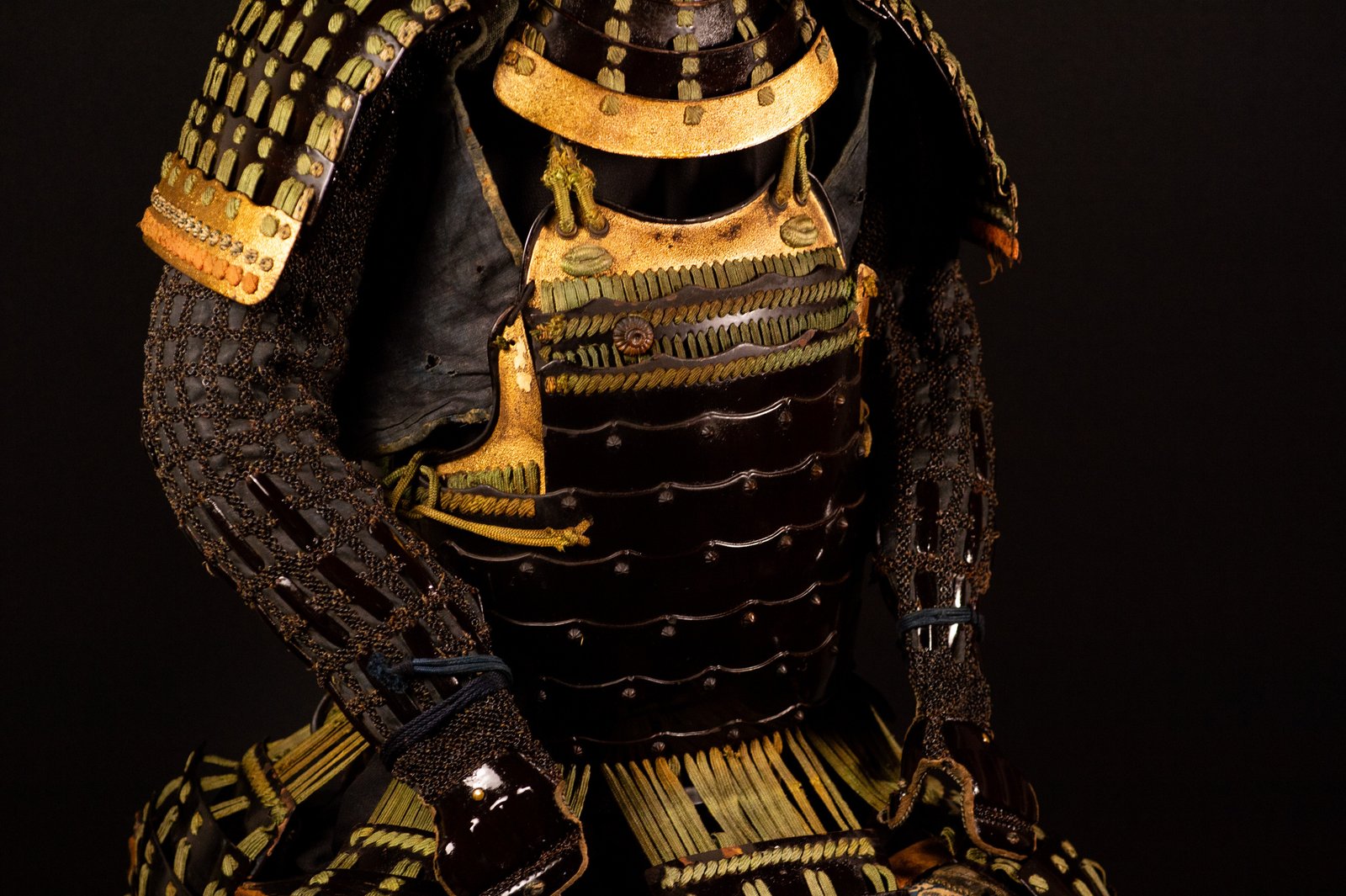
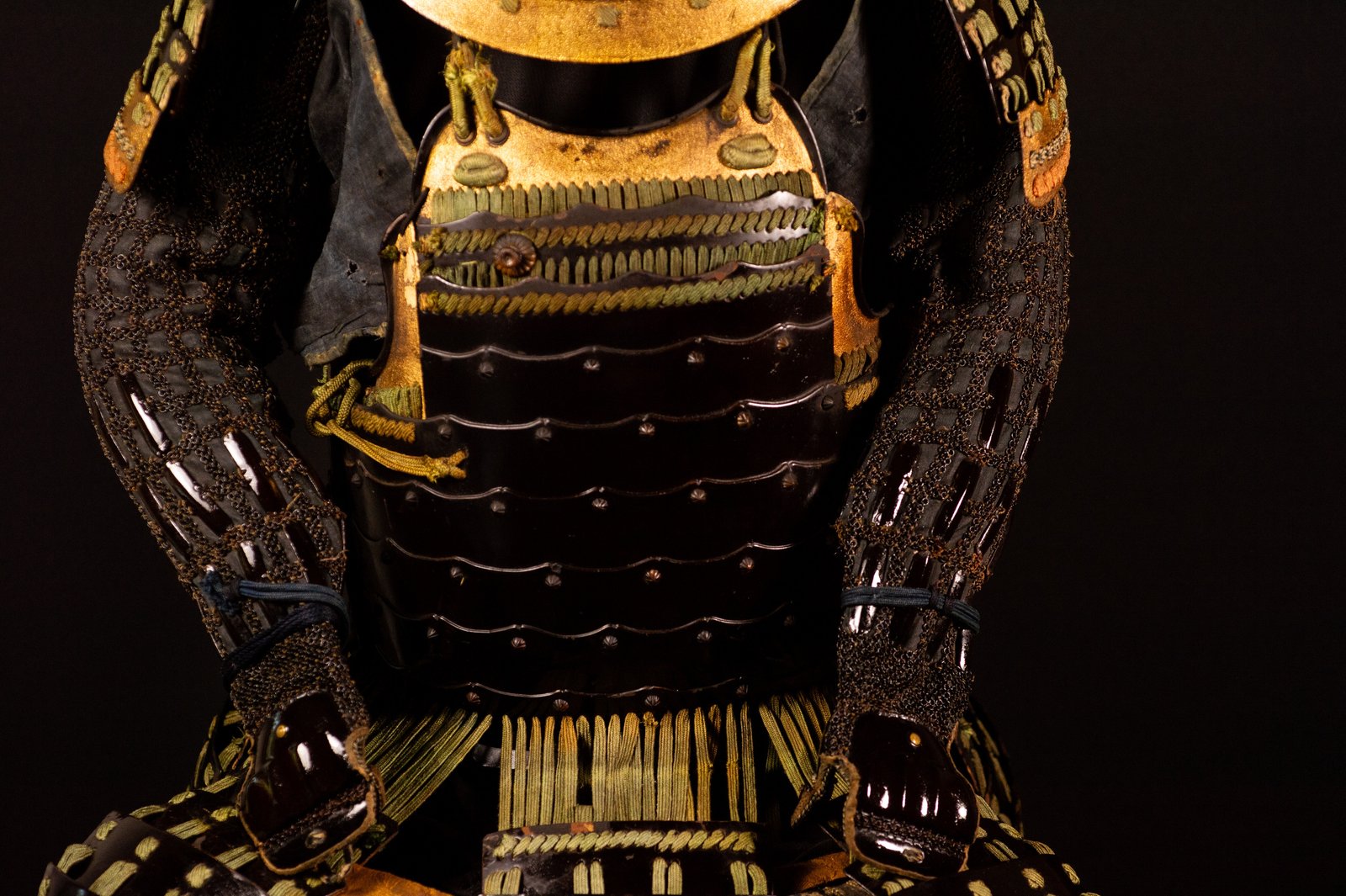
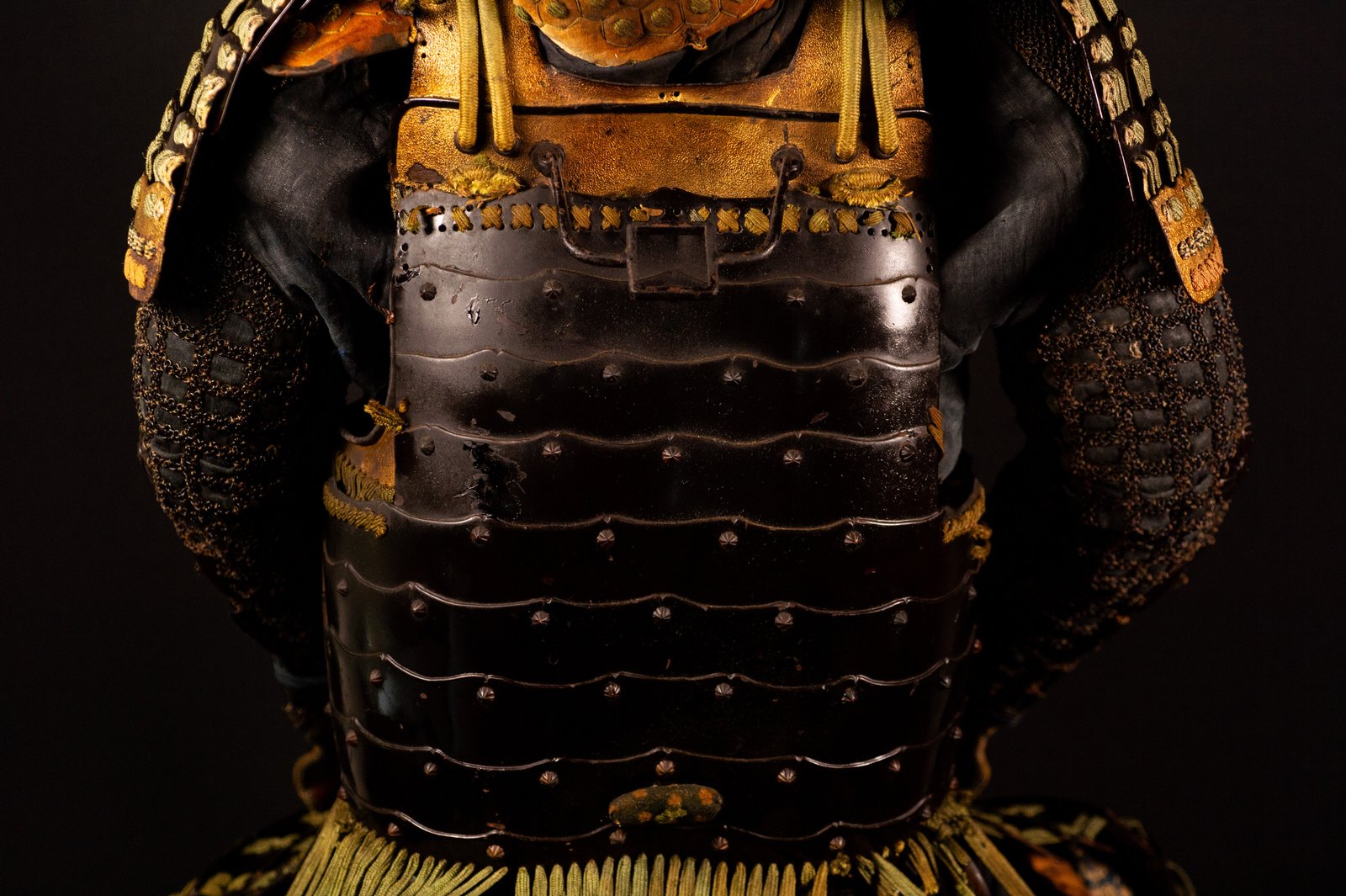
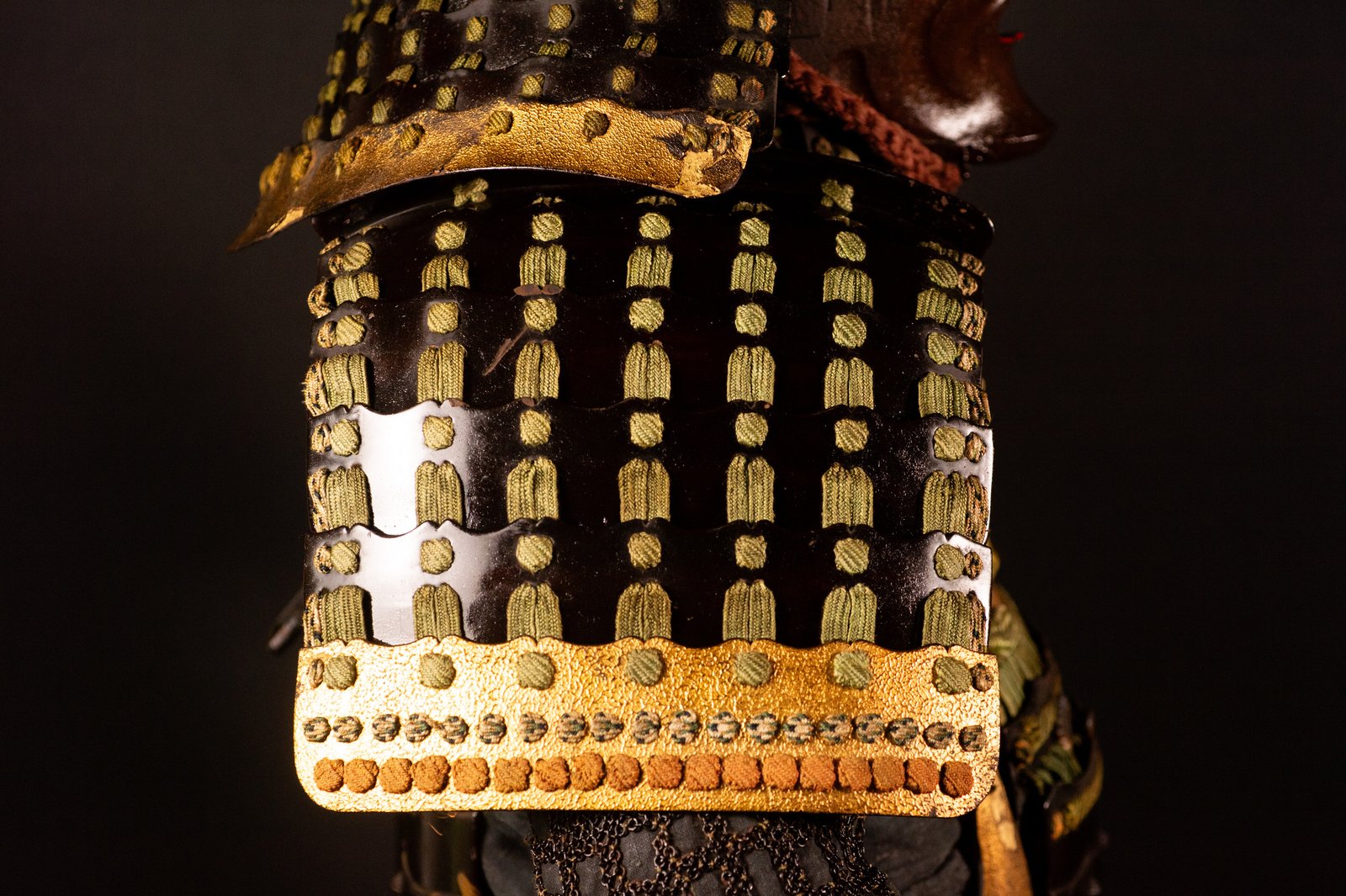
The dō is constructed from black-lacquered kozane/iyozane lamellar plates joined with distinctive moss and olive-green odoshi lacing.
This combination of black lacquer and muted green cordage establishes the principal colour scheme of the armor and continues through several of its major components.
Gilt-lacquered borders trim the munaita, or upper edge of the chest plate, together with other leather-faced fittings, introducing restrained gold accents against the darker lacquered surfaces.
At the rear is an agemaki-no-kan, the decorative cord loop traditionally positioned on the back of the cuirass.
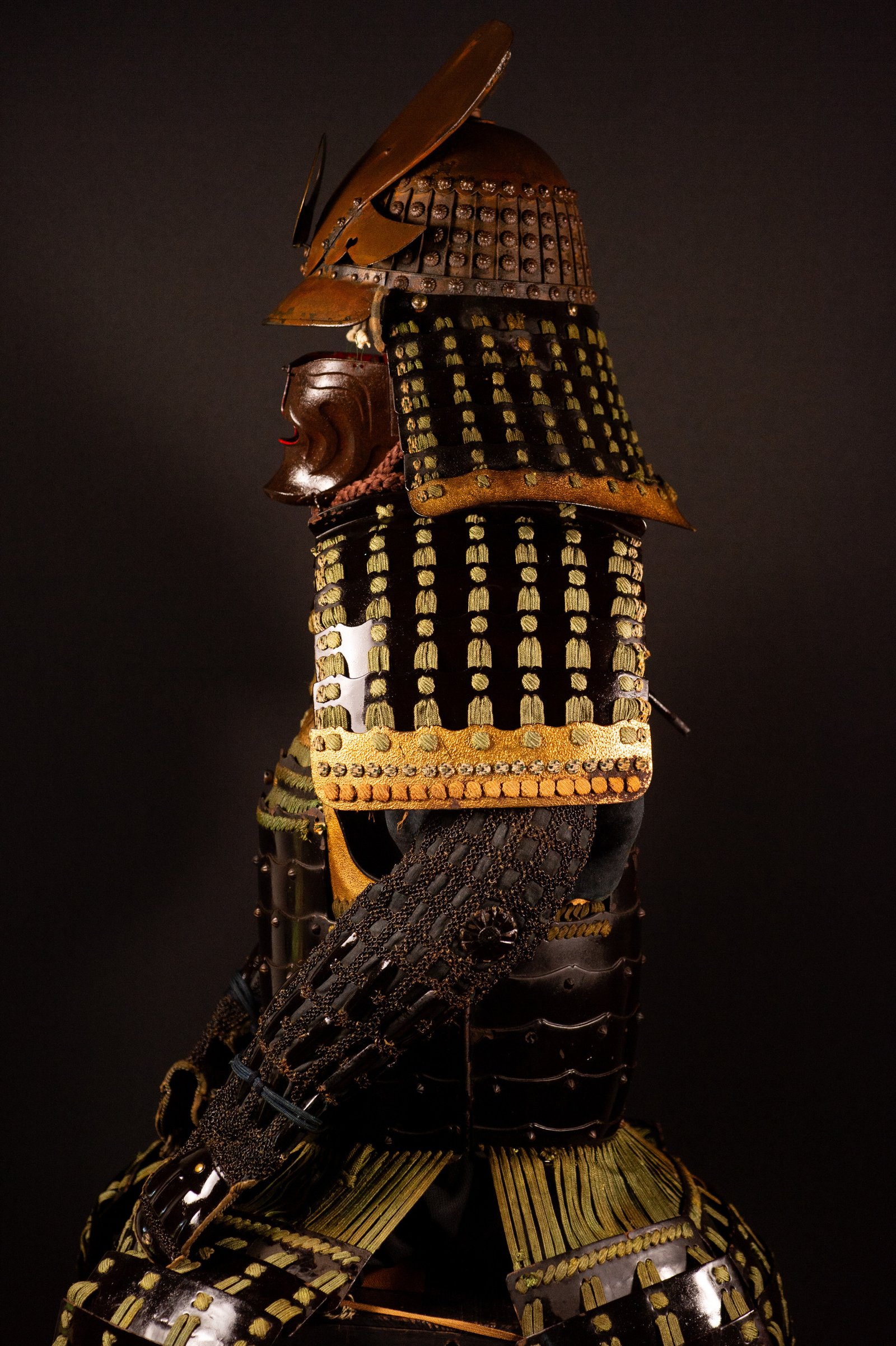
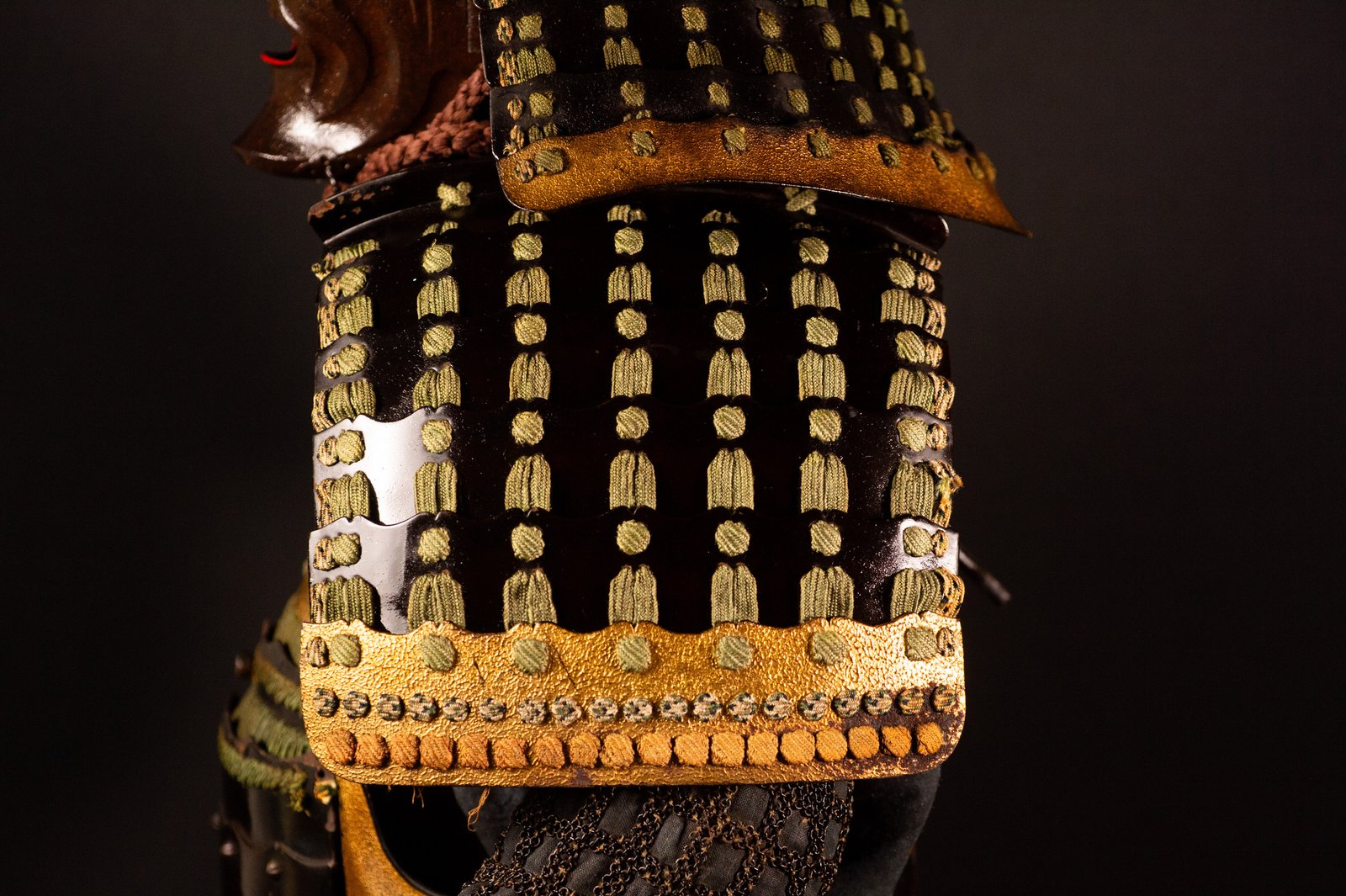
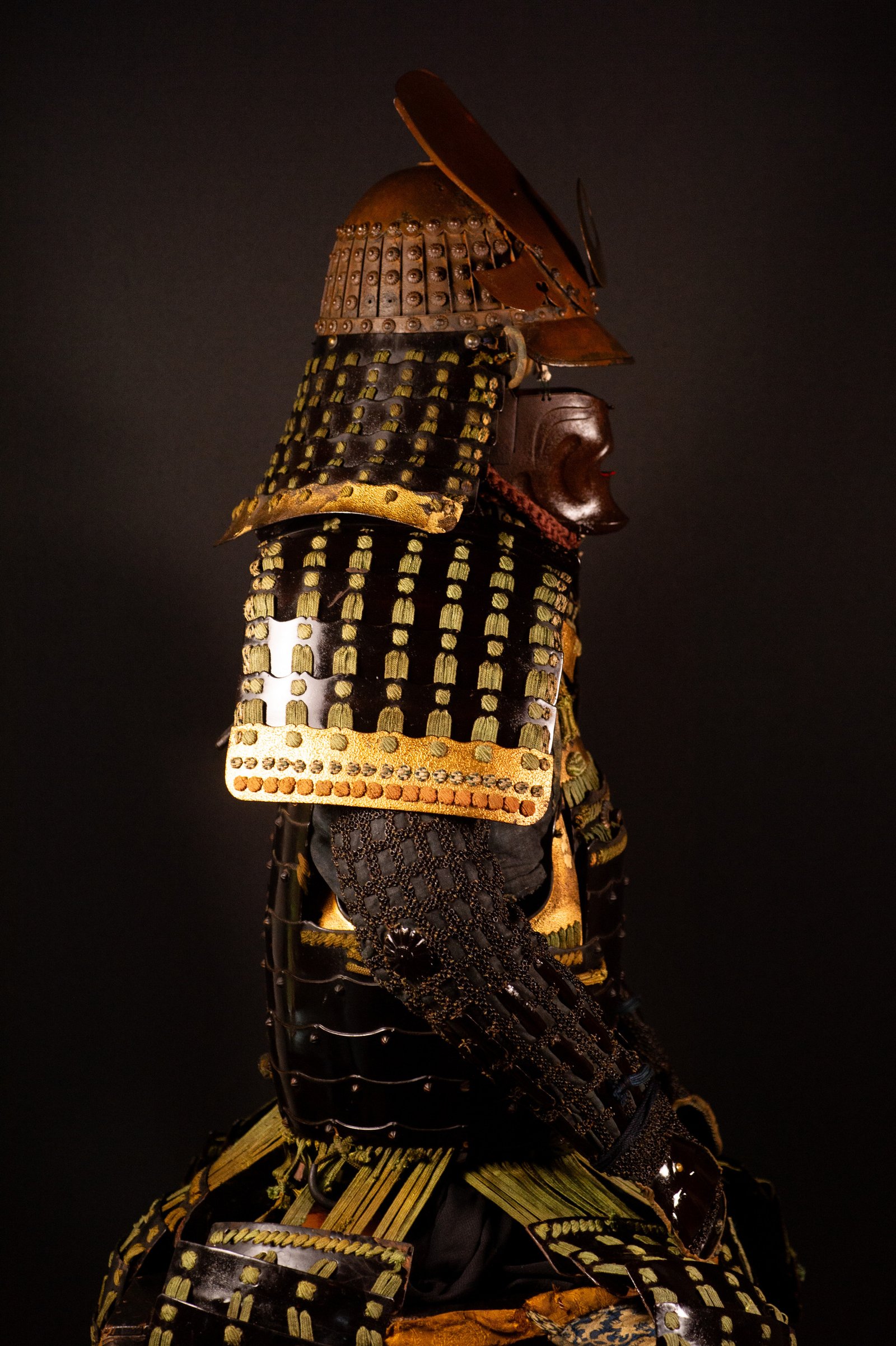
The shikoro follows the same black-lacquered lamellar construction and moss or olive-green odoshi seen on the cuirass.
Its coordinated materials and colours visually connect the helmet with the body armor, contributing to the cohesive character of the complete ensemble.
The contrast between the black lacquer and muted green lacing is one of the defining aesthetic characteristics of the armor.
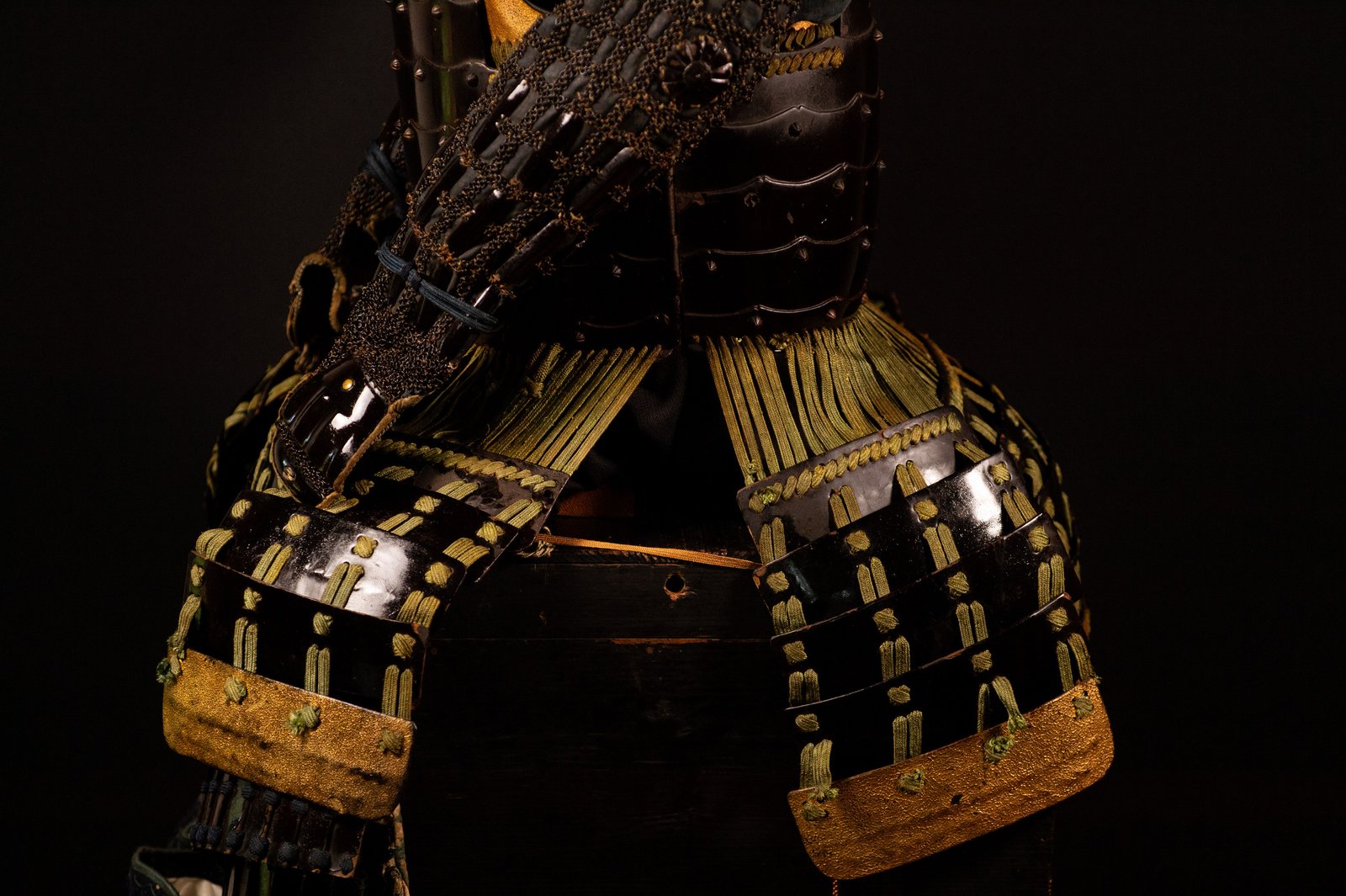
The large sode are constructed from matching black-lacquered lamellar plates.
They are joined with the same olive-green lacing used throughout the armor and finished with gilt borders, maintaining continuity with the decorative treatment of the dō.
Their substantial proportions provide both a strong visual silhouette and continuity within the black, green and gold decorative scheme.
The kote consist of dark kusari chain mail forming flexible protection for the arms.
Square protective plates are positioned along the forearm, combining the mobility of mail construction with additional rigid reinforcement.
The dark metalwork of the sleeves complements the black-lacquered components of the main armor.
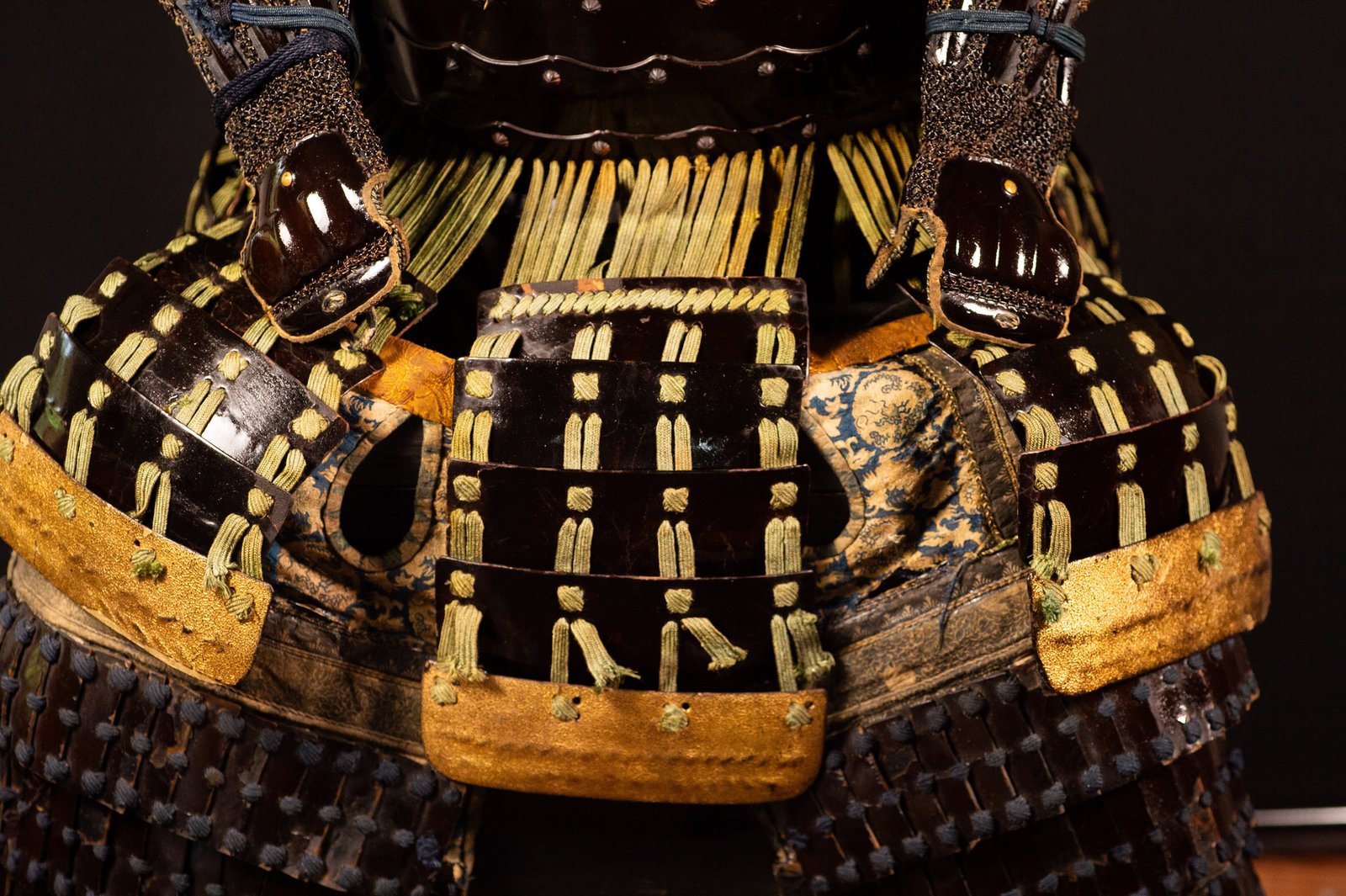
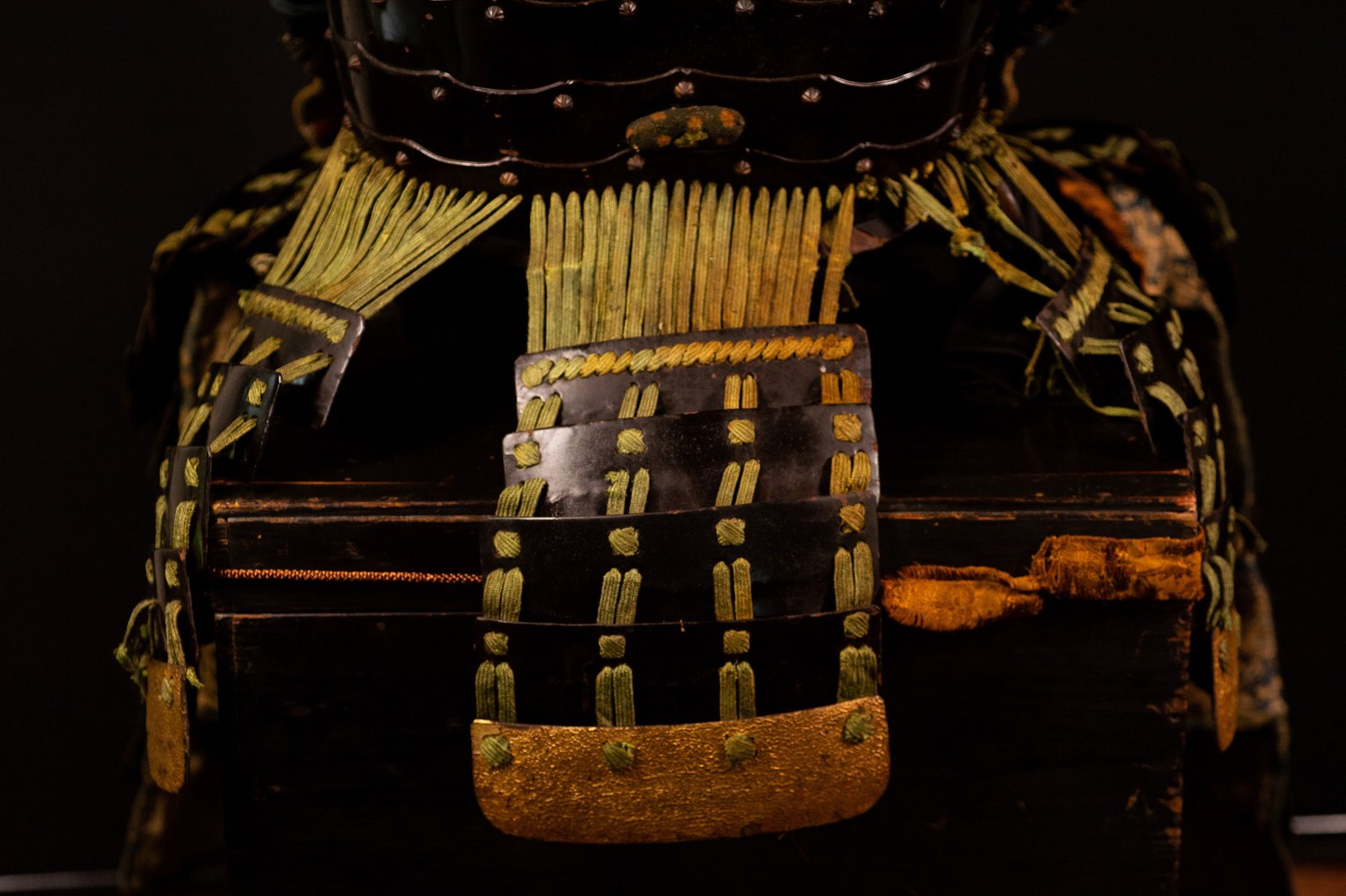
The kusazuri continue the black-and-olive lamellar scheme established by the cuirass and shoulder guards.
Black-lacquered plates are joined by the characteristic muted green lacing, extending the visual identity of the upper armor into the lower defensive sections.
Beneath the plates, areas of blue or indigo textile decorated with a floral or cloud-like motif are visible, forming part of the interior lining or underlying garment.
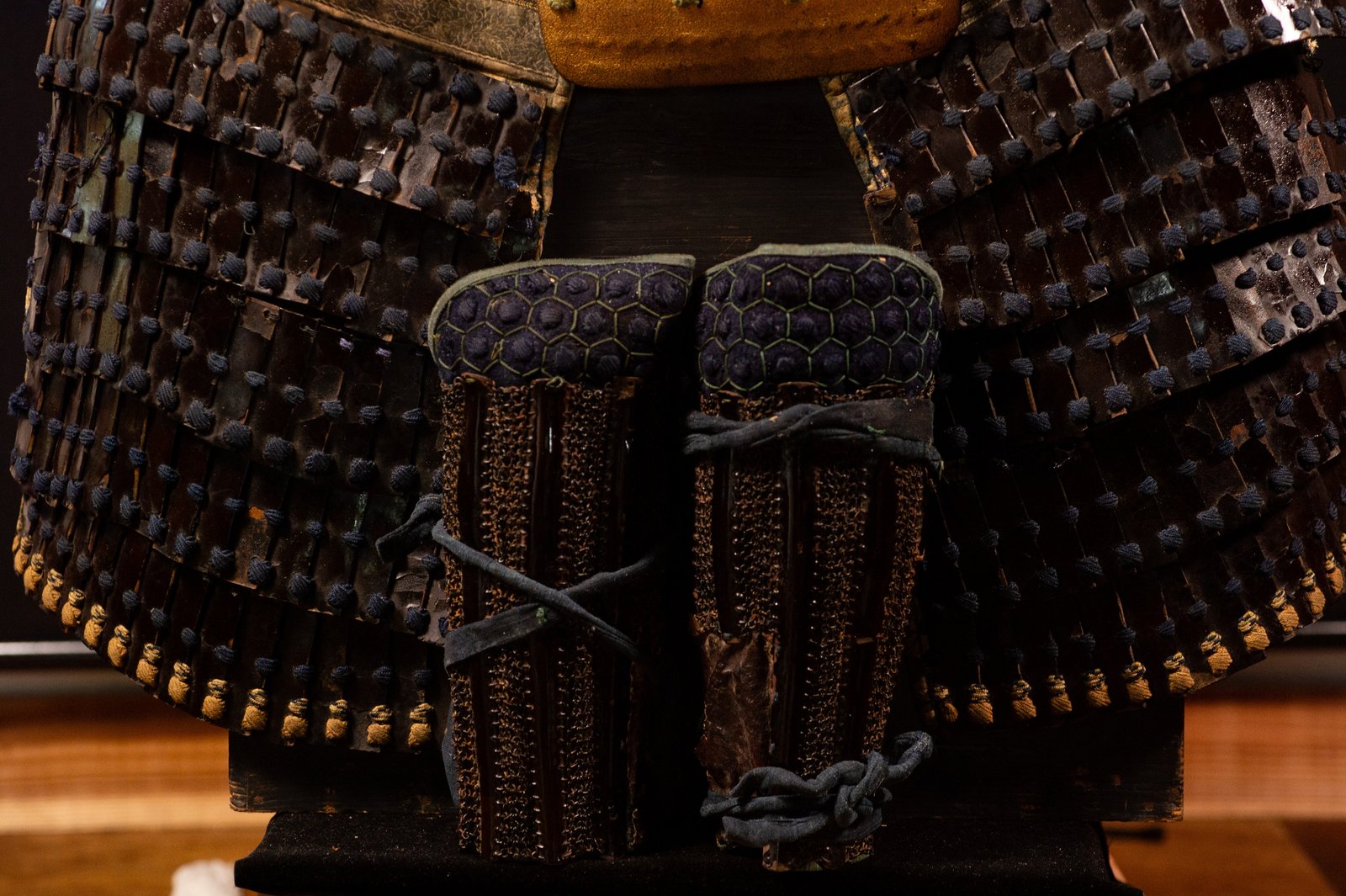
The haidate are mounted on quilted indigo textile panels distinguished by hexagonal kikkō stitching.
The lower edges are finished with a fringe of mail, combining textile construction and flexible metal protection.
The deep indigo fabric provides a subtle chromatic contrast with the black lacquer and olive-green lacing found throughout the rest of the armor.
The armor presents in cohesive and complete condition, with all major components present.
Consistent wear appropriate to its age can be observed throughout the ensemble and forms part of its historical character.
No certificate or formal attribution accompanies the armor. The piece was acquired as part of a dealer auction lot in Tokyo and is presented as a complete mid-Edo-period armor set.
This complete gusoku is distinguished by the visual coherence of its black-lacquered lamellar construction, muted olive-green odoshi, gilt details and indigo textile elements.
The russet-iron suji-bachi kabuto provides a particularly strong focal point, enhanced by its large gilt-copper fukigaeshi and commanding circular or crescent-shaped maedate. The dark lacquered facial armor with contrasting red interior further reinforces the expressive character of the head protection.
Across the body, the repeated black-and-olive scheme connects the dō, shikoro, sode and kusazuri, while gilt borders provide carefully controlled decorative accents. The indigo haidate with kikkō stitching and mail fringe introduce another layer of traditional textile and defensive construction.
Its survival with all major armor components present, together with its acquisition through a Tokyo dealer auction, makes the ensemble particularly appealing as a complete example of mid-Edo-period samurai armor.
Complete, imposing and visually cohesive, this mid-Edo-period Japanese gusoku combines a russet-iron suji-bachi kabuto, bold gilt maedate, dark lacquered facial armor and a harmonious black-and-olive lamellar construction. Preserved with its principal defensive components and showing appropriate signs of historical use, it represents a striking complete samurai armor set with considerable presence for a serious Japanese armor collection.
| Época | Edo |
|---|

Order above 1.000,00 € gets free shipping.

Secure and hassle-free payment process.

Certificate of authenticity included.

Have questions? Contact us via WhatsApp.
Contact