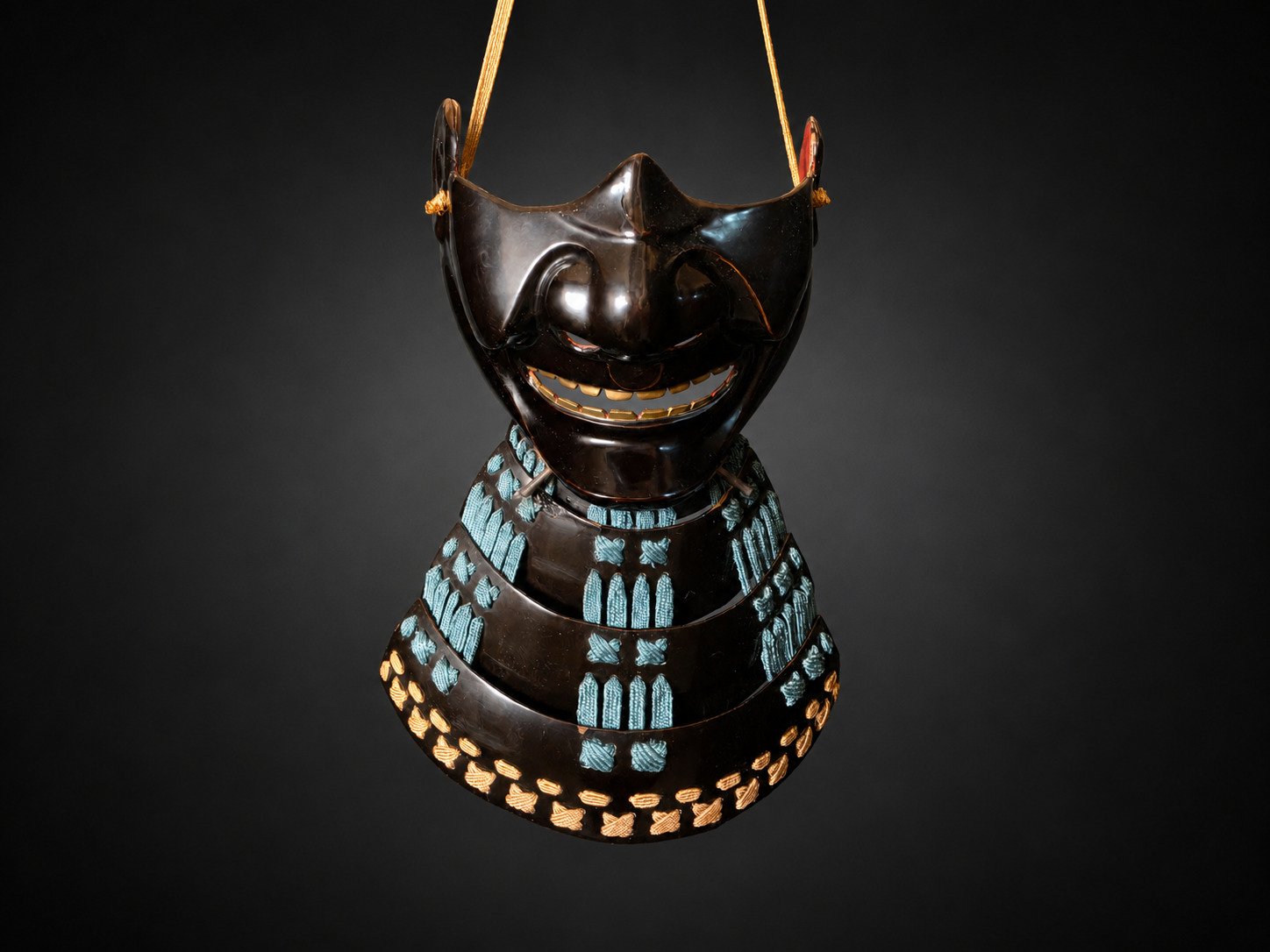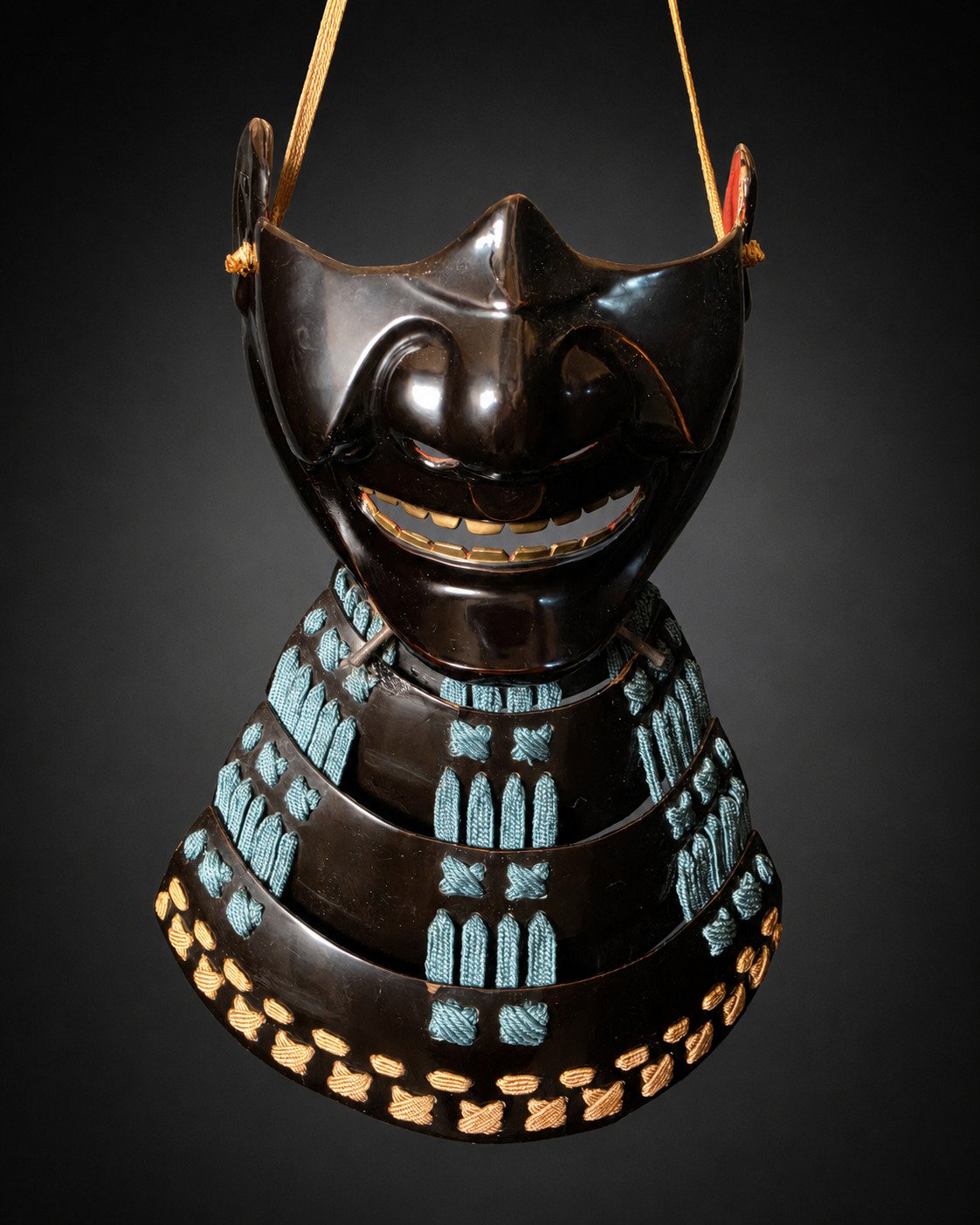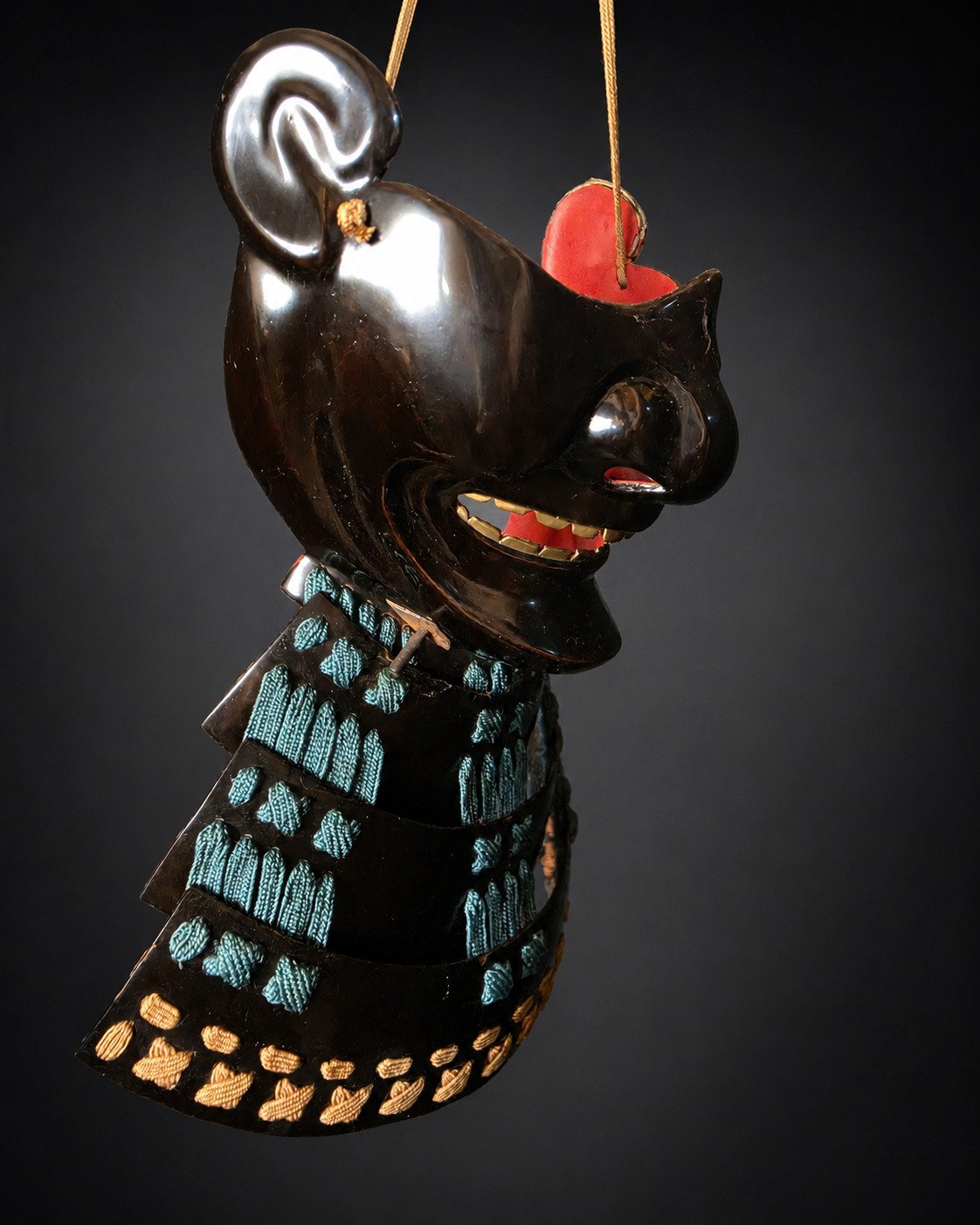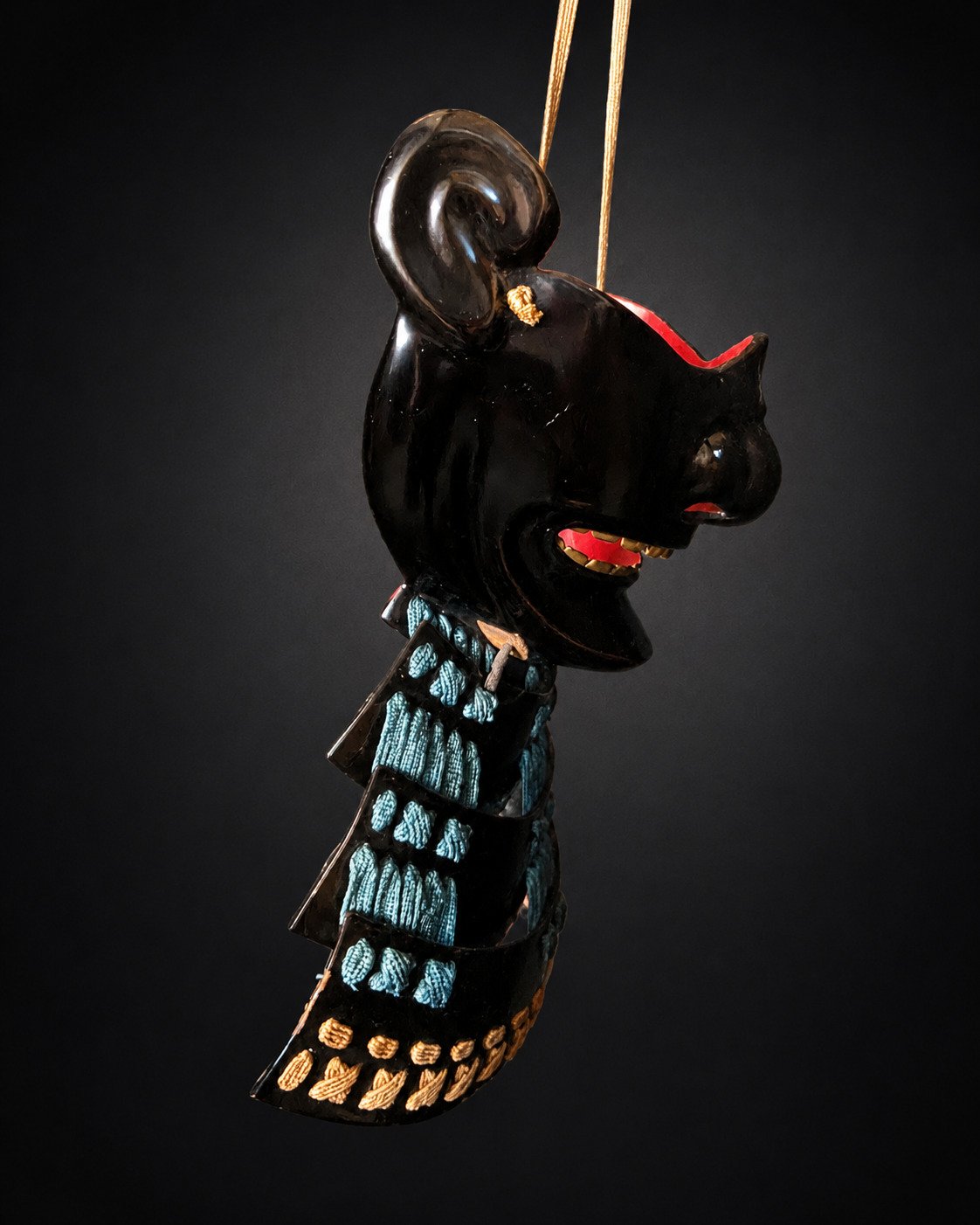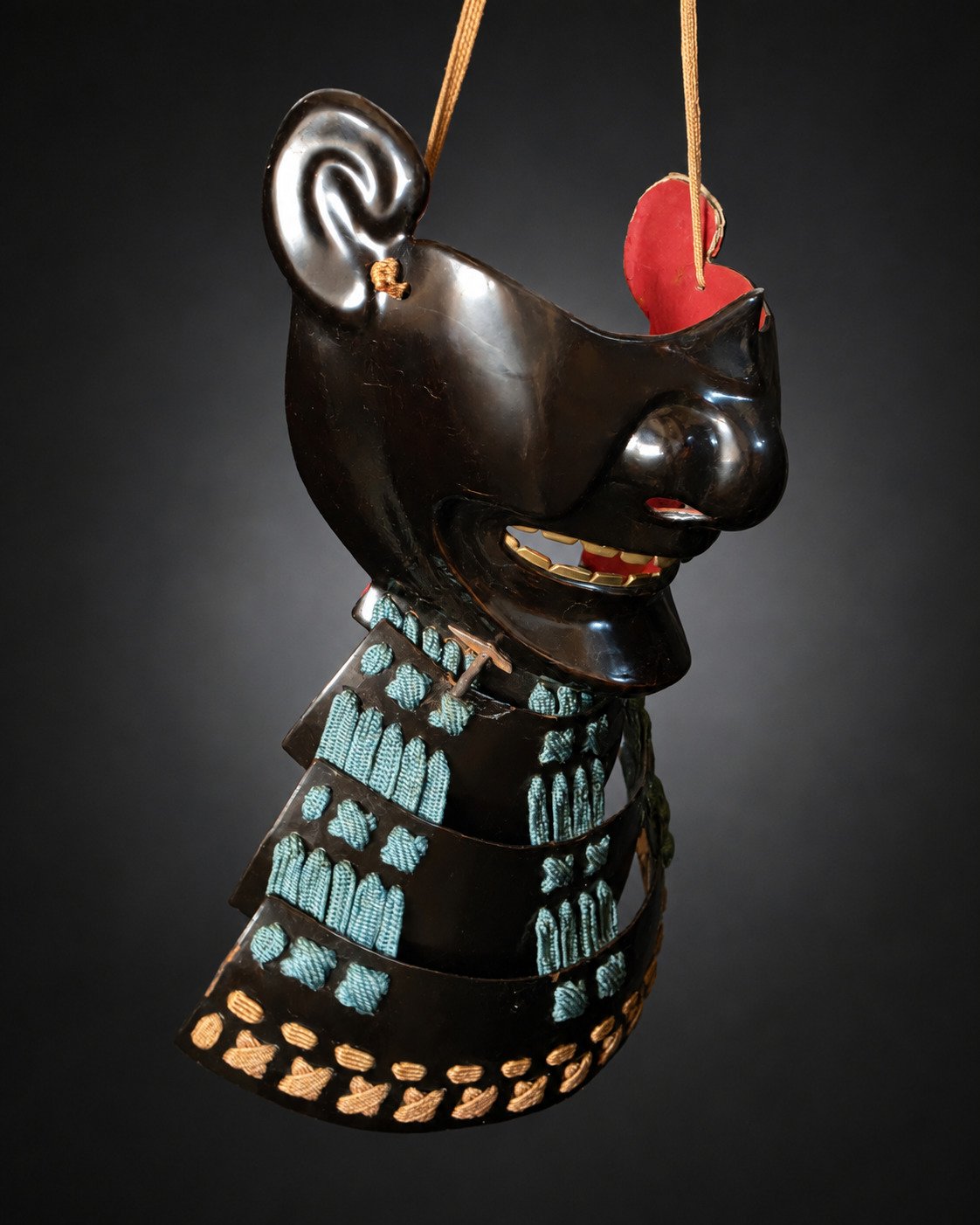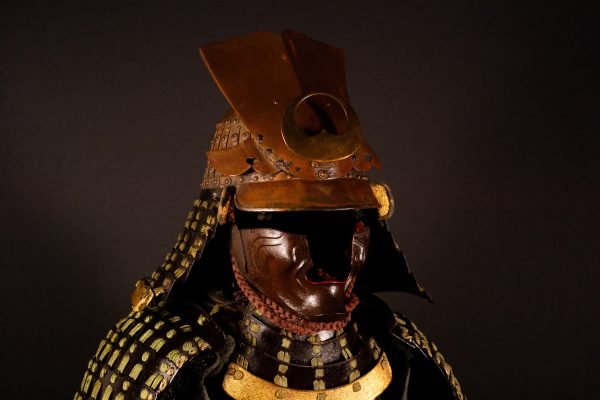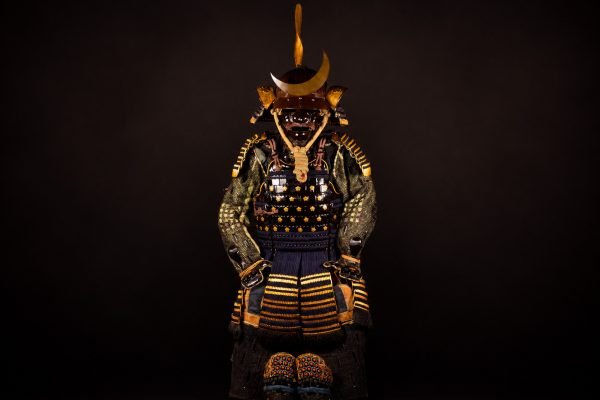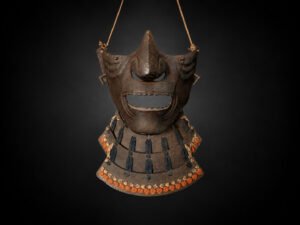
An elegant example of Japanese samurai facial armour, this nerikawa mempō is formed from hardened lacquered leather rather than iron and finished in a deep, glossy black surface.
Compared with more aggressively modelled iron masks, the facial treatment is notably restrained. The nose is rounded and prominent without becoming exaggerated, the cheeks are smoothly sculpted, and the open mouth is fitted with gilt teeth that provide a subtle but striking contrast against the black lacquer.
The mask is paired with a complete three-lame yodare-kake laced in pale blue-grey silk, creating a distinctive combination of black lacquer, cool blue cordage and gold accents.
The mask is described as being constructed in nerikawa, hardened and lacquered leather traditionally used as an alternative to iron in Japanese armour.
Once shaped and lacquered, nerikawa could provide a hard, durable surface while remaining lighter than comparable metal construction. This made it particularly suitable for elements worn directly against the face, where reduced weight and a degree of flexibility could improve comfort.
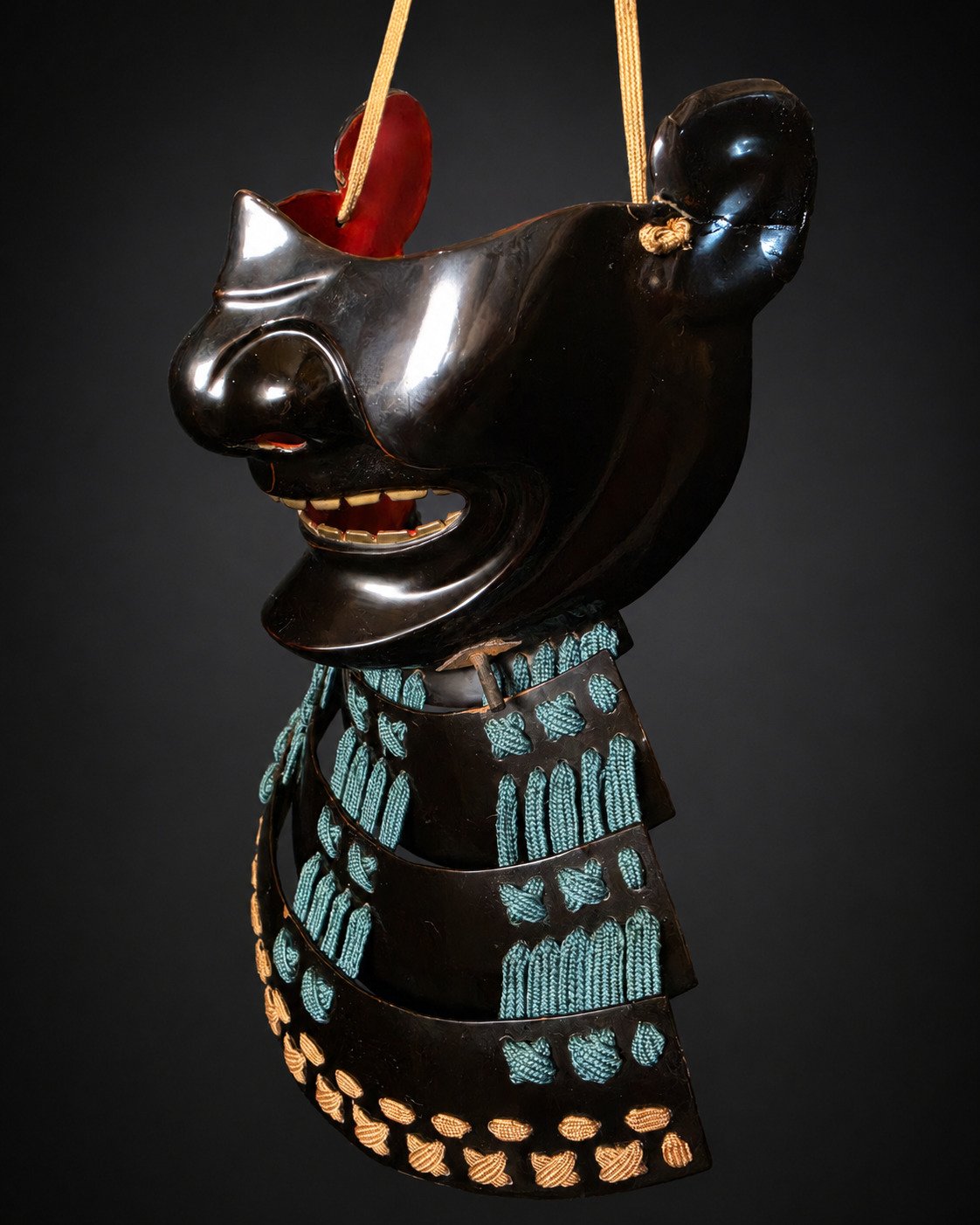
The smooth modelling visible on this example demonstrates how lacquered leather could still support carefully controlled sculptural forms, including the pronounced nose, shaped cheeks and articulated mouth.
The exterior is finished in a rich glossy black lacquer that retains considerable depth and sheen. Light surface marks and age-related wear are visible, but the overall finish remains notably well preserved.
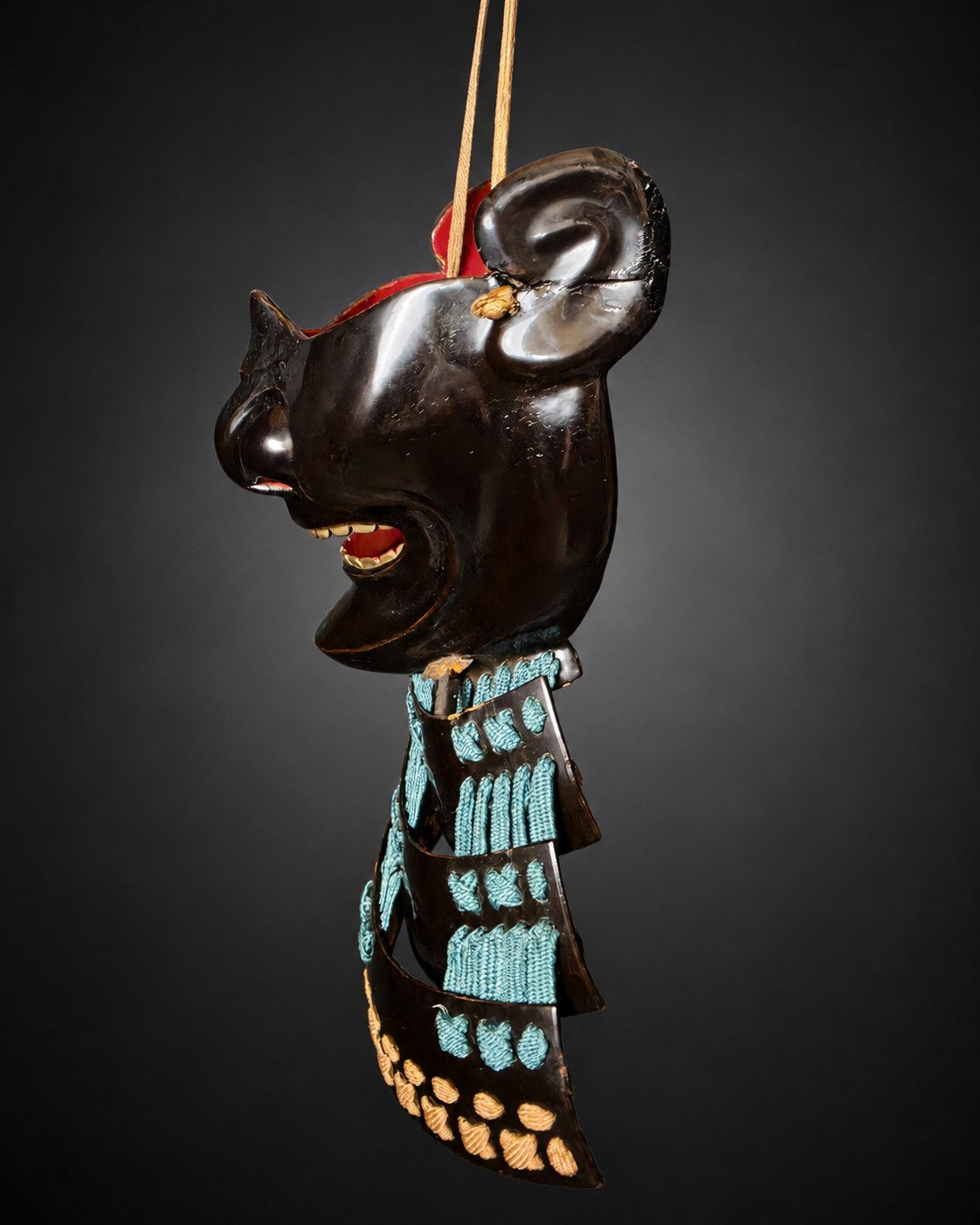
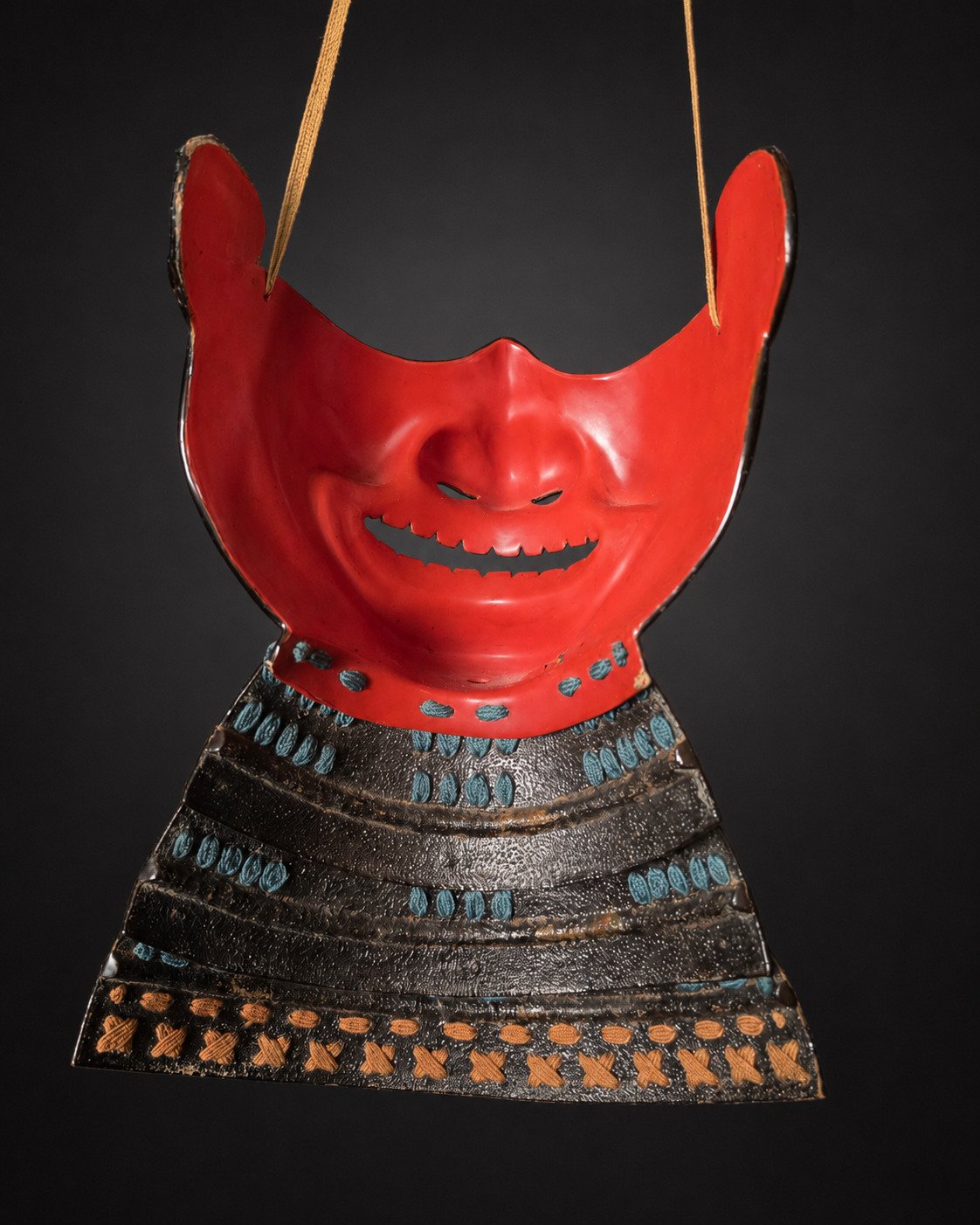
In strong contrast, the interior is finished in vivid vermilion-red lacquer. This colour is clearly visible through the mouth and eye openings and can also be seen on the reverse of the side elements.
The combination of black exterior and red interior is particularly effective visually: when worn, movement of the mouth and changes in viewing angle would have revealed flashes of vermilion beneath the otherwise dark surface.
The facial modelling is controlled rather than grotesque. The nose projects forward in a rounded form, while the cheeks are shaped with broad flowing contours that give the mask a strong but relatively composed expression.
The open mouth is one of the most distinctive details. Rows of gilt-finished teeth contrast sharply with the black lacquer and remain clearly visible across the articulated mouth structure.
This combination of restrained modelling and gold detail gives the mempō a refined visual identity without sacrificing the intimidating presence expected of samurai facial armour.
The mask incorporates articulated components intended to improve fit and movement when worn. Small hinged side elements allow the mask to accommodate the wearer’s face more comfortably, while the articulated lower facial section provides additional mobility.
Attachment cords survive at the upper sides, and a small opening beneath the chin serves as a practical drainage and ventilation feature.
These details reinforce the fundamentally functional nature of the piece: despite its decorative finish, it was designed as wearable armour rather than as a purely ceremonial mask.
Suspended beneath the mask is a complete three-lame yodare-kake, protecting the throat and upper chest while preserving freedom of movement.
The three dark lacquered lames widen gradually toward the bottom, creating the characteristic flared profile of Japanese throat armour.
They are joined with pale blue-grey kebiki-odoshi lacing in an asagi-like tone. Against the black lacquer, the cool blue cordage creates a particularly elegant contrast.
Along the lower edge, gold-toned twisted silk knots provide a second decorative accent, visually linking the yodare-kake with the gilt teeth of the mask above.
The restrained palette is one of the most successful aspects of this example. Deep black lacquer dominates the composition, while pale blue-grey lacing softens the overall appearance and small gold details provide controlled highlights.
The vermilion interior adds a further colour layer that is largely concealed when the mask is viewed directly from the front, making it a more intimate detail revealed through openings and movement.
This balance gives the mempō a markedly different character from heavier russet-iron examples: more polished and elegant, while still retaining the unmistakable visual authority of samurai armour.
Nerikawa was a well-established material within Japanese armour construction and offered armourers an alternative to iron for components where reduced weight was advantageous.
When properly hardened and lacquered, leather could achieve a rigid protective surface while retaining less weight and somewhat more flexibility than metal. It could also be shaped into complex forms and accept sophisticated lacquer finishes.
Its use should therefore not be understood simply as a lesser substitute for iron. Nerikawa appeared across different levels of Japanese armour production and could be employed in carefully finished pieces where comfort, weight and visual refinement were all important considerations.
The left-side cheek element shows an old break and subsequent repair around the hinge area. A small gold-toned repair or reinforcement is visible at this point.
Rather than concealing this intervention, it is best understood as part of the working history of the object. Repairs of this kind document continued use and preservation during the life of an armour component.
The repair is therefore noted transparently as part of the condition of the piece rather than treated as a modern manufacturing fault.
The mempō survives in good antique condition consistent with its age. The black lacquer retains strong gloss and depth, with minor surface marks and wear visible under direct light.
The vermilion interior remains vivid, and the gilt teeth are well preserved. The pale blue-grey lacing shows natural age and wear while remaining visually coherent with the piece.
An old repaired break is present on the left-side cheek element near the hinge area. This intervention appears historical and is retained as part of the object’s documented condition.
As with all antique Japanese armour, minor abrasions, irregularities, textile wear and age-related surface changes should be understood as part of the history and character of the piece.
A refined Edo-period nerikawa mempō distinguished by its glossy black lacquer, vivid vermilion interior, gilt teeth and pale blue-grey laced three-lame yodare-kake. Its lighter leather construction, carefully controlled modelling and surviving historical repair make it an evocative example of the balance between protection, comfort and visual refinement in samurai armour.
| Época | Edo |
|---|

Order above 1.000,00 € gets free shipping.

Secure and hassle-free payment process.

Certificate of authenticity included.

Have questions? Contact us via WhatsApp.
Contact