Edo Period Fuchi-Kashira with Shōki the Demon Queller – Bronze & Copper
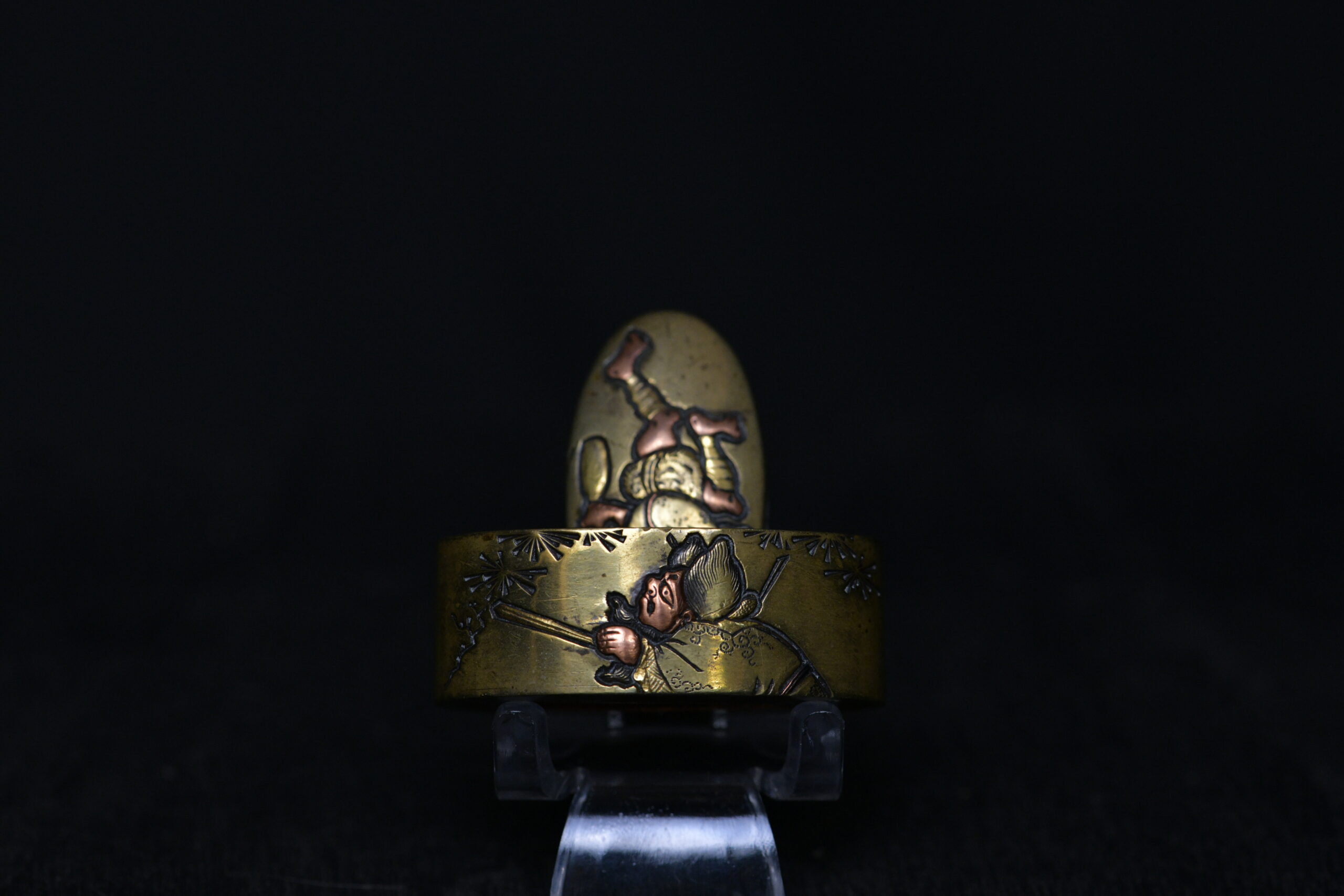
A decorative Japanese fuchi-kashira set from the Edo period, featuring imagery associated with Shōki, the legendary demon-quelling figure widely represented in Japanese art.
The matching sword fittings are executed in a bronze/copper-based metalwork composition with copper elements, combining carved and inlaid details across the two pieces.
The set was designed for use as part of a Japanese sword mounting and is suitable in scale for a katana or wakizashi koshirae.
Shōki – The Demon Queller
Shōki is the Japanese name for Zhong Kui, a legendary figure of Chinese origin who became an important protective subject within Japanese visual culture.
He is traditionally represented as a powerful warrior-like figure associated with the defeat or expulsion of demons and malevolent forces.
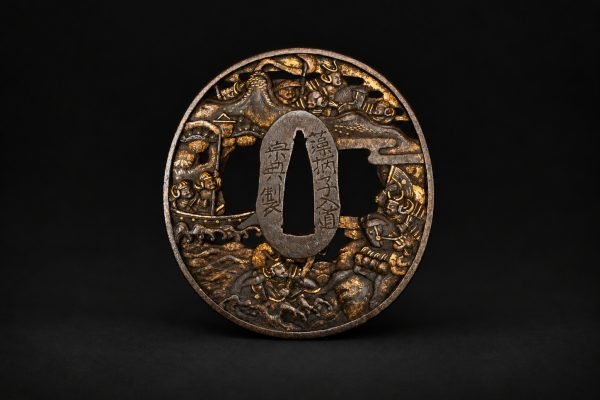
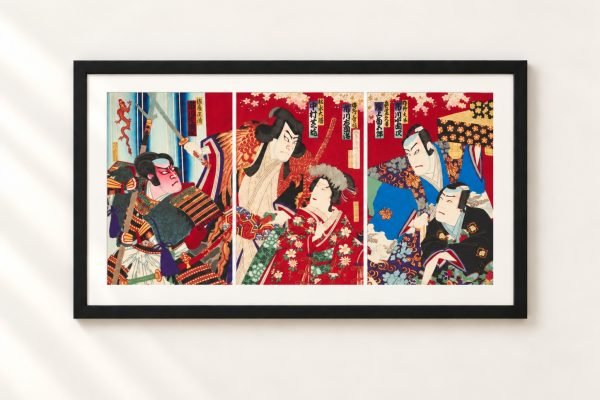
In Japanese painting, prints, armour decoration and sword fittings, Shōki is often shown confronting supernatural beings or appearing as a guardian figure.
His dramatic appearance and protective associations made him particularly suitable for the decoration of samurai objects and sword fittings.
Shōki in Japanese Sword Fittings
The world of Japanese tosogu frequently draws upon mythology, folklore, religion and classical literature.
Figures such as Shōki allowed metalworkers to introduce narrative subjects into very small surfaces, turning functional sword components into miniature works of pictorial metalwork.
On a fuchi-kashira set, the subject could be divided between the two fittings or developed through complementary details, allowing the pair to function visually as a coordinated composition.
Bronze and Copper Metalwork
The fittings are described as being made in bronze with copper elements.
Japanese sword fittings were produced in a wide variety of copper-based alloys, each offering different colour, patination and decorative possibilities.
In this set, the combination of darker bronze-toned surfaces and warmer copper details helps define the carved forms and decorative elements.
Carving and Inlay
The decoration combines carving and inlay, techniques frequently used in Japanese sword furniture to create depth, contrast and fine pictorial detail.
The relief modelling gives the figures and surrounding motifs greater three-dimensional presence, while contrasting metal elements help individual details stand out against the main surface.
The compact size of a fuchi-kashira requires considerable control from the metalworker, as the narrative has to remain legible within a very restricted area.
What Is a Fuchi-Kashira?
A fuchi-kashira is a matched pair of metal fittings used on the handle, or tsuka, of a traditional Japanese sword.
Although functional, these elements also became an important field of artistic expression within Japanese sword culture.
Fuchi
The fuchi is the collar positioned at the base of the sword handle, immediately next to the tsuba.
It reinforces and protects the lower end of the tsuka while also providing a decorative transition between handle and guard.
Kashira
The kashira is the pommel or end cap located at the opposite end of the handle.
It helps finish and reinforce the tsuka and also plays a role in securing the handle wrapping.
When produced as a coordinated pair, the fuchi and kashira often share a common material, decorative technique or narrative theme.
Tosogu as Miniature Decorative Art
The term tosogu refers broadly to the fittings and decorative components associated with Japanese swords.
During the Edo period, specialist metalworkers developed an extraordinary variety of decorative approaches, transforming components such as tsuba, fuchi, kashira and menuki into highly sophisticated objects in their own right.
Mythological and legendary subjects were particularly well suited to these fittings because they allowed the owner to combine aesthetic preference with culturally recognisable imagery.
Edo Period
This fuchi-kashira set dates to the Edo period, an era in which sword fittings became an especially important field of Japanese metalwork.
As the decorative vocabulary of the Japanese sword expanded, fittings could incorporate landscapes, animals, plants, historical figures, legends and supernatural subjects.
The depiction of Shōki belongs naturally within this tradition of compact narrative metalwork.
Dimensions
- Fuchi: 4 × 2.3 cm
- Kashira: 3.3 × 1.8 cm
Key Features
- Object: Japanese fuchi-kashira set
- Period: Edo period
- Category: Tosogu / Japanese sword fittings
- Subject: Shōki, the Demon Queller
- Material: Bronze / copper-based metalwork with copper elements
- Techniques: Carving and inlay
- Fuchi dimensions: 4 × 2.3 cm
- Kashira dimensions: 3.3 × 1.8 cm
- Use: Suitable in scale for katana or wakizashi mounting
Collector’s Interest
This set combines several features of interest to collectors of Japanese sword fittings: an Edo-period origin, a coordinated fuchi-kashira format, copper-based metalwork and an immediately recognisable mythological subject.
The representation of Shōki adds a narrative dimension to the fittings, illustrating how functional components of a Japanese sword could also serve as miniature works of decorative art.
An attractive Edo-period fuchi-kashira set depicting Shōki the Demon Queller, combining carved and inlaid bronze and copper-based metalwork with one of the most recognisable protective figures in Japanese art. A distinctive example of Japanese tosogu created for a katana or wakizashi mounting.