1 in stock
1 in stock
Add to Compare
Add to Wishlist
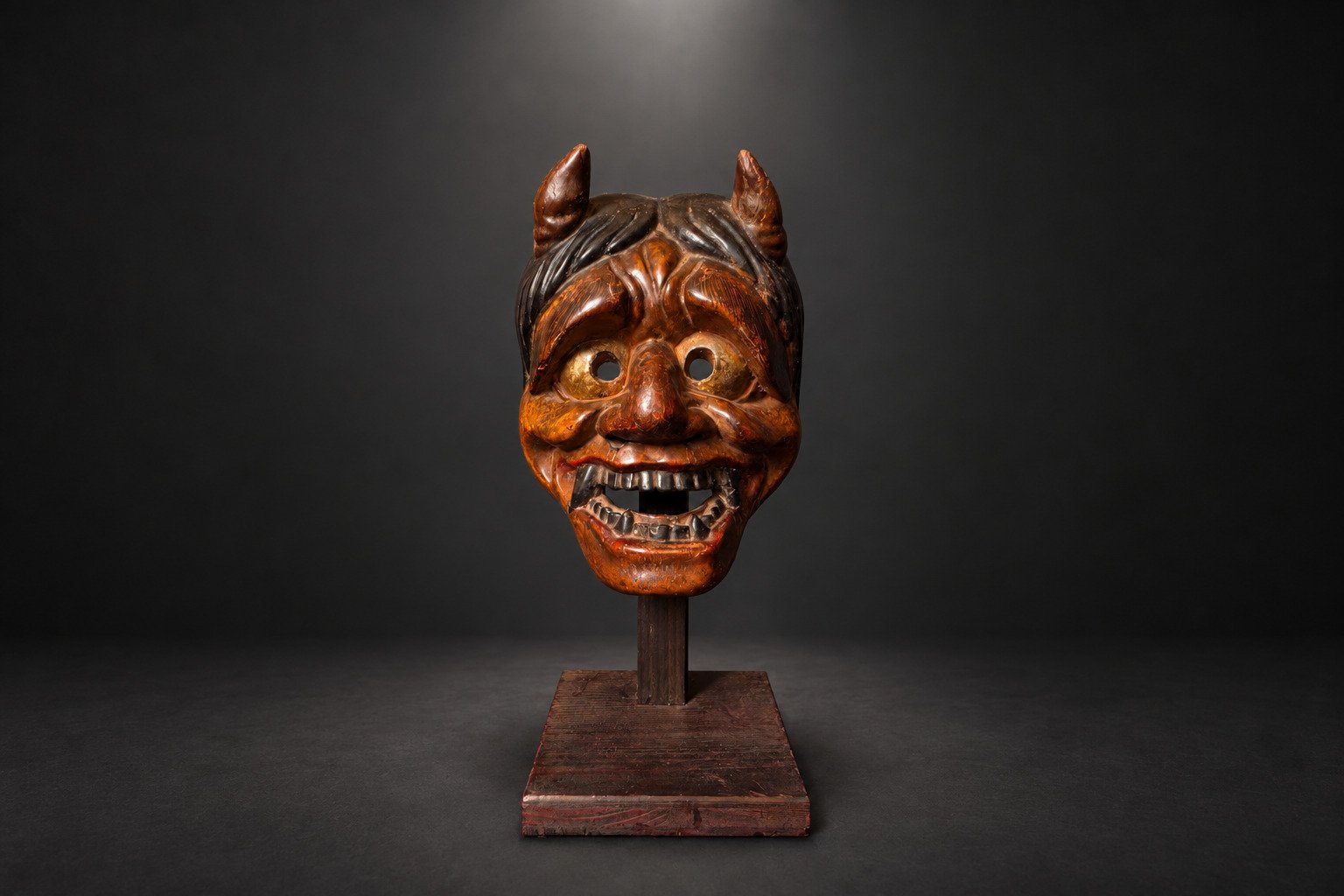
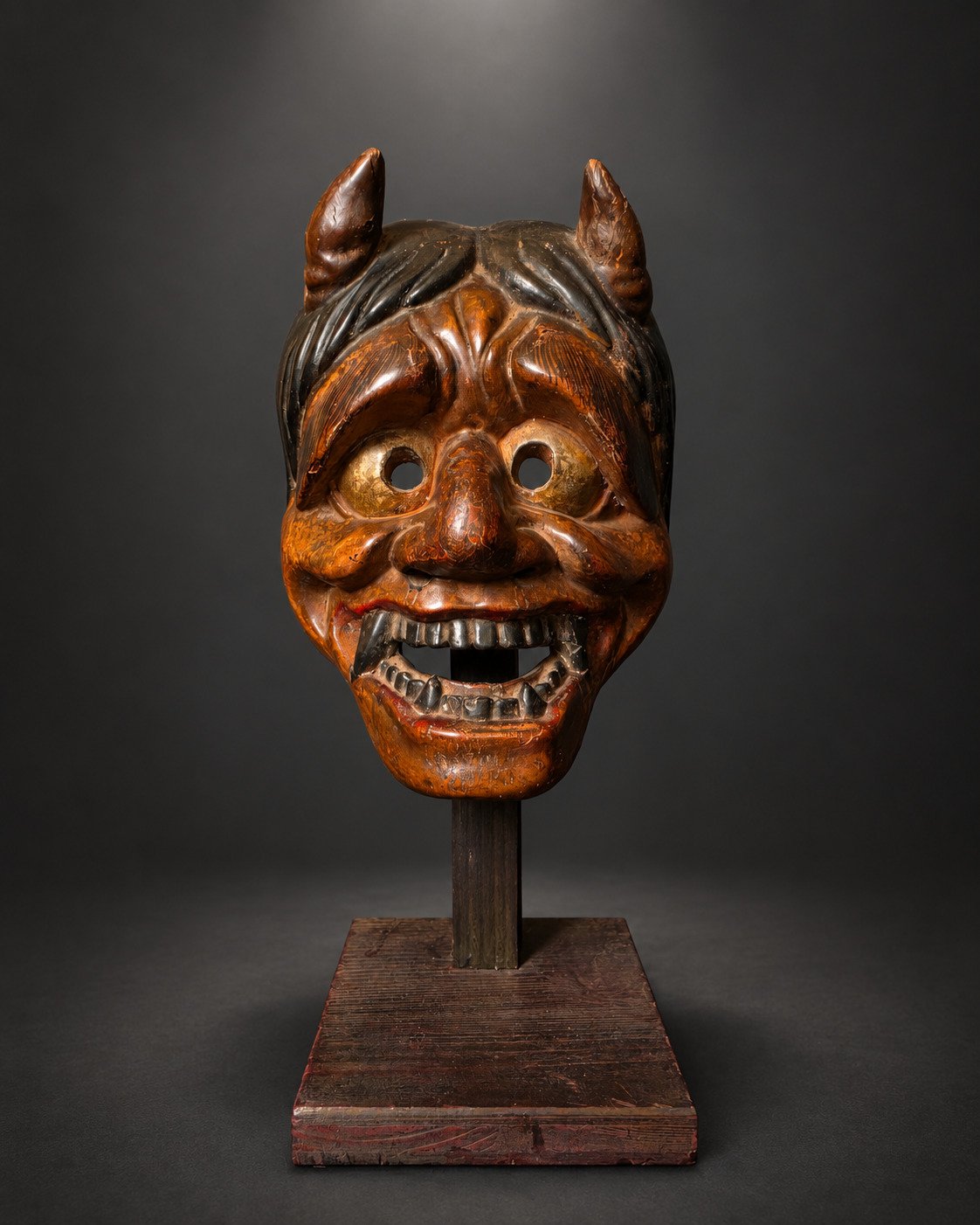
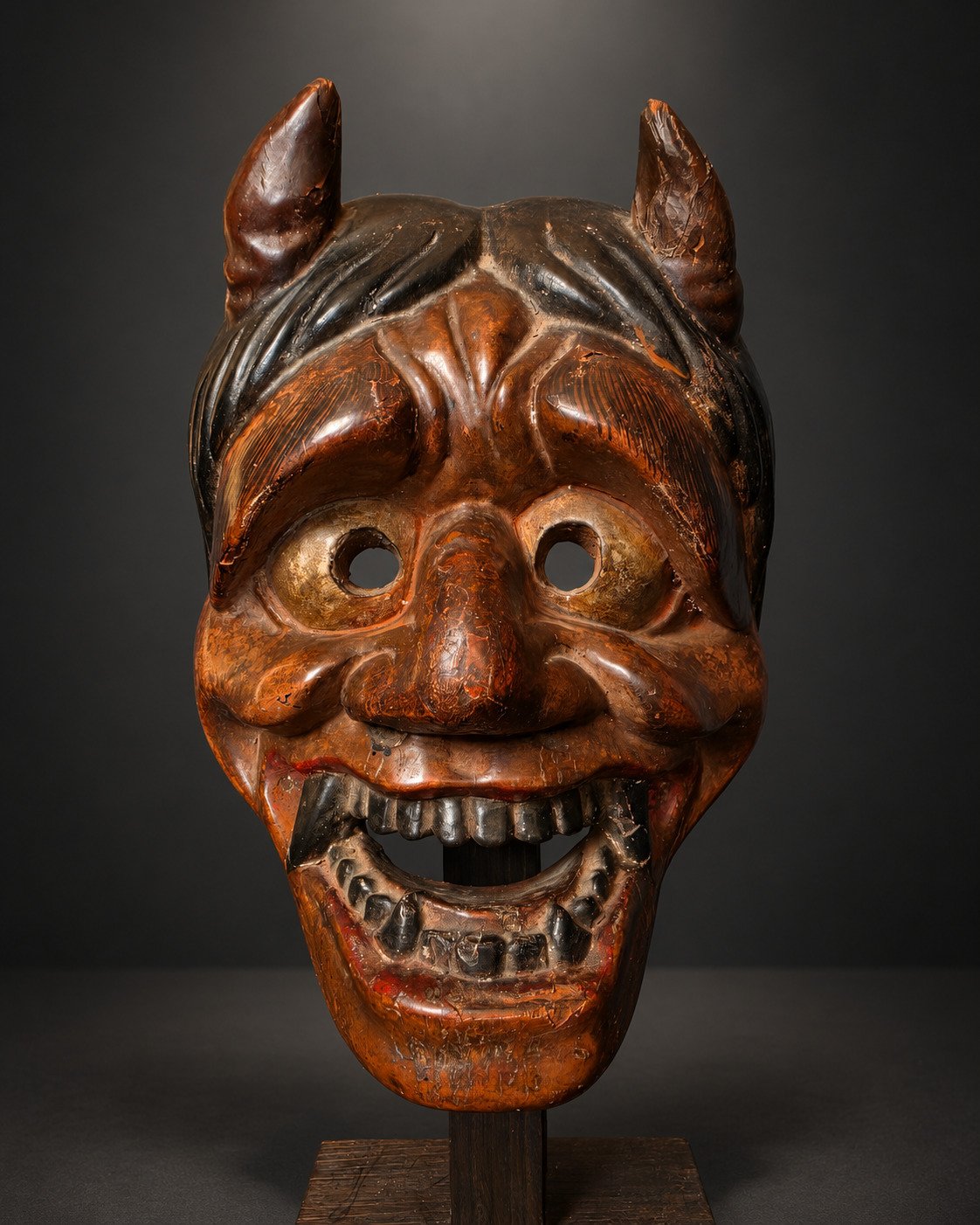
An expressive Japanese oni mask dating to the late Edo period, 19th century, carved from wood and finished in richly aged lacquer. With its prominent horns, gilt-ringed eyes, broad grin, blackened teeth and exaggerated features, the mask presents the oni not simply as a terrifying demon, but as a mischievous and almost comic supernatural character.
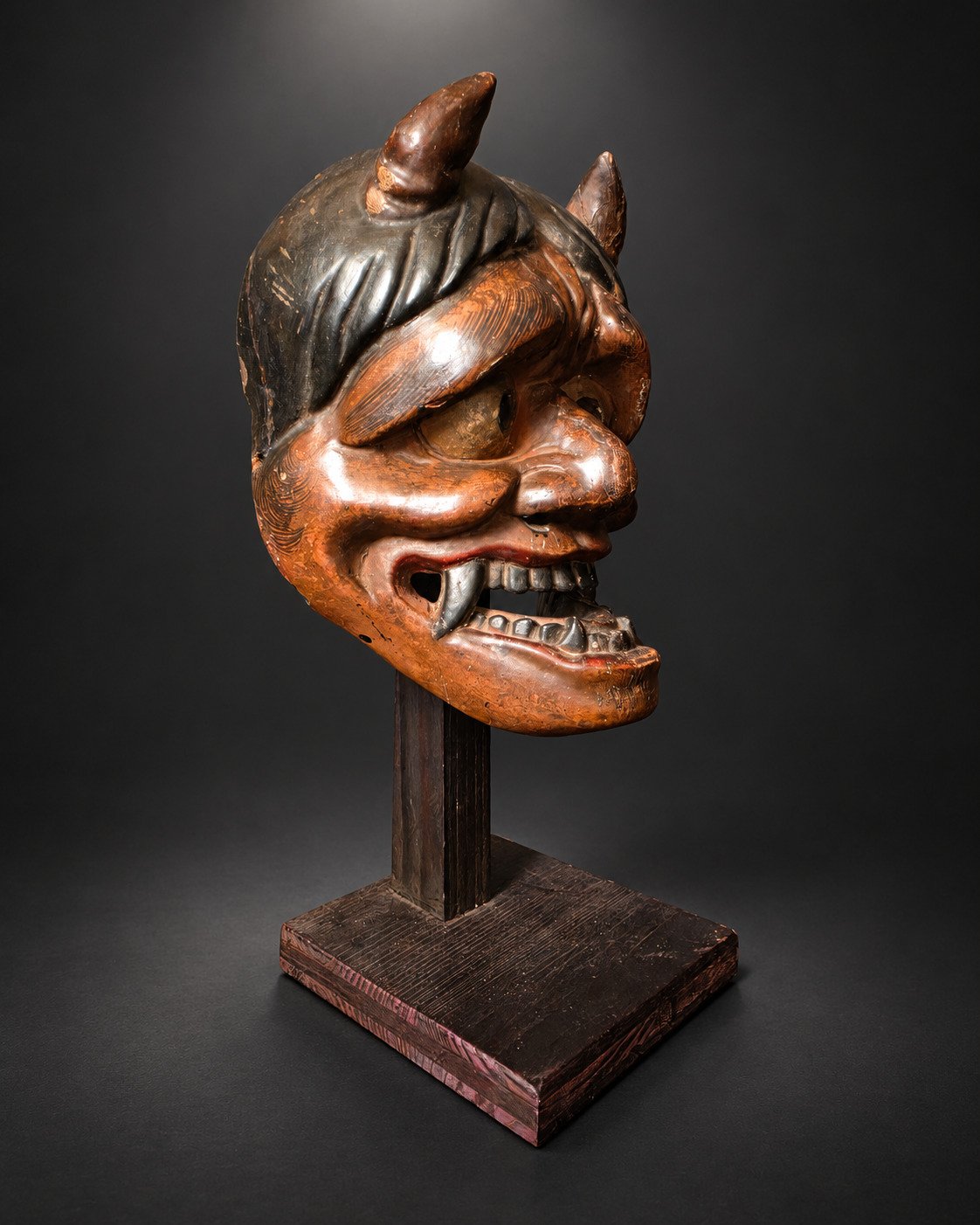
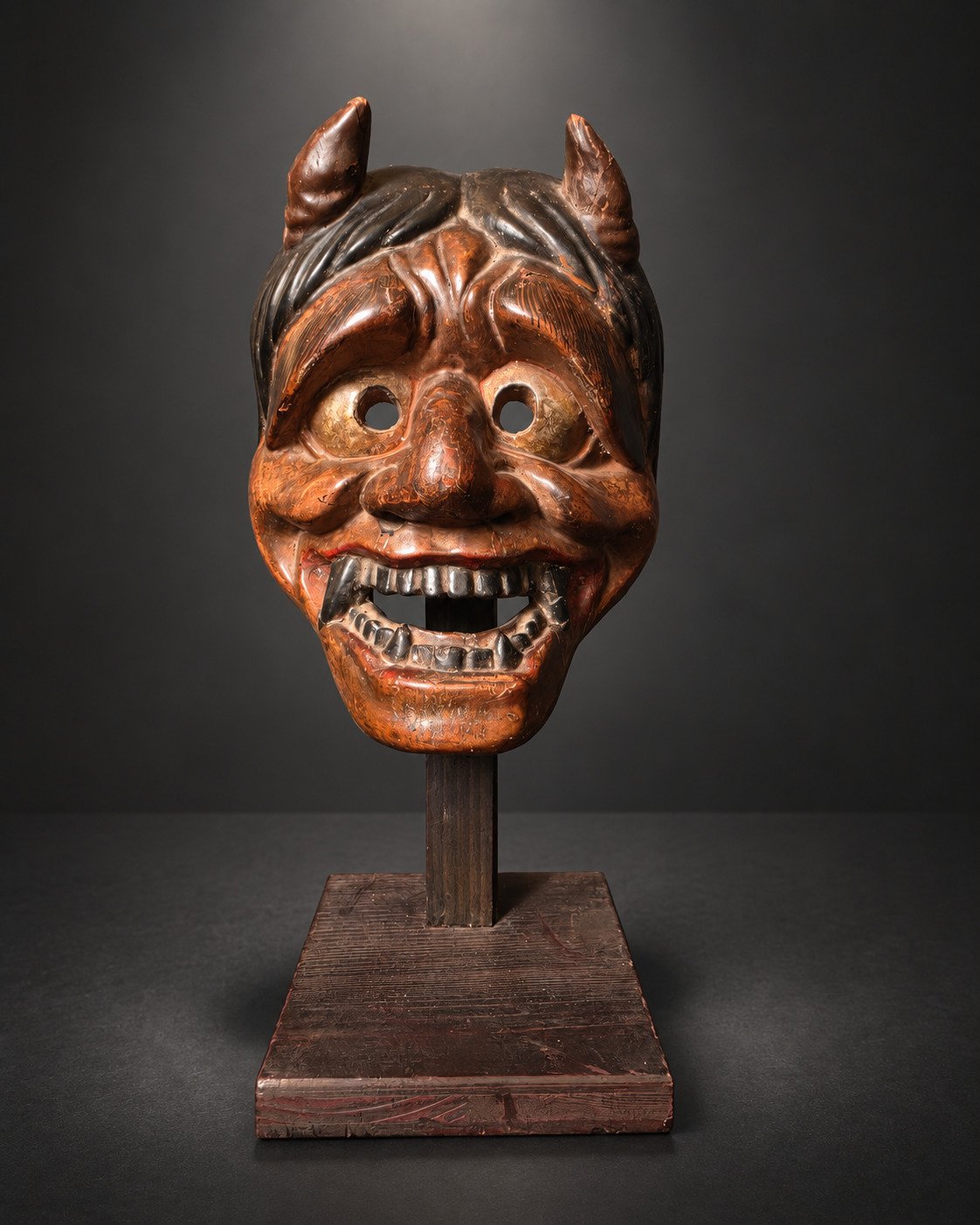
The face is modeled with remarkable personality: massive arched brows frame the wide eyes, a bulbous nose projects strongly from the center, deep folds sweep around the cheeks, and the open mouth reveals two rows of dark teeth and prominent fangs. Black-lacquered hair rises around the forehead in sculpted locks before terminating in two curved horns.
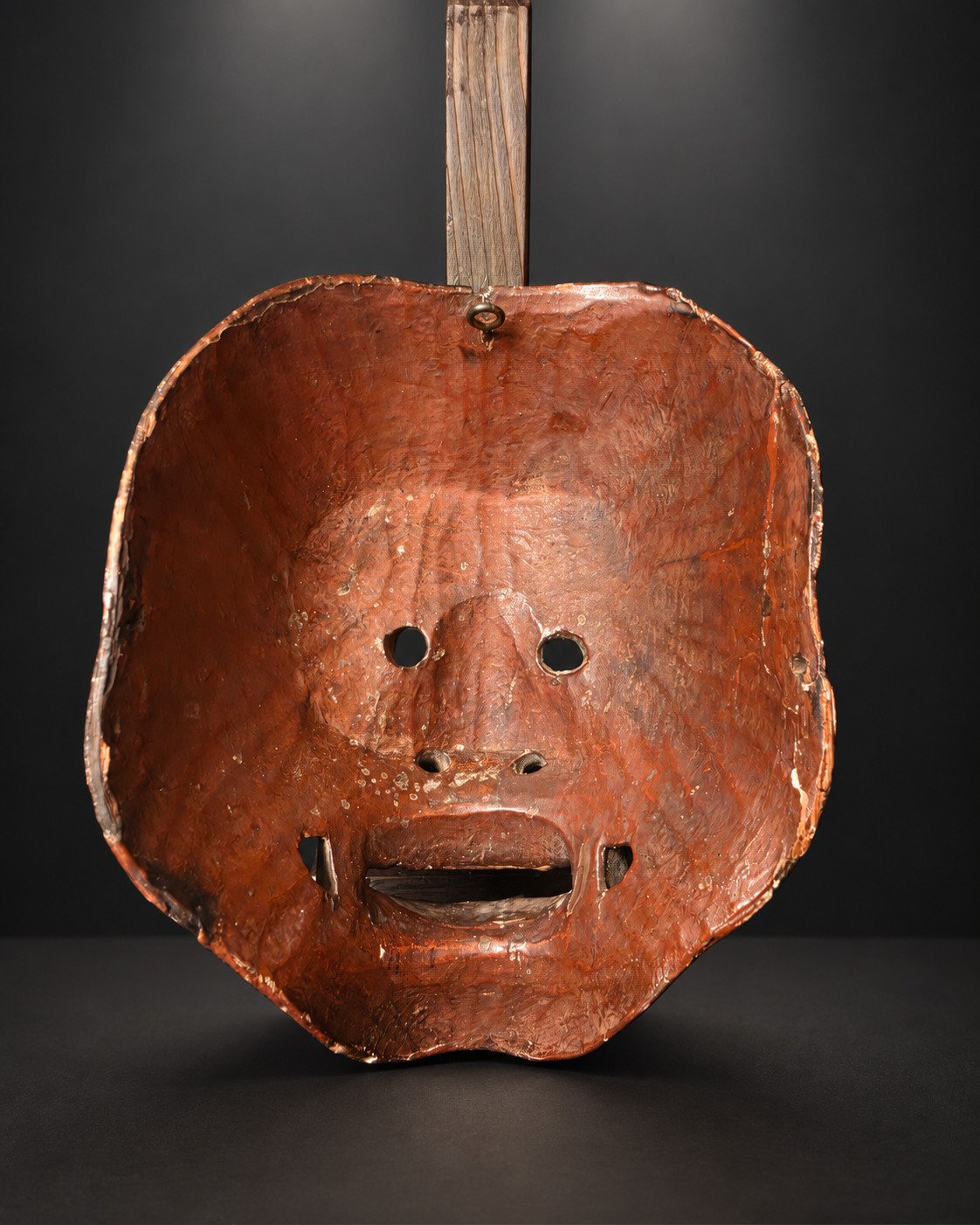
Unlike a purely decorative representation, the mask was constructed as a functional theatrical or ritual mask. The eyes are pierced for vision, the nostrils are open, additional apertures around the mouth provide ventilation and sight, and the reverse is completely hollowed and lacquered. The surface preserves extensive evidence of age and use, giving the mask a character that cannot be reproduced by a modern decorative object.
Oni (鬼) are among the most recognizable supernatural beings in Japanese culture. Usually depicted with horns, fangs, exaggerated facial features and formidable physical strength, they appear throughout Japanese folklore, Buddhist narratives, festivals, theater and visual art.
Their character, however, is not always straightforwardly evil. Depending on the story and context, oni can be terrifying punishers, dangerous spirits, guardians, comic figures or unruly supernatural beings whose exaggerated behavior provides both drama and entertainment.
This mask belongs to the more animated side of that tradition. Its wide grin, enormous brows and almost playful expression give it a distinctly theatrical personality rather than the severe or tragic intensity associated with masks such as Hannya.
The expression is one of the most compelling aspects of the piece.
Rather than relying solely on aggression, the carver created a face full of movement and humor. The enormous brows arch dramatically above the eyes, the cheeks swell outward, the nose projects heavily from the center of the face, and the corners of the mouth pull upward into a broad demonic grin.
The result is simultaneously unsettling and amusing — precisely the ambiguity that makes many Japanese oni representations so visually memorable.
The mask dates to the late Edo period in the 19th century, a time when masks continued to play important roles in Japanese theatrical performances, regional ritual traditions, festivals and popular religious culture.
Its carved wooden construction, layered lacquer surface, functional openings and extensive natural wear are consistent with an object made to be handled and used rather than simply produced as a static decorative sculpture.
The face is strongly modeled in wood, with considerable depth given to the brow, nose, cheeks, mouth and jaw.
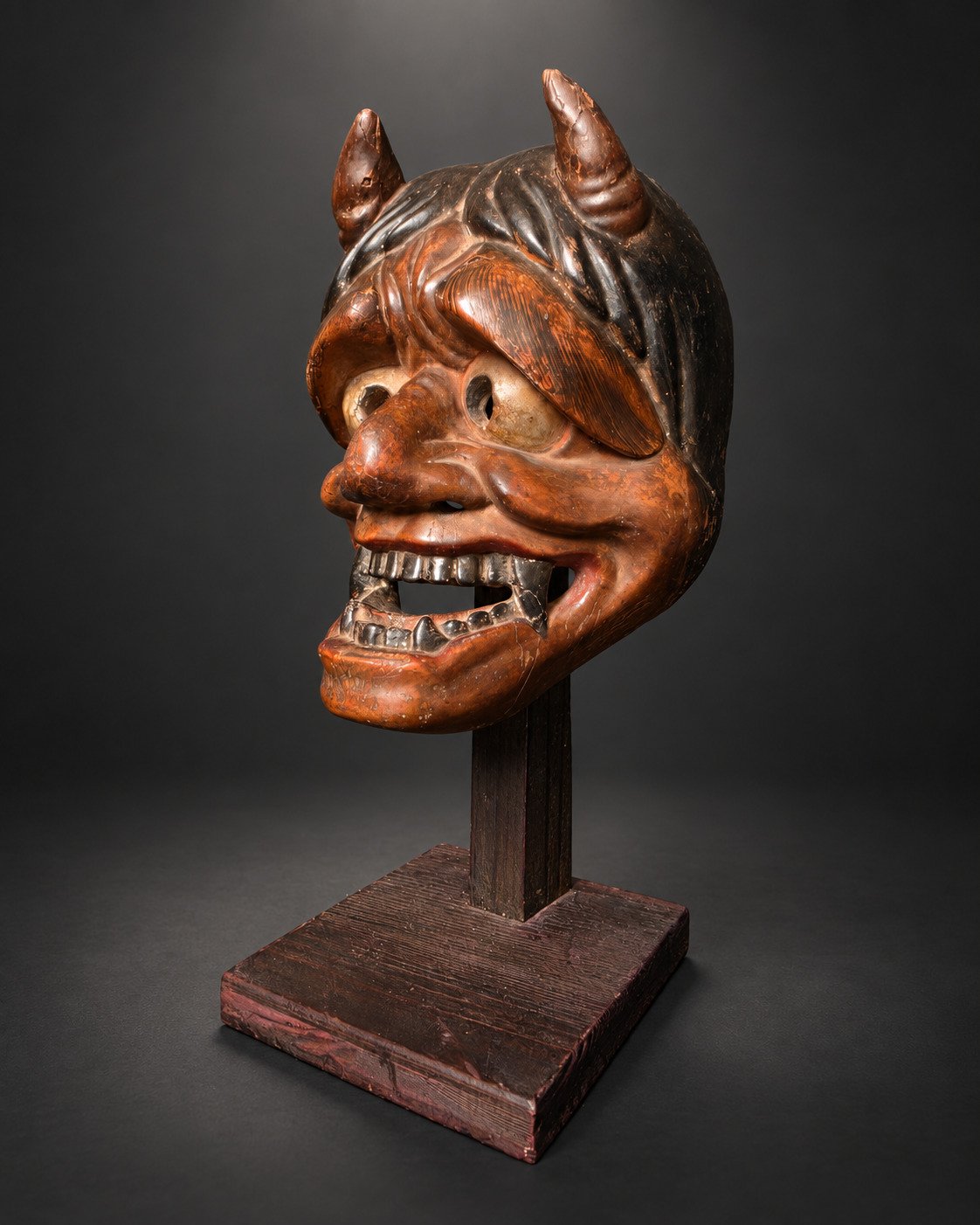
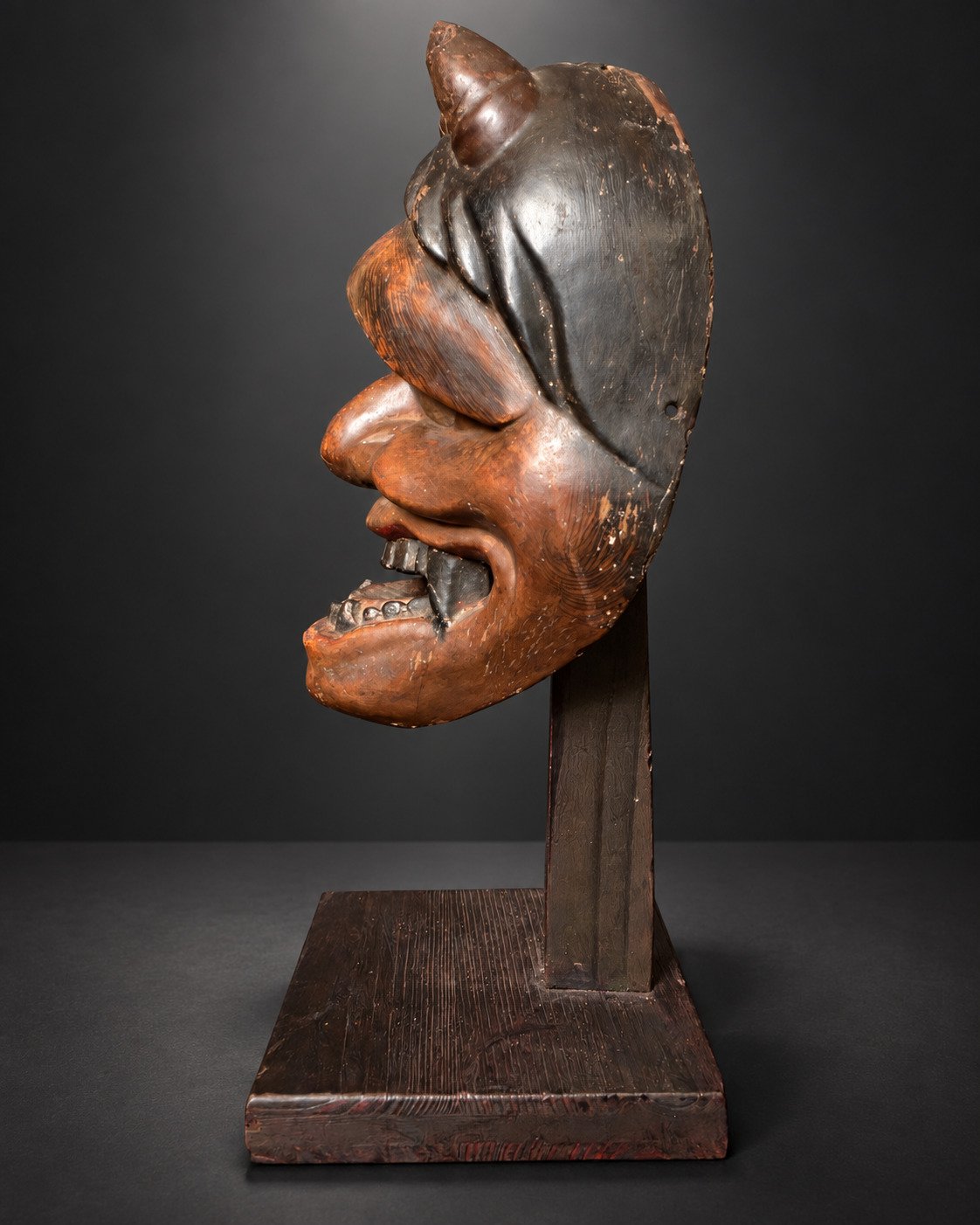
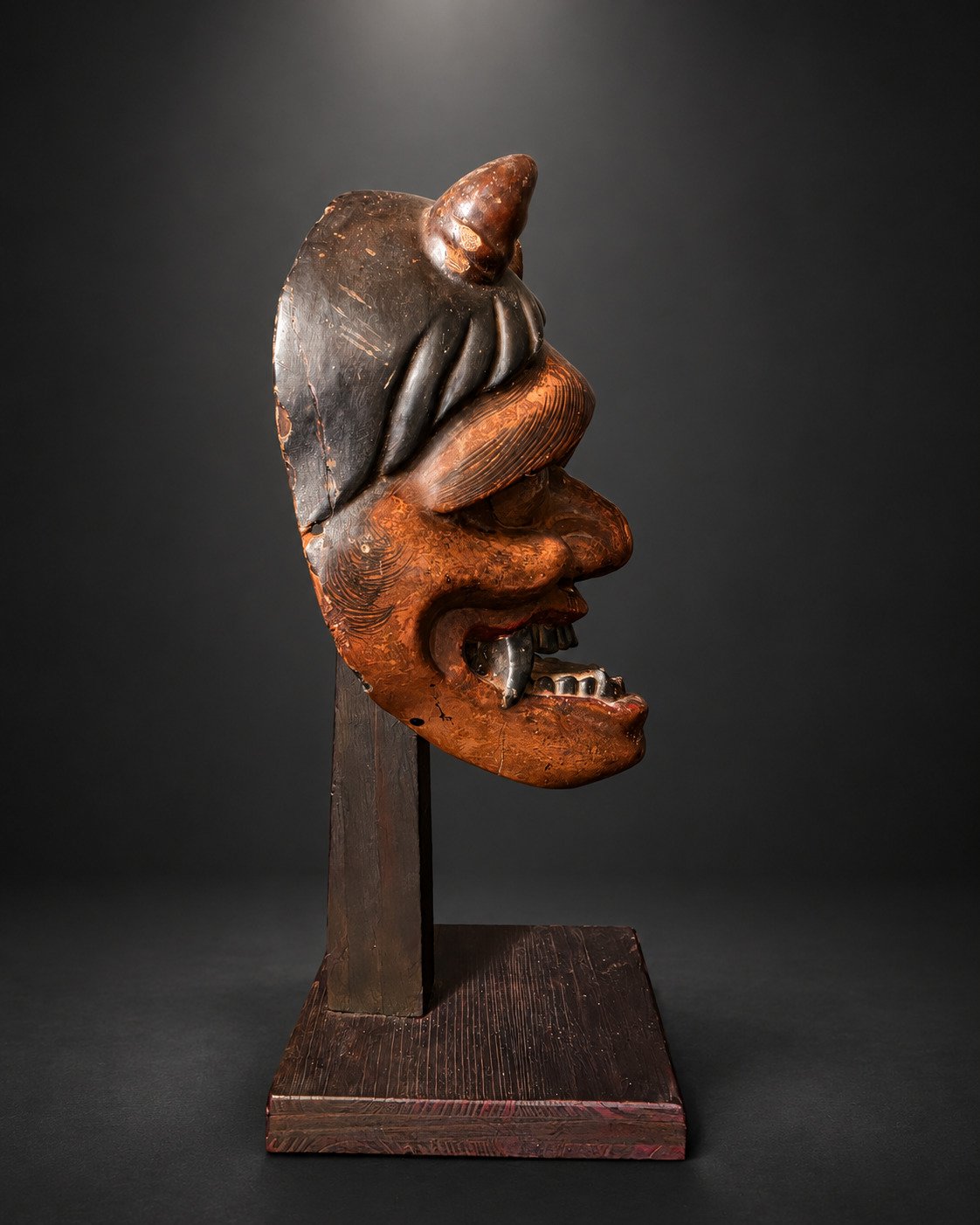
Seen in profile, the sculptural character becomes particularly clear. The brow projects heavily over the eyes, the nose extends well beyond the plane of the face, and the open jaw creates a dramatic silhouette.
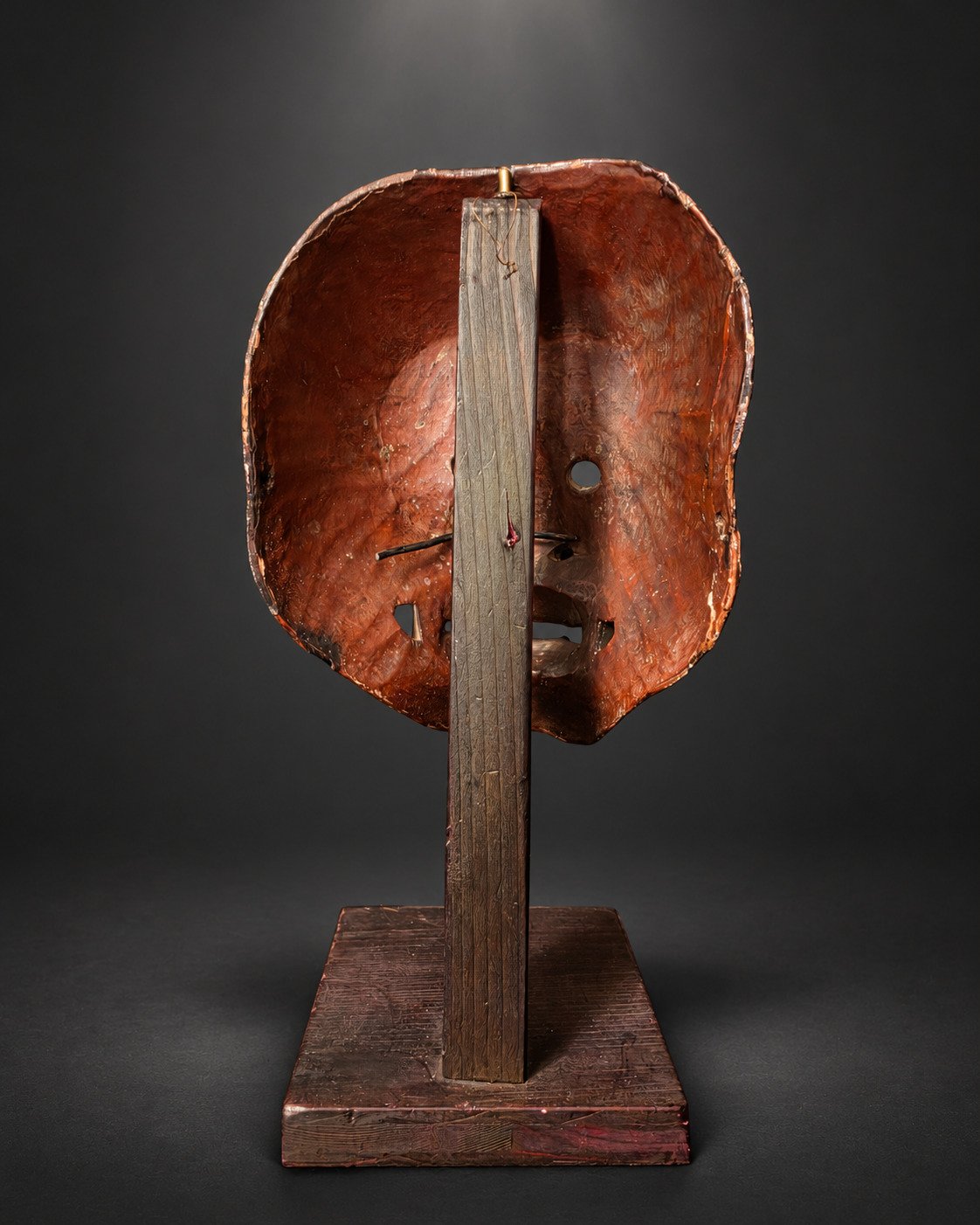
The reverse is completely hollowed, reducing the weight of the mask while creating the internal space required for it to be worn.
The face is finished in a rich russet-brown lacquer that has developed considerable visual depth through age and use.
The surface is not uniformly polished. Instead, it preserves subtle crackling, rubbing, scratches, small losses and variations in tone that document the history of the object.
These changes are particularly visible around the forehead, cheeks, chin and other raised areas naturally exposed to handling and contact.
A broad mass of black-lacquered hair surrounds the upper portion of the face.
Rather than being represented as a flat painted area, the hair is modeled into substantial flowing ridges that sweep across the forehead and around the sides of the head.
The contrast between the dark hair and warm russet complexion strengthens the mask’s exaggerated theatrical appearance.
Two curved horns rise dramatically from the top of the head, immediately identifying the supernatural nature of the figure.
They are integrated directly into the overall sculptural composition, emerging from the black hair and extending upward to create the characteristic horned silhouette associated with oni imagery.
Their surfaces retain visible age-related wear, particularly toward the exposed tips.
The eyebrows are among the most exaggerated features of the mask.
Deeply carved and dramatically arched, they project above the eyes as substantial sculptural forms. Fine incised lines create the impression of individual hairs and add texture to their surfaces.
Their exaggerated scale gives the face much of its comic intensity and directs attention toward the unusually wide eyes below.
The eyes are surrounded by gilt surfaces, producing a striking contrast against the reddish-brown face and dark hair.
Large circular openings at their centers allowed the wearer to see through the mask.
The surviving gilding shows natural age and surface variation, adding further visual depth without diminishing the dramatic effect of the eyes.
A large, bulbous nose dominates the center of the face.
Deep folds extend from the nose toward the cheeks and mouth, while strongly modeled cheek forms push outward on either side.
These deliberately exaggerated proportions would have made the expression legible even at a distance during theatrical, ritual or festival use.
The mouth opens into a broad grin extending across much of the lower face.
Touches of red lacquer remain around the lips and corners of the mouth, providing a subtle contrast with the warm brown complexion.
The combination of the smile, exposed teeth and projecting fangs gives the oni an unusually animated expression — menacing at first glance, but almost humorous when viewed more closely.
Two rows of individually modeled teeth fill the open mouth.
The teeth have a darkened finish, while prominent upper fangs project downward on either side, emphasizing the supernatural character of the figure.
The substantial lower jaw and irregular teeth further contribute to the mask’s deliberately grotesque and theatrical appearance.
Fine incised lines appear throughout the brows, facial hair and beard areas.
These details break up the broader lacquered surfaces and give the face additional texture when viewed closely.
The contrast between these finely worked lines and the mask’s exaggerated sculptural volumes demonstrates the attention given to both close inspection and theatrical visibility.
The mask belongs stylistically to the broader world of Japanese theatrical and ritual masks associated with traditions such as kagura and kyōgen, where demons and supernatural beings could appear in dramatically different roles.
Unlike the highly codified subtlety of many Noh masks, masks used in regional performance and comic theatrical contexts frequently employ stronger exaggeration, broad expressions and immediately recognizable supernatural features.
The combination of horns, gilt eyes, exaggerated brows, broad grin and prominent fangs gives this example precisely that powerful visual immediacy.
The construction demonstrates that this was not conceived simply as a decorative wall mask.
The eyes are pierced to provide vision, while the nostrils are open and additional small apertures around the mouth assist with ventilation and visibility.
The interior has been completely hollowed and lacquered, creating a functional cavity behind the face.
These features are important evidence of its original character as a wearable theatrical or ritual object.
The reverse is particularly revealing.
Unlike the carefully modeled exterior, the interior preserves an irregular hand-worked surface beneath layers of warm reddish-brown lacquer.
Visible brushwork, surface variation and tool marks remain throughout, providing direct evidence of its construction and finishing.
The contrast between the expressive exterior and utilitarian interior is characteristic of an object intended primarily to be seen from the front during use.
In addition to the large eye openings, the mask retains pierced nostrils and small apertures around the mouth.
These openings would have improved airflow and visibility for the wearer while preserving the appearance of the face when viewed from the front.
Their presence further distinguishes the piece from later decorative reproductions designed only for display.
A small brass fitting is attached to the upper interior edge of the mask.
This provides a practical hanging point and forms part of the object’s later display history.
One of the most attractive aspects of the mask is the survival of its aged lacquer surface.
Rather than appearing artificially uniform, the lacquer displays a soft crackled character, areas of rubbing, small scratches and localized losses along exposed edges, particularly around the horns and hairline.
These signs of age do not interfere with the expression. Instead, they reinforce the physical presence and historical character of the piece.
The mask remains structurally stable, with no structural damage observed.
The lacquer shows age-appropriate wear, including surface crackling, rubbing, scratches and small localized losses, particularly along exposed areas such as the horns, hairline and edges.
The gilt eye surrounds retain visible age and wear, while the black and russet lacquer surfaces remain coherent and visually strong.
These signs are consistent with the age and history of a functional 19th-century object.
The mask is presented on a custom dark wooden display stand, which is included with the piece.
The stand allows the mask to be displayed vertically while leaving its profile and sculptural depth clearly visible.
At approximately life size, the combination of mask and stand creates a particularly strong display for a private collection, gallery, study or dedicated Japanese art interior.
This mask combines several qualities of particular interest to collectors of Japanese masks and theatrical art: late Edo-period dating, functional wearable construction, expressive oni iconography, gilt eyes, blackened teeth, sculpted horns, aged lacquer and a fully worked interior.
Its appeal lies not only in the supernatural subject, but also in the individuality of the carving. The exaggerated brows, enormous eyes, broad grin and projecting fangs give the oni a distinctive personality that changes considerably between frontal and profile views.
For collectors of Japanese folk art, theatrical masks, kagura, kyōgen-related material or Edo-period decorative arts, it is a highly expressive example of the enduring visual power of the oni in Japanese culture.
A highly expressive late Edo-period Japanese oni mask, carved from wood and finished in richly aged russet and black lacquer with gilt-ringed eyes, sculpted horns, blackened teeth and prominent fangs. Its exaggerated brows, bulbous nose, deeply modeled cheeks and broad demonic grin give the figure an unusually animated character, balancing supernatural menace with the mischievous humor associated with some Japanese theatrical and ritual oni traditions. Functional eye, nostril and mouth openings, together with the fully hollowed and lacquered interior, confirm its construction as a wearable mask rather than a purely decorative object. Measuring approximately 25 × 20 cm and presented on its included custom wooden stand, it is a striking 19th-century Japanese mask with exceptional sculptural presence and a beautifully preserved surface shaped by genuine age and use.
| Época | Edo |
|---|

Order above 1.000,00 € gets free shipping.

Secure and hassle-free payment process.

Certificate of authenticity included.

Have questions? Contact us via WhatsApp.
Contact