1 in stock
1 in stock
Add to Compare
Add to Wishlist
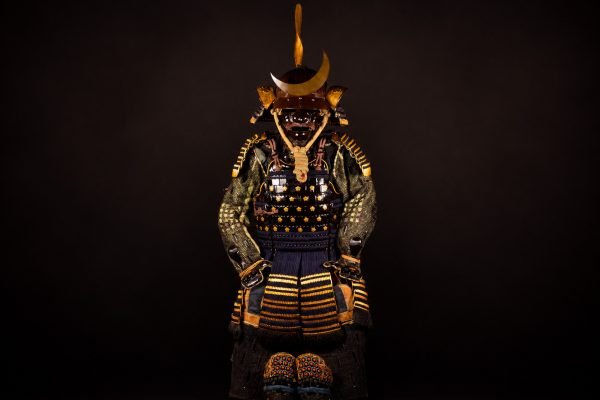
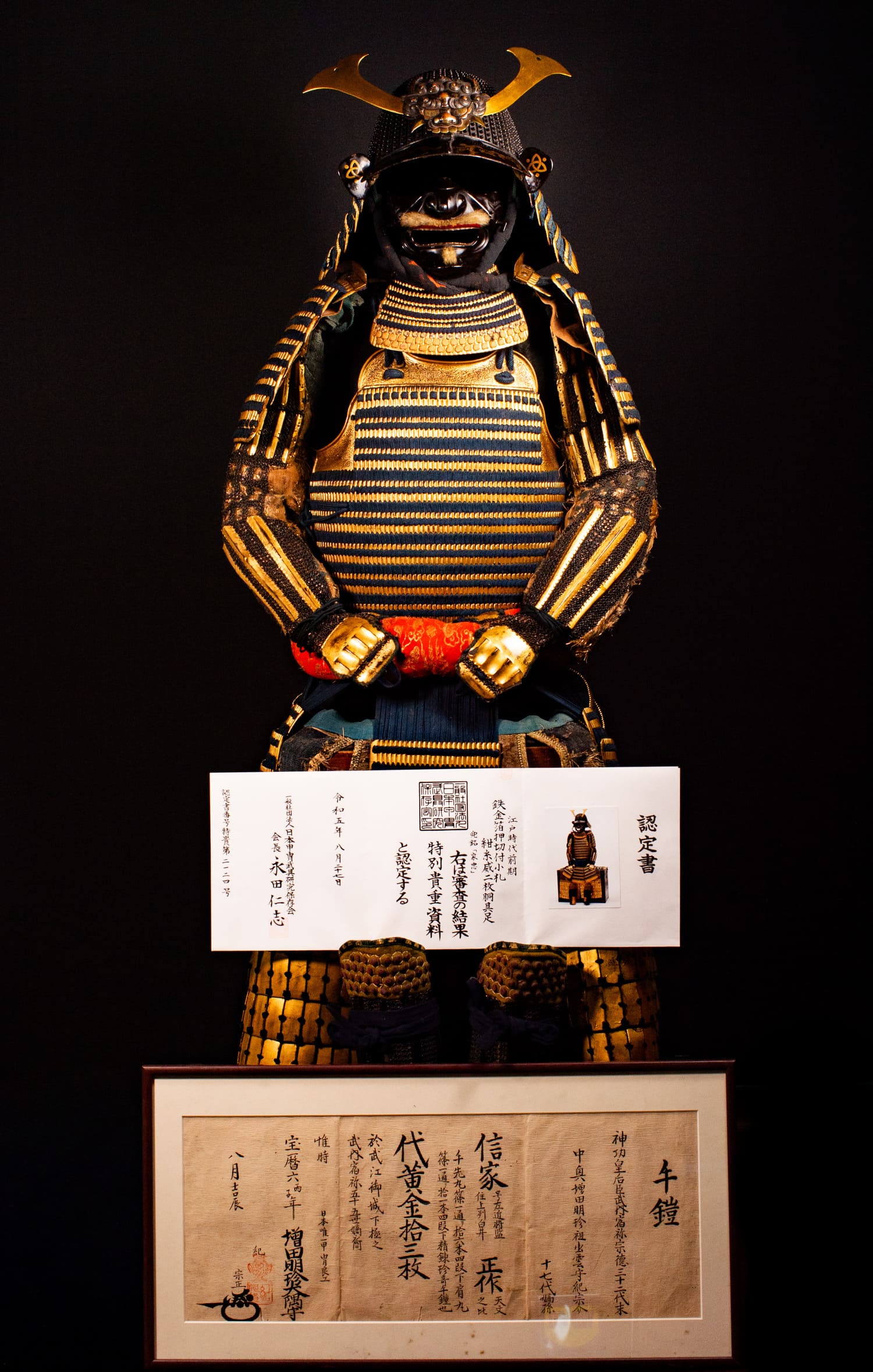
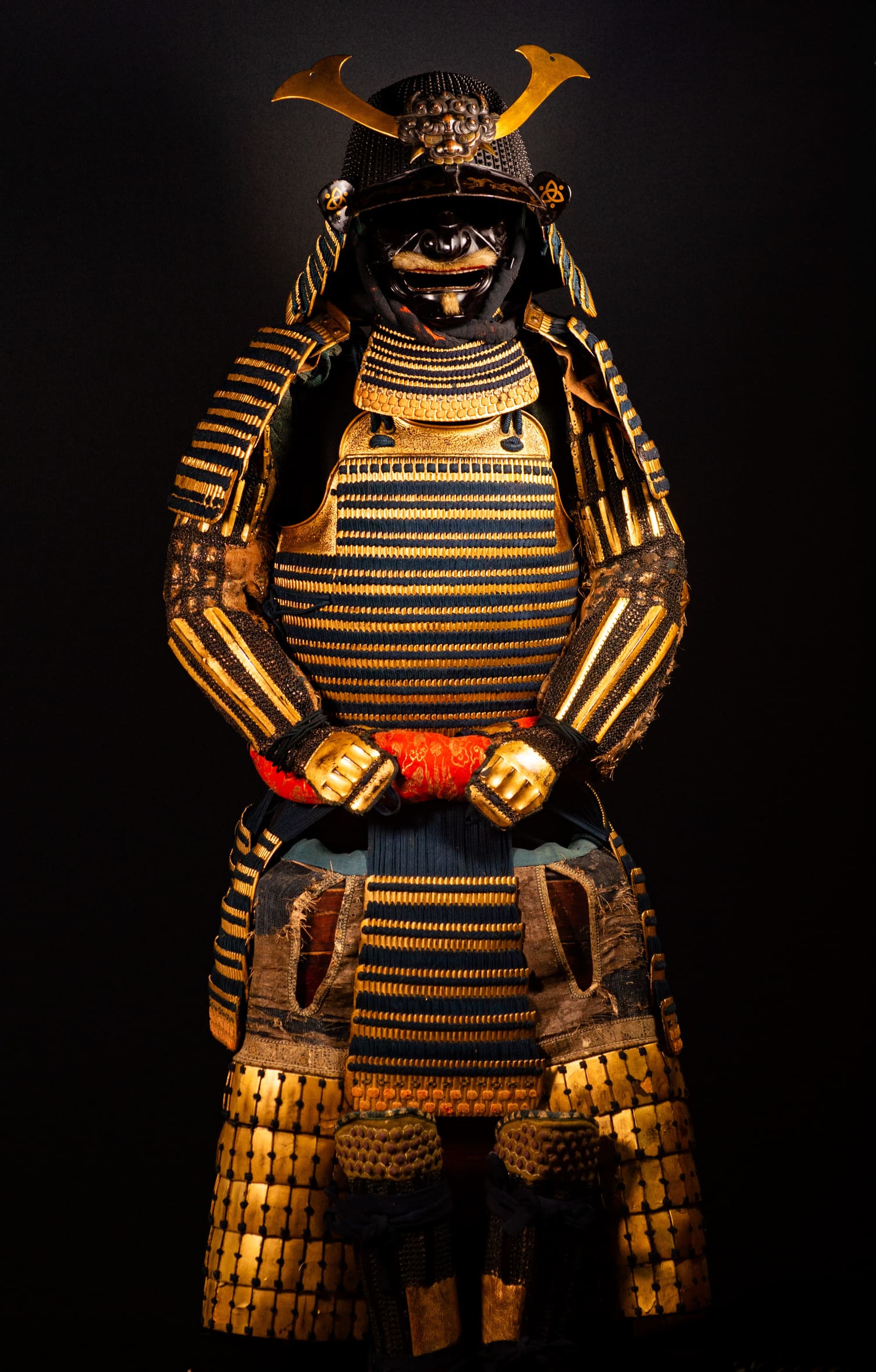
An exceptional complete gusoku dating from the early Edo period, attributed to the renowned Saotomé School and bearing the signature Ietada (家忠) on the helmet. Combining remarkable artistic refinement with documented historical provenance, this armor represents an outstanding example of Japanese samurai equipment produced during the first decades of Tokugawa rule, when military craftsmanship reached a balance between battlefield functionality and ceremonial elegance.
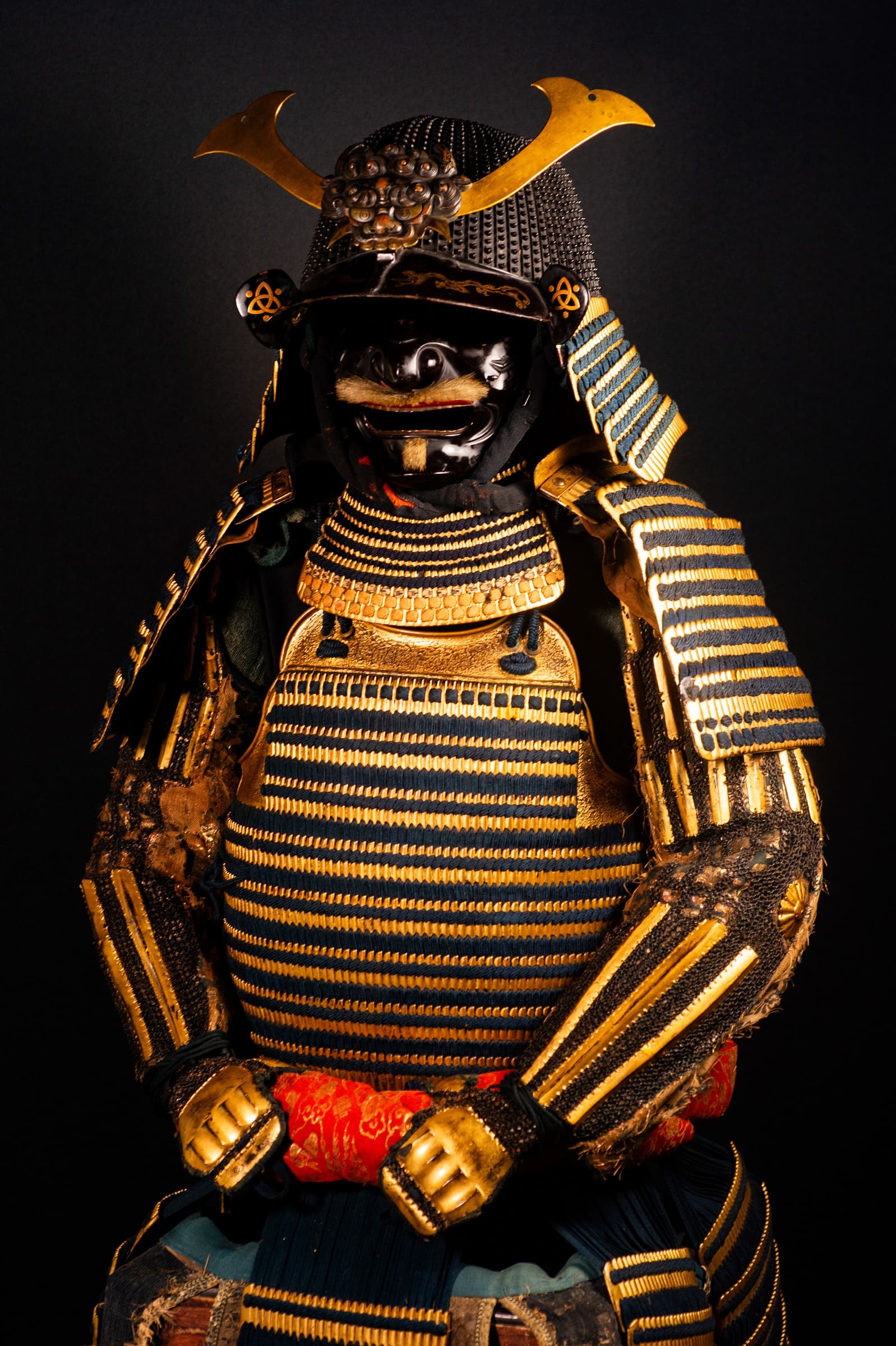
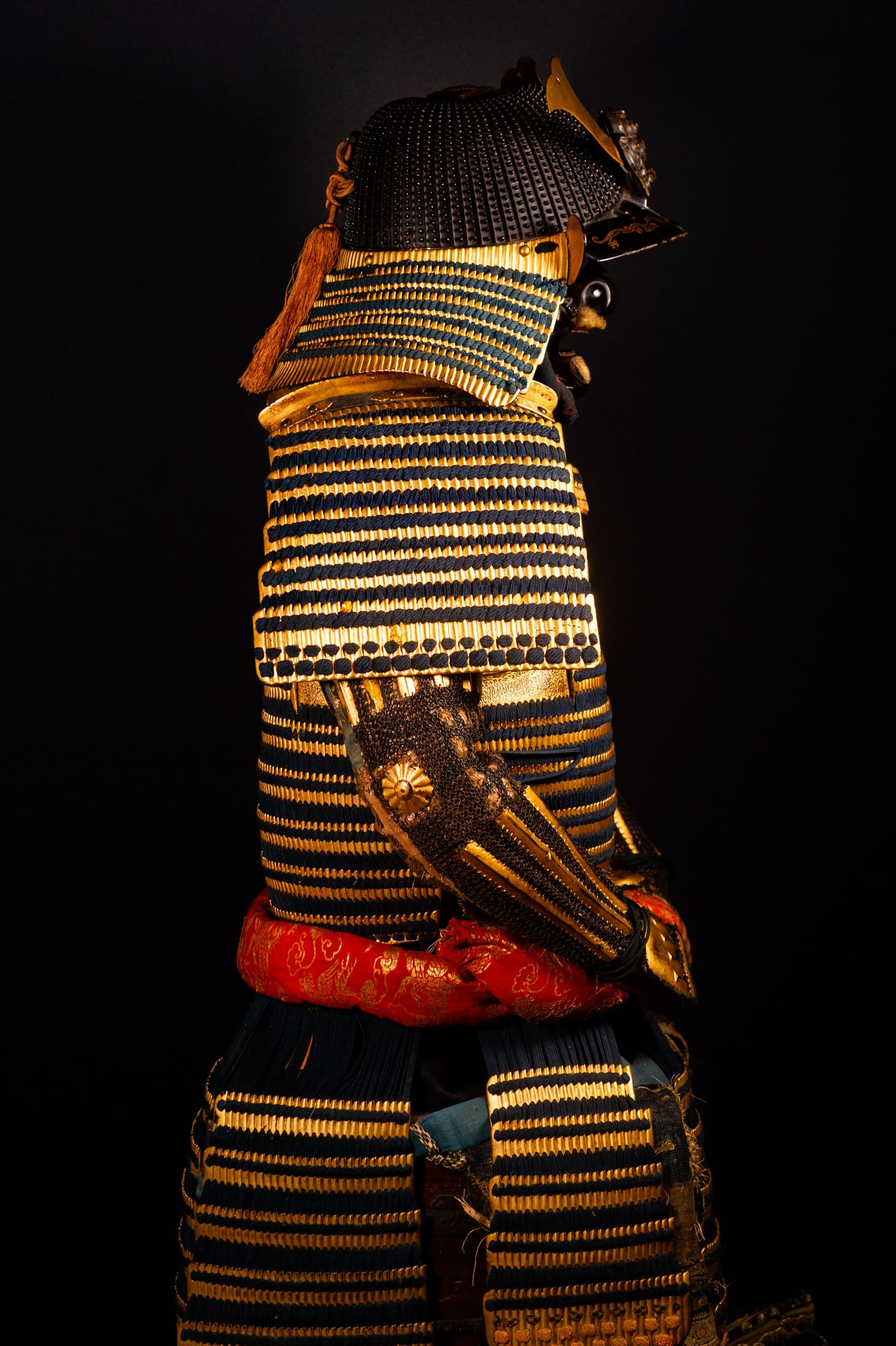
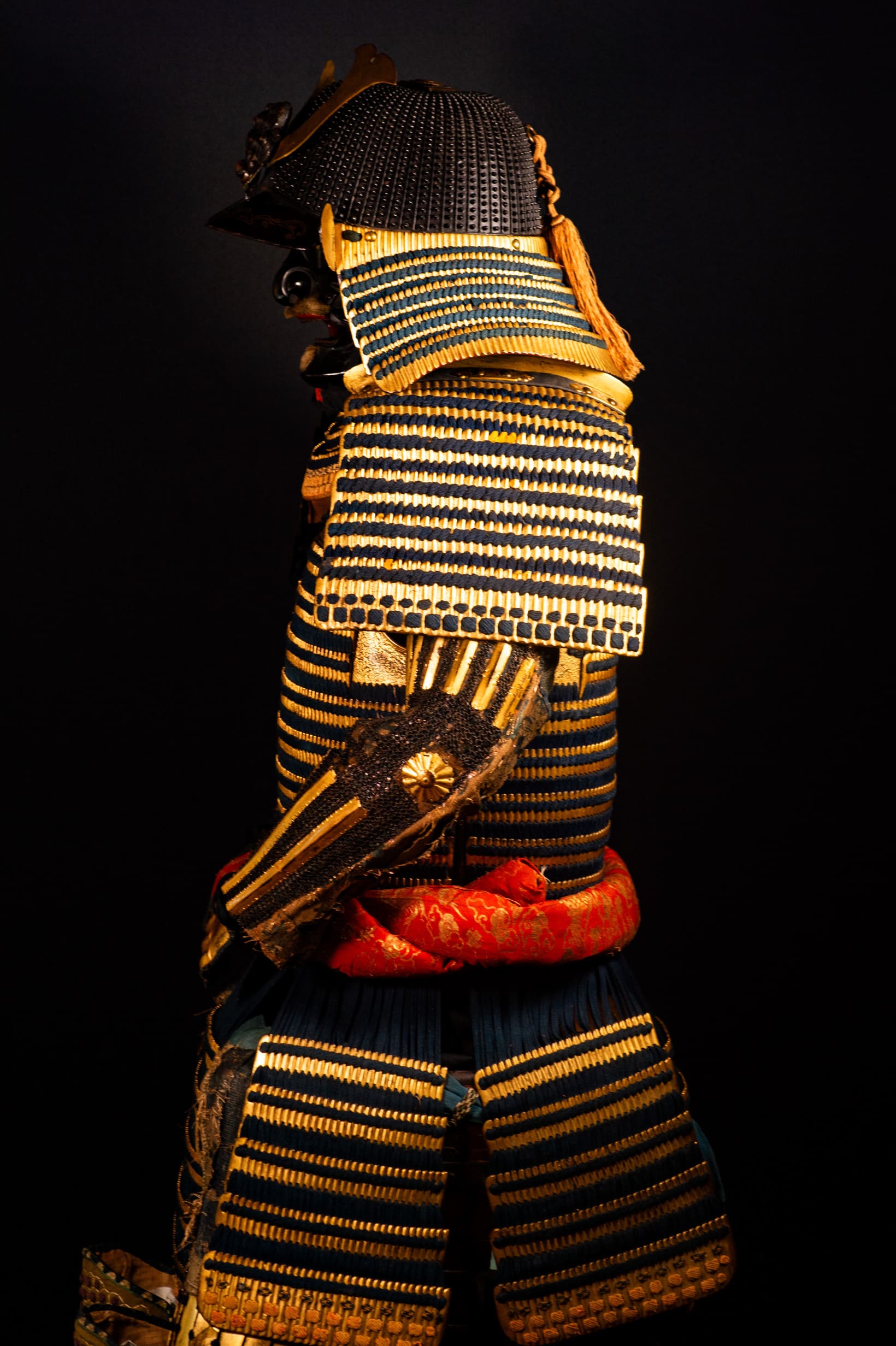
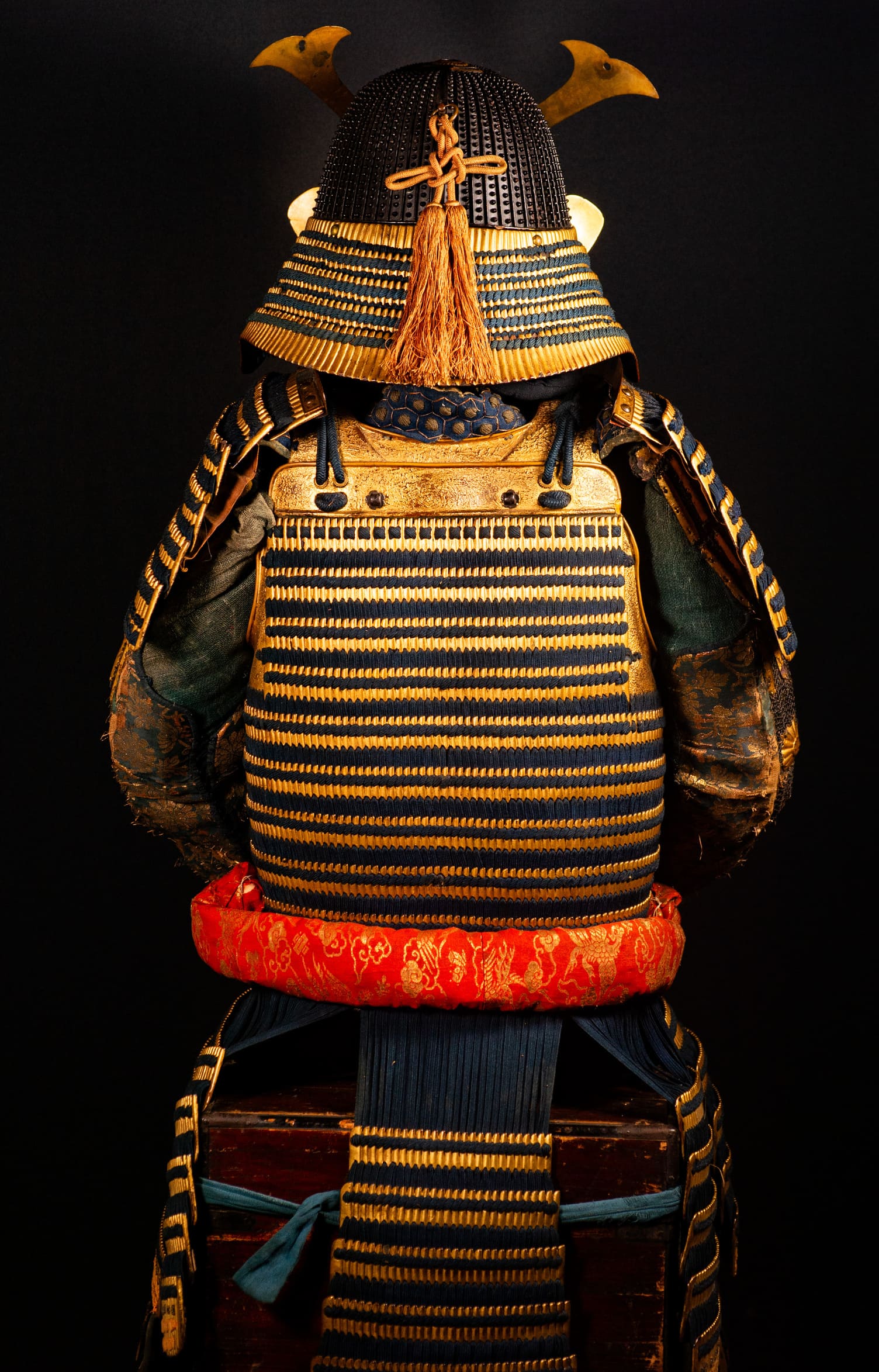
Unlike many surviving samurai armors assembled from unrelated components over centuries of use and collecting, this ensemble displays remarkable technical and stylistic consistency throughout every element. The kabuto, menpō, dō, sode, kote, haidate and suneate share harmonious construction techniques, lacquer finishes, silk lacing and materials, with no visible indication of later composite assembly (yoseate). This coherence is further supported by the accompanying appraisal certificate, making the armor an unusually complete and convincing historical ensemble.
Produced during the early seventeenth century, shortly after the establishment of the Tokugawa Shogunate, the armor belongs to the period in which practical battlefield protection evolved into the highly sophisticated tōsei gusoku worn by the professional samurai class throughout the Edo period. While preserving the robust construction required for warfare, armors of this period increasingly reflected the owner’s rank, prestige and artistic taste through refined lacquerwork, carefully selected fittings and masterful decorative techniques.
The present example illustrates this evolution perfectly. Its magnificent gilt fittings, elegant indigo silk lacing, finely executed makie decoration and beautifully sculpted metalwork create an armor that is both visually commanding and historically authentic. The documented signature, preserved family lineage scroll and official certification further distinguish it from the vast majority of Edo-period armors encountered on today’s international market.
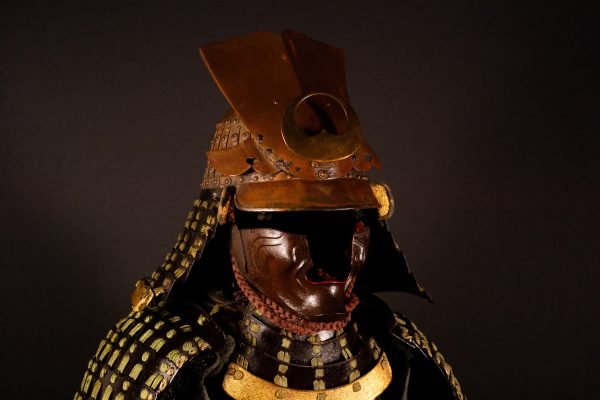
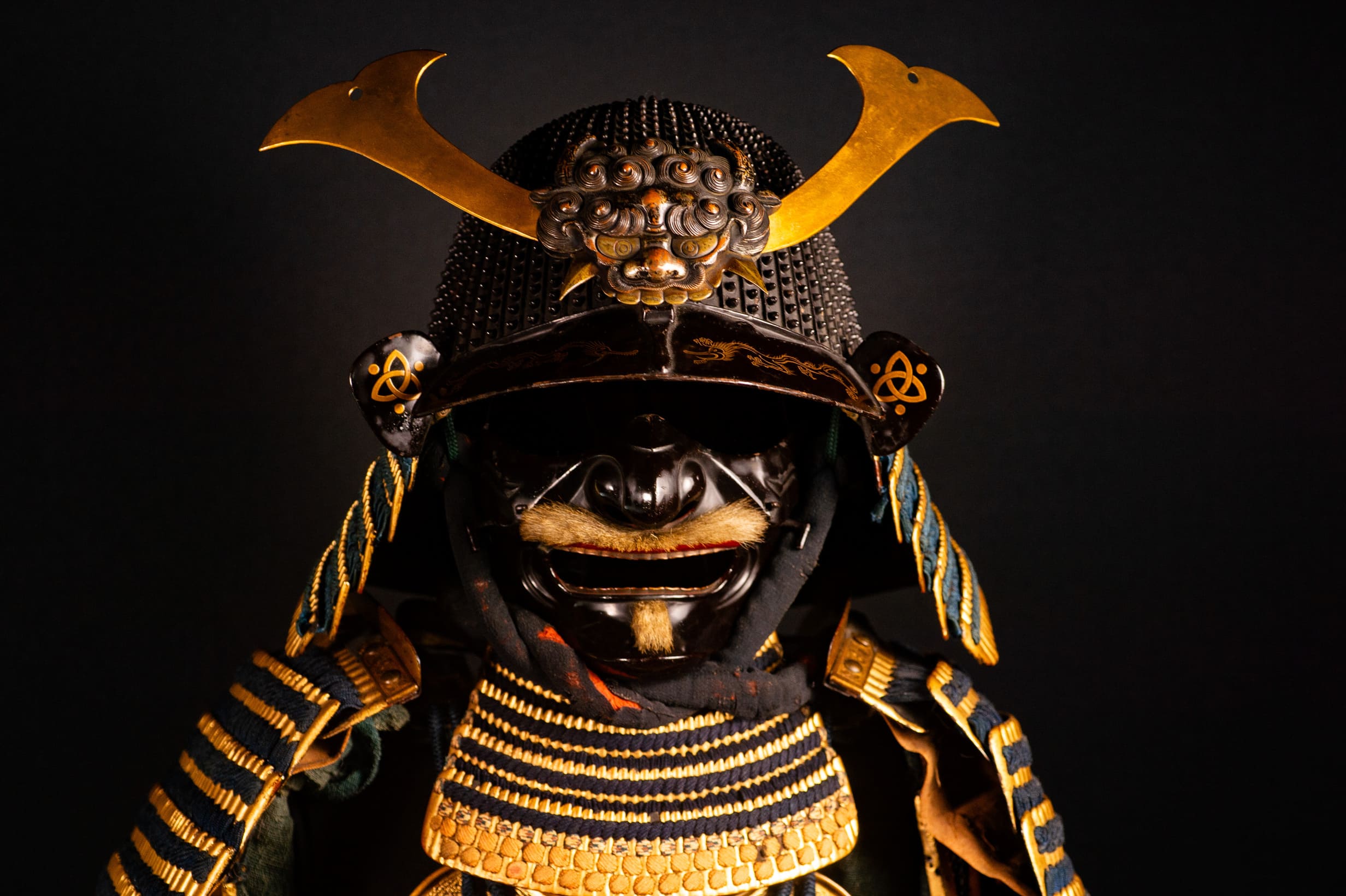
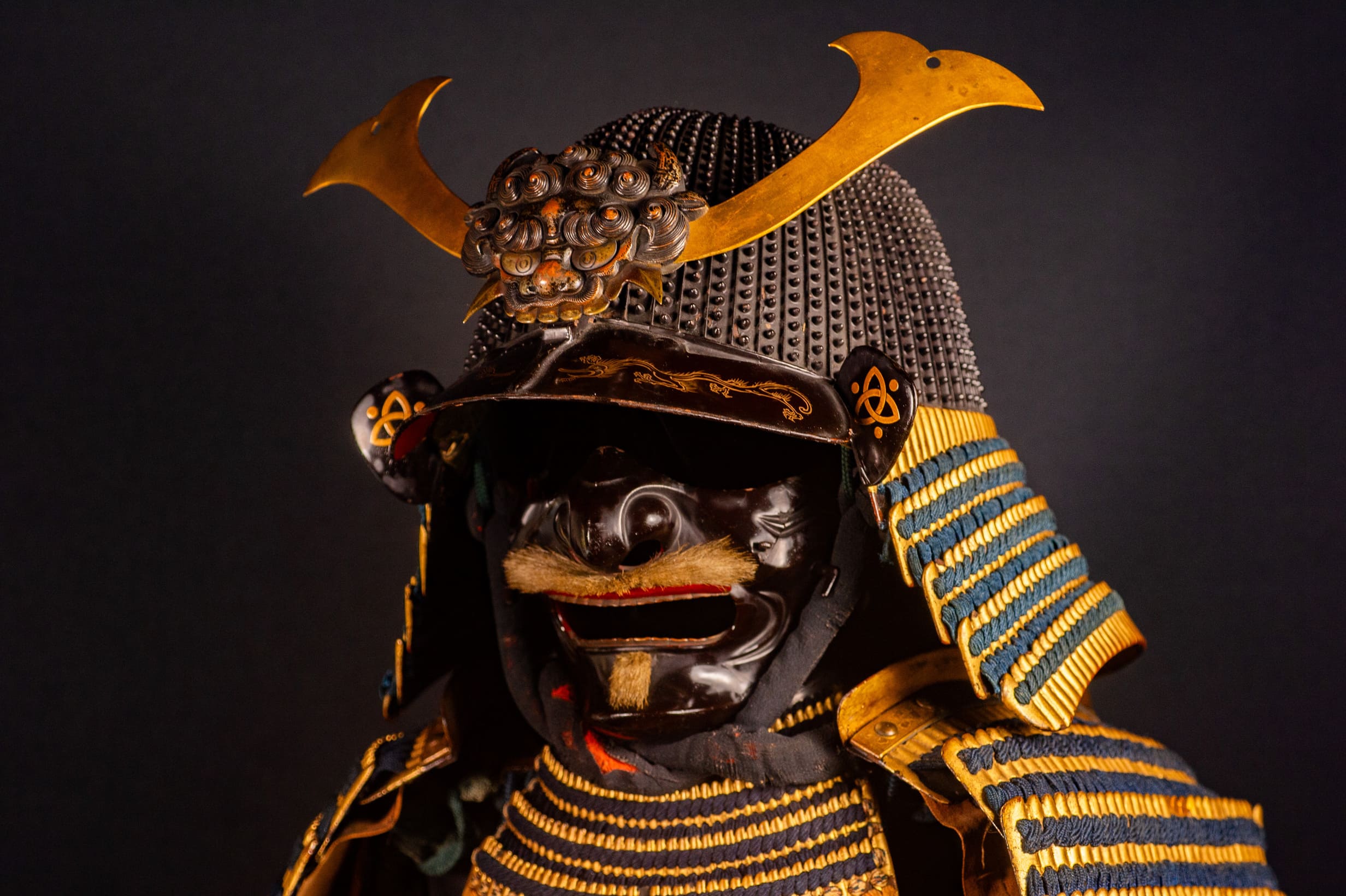
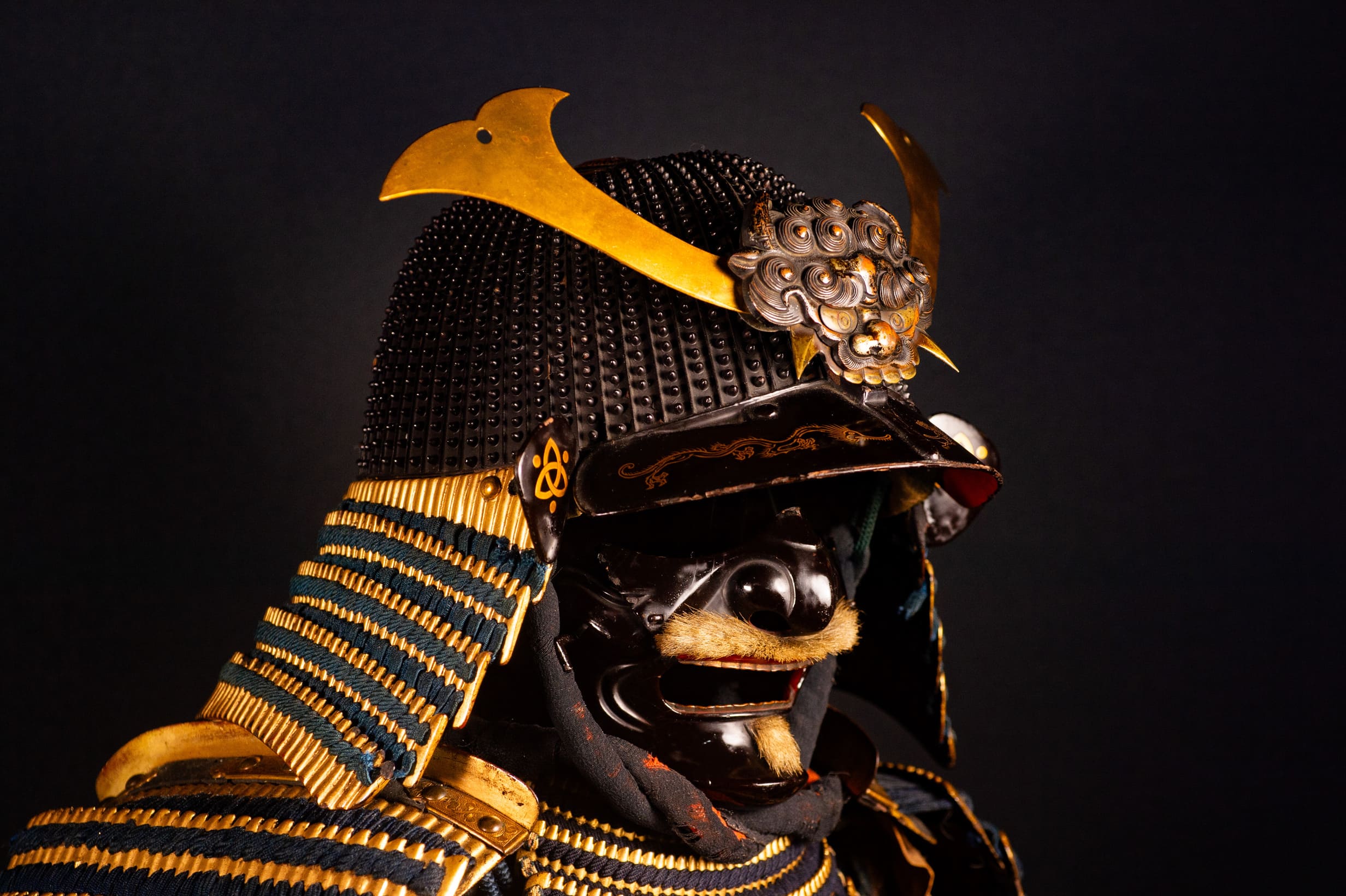
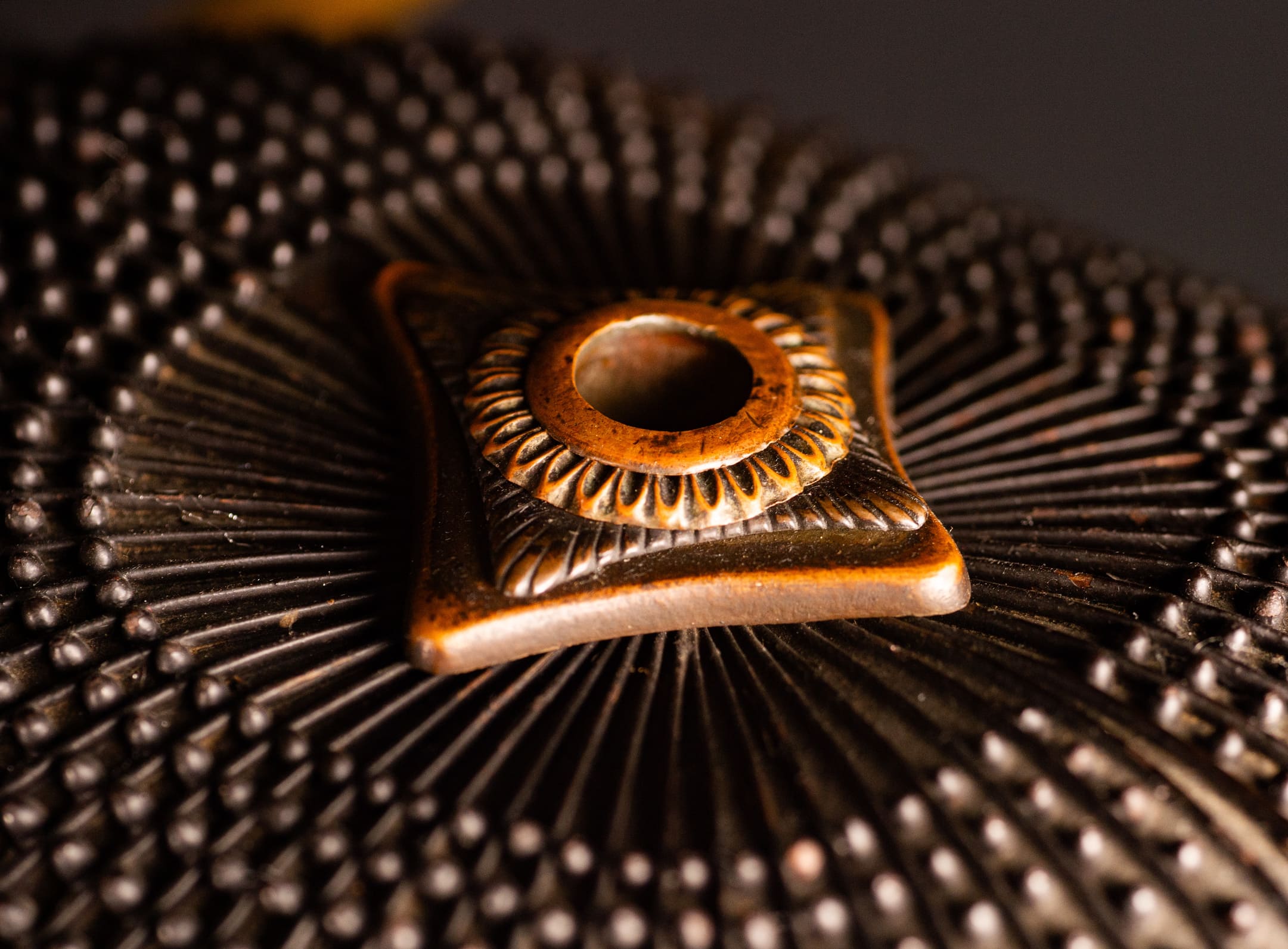
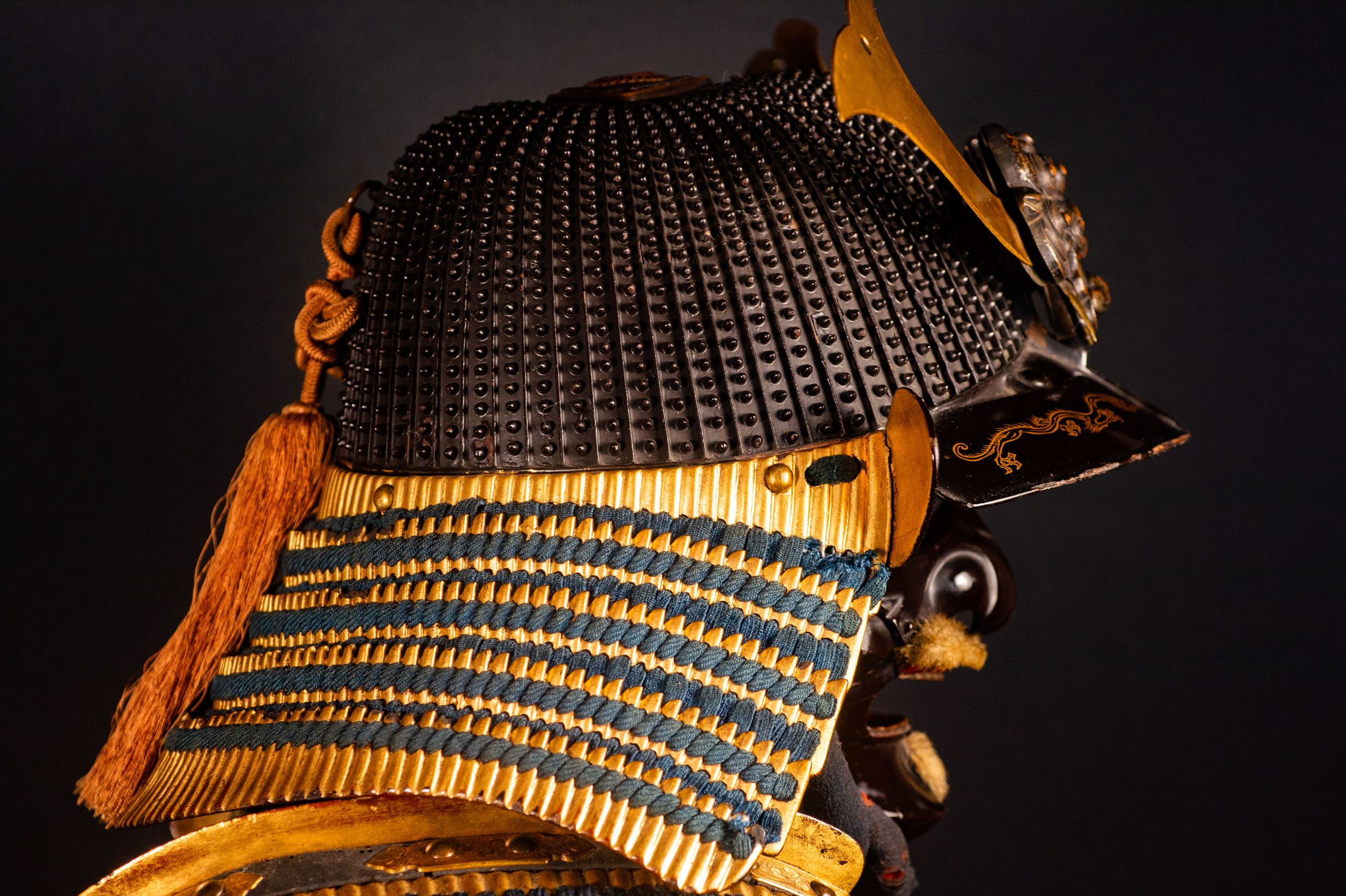
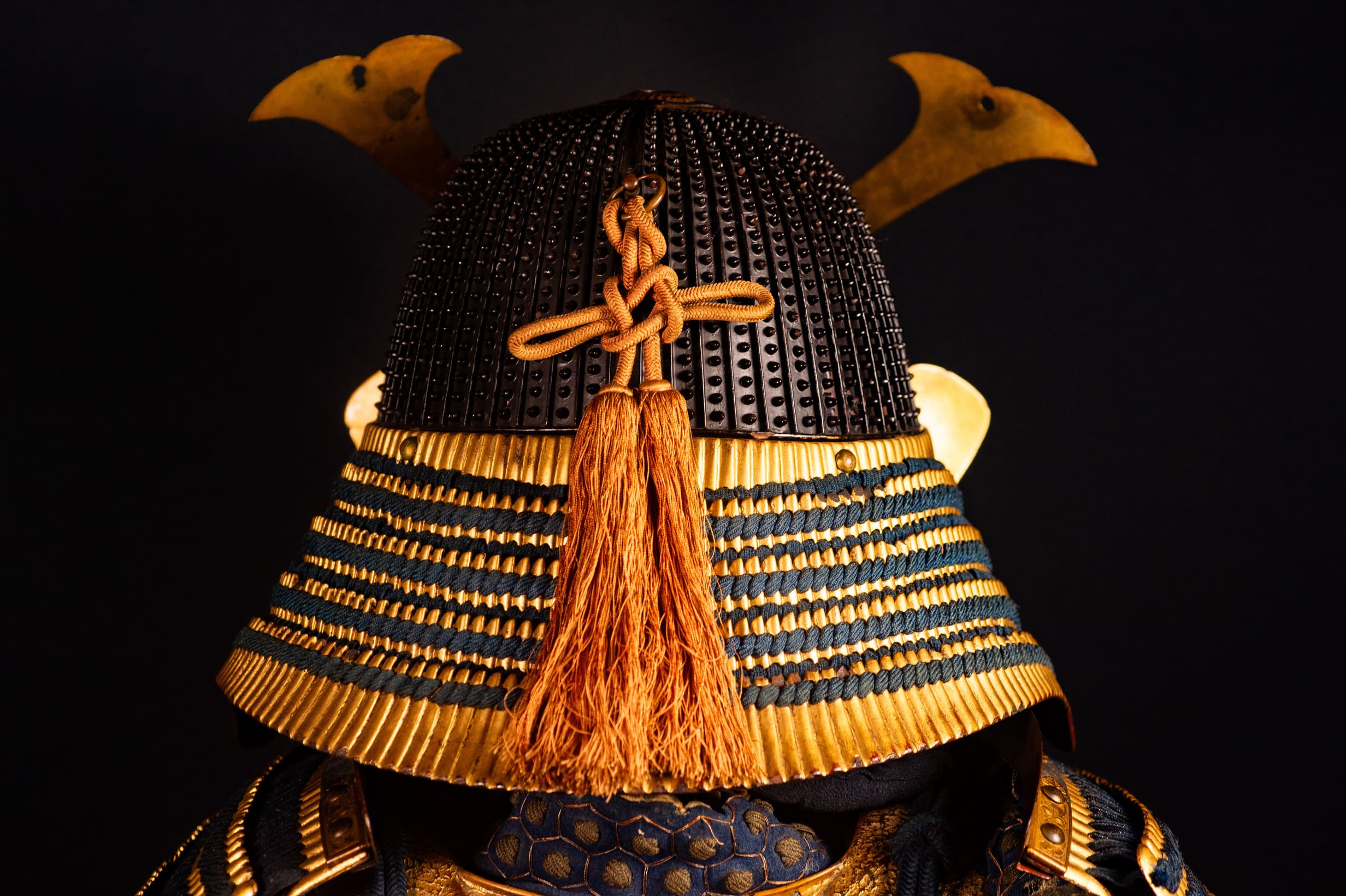
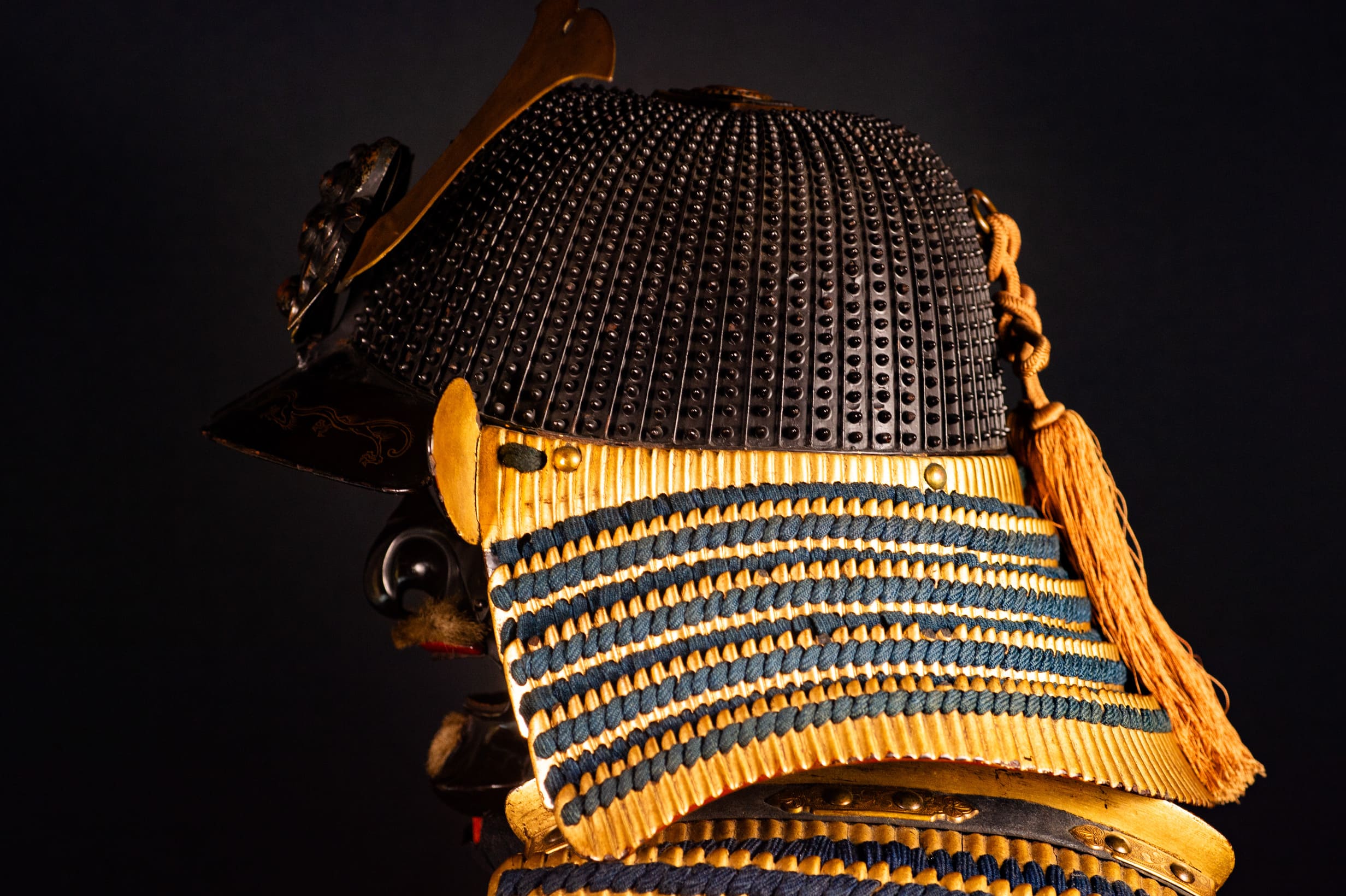
The helmet is undoubtedly the defining feature of the entire ensemble. Constructed as a traditional hoshi-bachi, the bowl is formed from multiple riveted iron plates whose carefully aligned raised rivets create the characteristic texture associated with high-quality Japanese helmets. This demanding construction required considerable technical skill and remains one of the most respected forms of kabuto manufacture.
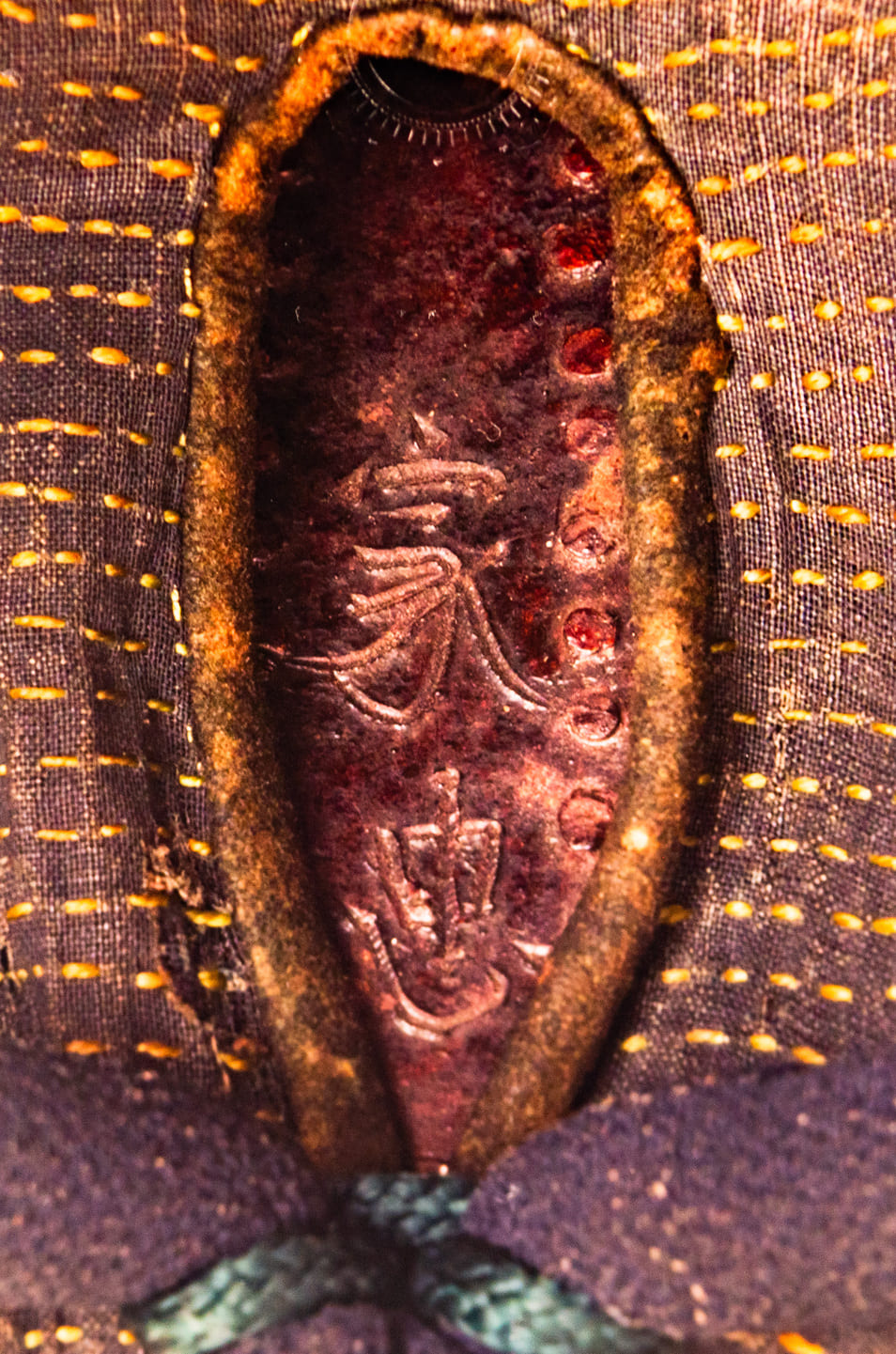
The bowl bears the signature 家忠 (Ietada), a documented smith’s name associated with the prestigious Saotomé School. Rather than representing an isolated inscription, the signature corresponds to one of several hereditary names historically employed by armor makers of this distinguished lineage, reinforcing the scholarly attribution of the helmet.
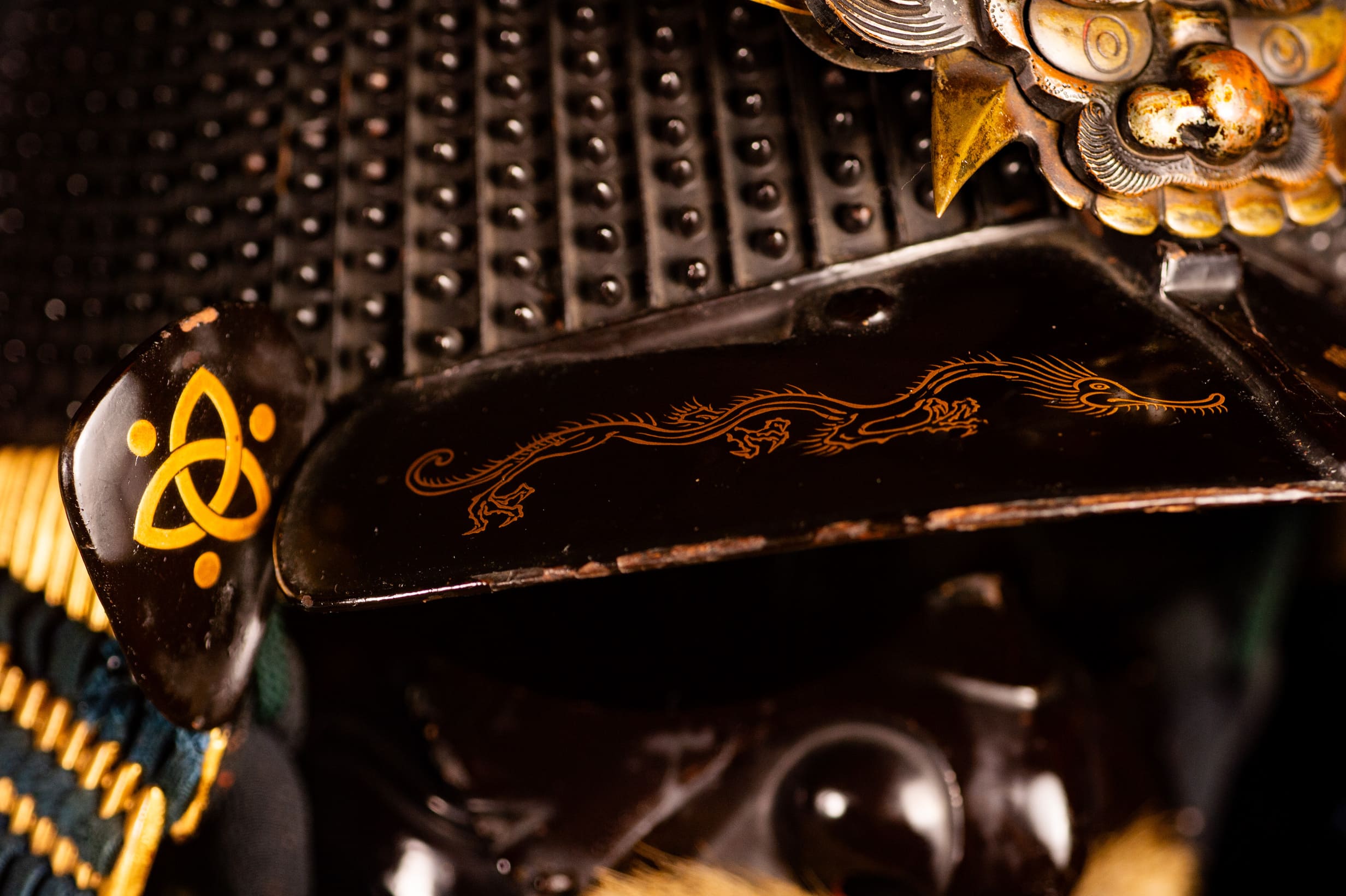
Mounted prominently at the front is an elegant pair of finely crafted gilt-brass kuwagata, whose graceful proportions immediately establish the helmet’s imposing appearance. Between them rises the frontal ornament, while below, the black rō-iro lacquered mabezashi is decorated with an exquisitely executed gold makie dragon. Painted with delicate brushwork, the dragon displays exceptional movement and refinement, demonstrating the collaboration between lacquer artists and armor craftsmen that characterises superior Edo-period commissions.
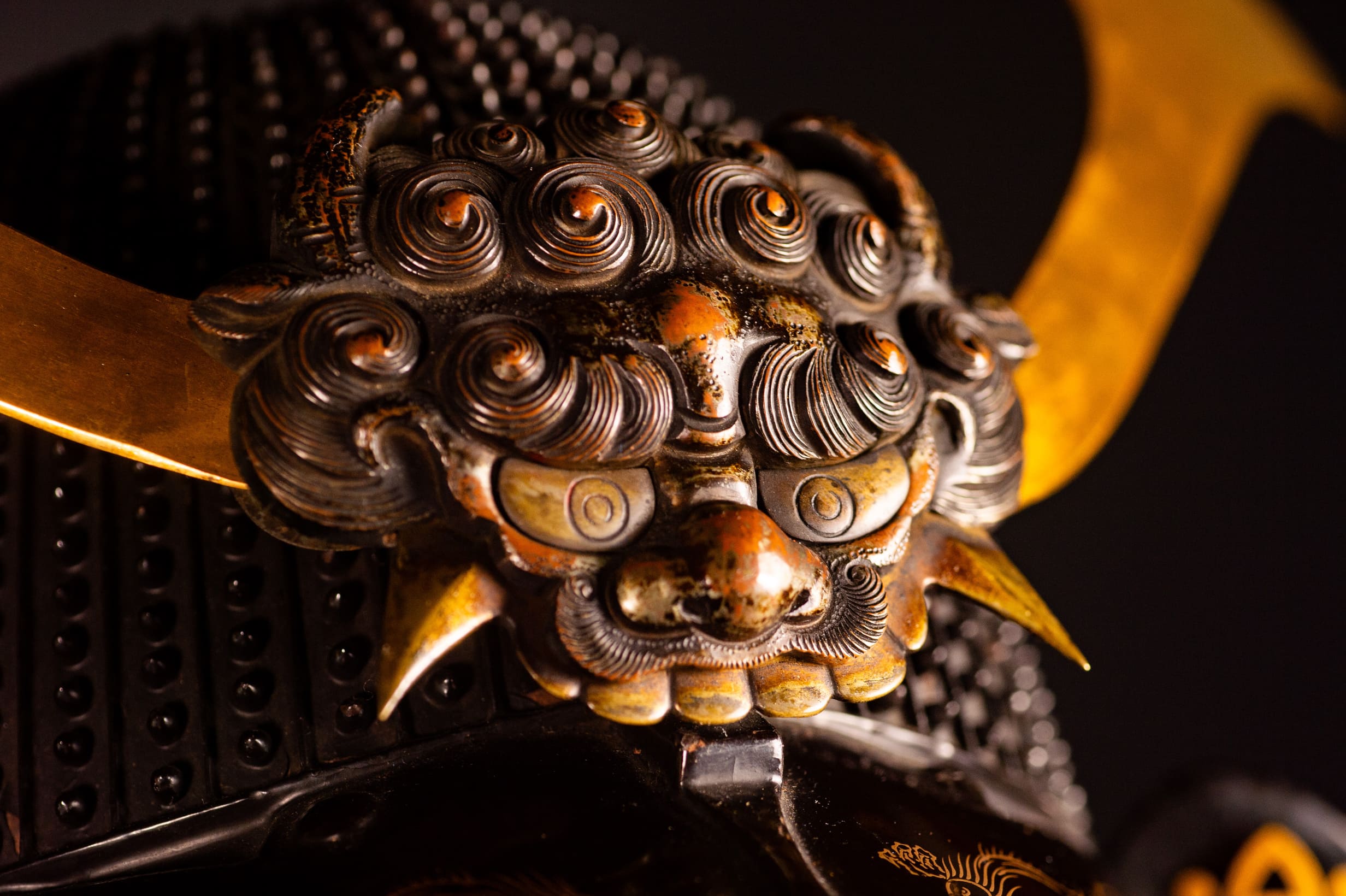
Perhaps the most remarkable sculptural feature of the helmet is the magnificent shishi mounted to its front. Executed in darkened repoussé metal, it exhibits extraordinary attention to detail, from the individually carved curls of its mane to its engraved circular pupils and finely gilded fangs. The modelling achieves an impressive sense of vitality and depth, making this one of the most artistically accomplished decorative elements of the entire armor. Beyond its decorative role, the shishi traditionally symbolised courage, vigilance and divine protection, qualities closely associated with the samurai warrior.
Completing the helmet is its elegantly constructed shikoro, whose lacquered lames descend in harmonious tiers joined by deep indigo silk lacing. The excellent preservation of both lacquer and odoshi contributes significantly to the remarkable visual coherence of the entire suit.
Accompanying the helmet is an exceptionally attractive iron menpō, finished in deep black lacquer and preserving many of the features most appreciated by collectors of Japanese armor.
The mask retains its original natural-hair moustache, while the lips are highlighted in rich vermilion lacquer, creating a vivid contrast against the dark surface of the face. Together with the carefully modelled cheeks and expressive contours, these details produce the fierce yet dignified expression traditionally intended to intimidate opponents while projecting the authority of the wearer.
The articulated jaw remains fully preserved, allowing the lower section of the mask to move naturally with the wearer while improving both comfort and ventilation. Such construction demonstrates the sophisticated engineering characteristic of high-quality Japanese armor, where practical functionality and artistic execution were never regarded as separate disciplines.
The lacquer finish of the menpō harmonises perfectly with that of the helmet and cuirass, contributing further evidence that the armor has remained together as a coherent ensemble rather than being assembled from unrelated components at a later date.
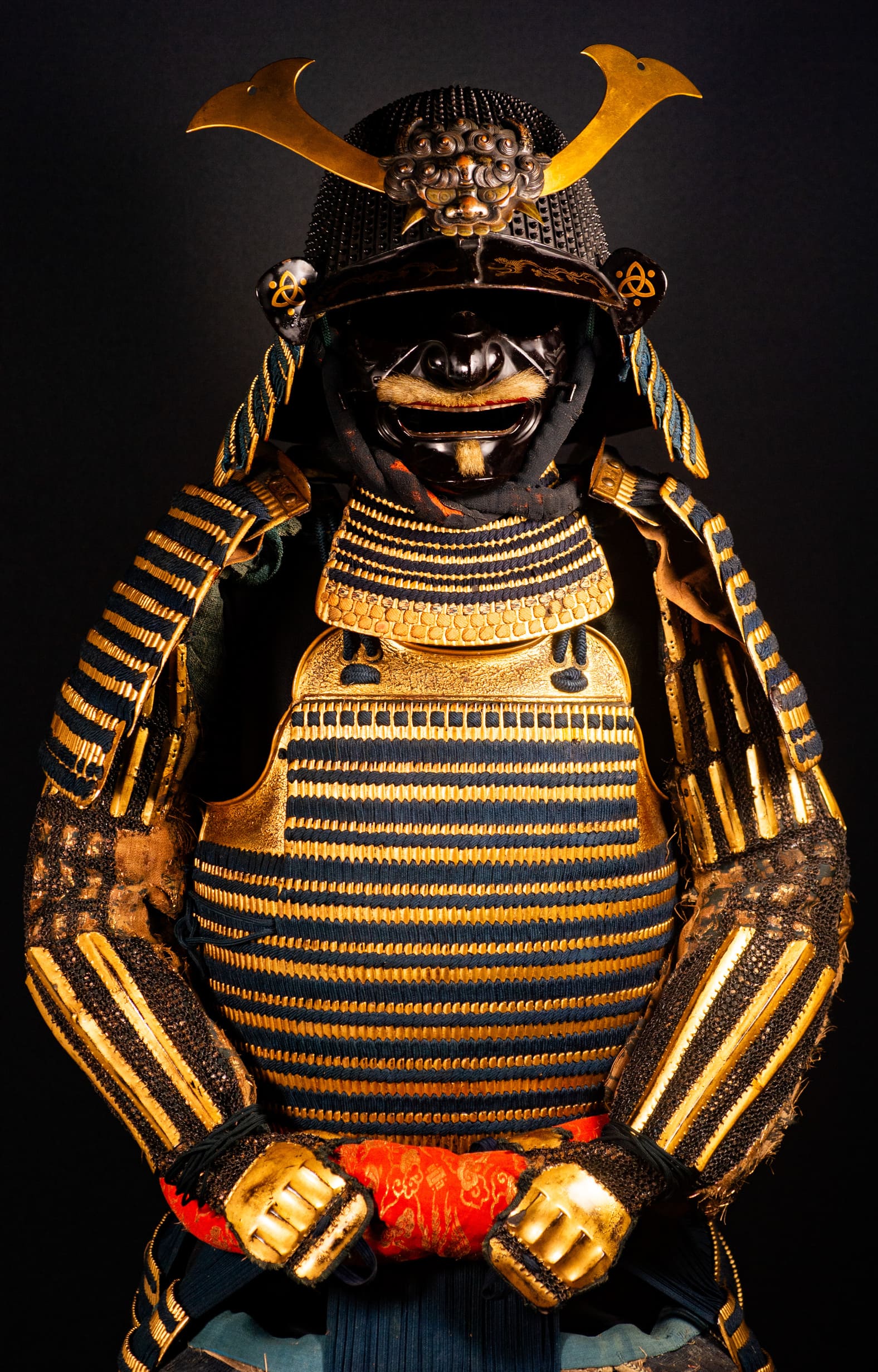
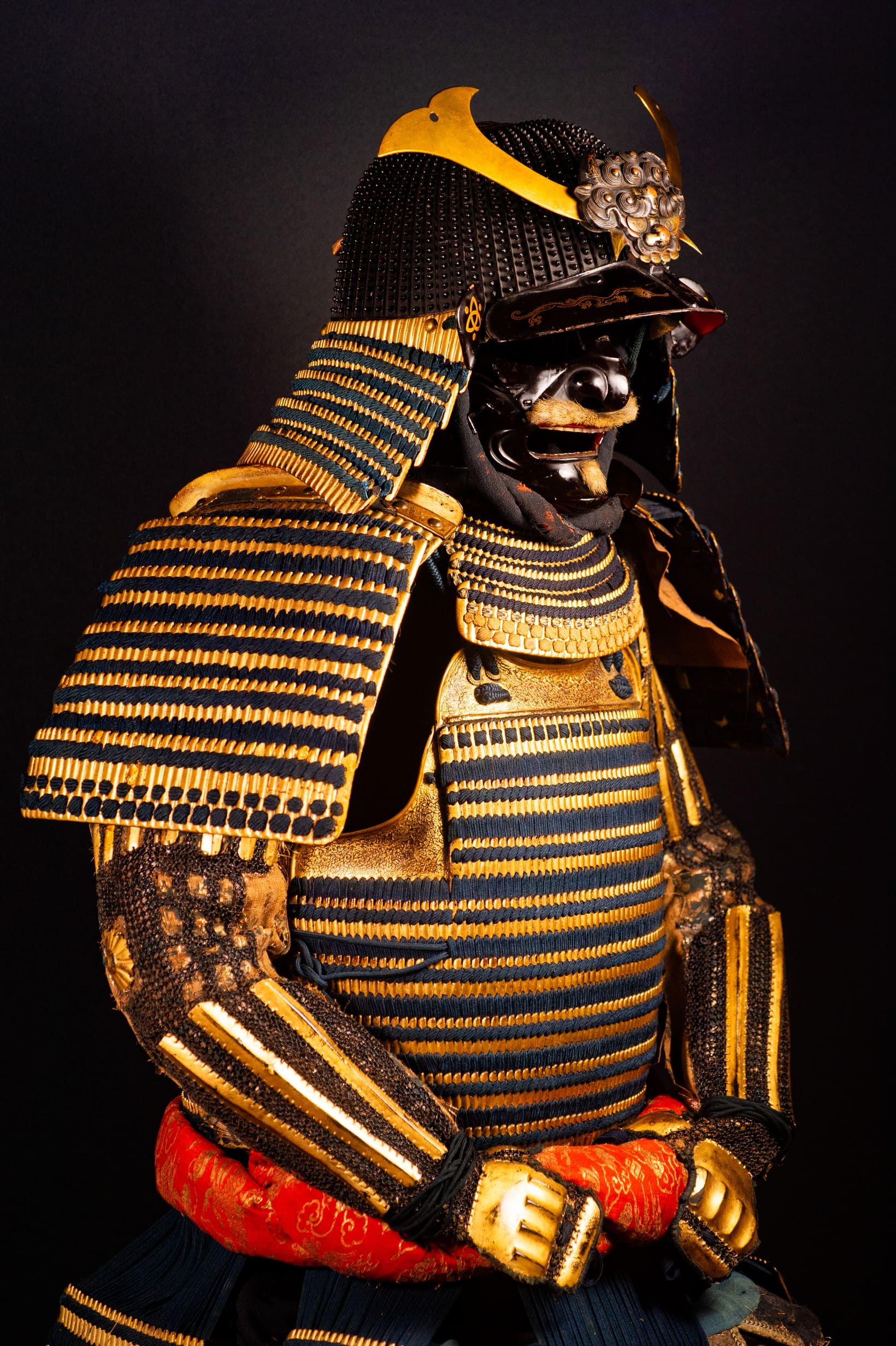
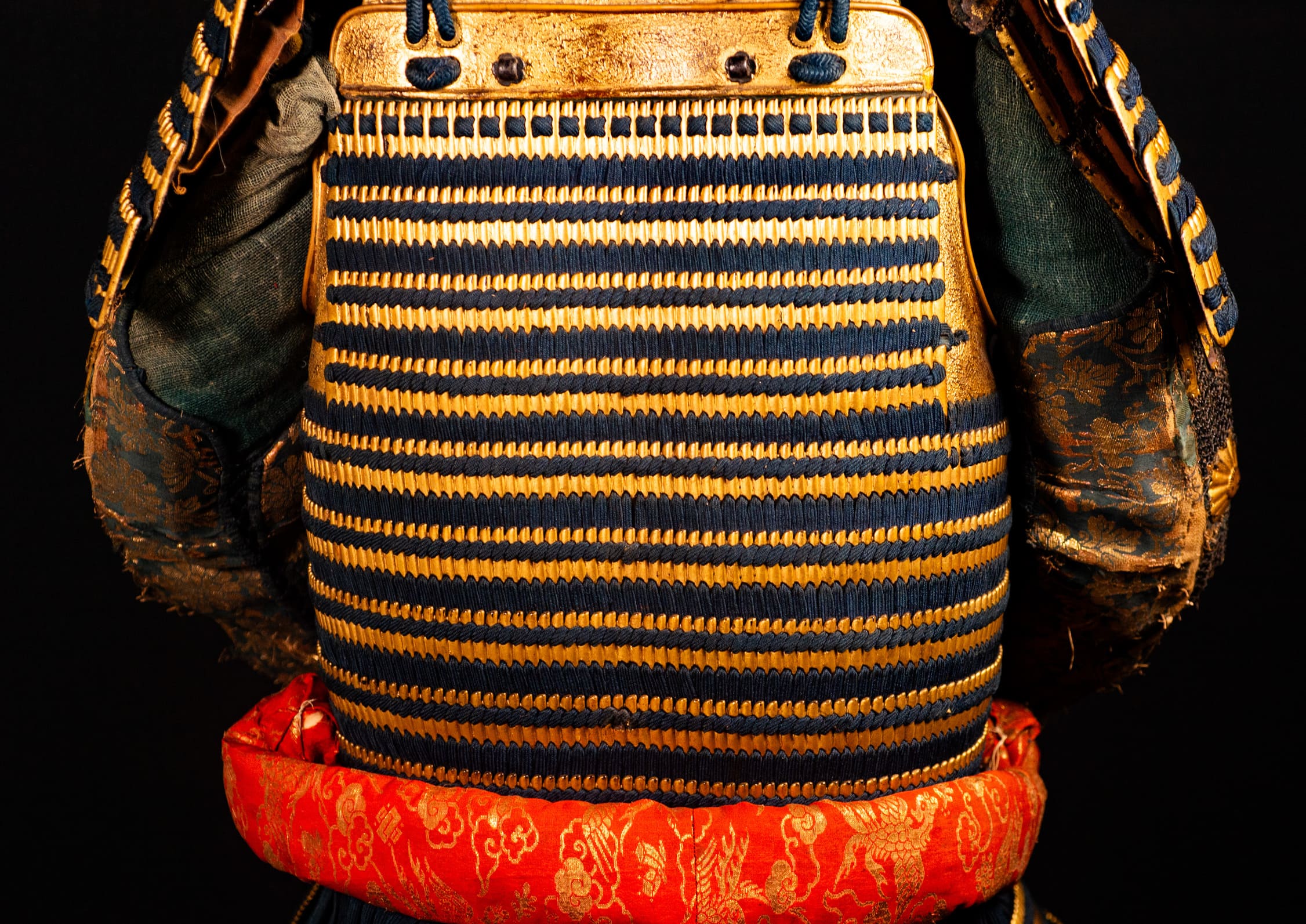
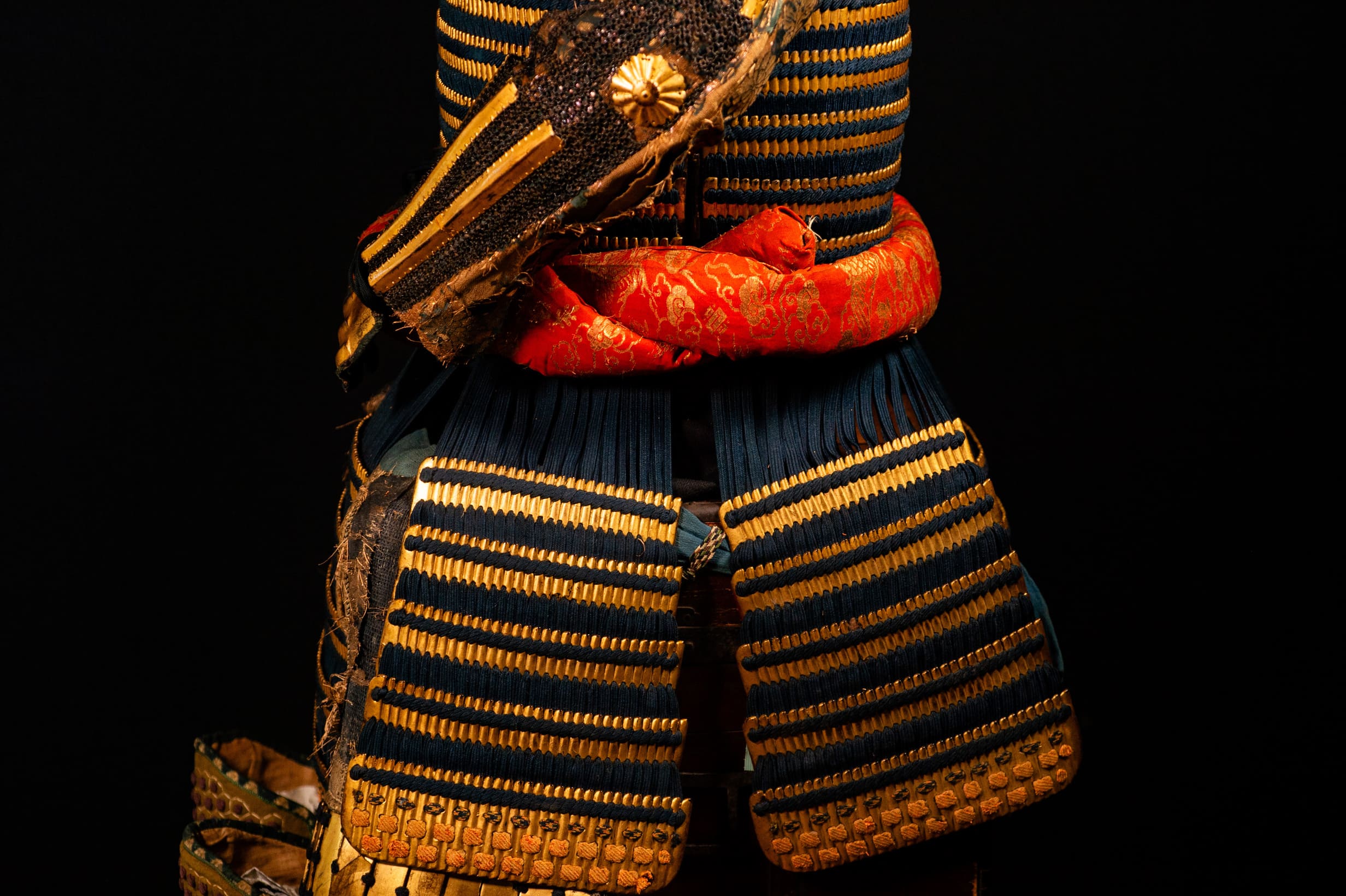
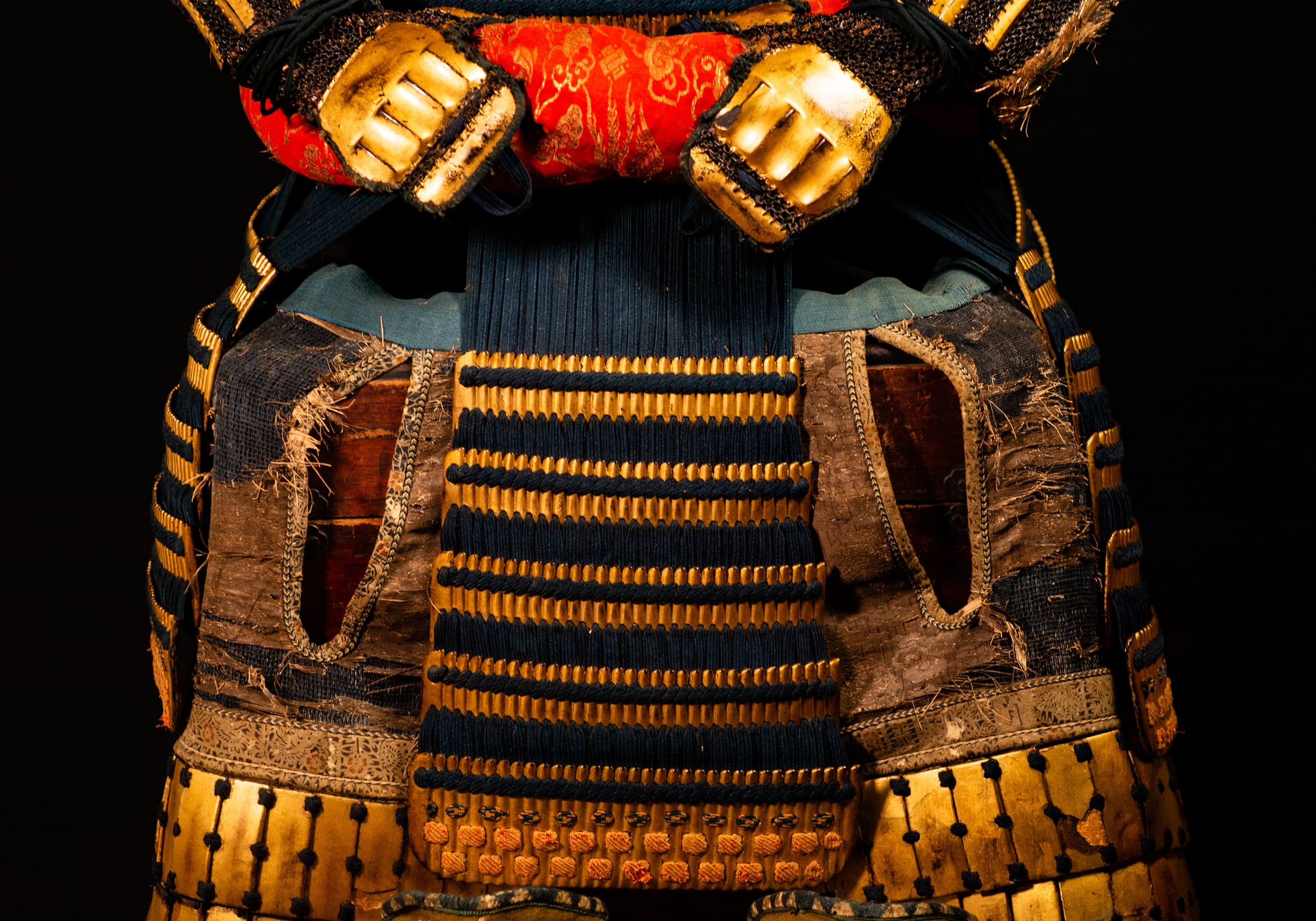
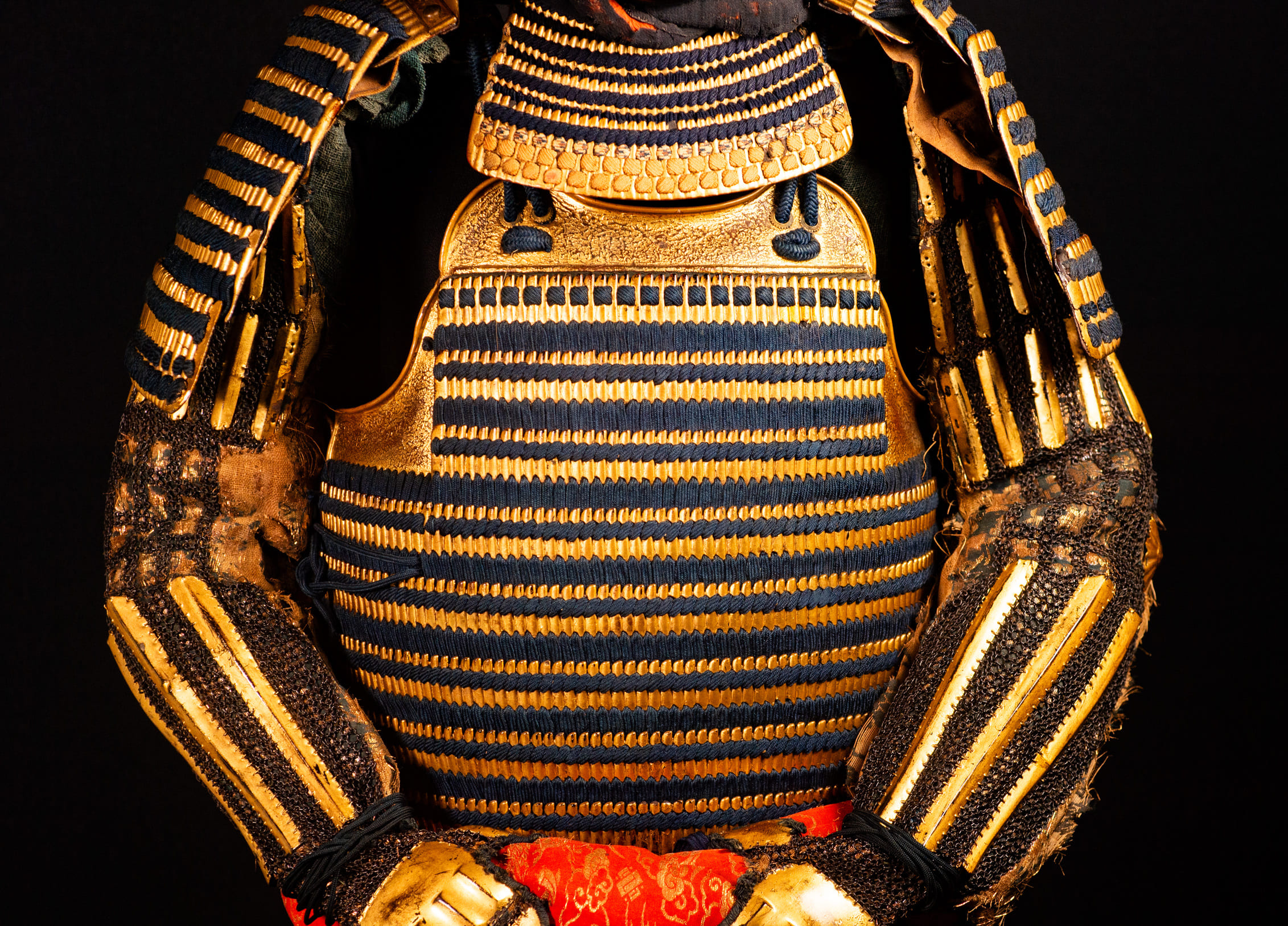
The cuirass is constructed in the classic nimai-dō configuration, formed from two principal hinged iron sections that provide excellent protection while allowing greater freedom of movement than earlier forms of lamellar armor. This style became one of the defining characteristics of early Edo-period military equipment and reflects the evolution of Japanese armor following the end of the Sengoku period.
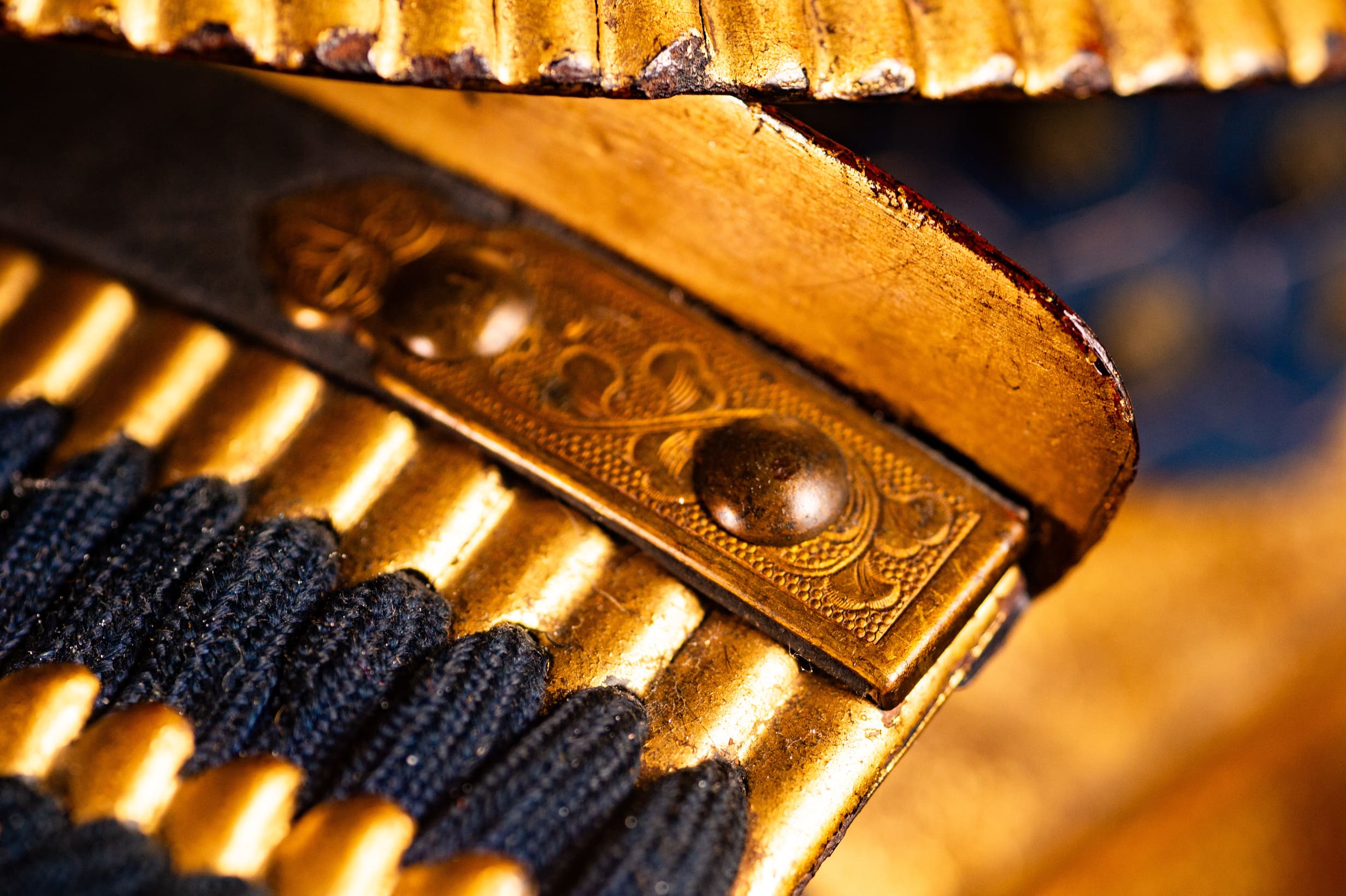
Its surface is composed of carefully assembled iron kozane finished with an elegant layer of beaten gold leaf (kinpaku-oshi), producing a refined metallic appearance that subtly changes under different lighting conditions. Rather than overwhelming the design, the gold finish enhances the armor’s sculptural quality while reflecting the elevated status traditionally associated with commissioned samurai equipment.
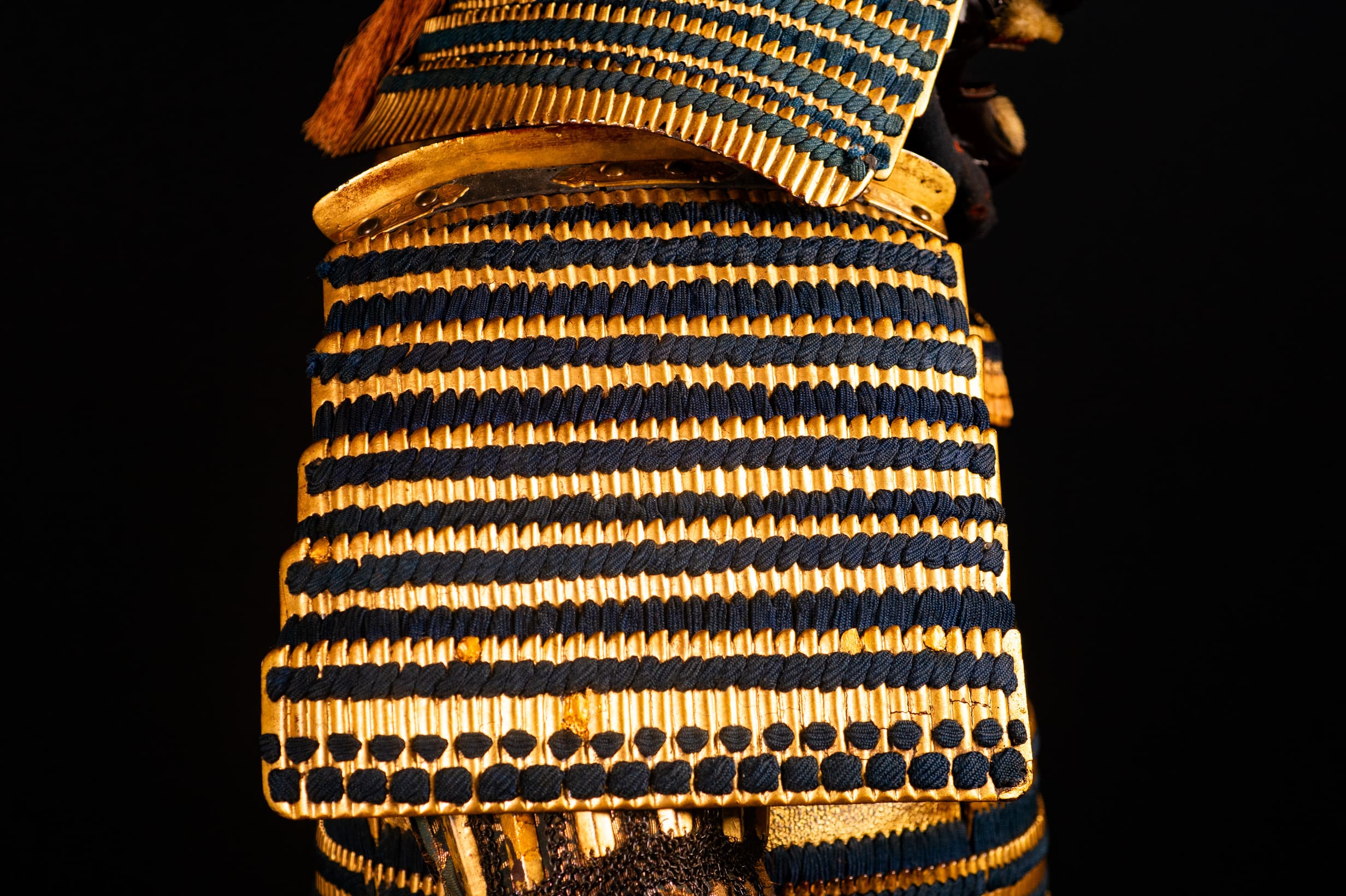
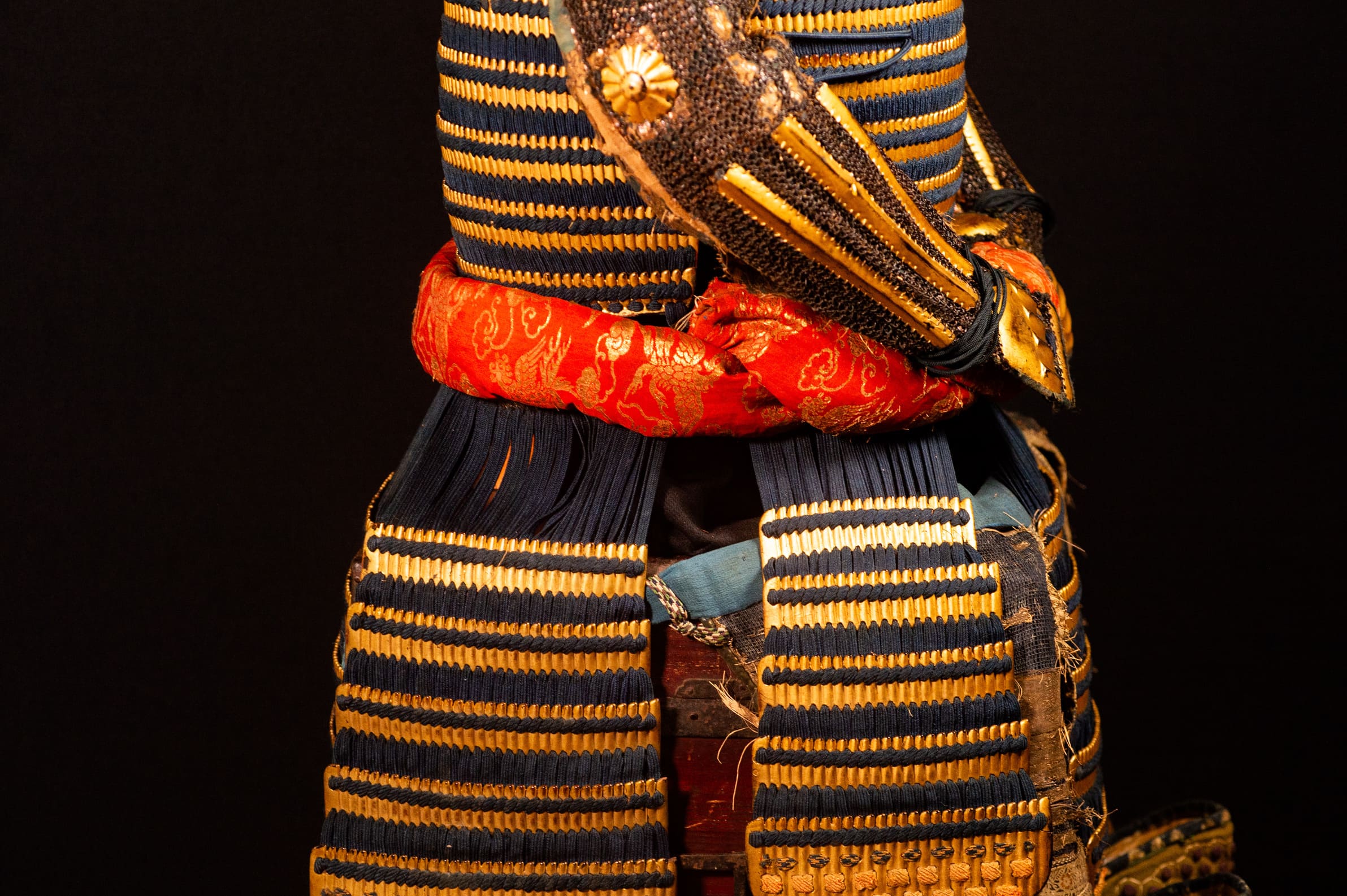
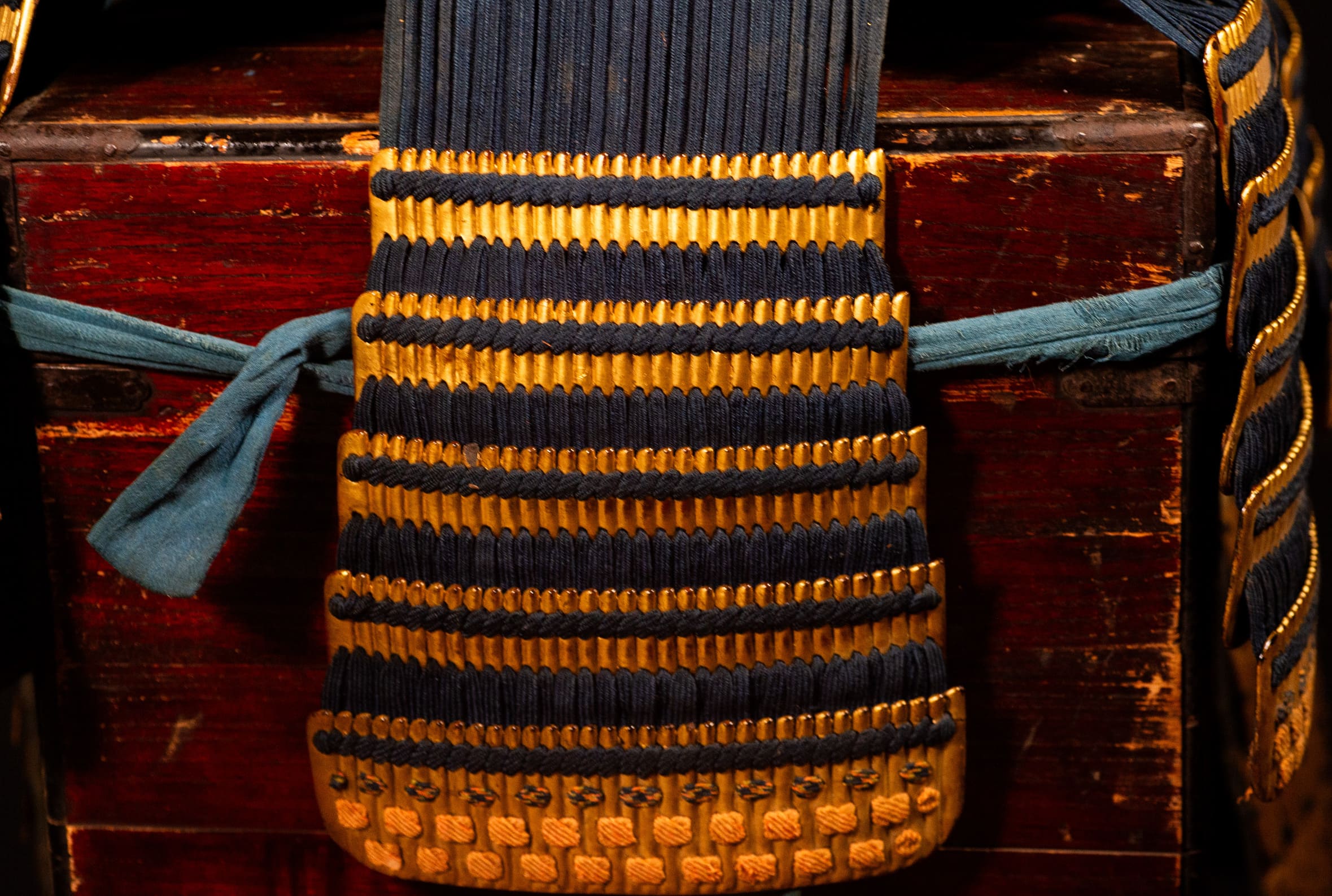
The entire cuirass is laced in deep indigo silk (kon-ito) following the traditional kebiki odoshi pattern, in which every lamella is connected with closely spaced rows of silk braid. This demanding technique required exceptional craftsmanship and remains one of the most admired lacing styles among collectors due to its elegance, structural strength and visual uniformity.
The harmonious relationship between the lacquer, gilt finish and indigo silk creates one of the armor’s most striking visual characteristics. Every material has aged consistently, producing the rich patina expected of an authentic early Edo-period gusoku while preserving the dignity and sophistication that distinguish superior examples of Japanese armor.
The large rectangular sode faithfully reproduce the construction and decorative language established throughout the armor. Formed from successive iron lamellae finished in black lacquer, they are joined by deep indigo kon-ito silk lacing executed in the traditional kebiki odoshi style, creating perfect visual continuity with the cuirass.
Their generous dimensions reflect the practical requirements of early Edo-period armor, offering extensive protection to the shoulders while remaining sufficiently flexible for mounted and dismounted combat. The quality of the lacquer and the remarkably consistent colour of the silk indicate that these components have remained associated with the armor for centuries, rather than representing later replacements.
The kote combine iron defensive elements with reinforced textile in the sophisticated manner characteristic of high-quality Edo-period armor. Articulated iron plates protect the forearms while sections of chainmail provide flexibility around the elbows, allowing unrestricted movement without compromising defensive performance.
Particularly noteworthy are the floral-patterned textile reinforcements visible beneath the arms and around the principal joints. Rather than modern replacements, these fabrics are entirely consistent with traditional period repairs, carried out during the armor’s active lifetime to reinforce areas subjected to the greatest mechanical stress. Their presence contributes positively to the historical authenticity of the ensemble, illustrating the practical maintenance expected of equipment intended for prolonged service.
The balance between rigid protection, flexible chainmail and textile reinforcement demonstrates the advanced engineering achieved by Japanese armor makers during the early Edo period.
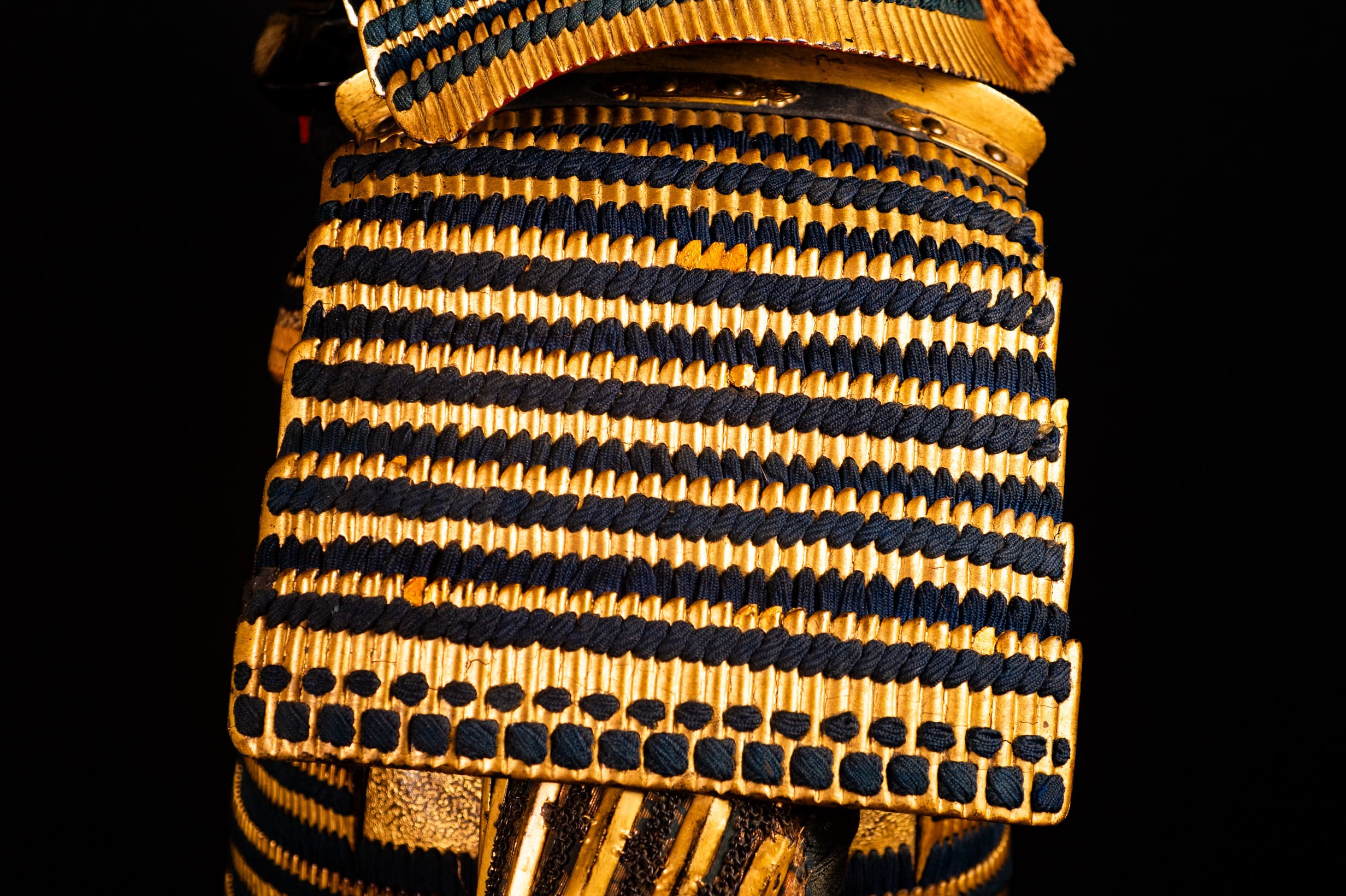
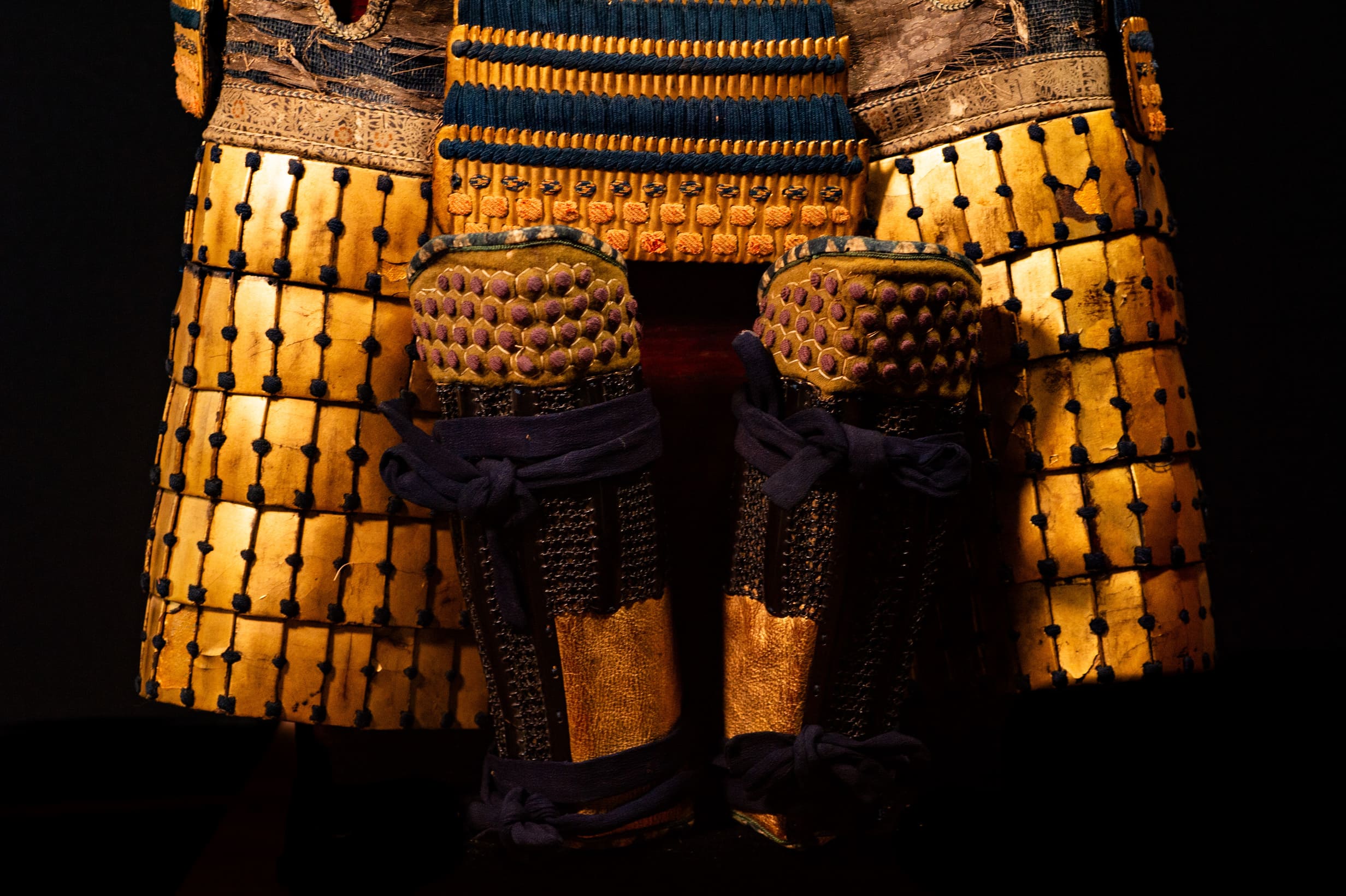
The haidate continue the unified construction of the armor through carefully arranged iron protective elements mounted upon durable textile foundations. Their flexible design ensured effective defence of the upper legs while allowing the wearer complete freedom of movement during combat.
As with the kote, areas of floral-patterned reinforcement appear in locations naturally subjected to repeated wear. These period repairs have aged harmoniously alongside the surrounding materials and should be understood as evidence of historical use rather than later restoration. Their preservation contributes to the remarkable integrity of the armor as a genuine working object rather than a reconstructed display piece.
The articulated suneate are constructed from vertically arranged iron splints carefully secured to textile backing, providing robust protection while maintaining excellent mobility. Their lacquer finish matches the remainder of the armor, while the indigo fastening cords preserve the chromatic harmony that characterises the entire ensemble.
The overall preservation of the lacquer and ironwork reflects centuries of careful storage and maintenance, with natural signs of age entirely consistent with a genuine early Edo-period suit of armor.
One of the most important features of this armor is the signature 家忠 (Ietada) engraved on the helmet bowl.
The name Ietada is historically documented among armor makers of the celebrated Saotomé School (早乙女), one of Japan’s foremost traditions of helmet manufacture. Founded by Saotomé Nobuyasu, himself a direct disciple of the renowned master Myōchin Nobuie, the school flourished in the former province of Hitachi and became particularly respected for the production of finely forged kabuto during the late Muromachi and early Edo periods.
Several generations of Saotomé craftsmen adopted names incorporating the character 家 (Ie), including Ietada, Ienari, Iesada and Iechika. Consequently, the present signature corresponds closely with the documented naming practices of the school rather than representing an isolated or uncertain attribution.
The robust construction of the hoshi-bachi, together with the sophisticated decorative program of the helmet, further supports its association with this distinguished lineage of armor makers.
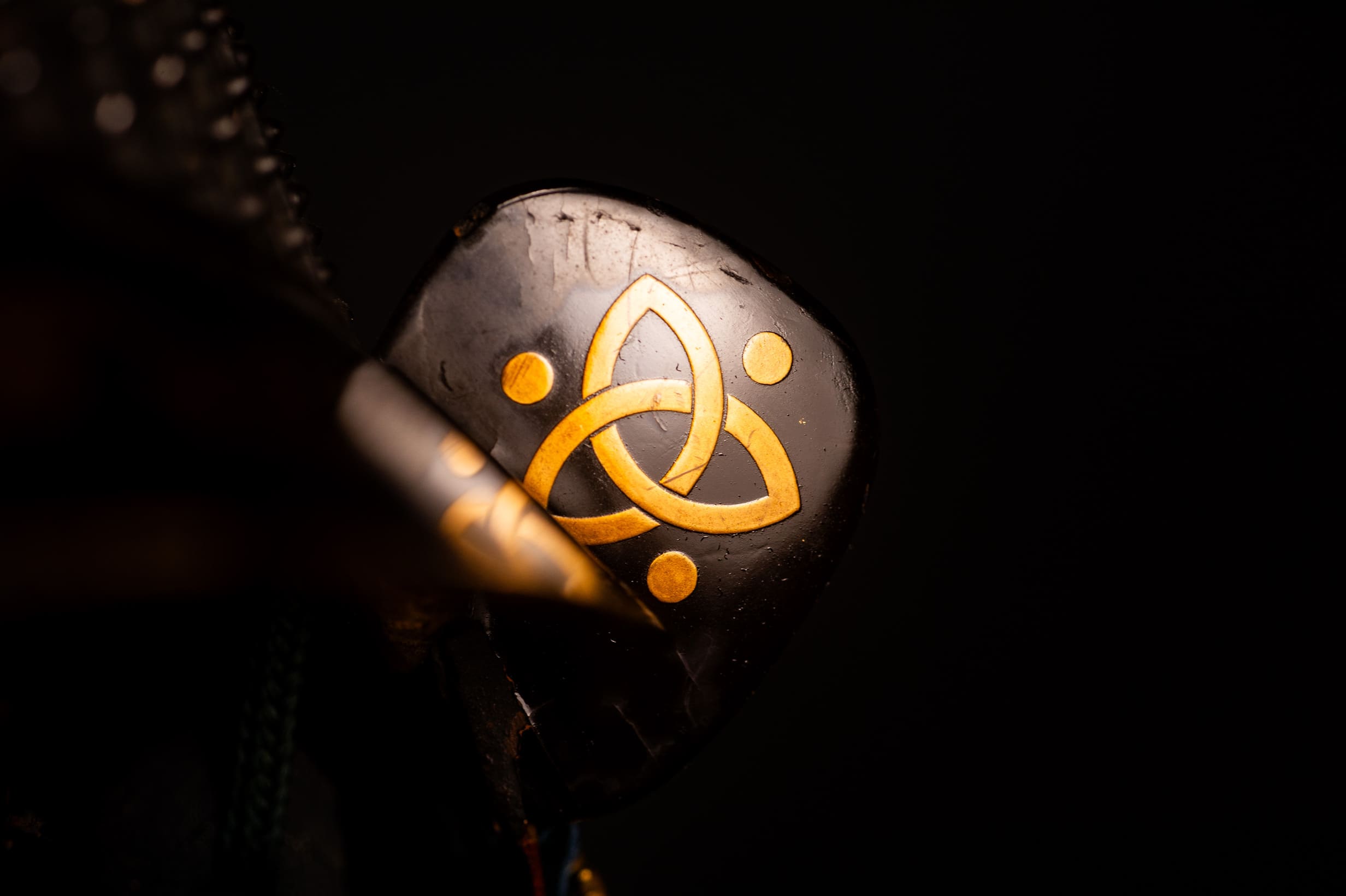
Displayed upon the fukigaeshi is an elegant family crest consisting of a three-lobed knot accompanied by three smaller circular elements.
Its closest identification corresponds to the Kashiwa (柏) family of crests, most probably the Musubi-gashiwa (結柏) variation. Originating in Shinto ritual symbolism, the Kashiwa motif became widely adopted by shrine families, regional administrators and several samurai lineages throughout Japan.
Although the crest is fully compatible with the historical context of the Saotomé School and the Hitachi region in which it flourished, it should not be interpreted as conclusive evidence for ownership by a specific clan without dedicated specialist examination. Nevertheless, its presence enriches the historical identity of the armor while preserving an authentic heraldic element from its original period of use.
This armor belongs to the formative decades of the Edo period, an era during which Japan entered more than two centuries of relative peace under Tokugawa rule. While large-scale warfare gradually disappeared, the samurai retained their social status and continued to commission armor of exceptional quality, not only for military preparedness but also for ceremonial processions, official duties and expressions of family prestige.
The nimai-dō construction embodied this transition perfectly. It preserved the practical functionality required by professional warriors while allowing armor makers greater freedom to refine proportions, lacquer finishes, decorative metalwork and silk lacing. As a result, early Edo armors often represent the highest point of artistic development achieved by Japanese armor craftsmanship.
The present gusoku exemplifies this balance between functionality and artistic excellence. Its refined materials, exceptional sculptural ornamentation, documented signature and coherent preservation illustrate the remarkable level of craftsmanship attained by the Saotomé tradition during one of the most sophisticated periods of Japanese military art.
One of the most compelling aspects of this armor is the exceptional documentary support accompanying it. Beyond its artistic and historical qualities, the ensemble is backed by both an official modern appraisal and an important eighteenth-century genealogical document, providing a rare level of provenance seldom encountered in the market for Japanese armor.
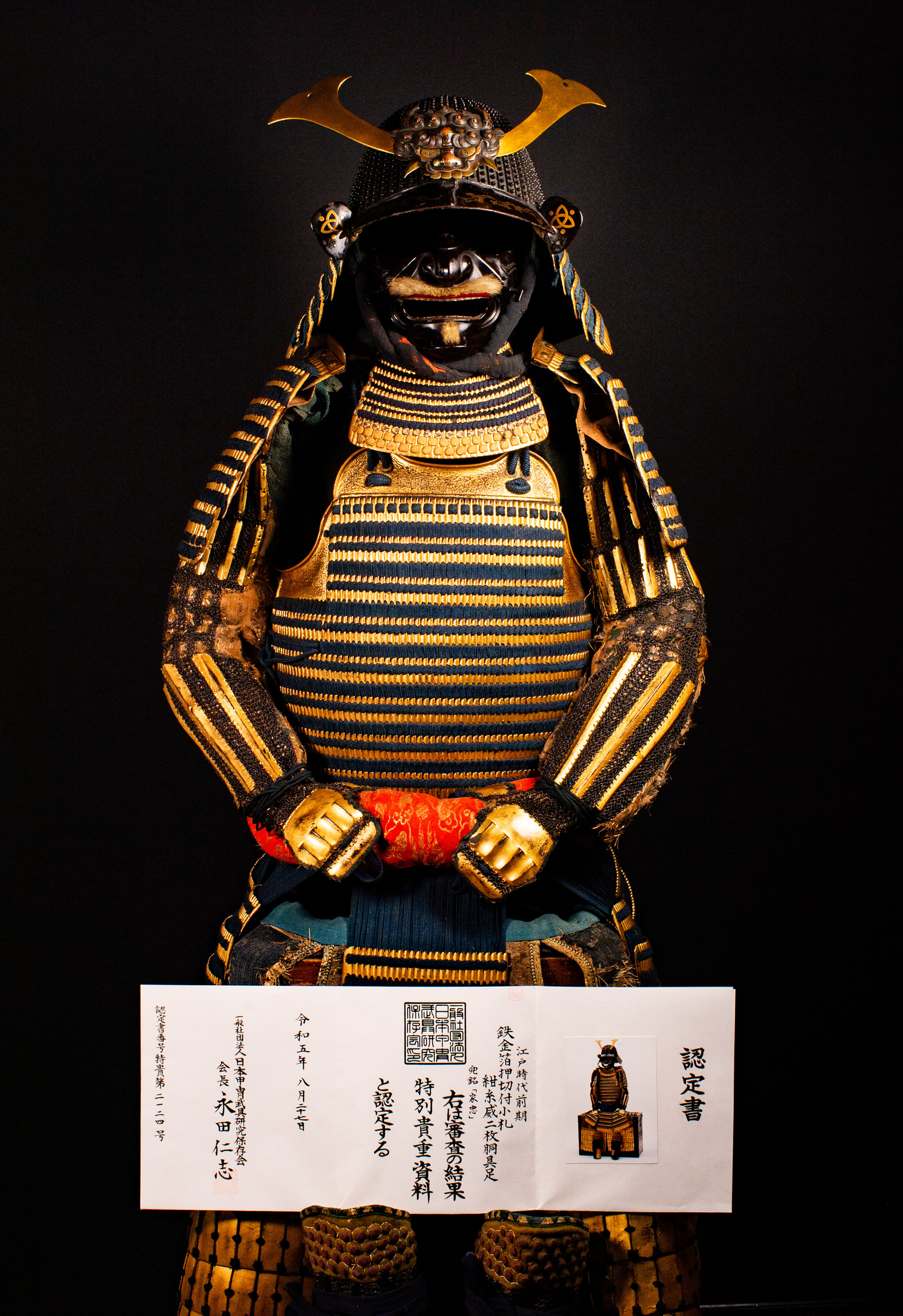
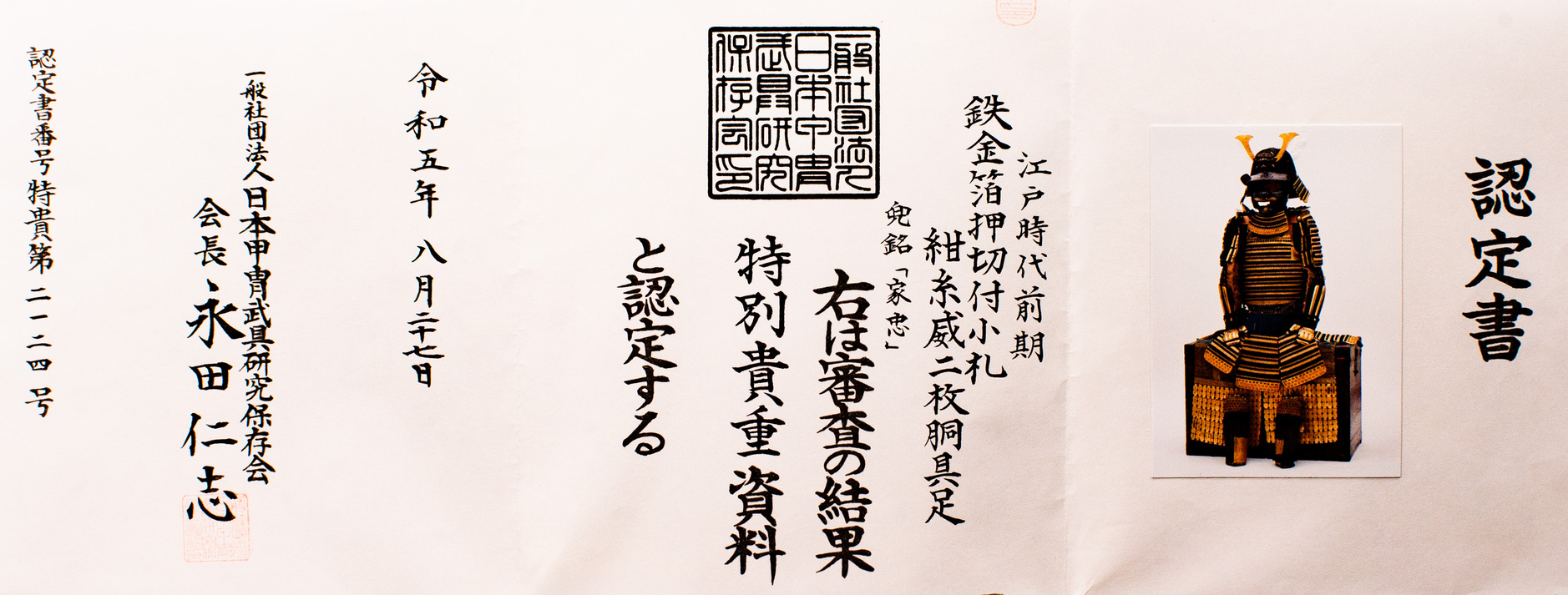
The armor is accompanied by a certificate issued by the Nihon Katchū Bugu Kenkyū Hozonkai (日本甲冑武具研究保存会), the Japanese Society for the Research and Preservation of Arms and Armor. Established in 1961 and officially recognised by the Japanese Ministry of Education, the organisation is regarded as Japan’s principal authority dedicated exclusively to the study, authentication and preservation of traditional Japanese armor.
On 27 August 2023, the armor was classified as Tokubetsu Kichō Shiryō (特別貴重資料), or Special Valuable Historical Material. This designation represents the third level within the Society’s five-tier appraisal system and confirms that the armor possesses verified historical significance, authenticity and preservation worthy of formal recognition.
While this classification does not represent the highest level of certification available, it nevertheless constitutes an important endorsement issued by one of the most respected specialist organisations in Japan and significantly reinforces the historical credibility of the piece.
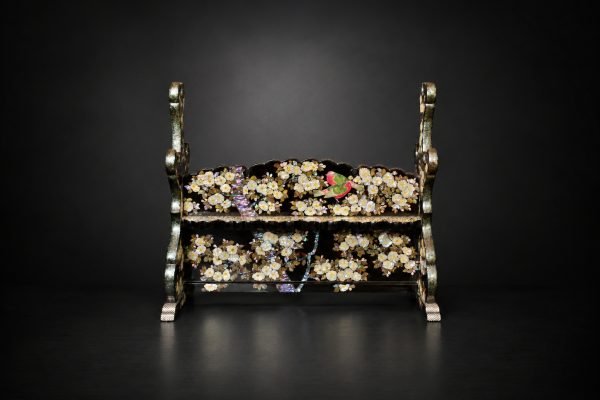
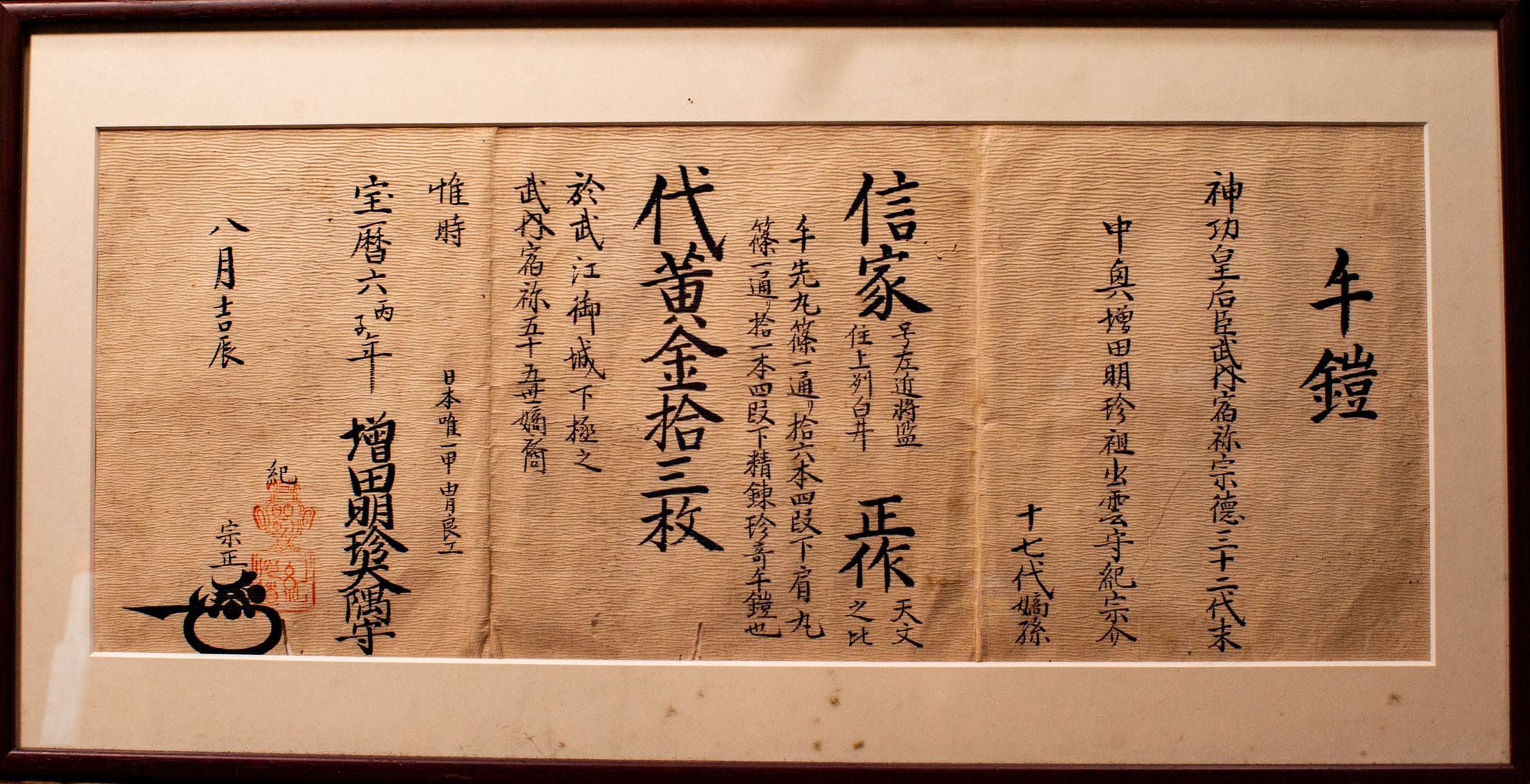
Accompanying the armor is an exceptionally interesting genealogical scroll dated Hōreki 6 (1756), recording the lineage of the Saotomé School from the semi-legendary ancestor Takenouchi no Sukune through successive generations to the celebrated master Myōchin Nobuie, identified with his historically documented title of Sakon no Shōgen during the Tenbun era.
Rather than serving as a manufacturing certificate for the present armor, the scroll should be understood as a traditional lineage document (keifu) issued to preserve the prestige and continuity of one of Japan’s great armor-making traditions. Such documents were maintained by major workshops to demonstrate the legitimacy of their hereditary transmission and professional authority.
Its importance lies in the fact that it independently corroborates the historical existence of the lineage to which the helmet’s signature is attributed. Together with the documented use of the name Ietada within the Saotomé School, the scroll provides valuable contextual support that substantially strengthens the proposed attribution without relying upon unsupported assumptions or modern speculation.
The convergence of the signed helmet, the documented school, the eighteenth-century lineage record and the modern appraisal certificate creates an unusually coherent documentary framework that is rarely encountered in complete Edo-period armors.
The armor remains in an excellent state of preservation considering its age of nearly four centuries.
The lacquer survives remarkably well across the helmet, cuirass and all principal iron components, retaining its rich depth and visual harmony throughout the ensemble. The gilt decorative elements continue to provide elegant contrast against the black lacquer, while the indigo silk lacing preserves its balanced appearance across every section of the armor.
Minor evidence of historical use is naturally present, particularly within certain textile reinforcements of the kote and haidate. These areas correspond to locations historically subjected to the greatest wear and are entirely consistent with traditional period repairs rather than modern intervention.
Most importantly, no evidence suggests that the armor has been artificially reconstructed from unrelated components. The remarkable consistency of materials, lacquer, construction techniques and silk lacing strongly indicates that the ensemble has remained together throughout its history, a characteristic increasingly difficult to find among surviving Japanese armors.
Complete Edo-period samurai armors are increasingly scarce, yet examples combining documented authorship, coherent construction and official authentication remain exceptionally rare.
This armor distinguishes itself through several remarkable characteristics. The signed Ietada helmet places it within the documented production of the prestigious Saotomé School, one of Japan’s foremost traditions of helmet manufacture. The overall consistency of the ensemble strongly indicates that it has not been assembled from unrelated components, preserving the historical integrity sought by advanced collectors.
Its official Tokubetsu Kichō Shiryō certification independently confirms its authenticity and historical importance, while the accompanying eighteenth-century genealogical scroll provides an additional layer of documentary context seldom found alongside an individual suit of armor.
Artistically, the armor displays an exceptional balance between refined craftsmanship and martial functionality. The beautifully sculpted shishi, elegant gold makie dragon, beaten gold cuirass and harmonious indigo silk lacing create an ensemble of remarkable visual presence without sacrificing historical authenticity.
For collectors seeking museum-quality Japanese armor supported by substantial documentary evidence rather than solely aesthetic appeal, this gusoku represents an outstanding acquisition and an increasingly uncommon opportunity within today’s international market.
Representing the finest traditions of early Edo-period armor making, this magnificent signed Saotomé School gusoku combines historical authenticity, artistic excellence and exceptional documentary provenance. Its coherent preservation, official Tokubetsu Kichō Shiryō certification, eighteenth-century genealogical scroll and beautifully executed craftsmanship elevate it far beyond the majority of surviving samurai armors, making it a truly important collector’s piece worthy of the most distinguished collections of Japanese arms and armor.
| Época | Edo |
|---|

Order above 1.000,00 € gets free shipping.

Secure and hassle-free payment process.

Certificate of authenticity included.

Have questions? Contact us via WhatsApp.
Contact