November 8, 2026
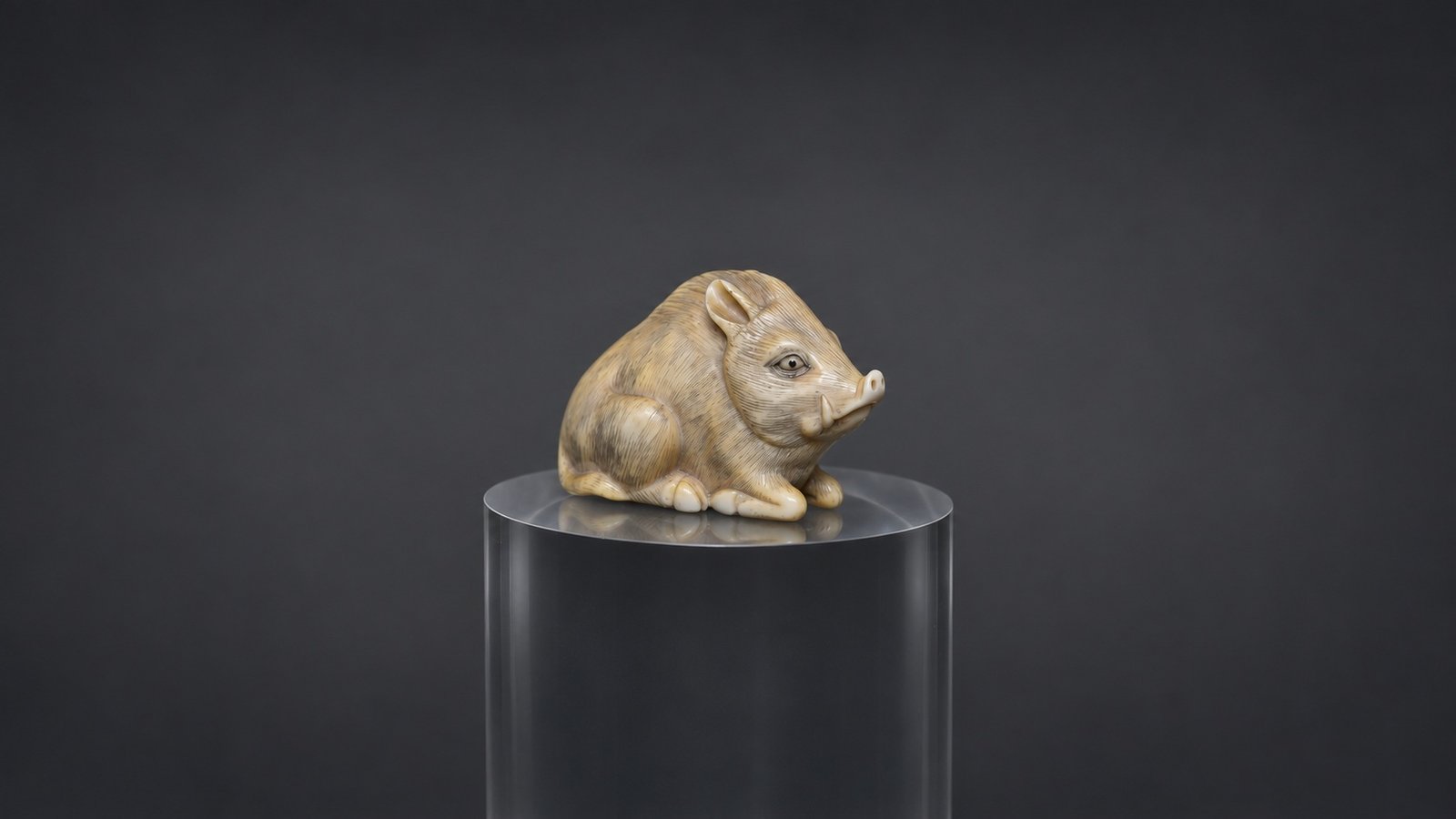
At first glance, this netsuke is very simple.
A wild boar is lying down.
There is no dramatic scene, no human figure, no mythological creature and no complicated narrative to decode.
But that simplicity is precisely what makes the piece interesting.
The animal is completely at rest. Its body has been compressed into a low, compact shape, the legs drawn inward and the mass of the torso forming most of the sculpture. Brown-stained details settle into the carving and help define the surface against the lighter ivory.
And beneath it is a signature:
“Gyokuseki.”
The piece dates to the Meiji period and measures only 5 × 3 × 2 cm.
But why would someone choose a wild boar as the subject for something as personal as a netsuke?
The answer takes us into Japanese ideas about animals, the zodiac, courage, good fortune and even the symbolic meaning of a sleeping or reclining boar.
The wild boar has been a familiar animal in Japan for centuries.
Unlike dragons or mythical beasts, it belonged to the landscape people actually knew. It was powerful, difficult to control and potentially dangerous.
That physical character naturally shaped the way the animal was understood.
The Metropolitan Museum of Art describes the boar, the twelfth animal of the zodiac, as traditionally associated with a kind of fearless or even reckless courage.
That makes sense when we think about the animal itself.
A wild boar is not a delicate creature.
It has a heavy body, tremendous physical determination and a reputation for continuing forward rather than retreating.
But Japanese artists did not always represent that energy through movement.
Sometimes they did exactly the opposite.
They showed the boar asleep.
That is what makes this particular netsuke so appealing to me.
The animal is powerful, but nothing in the carving needs to prove it.
The boar is simply lying down.
There is something almost paradoxical about that image.
An animal associated with courage and force is shown completely at rest.
The Metropolitan Museum has another netsuke showing a sleeping boar hidden among autumn grasses. Its curators make the same observation: although the boar traditionally possessed associations with reckless courage, its closed eyes transform it into something unexpectedly gentle and defenseless.
That contrast appears again and again in Japanese animal art.
Strength does not always have to be represented through aggression.
Sometimes the fact that a powerful animal can rest completely undisturbed says just as much.
There is another reason the boar was an obvious subject for netsuke carving.
It belongs to the twelve-animal zodiac.
The cycle consists of the rat, ox, tiger, hare, dragon, snake, horse, sheep, monkey, rooster, dog and finally the boar.
These animals were not simply decorative signs. They were used to represent years, but historically they could also relate to hours, days and directions.
And this zodiac system had a direct relationship with netsuke.
According to the Metropolitan Museum, netsuke representing zodiac animals had become popular by the late eighteenth century, and it was considered fortunate to wear a netsuke representing the animal associated with the year in which a person had been born.
That gives us a very practical answer to the question:
Why carve a boar as a netsuke?
Because the subject could have personal meaning.
A boar was not merely an animal sculpture.
For someone born in the Year of the Boar, it could become an object directly connected with personal identity and good fortune.
This is important because today we normally encounter netsuke inside cabinets, auction catalogues and collections.
Originally, they were worn.
Traditional Japanese clothing did not contain pockets in the Western sense. Small containers such as inrō, tobacco pouches and other personal objects could therefore be suspended from the obi by a cord.
The netsuke acted as the toggle that prevented the cord from slipping through the sash.
That functional origin changes the way I look at animal netsuke.
Imagine choosing one.
It would not simply sit somewhere in your house.
You would handle it.
You would feel its shape.
You would see it regularly.
And other people could see the object you had chosen to wear.
Netsuke therefore became more than practical devices. They also became personal ornaments through which taste, humor, interests and cultural references could be expressed.
A zodiac animal fits perfectly into that world.
There is an even more specific tradition connected with the reclining boar.
Japan Search, drawing on material from the Tokyo National Museum, explains that representations of a boar lying or sleeping acquired auspicious associations in Japanese art.
Wordplay around the written expression for the reclining boar allowed artists to connect the image with character combinations suggesting prosperity and longevity, and with another expression associated with pacification and stability.
By the late Edo period, the reclining boar could therefore appear as an auspicious image associated with hopes for peace and tranquility.
That gives the pose a completely different dimension.
A standing or charging boar can communicate physical energy.
A reclining boar can suggest something more subtle:
strength at peace.
Again, I would be careful here.
We cannot say that the person who carved this particular Meiji netsuke definitely intended every one of those meanings.
There is no document attached to the piece telling us what the carver was thinking.
But the broader cultural tradition helps us understand why this pose was meaningful and why Japanese artists repeatedly returned to it.
I particularly like the tension between the two ideas.
On one side, the boar is associated with courage.
On the other, the animal is sleeping or resting.
Normally we expect courage to be represented through action: a warrior with a sword, an animal charging, a dramatic confrontation.
Here there is none of that.
The boar does not need to move.
Its compact body still communicates weight and physical presence.
Perhaps that is one reason this animal works so well as a netsuke.
Its natural body shape lends itself beautifully to the form.
A netsuke had to work physically.
An object with long, fragile projections would have been inconvenient to wear.
Compact animals therefore offered carvers a very useful sculptural solution.
A reclining boar can be reduced almost naturally into a rounded mass.
The legs can remain close to the body.
The head can integrate into the overall silhouette.
The back creates one continuous curve.
Nothing needs to project very far from the object.
The result is both visually satisfying and practical.
We can see this same tendency in historical examples preserved by museums. The Metropolitan Museum has a wooden boar netsuke with its body compressed into a similarly low resting form, while LACMA preserves several boar netsuke using equally compact compositions.
That is one of the fascinating things about netsuke.
Function and sculpture often become almost impossible to separate.
Returning to the Supein Nihonto piece, the first thing I notice is the horizontal structure.
At 5 × 3 × 2 cm, it is longer than it is tall.
That works naturally with the reclining posture.
The animal’s body provides most of the volume, while the head and folded limbs remain integrated into the composition.
There is very little wasted space.
And that is exactly what I like about it.
The subject has been reduced to the essentials without losing the impression of the animal.
The piece is carved from ivory, with brown staining used to emphasize parts of the carving.
This matters on such a small object.
When everything is only a few centimeters across, even minor changes in tone can make a substantial difference to how the surface is read.
The darker color settles into the carved recesses.
The lighter ivory remains more visible on raised areas.
The result increases the sense of depth without requiring exaggerated carving.
It allows details to become clearer when the netsuke is turned in the hand or viewed under changing light.
The base bears the signature “Gyokuseki.”
I prefer to describe it exactly that way.
Signed “Gyokuseki.”
A signature is an important part of a netsuke, but a signature alone should not automatically become an attribution to a specific historical carver without further supporting evidence.
That distinction is important, particularly with Japanese decorative arts where names could be repeated, adopted or imitated.
The signature remains part of the history of the object.
We simply do not need to make it say more than it does.
This piece dates to the Meiji period, which makes its story particularly interesting.
The Meiji Restoration of 1868 transformed Japanese society dramatically.
As Western clothing gradually became more common and traditional modes of dress changed, the everyday practical role of netsuke began to decline.
At the same time, Western collectors developed an enormous interest in Japanese decorative arts.
The Metropolitan Museum notes that during the late nineteenth century, netsuke increasingly moved from their original role as functional and fashionable accessories toward becoming objects of art collected for their carving and miniature scale.
So a Meiji netsuke exists in an interesting transitional world.
It still belongs to a tradition created around practical wearable objects.
But it also belongs to a period when netsuke were increasingly appreciated simply as sculpture.
That may help explain why Meiji carvings can place so much attention on surface, expression and detail.
This is perhaps the part of the story I find most interesting.
Japan was changing enormously during the Meiji period.
Yet artists continued carving subjects that belonged to a much older visual vocabulary.
The zodiac did not disappear.
Animal symbolism did not disappear.
The wild boar did not disappear.
The function and audience of netsuke could change, while the stories contained inside them remained recognizable.
This small ivory boar therefore sits between two worlds.
A traditional zodiac animal.
An old auspicious subject.
A miniature sculpture belonging to the culture of the obi and inrō.
And at the same time, a Meiji-period object made during the moment when netsuke were becoming internationally collected artworks.
So if somebody asks why a Japanese artist would choose a wild boar for a netsuke, there is no single answer.
Because it is one of the zodiac animals.
Because zodiac netsuke could have personal and auspicious meaning.
Because the boar was associated with courage.
Because the reclining animal had its own auspicious associations with peace, stability and longevity.
Because its compact body is almost naturally suited to the physical form of a netsuke.
And perhaps simply because a skilled carver could take an animal everybody recognized and give it personality in only a few centimeters.
That last reason should not be underestimated.
Not every netsuke needs to contain a complicated hidden message.
Sometimes observing an animal well was enough.
For me, that is ultimately what makes this particular piece interesting.
It does not show the wild boar charging through a forest.
It does not show a hunt.
There is no confrontation.
The animal simply rests.
Yet because we know something about the cultural history surrounding the boar, the image becomes richer.
The animal associated with courage has become quiet.
The powerful body has folded inward.
A potentially dangerous creature has been transformed into an object small enough to fit in the palm of a hand.
And a subject rooted in the Japanese zodiac and older traditions survives in a Meiji-period miniature sculpture only 5 centimeters long.
That ability to compress an animal, a cultural reference and a small piece of history into something so physically modest is one of the reasons netsuke remain so fascinating.
For anyone discovering these objects for the first time, our guide to what a netsuke is and how it was originally used provides a broader introduction to their history, function and evolution.
And this reclining wild boar is a particularly good reminder that even the quietest netsuke can have a much bigger story behind it.
CEO of SupeinNihonto, dealer and collector of ancient Japanese art and weapons from Canillo, Andorra.
Contact