November 8, 2026
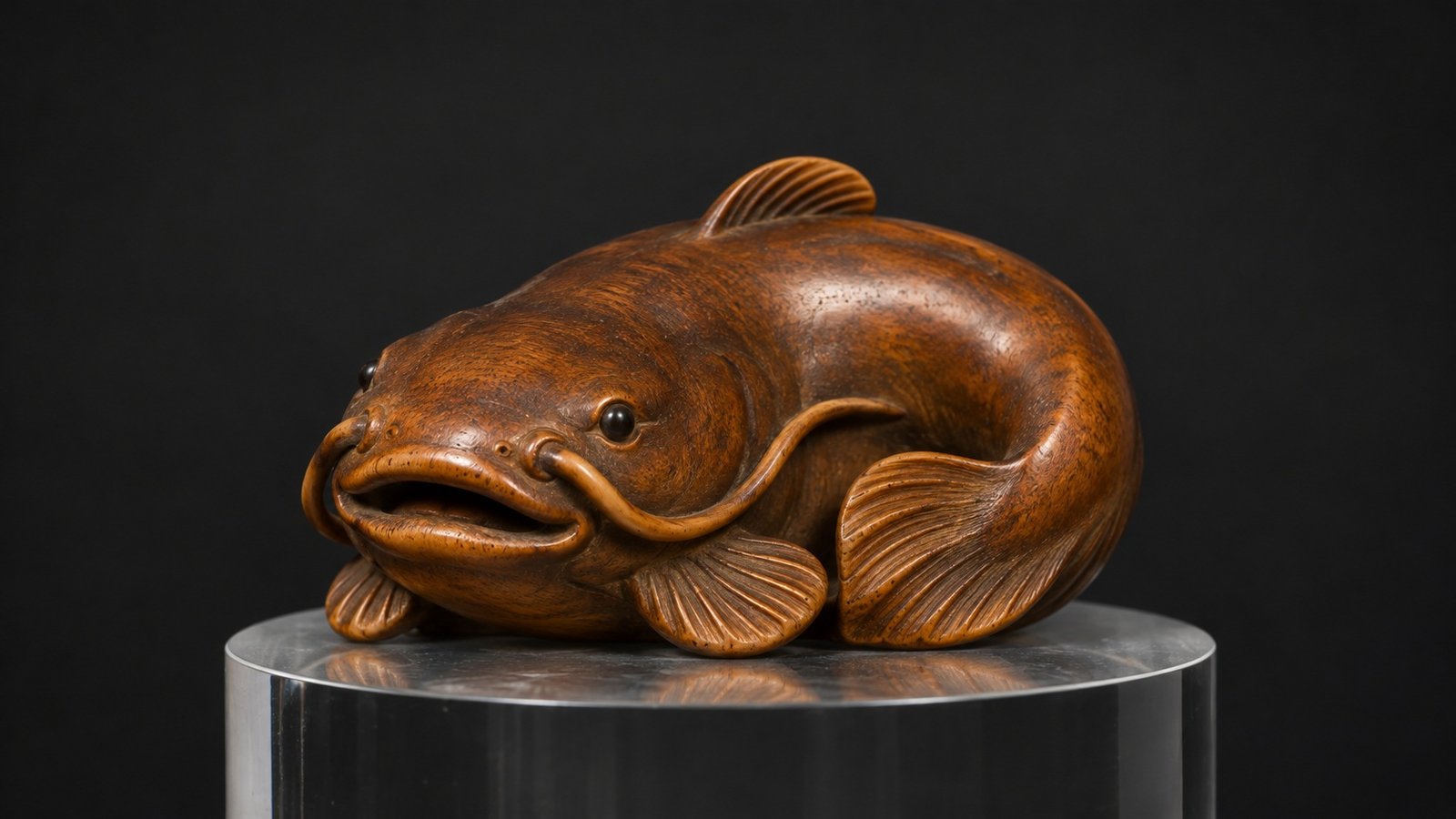
There is something about Japanese art that keeps drawing me back: the moment when an image I find amusing begins to tell a much more complicated story.
A giant catfish surrounded by angry people is a good example. At first, I notice the absurdity of the scene. Then I want to know why everyone is so upset with the fish. Before long, I am reading about an earthquake, a city trying to recover, and people whose feelings seem surprisingly familiar.
That is what draws me to namazu-e, the Japanese catfish prints associated with earthquakes. The more I learn about them, the more I find myself looking past the animal and toward the people around it.
In a Japanese tradition associated with earthquakes, a giant catfish lives beneath the ground, and its movements cause the earth to shake. The deity Kashima restrains it with a sacred stone, the kanameishi. Images of the subdued fish were also used as protective charms against future earthquakes. eri.u-tokyo.ac.jp
I find that image powerful: an enormous, restless creature held in place by a stone. It gives an invisible danger a shape. Suddenly, something beyond human control has a face we can recognize, a body we can point to, and even someone responsible for keeping it still.
For me, that makes the legend a moving starting point for looking at the prints.
On November 11, 1855, a devastating earthquake struck Edo, now Tokyo. In its aftermath, catfish became the subjects of color woodblock prints known as namazu-e. The name means “catfish pictures,” and it generally refers to the prints produced in response to this disaster. Digital Exhibitions
It is easy to approach an old print as something comfortably distant. A date, a subject, perhaps a few unfamiliar characters. I have to remind myself that the people who first looked at these images were living through the events they depicted.
That thought changes the way I look at the humor. I become less interested in whether a scene makes me laugh and more curious about what it might have meant to someone who had just lost their home.
Some prints made shortly after the earthquake show victims taking revenge on the catfish for the destruction it caused. eri.u-tokyo.ac.jp
There is an immediate emotional logic to that. The disaster has become a creature that can be confronted. People can gather around it, accuse it, and demand an answer.
I would hesitate to treat the comic appearance of these scenes as evidence of how lightly anyone took the catastrophe. When I look at them, I see room for several feelings at once: anger, fear, helplessness, and perhaps the relief of finding an image that other people would understand.
That mixture is part of what makes them worth spending time with.
One example preserved in the Caltech Archives introduces an uncomfortable twist. The giant catfish lifts the stone that restrains it, while carpenters and plasterers encourage it because repairing earthquake damage will bring them work. digital.archives.caltech.edu
This is the detail that stays with me.
The same creature can look very different depending on who is standing beside it. Someone sees destruction. Someone else sees a livelihood. The picture asks us to notice both.
I read it as a sharp observation about the unequal consequences of disaster. It makes me wonder where sympathy ends and self-interest begins, and whether the people who first saw the print argued about that too.
I cannot know their conversations. But the image gives me a reason to imagine the questions they might have asked.
The imagination behind these prints extended to theatrical parody. The National Museum of Japanese History documents an example in which a catfish takes a character’s place in a scene adapted from the kabuki play Keisei Asamagatake. A courtesan’s ghost confronts it, bringing the earthquake into a familiar theatrical story. archive.rekihaku.ac.jp
I enjoy that extra layer of recognition. A viewer who knew the play would have brought something to the image that I have to learn through research.
It is a useful reminder whenever I look at Japanese woodblock prints: some of the most interesting details become visible only when someone helps us understand the reference.
A little context can transform the experience of looking.
The next time you come across a namazu-e, I would suggest beginning with the figures around the catfish. Who approaches it? Who appears angry? Who seems to benefit? What are their hands doing?
Those are the questions I would bring to the image before trying to settle on a single interpretation.
I also like to leave some room for uncertainty. A visual joke may depend on a word I cannot read or a reference I have not yet recognized. There is pleasure in discovering an answer, but there is also pleasure in realizing how much remains to be learned.
What stays with me about namazu-e is the human company gathered around such an unlikely animal.
I find people trying to explain what happened, people looking for someone to blame, and people finding a way to make an image out of something frightening. Looking at these prints, I feel closer to the questions than to any easy answers.
That is one of the pleasures of Japanese art for me. I begin with curiosity about an unfamiliar subject and end up thinking about experiences I can recognize.
Sometimes, a giant catfish is enough to open that door.
CEO of SupeinNihonto, dealer and collector of ancient Japanese art and weapons from Canillo, Andorra.
Contact