November 2, 2026

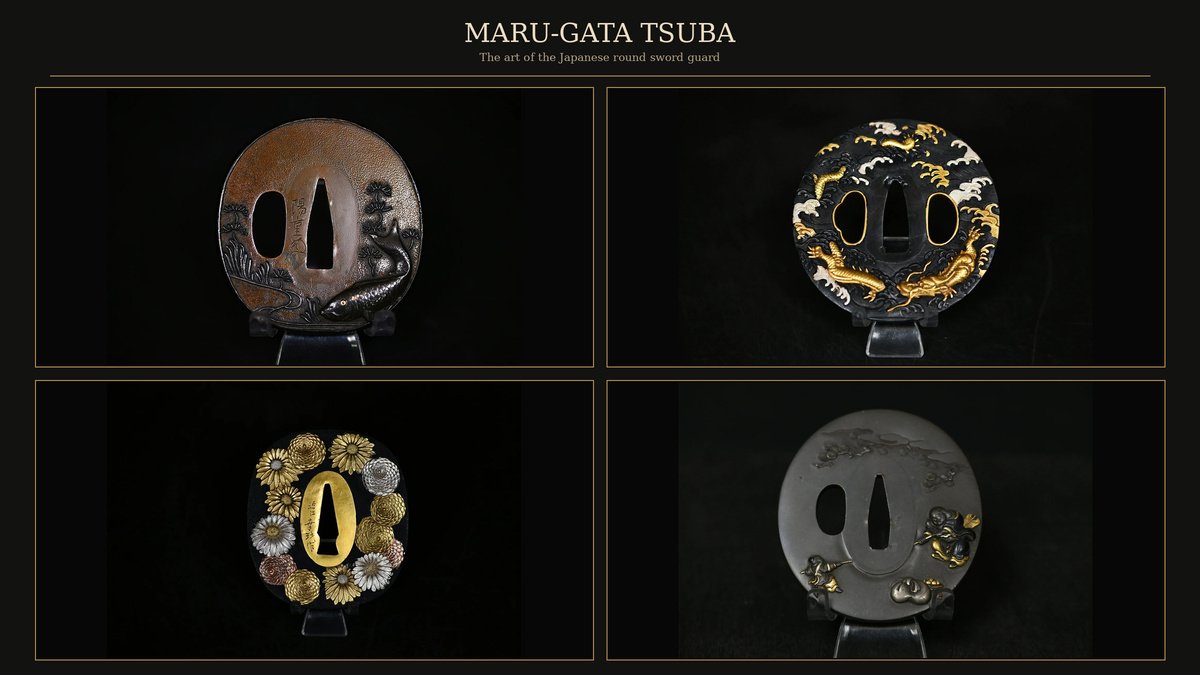
A circle can look simple until you take a closer look.
In a Japanese sword guard, the rounded outline of a maru-gata tsuba creates a compact stage for metal, texture and design. One example may be quiet and almost austere; another may be filled with moving water, a dragon, a koi or a carefully worked floral pattern. The shape stays familiar, but the character of each piece changes completely.
Maru-gata (丸形) means “round shape”. It describes the outline of the tsuba. By itself, it does not tell us who made it, when it was made, what metal was used or which technique appears on its surface. Those details have to be considered separately.
Explore the tsuba collection at Supein Nihonto to see how many different designs can grow from this enduring form.
The tsuba sits between the sword’s hilt and blade. Its practical role was to help protect the hand from sliding forward onto the blade, while also forming part of the balance and overall mounting of the sword. Its central opening, the nakago-ana, accommodates the tang of the blade.
Many guards also have smaller openings beside the centre. These are commonly called hitsu-ana and are associated with fittings carried in the scabbard, such as the kozuka and kōgai. Not every tsuba has the same openings: their number, shape and treatment vary from piece to piece. The area around the central opening, known as the seppa-dai, and the outer rim, or mimi, are also worth examining.
Within that functional structure, the artist had room to work. A round plate could be left relatively plain, pierced with openwork, textured, engraved or decorated with metal inlay. The tsuba was both a hand guard and an element that helped balance the sword; its decoration could also display the maker’s skill and imagination.
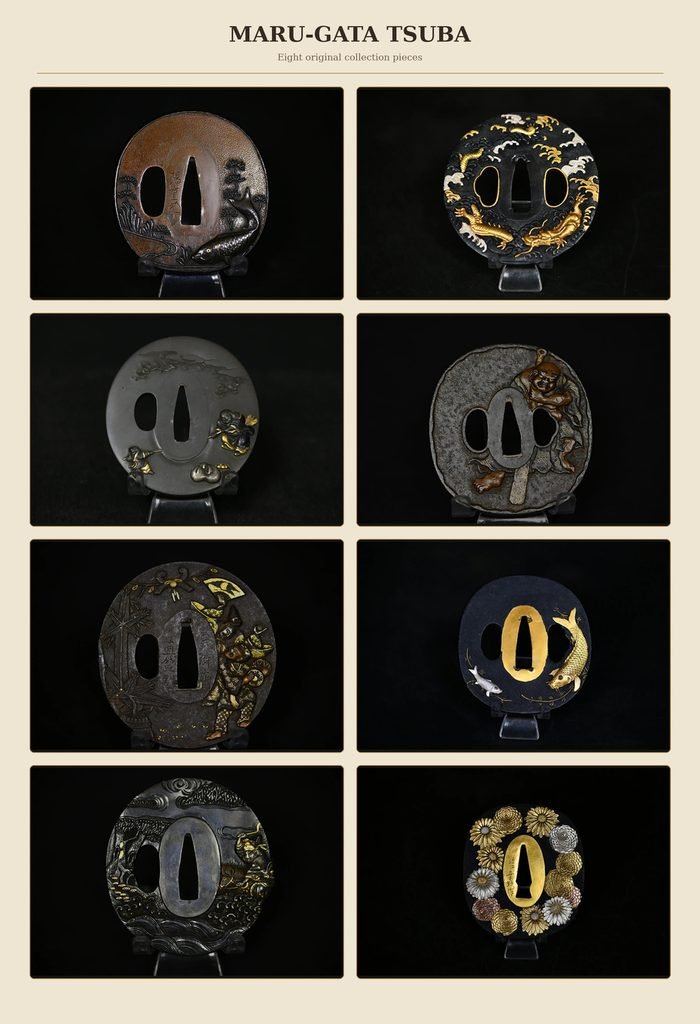
The circle gives a design a clear boundary, but it does not make every composition symmetrical. A maker might place a subject to one side, leave much of the plate open, or use the central opening as part of the visual rhythm. A dragon’s body can curve around the rim; waves can sweep across the lower half; a small figure can bring scale and movement to an otherwise quiet surface.
That contrast is easy to see in the collection’s koi designs. In one copper and shakudō example, two fish meet across a dark ground: one rendered in pale metal, the other in gold-toned detail. Their different sizes and positions draw the eye around the plate. Another koi tsuba combines the fish with a more subdued, textured landscape. The shared round outline connects them, while the materials and composition give each its own presence.
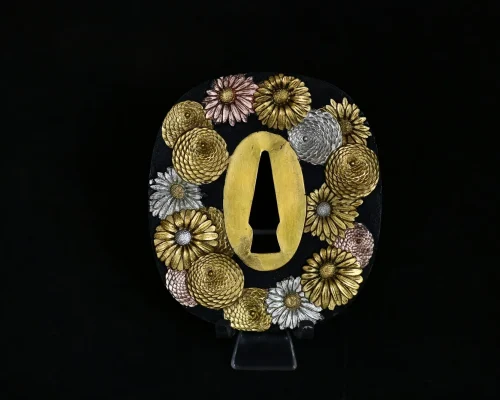
Dragon-and-wave designs use the circle differently. The curves of the waves and the dragon’s body create a sense of motion contained within the rim. A shakudō tsuba with chrysanthemums offers a very different effect: repeated floral forms and contrasting metal details create a more measured rhythm. These are not separate “types” of maru-gata; they are different artistic solutions using a similar outline.
Material changes the way a tsuba meets the light. Iron can appear rugged, restrained or finely worked. Shakudō, a copper-based alloy traditionally given a dark blue-black patina, provides a strong contrast for gold and other metal details. Shibuichi, another copper-based alloy, can have a softer grey appearance. The exact look depends on the object’s materials, finish, condition and lighting.
Look closely at how the surface has been made. Is the design carved into the plate, raised above it, pierced through it or built up with inlaid metals? Are the details crisp and linear, or soft and rounded? Does the rim have a different finish from the central field? These observations help describe the object accurately before assigning it to a school or interpreting its symbolism.
A signature, or mei, can be an important feature, but it should be considered alongside the workmanship, condition, materials and any documentation. A name alone is not enough to establish an attribution.
Tsuba designs draw on many subjects, including the natural world, stories, historical figures and heraldic emblems. A koi, dragon, chrysanthemum or human figure may carry cultural associations, but a motif does not always have one fixed meaning. Interpretation depends on the specific design and its context.
For that reason, it is useful to separate what can be seen from what may be inferred. “Two koi in contrasting metals” is a direct description. A further reading of what those fish might signify should be presented as an interpretation unless it is supported by reliable documentation for that particular piece.
These details explain why two round tsuba can feel worlds apart. One may invite attention through the restraint of its iron surface; another through bright inlay, a lively subject or the way the design uses the central opening.
The maru-gata tsuba is not a single style but a shape with room for many styles. Across the collection, round guards bring together iron, shakudō, shibuichi and other metals, with subjects ranging from koi and dragons to flowers, figures and narrative scenes.
Browse the available Japanese tsuba and compare the pieces directly. If you are drawn to the balance of the round outline, view the tsuba collection at Supein Nihonto and look beyond the silhouette: the surface, openings, rim and composition are where each guard begins to tell its own story.
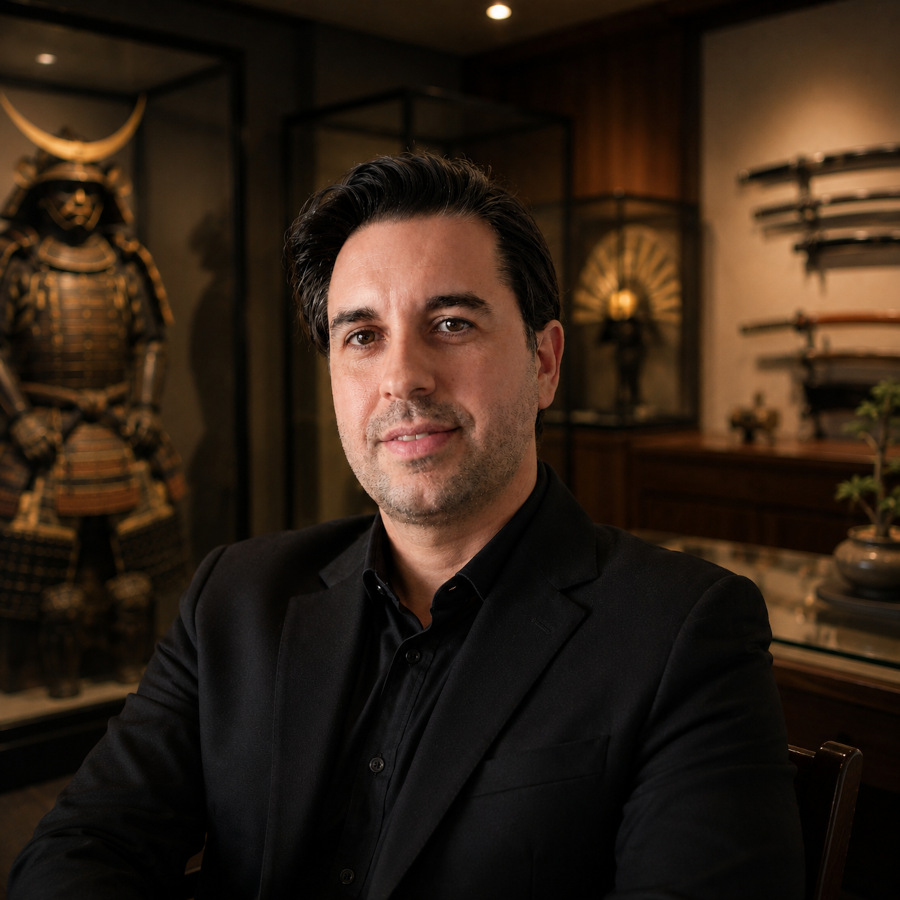
CEO of SupeinNihonto, dealer and collector of ancient Japanese art and weapons from Canillo, Andorra.