November 13, 2026

There is an understandable temptation to look at the certificate before looking at the sword.
When someone encounters a Japanese katana accompanied by Tokubetsu Hozon papers, those two words immediately attract attention. They suggest careful examination, recognised craftsmanship and a connection to the long tradition of preserving Japanese swords as works of art.
But I have always found another question more interesting.
What is it about the sword itself that makes those words meaningful?
After all, the certificate is relatively recent. The blade may have existed for centuries before anyone issued that particular document.
Generations of swordsmiths, polishers, scholars and collectors have contributed to the knowledge that allows us to appreciate Japanese swords today.
And somewhere within that history lies the real meaning of Tokubetsu Hozon.
To explore it, I would like to examine a fascinating example: a katana by the second-generation Hizen Masahiro, accompanied by an NBTHK Tokubetsu Hozon certificate issued in 2025.
Rather than treating the document as the end of the story, we will use it as a starting point.
Because sometimes, understanding a Japanese sword begins with learning what to look for.
Tokubetsu Hozon (特別保存) is generally translated as “Special Preservation”.
In the context of Japanese swords, the full designation is Tokubetsu Hozon Tōken (特別保存刀剣), meaning a sword judged especially worthy of preservation.
The distinction is awarded by the Nihon Bijutsu Tōken Hozon Kyōkai (NBTHK), the Japanese organisation established in 1948 to preserve and promote the study of Japanese swords as works of art.
What makes this recognition important is the principle behind it.
According to the NBTHK’s published examination standards, Tokubetsu Hozon is intended for swords that meet the Hozon requirements and demonstrate a higher standard of workmanship together with good preservation.
The criteria also establish specific restrictions and exceptions relating to certain unsigned blades, retempered swords and other circumstances.
In other words, Tokubetsu Hozon is not awarded simply because a sword is old or carries a celebrated name.
The quality and preservation of the blade matter.
That may sound obvious, but I think it is one of the most important ideas to understand when studying Japanese sword certification.
A famous signature can attract our attention. A prestigious school can help us understand the historical background.
Yet the steel must still be examined.
Its structure, its tempering, its condition and its relationship to the workmanship of the attributed swordsmith are all part of understanding the object.
Tokubetsu Hozon is a formal recognition within that process of appreciation.
It is not a government designation of National Treasure or Important Cultural Property, nor is it a certificate assigning a monetary value.
For a broader explanation of the different examination systems and paper categories, our guide to NBTHK and NTHK Japanese sword certificates explores those distinctions in more detail.
Here, however, I would like to concentrate on what happens when we bring the certificate and the actual sword together.
A certificate becomes much more interesting when we can connect its contents to an individual blade.
The document accompanying the Hizen Masahiro katana provides a useful example.
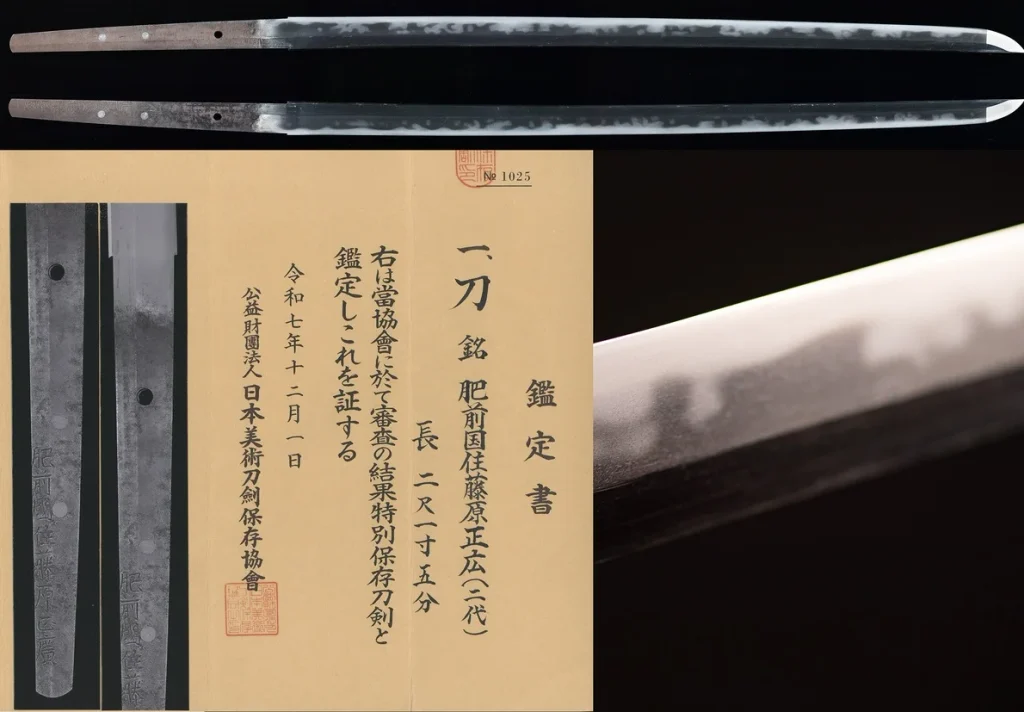
At the top appears the Japanese word Kanteisho (鑑定書), meaning an appraisal certificate.
The principal inscription identifies the object as a katana, followed by its signed attribution:
肥前国住藤原正広(二代)
Hizen no Kuni Jū Fujiwara Masahiro (Nidai)
In English, this identifies Fujiwara Masahiro, resident of Hizen Province, with the attribution specifying the second generation.
The certificate also records the blade’s length:
二尺一寸五分 — 2 shaku, 1 sun, 5 bu
This corresponds to approximately 65.2 centimetres.
The document bears the date 1 December 2025, expressed in the Japanese calendar as the seventh year of the Reiwa era.
And, most importantly, its certification wording states that the sword has been judged Tokubetsu Hozon Tōken.
These details may appear purely administrative at first.
But they serve an essential purpose.
They connect the appraisal to an identifiable physical object: a particular blade, with a particular signature and a recorded measurement, examined at a particular point in time.
The certificate establishes a documented specialist assessment.
What it does not do is provide a complete explanation of every individual observation made during the examination.
It does not describe all the subtle activity in the steel or narrate the sword’s entire history.
For that, we must look beyond the paper.
And this is where the Hizen Masahiro example becomes especially rewarding.
The katana discussed here is attributed to the second-generation Hizen Masahiro, a member of the celebrated Hizen Tadayoshi swordmaking lineage.
The Hizen tradition developed during the early Edo period in the territory associated with the Nabeshima family.
It became particularly admired for the refinement of its forging and the quality of its steel.
The second-generation Masahiro was the son of the first-generation Kawachi no Daijō Masahiro and a great-grandson of Hizen Tadayoshi.
According to the historical account accompanying this blade, he originally used the name Masanaga before adopting Masahiro following his father’s death in 1665.
Later in his career, he also used the honorary title Kawachi no Kami.
This sequence of names matters when we examine the inscription preserved on the sword.
The blade is signed:
肥前国住藤原正広
Hizen no Kuni Jū Fujiwara Masahiro
The signature does not include the later Kawachi no Kami title.
That detail is consistent with an earlier phase of the second-generation swordsmith’s independent career.
I find this fascinating because it illustrates how much historical information can sometimes be contained within a few characters engraved on an old iron tang.
The signature is not simply a name.
Its wording, style and relationship to the known chronology of a swordsmith can contribute to the study of the blade.
Of course, the absence of a title does not independently establish an exact date of manufacture.
Historical interpretation requires comparison with other evidence, including workmanship and authenticated examples.
But the signature gives us an important starting point.
And this is one reason why the attribution recorded on a Tokubetsu Hozon certificate is so meaningful: it connects a surviving work to a particular artistic tradition and an identified swordsmith.
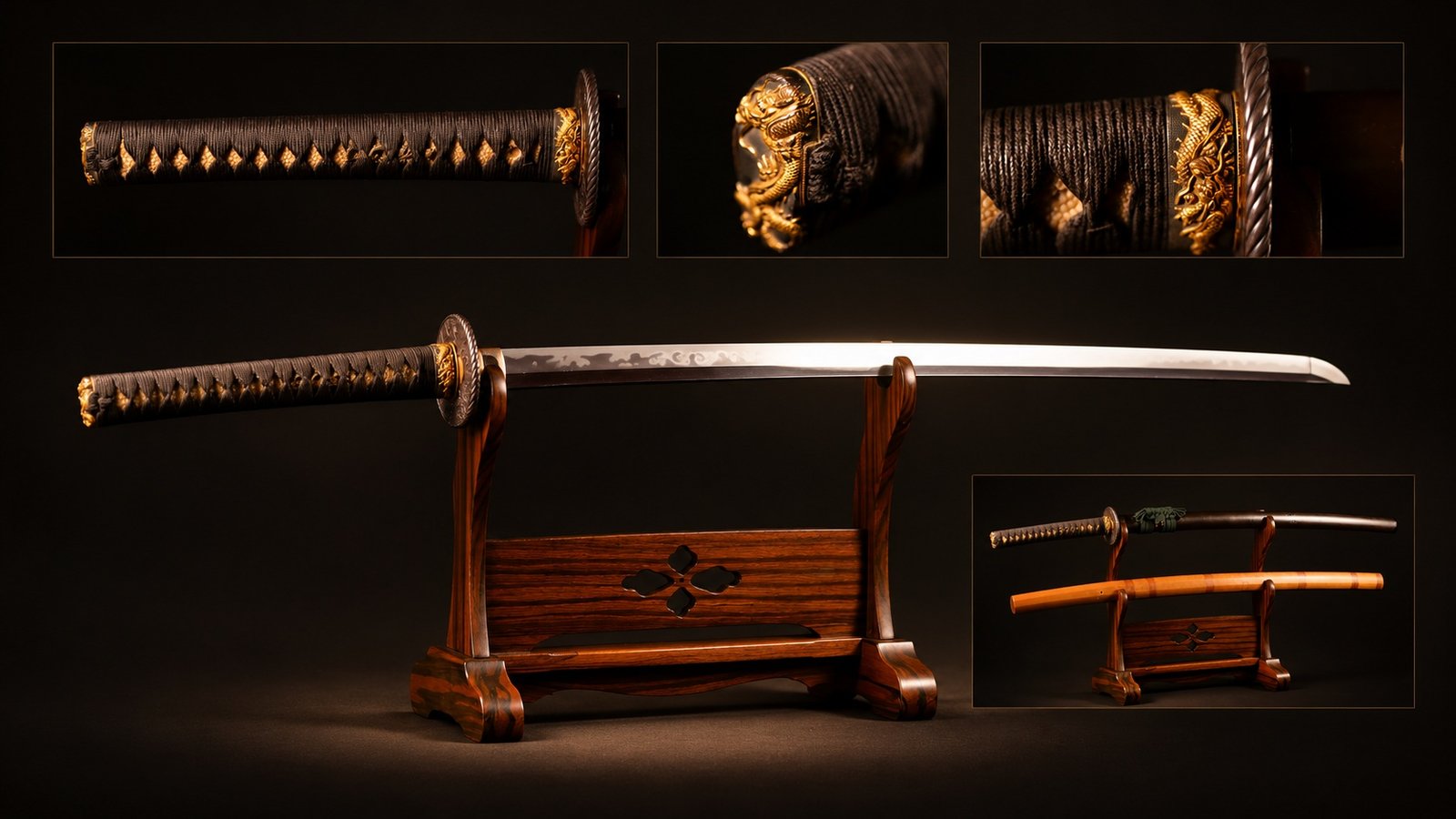
When looking at the photographs of this Hizen Masahiro katana, one detail immediately stands out.
The blade has very little curvature.
Its unusually shallow sori creates an almost straight silhouette, quite different from the deeply curved profile that many people instinctively associate with Japanese swords.
This restrained shape is characteristic of developments in swordmaking during the Kanbun era.
But there is something particularly interesting about the contrast between the sword’s overall shape and the activity visible within its steel.
From a distance, its form appears controlled and almost austere.
Look more closely, and an entirely different visual world begins to emerge.
The jigane, or visible steel surface, is described in the sword’s documentation as an exceptionally tight ko-itame structure.
Its refinement approaches the fine texture associated with konuka-hada, one of the celebrated characteristics of Hizen swordmaking.
The term konuka refers to rice bran, an appropriate comparison for the delicate, closely worked appearance of this type of steel.
I particularly like this aspect of Japanese swords because it rewards patience.
At first, the surface may seem almost uniform.
Only through careful observation do the subtle patterns and variations begin to reveal themselves.
Unlike applied ornamentation, these features are connected to the metal’s forging and finishing.
They form part of the sword’s artistic identity.
And when studying a blade attributed to a particular school, the relationship between these characteristics and the known traditions of that school becomes especially important.
The hamon provides a striking contrast.
Where the steel surface appears remarkably refined, the temper pattern is much more dynamic.
The Hizen Masahiro katana displays a vigorous gunome-midare hamon, accompanied by complex activity involving nie, nioi and tobiyaki.
The repeated rounded formations of gunome-midare give movement to the hardened edge.
Meanwhile, the isolated areas of tobiyaki above the principal temper line introduce further complexity.
This combination is particularly appealing.
The blade’s silhouette may seem restrained, but the closer we examine its tempering, the more expressive it becomes.
I think this is a wonderful example of why evaluating Japanese swords requires far more than looking for an attractive shape or a spectacular signature.
The workmanship contains its own language.
Learning to recognise that language is part of what makes the study of nihontō so rewarding.
And although a Tokubetsu Hozon certificate does not provide a detailed artistic commentary, the quality of the workmanship is central to understanding why such recognition matters.
This Hizen Masahiro katana raises another particularly interesting question.
The blade has been shortened.
Its historical documentation records a suriage of approximately three sun, and the tang preserves multiple mekugi-ana, the holes used to secure the blade within successive mountings.
In many collecting fields, alterations are immediately associated with a loss of originality.
Japanese swords require a more nuanced approach.
Throughout their history, blades were sometimes shortened or remounted to accommodate different preferences, changing methods of use or new owners.
These alterations can become part of a sword’s historical record.
Naturally, they must be studied carefully.
The extent of the modification, the preservation of the original workmanship and the condition of the tang all matter.
In this particular case, the signature remains preserved despite the historical shortening.
That is a significant detail.
The NBTHK’s published Tokubetsu Hozon criteria do not impose an absolute prohibition on every historically shortened blade.
They do, however, establish important restrictions relating to certain unsigned works, retempered blades and preservation problems.
The Hizen Masahiro katana illustrates why these distinctions should not be oversimplified.
A historical alteration does not necessarily erase the artistic identity of an object.
Sometimes it becomes part of the evidence through which we understand its journey across the centuries.
What matters is how much of the blade’s essential character has survived.
Perhaps my favourite aspect of this particular katana is that its documentary history did not begin in 2025.
According to the historical material accompanying the sword, it appeared in the Japanese specialist publication Rei (麗) in 1969.
The blade was featured in the Yūhin Zukan, or “Gallery of Fine Works”, section.
The published study included an oshigata, a traditional graphic record that can reproduce the outline of a blade, its temper pattern and the inscriptions on its tang.
The accompanying commentary discussed several of the characteristics that continue to make the sword interesting today.
Among them were its unusually shallow curvature, its distinctive signature and its historical shortening.
The study also drew attention to the quality of the tempering, describing it as particularly outstanding within Masahiro’s work.
There is something deeply satisfying about this kind of historical documentation.
It reminds us that the appreciation of Japanese swords is not a recent phenomenon.
Long before a modern website, a digital photograph or an online catalogue existed, specialists were studying these same details.
The 1969 publication and the 2025 Tokubetsu Hozon certificate represent different kinds of evidence.
The former provides an earlier specialist examination and published record.
The latter documents a formal NBTHK appraisal under its classification system.
They should not be treated as interchangeable, but together they help illuminate the history of the sword’s study.
For me, this is one of the most appealing aspects of collecting Japanese art.
Every generation has the opportunity to observe, document and preserve objects that existed long before it.
And sometimes, the knowledge accumulated around a sword becomes almost as fascinating as the sword itself.
There is another distinction that deserves attention.
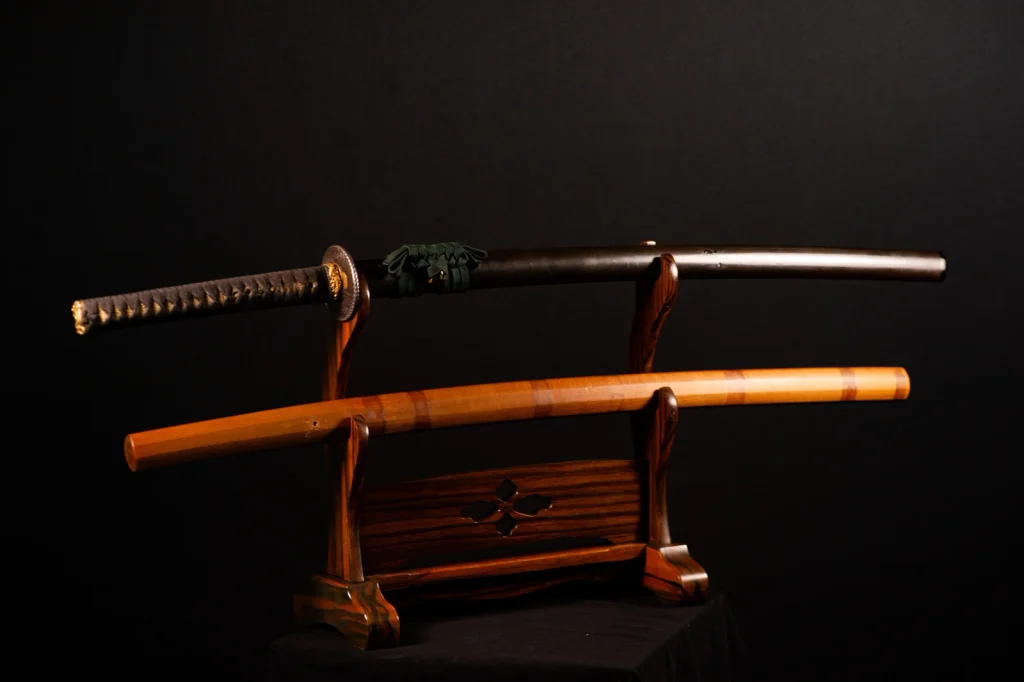
A Japanese sword can be accompanied by extraordinary fittings and an elaborate koshirae.
The Hizen Masahiro katana, for example, has a coordinated dragon-themed mounting.
Its dark shakudō fittings, gilded dragons, carefully wrapped handle and black lacquered saya create a beautiful visual relationship.
The details of the fuchi, kashira and menuki demonstrate the artistic contributions of craftsmen beyond the swordsmith himself.
However, the Tokubetsu Hozon Tōken certificate accompanying this sword concerns the blade, not automatically every component of its mounting.
The NBTHK also evaluates sword mountings and fittings, but these are distinct appraisal categories.
I think this distinction is important because the Japanese sword is often the result of several different artistic disciplines working together.
The swordsmith created the blade.
Other specialists produced the decorative metalwork, lacquered scabbard and handle wrapping.
Each deserves to be appreciated on its own terms.
Similarly, Tokubetsu Hozon should not be interpreted as a guarantee of financial value.
Two swords holding the same certification can differ considerably in their workmanship, rarity, historical interest, preservation and documentation.
Nor does the certificate establish that nothing about the object’s condition can change after the date of examination.
It records a specialist judgement about the sword at a particular moment.
That is valuable information, but it is not a substitute for continued study and responsible preservation.
The more we study Japanese swords, the easier it becomes to understand why preservation cannot be reduced to simply keeping an object safe.
Physical preservation is essential, of course.
Without proper care, even a remarkable blade can suffer irreversible damage.
But there is another kind of preservation that I find equally interesting.
The preservation of knowledge.
When a Japanese sword is attributed to a particular craftsman, its signature documented, its workmanship studied and its historical records maintained, we preserve information that might otherwise disappear.
That information connects an individual object to the techniques, traditions and people responsible for its creation.
This is especially meaningful in the case of a sword such as the Hizen Masahiro katana.
Its distinctive forging connects it to the Hizen tradition.
Its signature provides historical clues about the swordsmith’s career.
Its shortened tang records changes that occurred during its life.
Its appearance in a specialist publication in 1969 preserves an earlier scholarly perspective.
And its Tokubetsu Hozon certificate adds a modern appraisal to that accumulated record.
None of these elements tells the entire story independently.
But together they help us understand the sword in a much richer way.
This is why I believe Tokubetsu Hozon is best understood as more than a prestigious designation.
It is part of a continuing effort to recognise, study and preserve Japanese sword art.
If I were beginning to study a katana with Tokubetsu Hozon papers, I would try not to stop at the certificate.
I would want to understand the attribution and the history behind the swordsmith’s name.
I would look at the blade’s proportions and ask whether its shape makes sense within the historical period to which it is attributed.
I would pay attention to the surface of the steel and the activity within its hamon.
I would examine the tang, its signature and any evidence of historical alterations.
And I would be particularly interested in earlier documentation, when available.
Not every sword will have a published record extending back decades.
Not every blade will preserve the same combination of evidence.
But each of these questions can help us move beyond a superficial appreciation.
The certificate tells us that a specialist assessment has taken place. Understanding the sword helps us appreciate the significance of that assessment.
And that, for me, is where collecting becomes genuinely interesting.
After examining the Hizen Masahiro example, I find myself returning to the same thought with which we began.
A certificate can attract our attention.
But the sword is what deserves to hold it.
The refined Hizen steel, the energetic temper pattern, the unusual signature and the traces of its long history are all part of what makes this blade worth studying.
Its Tokubetsu Hozon recognition adds an important contemporary assessment to those surviving qualities.
Yet the real fascination does not lie in treating the certificate as the final word.
It lies in understanding how much there still is to discover.
Every carefully observed detail can bring us closer to the artistic decisions of a swordsmith who lived centuries ago.
Every surviving document can help preserve knowledge for those who will study the blade in the future.
And perhaps that is the most meaningful interpretation of Tokubetsu Hozon.
Not simply the recognition that a Japanese sword deserves special preservation.
But the reminder that preserving a sword also means preserving the opportunity to understand it.
For readers interested in exploring the example discussed throughout this article, the second-generation Hizen Masahiro katana, its Tokubetsu Hozon certificate and accompanying historical documentation provide a fascinating opportunity to see how these different elements come together in one surviving Japanese sword.
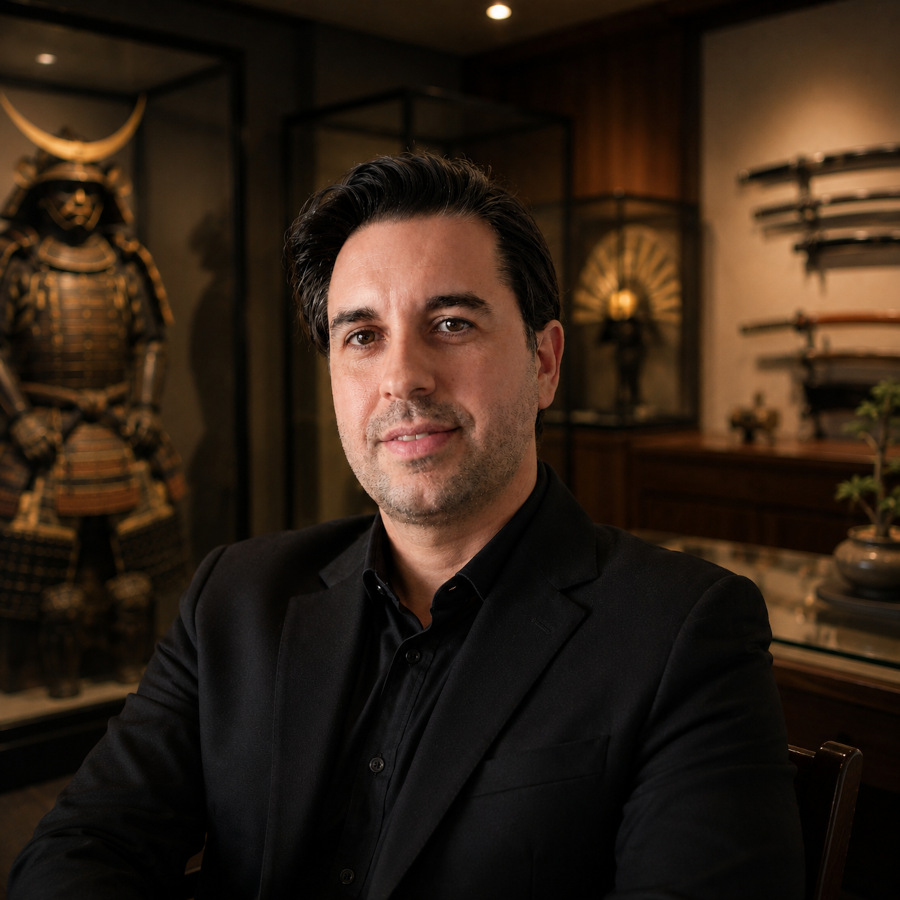
CEO of SupeinNihonto, dealer and collector of ancient Japanese art and weapons from Canillo, Andorra.