November 17, 2026

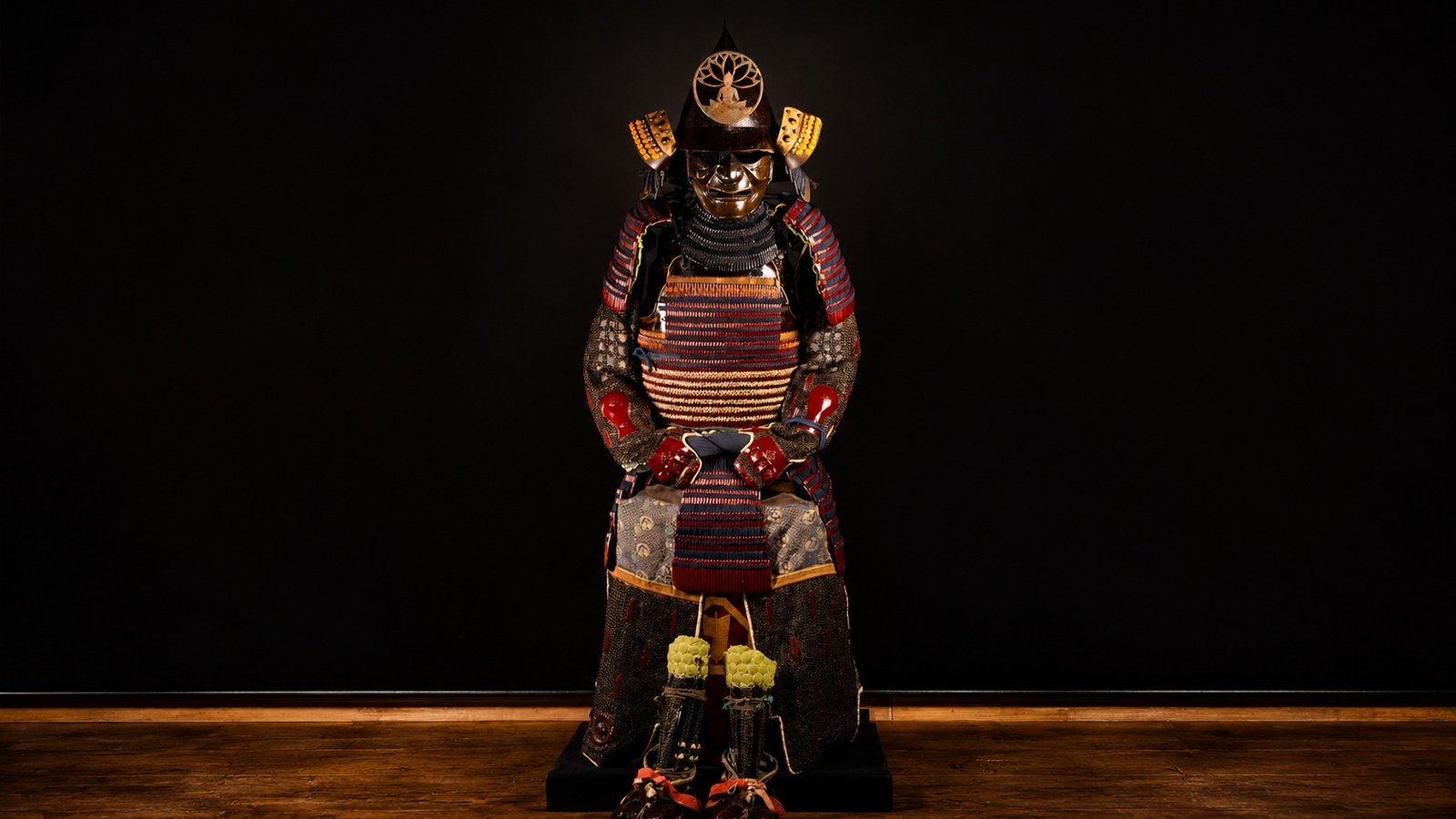
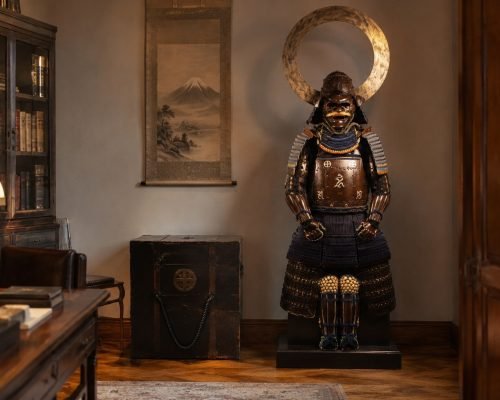
When you first look at a complete samurai armor, the cuirass is rarely the first thing that feels complicated.
The helmet usually gets your attention.
Then the mask.
Then the lacing, the colors, the crests, and all the smaller details.
But if you want to understand how a gusoku is actually built, the dō is one of the best places to start.
And one term appears again and again in Japanese armor:
nimai-dō.
At first, it sounds straightforward. Ni means two, and the term describes a cuirass divided into two principal sections.
But that simple definition can be misleading.
A nimai-dō is not one particular visual style. It is not defined by black lacquer, red lacquer, individual scales, large plates, sparse lacing, or dense lacing.
It describes something much more fundamental:
how the cuirass opens around the body.
That distinction is what makes the nimai-dō so interesting.
A nimai-dō is a cuirass formed from two principal body sections.
A documented example in the British Museum is hinged along the right side and secured on the left, allowing the cuirass to open so that the wearer can get in and out of it.
That sounds like a minor mechanical detail.
It is not.
The cuirass is the structural center of the armor. It has to protect the torso while still allowing the warrior to breathe, move, mount a horse, use weapons, and wear multiple layers of equipment around it.
The way that shell opens therefore affects the entire experience of putting on and wearing the armor.
A two-section construction offered a relatively direct solution:
open the body armor, place it around the torso, close it, secure it, and allow the articulated components around it to do their work.
This is probably the most important point.
When we say two-piece cuirass, we are talking about the two main sections of the dō.
We are not saying that the entire cuirass is made from only two pieces of iron.
A nimai-dō can itself be constructed from many smaller elements.
It may use individual scales.
It may use longer plates shaped to imitate rows of scales.
It may use horizontal plates.
It can be lacquered black, red, brown, or finished in more elaborate combinations.
The lacing can also vary considerably.
So two armors can both be nimai-dō and look almost unrelated at first glance.
That is exactly what makes the category useful.
It describes the architecture beneath the decoration.
The current Supein Nihonto collection gives us some particularly good examples of this.
One is a Certified Edo Samurai Armor – Nimai-dō Gusoku.
Its cuirass is formed from two main sections using horizontal black-lacquered plates and indigo-blue sugake odoshi, a relatively open style of lacing.
Visually, it is restrained.
Dark lacquer.
Blue cord.
Very little unnecessary distraction.
It lets you see the structure clearly.
Now compare that with the Certified Early Edo Red Lacquer Nimai-dō Gusoku.
This is still a nimai-dō.
But visually it is completely different.
The cuirass is finished in vivid shu-urushi red lacquer and uses kiritsuke iyo-zane construction with yellow-green moegi-ito sparse lacing.
The structural idea is the same.
The aesthetic language is not.
And then there is this Mid-Edo Nimai-dō Gusoku with Urumi Lacquer and Takuboku Lacing.
Its two-section cuirass is finished in translucent reddish-brown urumi-urushi, with dark indigo kon-ito combined with polychrome takuboku-ito.
Again:
same basic cuirass type.
Completely different personality.
This is why learning the term is useful.
You stop judging Japanese armor only by color and decoration and begin seeing how it is actually assembled.
A nimai-dō is not automatically better than another type of cuirass.
It is not a grade.
It is not a certification.
It does not tell us whether the armor belonged to a famous warrior or whether it was made by an important workshop.
It tells us how the cuirass is organized.
The quality has to be read somewhere else:
in the ironwork,
the lacquer,
the plate construction,
the lacing,
the fittings,
the textile,
the coherence of the complete suit,
the condition,
and, when available, documentation and certification.
This is especially clear in a Certified Early Edo Nimai-dō with Gilt Ōkuwagata.
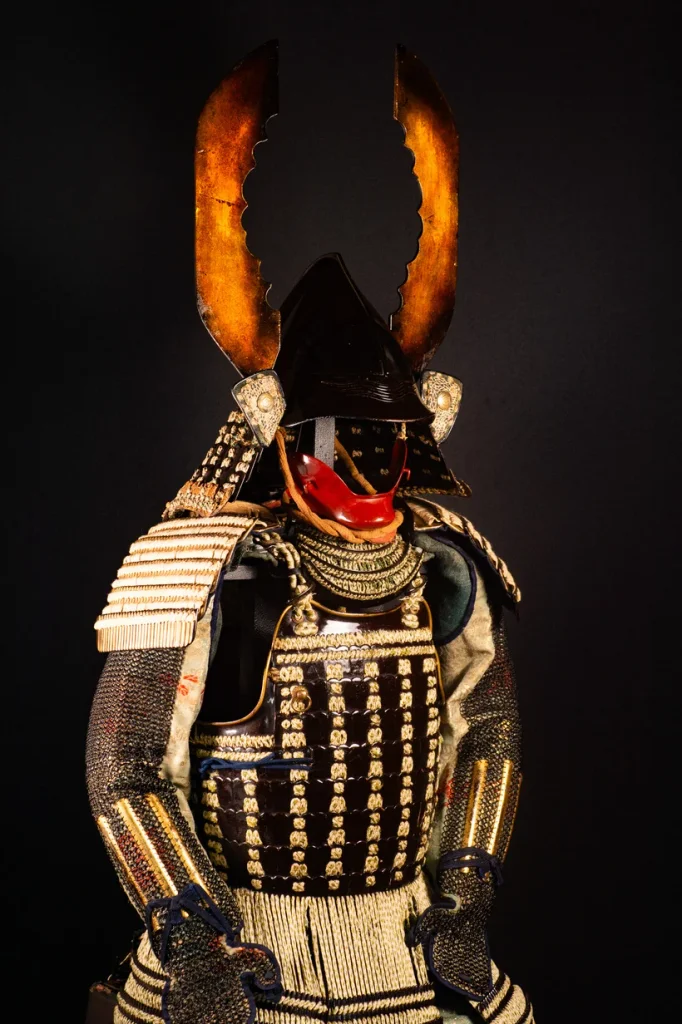
Its black-lacquered two-piece cuirass uses kiritsuke-iyozane construction and sugake odoshi with multicolored takuboku silk cords.
The nimai-dō designation tells us how the cuirass is divided.
The quality of the armor comes from everything built around that structure.
Japanese armor had to solve a difficult problem.
Protection wants rigidity.
The human body wants movement.
A completely rigid shell is strong, but difficult to wear and restrictive.
A cuirass made from articulated components can distribute protection around the torso while still allowing a practical way to put the armor on.
The nimai-dō achieves this through a relatively simple division of the cuirass.
Two principal sections wrap around the torso and are connected so that the body can be opened and closed.
The British Museum example provides a useful physical illustration: the cuirass hinges on one side and fastens on the other.
Once you see this in person — or in good photographs of the side of the armor — the term suddenly becomes much easier to understand.
Most armor photography concentrates on the frontal view.
That makes sense aesthetically.
But if you are trying to understand a nimai-dō, one of the most useful angles is the side.
Look for the point where the two principal sections meet.
Look for hinges.
Look for cords or fastening systems.
Look at how the upper edge of the dō meets the shoulder straps.
Then look lower, where the cuirass transitions into the kusazuri.
From the front, the armor may look like a single continuous shell.
From the side, its mechanical logic becomes much clearer.
That is something worth remembering whenever you examine Japanese armor:
the most beautiful angle is not always the most informative one.
These terms are sometimes confusing because both describe armor wrapping around the torso.
But they are not the same thing.
A traditional dō-maru is fundamentally a wraparound cuirass without the same hinged two-section arrangement that defines a nimai-dō.
A museum catalog describing later Japanese armor makes this distinction particularly clear by identifying dō-maru examples as hinge-less cuirasses, while nimai-dō are described as two-sectional cuirasses.
That does not mean one simply replaced the other overnight.
Japanese armor developed over centuries, and older forms continued to influence later construction and decoration.
Edo-period armorers were perfectly capable of combining technically newer structures with deliberately archaic visual references.
This is one reason classification can become complicated.
An armor may look ancient in spirit while using a construction belonging to a later period.
The same naming logic helps here.
A gomai-dō uses five principal hinged sections.
So when you move from nimai-dō to gomai-dō, you are not necessarily moving from one decorative style to another.
You are changing the way the cuirass is divided around the torso.
More sections can create a different balance between rigidity, fit, folding, and storage.
Once you understand that, terms that initially seem obscure become surprisingly logical.
Nimai-dō: two principal sections.
Gomai-dō: five.
The terminology is describing construction before appearance.
The structural simplicity of two principal sections does not make a nimai-dō visually simple.
Take the urumi-lacquered Mid-Edo example mentioned earlier.
The cuirass uses kiritsuke-kozane, creating the visual impression of rows of individual scales.
Across that surface, different colors of lacing introduce another layer of rhythm.
The reddish-brown lacquer changes dramatically depending on the light.
From a distance, the armor feels decorative.
Up close, the surface becomes architectural.
That tension between simple underlying structure and complex surface treatment is one of the things I find most interesting about Japanese armor.
The more closely you look, the more layers of construction appear.
A nimai-dō can also teach us a lot about odoshi, the lacing that connects and articulates armor components.
Compare the examples at Supein and you immediately see how much character this adds.
The certified Mid-Edo black cuirass uses restrained indigo-blue sugake odoshi.
The red Early Edo armor uses yellow-green moegi-ito.
The urumi-lacquered example combines indigo with multicolored takuboku-ito.
The lacing changes the visual personality of each armor dramatically.
But underneath all three is the same basic two-section concept.
That is a useful way to separate two questions when studying armor:
How is it built?
and:
How is that construction expressed visually?
They are related, but they are not the same question.
The nimai-dō belongs to the broader development of later Japanese armor that became particularly important from the late sixteenth century onward.
The period brought major changes in warfare, armor construction, battlefield organization, and visual identity.
Museum collections preserve nimai-dō from the late Momoyama and early Edo periods as well as later Edo examples, showing that the two-section cuirass was not a brief experiment.
It became one of the established solutions within Japanese armor construction.
And because it could be combined with so many different plate types, lacquers, textiles, crests, and helmets, it remained remarkably adaptable.
That adaptability is probably one reason the term appears across armors that otherwise look so different.
When examining one, I would start with the cuirass itself.
Not the helmet.
Not the crest.
The dō.
Find the division between the two main body sections.
Look at how they connect.
Then examine the plate construction.
Are you looking at individual scales?
Longer plates?
Kiritsuke construction simulating scales?
Horizontal iron plates?
Then look at the lacquer.
Black?
Red?
Urumi?
Does it remain consistent across the two sections?
After that, move to the lacing and fittings.
Finally, step back and ask how the cuirass relates visually to the rest of the gusoku.
That sequence makes it much easier to understand what you are actually looking at.
“Nimai-dō” sounds like one of those specialist Japanese armor terms that can make the subject feel unnecessarily complicated.
In reality, it does the opposite.
Once you understand what it means, it simplifies what you are seeing.
Two very different gusoku may use completely different lacquer, lacing, helmets, masks, and decorative programs.
But if their cuirasses share the same basic two-section architecture, they belong to the same structural family.
And that is one of the most satisfying parts of learning to read Japanese armor.
You gradually stop seeing a single spectacular object.
You begin seeing decisions.
How it opens.
How it closes.
How it moves.
How it was assembled.
How its surface was built over that structure.
And once you start looking at a nimai-dō this way, the cuirass becomes much more than the part sitting beneath the helmet.
It becomes the framework around which the entire gusoku makes sense.
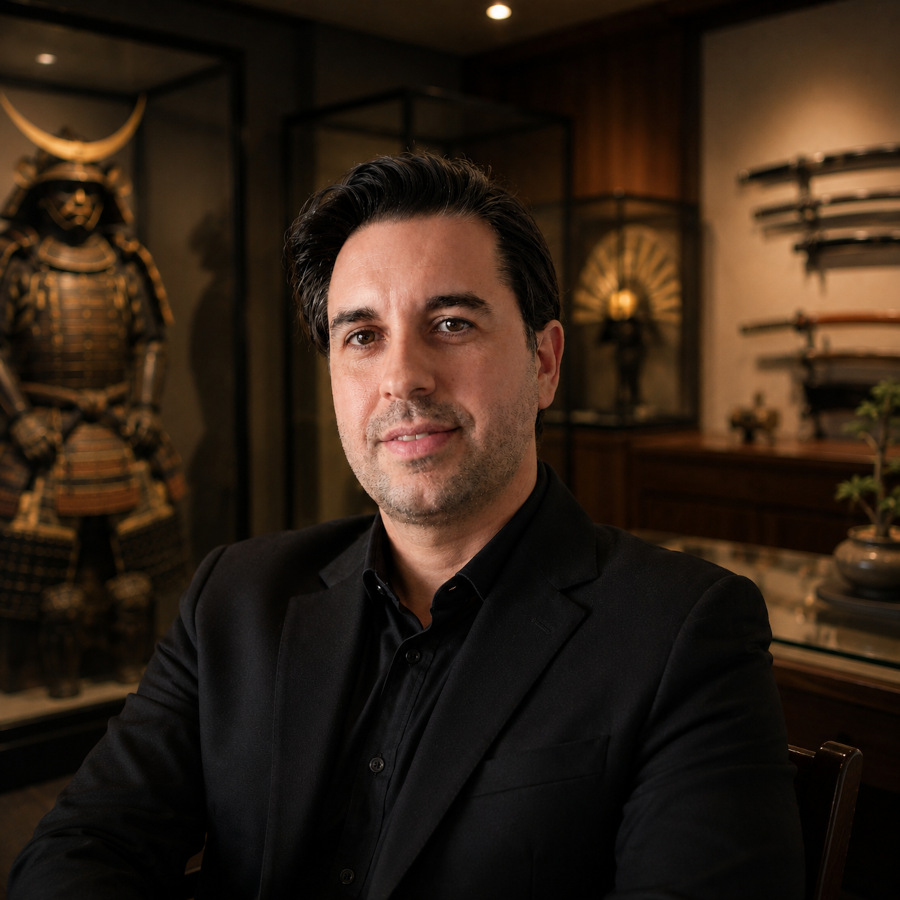
CEO of SupeinNihonto, dealer and collector of ancient Japanese art and weapons from Canillo, Andorra.