November 10, 2026

Some tsuba reveal almost everything at first glance.
Others need to be turned over.
This Edo-period shakudō tsuba depicting Shōki and an oni definitely belongs to the second group.
The front is already rich in detail. Shōki occupies the right side of the guard, his long beard falling across his robes, while a much smaller oni appears among pine branches in the upper left. Gold and other contrasting metals emerge from the dark shakudō surface without overwhelming it.
Then you turn the tsuba over.
The decoration continues.
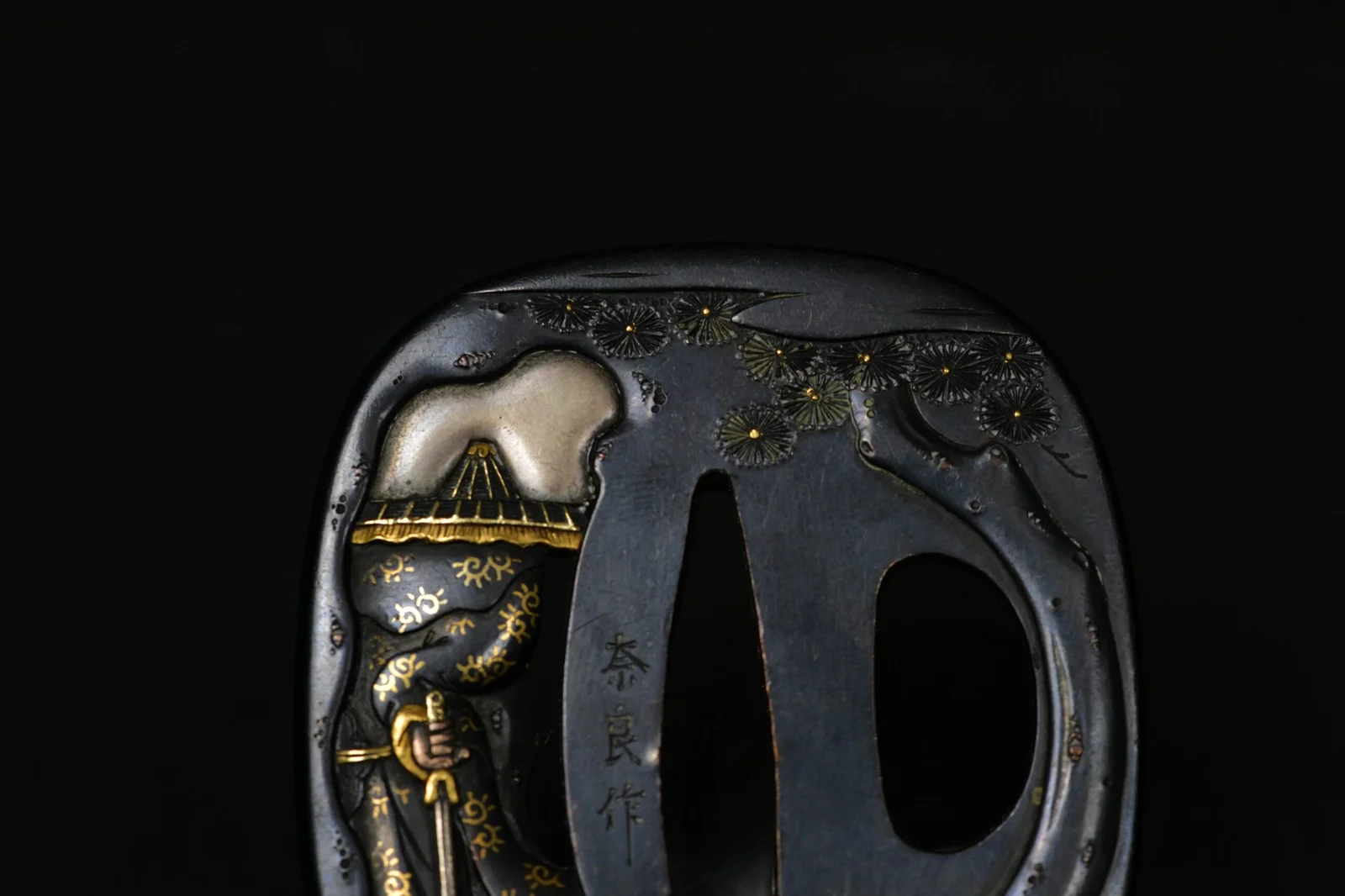
We see more of Shōki’s robes, his hand around the hilt of his sword, additional pine branches and, beside the central opening, a vertically cut signature.
For me, that is where the piece becomes particularly interesting.
It is not simply a decorated front and a secondary reverse. The two sides belong to the same composition.
The guard measures only 6.0 × 5.4 cm and has a kakugata form with softly rounded corners.
Within that very limited space, the metalworker has organized figures, vegetation, relief, contrasting metals and the functional openings of the guard without making the composition feel overcrowded.
The central nakago-ana was made for the tang of the sword, while the additional hitsu-ana formed part of the functional structure of the fitting.
A tsuba was mounted between the blade and grip of a Japanese sword to protect the hand. Although fundamentally functional, from around the sixteenth century onward increasingly elaborate tsuba became a specialized field of Japanese metalwork.
That dual identity is important when looking at this piece.
It is a sword fitting.
But it is also a miniature metal sculpture.
The main ground of the tsuba is shakudō.
Shakudō is a copper-gold alloy traditionally patinated to produce a deep blue-black or blackish surface. Museum collections frequently record it in combination with gold, silver, copper and shibuichi in Japanese sword fittings.
That dark surface is essential to the visual effect of this tsuba.
Gold becomes much brighter against it.
Silver and shibuichi introduce cooler gray tones.
Copper creates warmer areas.
The product itself is documented as shakudō with decoration in gold, silver, shibuichi and copper, dating to the Edo period.
What I like is that these materials are not used uniformly.
The artist leaves significant areas of the dark ground visible.
That empty space allows the figures to stand out.
The principal figure is Shōki, the Japanese name for the Chinese legendary figure Zhong Kui.
He is represented here as an imposing bearded man with broad headwear and flowing robes.
His beard is particularly effective.
Instead of being treated as a single solid mass, it is defined by repeated carved lines that give it direction and movement.
The gold-colored edge of the headwear immediately draws the eye upward, while smaller metallic details appear throughout the clothing.
Shōki was traditionally recognizable in Japanese art by attributes such as his long beard, distinctive hat and sword, and these same characteristics appear repeatedly on Edo-period tsuba preserved in museum collections.
The story of Shōki originated in China, where he is known as Zhong Kui.
It is important to describe this as a legend rather than straightforward history.
In later versions of the story, Zhong Kui was a highly capable scholar who was denied the recognition he expected through the civil service examination system and subsequently died by suicide. He was later honored, and the legend developed around his appearance in an emperor’s dream as a supernatural figure capable of defeating demons and harmful spirits.
In Japan, Zhong Kui became Shōki.
His image developed strong protective associations.
The Metropolitan Museum describes him as a mythical demon queller, while Japanese images of Shōki were also associated with protection from disease and with the health of children.
During the Edo period, images of Shōki were displayed in connection with Boys’ Day, celebrated on the fifth day of the fifth month. Hokusai’s 1846 painting of Shōki, for example, was explicitly connected with the figure’s traditional role in warding off illness.
Knowing that history changes the way I look at the figure on this tsuba.
He is not simply a warrior-like man with a beard.
He belongs to a very recognizable protective tradition.
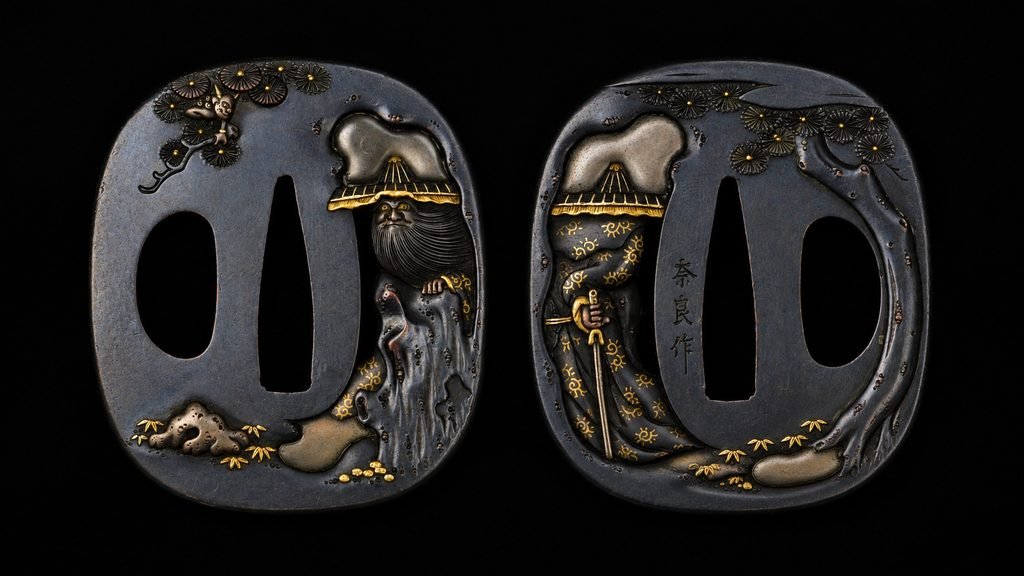
The small oni in the upper left is easy to overlook at first.
Compared with Shōki, it is tiny.
It appears among the pine branches rather than confronting him directly.
That difference in scale gives the composition some personality.
Shōki feels monumental.
The oni feels almost as though it is trying to remain out of his reach.
I would not invent a precise episode for this particular scene, because we do not have evidence that it represents a specific moment from a named story.
What we can say is that pairing Shōki with demons was completely established within Japanese art.
Museum collections contain numerous Edo-period tsuba in which Shōki appears together with, pursuing or confronting oni.
So the relationship between these two figures would have been immediately understandable within that artistic tradition.
There is something particularly appropriate about placing Shōki on a tsuba.
The object itself belonged to a sword.
Shōki is traditionally represented carrying a sword.
And his entire identity revolves around confronting threatening supernatural forces.
One late Edo–Meiji tsuba in the Walters Art Museum depicts Shōki actively chasing several demons, and the museum specifically notes how naturally his fierce warrior character suits a sword fitting.
That does not tell us why the original owner of this particular tsuba chose the subject.
But it does help explain why Shōki became such a successful motif for Japanese sword furniture.
The imagery and the object reinforce one another.
The pine branches are also worth stopping to look at.
They appear around the oni on the front and continue across the upper area of the reverse.
In Japanese art, evergreen pine commonly carried auspicious associations with longevity and endurance. Museum descriptions of Japanese paintings, textiles and sword fittings repeatedly identify pine as a symbol of long life.
That does not prove that the metalworker intended a specific symbolic message in this tsuba.
We should not automatically turn every decorative pine tree into a coded statement.
But it does place the motif within a broader visual language that an Edo-period viewer would have known.
And visually, the pine works extremely well here.
Its fine needles and small metallic highlights contrast with the much larger mass of Shōki’s robes.
The reverse is one of my favorite parts of this piece.
We no longer see Shōki’s face, but the figure continues.
His robes occupy much of the left side.
Small gold-colored motifs appear across the darker garment.
A hand emerges and grips the hilt of his sword.
Above him, the pine branches continue across the tsuba.
That continuation is important.
It tells us that the composition was conceived around the object.
The front and reverse are not independent pictures.
They form one visual narrative.
This approach has strong historical parallels.
A mid-19th-century Shōki tsuba by Kashino Naonobu in the Walters Art Museum has part of Shōki’s body wrapping around the edge and continuing onto the reverse. Another example by Tsuchiya Yasuchika VII continues its scene of Shōki pursuing demons onto the back of the guard.
I am not suggesting that this tsuba is by either artist.
The comparison is useful because it shows that using both surfaces to develop a Shōki scene was an established way of designing a tsuba.
Another detail I appreciate is that the decoration does not ignore the functional structure of the guard.
The nakago-ana and hitsu-ana remain central to the composition.
The figures and branches are arranged around them.
Shōki occupies the outer right side of the front.
The oni balances the upper left.
The reverse places the robe and sword beside the central opening.
Rather than trying to disguise the holes, the artist uses the remaining metal around them as the space in which the narrative develops.
This is one of those details that reminds us that the object was designed as sword furniture, not simply as a rectangular metal picture.
The gold-colored details are small, but they have a major visual effect.
They appear along Shōki’s headwear.
Across his clothing.
On parts of the sword.
Within the pine branches.
And among the smaller vegetation at the lower edge.
Because the main surface is so dark, very little gold is needed.
The same principle appears frequently in Edo-period shakudō fittings, where small areas of gold, shibuichi, silver or copper provide contrast against a patinated dark ground.
Viewed under different light, the tsuba would change considerably.
The shakudō remains comparatively subdued while the different metals catch the light at different intensities.
The reverse contains a vertically cut inscription beside the nakago-ana.
Looking carefully at the original photograph, the three characters appear to be:
春良作
This deserves some caution.
The final character, 作, is straightforward in this context.
It is read saku and is commonly used in Japanese art signatures with the meaning “made by.”
Museum records provide many examples. A Walters tsuba signed 伯應作 is cataloged as Hakuo saku, “Made by Hakuo,” while another reads 知光作, Tomomitsu saku.
The first two characters, 春良, are less straightforward.
Japanese artist names cannot always be read confidently from the kanji alone.
A Japanese name reference gives 春良 at least two possible readings:
Haruyoshi and Harunaga.
So one possible reading of the inscription is:
Haruyoshi saku — “made by Haruyoshi.”
But Harunaga saku is also linguistically possible.
This is why I would not publish “made by Haruyoshi” as a confirmed attribution yet.
A signature needs more than a plausible reading.
Ideally, we would compare the mei with authenticated examples, establish the metalworker’s school and period, and examine whether the carving and inlay work are consistent with that maker.
Until that research is complete, the most defensible description remains:
signed 春良作
with Haruyoshi saku mentioned only as a possible reading.
This distinction is important with Japanese sword fittings.
Being able to read the characters does not automatically identify the maker.
Different artists could use the same or similar art names.
Names could have multiple readings.
Signatures could be copied or added later.
And even genuine signatures need to be compared stylistically and epigraphically with authenticated work.
So the signature gives us a valuable clue.
It does not yet give us a proven artist.
I actually find that more interesting than forcing a name onto the object.
It leaves us with a genuine research question.
This particular tsuba also belongs to a broader tradition that we can document very well.
The Metropolitan Museum preserves a late 18th- to early 19th-century tsuba specifically cataloged as Shōki the Demon Queller.
The Walters collection contains several more, including works associated with Nara Jōi, Narikawa Motohiro, Kashino Naonobu, Yokoya Sōmin and Tsuchiya Yasuchika VII.
They differ considerably in material, pose and composition.
That variety is useful.
It tells us that Shōki was not represented according to one fixed formula.
Artists could use the same recognizable character to create very different scenes.
Sometimes the demon is hidden.
Sometimes it runs.
Sometimes Shōki draws his sword.
Sometimes the narrative continues around the reverse.
Our tsuba belongs naturally within that larger visual tradition.
The piece is recorded as dating to the Edo period.
I would resist narrowing that date further without additional evidence.
The Edo period saw sword fittings develop into an extraordinarily sophisticated area of metalwork. Decorative tsuba increasingly incorporated subjects from literature, religion, mythology and the natural world while continuing to function as parts of sword mountings.
This tsuba brings several of those traditions together.
A legendary protective figure.
A demon.
A sword.
Pine branches.
Multiple metals.
Relief carving.
A composition extending across both surfaces.
And a signature that still leaves us with something to investigate.
What interests me most is not a single luxurious material or one spectacular technical detail.
It is the way everything has been organized within such a small object.
From the front, the story seems simple:
Shōki and an oni.
Turn it over and more information appears.
The sword.
The continuation of the robe.
The pine.
The signature.
Then historical research adds another layer.
Shōki is not just a bearded warrior but a protective demon-queller with Chinese origins and a long Japanese visual tradition.
The pine is not simply foliage but a motif with established auspicious associations.
The dark metal is not just blackened copper but shakudō, a material central to Japanese decorative metalwork.
And the inscription 春良作 may preserve the name of the person who made it, even if we are not yet in a position to say exactly who that person was.
That is why objects like this reward careful looking.
The tsuba is only 6.0 × 5.4 cm.
But once you begin examining both sides, its materials, its imagery and its signature, it becomes a much larger historical object than its dimensions suggest.
The front introduces the story.
The reverse makes you investigate it.
CEO of SupeinNihonto, dealer and collector of ancient Japanese art and weapons from Canillo, Andorra.