Some netsuke can be understood almost immediately.
An animal resting. A single figure. A familiar object reduced to a few centimeters.
This one takes a little longer.
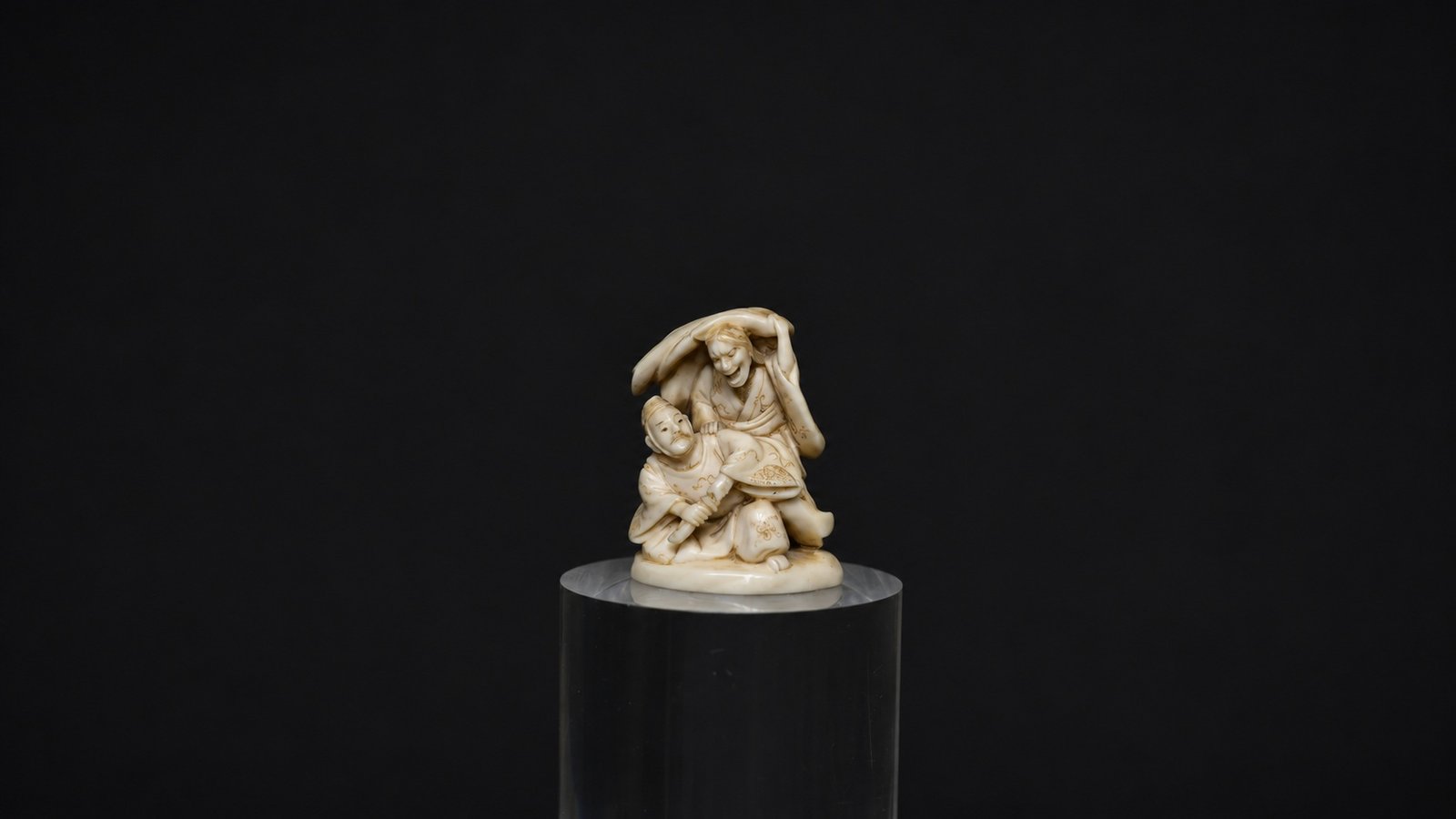
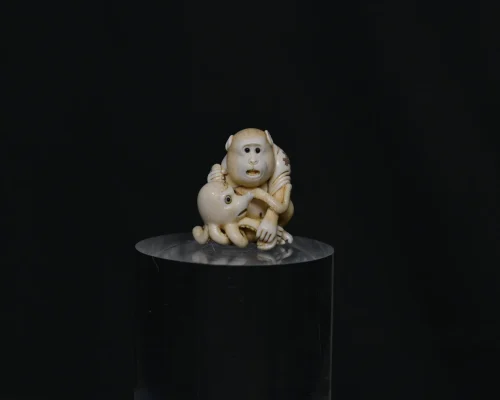
At first we see two figures carved very closely together. In the lower part of the composition sits a samurai. Above and behind him appears Hannya, leaning over the scene and creating an immediate sense that something is happening.
The description accompanying the piece identifies the moment as Hannya surprising the samurai from behind as he disembarks.
That small narrative detail changes the way the carving is read.
It is not simply a pair of figures placed together. It is a scene.
The netsuke measures only 4.3 × 3.5 × 3 cm.
That is not much space in which to place two separate characters, their clothing, their gestures and the relationship between them.
The solution is to build the sculpture vertically.
The samurai occupies the lower part of the netsuke, while Hannya rises behind him. Their bodies overlap visually, allowing the carving to remain compact instead of spreading outward.
This is one of the most interesting aspects of the piece.
When viewed from a distance, both figures almost form a single silhouette. Only when we begin looking more carefully do the individual characters separate from one another.
The scene becomes progressively easier to read.
The samurai is the figure we encounter first.
He is positioned in the lower part of the composition, with his body turned across the base of the carving.
The folds and details of his clothing help distinguish his figure from the one behind him, while his position gives the scene a clear visual foundation.
Because the carving is so small, there is very little empty space between the two characters.
The samurai is therefore not simply standing in front of Hannya. He forms part of the same compact sculptural mass.
That closeness is important to the scene.
It makes the encounter feel immediate.
Above him is Hannya.
The figure leans over the samurai from behind and occupies the upper section of the carving.
Visually, this is what gives the composition much of its tension.
The eye first recognizes the lower figure and then naturally moves upward toward the second face and body.
There is a strong difference between the position of the two figures, but they remain physically connected within the same small form.
The result is a surprisingly complex scene for an object only a few centimeters tall.
One of the pleasures of figural netsuke is that they are not really designed to be understood from only one viewpoint.
A photograph gives us one interpretation of the carving.
Turning the object would reveal how the two figures connect, where one body ends and the other begins, how the base has been finished, and how the composition has been compressed into such a limited volume.
This is especially relevant here because the base is decorated and the piece is also signed.
Those details make the underside part of the object rather than merely a support.
For collectors who enjoy looking closely at these small sculptures, this is one of the qualities that makes Japanese netsuke particularly rewarding.
The piece is carved in ivory.
In this composition, the same material is used to define both characters and their clothing, so the separation between them depends largely on carving, relief and the arrangement of the forms rather than contrasting materials.
That makes the construction of the scene especially important.
Faces, garments and overlapping bodies all need to remain legible within one continuous surface.
Even in the photograph, it is possible to see how the vertical organization helps prevent the composition from becoming confused.
The figures are close together, but their positions remain understandable.
The piece is dated to the Meiji period, in the late 19th century.
Rather than trying to build a wider attribution around that date, I think it is more useful to stay with what the object itself gives us.
We have a small signed ivory carving, two figures, a clearly defined narrative moment and a decorated base.
That is already quite a lot of information contained within an object measuring little more than four centimeters.
The netsuke is signed.
Without additional documentation identifying the carver, it would not be appropriate to turn that fact into a definite attribution.
But the presence of the signature remains an important recorded characteristic of the piece.
The same is true of the decoration on the base.
With netsuke, the underside can be just as interesting as the front because it often reveals details that disappear when the object is viewed only as a small sculpture standing upright.
This is a piece that really benefits from being examined from every side.
The netsuke is accompanied by a certificate of appraisal and CITES documentation.
That documentation is particularly relevant for objects made from ivory.
It should, however, be distinguished from the legal requirements that may apply when an object crosses borders. Import, export, possession and transport rules can vary depending on the destination country, so those requirements need to be checked separately.
What I find interesting about this netsuke is not simply the presence of Hannya or the samurai.
It is the way the two have been fitted together.
The entire scene depends on proximity.
The samurai is below.
Hannya appears immediately behind him.
The figures overlap.
The composition rises vertically.
And all of this has been compressed into 4.3 × 3.5 × 3 cm.
From the front, the piece initially looks like a dense group of carved forms.
Then the scene begins to open up.
A face appears.
Then another figure.
Then the relationship between them.
That gradual discovery is part of what makes small figural netsuke so enjoyable to examine.
For readers who would like a broader introduction to these objects, our guide What Is a Netsuke? explains their historical function and development in Japanese material culture.
This particular example does something quite simple but effective: it takes a moment involving two characters and compresses it into an object small enough to sit in the palm of a hand.
And the closer you look, the clearer the scene becomes.
CEO of SupeinNihonto, dealer and collector of ancient Japanese art and weapons from Canillo, Andorra.
Contact