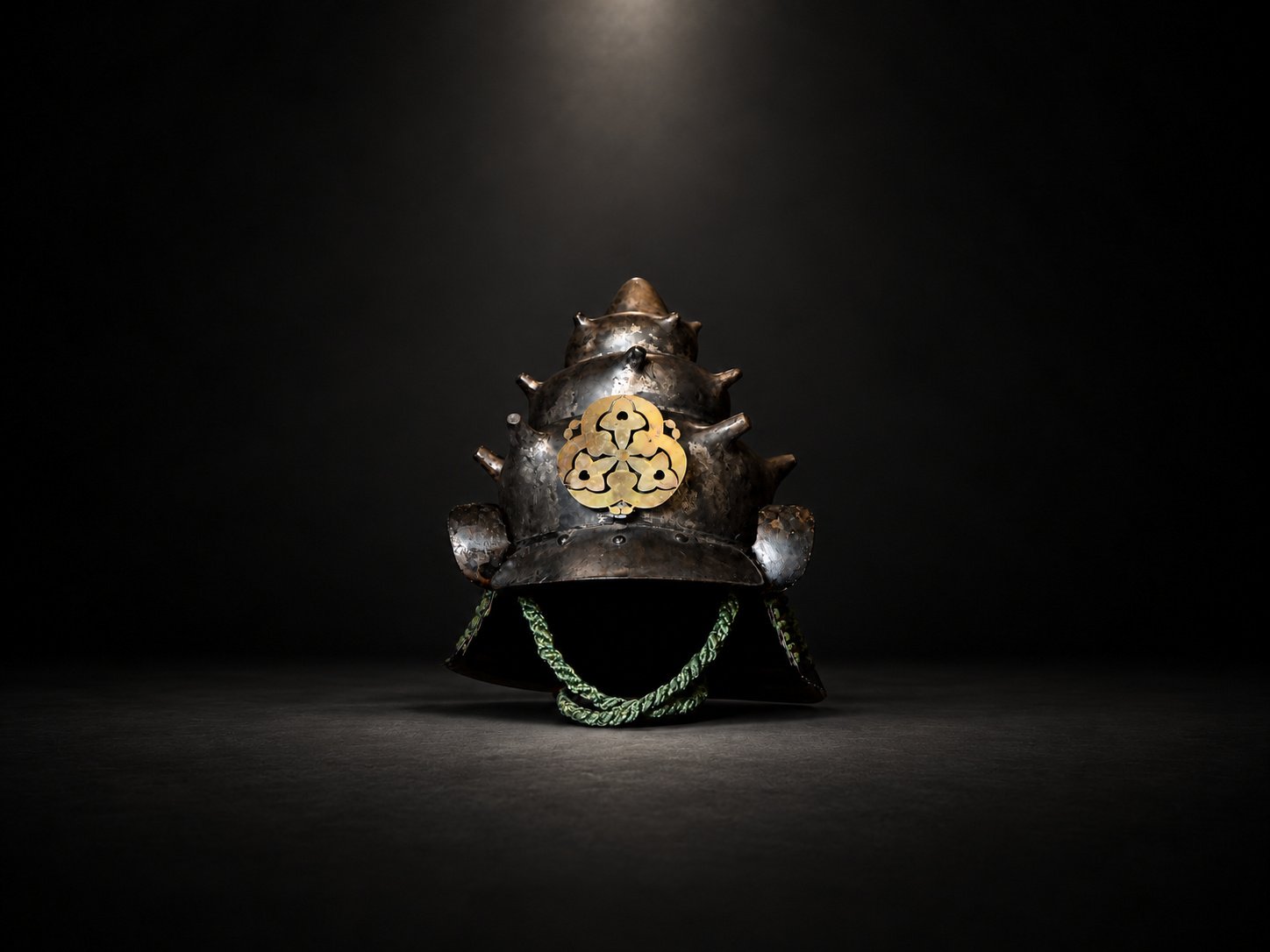
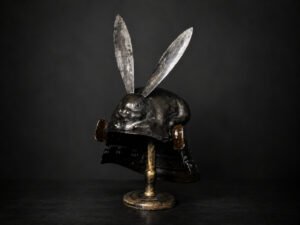
An exceptional Japanese sazae-nari kawari kabuto, distinguished by its extraordinary multi-tiered, spiraling silhouette inspired by the ridged shell of a sazae, the Japanese turban shell.
The helmet belongs to the broad category of kawari kabuto — “unusual” or eccentric-form helmets — in which sculptural silhouette became an important means of visual identity. Here, the crown rises through a succession of rounded, projecting tiers and pointed bosses, creating a highly recognizable shell-like form with remarkable presence from every angle.
The piece is accompanied by an official certification from the Nihon Katchū Bugu Kenkyū Hozonkai (日本甲冑武具研究保存会), which classifies it as 貴重資料 (Kichō Shiryō, “Valuable Reference Material”). The document specifically records the hachi as Edo-period, while indicating the helmet in its present configuration as Meiji period or later.
The defining characteristic of the helmet is its sazae-nari form, named after the Japanese turban shell or sea snail.
The bowl rises in several stacked, asymmetrical tiers, each projecting outward and terminating in prominent pointed bosses. The successive layers create the impression of a spiral shell expanding upward from the base of the helmet.
This deliberately unconventional silhouette places the piece firmly within the tradition of kawari kabuto, helmets designed to stand apart visually from more conventional multi-plate forms.
The construction is especially effective in profile, where the progressively rising tiers and irregular projections give the helmet an almost architectural quality.
The helmet is described in its certification as hari-kake (張懸), a lightweight sculptural construction method particularly suited to elaborate kawari-kabuto forms.
Rather than relying exclusively on a heavy forged iron bowl to create the external silhouette, hari-kake techniques use built-up material to form complex three-dimensional shapes that would be difficult or impractical to produce entirely from solid metal plate.
This allowed armor makers to create dramatic projections, layered forms and unusual profiles while keeping the finished helmet comparatively manageable in weight.
In this example, the technique is fundamental to the extraordinary shell-like architecture of the crown.
The surface is finished in gin-paku oshi (銀箔押), an applied silver-foil treatment specifically recorded on the accompanying certificate.
Time and oxidation have transformed the original silver surface into a complex range of dark grey, charcoal and softly reflective metallic tones. Areas of surviving brighter silver remain visible across the ridges and raised sections, particularly where light catches the sculptural crown.
This aged metallic surface is one of the most visually compelling characteristics of the helmet, emphasizing the irregular geometry of the sazae-nari form without obscuring the marks of age and use.
The certification makes an important chronological distinction, recording:
鉢は江戸時代
Hachi wa Edo jidai
“The hachi is from the Edo period.”
The hachi, or core helmet bowl, is therefore recognized in the certification as an authentic Edo-period component.
The same document indicates Meiji period or later for the helmet in its present configuration. This suggests that the historic Edo-period bowl was subsequently incorporated into, restored as, or refinished within the form in which the helmet survives today.
Accordingly, the most accurate description is not simply “an Edo-period kabuto,” but rather a sazae-nari kawari kabuto incorporating an Edo-period hachi, with later work or finishing recognized by the certification.
A broad mabizashi projects from the front of the helmet, forming the characteristic visor above the face.
On either side, turned-back fukigaeshi extend outward from the lower bowl. These elements were an established functional and decorative feature of Japanese helmets, protecting the sides while also creating additional visual breadth around the face.
Their dark metallic surfaces remain visually consistent with the aged finish of the hachi and the rest of the helmet.
A large circular openwork crest ornament is mounted toward the side-front of the crown.
The ornament is worked in a warm gilt metal combined with darker elements and forms a symmetrical stylized floral or quatrefoil design.
Its rounded geometry provides a strong visual counterpoint to the irregular projections of the sazae-shaped crown, while the gold-toned surface contrasts elegantly with the darkened silver finish of the helmet.
Without further documentation, the precise alloy of the ornament should remain unconfirmed.
A substantial five-lame shikoro descends from the lower edge of the helmet, providing protection to the back and sides of the neck.
The lames are finished in glossy black lacquer and connected by green odoshi lacing, creating a restrained but highly effective color contrast with the dark metallic crown.
Small gilt fittings along the upper section further connect the palette of the neck guard with the gold-toned crest ornament.
The regular horizontal structure of the shikoro provides a deliberate visual contrast with the irregular, spiraling architecture of the helmet above.
The green textile elements are an important part of the helmet’s visual character.
Green odoshi binds the individual shikoro lames, while a heavier braided green cord survives as part of the helmet’s fastening system.
The muted green tone complements both the black lacquered neck guard and the aged silver-grey surface of the crown, producing a sophisticated and historically appropriate combination of color and material.
The interior retains its fabric lining or ukebari, an important functional component that separated the wearer’s head from the internal structure of the helmet.
The survival of interior textile elements contributes to understanding the piece as a complete piece of armor rather than solely as a sculptural shell.
The helmet is accompanied by an official Ninteisho (認定書) issued by the:
一般社団法人 日本甲冑武具研究保存会
Nihon Katchū Bugu Kenkyū Hozonkai
an association dedicated to the study and preservation of Japanese armor and arms.
The piece was examined and formally classified as:
貴重資料 — Kichō Shiryō
which may be translated as “Valuable Reference Material.”
The certification is dated:
December 8, Reiwa 6 (2024)
and carries registration number:
貴第1360号 — Kichō No. 1360
The central descriptive inscription identifies the helmet as:
張懸 銀箔押 栄螺形兜
Hari-kake · gin-paku oshi · sazae-nari kabuto
That is, a sazae-shaped helmet of hari-kake construction with applied silver foil.
The document also records:
明治以降 鉢は江戸時代
indicating Meiji period or later for the present object or configuration, while explicitly identifying the hachi as Edo period.
This distinction is particularly important because it provides documentary support for both the age of the core bowl and the later history of the surviving helmet.
The certificate is issued under the authority of the Nihon Katchū Bugu Kenkyū Hozonkai and bears the name of its president:
永田仁志 — Nagata Hitoshi
The reverse also records members involved in the examination process, providing additional documentary context for the assessment.
The presence of this recent Japanese armor certification substantially strengthens the documentary provenance of the helmet and establishes the terminology under which the piece has been formally assessed.
This helmet is particularly compelling because it combines several distinct layers of interest.
Its sazae-nari form gives it an immediately recognizable sculptural identity, while the hari-kake construction demonstrates the technical solutions used to create elaborate kawari-kabuto silhouettes.
The surviving silver-foil finish, dark patination, gilt crest, black-lacquered shikoro and green odoshi create a sophisticated visual ensemble whose character has been enhanced rather than diminished by age.
Most importantly, the accompanying certification documents the Edo-period origin of the hachi while acknowledging later work associated with the helmet’s present form. This makes the piece especially valuable not only as an impressive armor object but also as a documented example of the long working life, adaptation and preservation of Japanese samurai armor.
An exceptional certified sazae-nari kawari kabuto of sculptural hari-kake construction, finished with aged silver foil and built around a hachi formally identified as Edo period. Its distinctive turban-shell silhouette, projecting bosses, gilt openwork crest, black-lacquered five-lame shikoro and green odoshi create a striking and highly individual armor composition. Certified in Japan as Kichō Shiryō (Valuable Reference Material), registration no. 1360, the helmet is especially significant for the documented distinction between its Edo-period hachi and its later Meiji-or-after configuration or restoration.
| Época | Edo |
|---|

Order above 1.000,00 € gets free shipping.

Secure and hassle-free payment process.

Certificate of authenticity included.

Have questions? Contact us via WhatsApp.
Contact