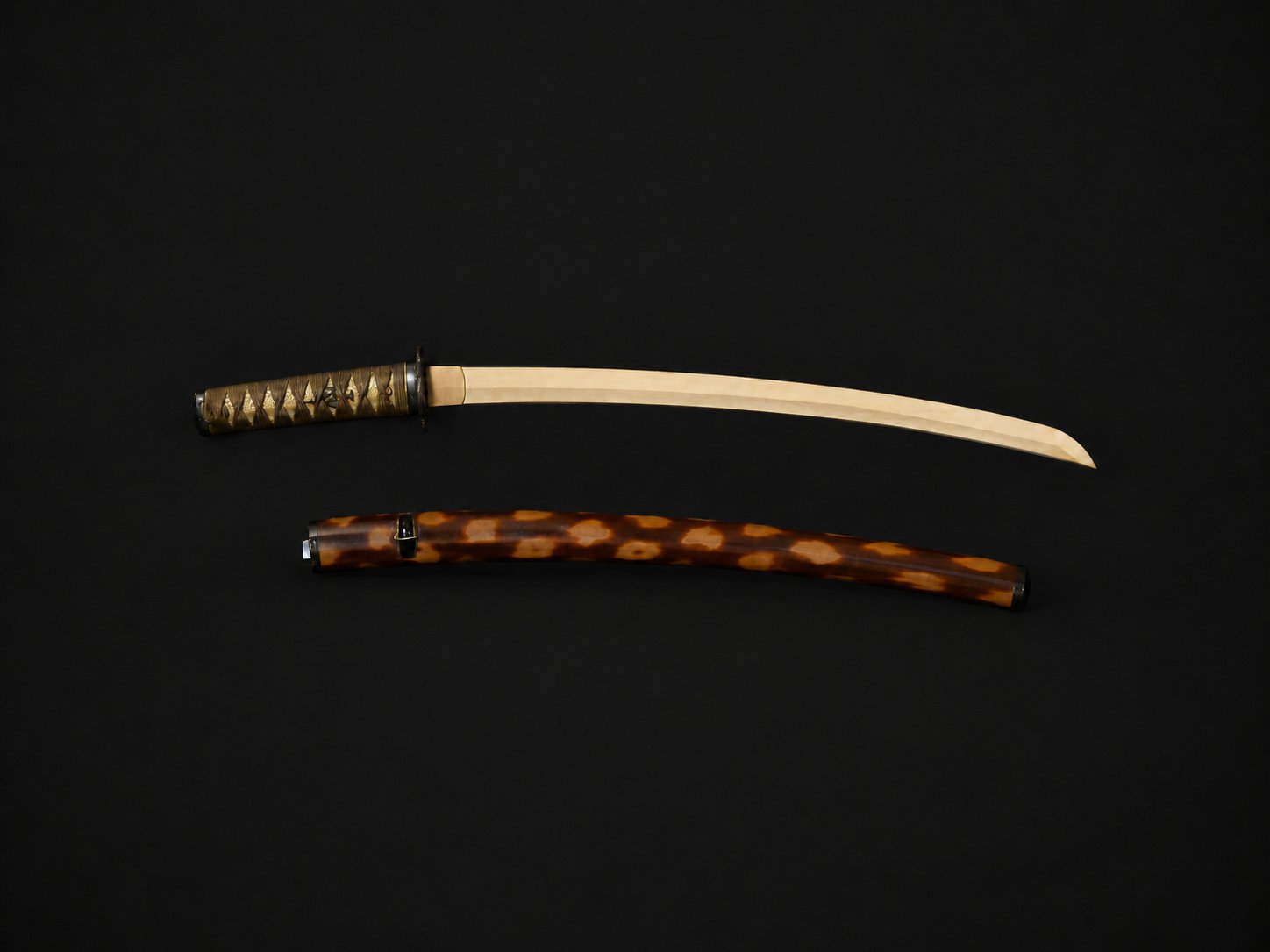
A highly distinctive 19th-century Japanese sword mounting (koshirae), combining an unusually luxurious selection of materials with a coherent Hannya-mask decorative theme.
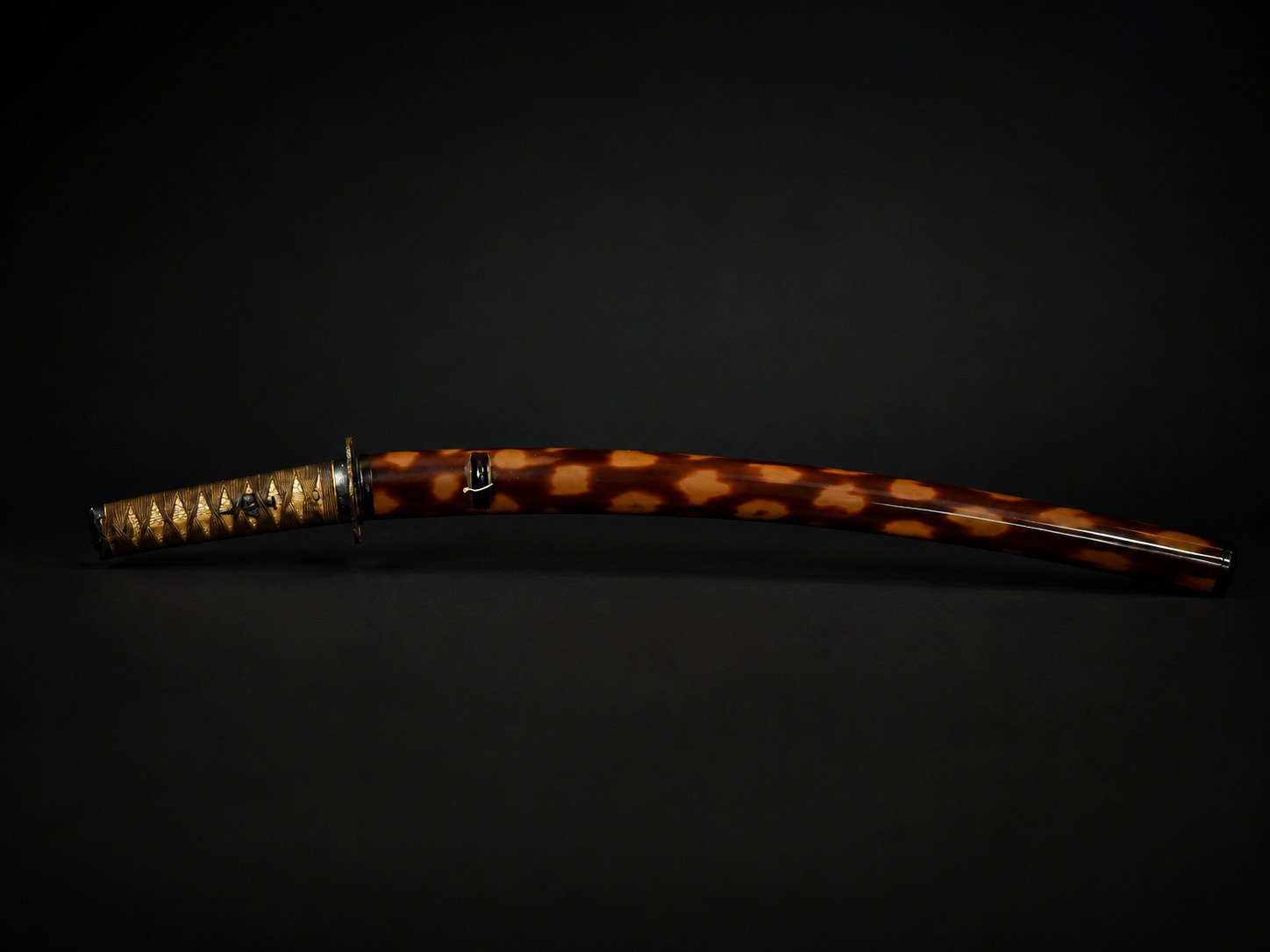
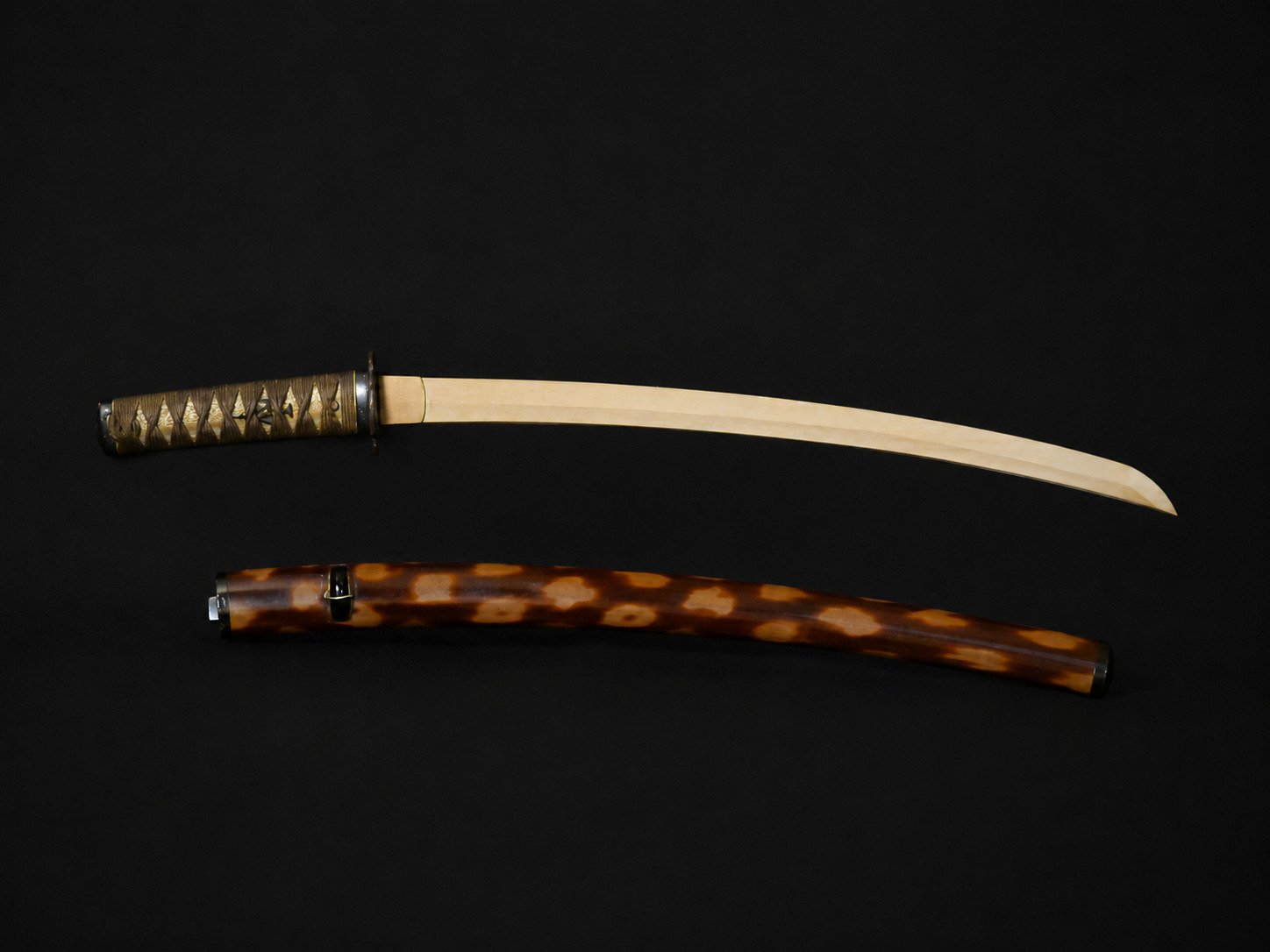
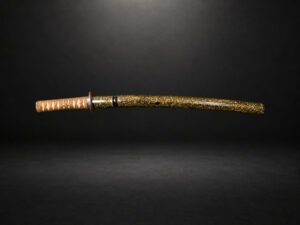
The mounting features a genuine tortoiseshell (bekko) saya with rich amber-and-black mottling, a traditionally wrapped tsuka laid over gold-dyed snakeskin rather than conventional same, and a coordinated group of fittings centred on the dramatic Hannya mask motif.
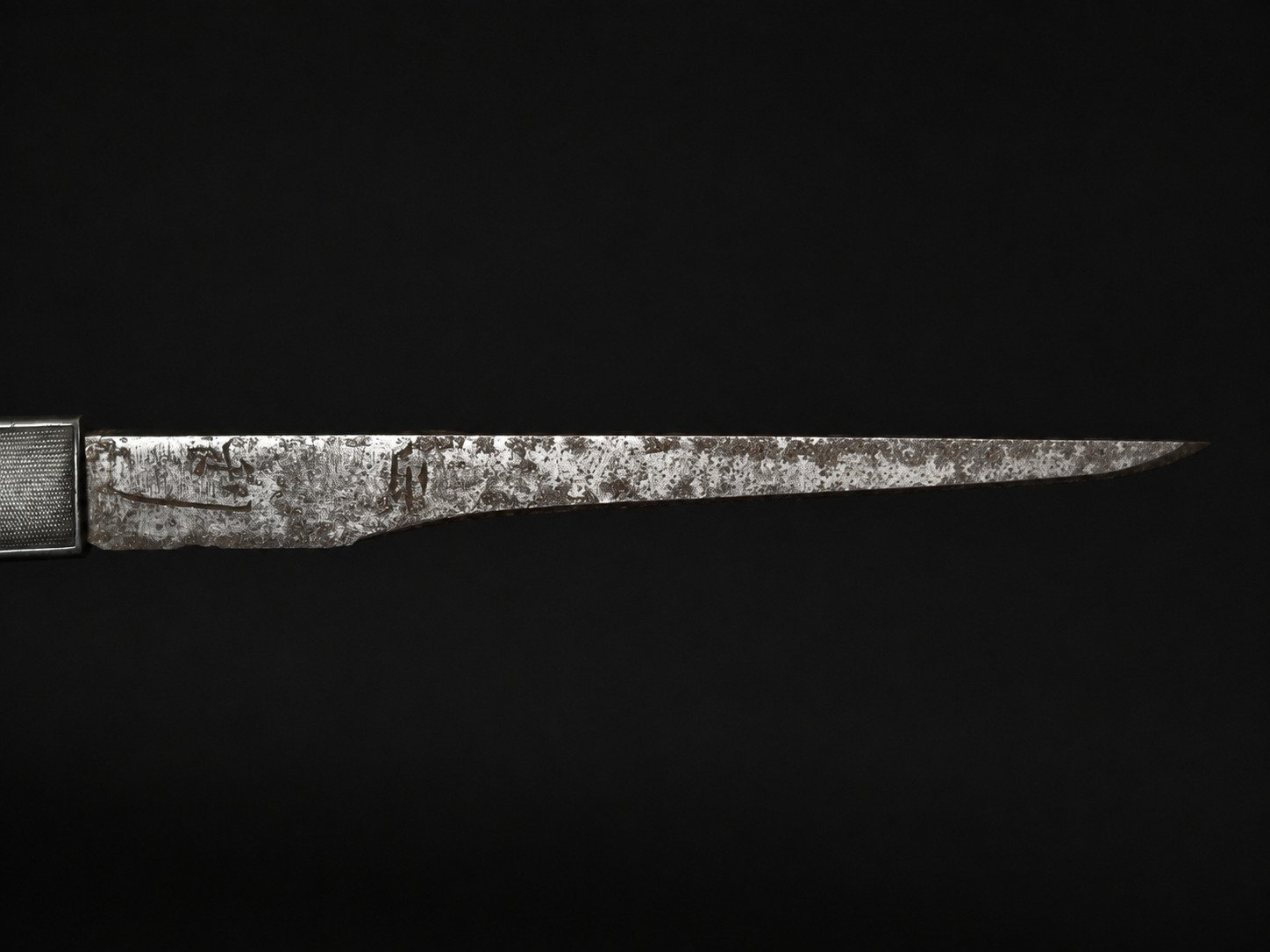
The saya also retains its kozuka and accompanying signed kogatana blade, adding both completeness and particular interest for collectors of Japanese sword fittings.
In Japanese sword terminology, koshirae refers to the complete external mounting of a sword, including the saya, tsuka, tsuba and associated fittings.
This example survives as a visually coherent ensemble rather than a loose assembly of unrelated components, with its principal fittings linked through a deliberate Hannya iconographic program.
The combination of bekko, gilt decoration, dark patinated metal and unusual snakeskin underlay gives the mounting a particularly individual character.
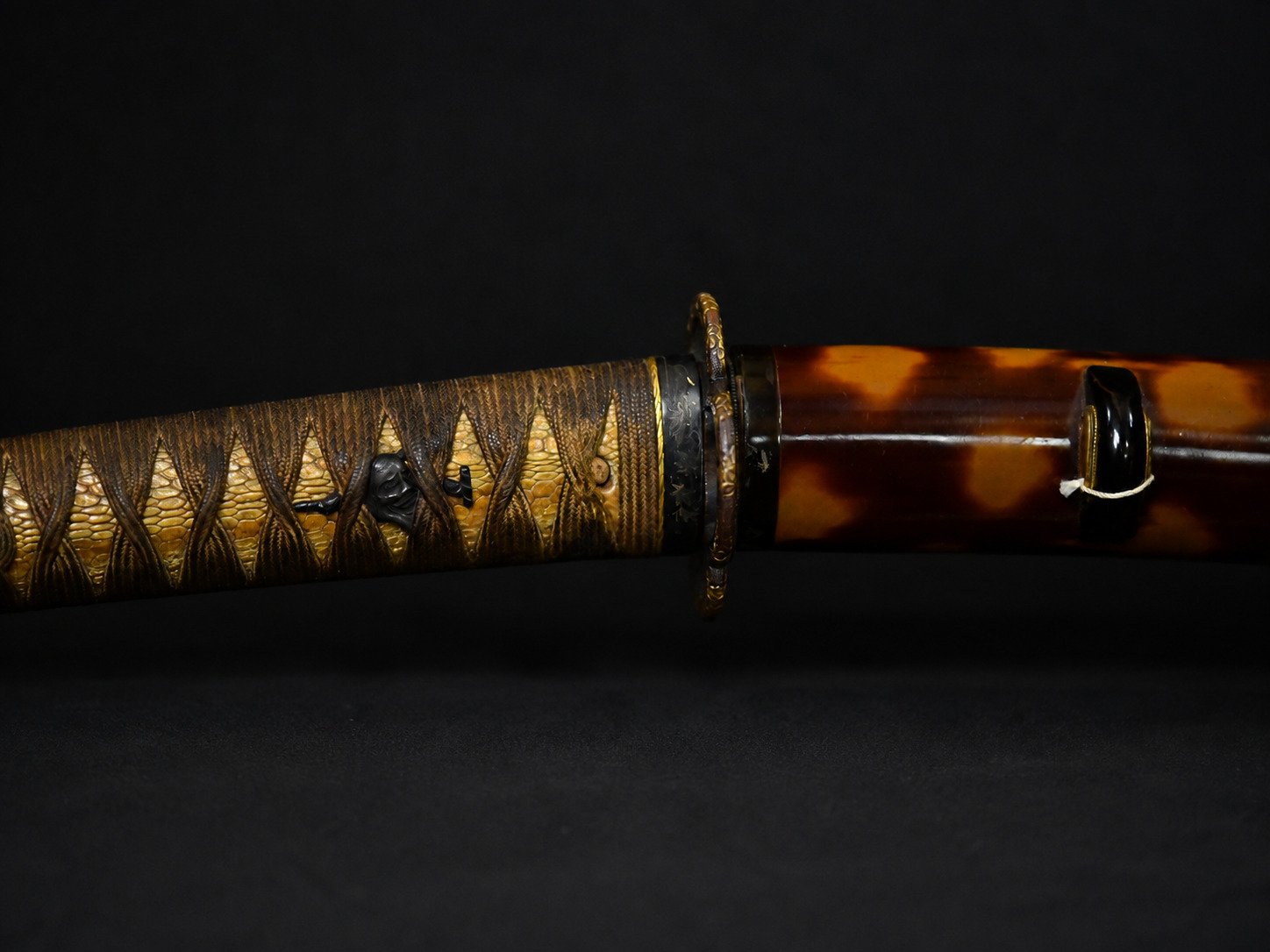
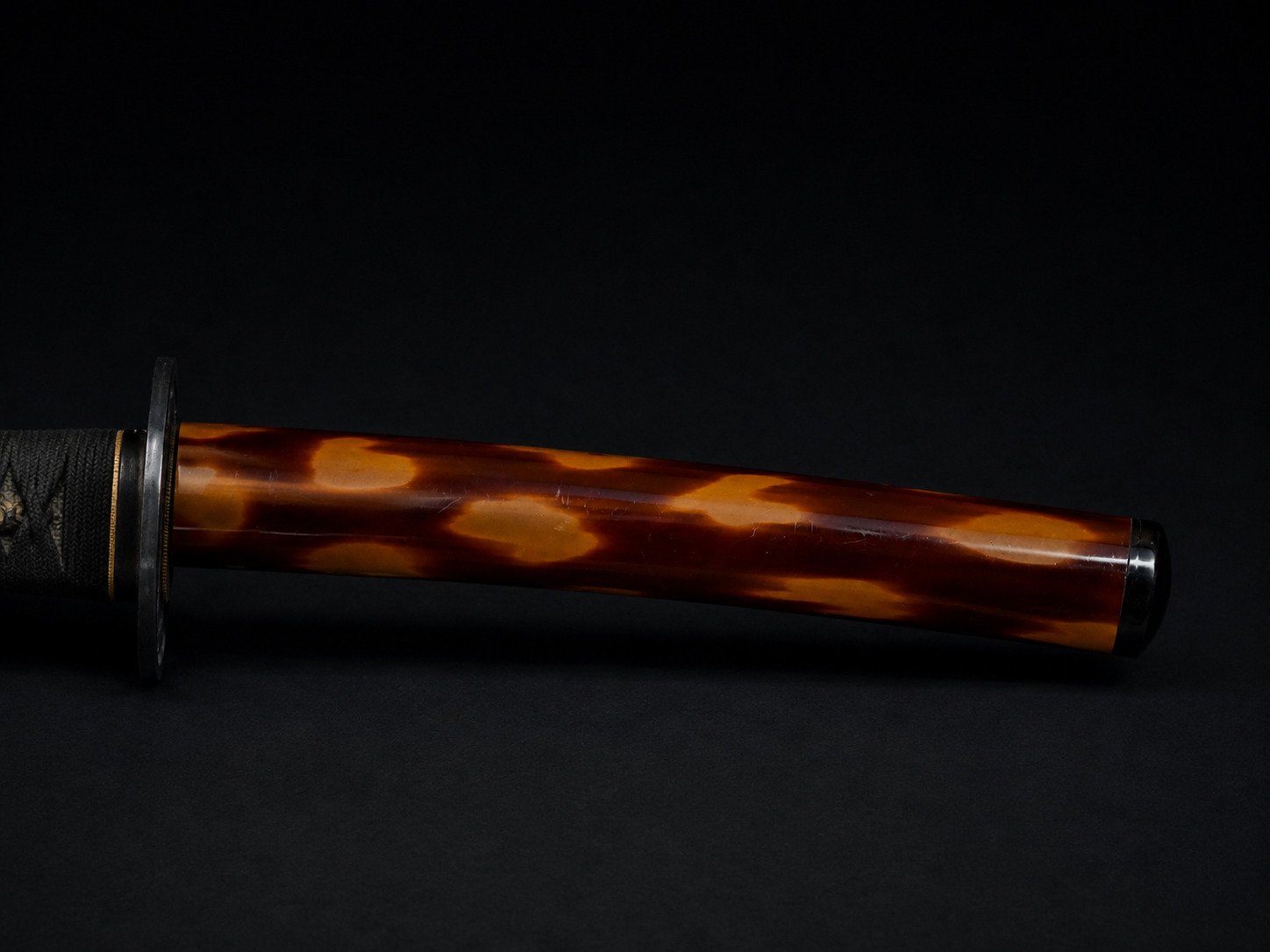
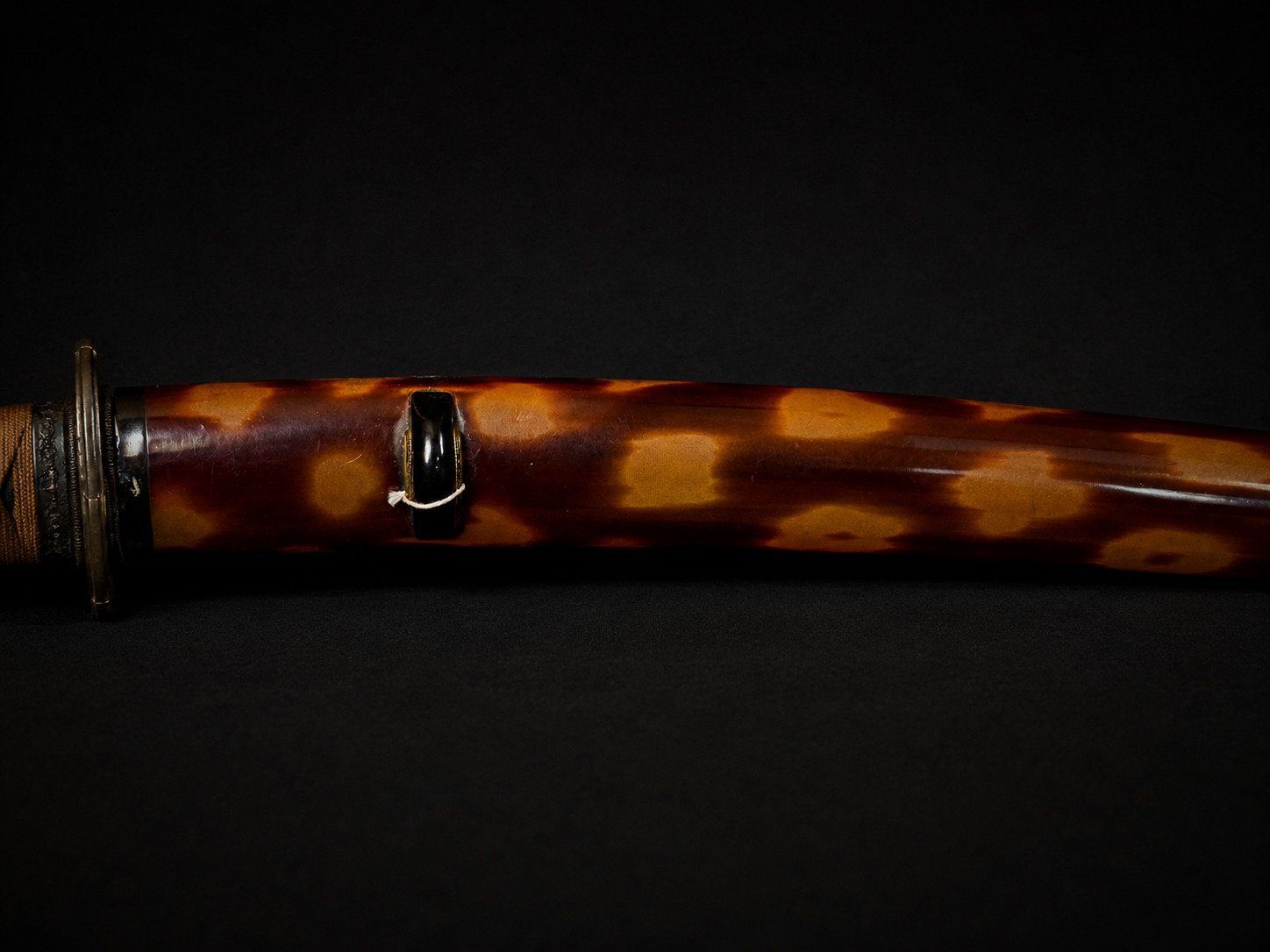
The saya (scabbard) is fashioned from genuine bekko (tortoiseshell), displaying the characteristic translucent amber, brown and black mottling associated with the material.
The natural patterning creates a highly decorative surface without the need for extensive pictorial lacquer decoration, giving the saya an elegant organic appearance that changes subtly under different lighting.
Bekko was a luxury material in Japanese decorative arts and is considerably more unusual on sword mountings than conventional lacquered wood.
The surface of the saya is defined by irregular areas of warm amber and deeper dark coloration, creating a naturally patterned finish across its length.
Rather than relying on painted or inlaid ornament, the visual interest comes from the intrinsic pattern of the material itself.
This rich mottling contrasts strongly with the black lacquer mounts and the darker metal fittings of the tsuka.
The saya is fitted with contrasting black lacquer elements at the koiguchi and kurikata.
The koiguchi reinforces the mouth of the scabbard, while the kurikata provides the attachment point through which the sageo would traditionally be passed.
The dark finish of these fittings creates a clean visual break against the warm translucent tones of the bekko.
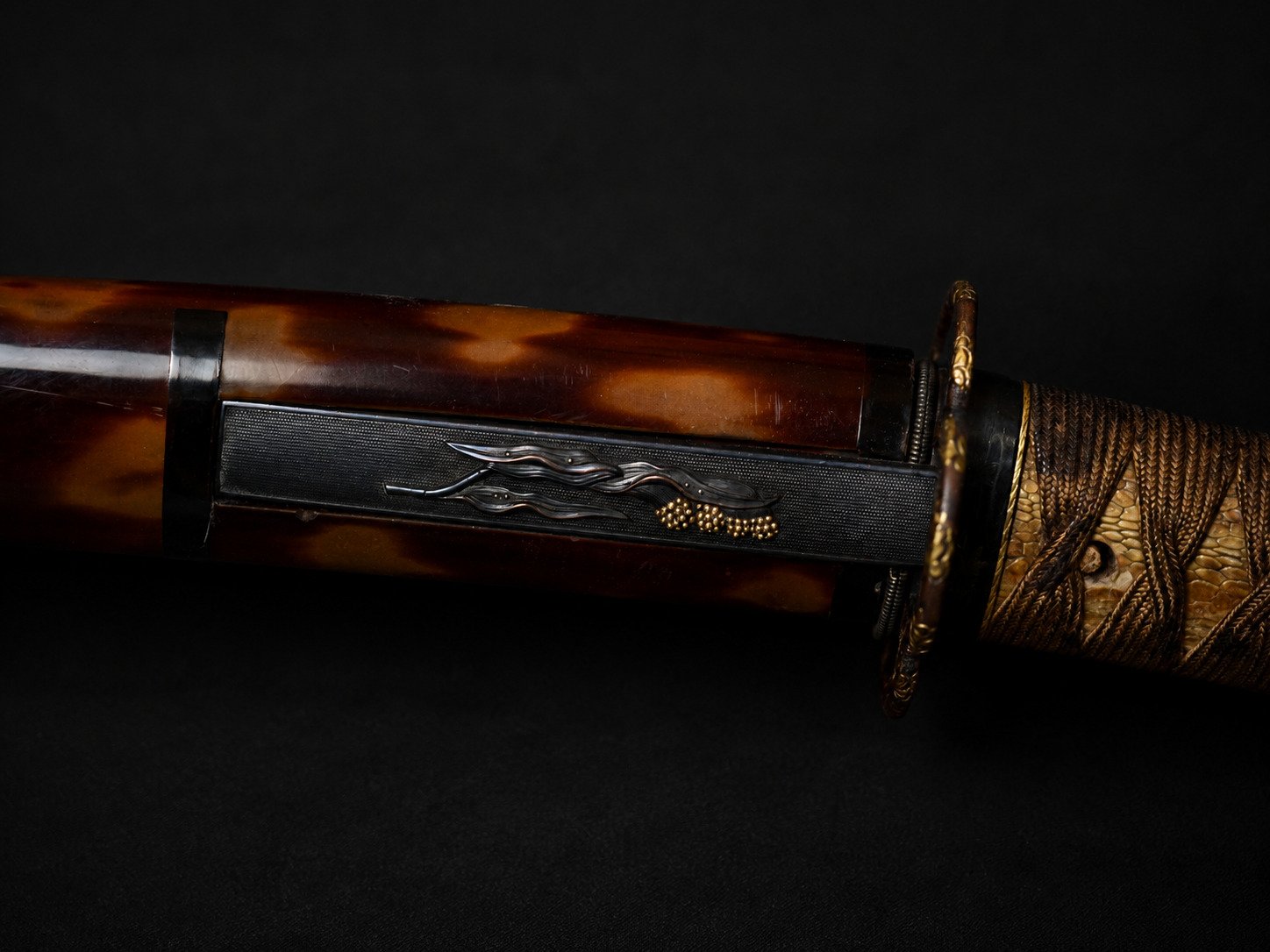
The saya incorporates a kozuka pocket containing its accompanying kozuka and small utility blade, or kogatana.
The kogatana is signed, an important detail for collectors and one that distinguishes the ensemble from incomplete mountings where the original auxiliary knife has been lost.
The preservation of this component adds further completeness to the koshirae as a surviving mounting ensemble.
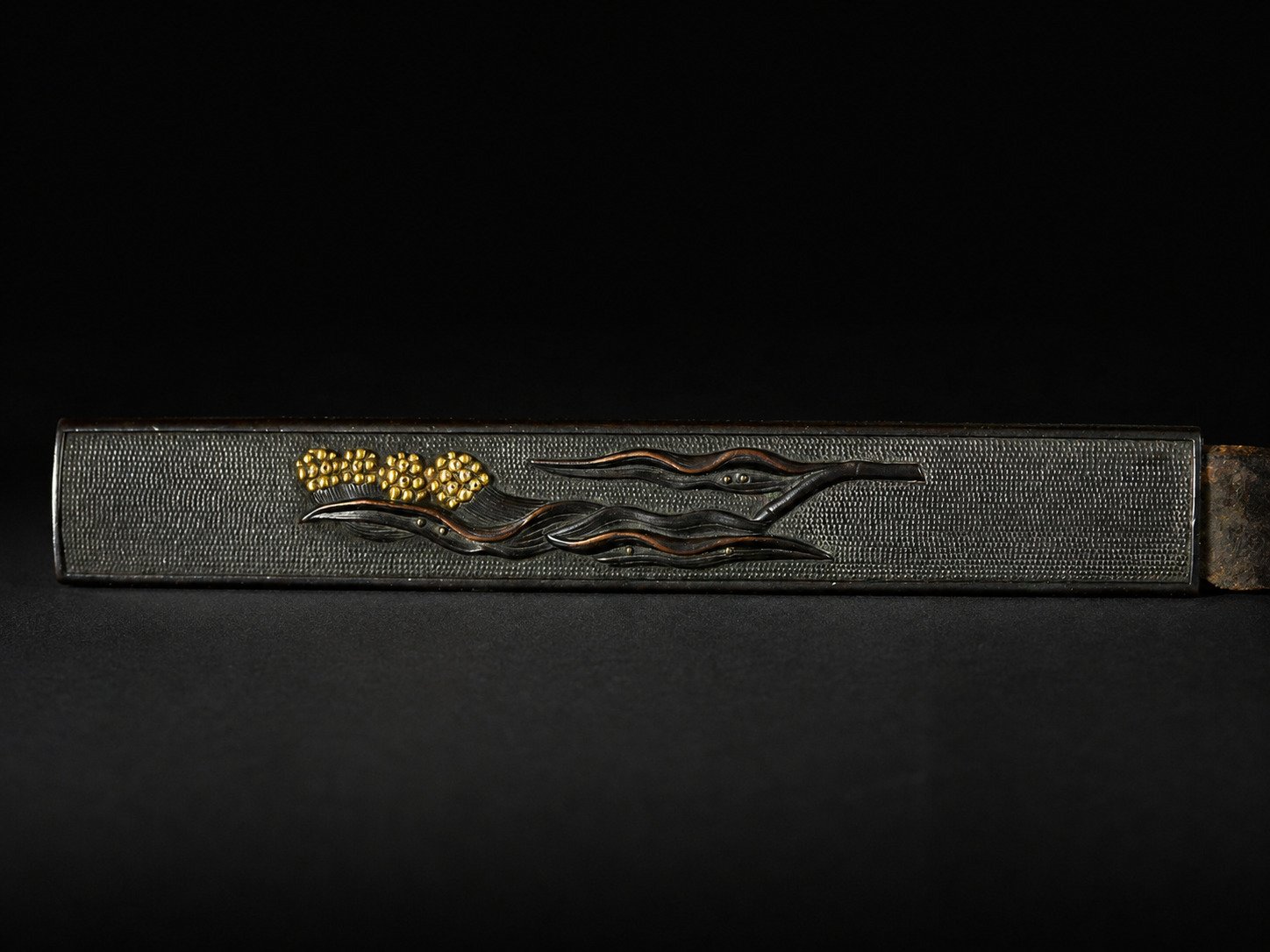
The kozuka is decorated on a dark shakudō ground worked in nanako-ji, the finely punched fish-roe texture characteristic of high-quality Japanese metalwork.
Its surface carries a decorative composition of flowing aquatic vegetation together with a cluster of berries rendered in contrasting gold relief.
The use of shakudō and gold creates a subtle but refined contrast that complements the richer materials used elsewhere in the mounting.
The decorative details on the kozuka include elements executed in gold takazōgan, a raised inlay technique in which the ornament projects from the darker metal ground.
This creates both tonal and physical contrast, allowing the gold elements to catch the light above the textured shakudō surface.
The result is a compact but sophisticated piece of metalwork integrated into the overall koshirae.
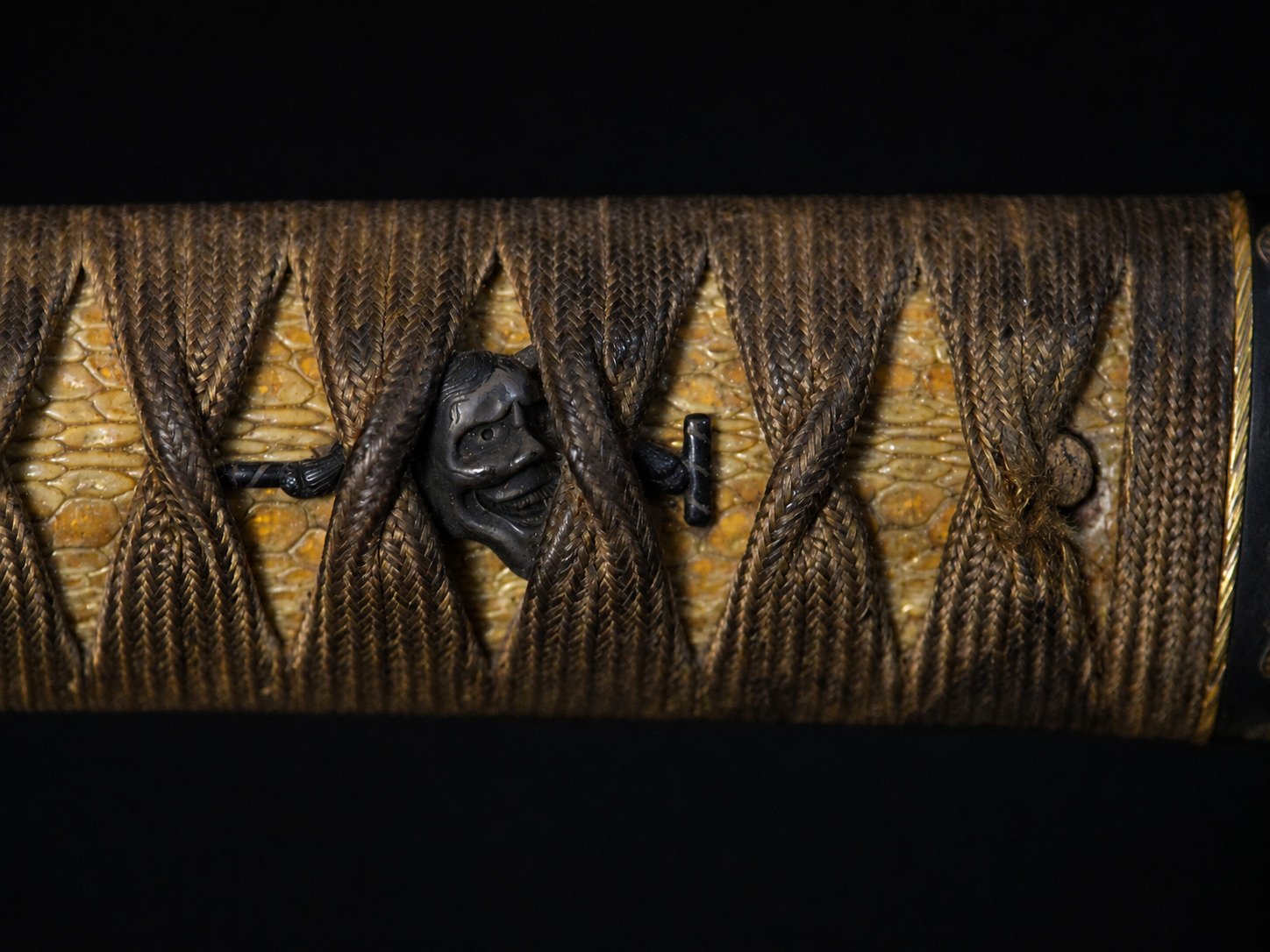
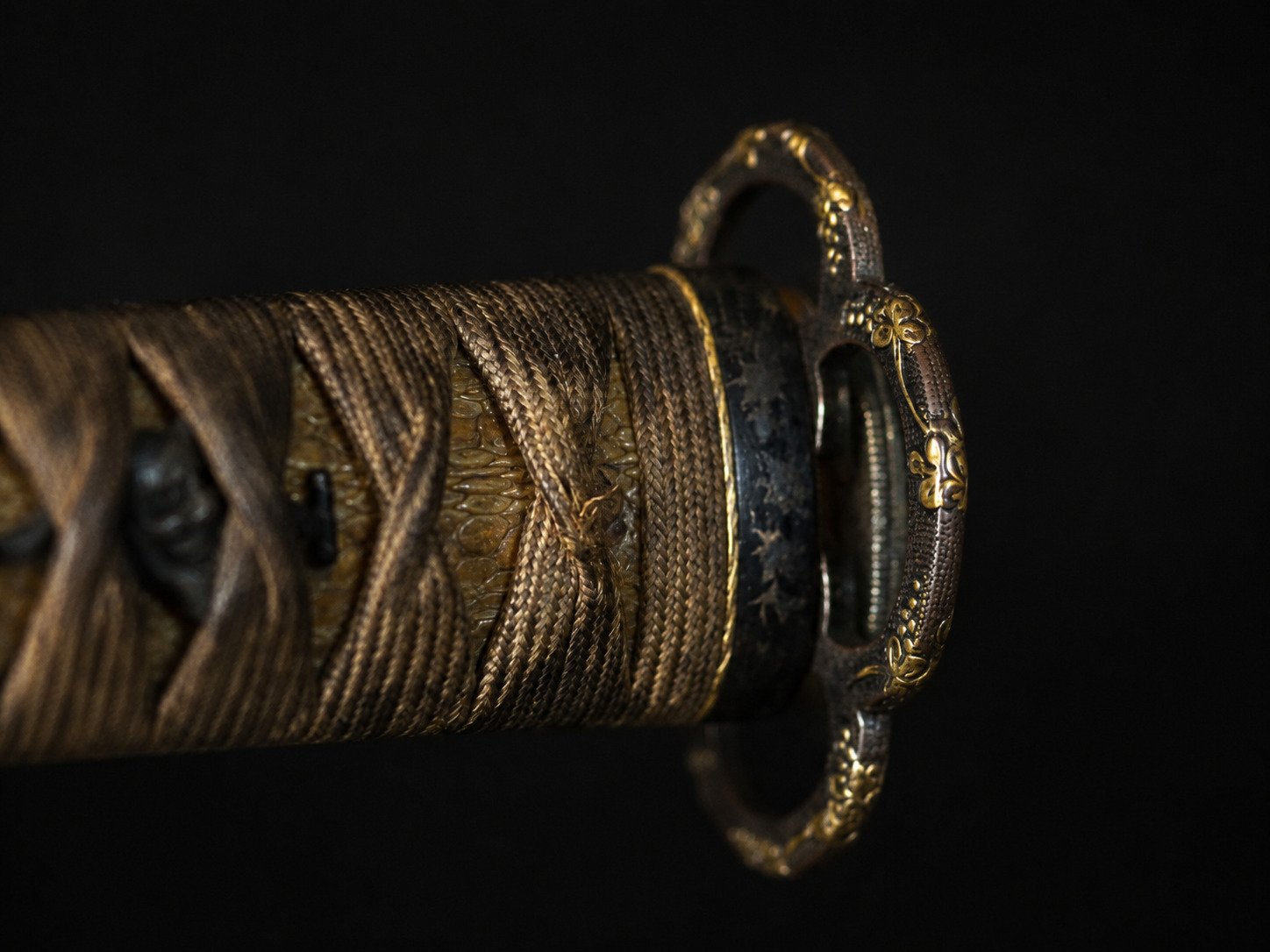
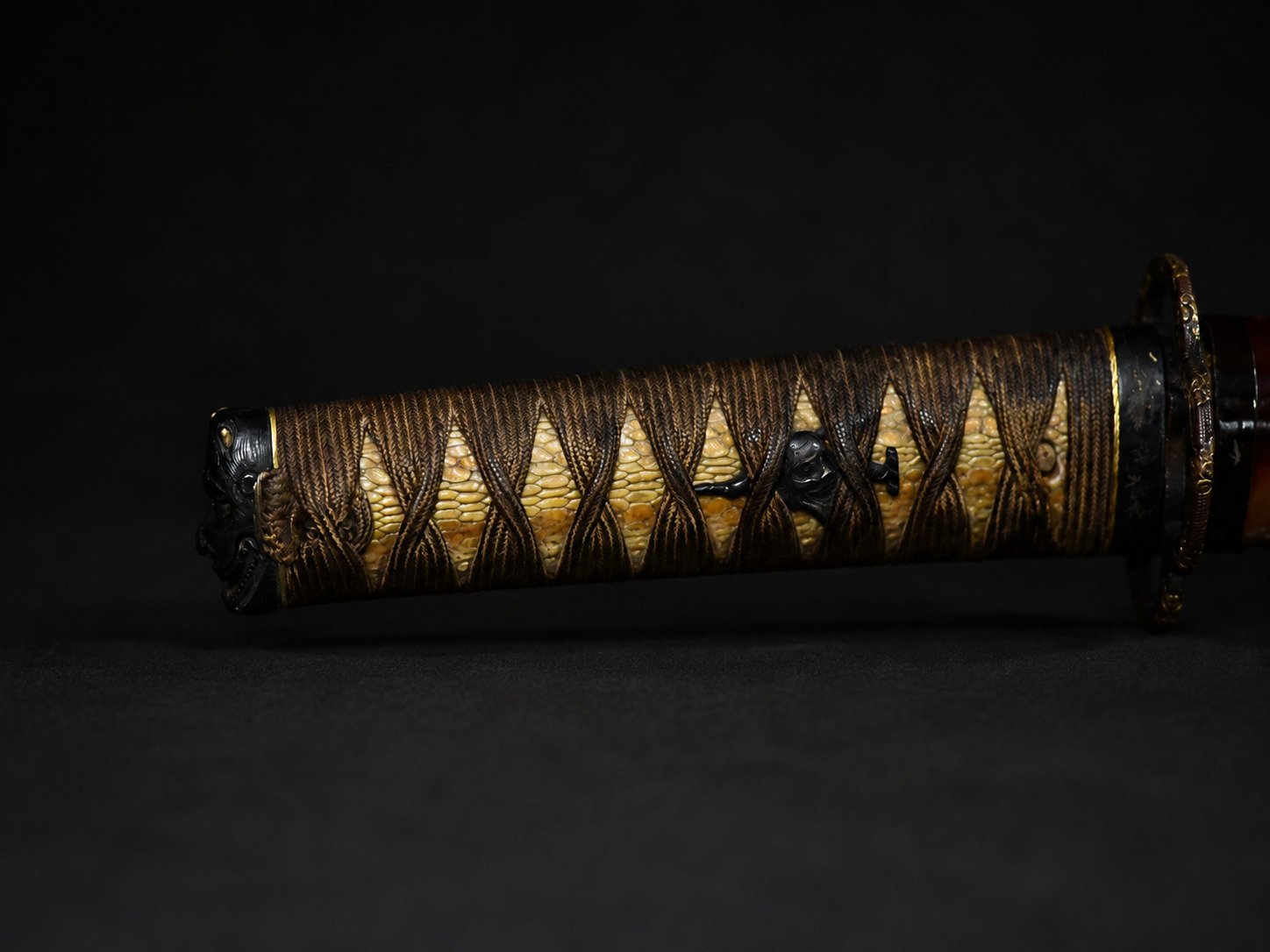
The tsuka (hilt) is wrapped in traditional brown tsukamaki, arranged in the familiar alternating diamond pattern used on Japanese swords.
The warm brown wrap harmonizes visually with the amber tones of the tortoiseshell saya while maintaining a restrained overall palette.
The wrapping also reveals the unusual material beneath it, one of the most noteworthy features of this mounting.
Instead of the more customary same (rayskin), the tsuka is mounted over snakeskin dyed in a gold tone.
This is a comparatively unusual material choice and gives the hilt a distinctive texture visible through the openings of the tsukamaki.
The gold coloration ties the underlay visually to the gilt Hannya fittings and the gold details on the kozuka and tsuba.
For collectors, this unconventional use of snakeskin is an especially noteworthy feature and adds significant individuality to the mounting.
The metal fittings follow a coherent Hannya-mask theme, creating a deliberate iconographic program across the hilt.
Rather than combining unrelated decorative motifs, the kashira and menuki repeat the same dramatic image, reinforcing the impression of a purposefully coordinated set.
This thematic unity is one of the strongest characteristics of the koshirae.
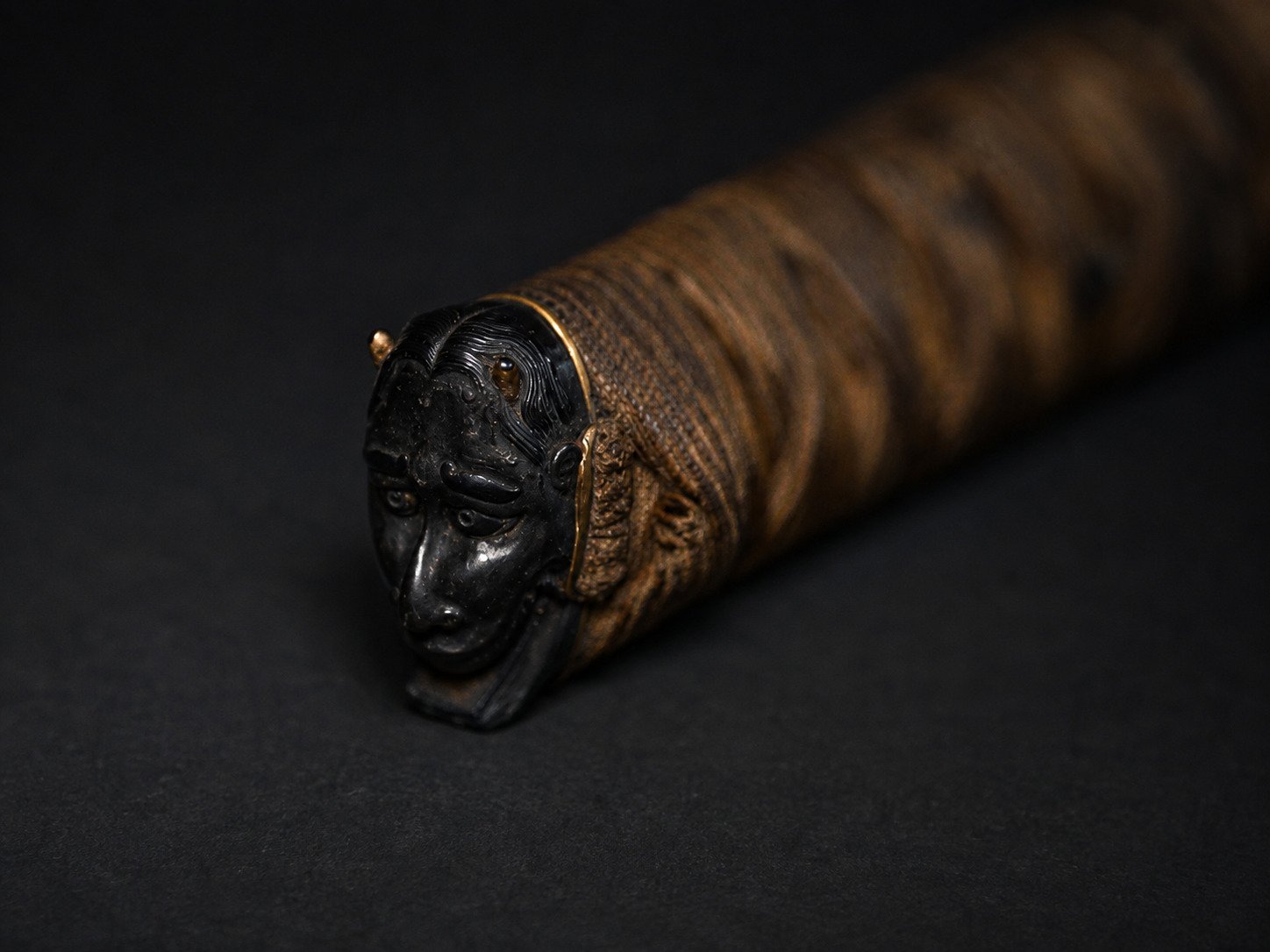
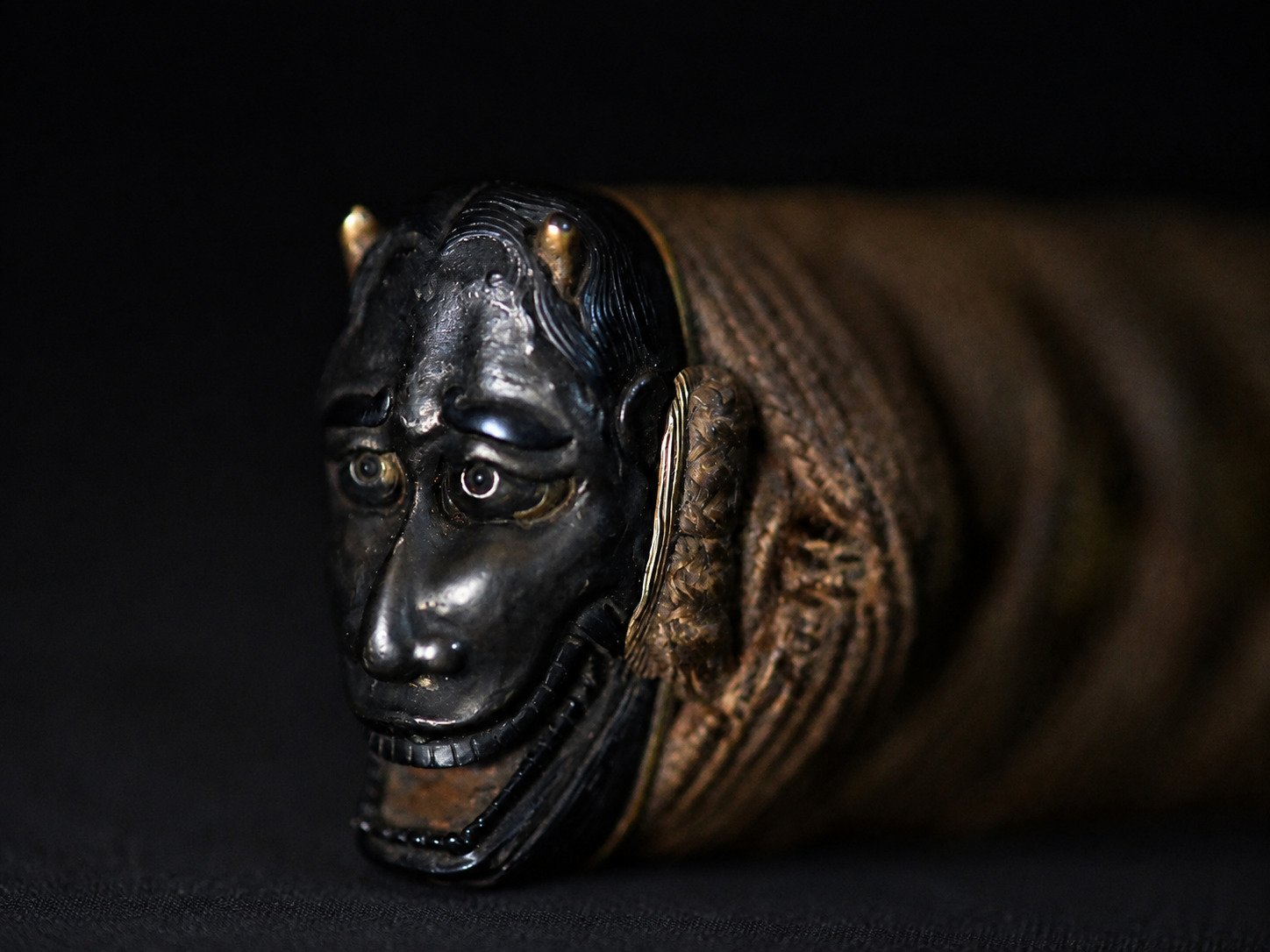
The kashira is sculpted as a Hannya mask in dark patinated metal.
Gilt horns and inlaid eyes heighten the expression, emphasizing the mask’s fierce and theatrical character.
The contrast between the dark metal and gold details gives the fitting strong visual presence while remaining consistent with the broader black, brown and gold palette of the mounting.
Beneath the tsukamaki are menuki depicting Hannya masks in gilt relief.
The repetition of the same subject on the menuki and kashira creates a clear decorative continuity along the hilt.
These small sculptural elements become partially visible through the wrap, adding depth and visual complexity without overwhelming the composition.
The Hannya is one of the most recognizable masks in Japanese Noh theatre, representing a woman transformed by jealousy, resentment and emotional anguish into a demonic form.
Its expression combines rage, sorrow and supernatural intensity, making it a particularly dramatic subject for sword fittings.
On this koshirae, the repeated use of the Hannya image gives the mounting a powerful narrative identity rather than serving merely as isolated ornament.
Hannya imagery occupies an important place within Japanese visual culture, especially in Noh performance and later decorative arts.
The mask’s horns, staring eyes and sharply modeled features make it exceptionally effective when translated into small-scale metal fittings.
Its presence on both kashira and menuki suggests that the motif was central to the intended design of the mounting.
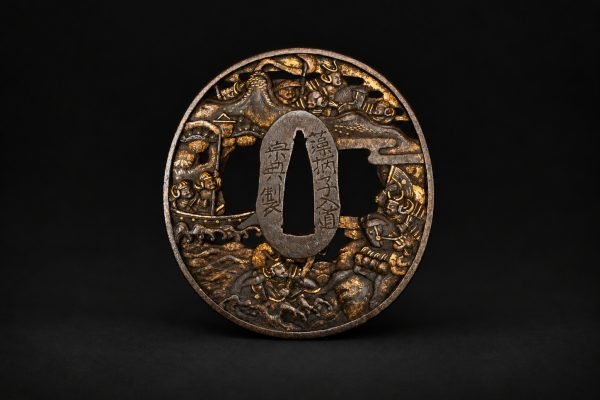
The mounting is fitted with a mokko-gata iron tsuba, its outline formed by the characteristic four-lobed shape associated with this type.
The dark iron provides a restrained structural counterpoint to the warmer tones of the bekko saya and tsuka.
Its relatively understated form also allows the more sculptural Hannya fittings to remain visually dominant.
Around the rim of the tsuba is fine gold nunome-zōgan scrollwork.
Nunome-zōgan involves applying precious metal to a cross-hatched iron surface, creating delicate linear decoration without the heavy relief of sculptural inlay.
The restrained gold pattern around the guard’s perimeter complements the other gilt details throughout the mounting.
The strength of the piece lies not simply in the quality of its individual materials, but in the way they are combined into a unified decorative scheme.
The warm tortoiseshell saya, brown tsukamaki, gold-dyed snakeskin, gilt Hannya fittings and gold-accented kozuka and tsuba all reinforce a consistent palette.
The result is a mounting with strong visual identity and considerable decorative sophistication.
The use of genuine bekko for the saya and gold-dyed snakeskin beneath the tsukamaki distinguishes this koshirae from more conventional lacquer-and-same mountings.
Both materials introduce distinctive textures and coloration, while the gold decoration on the metal fittings further enhances the sense of refinement.
Together they suggest a mounting conceived with significant attention to visual effect and material variety.
The consistent Hannya imagery across the kashira and menuki strongly suggests that the fittings were selected or produced to function together as a coordinated decorative group.
This thematic coherence is more convincing than would be expected from an arbitrary later assembly of unrelated fittings.
Without documentary provenance, however, it would be inappropriate to attribute the mounting to a specific owner or commissioning patron.
The materials, construction and metalwork are consistent with a well-appointed Japanese koshirae of the 19th-century Edo period.
Such mountings brought together multiple specialist crafts, including scabbard making, metalworking, wrapping and the preparation of luxury decorative materials.
This example is particularly notable for combining traditional sword-mounting techniques with less common materials and an unusually coherent iconographic theme.
This koshirae offers several features of particular interest to collectors: a genuine tortoiseshell saya, gold-dyed snakeskin beneath the tsukamaki, coordinated Hannya-mask fittings, a decorated mokko-gata iron tsuba, and the survival of its signed kogatana within the kozuka pocket.
Each element is noteworthy individually, but the combination makes the ensemble especially distinctive.
For collectors of nihontō fittings, samurai art, Noh iconography or Edo-period decorative arts, it represents a visually strong and unusually characterful mounting.
The koshirae measures approximately 65 cm in overall length.
Its proportions make it suitable for display on a katana-kake, within a glazed cabinet or as part of a broader collection of Japanese arms and armour.
The warm tones of the bekko and gilt elements respond particularly well to controlled directional lighting.
As an antique 19th-century mounting, the piece should be expected to show signs of age and historical handling appropriate to its period.
Bekko, lacquer, textile wrapping and metal fittings should all be handled carefully and protected from excessive heat, direct sunlight, humidity and abrasive cleaning.
Particular care should be taken with the tortoiseshell saya and the unusual snakeskin underlay, as both are integral to the historical and decorative character of the ensemble.
A highly distinctive 19th-century Edo-period Japanese koshirae combining a genuine mottled bekko saya, brown traditional tsukamaki over unusual gold-dyed snakeskin, coordinated Hannya-mask kashira and menuki, a mokko-gata iron tsuba with gold nunome-zōgan decoration, and a shakudō nanako-ji kozuka retaining its signed kogatana. The repeated Hannya imagery creates a deliberately unified decorative program, while the combination of tortoiseshell, gilt metalwork and gold-toned snakeskin gives the mounting exceptional visual character. Measuring approximately 65 cm, it is an unusually well-appointed and memorable example of 19th-century Japanese sword furniture.
| Época | Edo |
|---|

Order above 1.000,00 € gets free shipping.

Secure and hassle-free payment process.

Certificate of authenticity included.

Have questions? Contact us via WhatsApp.
Contact