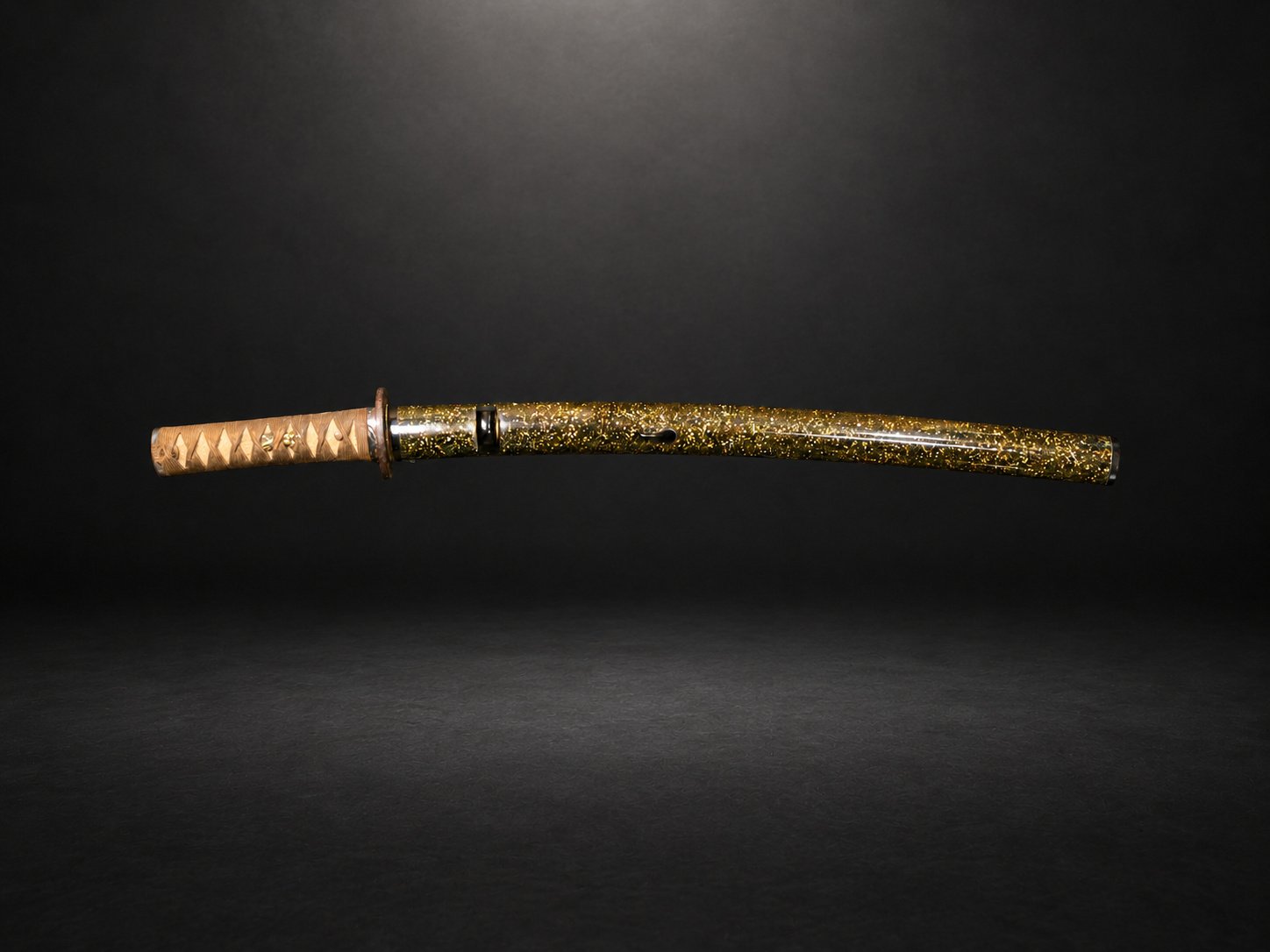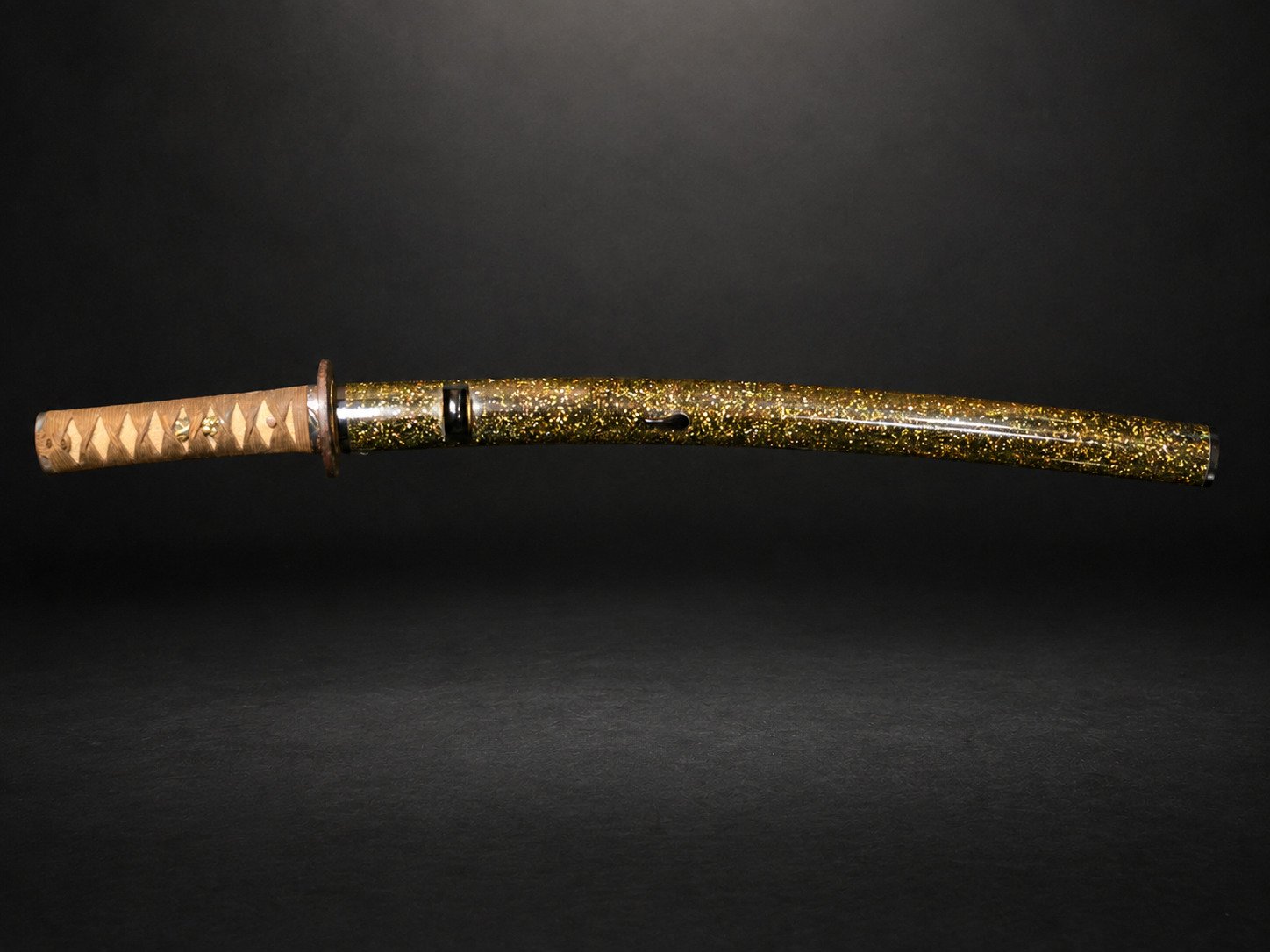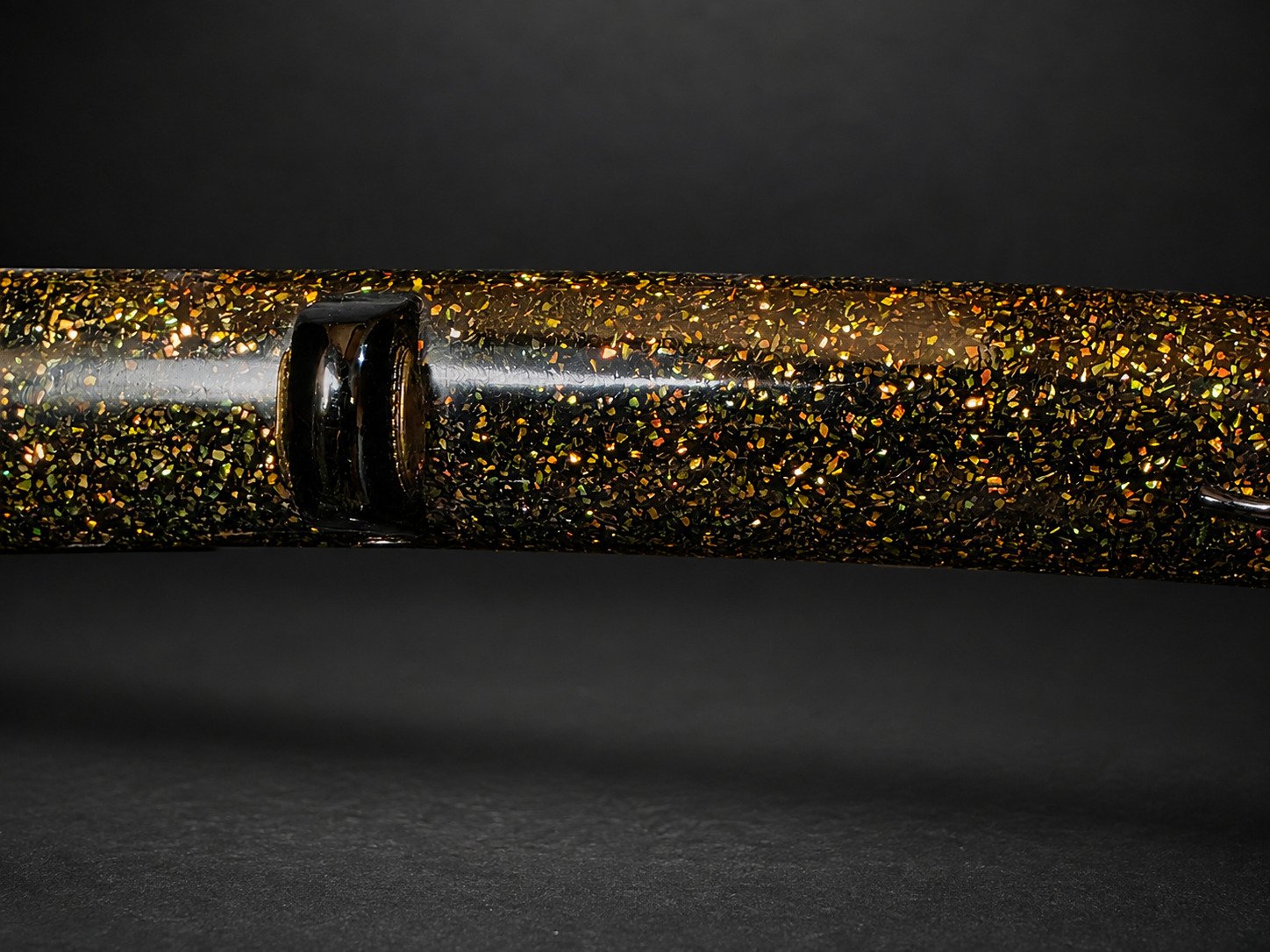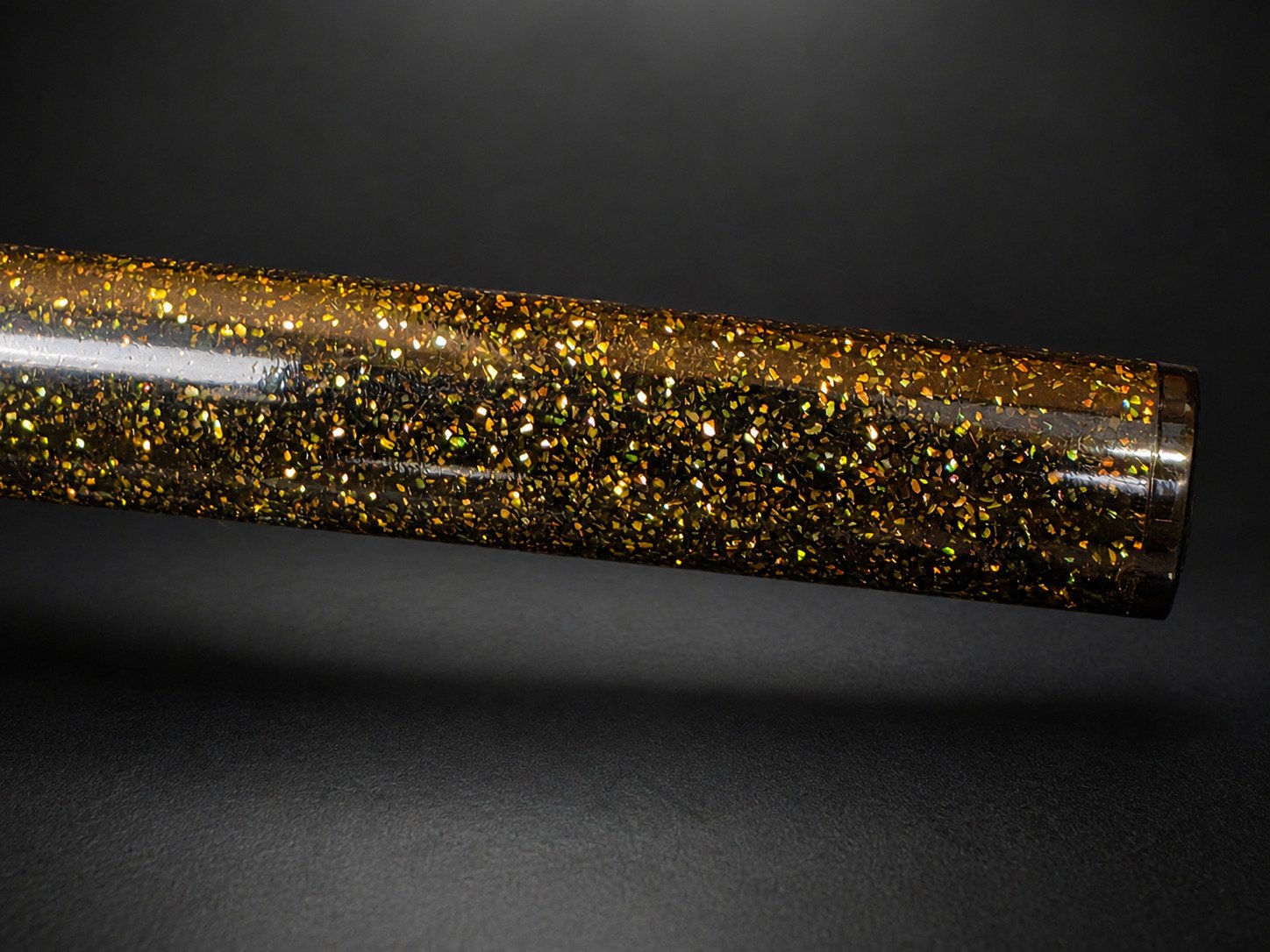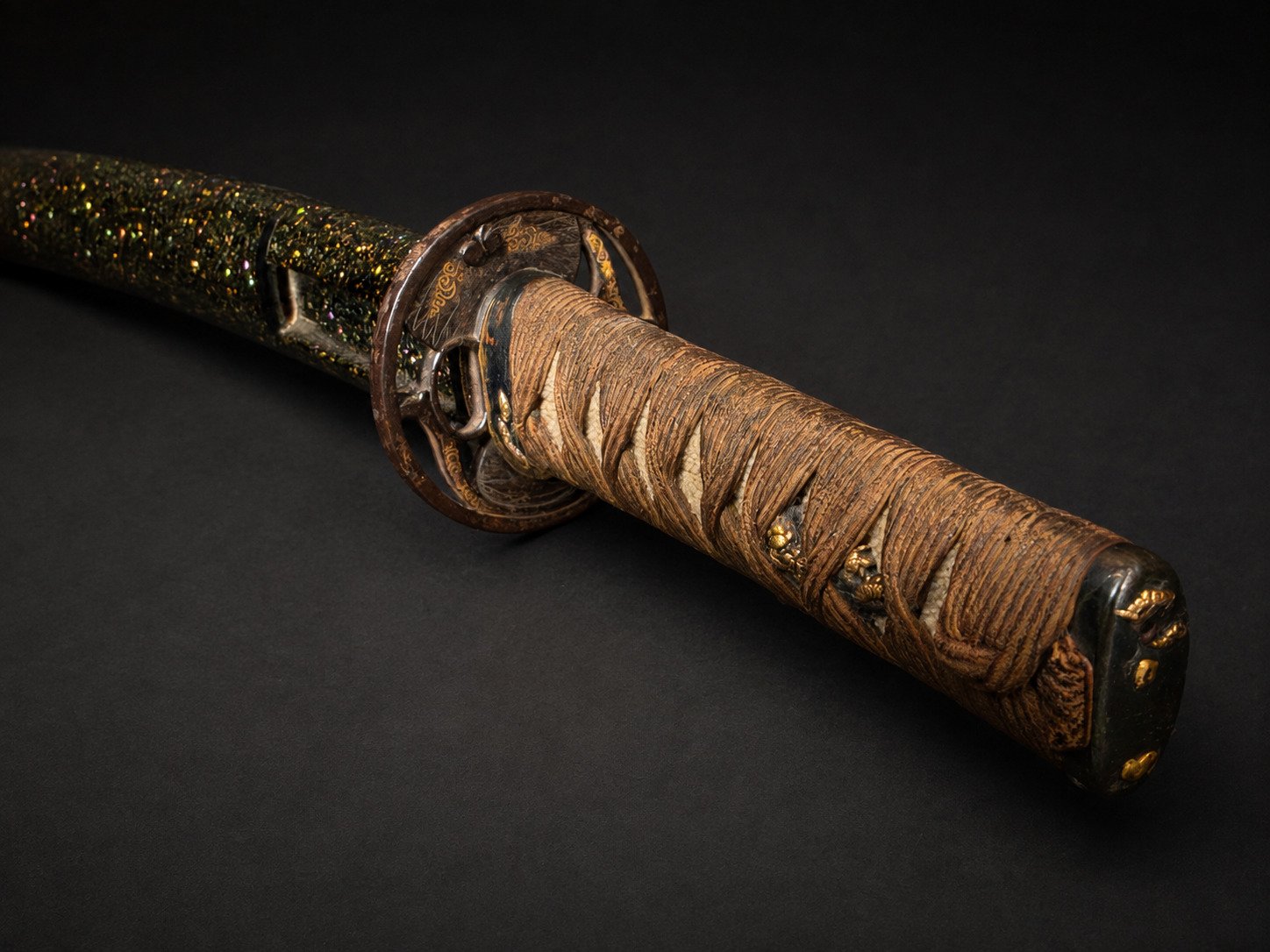
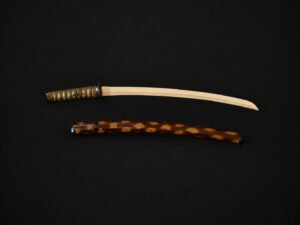
An elegant 19th-century Japanese sword mounting (koshirae), distinguished by a richly decorated black lacquer saya covered with dense, irregular gold flecks that create a shimmering, aventurine-like surface across the length of the scabbard.
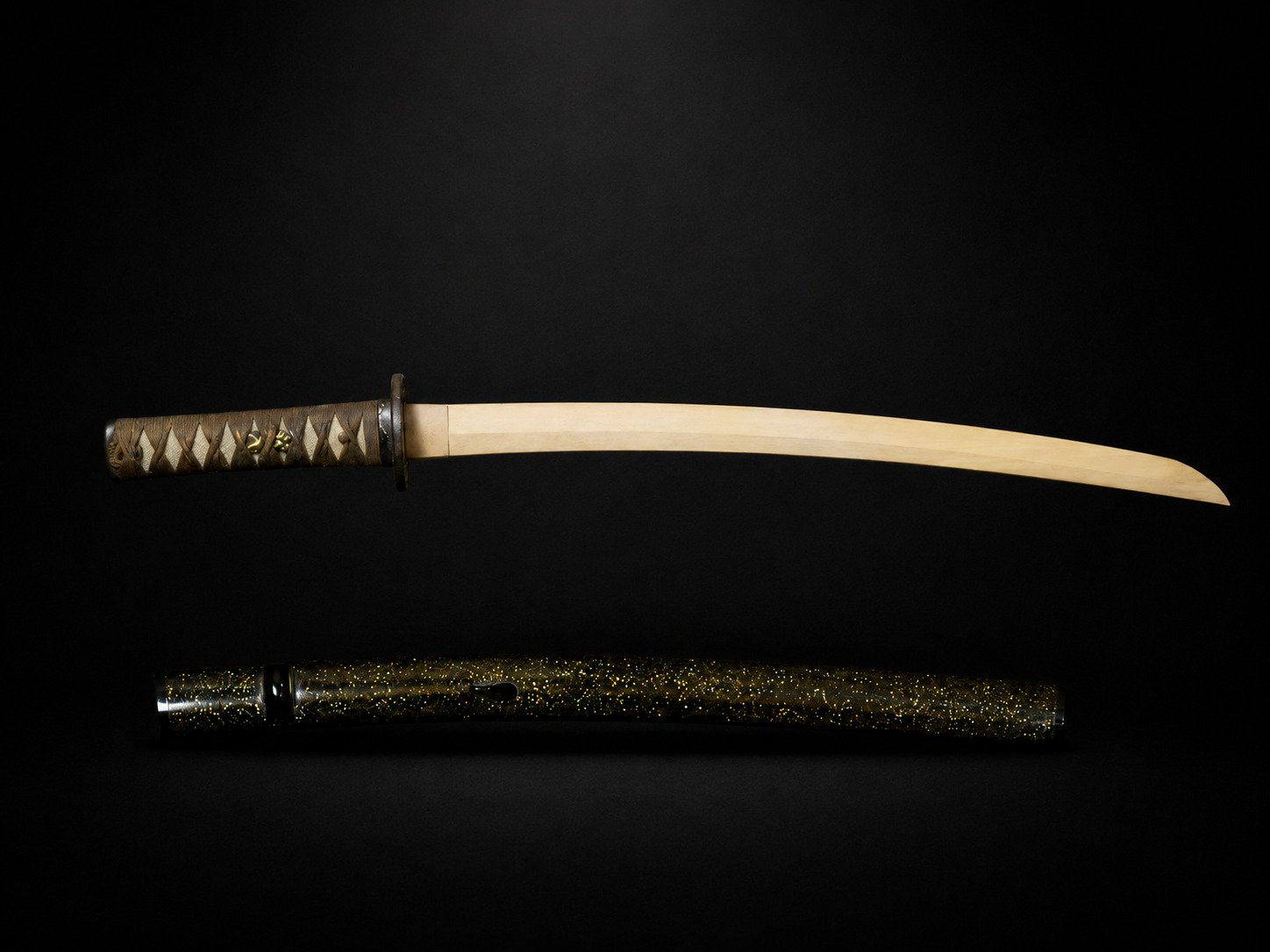
The ensemble retains its tsuka, tsuba, fuchi, kashira, menuki and lacquered saya, but is currently fitted with a shaped wooden display blade rather than a steel blade. The wooden blade follows the characteristic curvature of a Japanese sword and allows the mounting to be preserved and displayed as a complete ensemble.
The quality of the lacquer and fittings suggests a well-appointed koshirae originally intended for use with a genuine Japanese blade, consistent with good-quality Edo-period work of the 19th century.
In Japanese sword terminology, koshirae refers to the complete external mounting of a sword rather than the blade itself.
This ensemble brings together the saya, tsuka, tsuba and associated metal fittings into a visually coherent mounting, preserving the decorative presentation that would originally have surrounded the blade.
The combination of black lacquer, brilliant gold decoration, iron fittings and traditionally wrapped tsuka gives the piece a refined yet restrained character typical of higher-quality Japanese sword furniture.
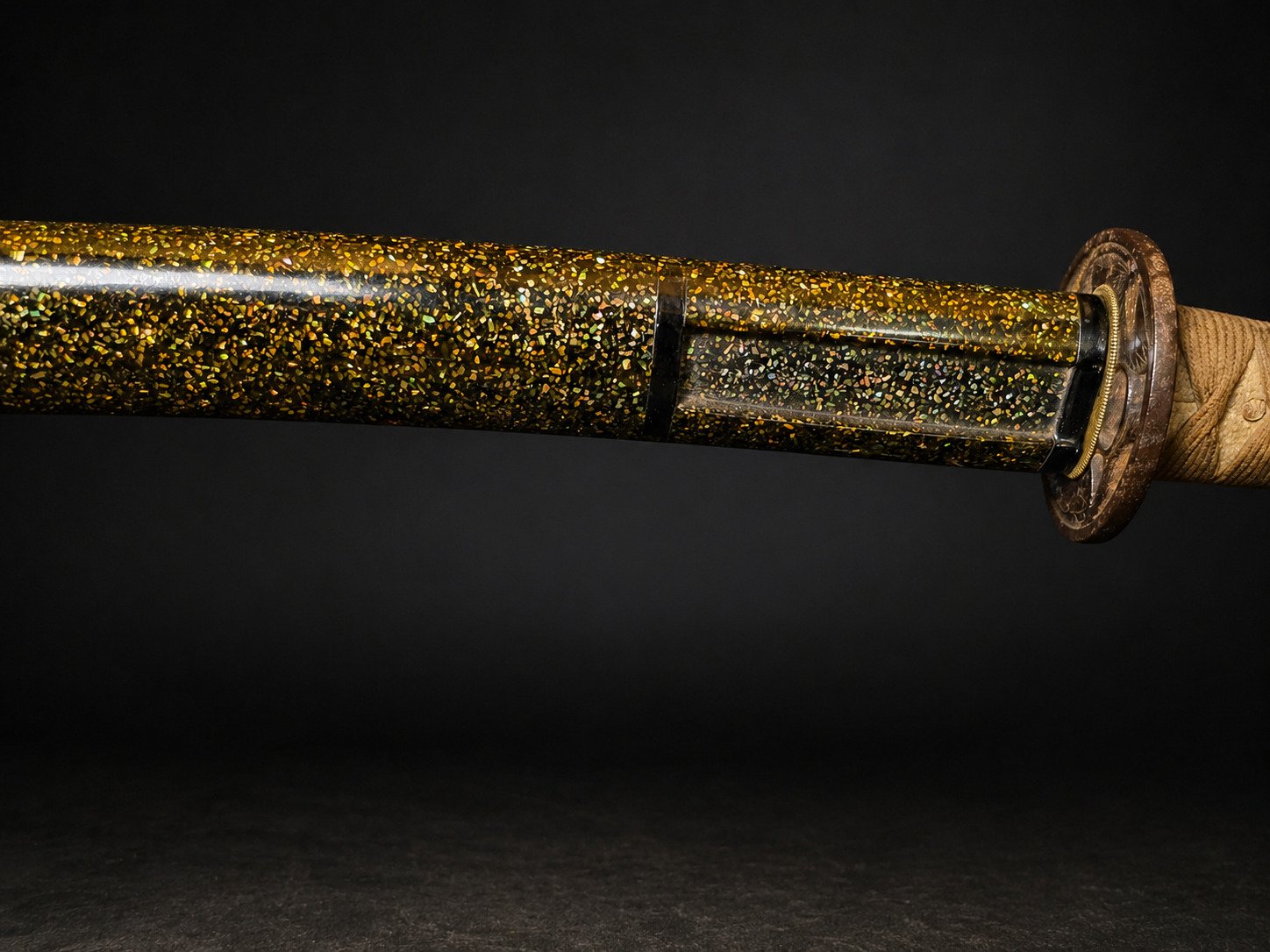
The most visually striking element is the saya (scabbard), finished over a dark ground with a dense field of irregular gold-colored flecks suspended beneath or within the lacquer surface.
The decoration extends across almost the entire length of the saya, producing a deep, sparkling effect that changes according to the angle and intensity of the light.
Rather than forming a conventional pictorial scene, the lacquer decoration relies on the contrast between the dark ground and countless metallic particles, giving the surface an appearance reminiscent of a star-filled night sky.
The highly speckled surface has an aventurine-like visual character, with irregular metallic particles distributed throughout the dark lacquer.
Such decoration may sometimes be broadly associated with nashiji-type effects, although the unusually large and irregular appearance of the flakes makes the more cautious description gold-flecked lacquer appropriate without closer technical examination.
Subtle touches of differing coloration among the particles add further depth to the surface, particularly when viewed under directional light.
The glittering body of the saya is punctuated by contrasting areas of plain black lacquer, particularly around functional components such as the koiguchi and kurikata.
These darker elements provide visual structure to the decoration while emphasizing the construction of the scabbard.
The contrast between brilliant gold flecks and deep black lacquer gives the mounting much of its distinctive visual identity.
At the mouth of the saya, the koiguchi forms the transition between the scabbard and the sword mounting.
Further along the saya is the kurikata, the fitting through which the sageo would traditionally be passed to secure the sword when worn.
Both elements are visually integrated into the dark lacquer scheme, allowing the more elaborate gold-flecked surface to remain dominant.
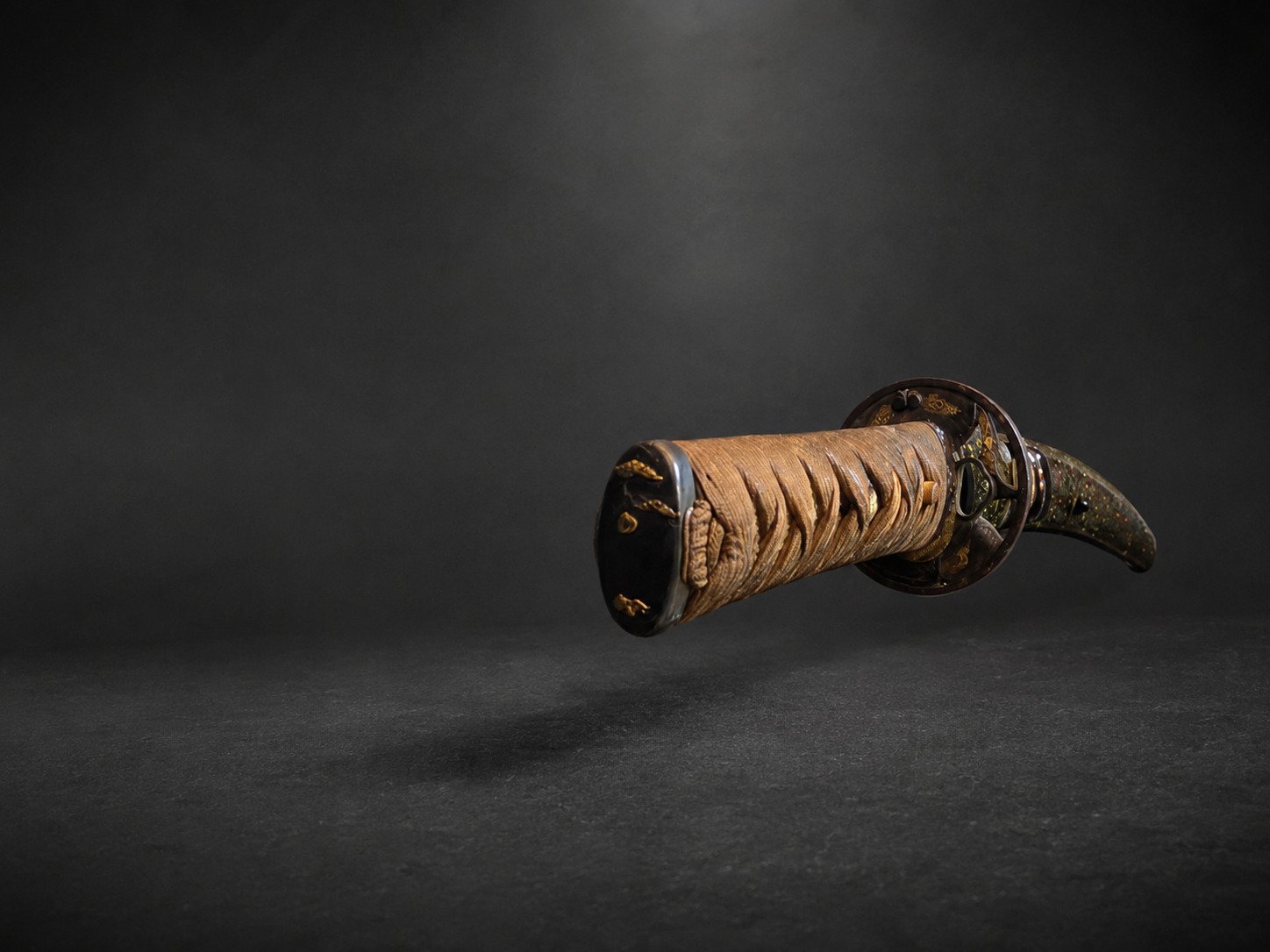
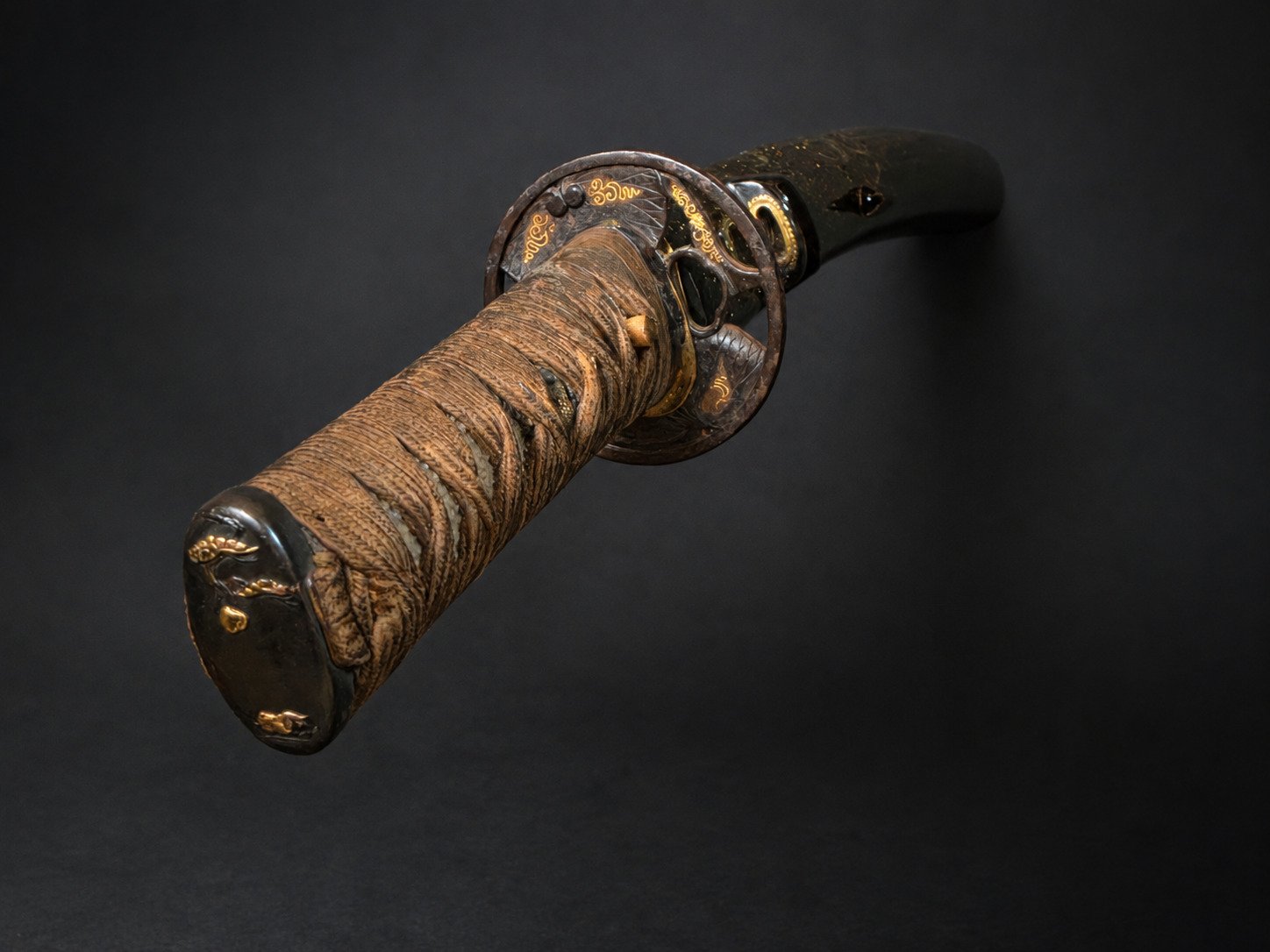
The tsuka (hilt) retains a traditional tsukamaki wrapping arranged in the characteristic alternating diamond pattern associated with Japanese sword mountings.
Beneath the wrapping, areas of pale same (rayskin) remain visible through the openings, creating a strong contrast with the warmer tones of the wrapping.
The carefully structured wrap is both functional and decorative, forming one of the most immediately recognizable elements of traditional Japanese sword furniture.
The visible panels beneath the tsukamaki are covered with same, traditionally prepared rayskin used extensively in Japanese sword hilts.
Its naturally textured surface helps provide grip beneath the wrapping while also introducing a distinctive visual texture.
The pale same visible through the diamond-shaped openings creates a layered appearance characteristic of traditionally mounted Japanese swords.
Set beneath the tsukamaki are gold-toned menuki, small ornamental fittings traditionally positioned on either side of the tsuka.
Menuki originally combined decorative and practical functions, contributing subtle relief beneath the hand while also allowing metalworkers to introduce miniature sculptural motifs into the mounting.
Here their warm metallic finish complements the extensive gold decoration of the saya and other fittings.
The end of the tsuka is finished with a dark kashira (pommel cap) carrying gold decorative elements.
The contrast between its dark ground and raised gold-toned ornament echoes the broader decorative vocabulary of the koshirae.
This repetition of black and gold across separate components helps unify the mounting as a complete decorative ensemble.
At the opposite end of the tsuka, the fuchi forms the collar immediately adjacent to the tsuba.
Together, fuchi and kashira frame the wrapped hilt and provide structural and decorative transitions between the tsuka and the remainder of the mounting.
The fittings contribute to the coherent dark-metal and gold-accented character of the ensemble.
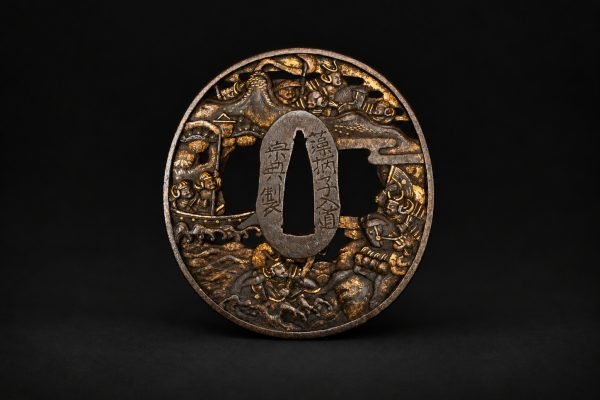
The sword is fitted with a rounded iron tsuba, its dark surface accented with fine gold-toned decoration.
The combination of iron and gold creates a restrained contrast, avoiding the visual dominance of a heavily pierced or sculptural guard while complementing the richly decorated saya.
The surviving gold details may represent nunome-zōgan or another form of applied or inlaid decoration; precise identification would require closer examination of the metal surface.
One of the strengths of the mounting is the consistent use of black and gold throughout the ensemble.
The sparkling saya provides the principal decorative field, while smaller gold details on the menuki, kashira and tsuba repeat the same palette on a more restrained scale.
This creates a visually unified koshirae in which no individual fitting feels isolated from the overall design.
The mounting currently contains a wooden blade rather than a sharpened steel blade.
The wooden insert has been shaped to follow the basic geometry of a Japanese sword, including its characteristic sori (curvature) and a defined kissaki-like point.
Its purpose may have been as a display substitute, a training-related insert, or a later replacement allowing the koshirae to retain its complete form after the original blade was removed. Without additional provenance, the precise date and original purpose of the wooden blade cannot be established.
A shaped wooden blade allows the various components of a sword mounting to remain assembled even when the original steel blade is no longer present.
This is particularly useful from a display perspective, as the relationship between tsuka, tsuba and saya can still be appreciated in essentially the same overall configuration as when mounted around a blade.
The piece should therefore be understood primarily as an antique Japanese koshirae ensemble, with the wooden blade serving to preserve its assembled presentation.
The quality of the lacquered saya, traditional tsukamaki and decorated metal fittings is consistent with a carefully produced Japanese sword mounting of the 19th-century Edo period.
Koshirae were functional objects, but they also provided an important field for specialized Japanese craftsmanship, bringing together lacquer workers, metalworkers, tsuka wrappers and other artisans.
This example demonstrates that combination particularly effectively through the contrast between its elaborate lacquer surface and comparatively restrained metal fittings.
The extensive gold-fleck decoration of the saya would have required considerably more decorative work than a plain lacquer scabbard.
Combined with the traditionally wrapped tsuka and gold-accented fittings, it indicates a mounting intended to have substantial visual presence rather than serving as a purely utilitarian ensemble.
Without documentary provenance, however, the social status or identity of its original owner cannot be established.
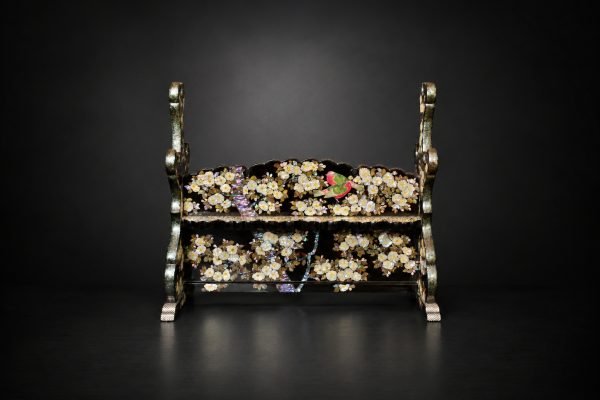
At approximately 65 cm in overall length, the mounting has sufficient scale to make a strong visual impression while remaining practical for display in a cabinet, on a katana-kake or as part of a broader collection of Japanese arms and armour.
The gold particles become especially prominent under directional lighting, creating a surface that can appear relatively restrained in low light and dramatically luminous when illuminated.
This changing visual character is one of the most attractive qualities of the lacquer decoration.
As an antique mounting dating from the 19th century, the piece should be expected to display signs of age and historical handling consistent with its period.
The lacquered surfaces, tsukamaki, same and metal fittings should be handled carefully, avoiding unnecessary friction, excessive humidity, direct sunlight and abrasive cleaning.
The wooden blade should not be interpreted as an original steel nihontō blade and is included as part of the mounting ensemble in its present configuration.
This koshirae is particularly attractive as an example of the decorative arts associated with the Japanese sword independently of the blade itself.
Its principal feature is undoubtedly the dense gold-flecked lacquer saya, whose sparkling surface contrasts strongly with the dark fittings and traditionally wrapped tsuka.
The surviving menuki, tsuba, fuchi, kashira and tsuka preserve much of the visual character of the original mounting, while the shaped wooden blade allows the ensemble to remain complete for display.
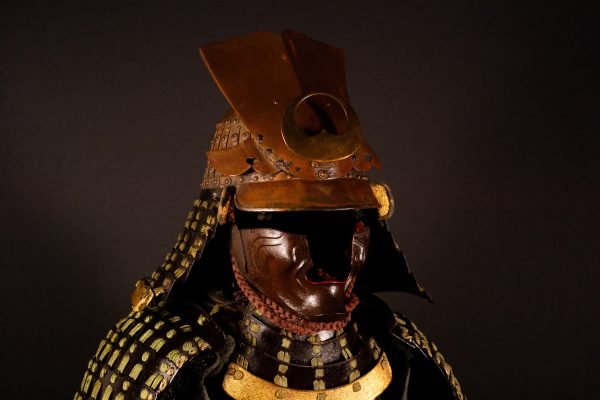
For collectors of nihontō fittings, Japanese lacquer, samurai art or Edo-period decorative arts, it represents a visually distinctive mounting ensemble with considerable display presence.
A visually striking 19th-century Edo-period Japanese sword mounting distinguished by its richly decorated gold-flecked lacquer saya, traditionally wrapped tsuka with pale same, gold-toned menuki, decorated iron tsuba and black-and-gold fittings. The dense metallic flecks scattered across the dark lacquer create a luminous, aventurine-like surface that gives the mounting exceptional decorative presence. Now fitted with a shaped wooden display blade rather than a steel sword, the ensemble preserves the form and visual coherence of a well-appointed antique koshirae and offers particular interest to collectors of Japanese sword fittings, lacquerwork and Edo-period decorative arts.
| Época | Edo |
|---|

Order above 1.000,00 € gets free shipping.

Secure and hassle-free payment process.

Certificate of authenticity included.

Have questions? Contact us via WhatsApp.
Contact