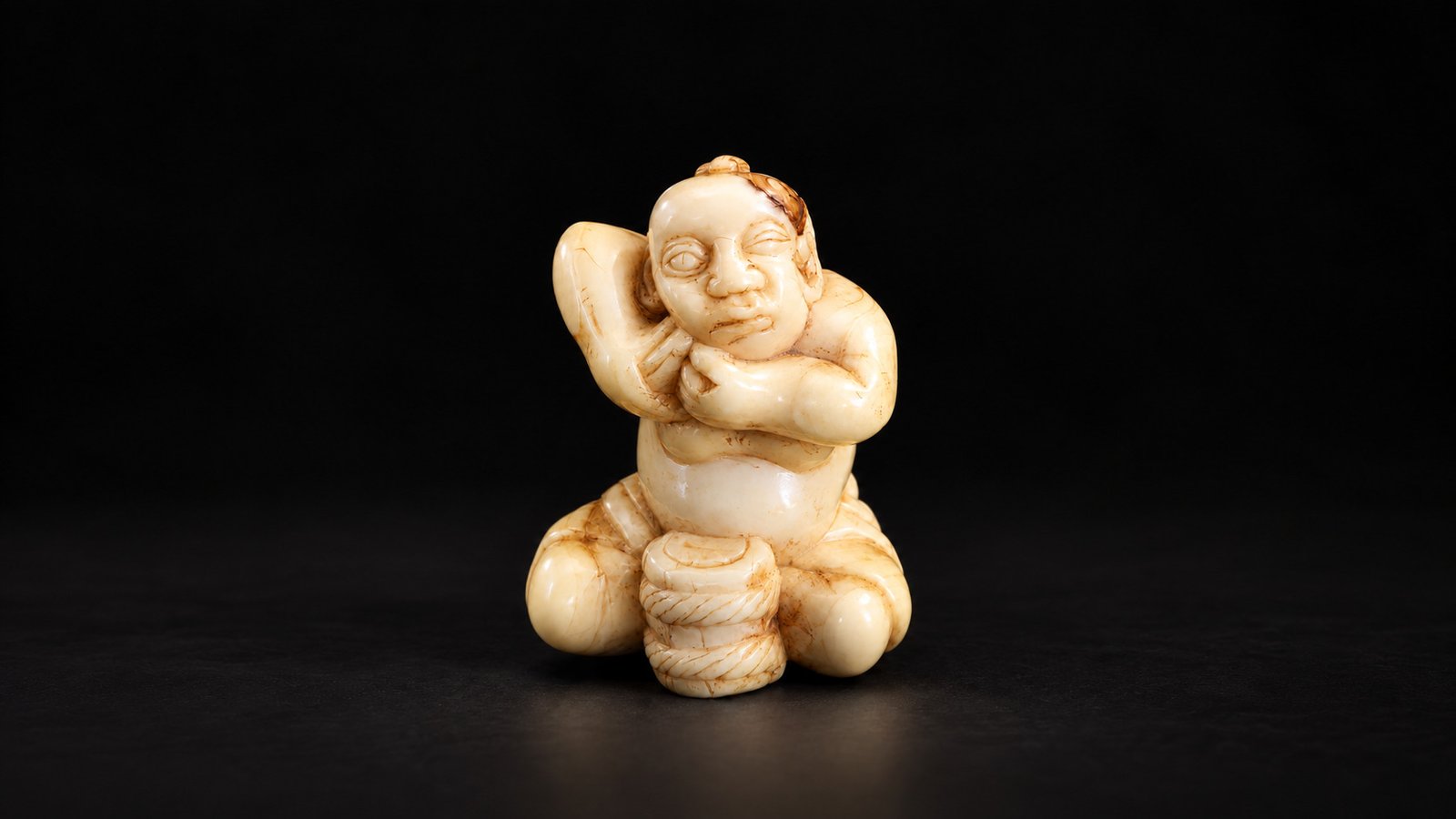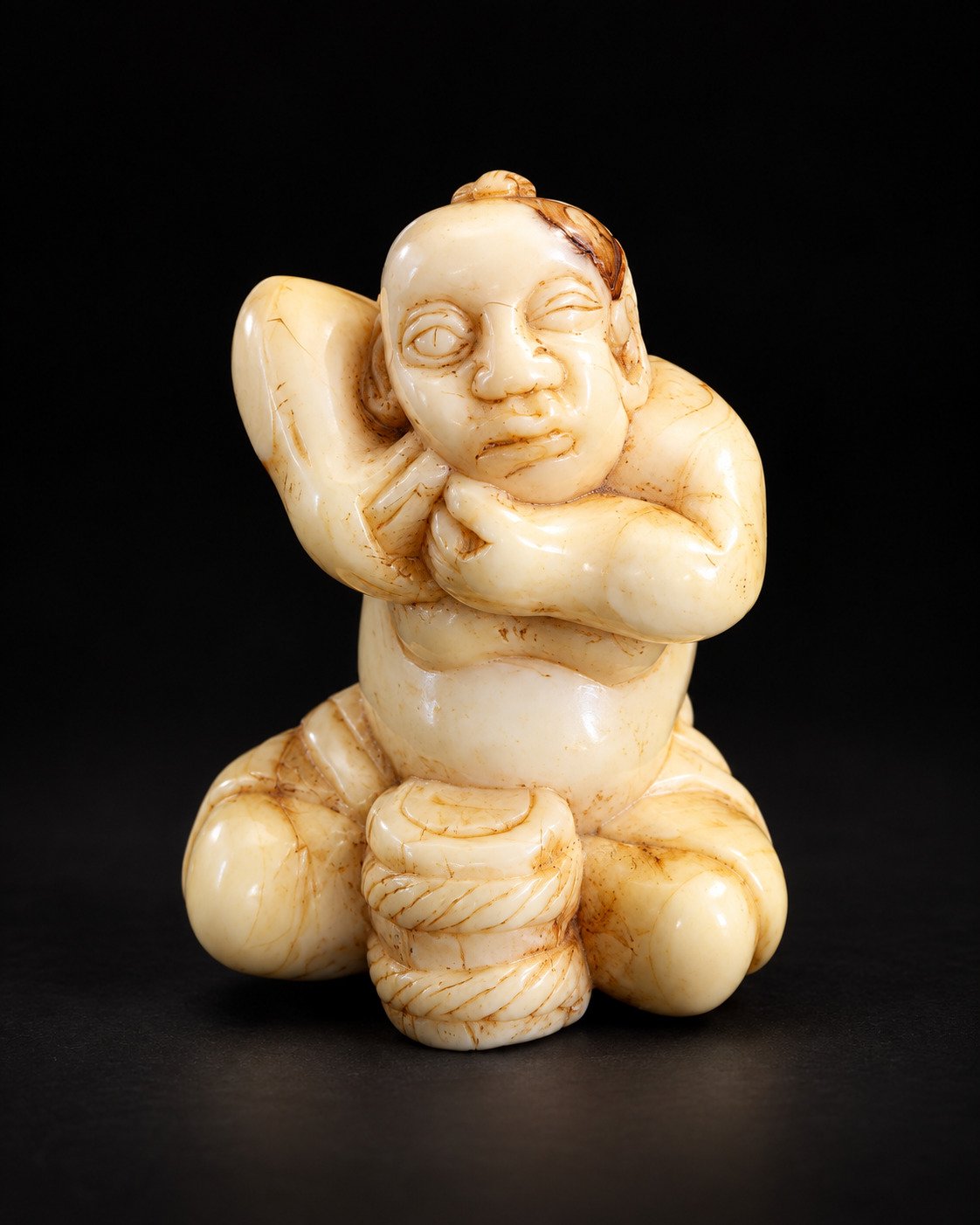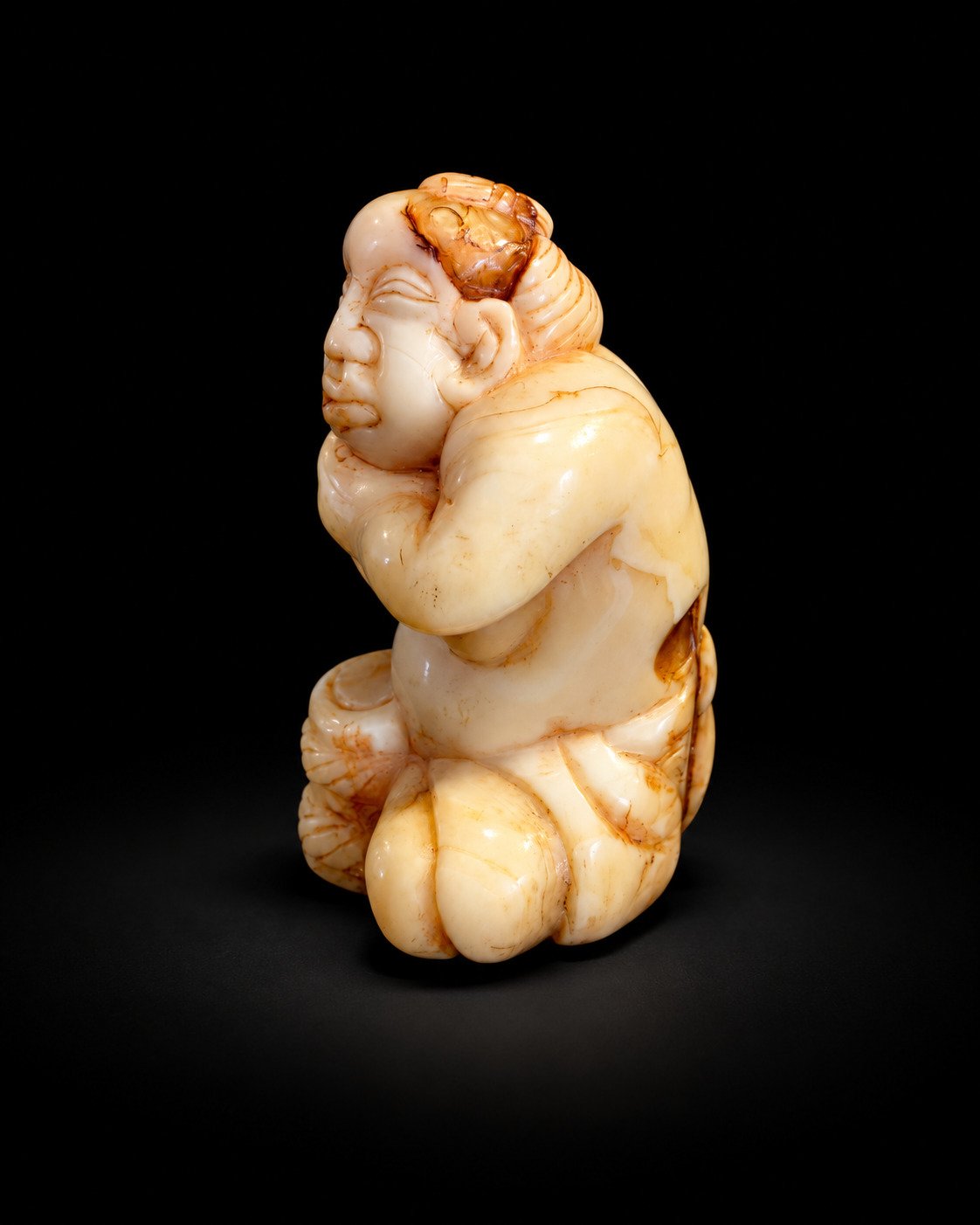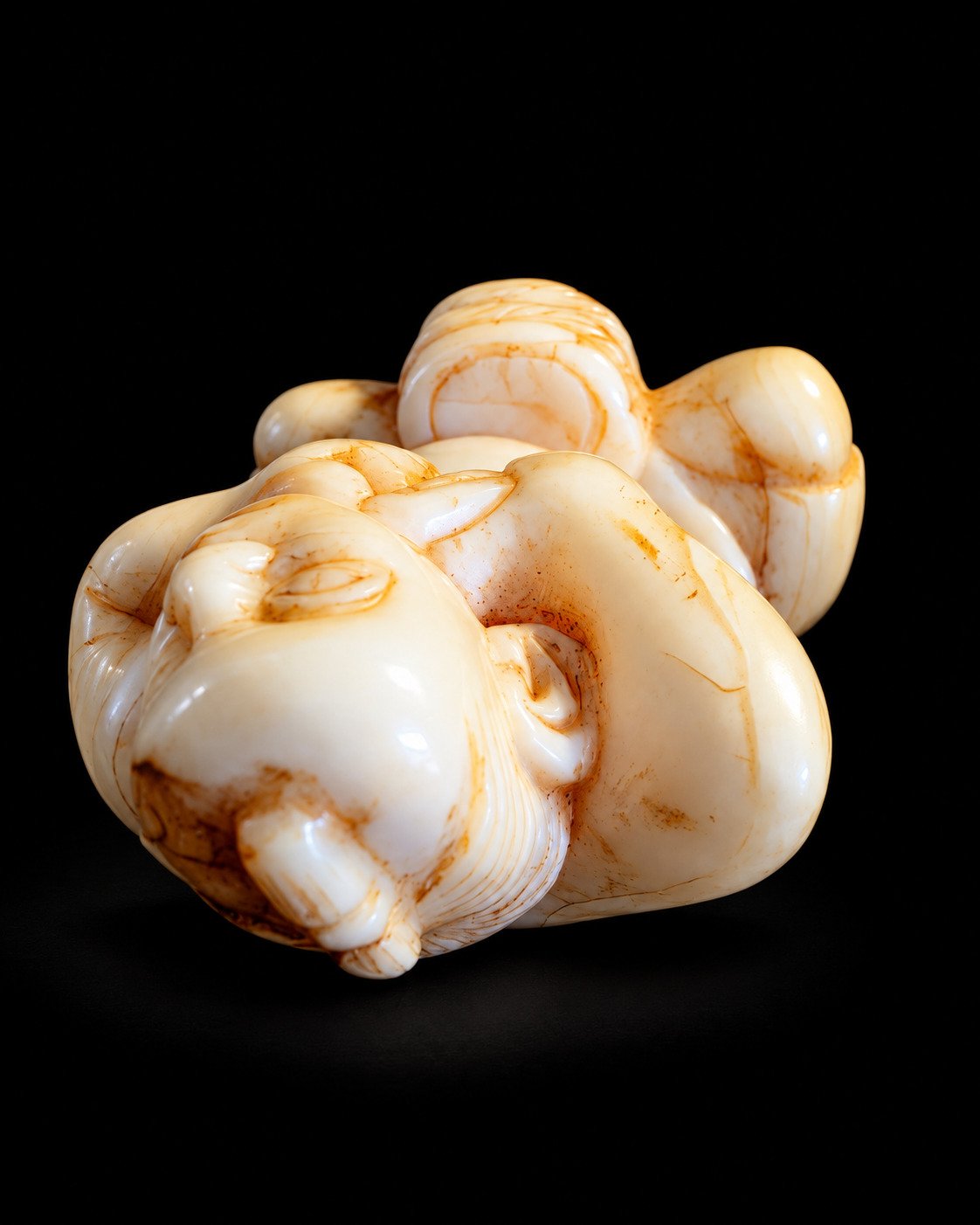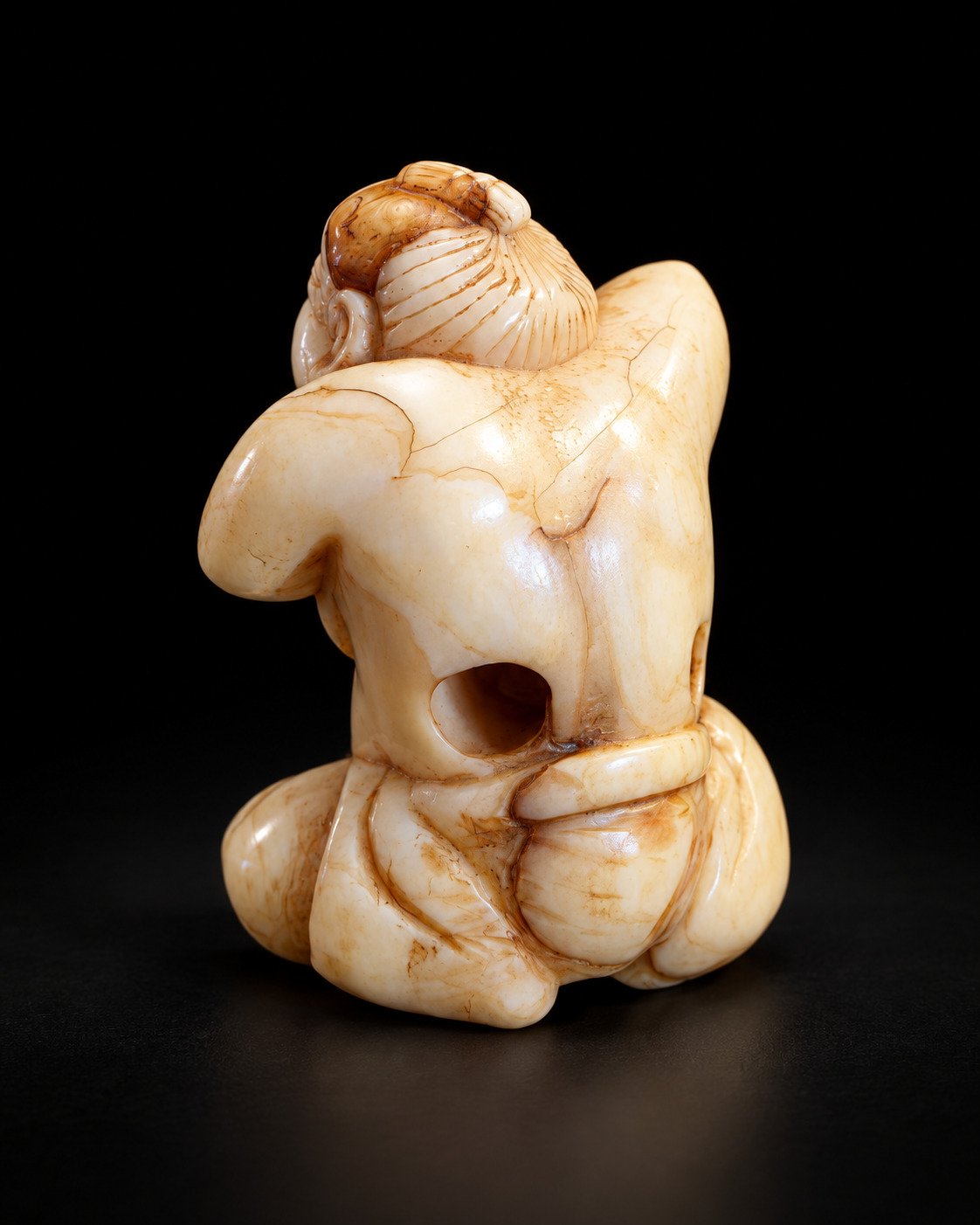
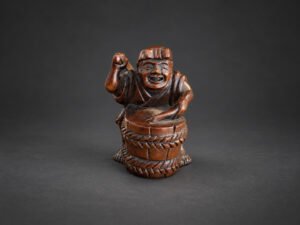
An expressive Japanese netsuke carved from walrus ivory, dating to the late Edo period, 19th century, depicting a heavy-set sumō wrestler kneeling beside a straw bale while carefully plucking the hairs from his chin with a pair of tweezers.
The humor of the scene is immediate. The wrestler’s massive body, powerful shoulders, and broad knees contrast with the tiny, almost absurdly delicate task occupying his full attention. One eye is squeezed tightly shut, the other opens wide, and his lips push forward in a pained grimace as he pulls at a stubborn hair.
Beyond its comic subject, the netsuke is notable for its material. It is accompanied by a laboratory report from the Molecular Identification Laboratory of the Museo Nacional de Ciencias Naturales (CSIC), Madrid, confirming the material as walrus ivory (Odobenus rosmarus).
The figure represents a sumō wrestler seated with his legs spread broadly beneath him, his substantial belly and shoulders filling the composition.
Rather than showing him wrestling, training, or displaying his strength, the carver captures an intimate and humorous moment: the wrestler holds a pair of tweezers (kenuki) between his fingers and uses them to remove stray hairs from his chin.
His reaction supplies the comedy. One eye closes tightly against the discomfort while the other remains wide open. His cheeks and mouth contract into an exaggerated expression of concentration and pain.
This contrast between an imposing physical figure and a tiny domestic task is exactly the kind of observational humor that gave many Edo-period netsuke their extraordinary personality.
The small implement held between the wrestler’s fingers can be identified as kenuki, traditional Japanese tweezers.
Despite the tiny scale of the carving, the gesture is immediately readable: both hands are brought toward the face while the wrestler concentrates on the delicate operation.
The tool becomes the focal point of the narrative and transforms what might otherwise have been a straightforward study of a wrestler into a miniature comic scene.
The face is one of the strongest aspects of the carving.
The asymmetrical expression — one eye squeezed shut and the other opened wide — conveys the unpleasant sensation of pulling a hair with remarkable economy. The lips project forward in a restrained grimace, while subtle lines around the eyes and mouth reinforce the sense of concentration.
Viewed closely, the face gives the small figure an unusually vivid psychological presence and demonstrates how effectively a netsuke carver could communicate character within only a few centimeters of material.
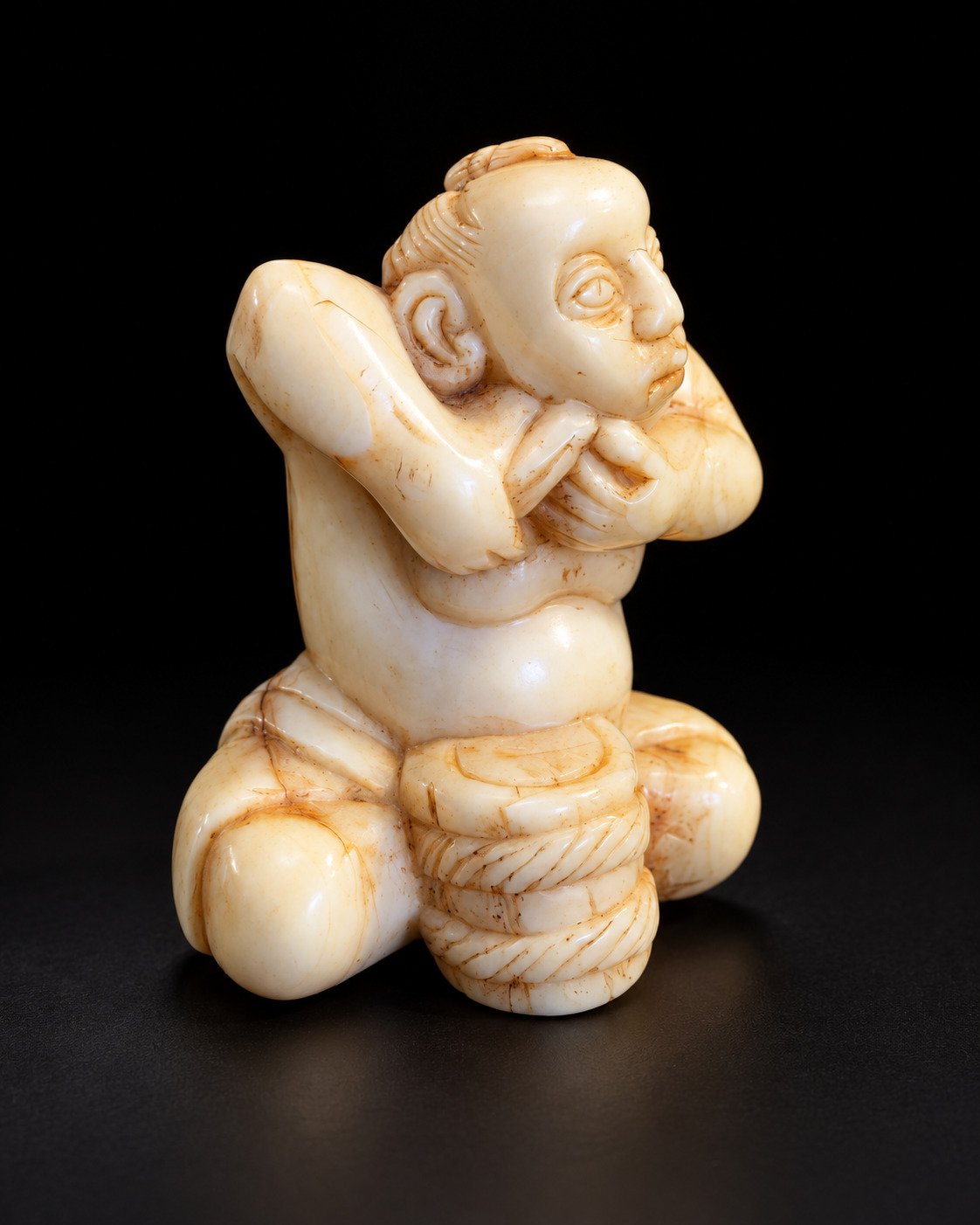
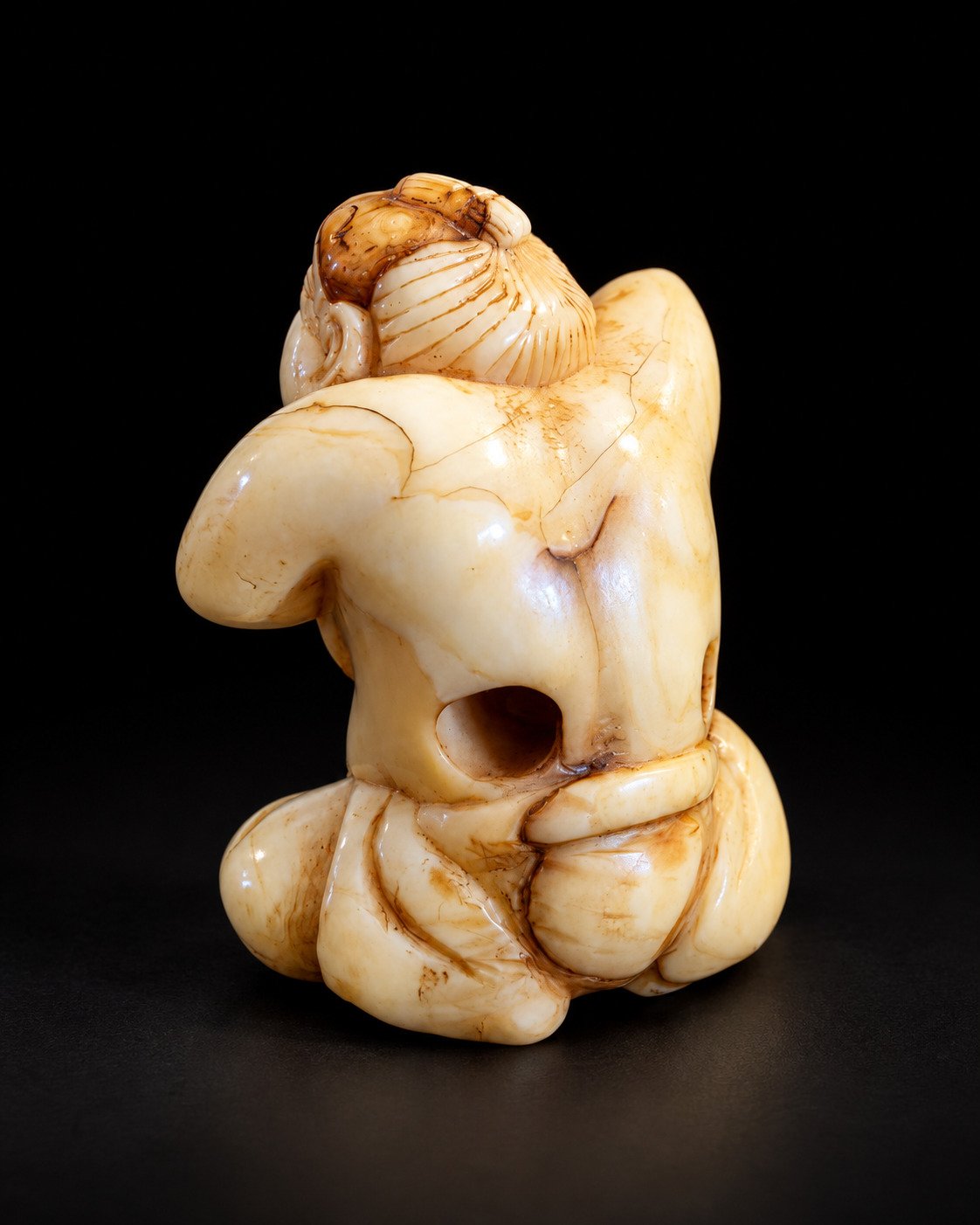
The wrestler’s hair is arranged in the traditional chonmage topknot associated with sumō wrestlers.
The combed strands are finely incised, with the small knot rising above the crown of the head. This carefully worked detail contrasts with the broad, smooth modeling of the wrestler’s face and body.
The hairstyle immediately identifies the subject as belonging to the world of sumō while also providing the carver with an opportunity for fine linear detail.
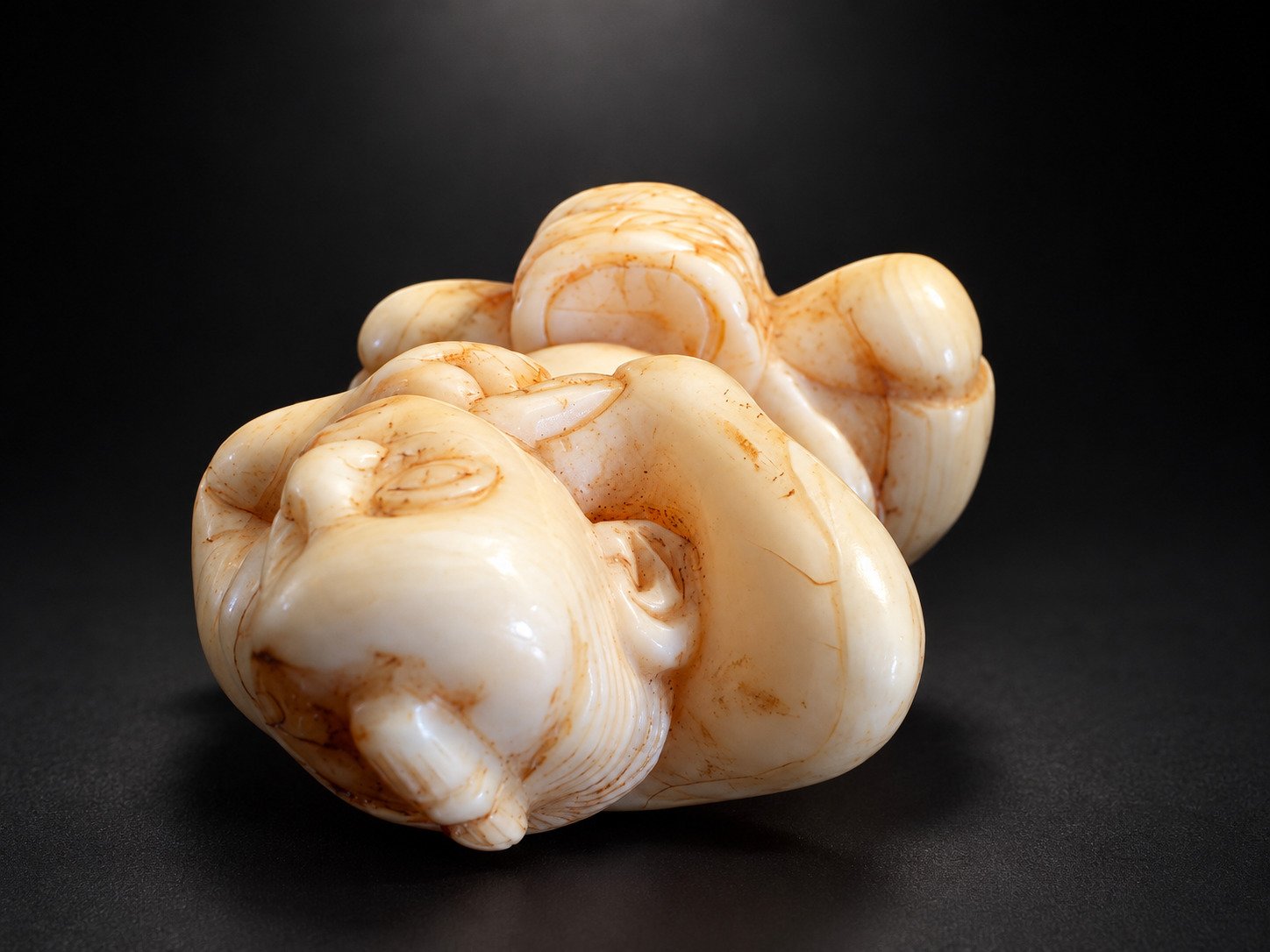
Beside the wrestler sits a substantial straw bale (tawara), represented with deeply carved twisted rope around its body.
Tawara are closely associated with the dohyō, the sumō ring, where partially buried straw bales define the boundary of the fighting area.
The inclusion of the bale establishes the wrestler’s identity and environment without requiring a larger setting. In the compact visual language of netsuke, a single object is enough to connect the humorous grooming scene unmistakably with sumō.
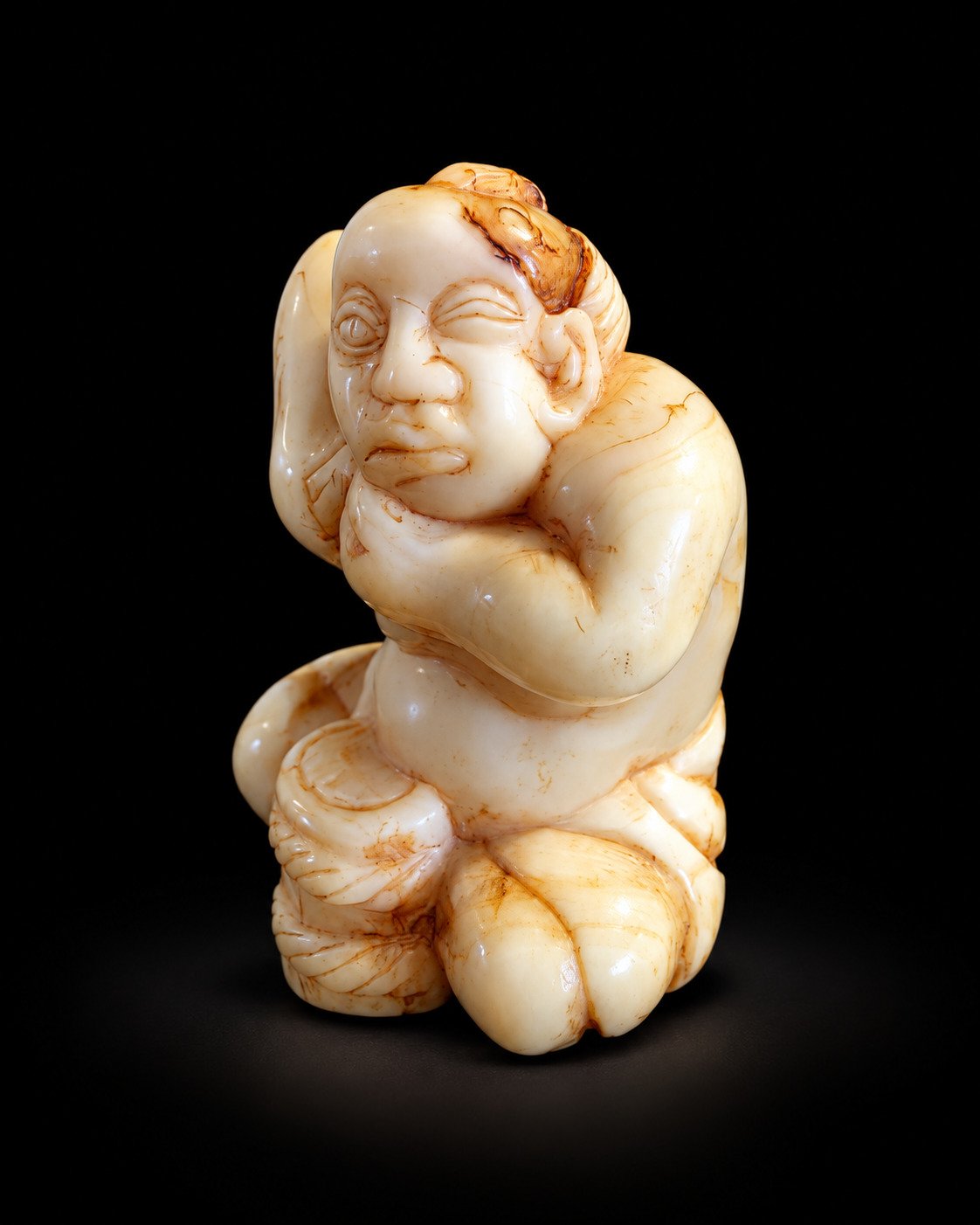
The netsuke has been designed as a compact, stable sculpture intended to be handled and viewed from every direction.
The wrestler’s broad shoulders, rounded belly, and widely spread knees create the principal mass of the carving. At the rear, the back follows the curve of the spine, while the mawashi is gathered into substantial folds around the hips.
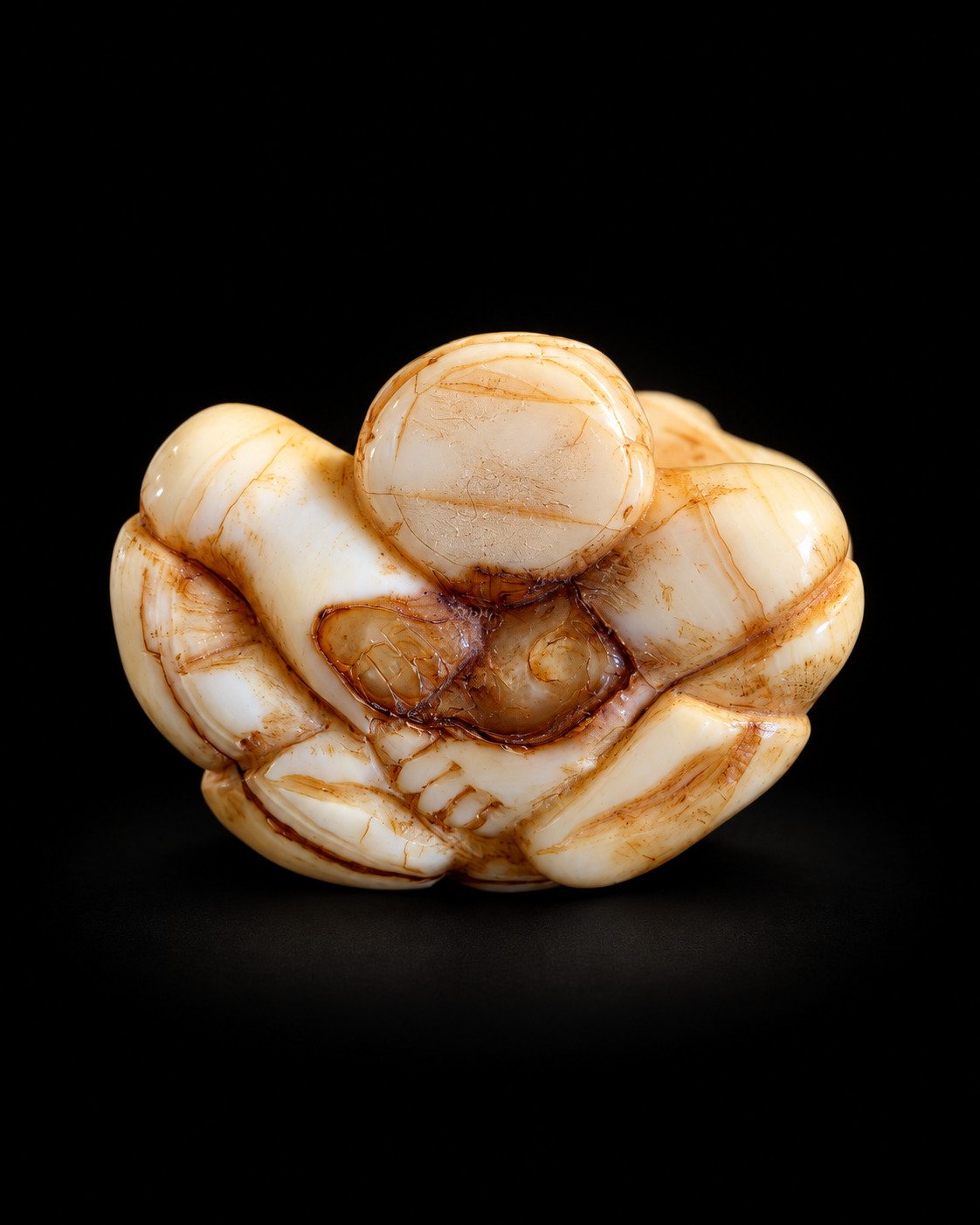
The underside continues the modeling rather than treating the base as an unfinished surface. The folded legs are clearly defined and the toes of one foot are individually articulated.
This attention to the reverse and underside is particularly important in netsuke, objects traditionally made to be handled, turned, and examined in the hand.
The carving retains its functional himotoshi, the cord openings that allowed a netsuke to be attached to the cord of an inrō, tobacco pouch, or other sagemono.
A large opening is located at the lower back, with a smaller corresponding exit at the side.
The placement of these openings is integrated into the compact form of the figure and preserves the object’s original function as a wearable netsuke rather than merely a miniature sculpture.
One of the most significant characteristics of this netsuke is its material: walrus ivory.
Ivory used by Japanese netsuke carvers could come from different sources. Elephant ivory reached Japan through international trade, particularly through the southern maritime routes associated with Chinese and Dutch merchants at Nagasaki. Walrus tusk originated much farther north and circulated in considerably smaller quantities.
Walrus tusk also presents distinctive structural challenges to the carver. Unlike the more uniformly workable outer dentine, the center contains a dense and characteristically mottled secondary dentine. This internal structure limits the amount of fine outer ivory available and requires the carver to plan the composition around the material.
For this reason, netsuke carved from walrus ivory are encountered considerably less frequently than many examples made from elephant ivory.
The material can be studied particularly clearly on the underside of the netsuke, where a translucent, mottled area of secondary dentine becomes visible.
This change in texture and internal structure is characteristic of walrus tusk and provides an important physical feature of the object.
Rather than concealing the difficult internal structure of the tusk, the carver successfully incorporated it into the compact design of the figure, making efficient use of the available material.
The netsuke is accompanied by a laboratory identification report issued by the Molecular Identification Laboratory of the Museo Nacional de Ciencias Naturales (CSIC), Madrid.
The report, reference LIM 2/2026, piece no. 7, identifies the material as:
Walrus ivory – Odobenus rosmarus.
This scientific documentation provides an unusually precise material identification and is an important part of the object’s accompanying documentation.
The ivory has developed a rich honey-to-amber coloration through age and handling.
Natural age cracks characteristic of walrus ivory run across the surface and have darkened over time into fine brown lines. Rather than disturbing the sculpture, these subtle veins emphasize the age, material character, and long history of handling of the object.
The polished high points retain a gentle luster, while recessed areas hold deeper tones that help define the folds, facial details, hands, and ropework of the tawara.
The netsuke dates to the late Edo period, 19th century, a time when netsuke carving had developed into an exceptionally sophisticated miniature sculptural tradition.
By this period, carvers explored an enormous range of subjects, from mythology and religion to occupations, animals, theater, everyday life, and humor.
This wrestler plucking his chin belongs particularly well to the latter tradition: a familiar and physically powerful figure reduced to an amusingly human moment of discomfort and concentration.
The netsuke survives in excellent condition for its age.
The walrus ivory displays a warm honey and amber patina, together with natural age-related cracking that has darkened into fine brown veins across the surface. These characteristics are consistent with the material and the antiquity of the piece.
There is only minor wear consistent with age and historical handling. The principal carved details remain clearly defined, including the facial expression, hands, hairstyle, folds of the mawashi, ropework of the tawara, and articulated toes.
This netsuke combines several features of particular interest to collectors: an engaging and humorous sumō subject, compact and accomplished carving, functional himotoshi, strong natural patina, and the comparatively unusual use of walrus ivory.
The accompanying CSIC laboratory report adds an important documentary element by scientifically confirming the material as Odobenus rosmarus.
The result is a distinctive late Edo-period netsuke whose appeal comes not only from technical execution, but from the personality of the subject and the unusual material from which it was carved.
A characterful late Edo-period netsuke of a sumō wrestler, carved from scientifically identified walrus ivory and capturing an unexpectedly intimate moment of comic discomfort. Kneeling beside a rope-bound tawara, the wrestler grips a pair of kenuki and carefully plucks a hair from his chin, one eye squeezed shut while the other remains dramatically open. The broad body, articulated hands, finely incised chonmage and compact three-dimensional modeling demonstrate the carver’s ability to combine humor with accomplished miniature sculpture. Particularly notable is the walrus ivory itself, with characteristic mottled secondary dentine visible beneath the figure and a warm honey-amber patina developed through age. Accompanied by a CSIC laboratory report confirming the material as Odobenus rosmarus, this is an unusual and highly expressive 19th-century Japanese netsuke with considerable material and sculptural interest.
| Época | Edo |
|---|

Order above 1.000,00 € gets free shipping.

Secure and hassle-free payment process.

Certificate of authenticity included.

Have questions? Contact us via WhatsApp.
Contact