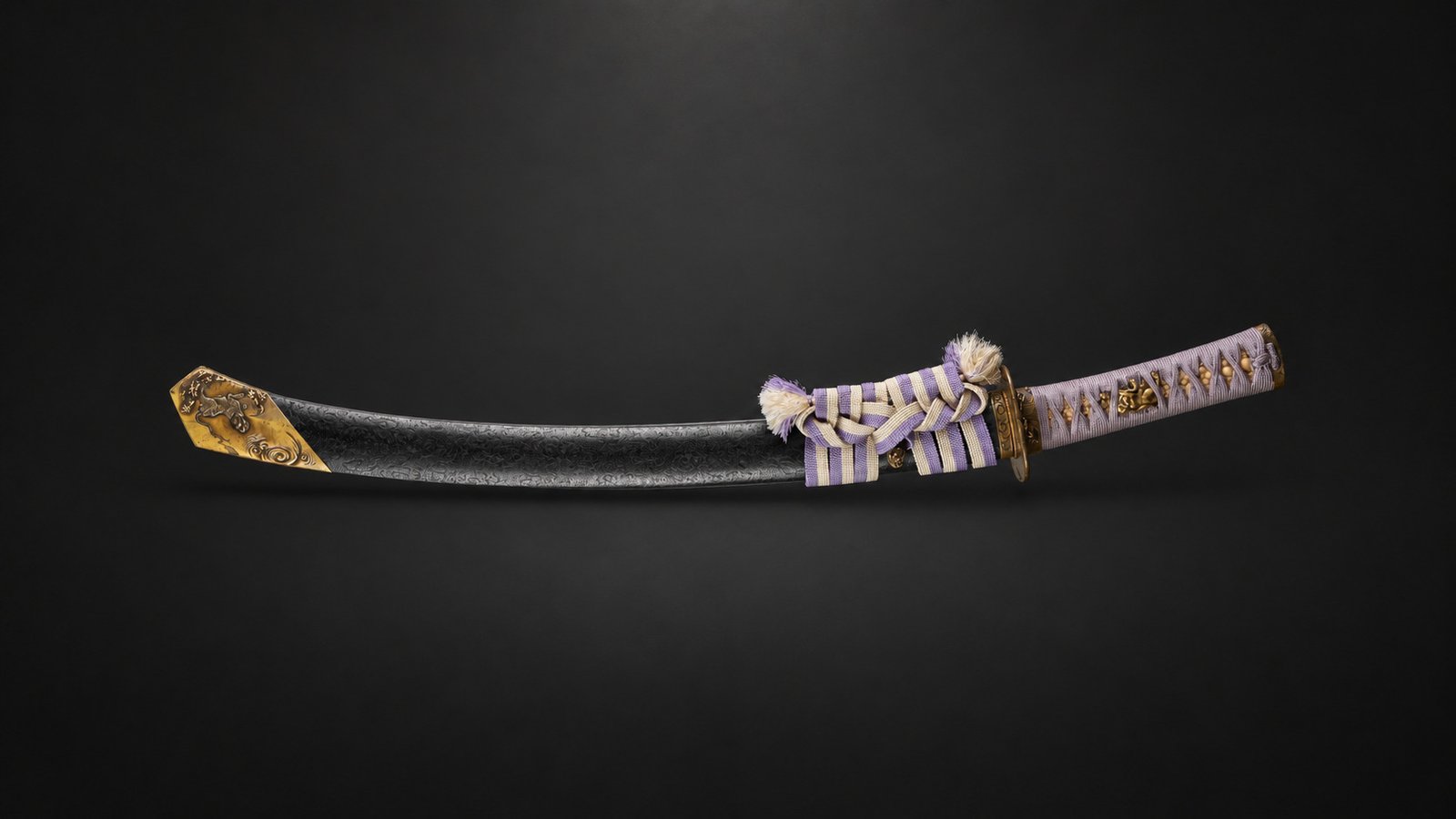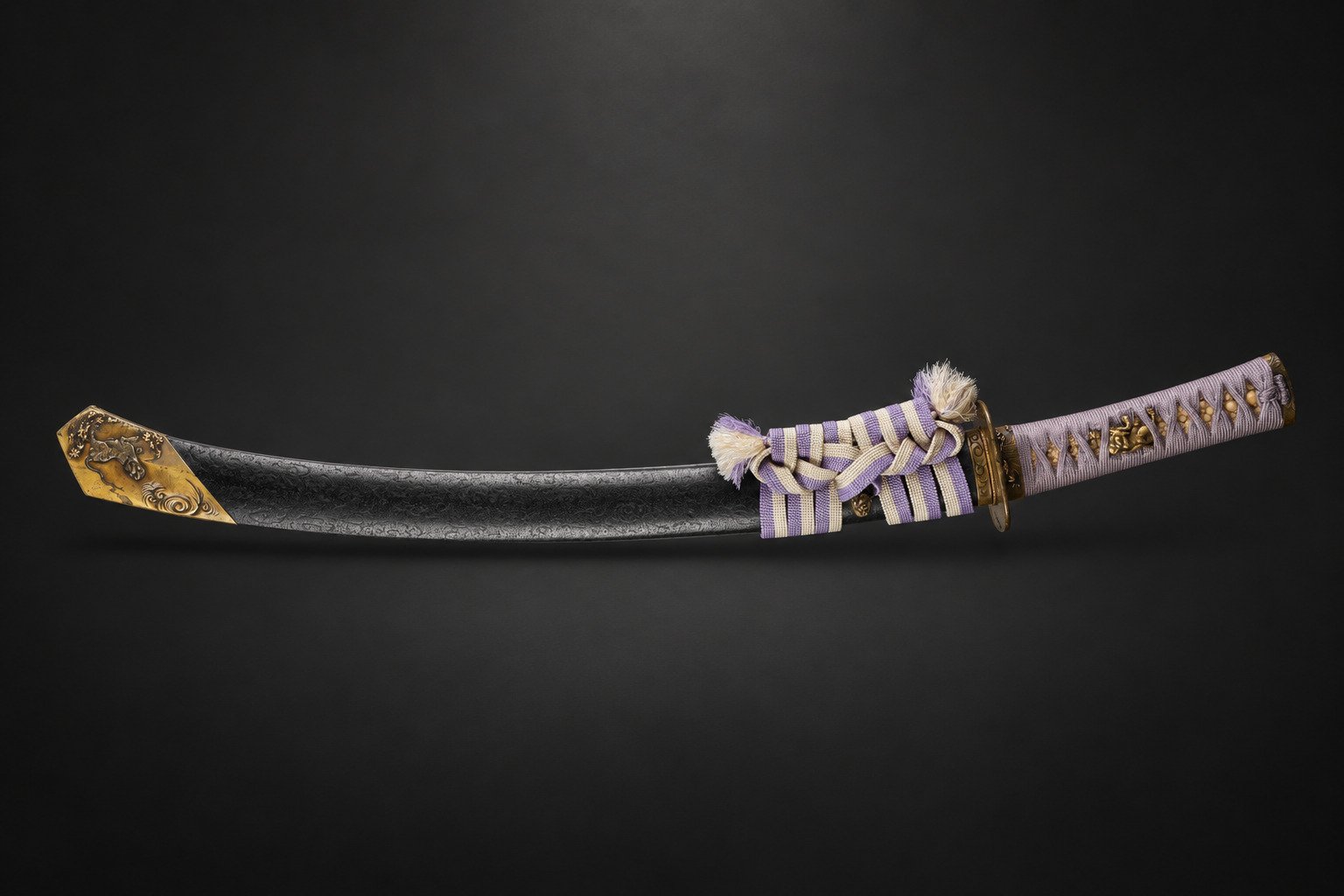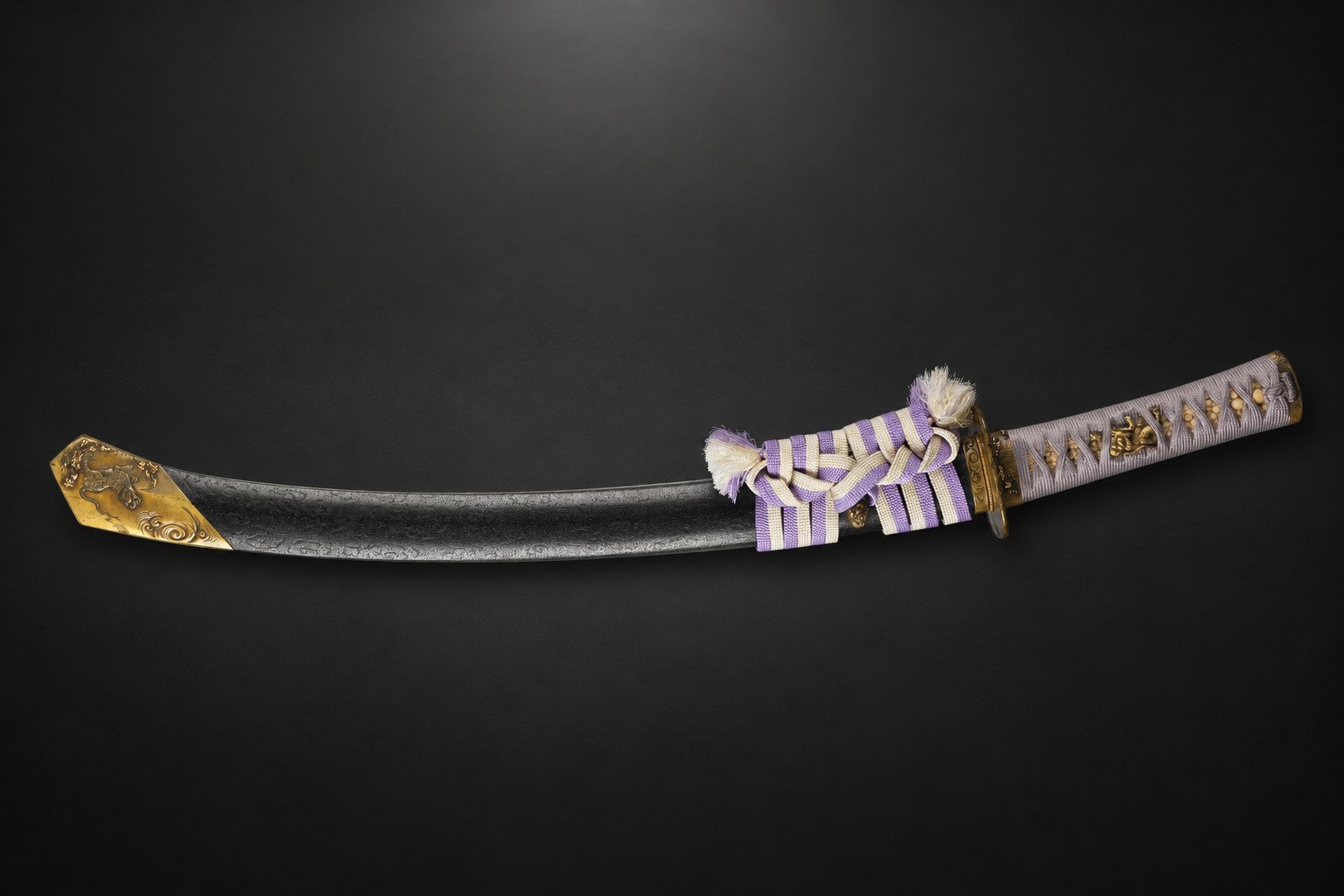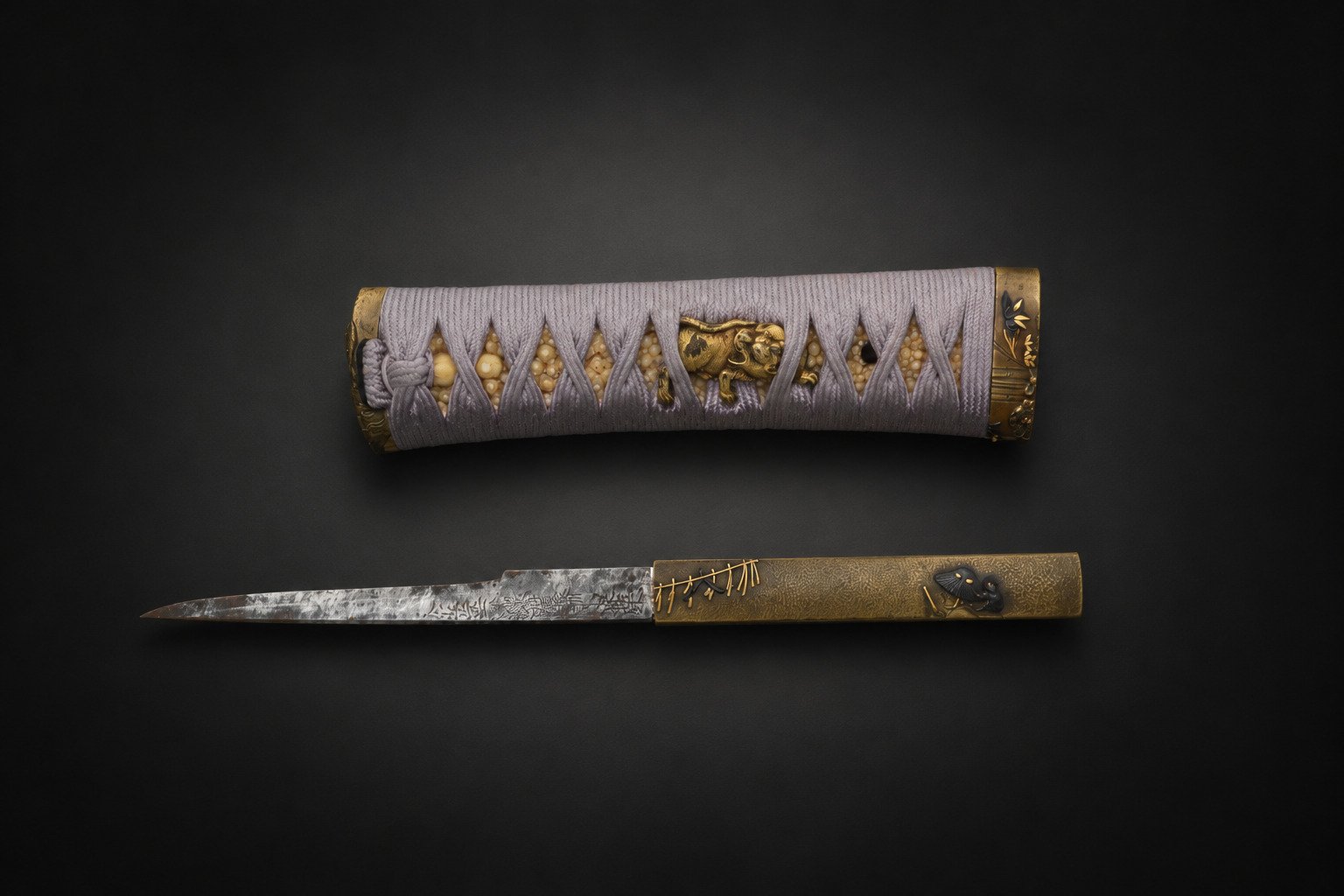
A complete Japanese wakizashi koshirae dating to the mid-19th century, distinguished by a remarkably coherent group of metal fittings combining two complementary decorative themes: the tiger among bamboo and auspicious imagery associated with the Japanese New Year.
The mounting is fitted for display with a wooden dummy blade, cut down to approximately half length rather than containing a genuine sword blade. The saya is especially distinctive, terminating in a dramatically widened and flared end described as taking the form of a shobugatana.
Across the fuchi, kashira, menuki, tsuba, kozuka, koiguchi and large kojiri, the decoration moves between powerful animal imagery and symbols of purification, prosperity and good fortune. The result is a visually unified koshirae in which the individual fittings reward close examination while remaining part of a carefully coordinated whole.
The koshirae survives as a complete mounting for a wakizashi, preserving the principal components of the sword’s exterior presentation.
Rather than a steel blade, the mounting currently contains a wooden dummy blade intended for display. This wooden insert has been cut down to approximately half length and should not be mistaken for an antique Japanese sword blade.
The complete mounting measures approximately 64 cm in overall length.
The saya, or scabbard, is one of the most immediately recognizable features of the mounting.
Its lower section widens toward the end into a pronounced splayed or flared profile, producing an unconventional silhouette described as taking the form of a shobugatana.
The lacquer decoration incorporates flowing cloud motifs, creating a visual connection with the metal fittings mounted at both ends of the scabbard.
The principal fittings form a coordinated group worked in sentoku, a warm bronze-colored copper alloy traditionally favored by Japanese metalworkers.
The surfaces are modeled in relief and enriched with details in gold, shakudō and other contrasting metals, creating a layered palette of warm bronze, dark patination and bright highlights.
The consistency of materials, technique and subject matter across the mounting gives the koshirae the appearance of a deliberately coordinated decorative program rather than an unrelated assembly of fittings.
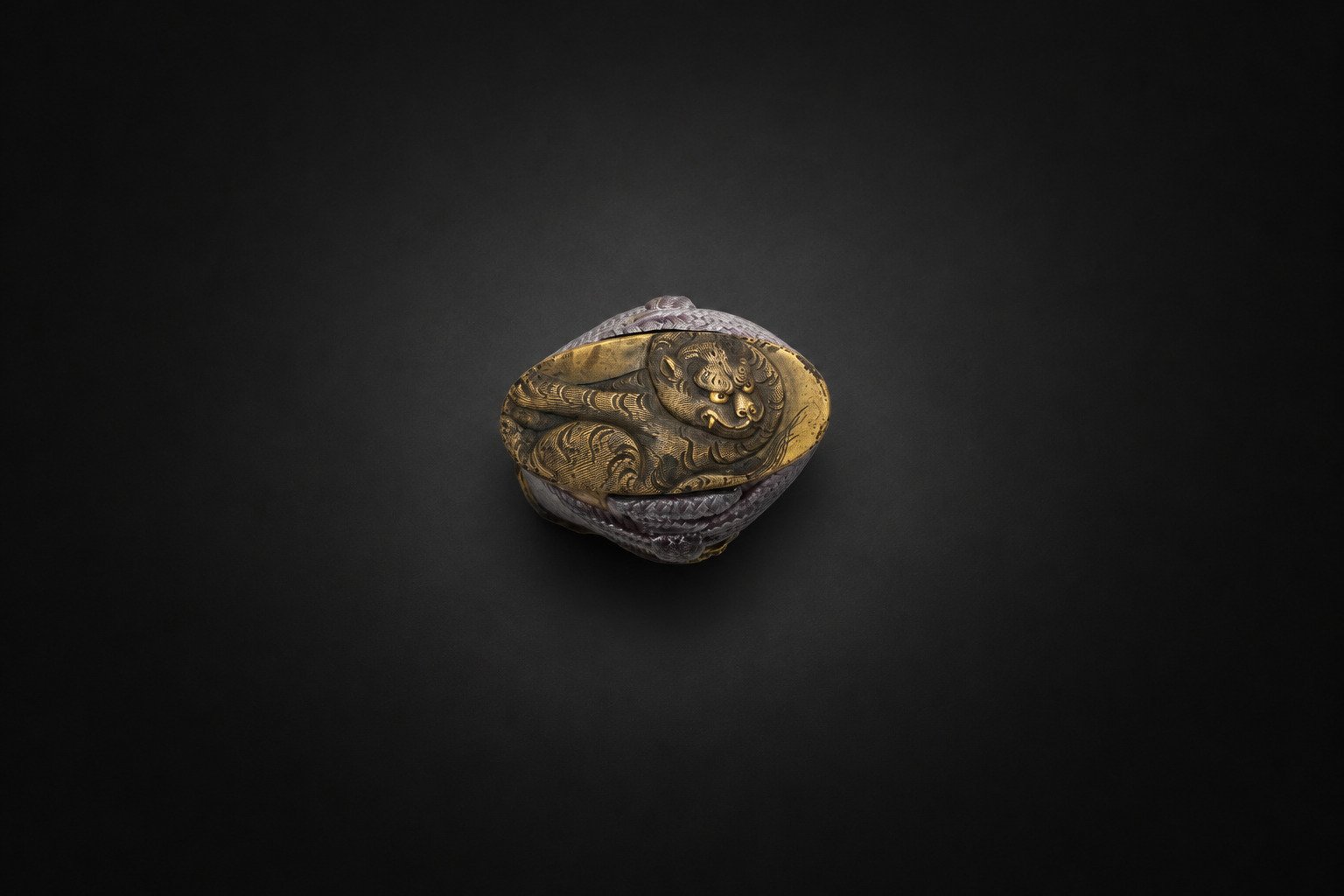
The fuchi and kashira — the collar and pommel fittings of the hilt — are decorated with a tiger among bamboo.
The tiger is modeled in relief against the surrounding vegetation, with details picked out in contrasting metals. The combination of tiger and bamboo was a particularly effective subject for Japanese metalworkers, allowing the strength and movement of the animal to be contrasted with the rhythm of the bamboo stems and leaves.
The fittings bear a kao, the highly personal cursive seal used by Japanese artists and craftsmen in place of, or in addition to, a conventional written signature.
Beneath the hilt wrapping are a pair of menuki in the form of tigers.
Finished in gilt metal, the small sculptural figures continue the tiger theme established by the fuchi and kashira and introduce bright golden accents beneath the wrap.
The repetition of the tiger across several components strengthens the visual coherence of the mounting and gives the entire tsuka a unified decorative identity.
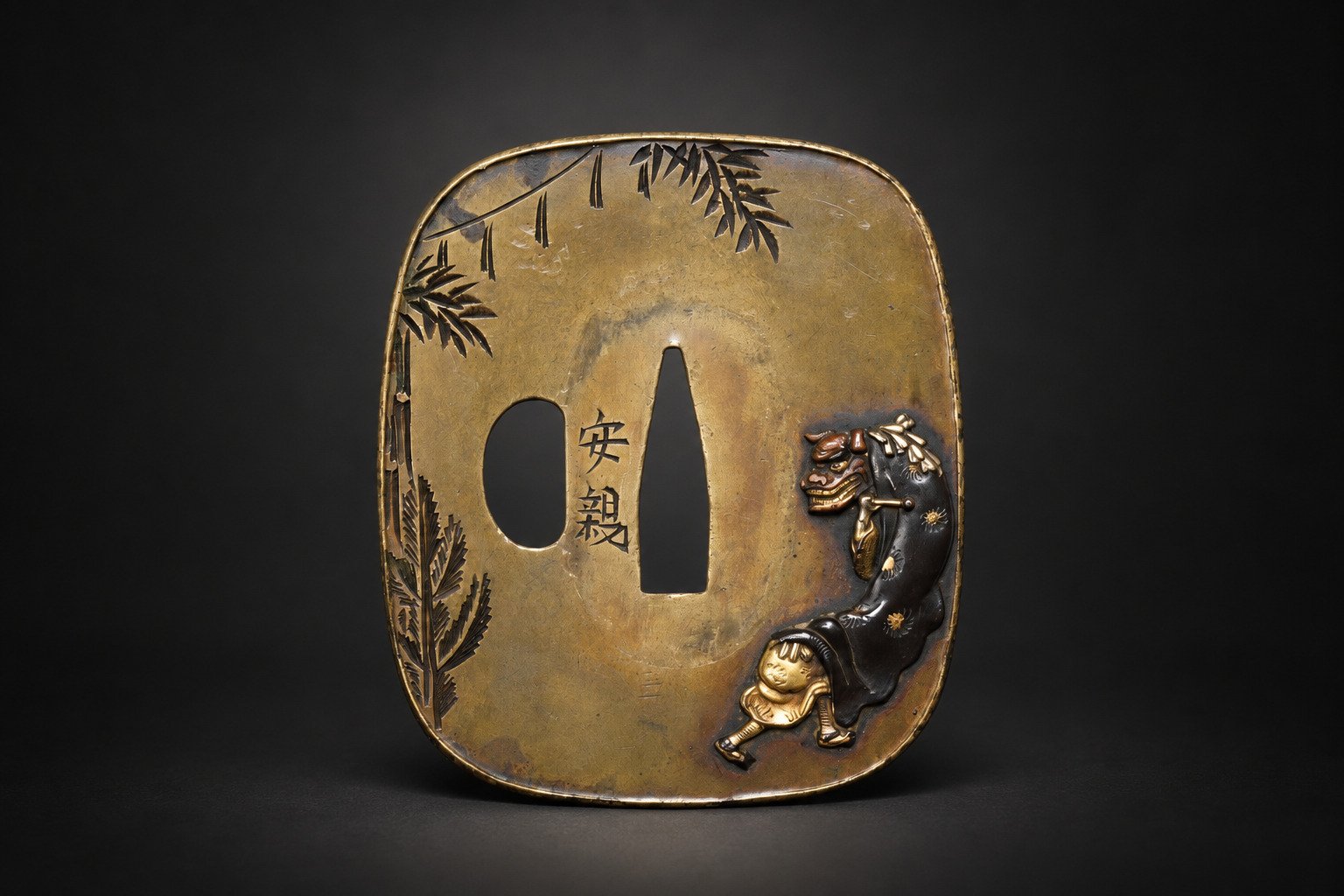
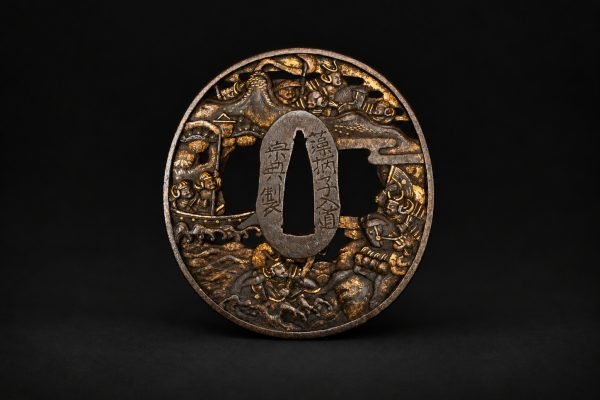
The tsuba introduces the second major decorative theme of the koshirae: the celebration and symbolism of the Japanese New Year.
The guard depicts a shishimai, or lion dancer. Shishimai performances traditionally appear during New Year celebrations and other festivals, with the lion associated with driving away harmful influences and inviting good fortune.
Also represented are a shimenawa, the sacred straw rope used in Shinto practice to mark a purified or sacred space, and a kadomatsu, the traditional arrangement of pine and bamboo placed at entrances during the New Year period to welcome the year’s deities.
Together, these motifs transform the tsuba into a compact composition of auspicious seasonal imagery centered on purification, protection and prosperity.
The tsuba bears the signature Yasuchika.
The name Yasuchika is closely associated with the celebrated lineage of Edo-period metalworkers founded by Tsuchiya Yasuchika, a school particularly admired for expressive animal subjects, including tigers and shishi, often executed in bold relief and contrasting metals.
The presence of the signature is an important feature of the fitting. Without additional specialist authentication, however, it should be understood as a Yasuchika signature or attribution within that artistic tradition, rather than as an independent confirmation of authorship by a specific master of the lineage.
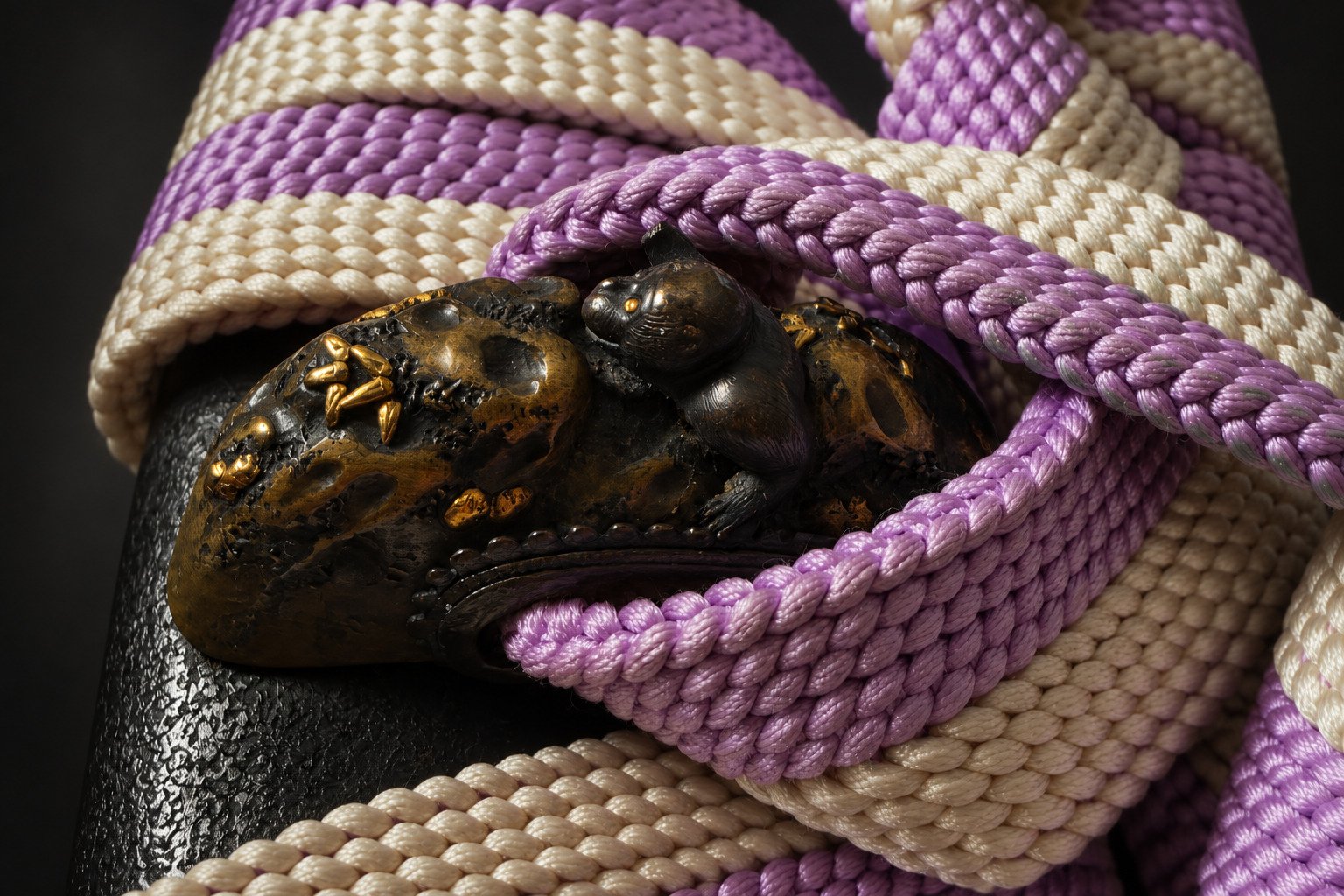
The koiguchi, the fitting surrounding the mouth of the saya, is decorated with clouds.
This motif continues directly into the lacquer decoration of the scabbard, creating a deliberate transition between metal and lacquer rather than treating the fitting as an isolated decorative element.
The cloud imagery also appears elsewhere on the mounting, contributing to the overall coherence of the design.
The kozuka, the handle of the small utility knife traditionally carried in a pocket along the saya, depicts a sarumawashi — a monkey trainer performing with his monkey.
Sarumawashi was a popular form of street entertainment and became particularly associated with New Year festivities. In traditional belief and popular culture, monkeys also carried auspicious associations connected with horses and their protection.
The composition includes another shimenawa, reinforcing the New Year and purification imagery found on the tsuba.
The kozuka bears the same kao found on the fuchi and kashira. This correspondence strongly suggests that these components were conceived as part of the same decorative group, although the exact workshop relationship cannot be established from the marks alone.
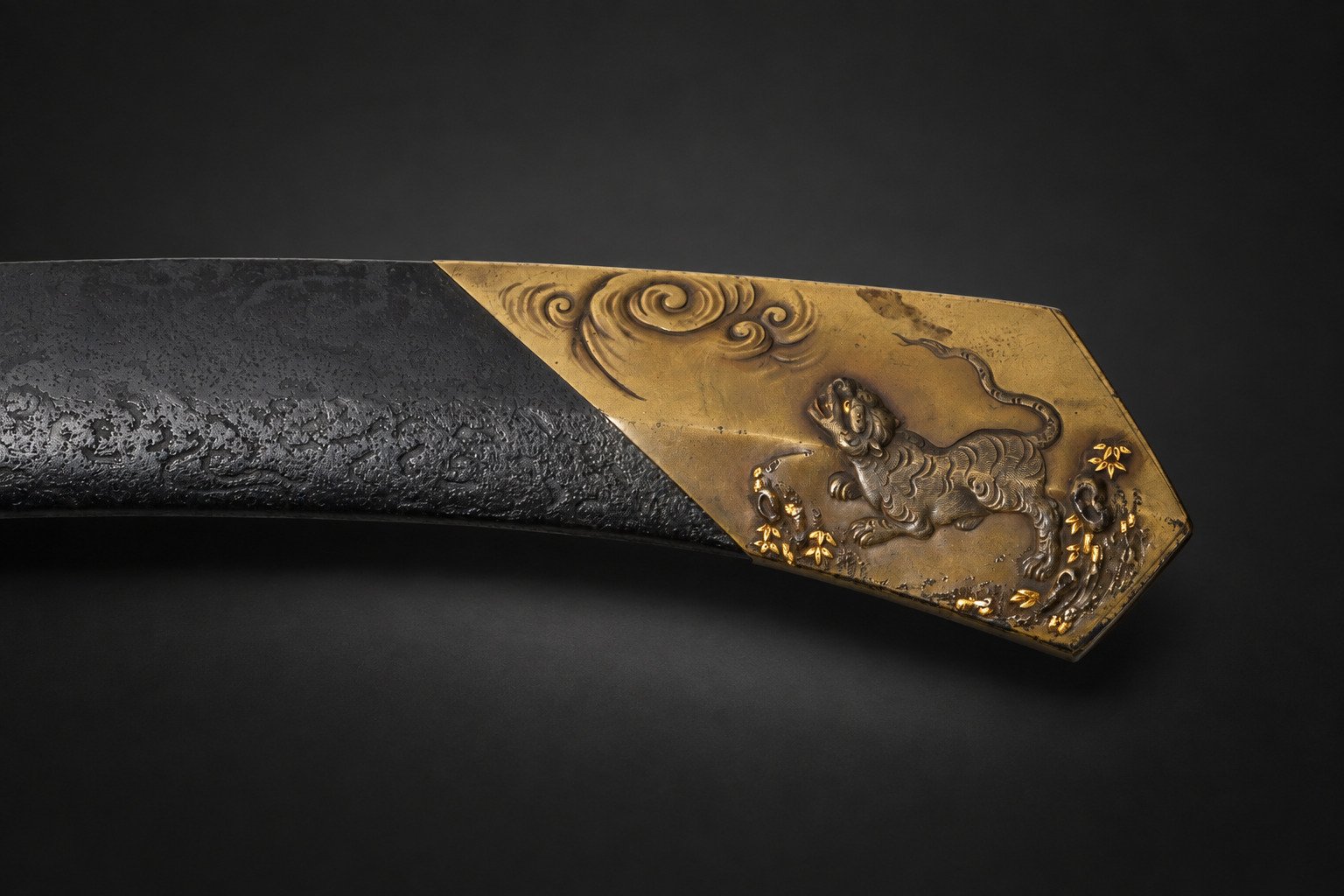
The large kojiri, protecting and decorating the lower end of the saya, returns to the principal tiger theme.
Its decoration combines tiger, bamboo and cloud imagery, bringing together motifs that appear elsewhere on both the hilt and scabbard.
Because of its unusually large size and the flared form of the saya, the kojiri becomes one of the dominant visual elements of the entire mounting rather than serving merely as a discreet terminal fitting.
The tiger among bamboo is one of the most compelling themes within the decorative arts of Japan.
The powerful animal is set against tall, flexible bamboo, creating a natural contrast between strength and resilience. For metalworkers, the subject also offered the opportunity to combine muscular animal forms with fine botanical detail and contrasting metal inlays.
On this koshirae, the motif appears repeatedly rather than as an isolated ornament, connecting the hilt fittings, menuki and kojiri into a consistent visual narrative.
The second theme of the mounting is equally coherent. The shishimai, shimenawa, kadomatsu and sarumawashi all belong to the broader visual culture of Japanese New Year celebrations and auspicious seasonal customs.
These subjects carry associations of purification, protection, good fortune and renewal, giving the fittings a meaning that extends beyond purely decorative appeal.
The combination of this felicitous imagery with the more forceful tiger-and-bamboo theme gives the koshirae an unusually rich iconographic character.
One of the most interesting aspects of the mounting is the way its decorative subjects repeat across different components.
The tiger appears on the fuchi, kashira, menuki and kojiri. Clouds connect the lacquered saya with the metal koiguchi and terminal fittings. New Year imagery links the signed tsuba with the kozuka.
Even where the individual fittings may carry different marks or signatures, the repeated materials, motifs and visual relationships create a strong sense of intentional coordination across the complete koshirae.
The mounting dates to the mid-19th century, during the final decades of the Edo period.
By this period, Japanese sword fittings had long developed into an independent field of highly sophisticated decorative metalwork. Koshirae could combine practical sword furniture with miniature works of sculpture, inlay and relief carving, allowing a single mounting to carry complex seasonal, religious and symbolic themes.
This example reflects that tradition particularly well through the variety and consistency of its fittings.
The koshirae is accompanied by a silk brocade storage bag.
Such textile bags protect sword mountings from dust and accidental surface contact while also forming part of the traditional presentation and storage of Japanese swords and their fittings.
The koshirae survives as a complete decorative mounting with its coordinated fittings and wooden display blade.
The surfaces show the natural signs of age expected from a mid-19th-century Japanese object, including wear and patination to the metal, lacquer and textile elements.
The current wooden blade is intended for presentation and preserves the assembled appearance of the koshirae without incorporating a genuine steel sword blade.
A richly conceived mid-19th-century Edo-period wakizashi koshirae, combining an unusual flared saya with a coordinated group of sentoku fittings enriched in gold, shakudō and contrasting metals. Tigers among bamboo recur across the fuchi, kashira, gilt menuki and monumental kojiri, while the signed Yasuchika tsuba and kao-marked kozuka introduce the auspicious world of Japanese New Year celebrations through shishimai, shimenawa, kadomatsu and sarumawashi imagery. Complete with its wooden display blade and silk brocade storage bag, the 64 cm mounting is an unusually coherent example of how Japanese sword furniture could unite metalwork, lacquer, seasonal symbolism and narrative decoration within a single complete ensemble.
| Época | Edo |
|---|

Order above 1.000,00 € gets free shipping.

Secure and hassle-free payment process.

Certificate of authenticity included.

Have questions? Contact us via WhatsApp.
Contact