Meiji Period Boxwood Netsuke – Peasant with a Kappa Trapped in His Bundle
Japan · Meiji Period · Katabori Netsuke · Peasant and Kappa · Boxwood (Tsuge)
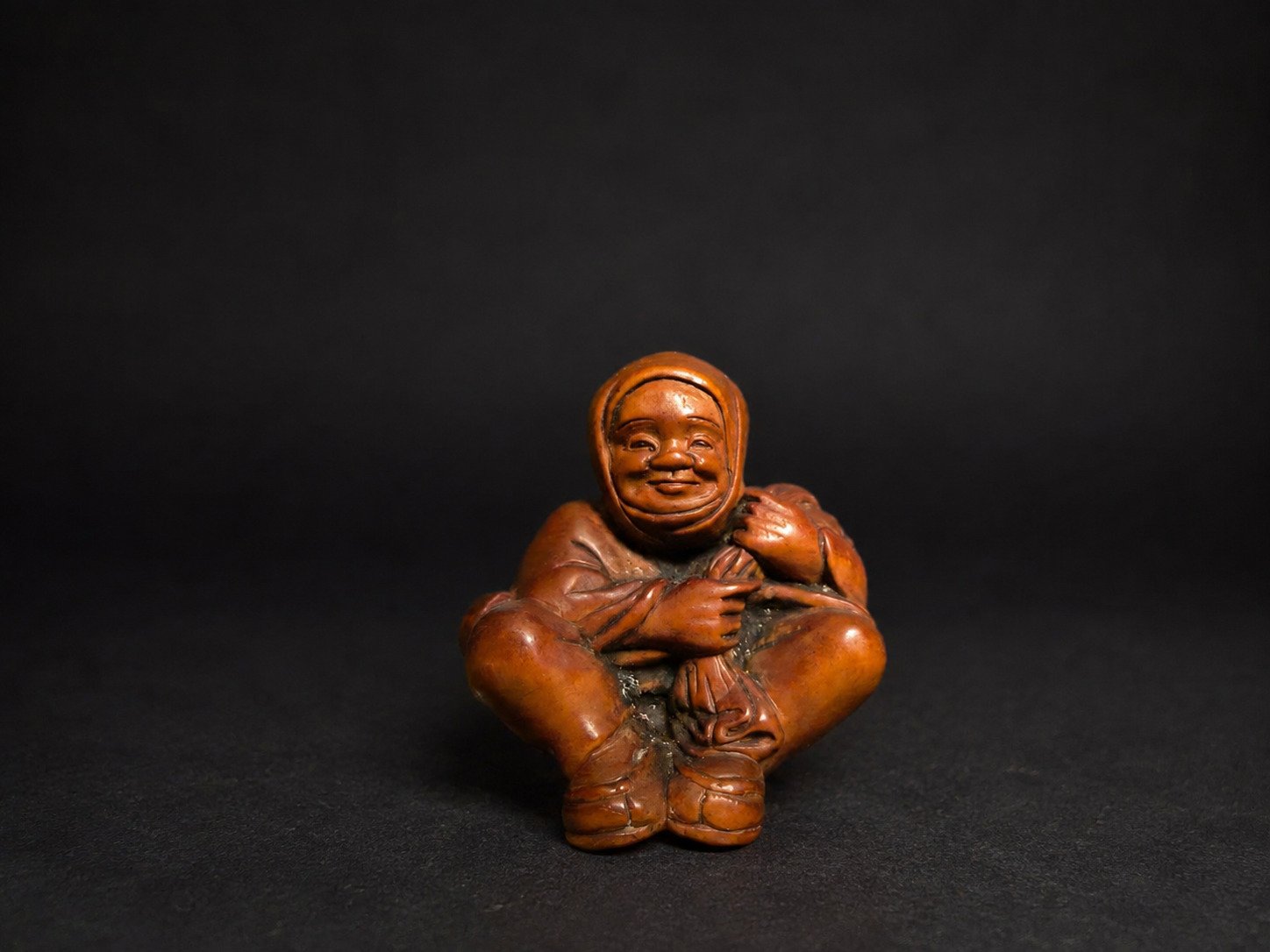
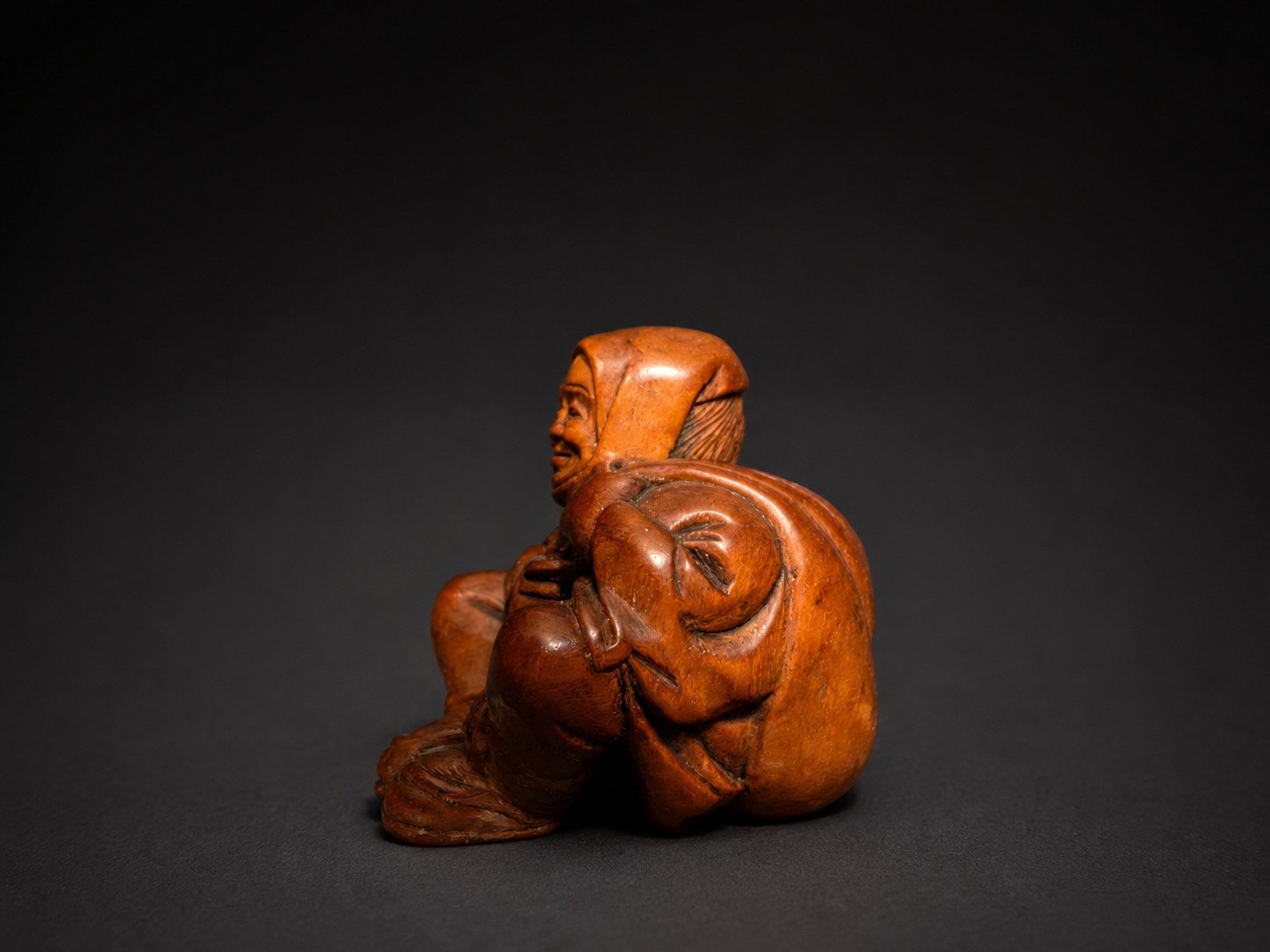
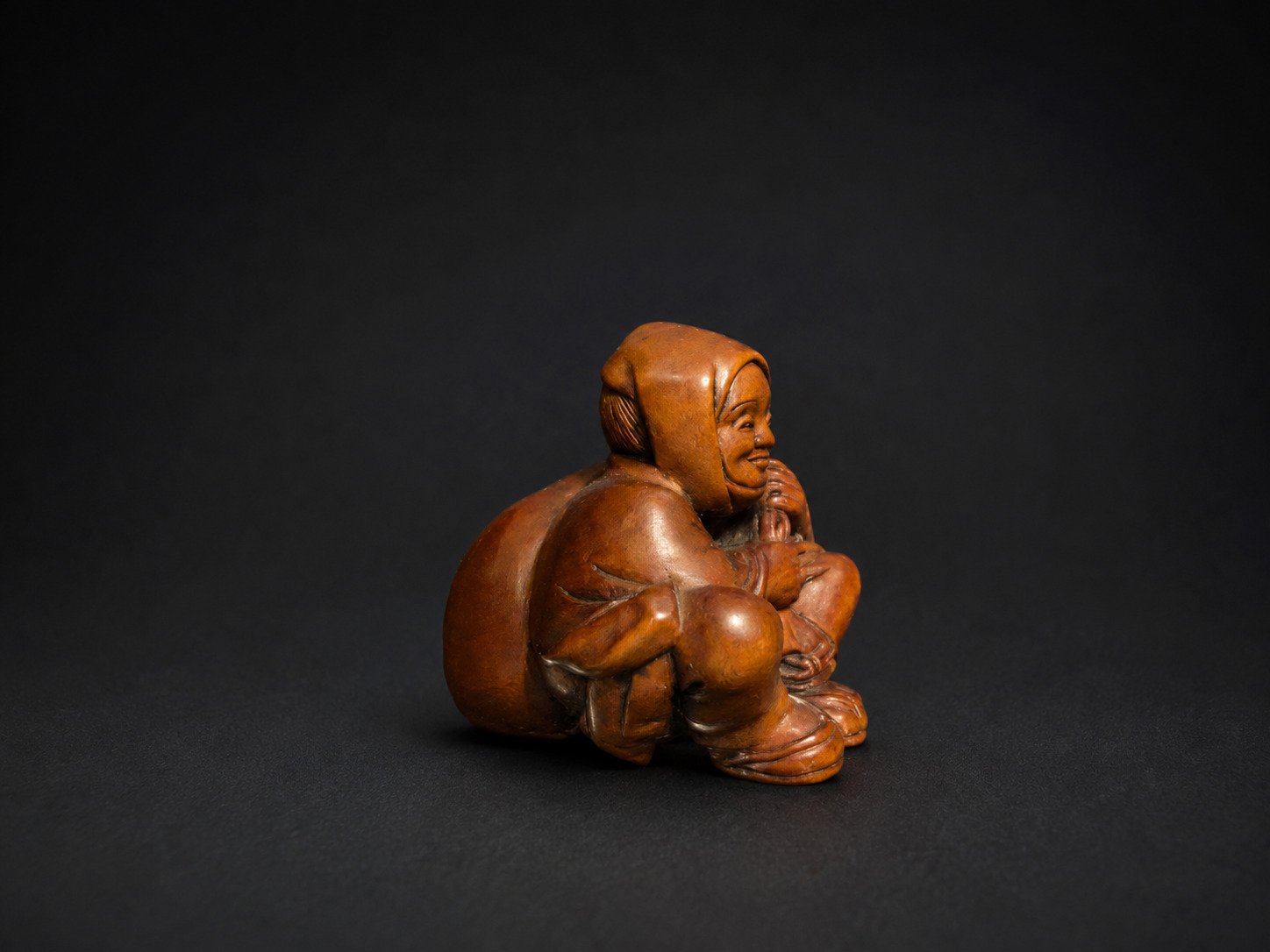
A charming Japanese boxwood katabori netsuke from the Meiji period, depicting a seated countryman or peasant clutching a large knotted bundle against his chest. The figure wears a hood or headscarf tied around his head and bears a cheerful, amused expression, giving the composition an immediate sense of character and narrative.
Carved from boxwood (tsuge), the netsuke has developed a rich caramel-brown patina that enhances the rounded modelling of the face, hands and clothing. The compact composition combines expressive figure carving with the humorous and supernatural imagery so characteristic of Japanese netsuke.
The Peasant
The central figure is a seated countryman shown with his legs folded closely in front of him. His rounded face is animated by a broad, good-humoured smile, with narrow eyes and softly modelled cheeks that give him a distinctly amused expression.
A hood or headscarf surrounds his head, while his hands firmly grasp the large sack positioned against his body. The compact arrangement of the bent legs, hands and bundle creates a balanced composition designed to be handled and viewed from multiple angles.
The treatment of the figure is particularly lively, with smooth modelling across the face and limbs contrasted by more deeply carved lines defining the garments, footwear and folds of the sack.
The Kappa in the Bundle
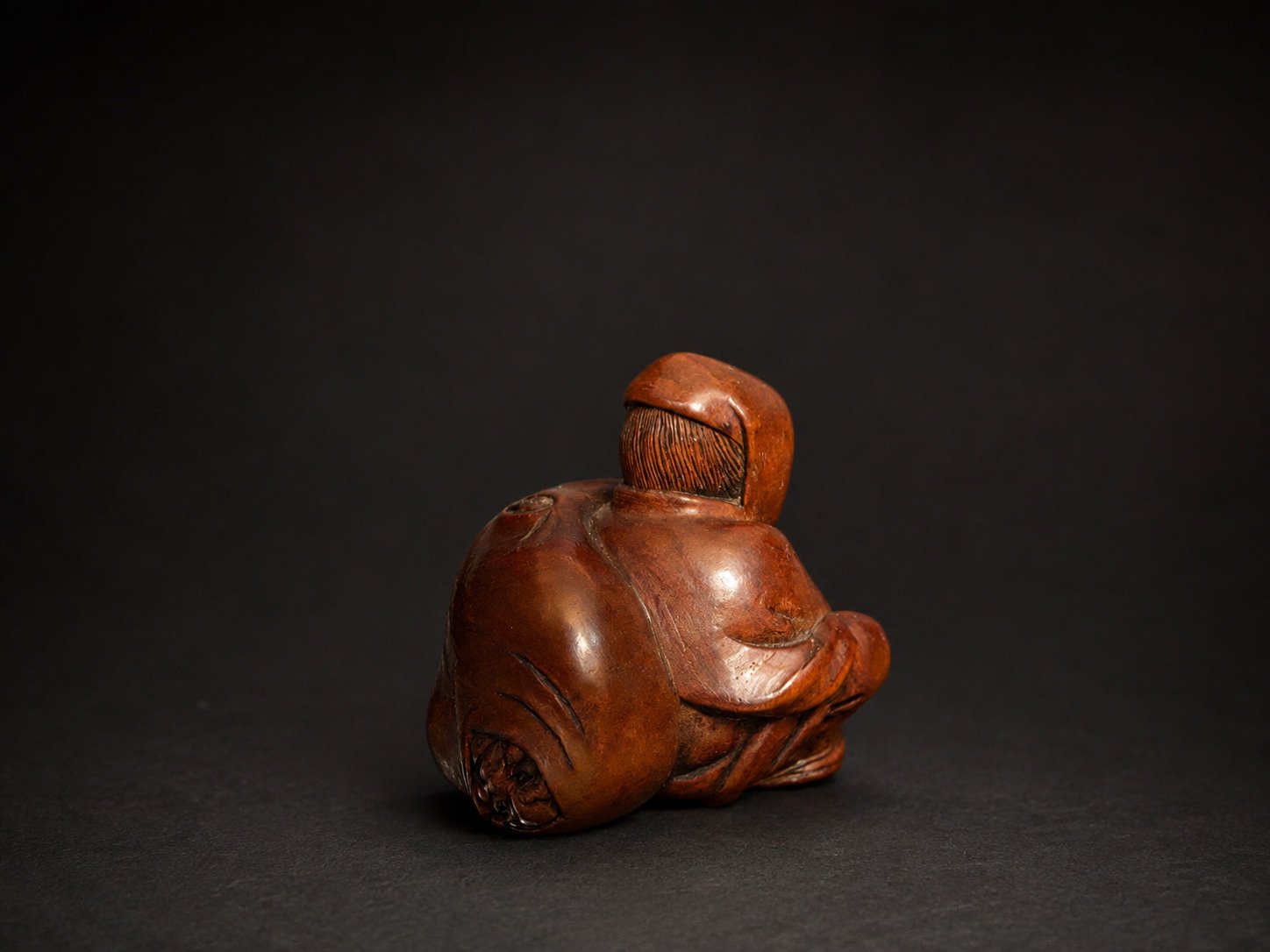
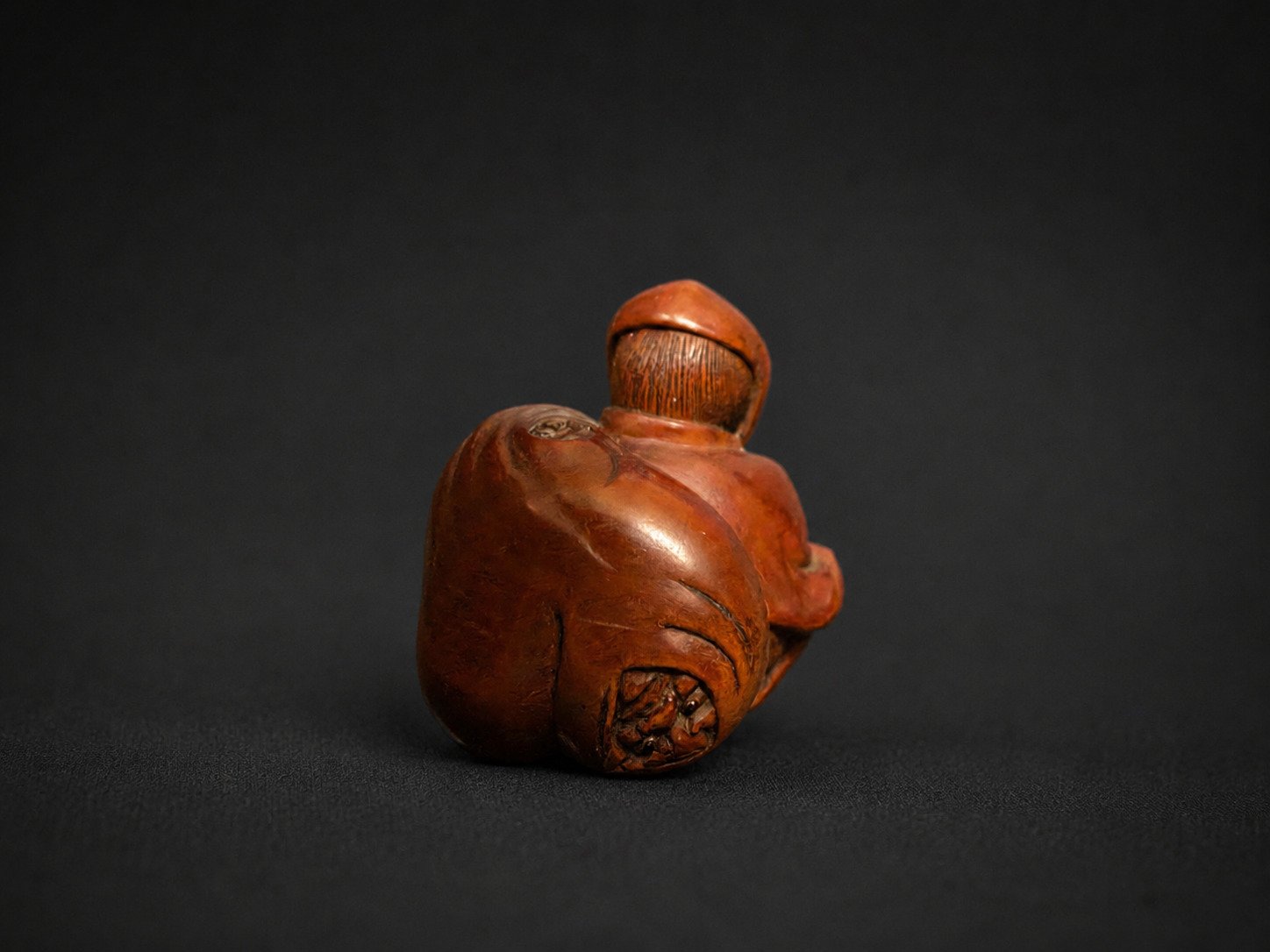
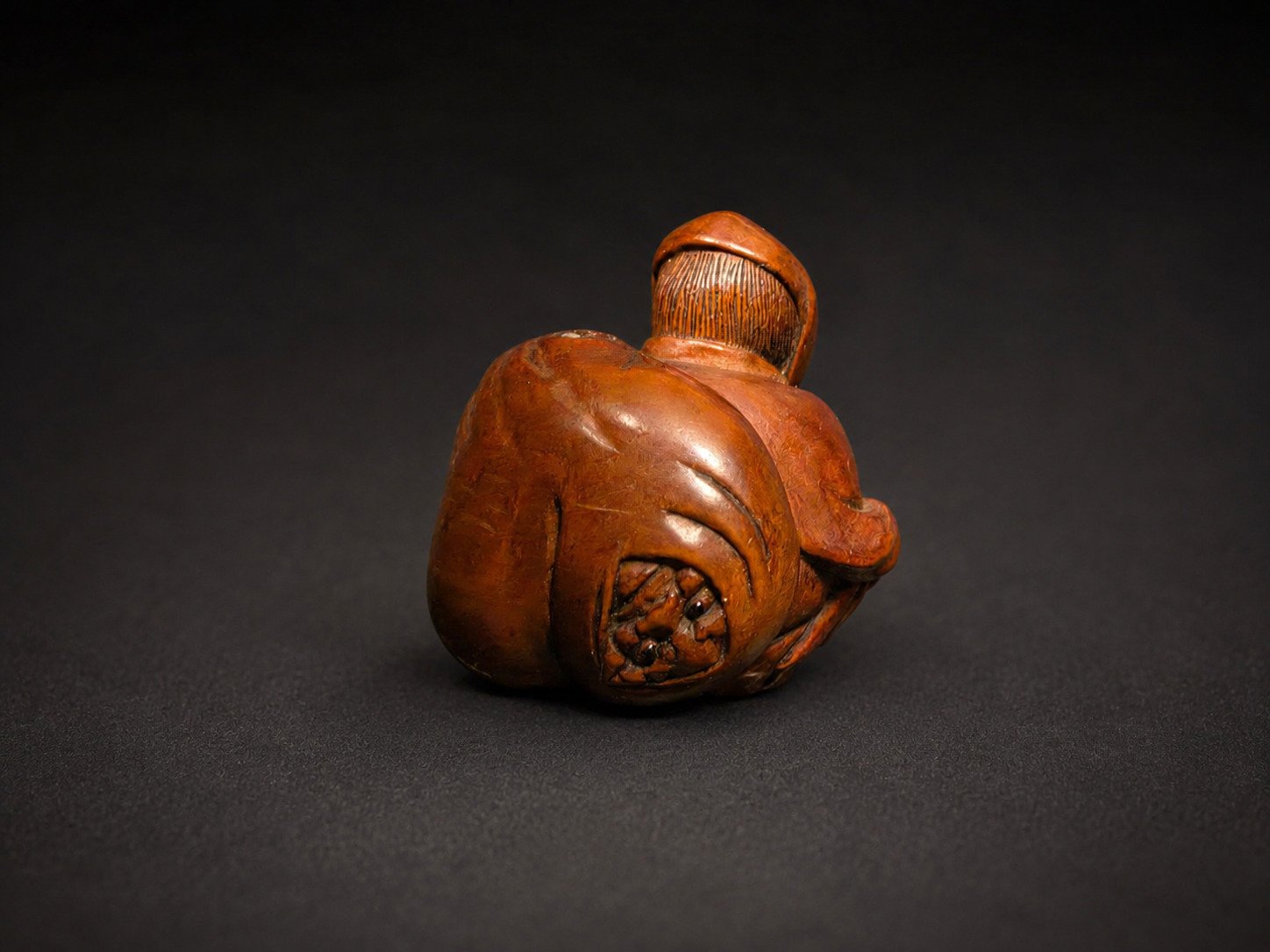
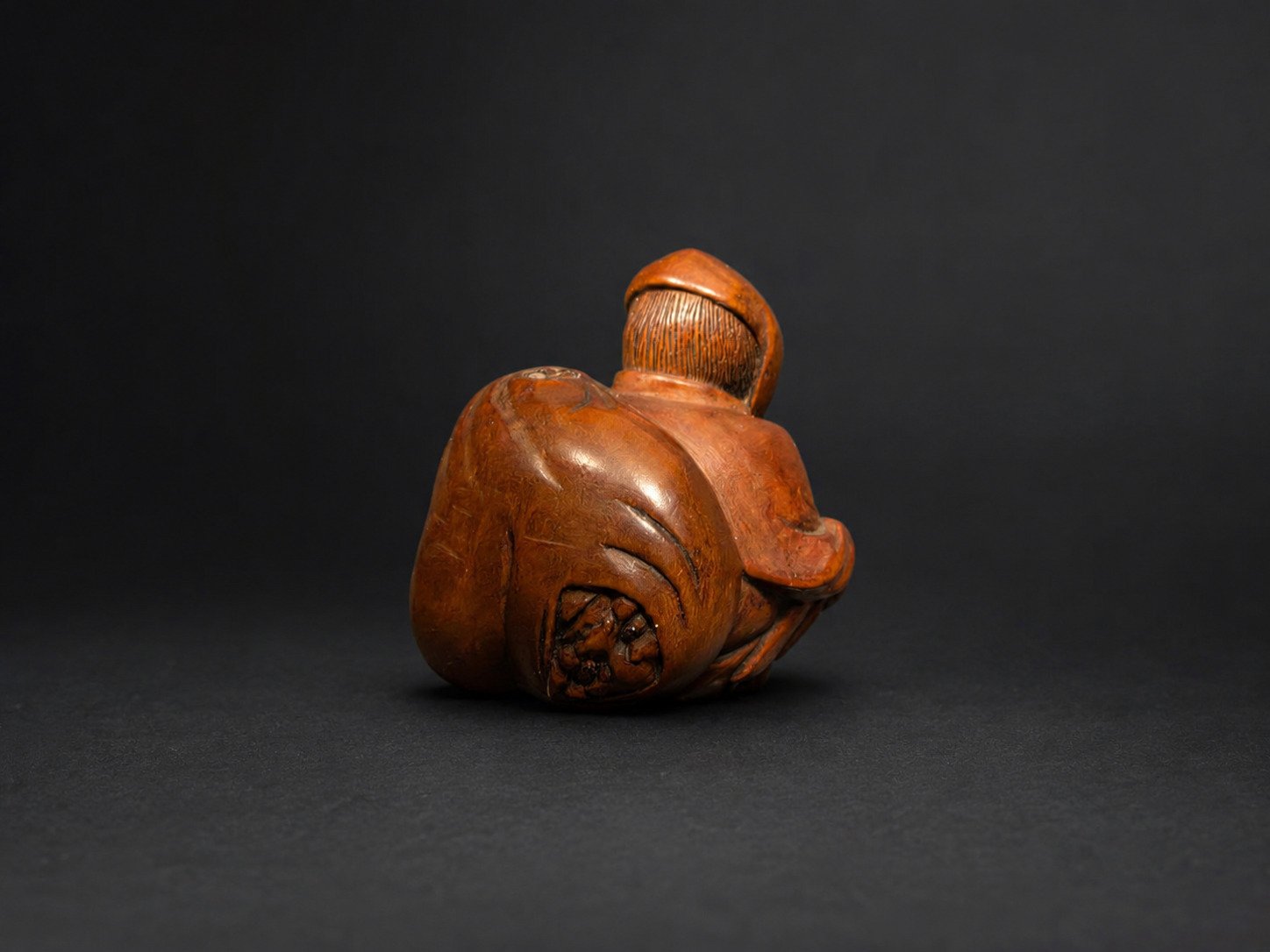
On the front of the sack is a small circular motif surrounded by radiating incised lines, deliberately distinguished from the surrounding folds of the fabric. A plausible interpretation is that this detail represents the face of a kappa peering out from inside the bundle, suggesting that the peasant has captured the mischievous creature and is carrying it away.
The identification should be regarded as an interpretation of the carving rather than an absolute attribution, but it fits well within the humorous supernatural themes frequently encountered in Japanese popular imagery.
The kappa is one of the best-known beings of Japanese folklore, traditionally described as a water spirit associated with rivers, ponds and other bodies of water. It is characteristically depicted with a shallow depression or dish (sara) on the top of its head, believed to contain the water on which its supernatural strength depends.
Folklore surrounding the kappa frequently tells of villagers overcoming the creature through intelligence rather than force. One well-known motif involves tricking a kappa into bowing, causing the water in its head-dish to spill and leaving it weakened. Other stories connect the creature with cucumbers, traditionally regarded as one of its favourite foods.
The apparent image of a peasant carrying away a captured kappa therefore evokes a broader narrative tradition in which ordinary villagers encounter, outwit and occasionally tame supernatural beings.
Carving and Composition
The carving balances the loose, organic modelling of the peasant’s face and hands with the fuller and more voluminous treatment of the sack. Its folds, gathered fabric and knotted upper section are rendered with considerable naturalism.
The figure’s limbs form a compact frame around the central bundle, giving the netsuke a rounded and stable silhouette. Deep incisions around the clothing and between the arms and sack create visual separation between the different elements despite the small scale of the piece.
The warm tones of the boxwood and the darker coloration retained within recessed areas further enhance the sculptural depth and give the carving a mature, well-developed surface character.
Boxwood and Patina
The netsuke is carved from boxwood (tsuge), one of the woods traditionally favoured by Japanese netsuke carvers for its density, fine grain and ability to hold precise detail.
The surface has developed a rich caramel to amber-brown patina, particularly attractive across the rounded areas of the face, knees and hands. Darker tones remain within the deeper cuts and recesses, increasing the contrast and helping define the modelling.
Himotoshi
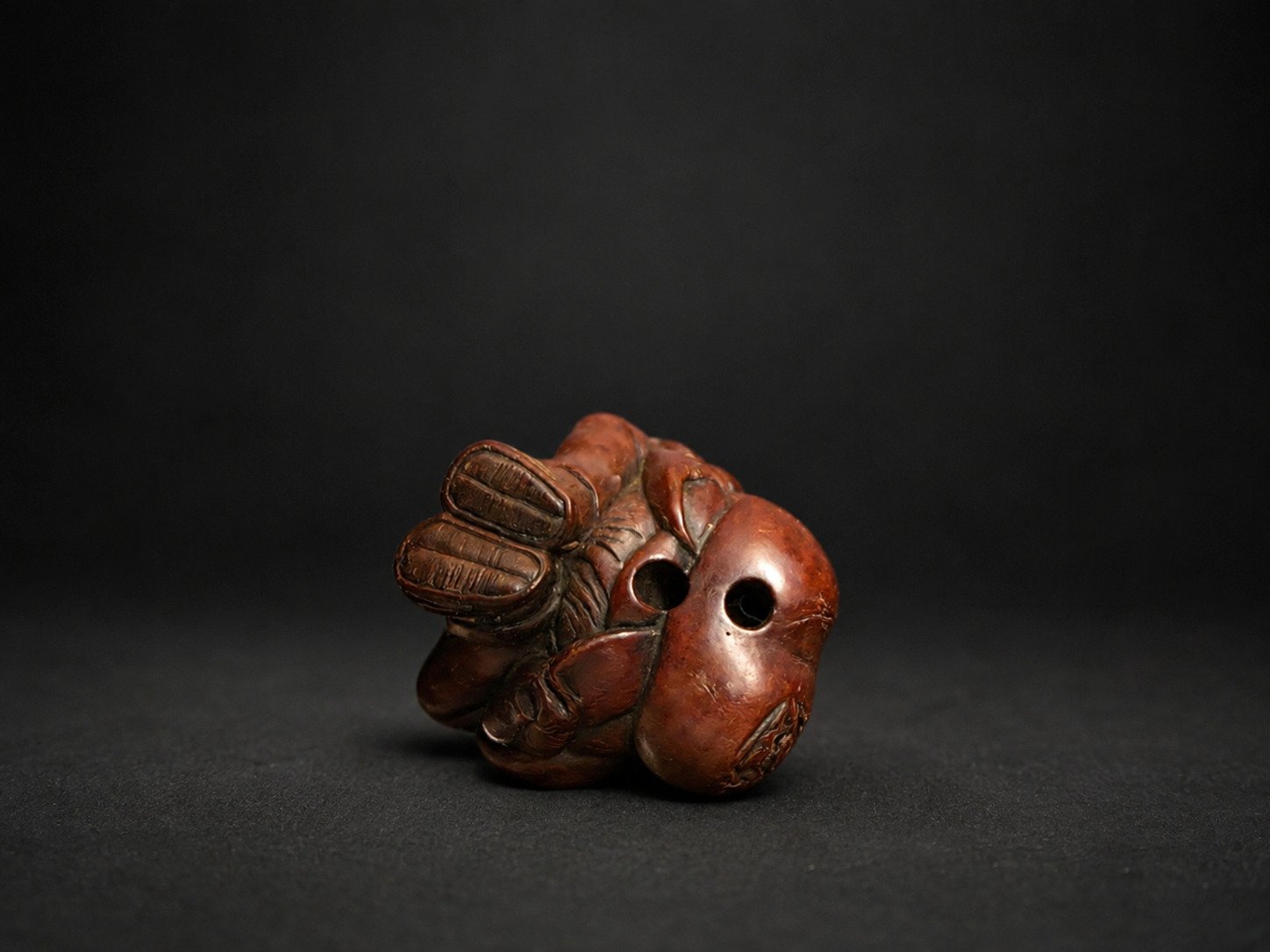
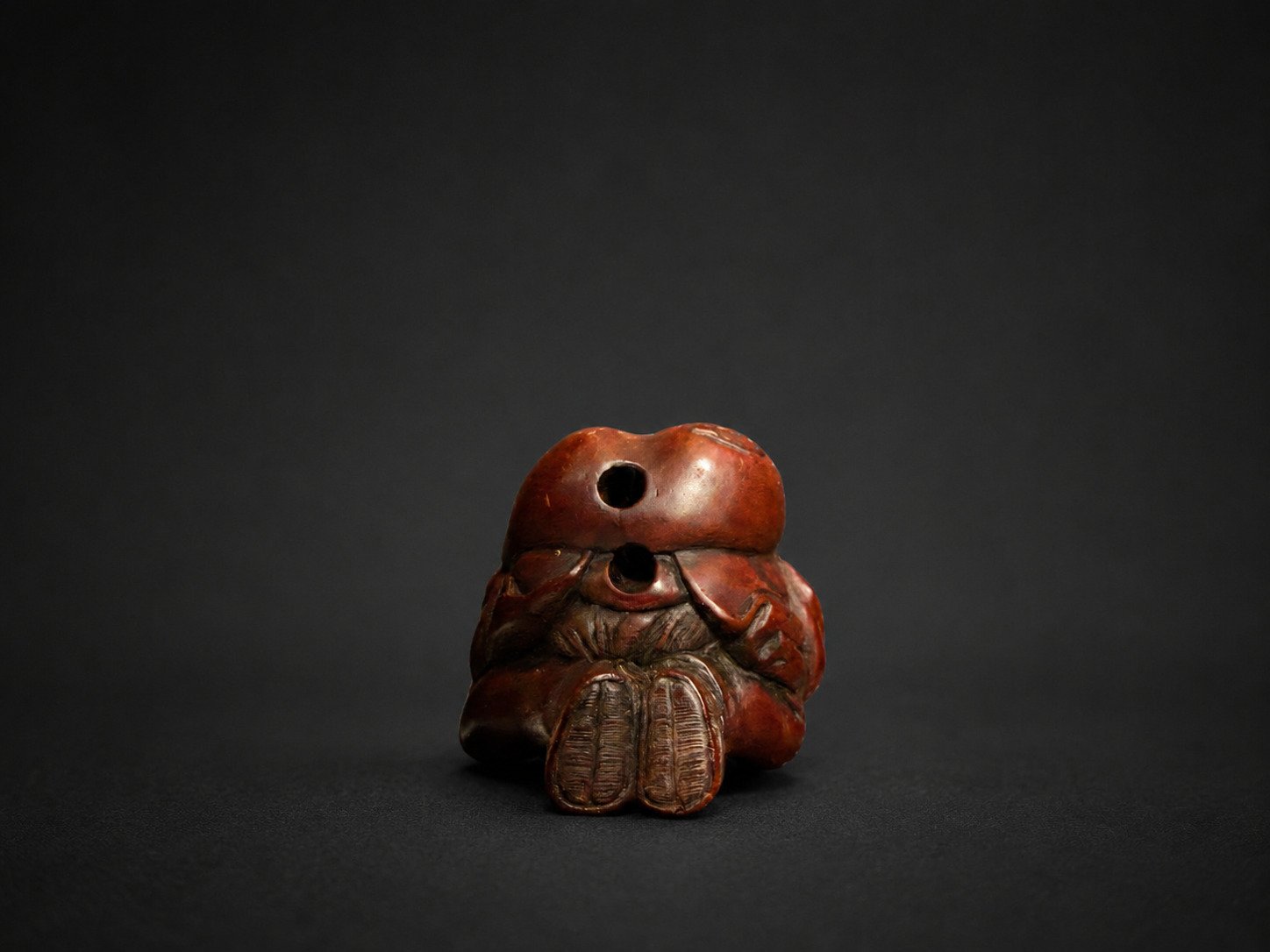
The underside of the sack incorporates a double-hole himotoshi, the traditional cord passage used to attach the netsuke to a sagemono such as an inrō, pouch or tobacco container.
Its placement within the underside of the composition preserves the sculptural appearance of the piece while maintaining its original practical function as a netsuke.
Collector’s Interest
This netsuke combines several elements attractive to collectors: expressive human characterisation, fine boxwood carving, a rich caramel patina and a humorous narrative apparently inspired by Japanese folklore.
The possible presence of a captured kappa within the peasant’s bundle gives the composition an additional storytelling dimension, linking the piece to Japan’s extensive visual tradition of supernatural creatures, comic encounters and everyday figures confronting the extraordinary.
Its compact form, lively expression and clearly integrated himotoshi make it an appealing example of Meiji-period figurative netsuke carving.
Specifications
- Object: Japanese netsuke
- Type: Katabori netsuke
- Subject: Seated peasant with a bundled figure interpreted as a kappa
- Period: Meiji period
- Origin: Japan
- Material: Boxwood (tsuge)
- Surface: Rich caramel-brown patina
- Himotoshi: Double-hole himotoshi to the underside of the sack
- Dimensions: 3.5 × 3.2 cm
A characterful Meiji-period boxwood netsuke depicting a cheerful seated peasant clutching a large bundle, with a small carved motif plausibly representing a captured kappa peering from within. The piece combines expressive figural carving, Japanese folklore and a rich caramel patina in a compact traditional katabori composition.