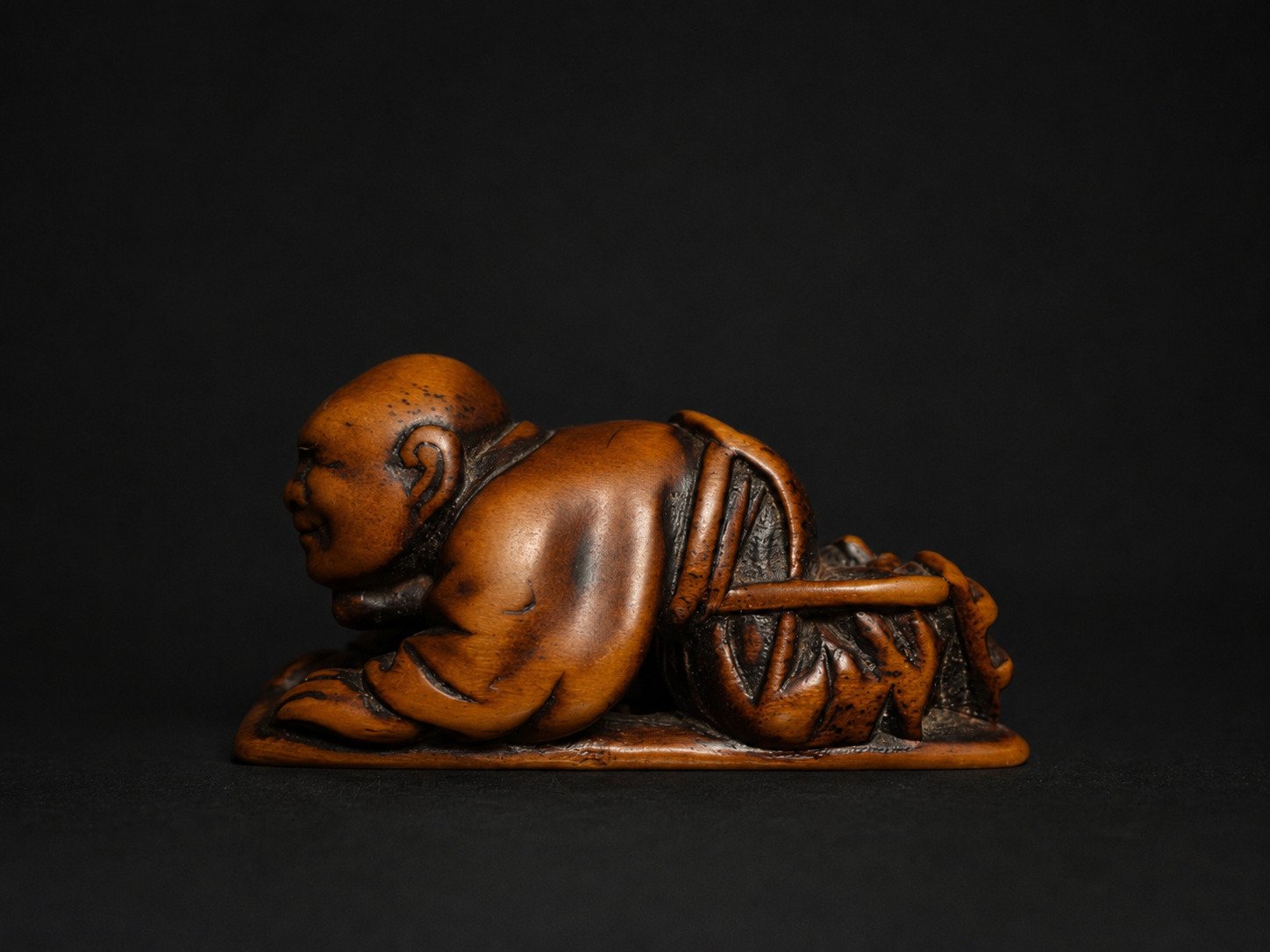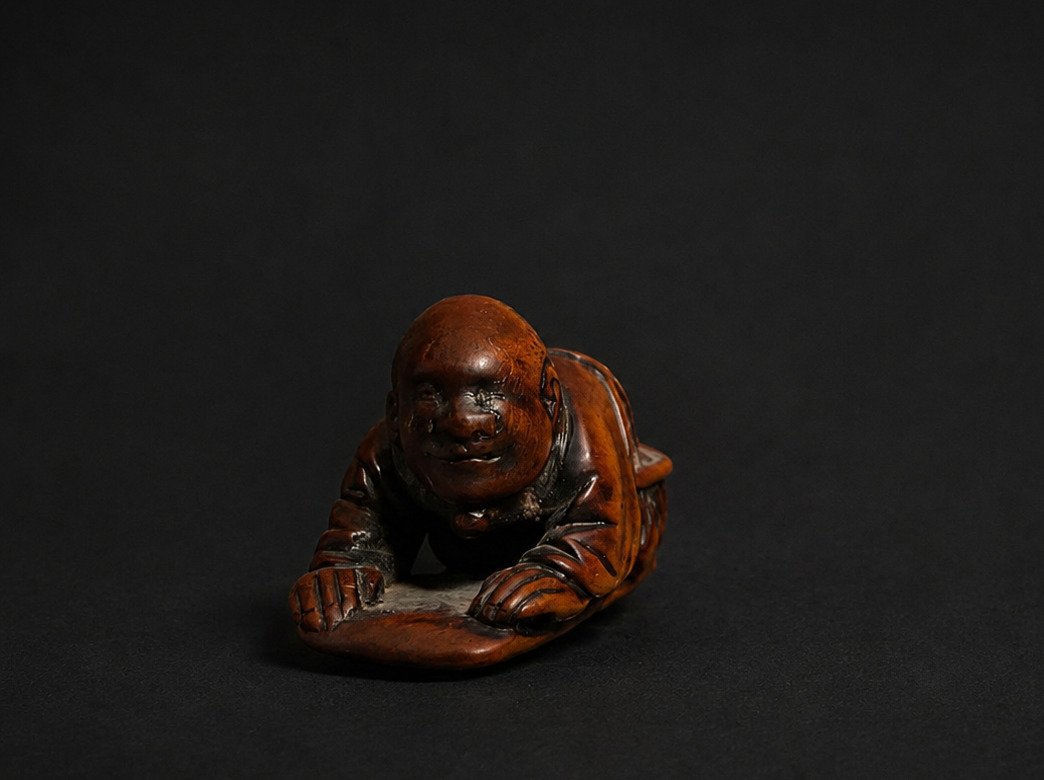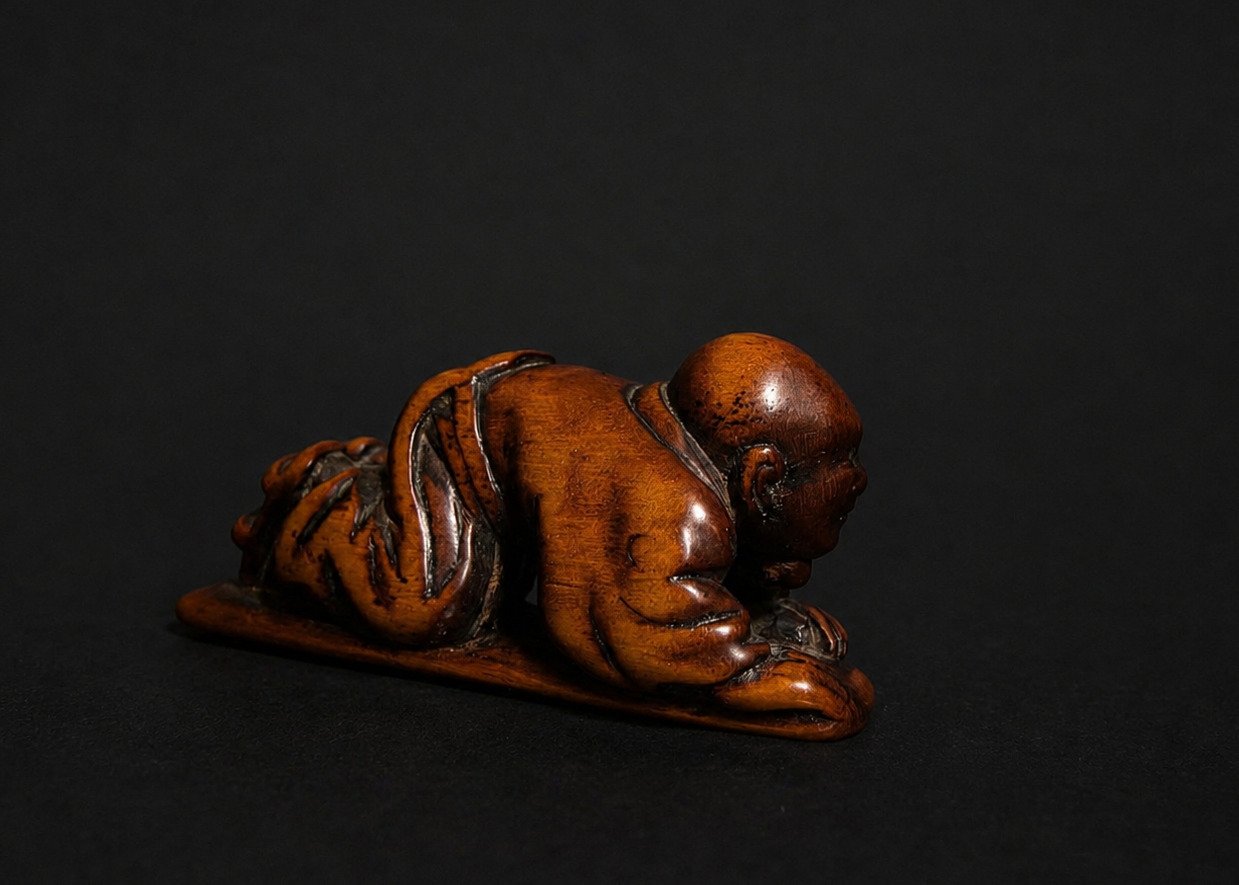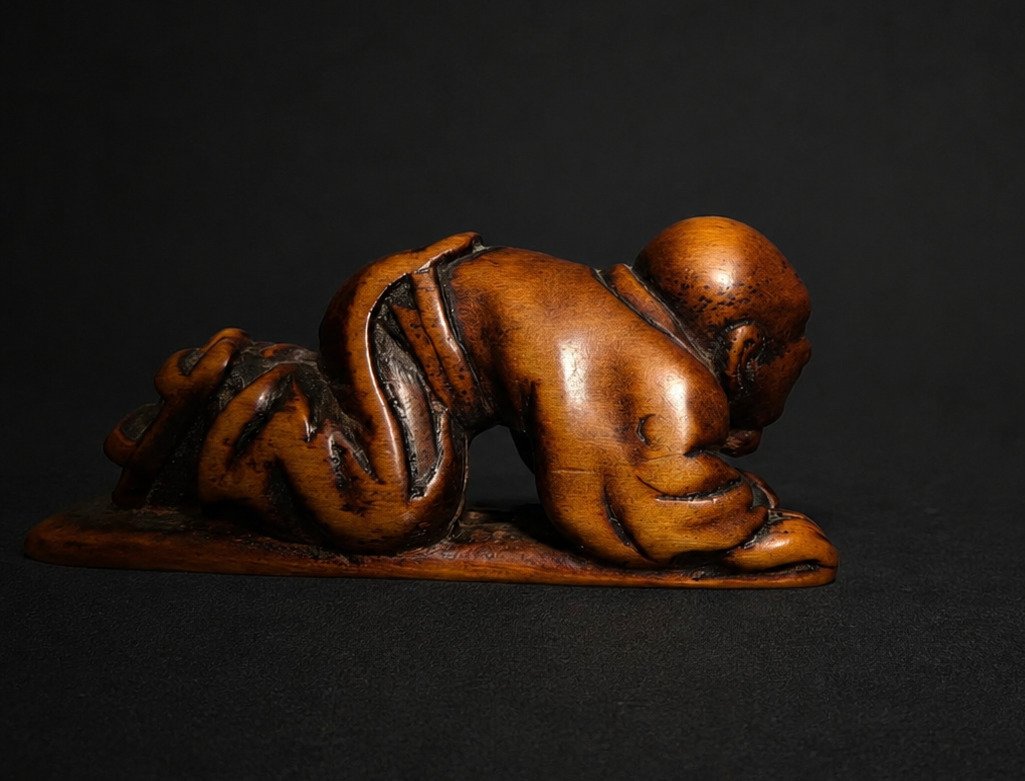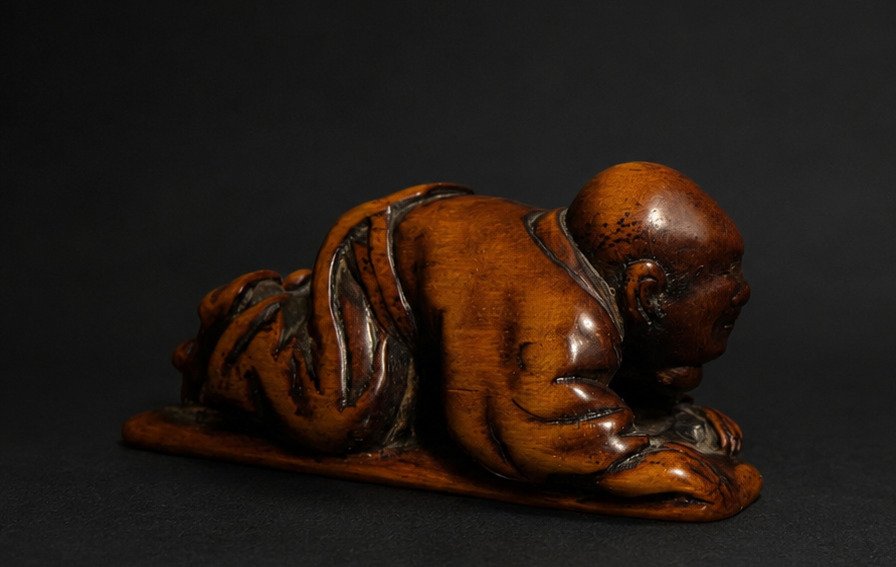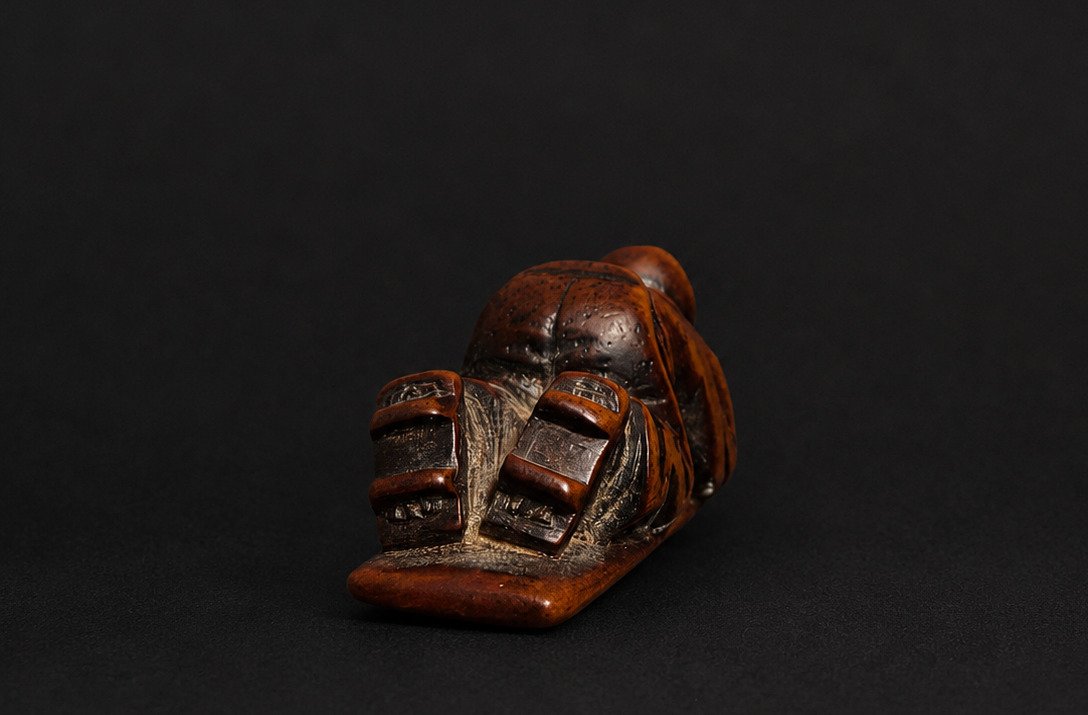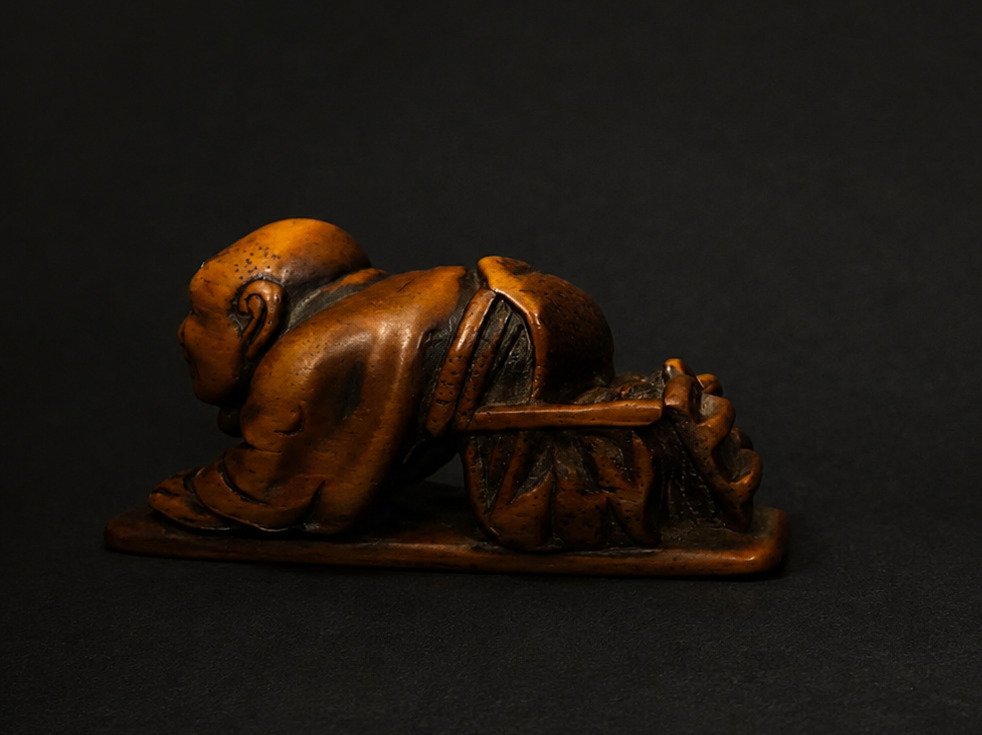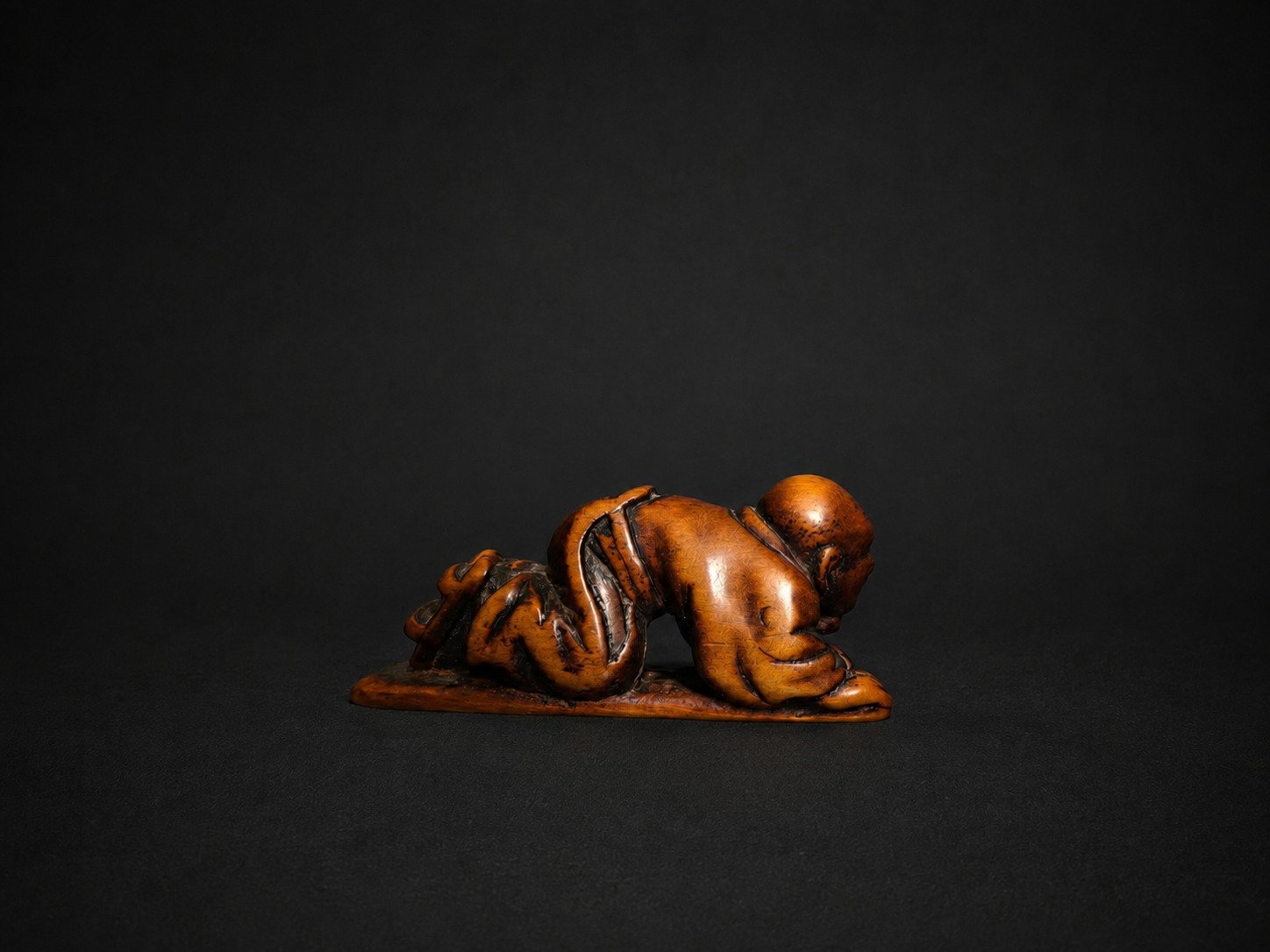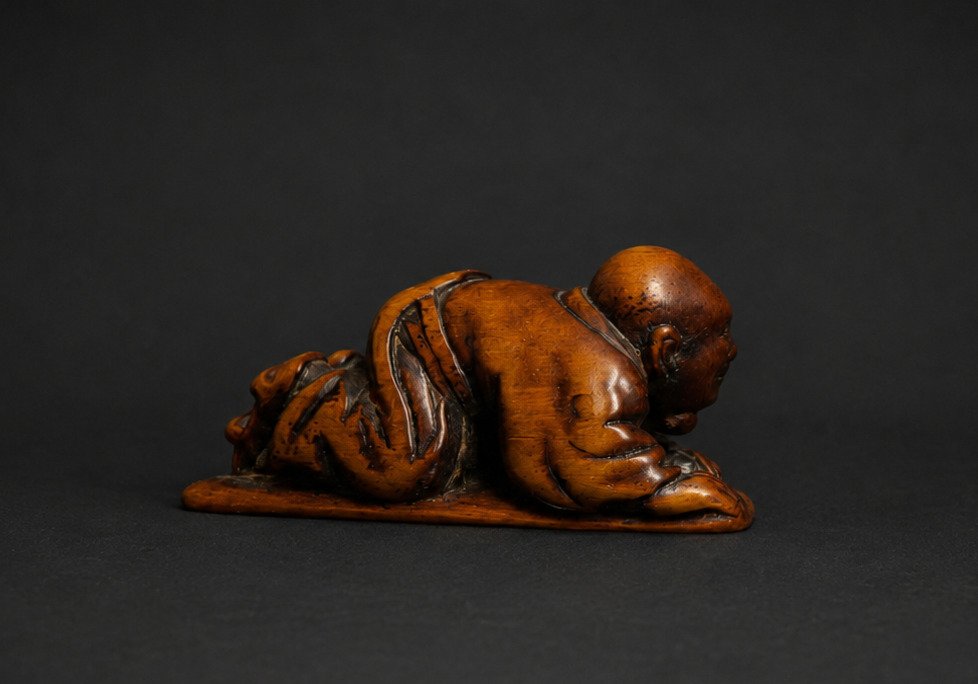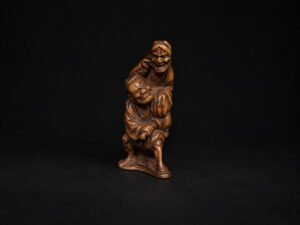
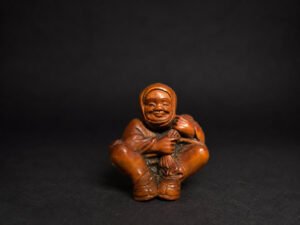
A characterful Japanese figural katabori netsuke carved in wood, dating to the 19th century, Edo period, and depicting a crouching male figure shown close to the ground in a compact, forward-leaning pose.
The figure is carved from warm amber-brown wood with an attractive mature patina. Darker coloration remains within the deeper recesses of the carving, accentuating the folds of the garments, facial features and layered details across the back and underside.
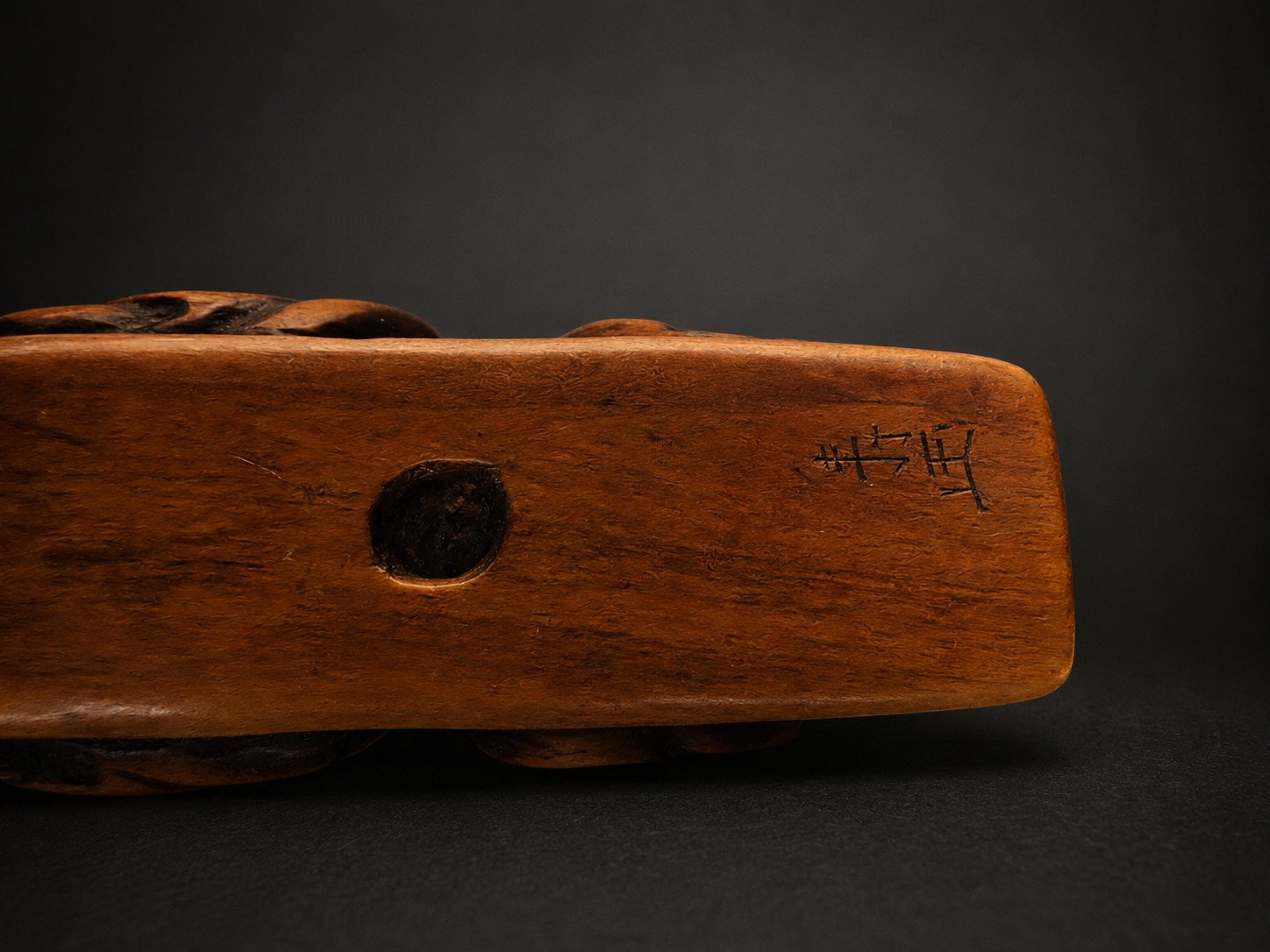
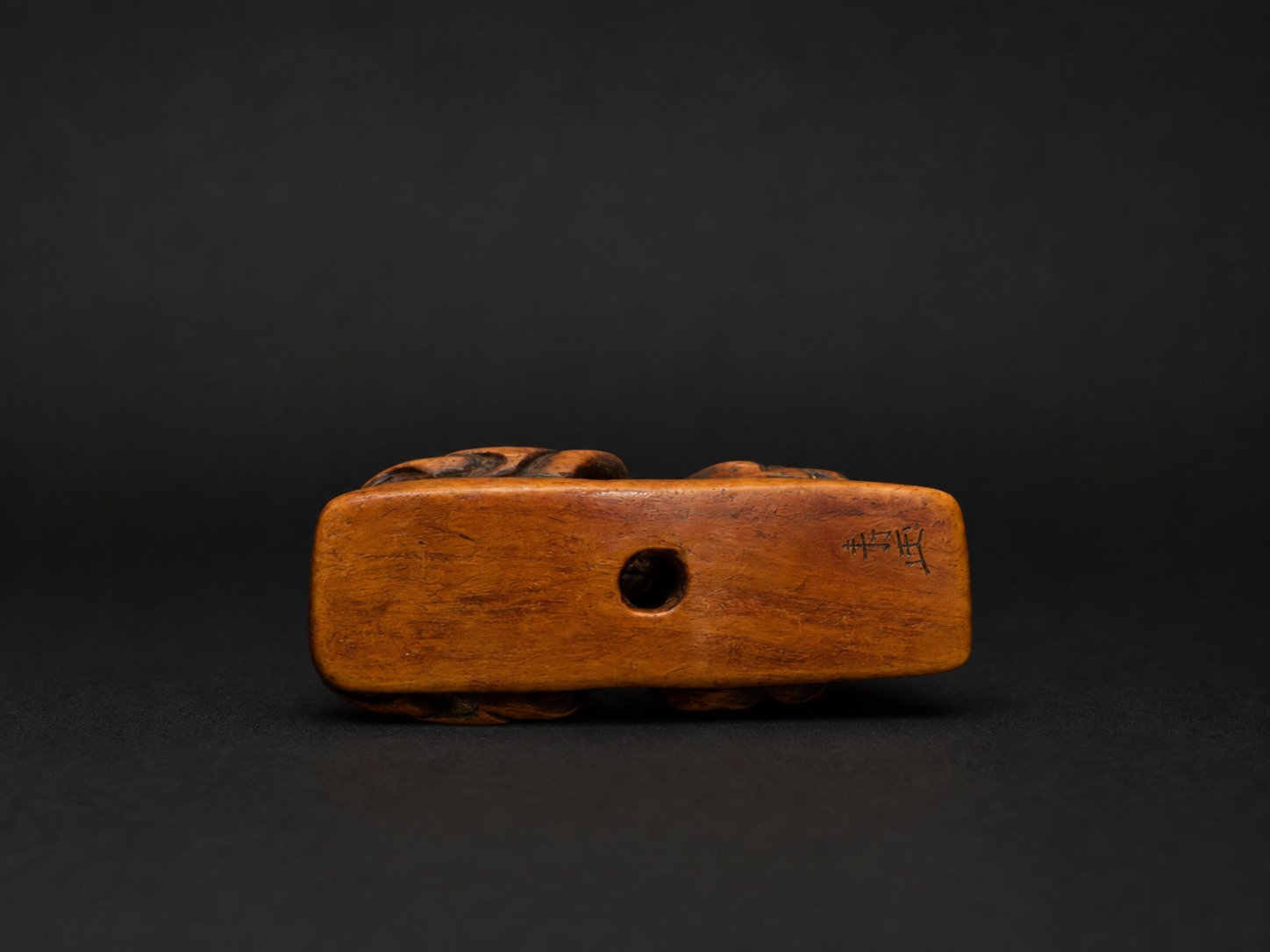
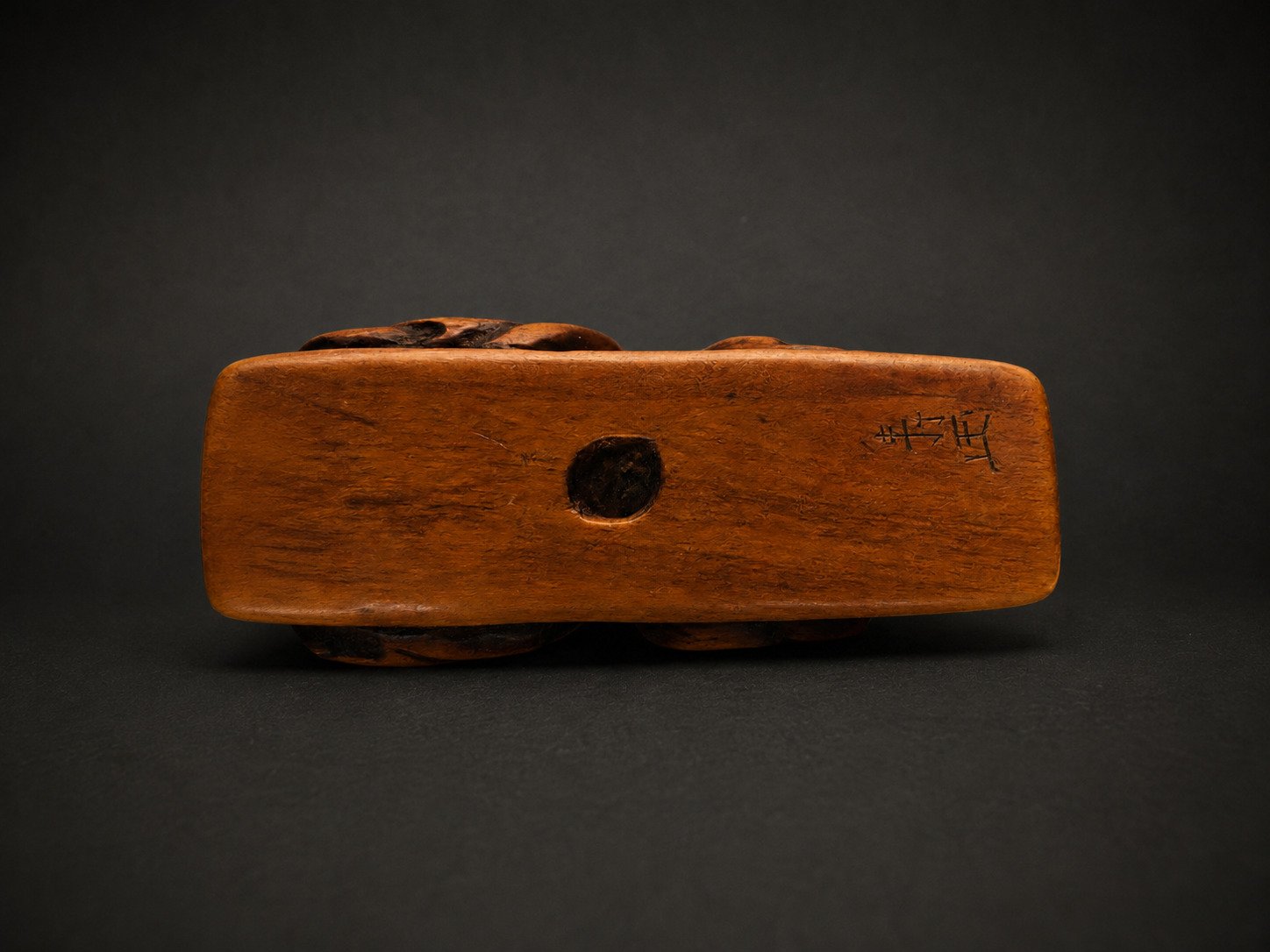
The base bears the incised signature 寿正, read as Toshimasa, together with a clearly defined functional himotoshi.
The subject is represented in a low, forward-leaning position, with the body compressed close to the ground and the limbs arranged into a compact horizontal composition.
The rounded head, carefully modelled facial features and voluminous clothing give the figure considerable sculptural presence despite the small dimensions of the netsuke.
Rather than presenting the subject in a conventional frontal pose, the carver has built the composition around the curve of the back, shoulders and bent limbs.
This arrangement gives the carving a strongly three-dimensional quality and encourages it to be examined from several different viewpoints.
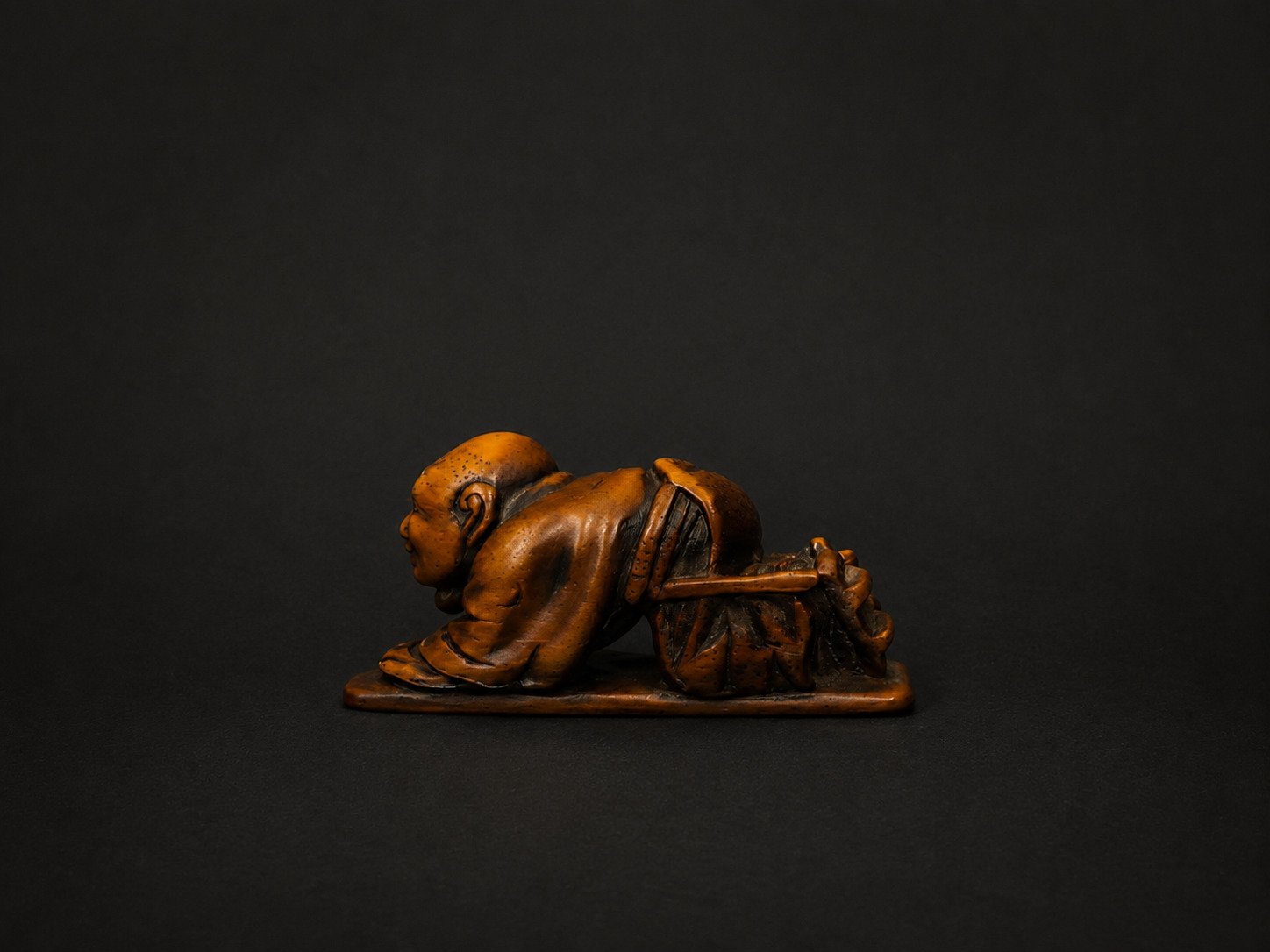
A long, narrow object resembling a staff or pole extends across the rear of the composition.
It is carefully incorporated into the surrounding garments and bundled forms, becoming an integral part of the sculptural structure rather than a separate projecting element.
The precise identity of the object, and consequently the specific narrative or occupation represented by the figure, has not been established with certainty.
For this reason, the subject is conservatively described as a crouching male figure with a staff or pole rather than being assigned to a specific character, profession or episode without documentary evidence.
The netsuke belongs to the katabori tradition of fully three-dimensional figural carving.
Its horizontal format is particularly effective: the folded body, garments and elongated staff-like element are compressed into a compact volume measuring less than five centimetres in length.
The form avoids unnecessarily fragile projections while retaining a strong sense of movement and sculptural complexity.
The figure remains visually legible from the front, sides, rear and underside, demonstrating that the carving was conceived as a complete object rather than as a relief intended to be viewed from only one direction.
The carving displays substantial three-dimensional modelling, particularly around the shoulders, arms, head and deeply folded garments.
Broad polished areas alternate with deeply recessed cuts, creating strong contrasts of light and shadow across the compact figure.
The garments are treated with layered folds and strongly cut edges, while the face, head and hands are more smoothly modelled.
This contrast between broad rounded volumes and sharper incised details gives the carving considerable visual variety despite its small scale.
The clothing plays an important role in defining the structure of the composition.
Deep folds follow the crouching posture of the body and help visually separate the limbs from the torso and the bundled forms at the rear.
Darker coloration retained within these recesses emphasizes the layered construction and increases the sense of depth.
The variation between polished high points and darker recessed areas also contributes to the mature appearance of the wood.
The underside bears a clearly incised two-character signature, 寿正, read as Toshimasa.
The signature is positioned near one end of the base and forms an important part of the identification and study of the netsuke.
It is therefore appropriate to describe the piece as signed Toshimasa.
The presence of the signature should nevertheless be distinguished from a separately documented or independently authenticated attribution to a particular historical carver unless such supporting documentation is available.
The underside retains a clearly visible circular himotoshi, the cord opening associated with the traditional function of a netsuke.
The presence of the himotoshi confirms that the object was conceived as a functional netsuke rather than merely as a small decorative figure.
Its placement within the broad underside allows the cord opening to be integrated discreetly into the overall design without disrupting the sculptural composition.
The underside has been carefully finished as an important part of the carving rather than treated as an unseen base.
It contains the himotoshi, the signature and further evidence of the way in which the limbs, garments and surrounding forms have been integrated into the compact composition.
Surface variation and wear visible on the underside are consistent with an object historically intended to be handled and suspended from the obi.
The netsuke is carved from a dense, fine-grained wood displaying warm amber-brown to honey-brown coloration.
Without material analysis, the precise wood species should remain unidentified.
The surface has developed an attractive mature patina, with smoother areas on the exposed high points and darker coloration retained within deeper cuts and folds.
This tonal variation enhances the modelling and contributes significantly to the visual and tactile character of the piece.
Wood was one of the principal materials employed by Japanese netsuke carvers.
Its combination of strength, relatively light weight and carving versatility made it particularly suitable for small functional objects that were designed to be handled frequently.
Dense woods allowed carvers to move between broad sculptural modelling and fine detail while retaining sufficient durability for practical use.
Over time, repeated handling could gradually polish the exposed surfaces and contribute to the rich patina now associated with antique wooden netsuke.
The netsuke dates to the 19th century during the Edo period (1603–1868).
During this period, netsuke continued to function as practical toggles associated with traditional Japanese dress while simultaneously developing into an exceptionally sophisticated form of miniature sculpture.
Because garments such as the kimono did not contain modern pockets, personal accessories and containers could be suspended from the obi.
The netsuke acted as the counterpiece that prevented the suspension cord from slipping through the sash.
Human figures formed an important part of the enormous range of subjects explored by netsuke carvers.
Artisans depicted characters from everyday life, folklore, religion, theatre, literature and legend, as well as anonymous figures whose specific identity may no longer be recoverable.
In such cases, the pose, clothing, attributes and sculptural treatment remain essential to understanding and appreciating the carving even when the precise narrative cannot be securely identified.
The present netsuke is particularly effective because the crouching posture itself becomes the foundation of the entire composition.
Netsuke were not conceived exclusively as objects to be viewed.
Their small size, rounded surfaces and fully worked backs and undersides reflect their original function as objects that were regularly handled.
This example demonstrates that quality particularly well.
The compact horizontal silhouette sits naturally within a small volume, while the deeply carved clothing and smoother rounded areas create contrasting tactile surfaces.
The proportions emphasize the unusual horizontal character of the composition, with the crouching figure extending across a length of only 4.8 cm.
The netsuke should be evaluated in the context of its age and historical function as a handled object.
The wood shows a mature surface with natural tonal variation, darker recessed areas and traces consistent with age and handling.
These characteristics contribute to the historical character and tactile quality of the piece.
Please examine all detailed photographs carefully, as they form an important part of the description and provide the best record of the preserved carving, signature, himotoshi, surface and overall condition.
This netsuke combines several qualities of particular interest to collectors of Japanese figural carving.
Its unusual low horizontal composition immediately distinguishes it from more upright figural netsuke, while the deeply carved robes and compact arrangement create considerable sculptural depth within a very small format.
The warm mature patina enhances the tactile quality of the wood, while the clearly preserved himotoshi demonstrates its traditional functional conception.
The incised 寿正 (Toshimasa) signature adds an important element for identification and further study.
Together, the signature, 19th-century Edo-period dating, compact modelling and expressive crouching pose make the piece an appealing example of traditional Japanese figural netsuke carving.
A characterful 19th-century Edo-period Japanese wood netsuke depicting a crouching male figure with a staff or pole-like object. The compact horizontal composition combines deeply carved garments, smooth sculptural modelling and a warm mature patina, while the underside retains both a functional circular himotoshi and the incised signature 寿正 (Toshimasa). Measuring 4.8 × 2.4 × 2.1 cm, the piece offers a particularly tactile and expressive example of Japanese figural katabori carving.

Order above 1.000,00 € gets free shipping.

Secure and hassle-free payment process.

Certificate of authenticity included.

Have questions? Contact us via WhatsApp.
Contact