
1 in stock
1 in stock
Add to Compare
Add to Wishlist
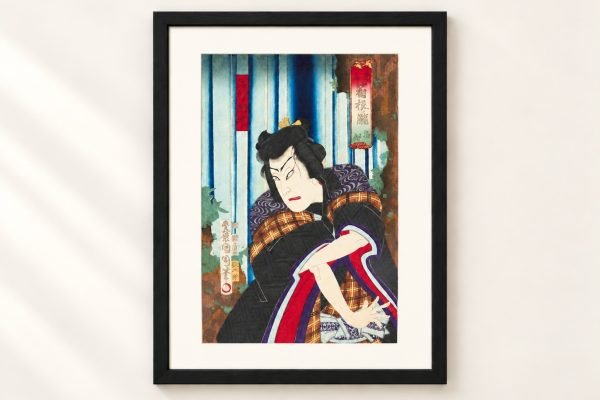
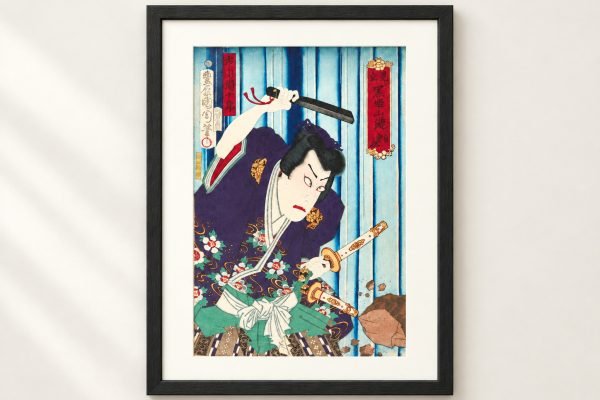
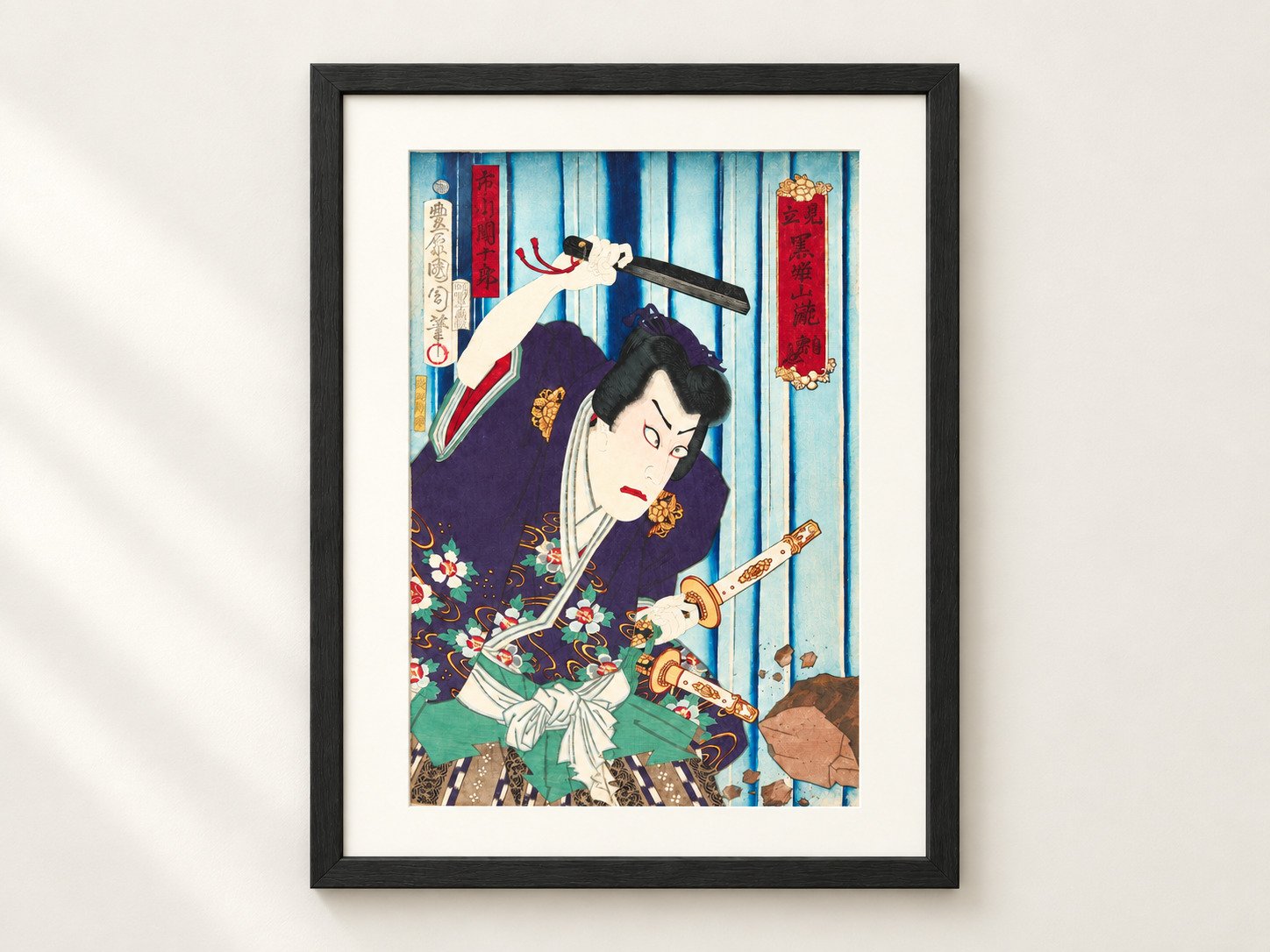
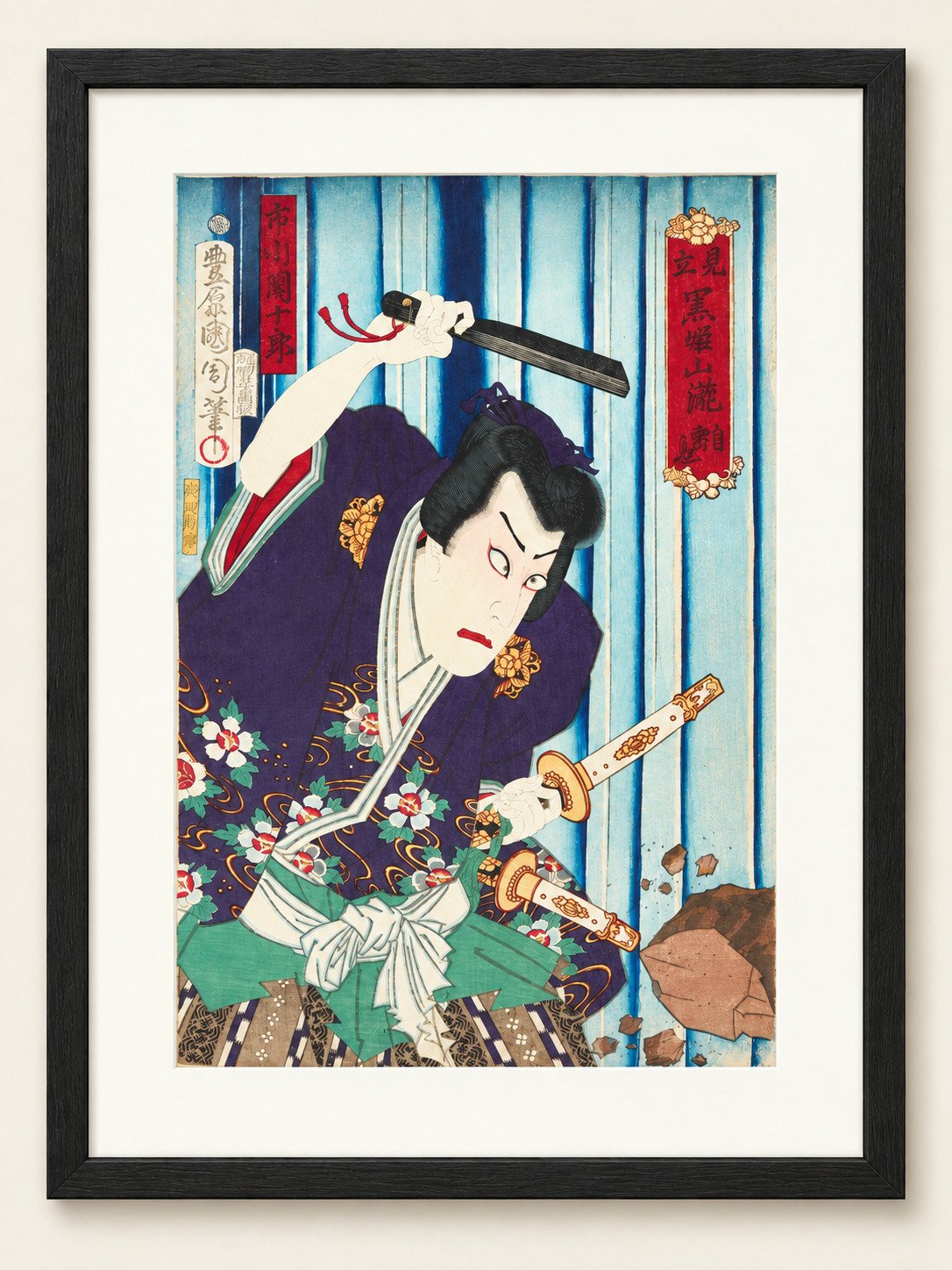
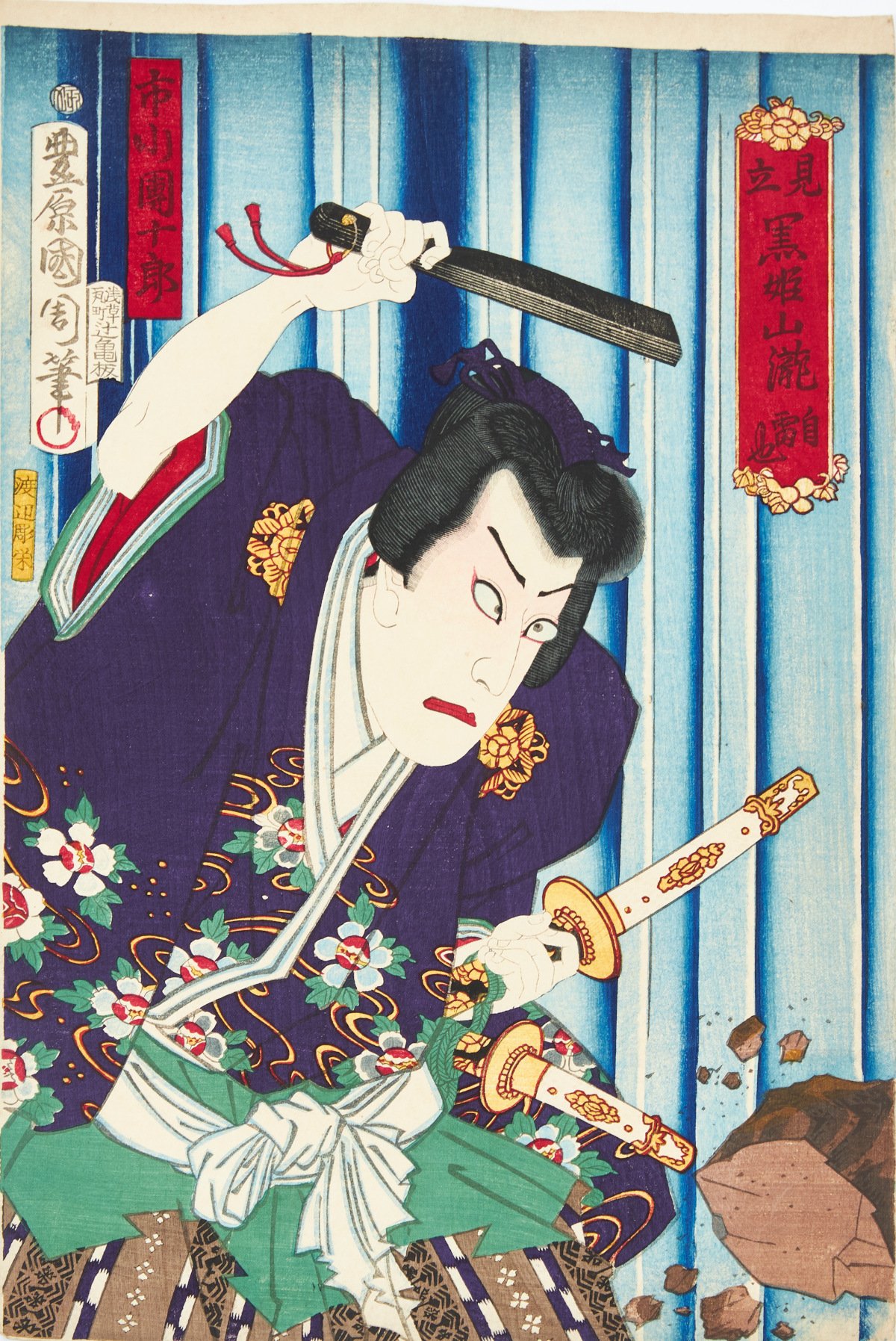
An original antique Japanese ukiyo-e woodblock print by Toyohara Kunichika (1835–1900), depicting the celebrated kabuki actor Ichikawa Danjūrō in the role of the legendary sorcerer Jiraiya in Mitate Kurohime-yama no Taki (見立 黒姫山の滝). Presented in vertical ōban tate-e format and printed as a richly colored nishiki-e, the composition captures Jiraiya at a moment of violent action, sword raised above his head against a dramatic ground of cascading blue water.
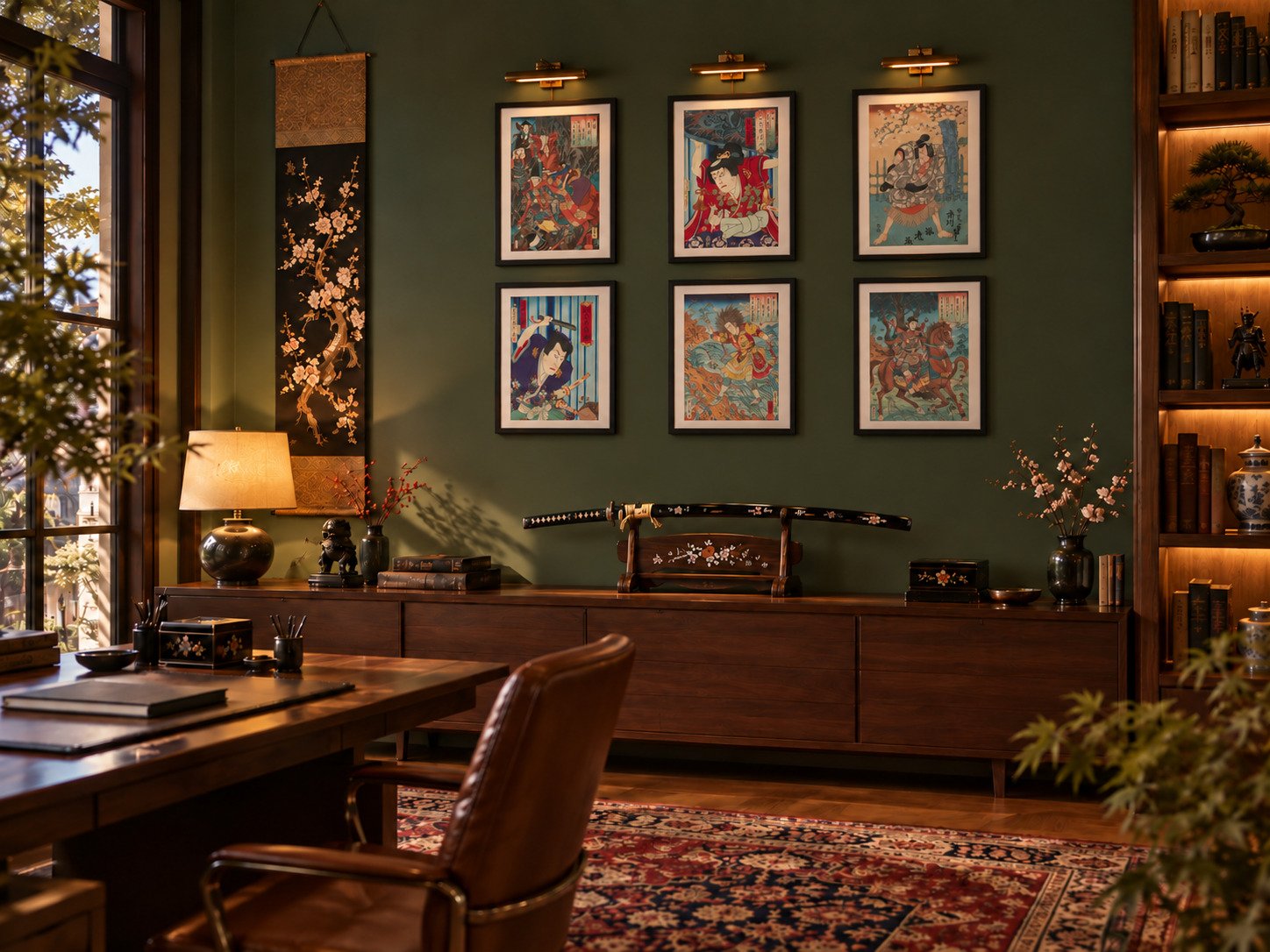
The ukiyo-e comes framed and ready to hang.
Ichikawa Danjūrō is caught mid-motion, drawing his sword upward with a fierce, wide-eyed glare.
He wears a deep purple kimono decorated with floral motifs, its powerful color standing sharply against the cool blue cascade behind him.
The role is Jiraiya, the famous toad-magic hero of Jiraiya Gōketsu Monogatari, a popular tale of ninjutsu, supernatural transformation and rival sorcery.
Kurohime-yama, named in the title, places the scene within the mitate framework of the series, in which theatrical characters are associated with dramatic waterfall settings.
The print presents Ichikawa Danjūrō in one of the most visually dramatic heroic roles of nineteenth-century kabuki.
Jiraiya is shown in the instant before action.
His right arm rises high above his head as he draws a sword, while his intense eyes and sharply angled brows create an expression of extreme concentration and aggression.
The movement of the body pushes diagonally through the composition, breaking against the strong vertical lines of the waterfall.
Kunichika was particularly skilled at capturing this kind of theatrical moment.
Rather than showing the actor in a static pose, he presents Danjūrō as though the action of the stage has been suddenly frozen.
The result is both a portrait of a celebrated performer and an image of the legendary character he embodies.
Jiraiya is the hero of Jiraiya Gōketsu Monogatari, a famous Japanese tale combining adventure, magic and supernatural rivalry.
Originally a bandit, Jiraiya becomes a heroic figure and masters ninjutsu together with the secret art of toad transformation, known as gama ninpō.
His story develops around a conflict between three powerful figures.
Jiraiya possesses toad magic.
His wife, Tsunade, is associated with her own supernatural powers.
Their enemy Orochimaru stands as Jiraiya’s great rival within the magical narrative.
The resulting story became especially suitable for kabuki, where transformation, dramatic combat and supernatural effects could be translated into spectacular theatrical scenes.
Kunichika’s portrait concentrates these associations into a single moment of physical intensity.
The title identifies the setting as Kurohime-yama no Taki, the waterfall of Mount Kurohime.
The print belongs to a series in which actors and dramatic characters appear against a repeated ground of cascading blue water.
Here, the waterfall is constructed from powerful vertical bands of blue, turquoise and white.
The almost abstract rhythm of the water creates a striking contrast with Jiraiya’s diagonal movement.
While the actor surges across the composition, the waterfall falls relentlessly downward behind him.
Kurohime-yama also contributes to the mitate character of the series, linking a celebrated theatrical role with an evocative landscape setting.
The result is not intended simply as a realistic representation of place.
Instead, landscape and kabuki performance are combined into a highly theatrical visual construction.
Toyohara Kunichika was born Ōshima Yasohachi in Edo in 1835.
He trained within the Utagawa artistic tradition before becoming a pupil of Utagawa Kunisada, also known as Toyokuni III.
Kunichika developed an unusually close relationship with the kabuki world of Edo and later Tokyo.
He spent much of his artistic life around the theatres, sketching actors directly from life and observing their performances, costumes, gestures and expressions.
Among the actors he portrayed was Ichikawa Danjūrō IX, one of the most important kabuki performers of the Meiji period.
This direct familiarity with the stage became one of the defining qualities of Kunichika’s work.
Kunichika is particularly celebrated for yakusha-e, woodblock prints depicting kabuki actors.
Actor portraiture had formed an important part of ukiyo-e for generations, but Kunichika carried the tradition into the rapidly changing visual culture of the Meiji era.
His prints frequently emphasize powerful facial expressions, dramatic gestures, bold patterns and striking combinations of color.
In works such as this, the distinction between actor and character becomes deliberately blurred.
The viewer recognizes Ichikawa Danjūrō, yet at the same time encounters Jiraiya, the legendary master of supernatural toad magic.
This fusion between theatrical celebrity and fictional role lies at the heart of Kunichika’s actor prints.
Ichikawa Danjūrō IX was among the leading kabuki actors portrayed by Kunichika.
Kunichika sketched performers directly from life and was therefore able to observe the distinctive physical presence and expressions of actors such as Danjūrō.
In the present print, the actor’s wide eyes, sharply drawn eyebrows and forceful posture dominate the composition.
The dramatic expression is reinforced by the upward movement of the sword.
His deep purple costume gives the figure considerable visual weight, while the floral decoration introduces intricate pattern against the simpler vertical structure of the waterfall.
The result demonstrates Kunichika’s ability to transform a recognizable actor into a larger-than-life theatrical character.
Kunichika was among the ukiyo-e artists who exploited the newly imported synthetic pigments that became available in Japan during the Meiji period.
These new colors allowed artists and printers to create unusually strong purples, reds and blues.
The present composition uses these contrasts to striking effect.
Deep purple dominates Jiraiya’s kimono.
Bright floral details and the pale sword fittings punctuate the costume.
Behind him, the waterfall is constructed from multiple shades of vivid blue and turquoise.
The contrast between these intense colors contributes significantly to the theatrical power of the image.
The print is executed as a nishiki-e, or full-color Japanese woodblock print.
This technique depended upon the careful coordination of multiple carved woodblocks.
A key block established the principal black outlines of the design, while additional blocks introduced the different areas of color.
In this composition, separate impressions build the various blues of the waterfall, the deep purple of Jiraiya’s robe, the floral decoration, green and red details, flesh tones and the different elements of the swords.
The finished image demonstrates the complexity that could be achieved through traditional Japanese polychrome woodblock printing.
The print is presented in vertical ōban tate-e format.
This proportion was particularly suited to kabuki actor prints because it allowed a single figure to dominate the composition.
Kunichika uses the tall format to emphasize the vertical descent of the waterfall.
Against these repeated vertical lines, Jiraiya’s body cuts dramatically across the image.
His raised arm and sword create additional diagonals, producing a composition filled with controlled visual tension.
The contrast between vertical water and diagonal human movement gives the scene much of its energy.
Movement is one of the defining features of this composition.
Jiraiya does not simply hold a sword.
Kunichika captures the action of drawing it upward.
The raised arm, twisted torso and lowered second hand create a strong sense of physical momentum.
At the center of the composition is the actor’s face.
His wide eyes and intense expression convey the heightened emotional language of kabuki.
The deep purple costume expands around the figure, while the floral motifs and multiple sword fittings create areas of visual complexity.
Behind everything, the repeated blue bands of falling water provide a powerful rhythmic counterpoint.
The image therefore functions simultaneously as an actor portrait, a theatrical scene and a highly structured study of movement.
This is an original antique Japanese woodblock print, not a modern reproduction or later decorative reprint.
Its age is an essential part of its character and historical significance.
Original ukiyo-e of this period have survived through generations of ownership, handling, storage and display.
Some modest surface variation, gentle toning, occasional small marks or light creasing are therefore entirely consistent with an authentic work on paper of this age.
Such characteristics should be understood within the context of an original historical print rather than compared with the appearance of a newly manufactured reproduction.
The print comes from the collection of Dr. Eugen Milch (1889–1958), an Austrian physician and artist whose life was marked by extensive international travel.
Milch served as a medical officer during the First World War.
During the early 1920s, he travelled throughout Europe on a combined study and painting journey.
In 1924 he married the artist Emma Bormann.
The couple visited Sweden that same year and, together with the artist Oskar Bergman, exhibited several paintings at Liljevalchs in Stockholm.
In 1937, Eugen Milch travelled to China with other Austrian physicians following an invitation from the Chinese government.
Emma joined him two years later.
Although the original posting did not materialise as planned, Milch became superintendent of a hospital in Beihai in 1938.
His years in East Asia combined his medical career with his continuing interest in art, travel and collecting.
In 1941, Japanese forces occupied parts of the southern Chinese coast, including Beihai.
The Milch family succeeded in relocating to Shanghai.
During their years in China, Eugen and Emma eventually decided to separate.
Eugen subsequently assisted British forces in China, service for which he was granted British citizenship.
His life and career therefore placed him within some of the major historical transformations affecting East Asia during the first half of the twentieth century.
Continuing his travels, Eugen Milch later went to Japan to study the aftermath of the war.
According to the provenance associated with the collection, it is considered likely that he acquired the present group of Japanese woodblock prints during this period.
He died in Hong Kong in 1958.
The collection subsequently passed by descent within the family.
This provenance adds another historical dimension to the print, connecting a nineteenth-century Japanese kabuki image with the remarkable international life of a twentieth-century physician, artist, traveller and collector.
The print shows some signs of wear consistent with age together with light handling creases.
It remains in good general condition.
As with original Japanese works on paper of this age, gentle toning, occasional small marks, minor creasing or traces of handling are normal and expected.
These characteristics are consistent with a genuine antique work that has survived for well over a century.
They should not be confused with damage or with artificial ageing applied to a modern reproduction.
The condition information is provided for transparency so that collectors can understand the actual preserved state of the work.
The ukiyo-e is individually framed and sold complete with its frame.
It arrives ready to hang.
The presentation allows the original woodblock print to be displayed immediately while providing a clean visual border around Kunichika’s powerful composition.
The dark frame and light mount contrast effectively with the intense blue waterfall, deep purple costume and vivid red and green details of the print.
This print combines several of the qualities for which Toyohara Kunichika is particularly admired: a celebrated kabuki actor, a legendary supernatural character, forceful theatrical movement and the vivid color associated with Meiji-era woodblock printing.
The figure of Jiraiya gives the work particular narrative strength.
His associations with ninjutsu, toad magic and the supernatural rivalry involving Tsunade and Orochimaru connect the print with one of Japan’s most enduring heroic legends.
Visually, the composition is dominated by the tension between Jiraiya’s explosive diagonal movement and the repeated vertical rhythm of the waterfall.
The deep purple costume creates a powerful field of color against the blues of the background, while the raised sword and intense expression capture the immediacy of kabuki performance.
The print also reflects Kunichika’s close relationship with actors such as Ichikawa Danjūrō IX and his importance within the final great phase of the yakusha-e tradition.
Its documented provenance from the collection of Dr. Eugen Milch adds a further layer of collecting history.
An original antique Japanese ukiyo-e by Toyohara Kunichika depicting Ichikawa Danjūrō as the legendary sorcerer Jiraiya in Mitate Kurohime-yama no Taki (見立 黒姫山の滝). The actor is caught in a moment of dramatic action, drawing his sword upward with a fierce expression while wearing a deep purple floral kimono against a striking field of cascading blue water. Jiraiya, hero of Jiraiya Gōketsu Monogatari, is famed for his mastery of ninjutsu and supernatural toad magic. Executed as an ōban tate-e nishiki-e, the print displays the vivid color and theatrical intensity characteristic of Kunichika’s celebrated yakusha-e. From the collection of Dr. Eugen Milch (1889–1958), subsequently by descent within the family. In good general condition with age-appropriate wear and light handling creases. Original antique woodblock print, not a modern reproduction. Individually framed and supplied ready to hang.

Order above 1.000,00 € gets free shipping.

Secure and hassle-free payment process.

Certificate of authenticity included.

Have questions? Contact us via WhatsApp.
Contact