

1 in stock
1 in stock
Add to Compare
Add to Wishlist
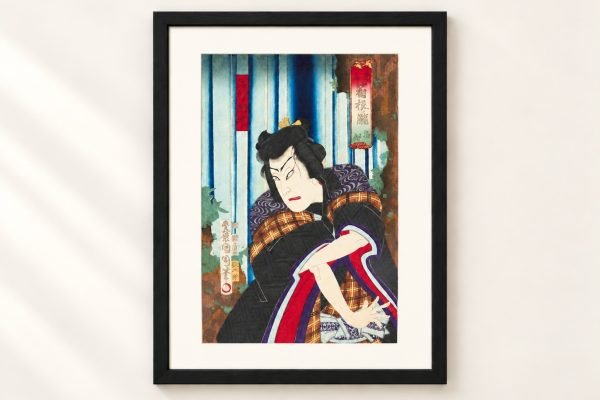
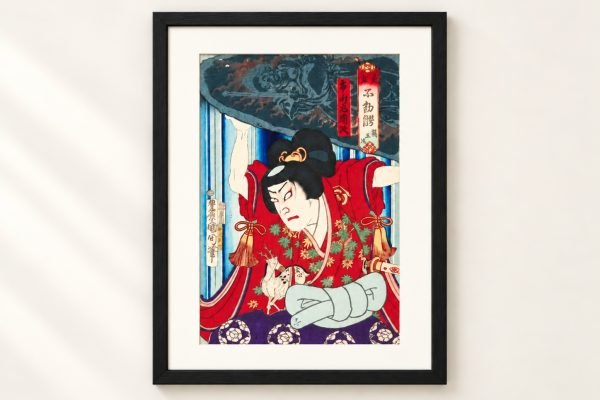
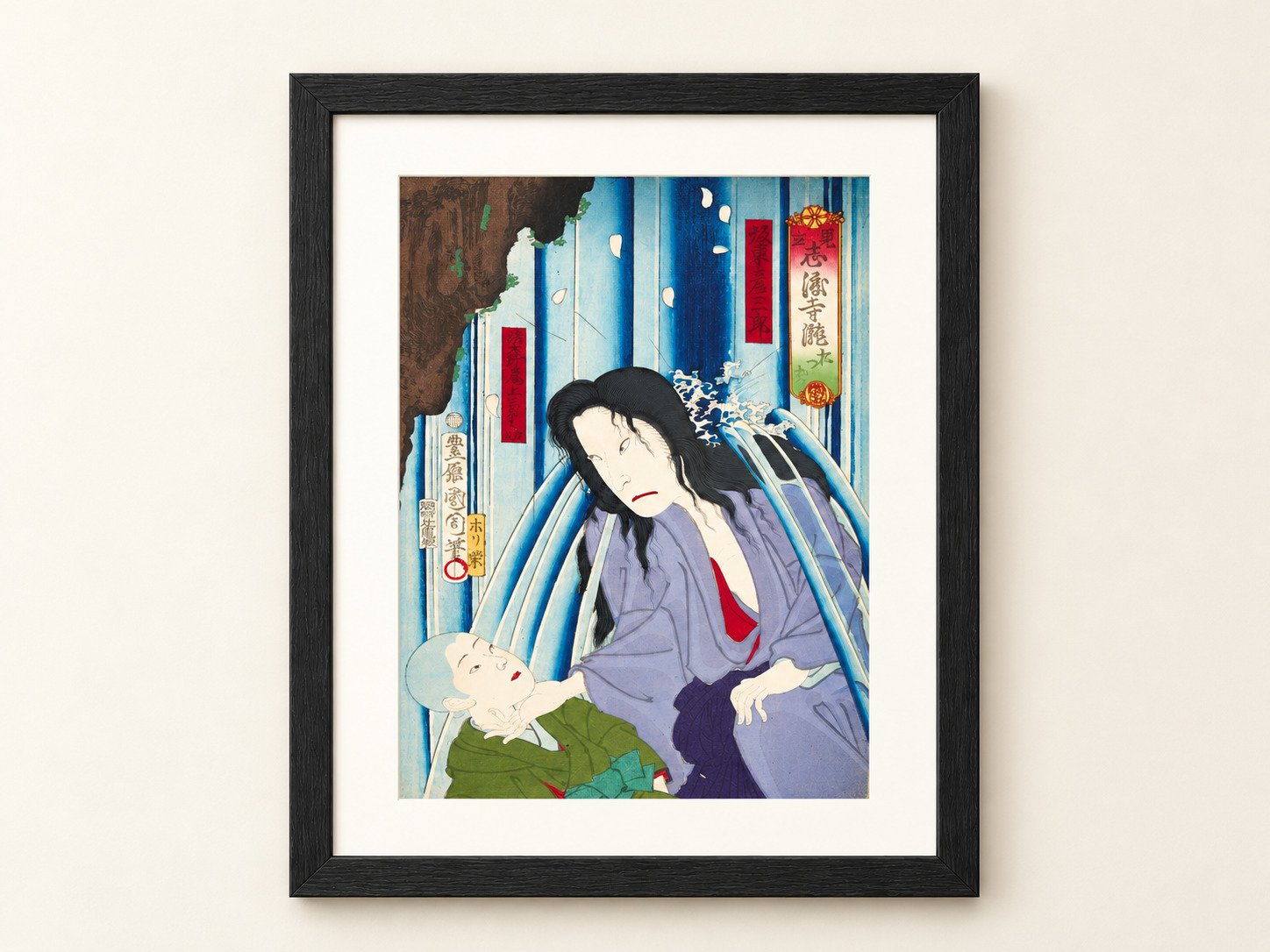
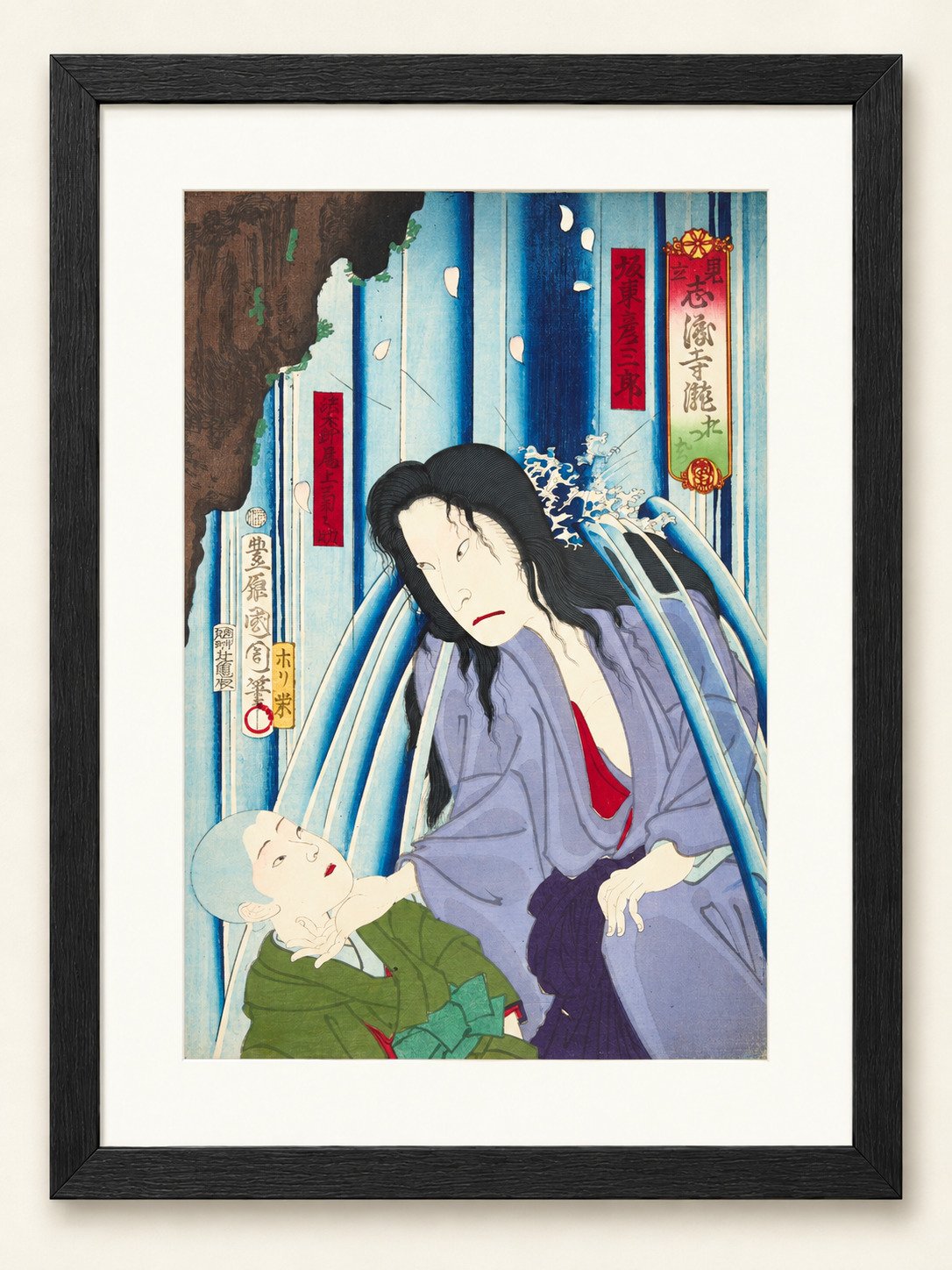
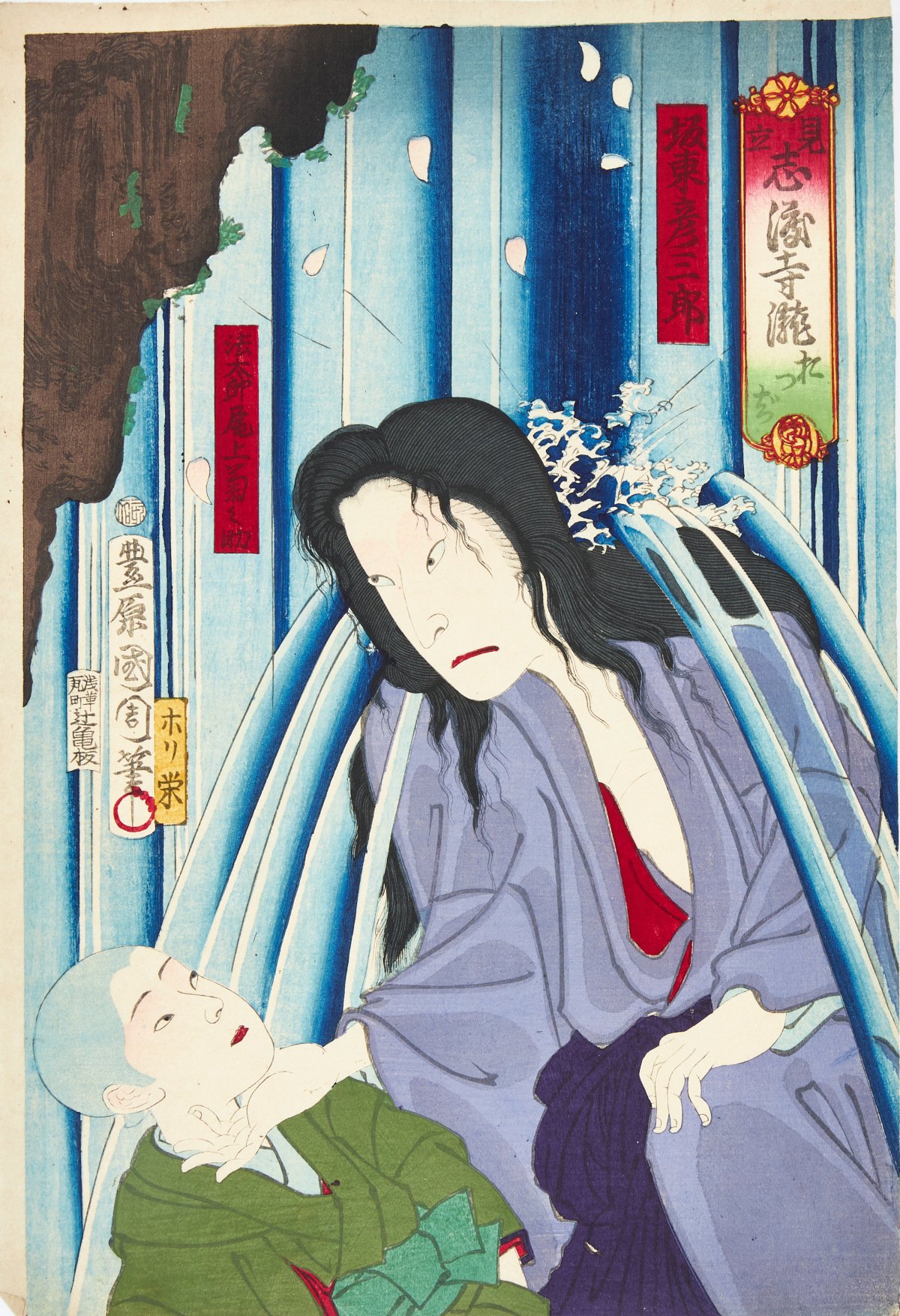
An original antique Japanese ukiyo-e woodblock print by Toyohara Kunichika (1835–1900), depicting the kabuki actor Bandō Hikosaburō in the female role of Otsuji in Mitate Shidō-ji Taki, Otsuji (見立 志渡寺滝, おつじ). Presented in vertical ōban tate-e format and printed as a richly colored nishiki-e, the composition captures the theatrical intensity for which Kunichika’s actor portraits are celebrated.
The ukiyo-e comes framed and ready to hang.
The actor is shown against a striking ground of cascading blue water, a dramatic setting that immediately establishes the emotional intensity of the scene.
Bandō Hikosaburō appears with long, disheveled black hair and an expressive face, wearing a lavender kimono that falls open over a vivid red inner robe.
He cradles a limp, shaven-headed figure, creating a powerful visual contrast between the theatrical force of the actor and the vulnerability of the figure held against him.
The subject is Otsuji, nursemaid to the young Tamiya Botarō in a popular kabuki legend associated with Shidō-ji temple.
When Botarō becomes gravely ill, Otsuji undertakes a desperate waterfall penance on his behalf, praying to the deity Konpira and, in more dramatic versions of the story, sacrificing herself in the hope that the boy might survive.
The print presents Bandō Hikosaburō in an onnagata role, the specialized kabuki tradition in which male actors perform female characters.
Kunichika was deeply familiar with the leading actors of his time and developed a reputation for capturing not only recognizable stage personalities but also the emotional intensity of specific roles.
Here, Bandō Hikosaburō is transformed into Otsuji through costume, gesture, expression, and the dramatic waterfall setting.
The long black hair is deliberately disordered.
The lavender outer robe falls open to reveal the red garment beneath.
The body bends dynamically through the composition while the face remains intensely focused.
The limp figure held against Otsuji adds emotional gravity and makes the scene more than a conventional actor portrait.
It becomes a theatrical moment of desperation, devotion, and sacrifice.
The subject belongs to a popular kabuki narrative centered on Otsuji, nursemaid to the young Tamiya Botarō.
According to the account associated with the print, Botarō falls seriously ill.
Faced with the possibility of losing the child, Otsuji undertakes an extreme religious penance at the waterfall of Shidō-ji temple.
Her actions are presented as an expression of loyalty and self-sacrifice.
She prays to Konpira for the boy’s recovery and, in the more dramatic versions of the legend, offers her own life so that Botarō might live.
The waterfall is therefore not merely decorative scenery.
It is central to the emotional and spiritual meaning of the scene.
Its repeated vertical bands of blue create an almost architectural background while simultaneously suggesting the physical severity of Otsuji’s penance.
The falling-water background is one of the most visually striking elements of the composition.
Strong vertical bands in shades of blue and turquoise descend behind the actor.
The effect creates rhythm, depth, and theatrical atmosphere.
Against this cool background, the lavender, red, green, black, and white elements of the costume become especially vivid.
The waterfall also gives the actor a dramatic visual frame.
Rather than placing the figure in a detailed architectural environment, the composition focuses on the cascading water and the emotional action taking place in front of it.
This concentration on figure and setting gives the print exceptional immediacy.
Toyohara Kunichika was born Ōshima Yasohachi in Edo in 1835.
He trained within the Utagawa artistic tradition and later became a pupil of Utagawa Kunisada, also known as Toyokuni III.
Kunichika became especially associated with images of kabuki actors.
Unlike artists who approached the theater primarily from published scripts or established pictorial conventions, Kunichika worked closely with the theatrical world of Edo and later Tokyo.
He frequently sketched actors from life and developed an intimate understanding of their stage presence, costume, gesture, and individual personalities.
This proximity to the theater became fundamental to his art.
Kunichika is particularly celebrated for yakusha-e, prints depicting kabuki actors.
Actor portraiture had been a major subject within ukiyo-e for generations, but Kunichika brought the tradition into the rapidly changing visual culture of the Meiji era.
His compositions often emphasize large figures, direct expressions, bold color combinations, and theatrical immediacy.
In works such as this, the actor is not presented simply as an individual portrait.
The print captures the fusion between performer and role.
Bandō Hikosaburō is recognizable as a kabuki actor, yet he simultaneously inhabits the emotional world of Otsuji.
This tension between celebrity portraiture and dramatic narrative is one of the defining characteristics of high-quality yakusha-e.
Bandō Hikosaburō was celebrated for performances that included onnagata roles.
In kabuki, onnagata acting developed into a highly sophisticated theatrical discipline.
Female characters were created through carefully controlled gesture, posture, costume, vocal technique, and movement.
Kunichika’s actor prints preserve the visual impact of these performances.
In the present work, Hikosaburō’s transformation into Otsuji depends upon the contrast between delicacy and intensity.
The costume is richly decorative, yet the gesture is forceful.
The face carries emotional tension, while the disheveled hair and open robe suggest physical and psychological strain.
Kunichika was among the artists who embraced the newly available synthetic pigments introduced into Japan during the Meiji period.
The supplied description specifically notes the striking lavender and deep blue tones visible in this composition.
These colors contribute significantly to the print’s impact.
The deep blues of the waterfall establish the dominant field of the background.
The lavender robe stands strongly against them, while the red inner garment and smaller green and white accents provide additional contrast.
The result is a vivid palette characteristic of the changing visual language of late nineteenth-century Japanese woodblock printing.
The print is executed as a nishiki-e, or full-color woodblock print.
This technique required the coordinated use of multiple carved blocks, with separate impressions used to build different areas of color and line.
The black key block establishes the principal contours.
Additional blocks introduce the blues of the waterfall, the lavender and patterned areas of the costume, the red garments, green details, flesh tones, and other accents.
The resulting image demonstrates the sophistication of Japanese color woodblock printing, where complex compositions could be created through careful registration of multiple impressions.
The print is in the vertical ōban tate-e format.
This proportion was particularly effective for actor portraiture because it allowed the figure to dominate the composition while preserving enough vertical space for gesture, costume, inscriptions, and dramatic background elements.
Here, the tall format reinforces the descending movement of the waterfall.
At the same time, the actor’s diagonal posture breaks across the strong vertical lines, creating visual tension.
The result is a composition that feels both structured and dynamic.
Kunichika’s strength as a theatrical artist is evident in the way the figure occupies the composition.
The body does not sit passively within the frame.
The raised arm, bent torso, flowing costume, long hair, and figure held close to the body create multiple directions of movement.
The viewer’s eye moves from the raised hand through the actor’s face and robe toward the figure being held.
The face becomes the emotional center of the composition.
Its sharply focused expression contrasts with the decorative richness of the costume and the almost abstract vertical rhythm of the waterfall.
This is an original antique Japanese woodblock print, not a modern reproduction or later decorative reprint.
Its age is part of its character and historical significance.
Antique ukiyo-e are objects that have survived through generations of ownership, handling, display, and storage.
Minor surface variation and evidence of age are therefore expected in authentic works on paper of this period.
These characteristics should be understood within the context of an original historical print rather than compared with the appearance of a newly produced reproduction.
The print comes from the collection of Dr. Eugen Milch (1889–1958), an Austrian physician and artist with an unusually international life.
Milch served as a medical officer during the First World War.
During the early 1920s, he traveled through Europe on a combined study and painting journey.
In 1924 he married the artist Emma Bormann.
The couple visited Sweden that same year and, together with the artist Oskar Bergman, exhibited several paintings at Liljevalchs in Stockholm.
In 1937, Eugen Milch traveled to China with other Austrian physicians following an invitation from the Chinese government.
Emma joined him two years later.
Although the original posting did not materialize as planned, Milch became superintendent of a hospital in Beihai in 1938.
His life in East Asia therefore developed through his medical work as well as his continuing interests in art and travel.
In 1941, Japanese forces occupied parts of the southern Chinese coast, including Beihai.
The Milch family was able to relocate to Shanghai.
During their years in China, Eugen and Emma eventually decided to separate.
Eugen later assisted British forces in China, service for which he was granted British citizenship.
His career and personal life thus placed him directly within some of the major historical transformations affecting East Asia during the first half of the twentieth century.
Continuing his travels, Eugen Milch later went to Japan to study the aftermath of the war.
According to the supplied provenance, it is considered likely that he acquired the present collection of Japanese woodblock prints during this period.
He died in Hong Kong in 1958.
The collection subsequently passed by descent within the family.
This provenance adds an additional historical layer to the print, connecting an Edo/Meiji-period Japanese artistic object with the international life of a twentieth-century Austrian physician, artist, traveler, and collector.
The print shows some signs of wear consistent with age, together with light handling creases.
It remains in good general condition.
As with original Japanese works on paper of this age, modest toning, occasional small marks, light creasing, or handling traces are normal and should be understood in the context of the print’s considerable age.
These features are consistent with an antique work that has survived for well over a century.
They do not indicate that the print is a modern reproduction artificially aged to resemble an original.
The condition information is provided transparently so that collectors can understand the actual preserved state of the work.
The ukiyo-e is individually framed and is sold complete with its frame.
It arrives ready to hang.
The presentation allows the original woodblock print to be displayed immediately while providing a clean visual border around Kunichika’s vivid composition.
The dark frame contrasts effectively with the light mount and the strong blue, lavender, red, green, and black colors of the print.
This print brings together several of the qualities for which Toyohara Kunichika is particularly valued: dramatic kabuki subject matter, a recognizable leading actor, expressive theatrical characterization, powerful color, and a composition closely tied to the stage culture of nineteenth-century Japan.
The waterfall setting gives the image exceptional visual rhythm.
Its repeated blue bands create a vivid backdrop against which Bandō Hikosaburō’s lavender and red costume becomes especially striking.
The subject of Otsuji adds emotional depth.
Her desperate penance for the sick Tamiya Botarō transforms the actor portrait into a scene of devotion, suffering, and sacrifice.
The print is also representative of Kunichika’s importance within the final great phase of the yakusha-e tradition.
As photography increasingly transformed the visual representation of actors, Kunichika continued to exploit the unique possibilities of color woodblock printing: exaggerated gesture, heightened color, theatrical composition, and direct emotional impact.
Its documented provenance from the collection of Dr. Eugen Milch adds another dimension for collectors.
The print is therefore significant not only as an original antique ukiyo-e and kabuki image, but also as an object with an identifiable twentieth-century collecting history.
An original antique Japanese ukiyo-e by Toyohara Kunichika depicting Bandō Hikosaburō as Otsuji in Mitate Shidō-ji Taki, Otsuji (見立 志渡寺滝, おつじ). Against a dramatic field of cascading blue water, the actor appears with disheveled black hair and a lavender kimono over a red inner robe, cradling a limp, shaven-headed figure. The scene refers to the kabuki legend of Otsuji and her desperate waterfall penance for the gravely ill Tamiya Botarō. Executed as an ōban tate-e nishiki-e, the print displays the vivid color and theatrical intensity characteristic of Kunichika’s celebrated yakusha-e. From the collection of Dr. Eugen Milch (1889–1958), subsequently by descent within the family. In good general condition with age-appropriate wear and light handling creases. Original antique woodblock print, not a modern reproduction. Individually framed and supplied ready to hang.

Order above 1.000,00 € gets free shipping.

Secure and hassle-free payment process.

Certificate of authenticity included.

Have questions? Contact us via WhatsApp.
Contact