Edo Period Wood Netsuke – Hannya Attacking a Samurai
Japan · Edo Period · Katabori Netsuke · Hannya and Samurai · Likely Tsuge Wood
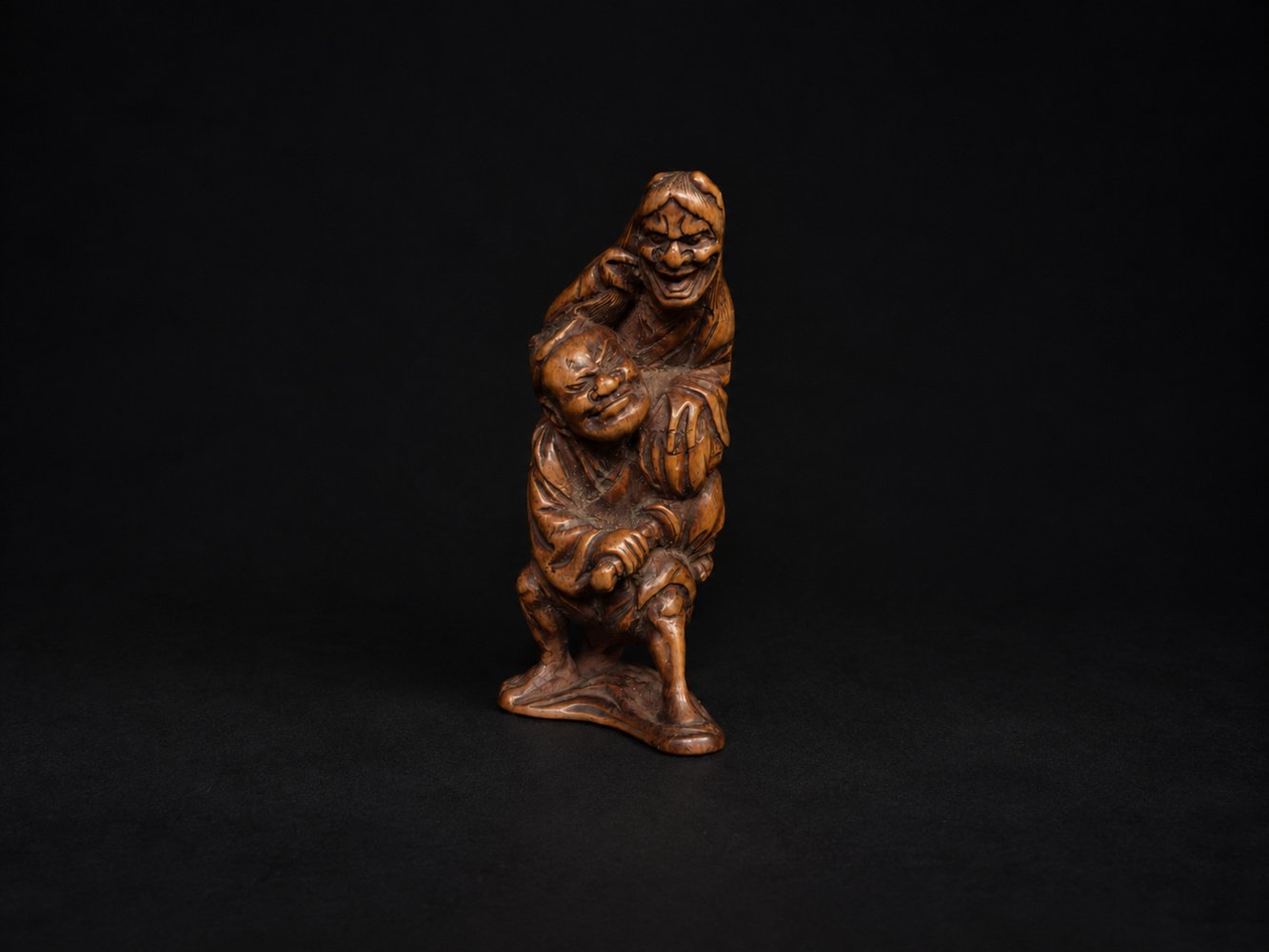
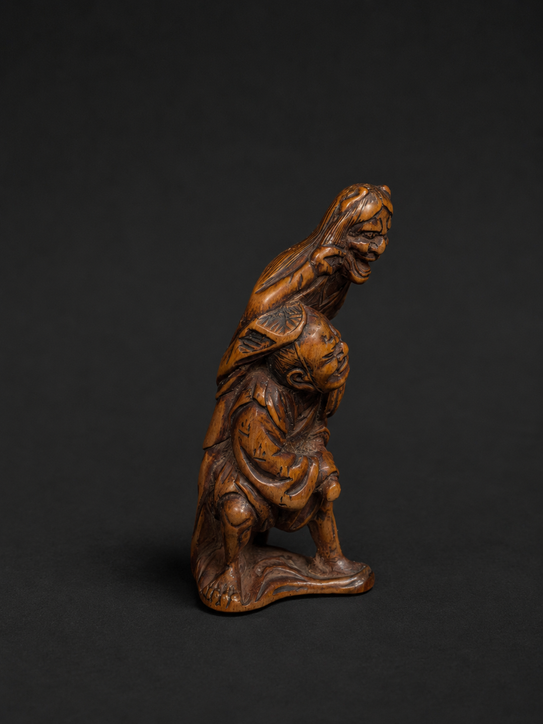
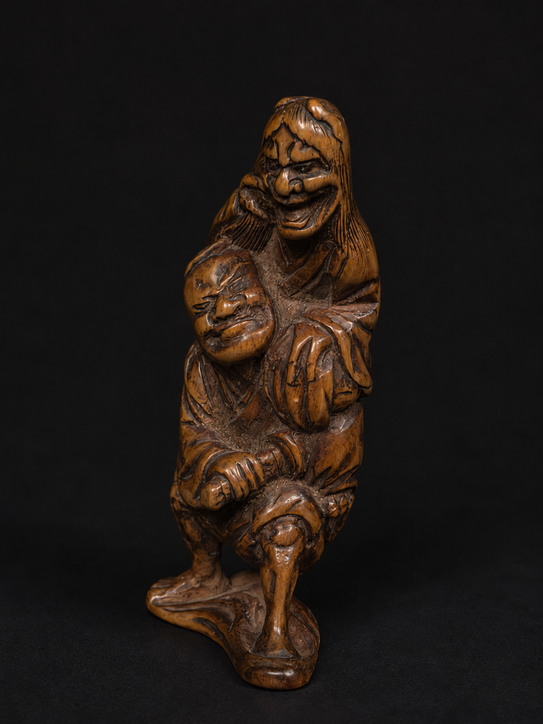
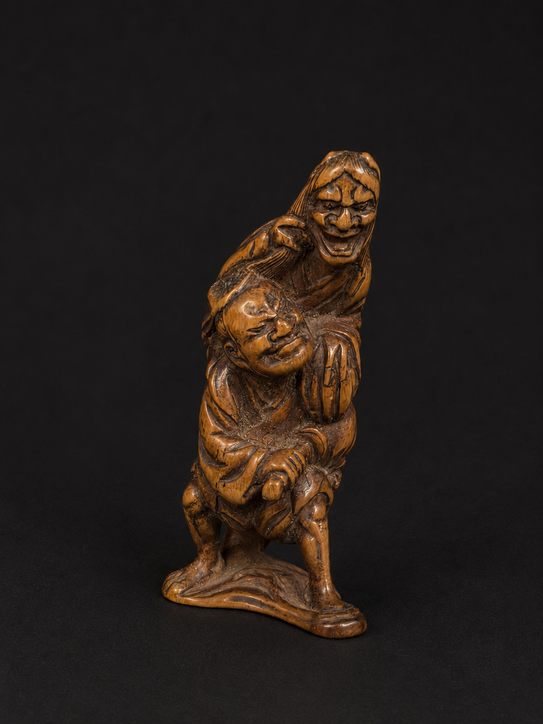
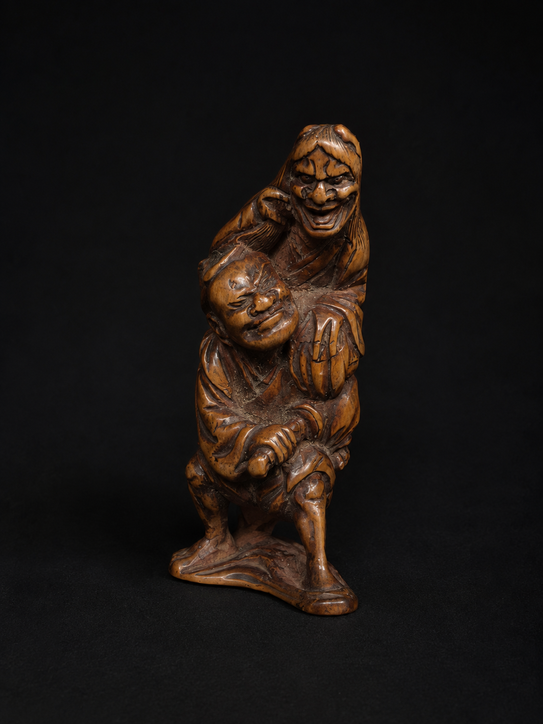
A finely carved Japanese katabori netsuke from the Edo period, depicting a dramatic encounter between a hannya — the horned female demon of Noh theatre — and a samurai caught in the act of drawing his sword.
The compact composition is carved in a warm honey-brown wood, most consistent with boxwood (tsuge), one of the materials traditionally associated with finely detailed Edo-period netsuke. Dark pigment or staining remains within the deeply incised lines, accentuating the hair, folds of the garments and facial features.
The Hannya
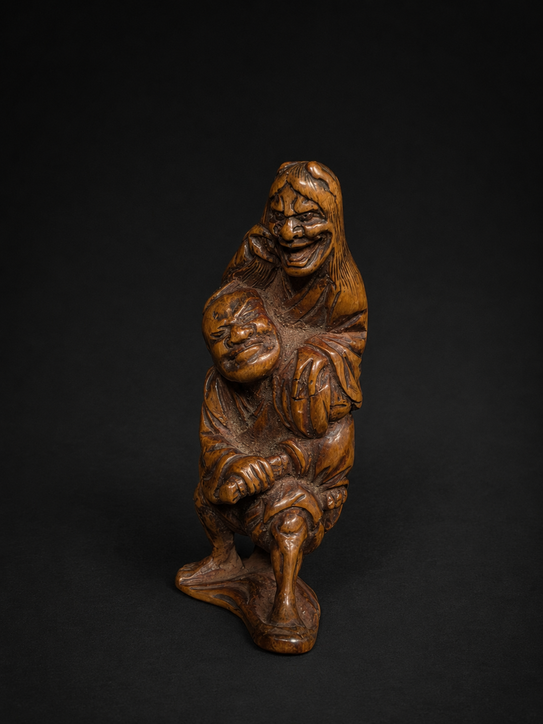
The upper figure represents a hannya, one of the most recognisable supernatural figures associated with Japanese Noh theatre. Her face is carved with a wide, snarling mouth, exposed teeth, deeply set eyes and a strongly furrowed expression.
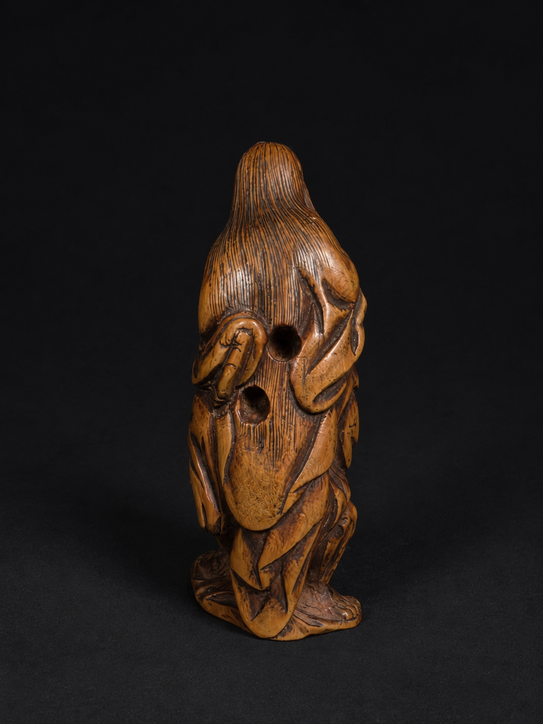
Long strands of wild hair descend past the shoulders in deeply incised lines, adding movement and intensity to the composition. One arm reaches downward and firmly grasps the samurai from behind, capturing the figures at the height of the confrontation.
In Noh tradition, the hannya embodies a woman transformed by overwhelming jealousy, resentment or obsessive grief. Such imagery became an enduring subject in Japanese decorative arts, appearing not only in netsuke but also in sword fittings, masks and other Edo-period works.
The Samurai
The lower figure is a samurai shown responding to the surprise attack. Rather than appearing defeated or passive, he is depicted at the moment of drawing his katana, with both hands brought towards the sword hilt as he turns to confront the demon behind him.
His rounded face and period headwear contrast with the aggressive expression of the hannya above. The robes are carved with deep, angular folds that reinforce the sense of movement and give the small sculpture considerable visual depth.
The scene recalls the supernatural imagery of Noh theatre, where destructive emotions may take demonic form. Hannya-related themes are particularly associated with plays such as Aoi no Ue and Dōjōji, although the present carving should be understood as a Noh-inspired dramatic composition rather than necessarily an illustration of one specific play.
Dynamic Katabori Carving
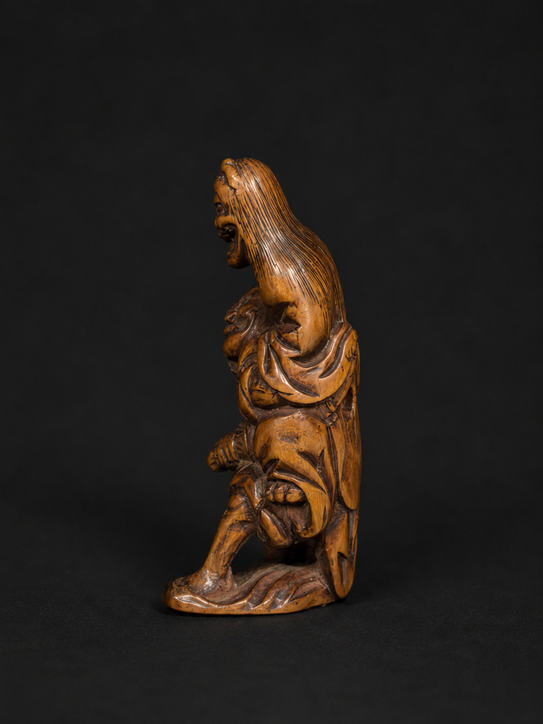
The two figures are arranged vertically in a compact and highly dynamic composition. Their intertwined arms, garments and bodies create a strong sense of movement despite the small dimensions of the netsuke.
The carving is deep and confident, with notable undercutting around the arms and folds of the clothing. The darker treatment within the incised details further emphasises the sculptural modelling of the figures.
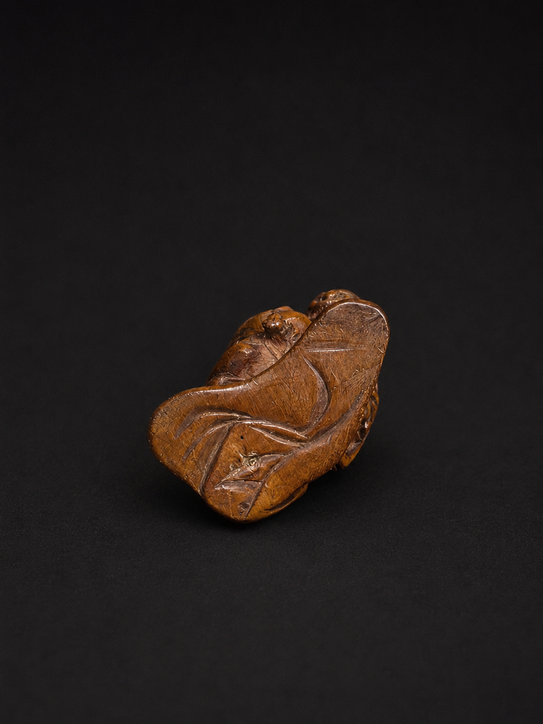
The base is carved as irregular rocky ground, giving the impression that the confrontation has been captured in the middle of movement rather than presented as a static group.
Himotoshi
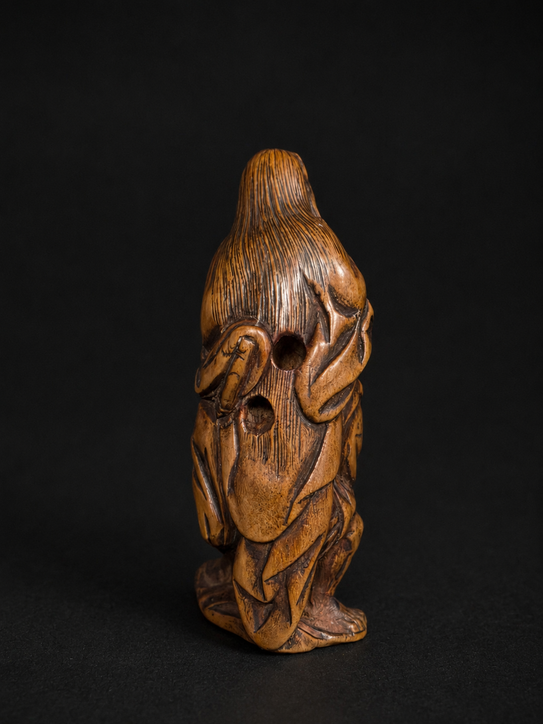
The reverse retains two circular himotoshi, the traditional cord holes used to suspend a netsuke from a sagemono such as an inrō or tobacco pouch.
Their integration into the reverse of the garment preserves the compact silhouette of the carving while allowing the piece to fulfil its original practical function.
Material and Surface
The netsuke is carved from a dense, warm honey-brown wood that appears consistent with tsuge (Japanese boxwood). As no material analysis has been carried out, the wood attribution should be considered probable rather than definitive.
Dark staining or pigment within the recessed carving enhances the hair, facial details and folds of the garments, creating strong contrast and improving the legibility of the composition.
Collector’s Interest
This netsuke combines several elements particularly appreciated by collectors of Japanese miniature sculpture: a dramatic figural composition, Noh-derived supernatural imagery, strong three-dimensional carving and functional himotoshi.
The confrontation between the hannya and the sword-drawing samurai gives the piece considerable narrative character, while its compact construction and deep undercutting demonstrate the sculptural possibilities achieved by Edo-period netsuke carvers on a very small scale.
Specifications
- Object: Japanese netsuke
- Type: Katabori netsuke
- Subject: Hannya attacking a samurai
- Period: Edo period
- Origin: Japan
- Material: Carved wood, likely boxwood (tsuge)
- Technique: Deep carving and undercutting with darkened incised detail
- Himotoshi: Two circular cord holes to the reverse
- Dimensions: 5.6 × 2.6 cm
A dramatic Edo-period katabori netsuke depicting a hannya attacking a samurai as he draws his sword, combining Noh-inspired imagery, expressive figural carving and the compact functionality characteristic of traditional Japanese netsuke.