October 24, 2026

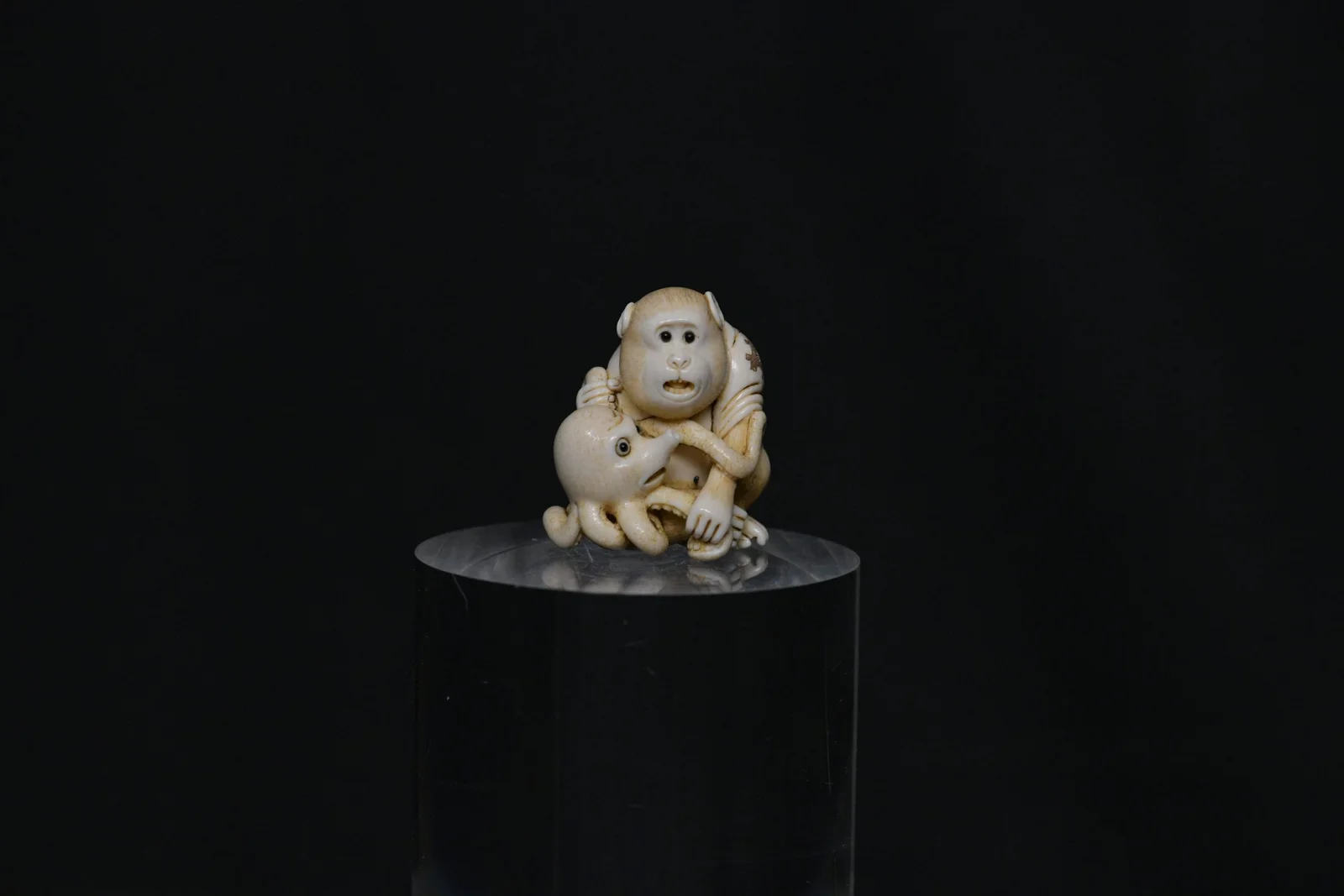
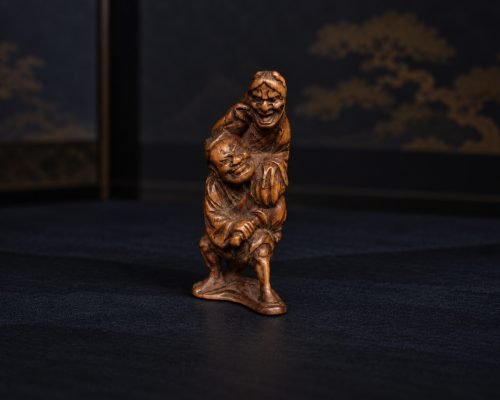
A man caught in a sneeze. A legendary figure stretching his impossibly long arms. A monkey wrestling with an octopus. Some Japanese netsuke invite a smile before we know anything about their age, maker, or original purpose.
Humor in Japanese netsuke often begins with something immediately recognizable: an awkward movement, an exaggerated expression, or a situation that seems to have gotten out of hand. Within a few inches of carved material, an artist could give a figure a surprisingly lively personality.
Looking closely at these small scenes reveals a playful side of Japanese art—and a different way to enjoy netsuke.
Netsuke originally served as toggles securing containers and other accessories suspended from an obi sash. Their subjects, however, went far beyond that practical role.
Carvers drew on everyday life, animals, theater, religion, and folklore. The Metropolitan Museum of Art also identifies parody and satire among their themes. These small accessories could express tastes and ideas that were more mischievous than their modest size might suggest.
Not every humorous netsuke carries a hidden political message or illustrates a particular story. Sometimes the appeal lies in a familiar gesture, carefully observed and pushed just far enough to make us laugh.
A sneeze is a wonderfully unceremonious subject for sculpture. It interrupts whatever a person is doing and briefly takes control of the face and body.
The wood netsuke of a sneezing man in Supein Nihonto’s collection captures that loss of composure. The seated figure lifts his head and opens his mouth, holding a small instrument used to provoke the sneeze.
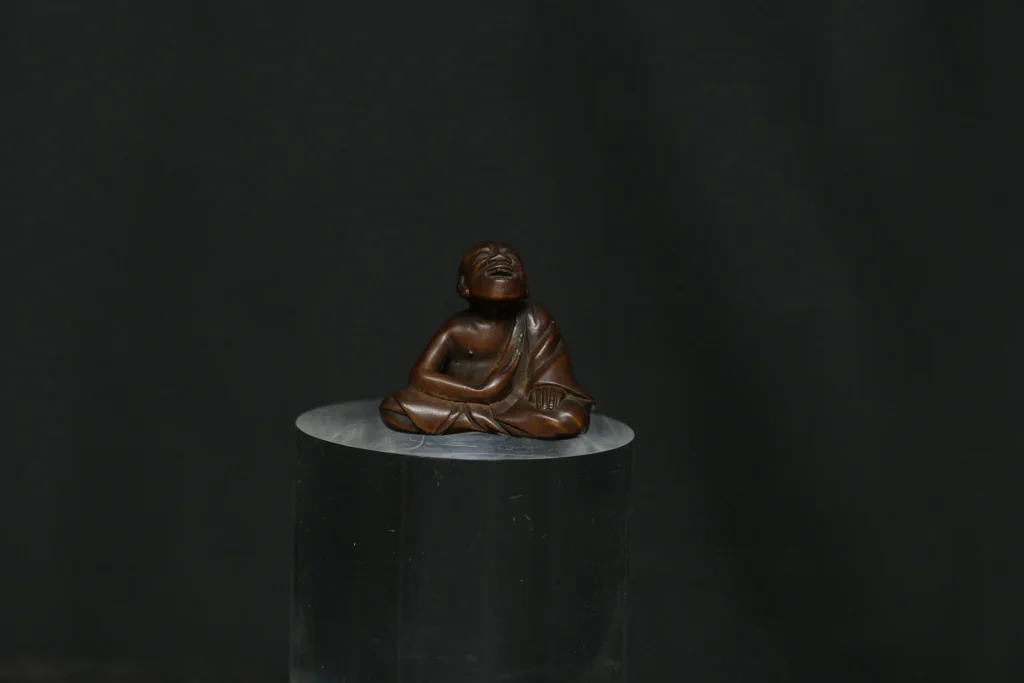
The subject is often described in museum collections as a “professional sneezer.” The Fitzwilliam Museum, for example, records a related figure holding a feather and identifies the activity as a form of entertainment.
Here, the joke depends on timing. A fleeting bodily reaction becomes a permanent pose, allowing us to study an expression that would normally disappear almost as soon as we noticed it.
Tenaga, the long-armed figure of East Asian folklore, offers another kind of comic possibility. His unusual proportions give a carver room to exaggerate an action without losing its human familiarity.
In this wood netsuke of Tenaga stretching, his arms rise above his head and his hands meet high overhead. His body arches into the movement, while his open mouth adds to the sense of effort.
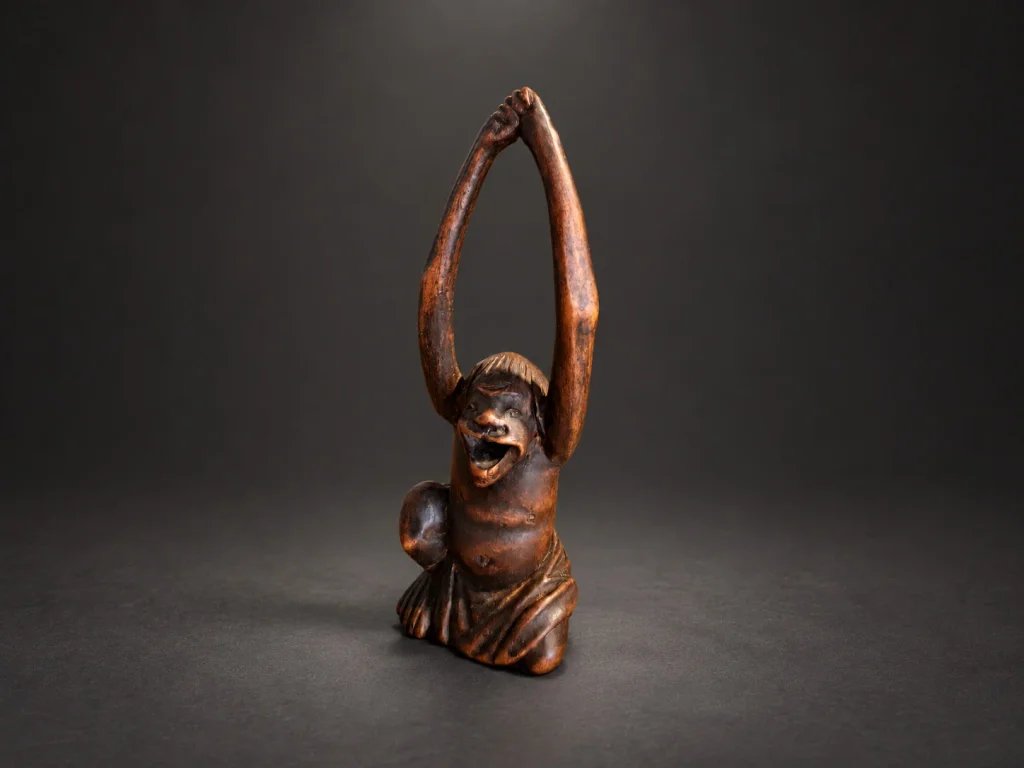
The expression might suggest a yawn, a shout, or an exhalation. That ambiguity is part of its appeal: the posture communicates more clearly than any single label.
The humorous effect comes from the contrast between a legendary body and an ordinary movement. We recognize the pleasure or effort of a full stretch, even when the arms performing it are anything but ordinary.
Other netsuke build their humor around an improbable situation.
The netsuke of a monkey wrestling with an octopus presents two animals in a compact struggle. The monkey’s decorated jacket adds a human element, making the encounter feel almost like a miniature theatrical performance.
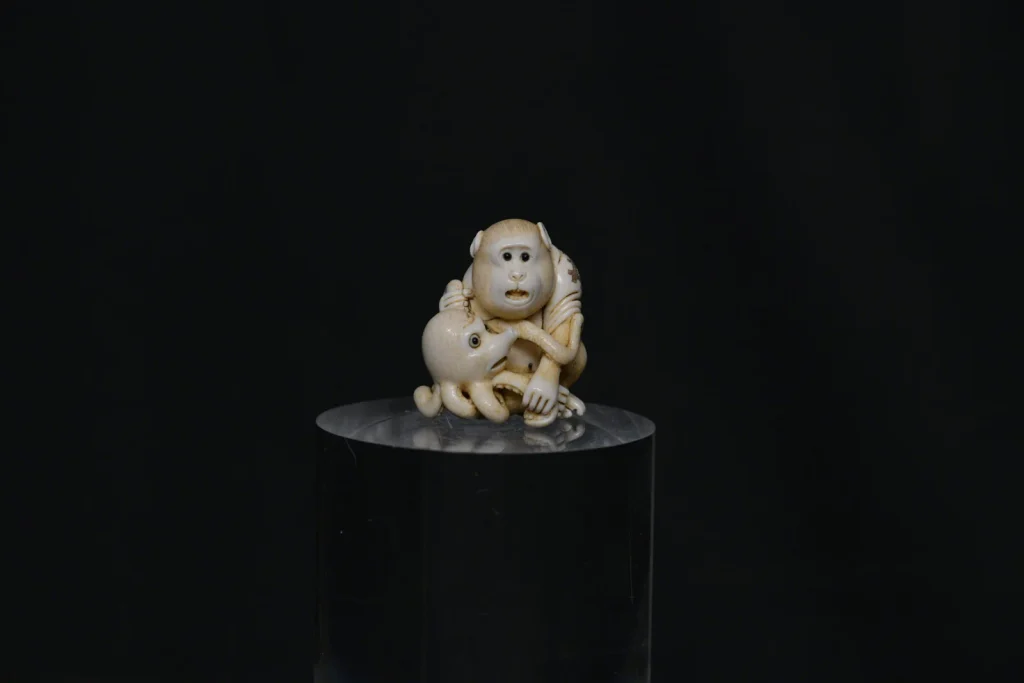
The pairing itself invites questions. Who started the struggle? Which animal has the advantage? How will either of them get free?
Those questions are a way of enjoying the scene, rather than evidence of a specific narrative. Without a documented identification, there is no need to attach a named legend or a fixed moral to the carving. Its unexpected encounter already gives the viewer plenty to explore.
When looking at a humorous netsuke, start with the whole pose. Then examine the relationship between the face, hands, and surrounding figures.
An open mouth alone may tell us very little. Combined with a tilted head, a raised arm, or an object held near the face, it becomes part of an action. Different views can make that action easier to understand.
This is one reason several photographs are so useful. A frontal image may capture the expression, while a side view explains the posture or reveals how two figures interact.
The pleasure of these carvings lies in that gradual discovery. Their makers gave lasting form to brief, awkward, and wonderfully recognizable moments. Centuries later, a sneeze, a stretch, or an unlikely wrestling match can still make us pause and smile.
Explore the netsuke collection at Supein Nihonto to discover more examples of expressive figures, animals, and miniature storytelling.

CEO of SupeinNihonto, dealer and collector of ancient Japanese art and weapons from Canillo, Andorra.