November 17, 2026

Personal thoughts on flowers, craftsmanship, and the pleasure of turning something over.
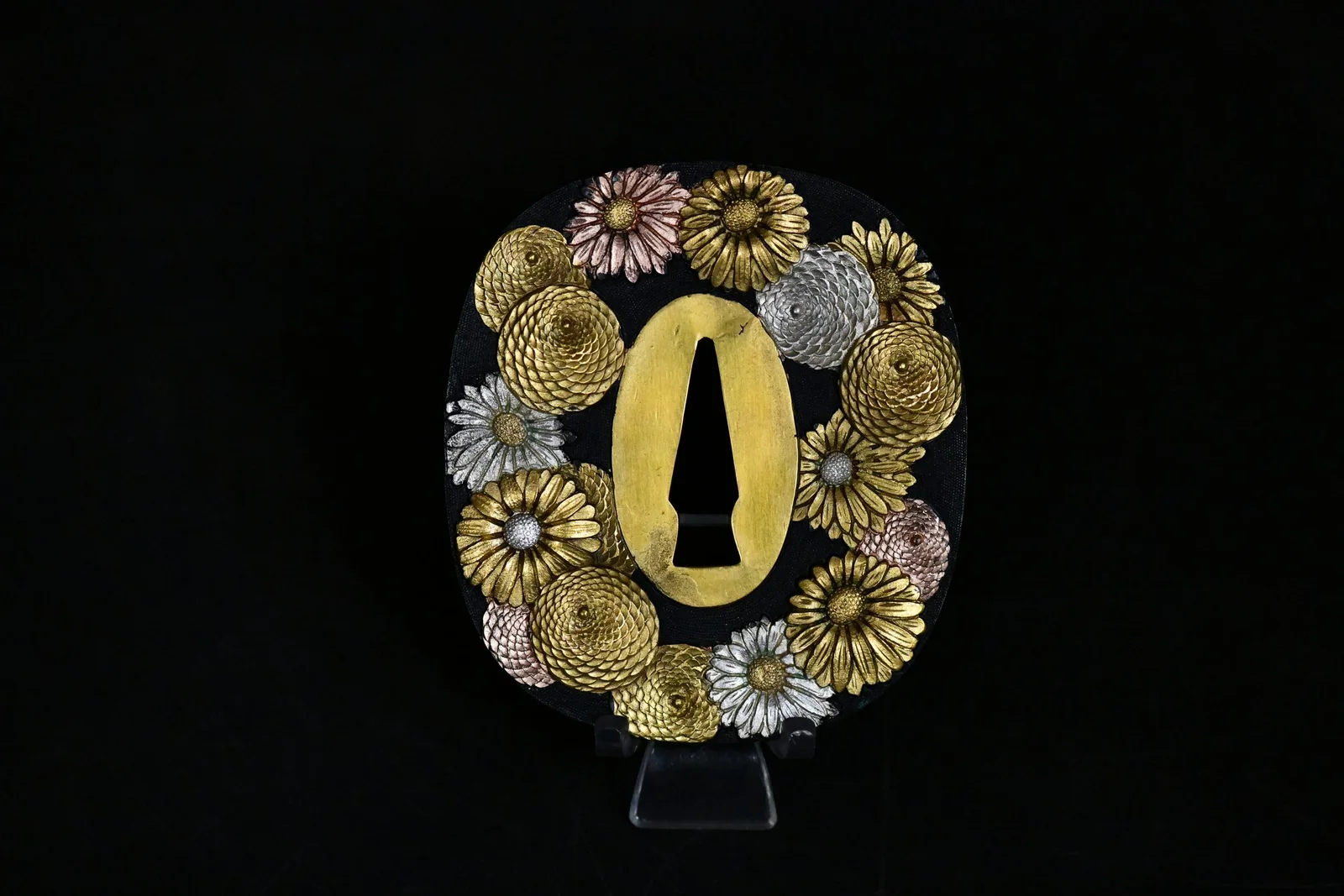
The first thing I notice is the flowers.
Before I begin looking at the signature or considering how the decoration is arranged, my eye goes straight to those tightly layered petals. Some flowers open outward around a clearly defined center. Others curl inward, their overlapping petals forming almost perfect little domes.
I find myself moving from one to another.
A pale flower beside a warm golden one. A small copper-colored bloom tucked near the edge. A rounded blossom that seems to sit just above its neighbors.
There is a great deal happening on this small surface, yet I enjoy how naturally the eye finds its way around it.
Then I look at the other side, and the arrangement begins again.
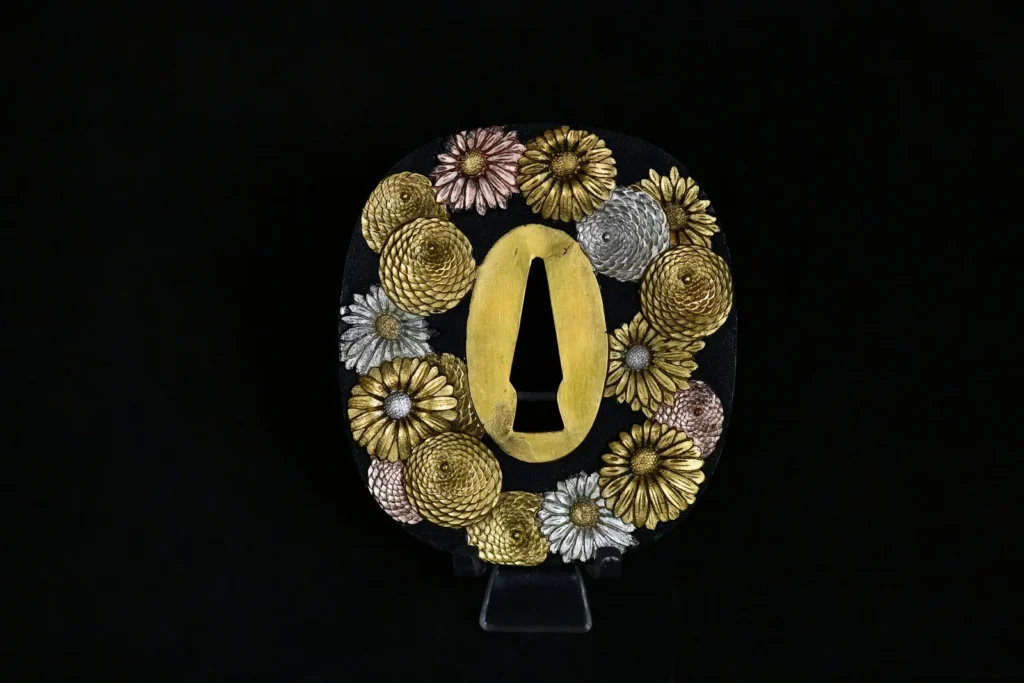
What I particularly like about this chrysanthemum tsuba is the variety within a single subject.
At first glance, we see a ring of flowers. Looking closer, that simple description starts to feel inadequate.
Some have long, narrow petals with distinct spaces between them. Others are built from closely overlapping layers, each petal contributing to a rounded shape. The centers vary, too: some stand out as small textured circles, while others seem to disappear into the surrounding folds.
I like following those differences.
The open flowers give my eye somewhere to rest. The denser ones invite me to look more carefully, tracing how the individual petals fit together.
It reminds me of looking at flowers in a garden. We recognize the general shape immediately, but the longer we stay, the more individual each bloom becomes.
Here, that variety has been expressed in metal.
The dark ground is easy to overlook because the flowers draw so much attention.
But when I imagine this same arrangement against a brighter background, I realize how much the darkness contributes.
It gives definition to the edges of the petals. The small gaps between flowers become visible. Pale and warm-colored surfaces stand apart without needing much space between them.
I especially enjoy the places where a flower seems almost to emerge from the darkness.
There is a balance between the decorated areas and the small patches of exposed ground. Those quieter spaces help me understand the shapes around them.
Even in a composition this full, a little space can make a difference.
My gaze does not move around this tsuba in a straight line.
It pauses at a silvery flower, shifts to a golden one, and then notices a warmer, pinkish bloom farther along the edge.
The changes in color help separate forms that might otherwise merge together.
I find that particularly effective where two densely layered flowers sit close to one another. Their shapes are related, but the difference in tone gives each its own presence.
Photographs can show these contrasts beautifully, though I am careful about treating color alone as proof of a particular metal. Lighting and surface condition affect what we see.
For the moment, I am happy simply to notice the relationship between the tones: cool beside warm, pale beside dark, a brighter center surrounded by more subdued petals.
There is plenty to appreciate before every material has been identified.
One of my favorite things about studying Japanese tsuba is remembering to give both sides my attention.
It is surprisingly easy to settle on a favorite photograph and let that become our idea of the whole object.
With this piece, looking at the second face is especially rewarding.
The same floral vocabulary is there, but individual blossoms occupy different positions. A pale flower becomes a new point of focus. Rounded blooms gather in another part of the composition. The eye takes a slightly different route.
I enjoy comparing the two photographs and noticing where my attention goes first on each one.
Neither view tells me everything.
Together, they give me a much fuller sense of the care invested in the piece.
When I look at the tightly layered flowers, I often think about the concentration such detail requires.
Each small shape needs to remain distinct enough for us to read it as a petal. At the same time, all those shapes need to belong to a convincing flower.
Then that flower has to find its place among the others.
I try to follow the transition from the outer petals toward the center. In places, the pattern becomes so compact that my eye has to slow down to keep track of it.
That is where I find much of the pleasure.
From a distance, the flower gives us an immediate impression. Up close, it offers a succession of smaller discoveries.
I do not need to imagine a particular workshop scene or invent a story about the maker to feel an appreciation for that effort. The visible work gives me enough to think about.
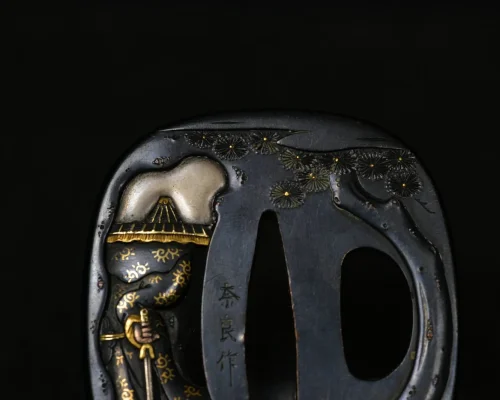
On one face, an inscription appears beside the central opening.
It introduces another point of interest, quite different from the flowers surrounding it.
My attention moves from rounded petals to individual written strokes. I begin wondering about the person behind the work and the information that further study might reveal.
A signature is a starting point for research. Reading it, interpreting it, and assessing an attribution deserve their own careful attention.
I like that an object can offer both an immediate visual pleasure and questions that take much longer to explore.
We can enjoy the flowers today and still have more to learn tomorrow.
There is something satisfying about an object that can hold our attention without being large.
This tsuba has a clear overall shape, but its character comes from many small decisions: the turn of a petal, the placement of a pale flower, the amount of dark ground left visible between two blooms.
The more I look, the more those decisions become apparent.
And sometimes, after concentrating on a single detail, I step back and enjoy the whole arrangement again.
That movement between the small part and the complete object is something I never tire of.
A flower draws me closer. Its petals keep me there. The other side gives me a reason to begin again.
For me, that is part of the lasting pleasure of Japanese sword fittings: there is often more to see than the first glance suggests.
Eric
Supein Nihonto

CEO of SupeinNihonto, dealer and collector of ancient Japanese art and weapons from Canillo, Andorra.