FREE EXPRESS INTERNATIONAL DELIVERY
1 in stock
1 in stock
Add to Compare
Add to Wishlist
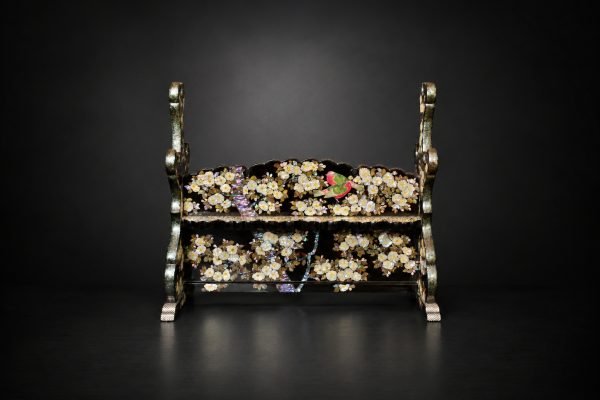
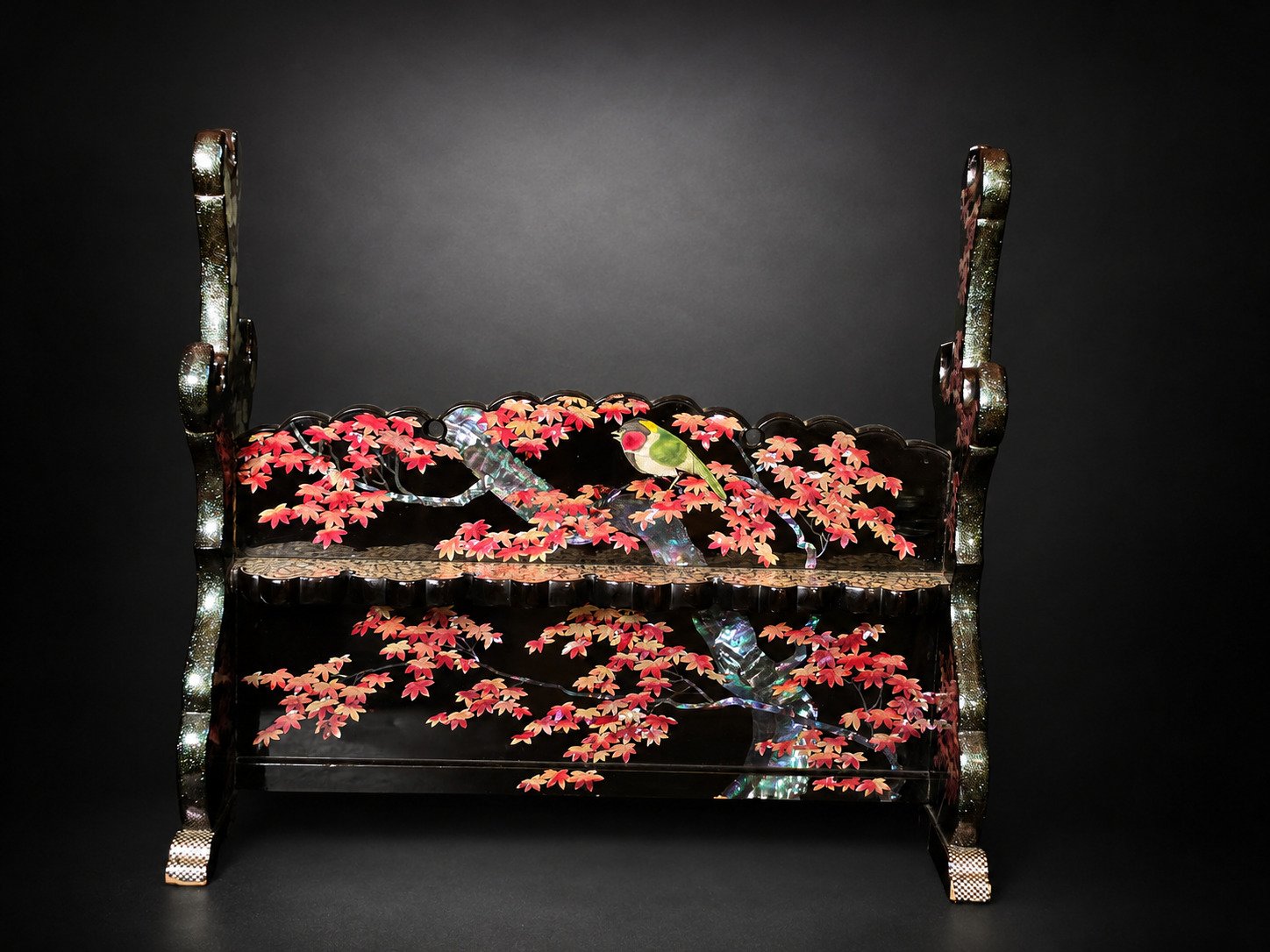
An exceptionally elaborate Japanese katana-kake from the 19th century, created to display three swords and richly decorated in glossy black lacquer with extensive raden and aogai-style mother-of-pearl and abalone shell inlay.
Far beyond the purely functional sword stands more commonly encountered, this example was conceived as a decorative object in its own right, combining architectural form, lacquer craftsmanship and extensive iridescent shell decoration across nearly every visible surface.
Its ambitious three-tier construction, dense pictorial decoration and lavish use of shell suggest a costly commission intended for an affluent samurai household or another patron of considerable means.
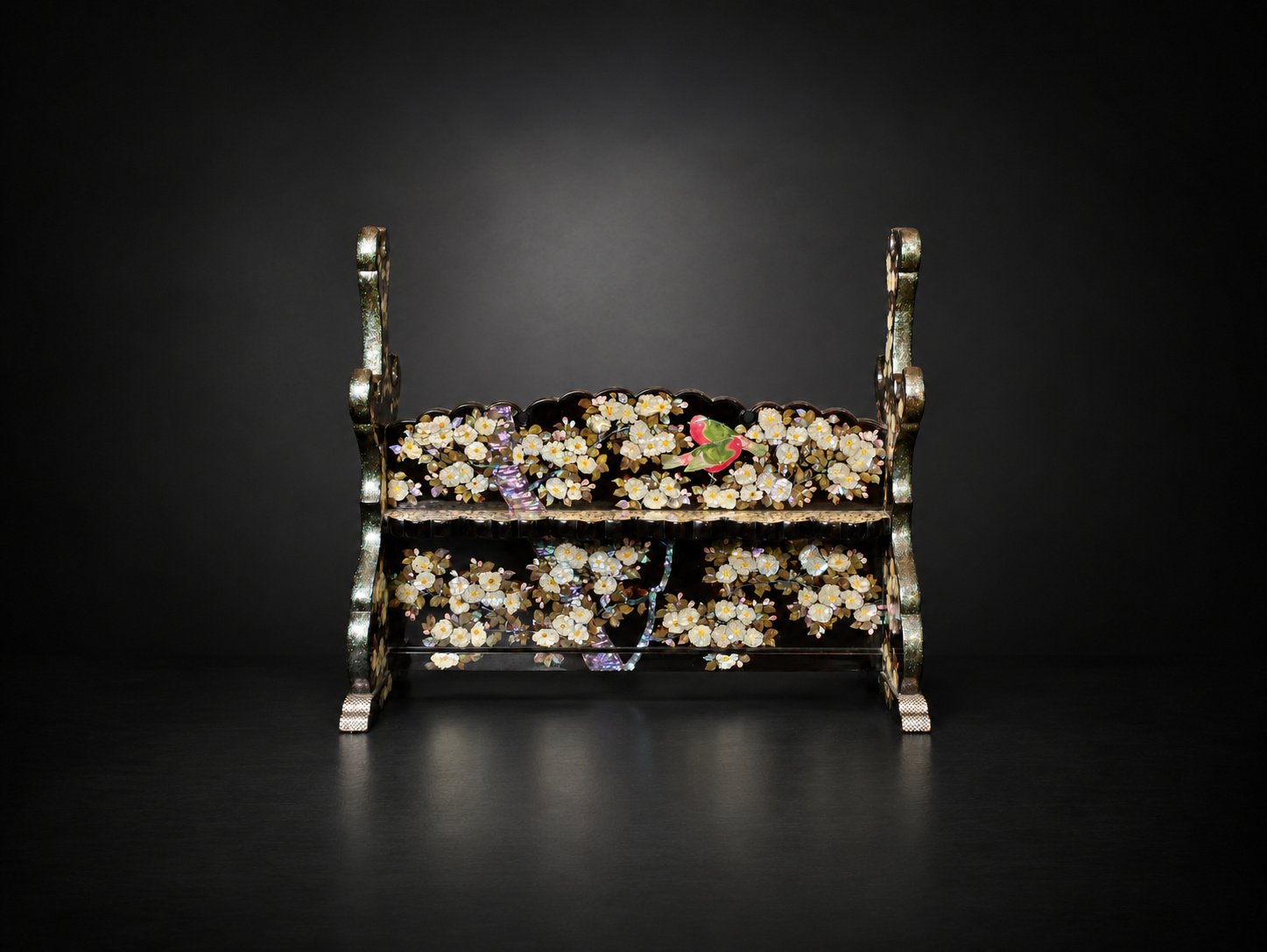
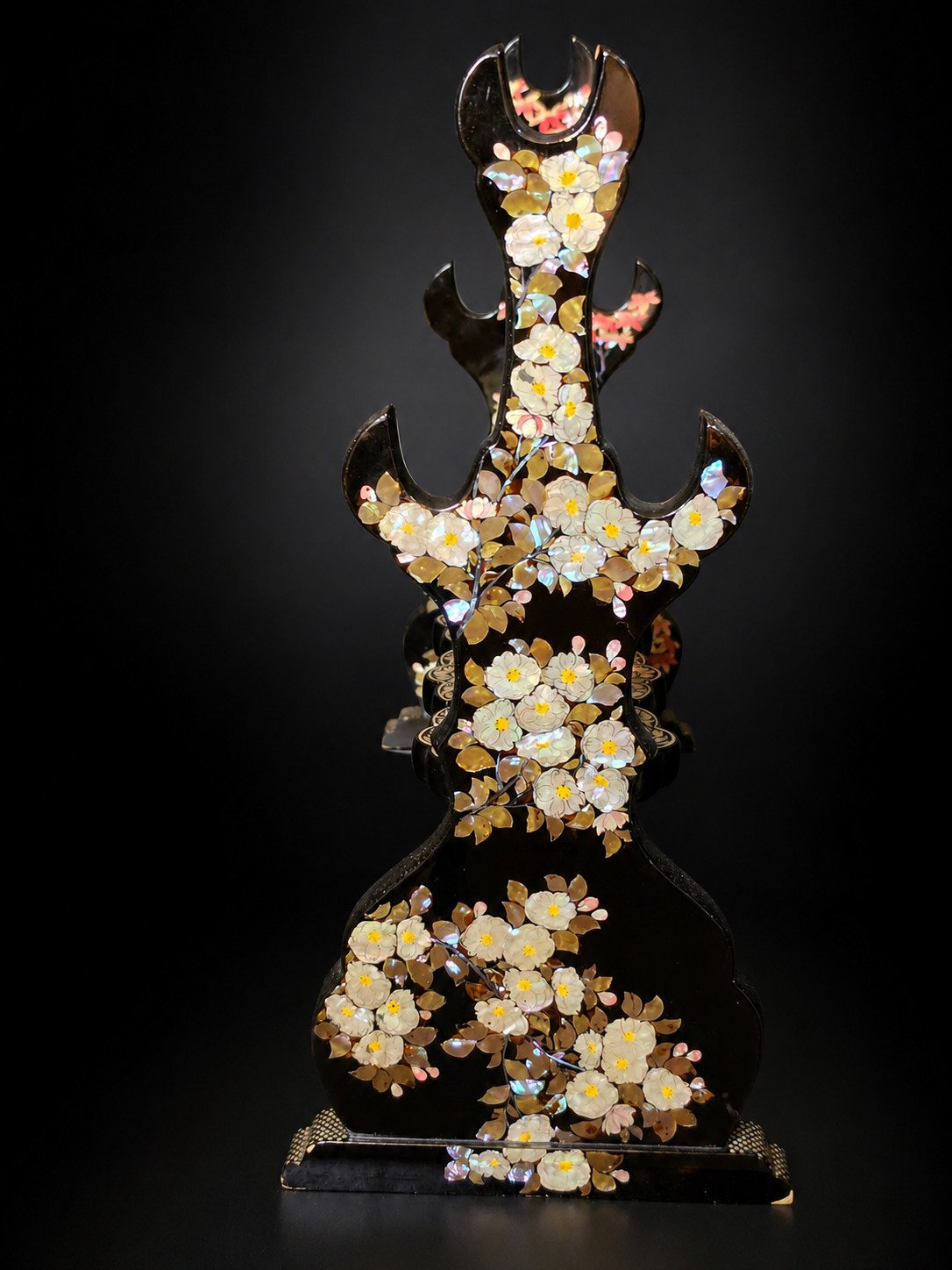
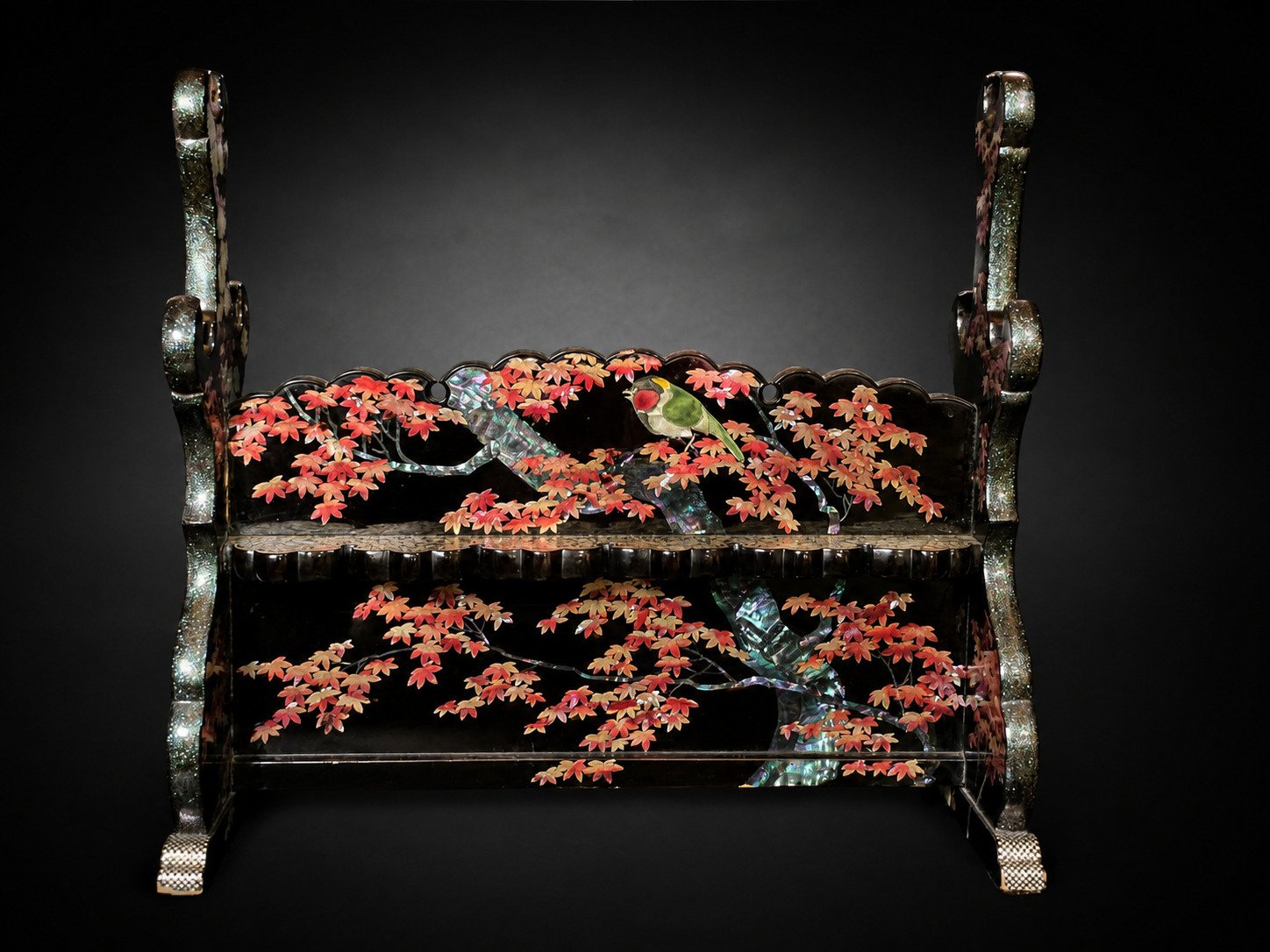
The stand is constructed in a commanding three-tier configuration, with two lower sword rests arranged at different heights and a third rising above them.
This allows three swords to be displayed together as a coordinated group, creating a more imposing presentation than the more usual one- or two-sword stands.
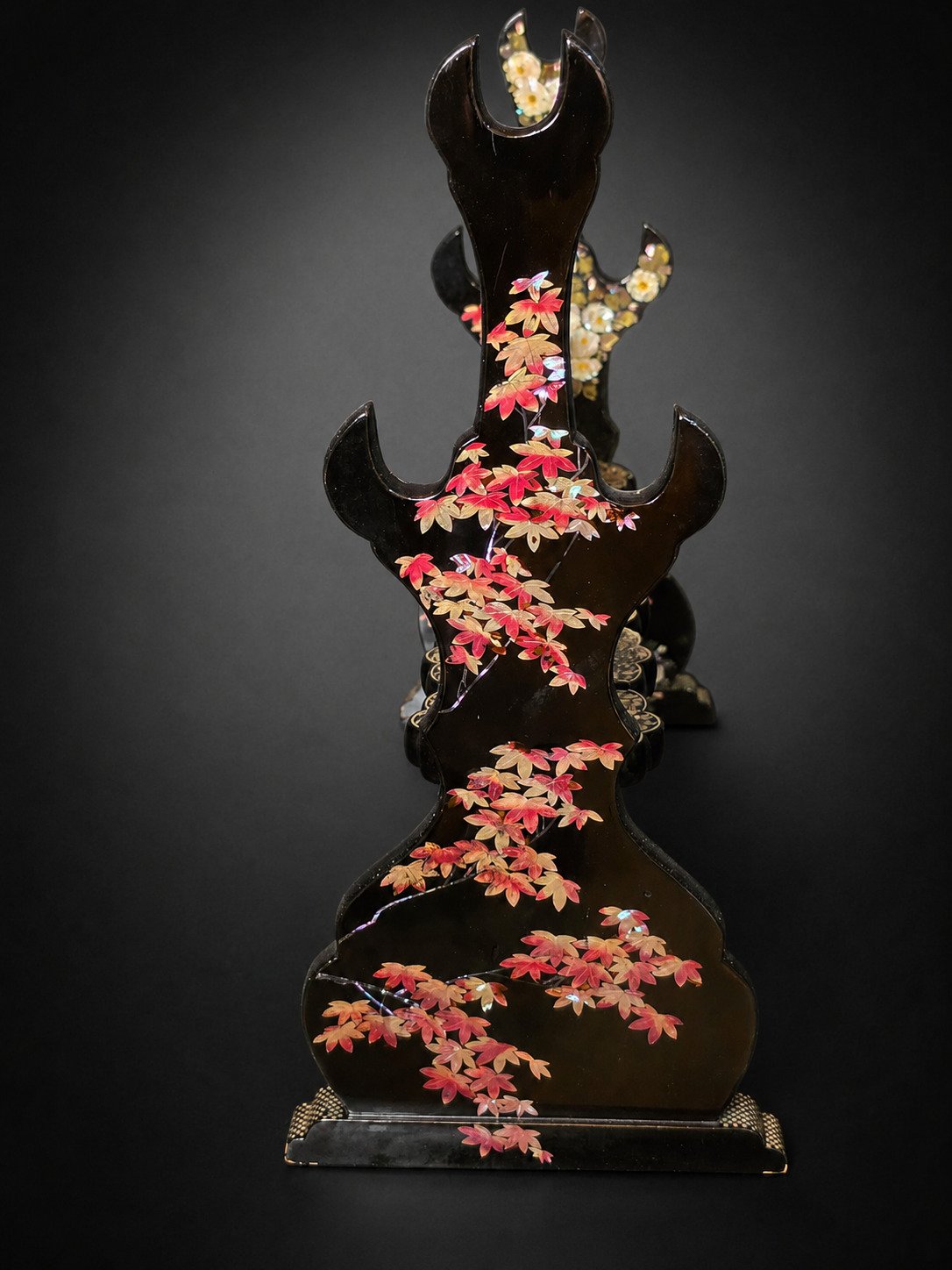
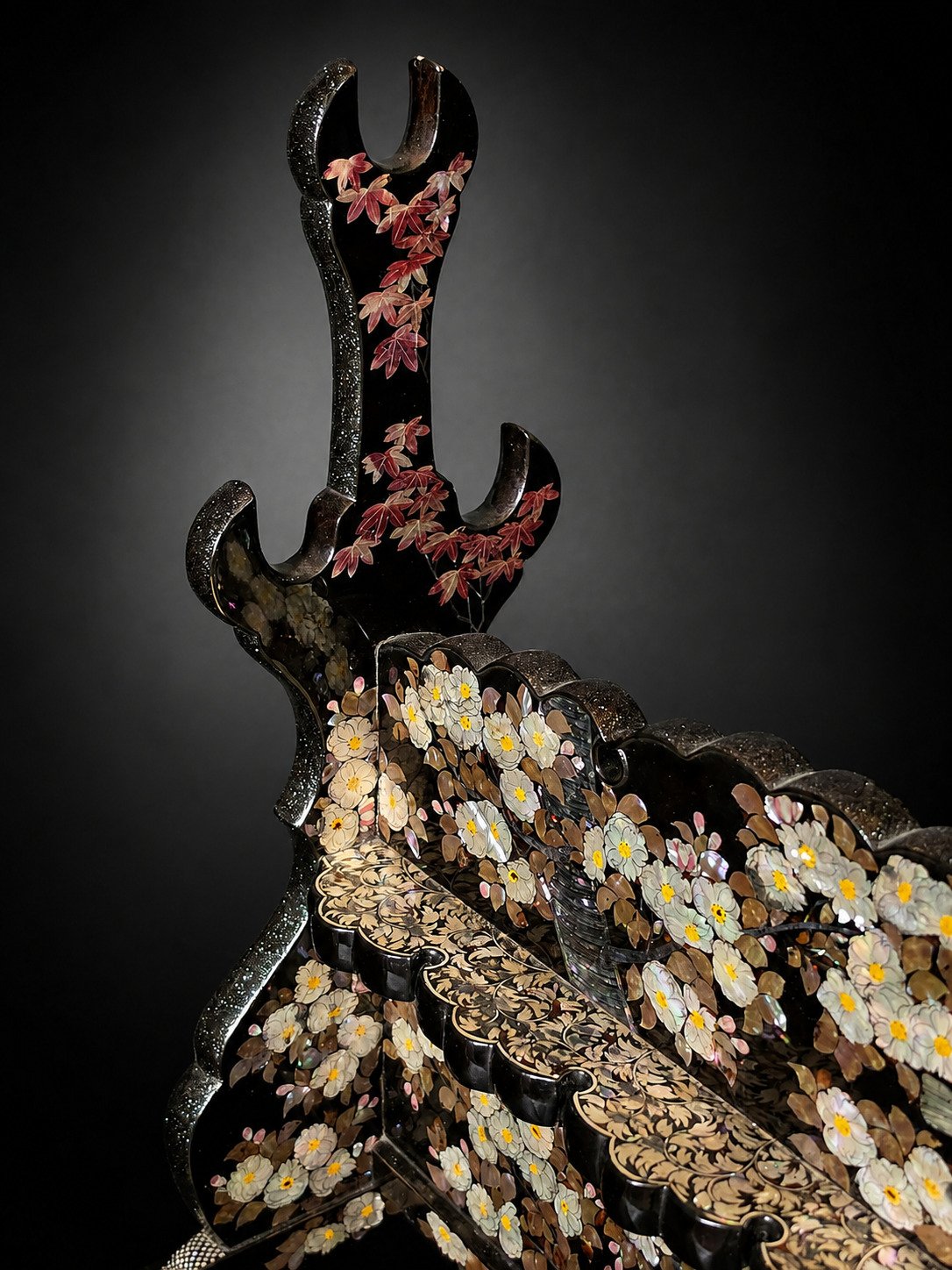
The tall lateral supports terminate in deeply curved sword cradles, while scalloped horizontal panels create an architectural framework for the extensive decoration.
The strongly vertical silhouette gives the piece a sculptural presence even when displayed without swords.
The principal surfaces are finished in a deep, glossy black lacquer, providing a dramatic background for the extensive shell inlay.
The dark ground allows the iridescent blues, greens, violets, reds and golds of the decorative materials to stand out with exceptional intensity under changing light.
The highly reflective lacquer also reinforces the luxurious character of the object, creating depth between the polished black surface and the raised or inset decorative elements.
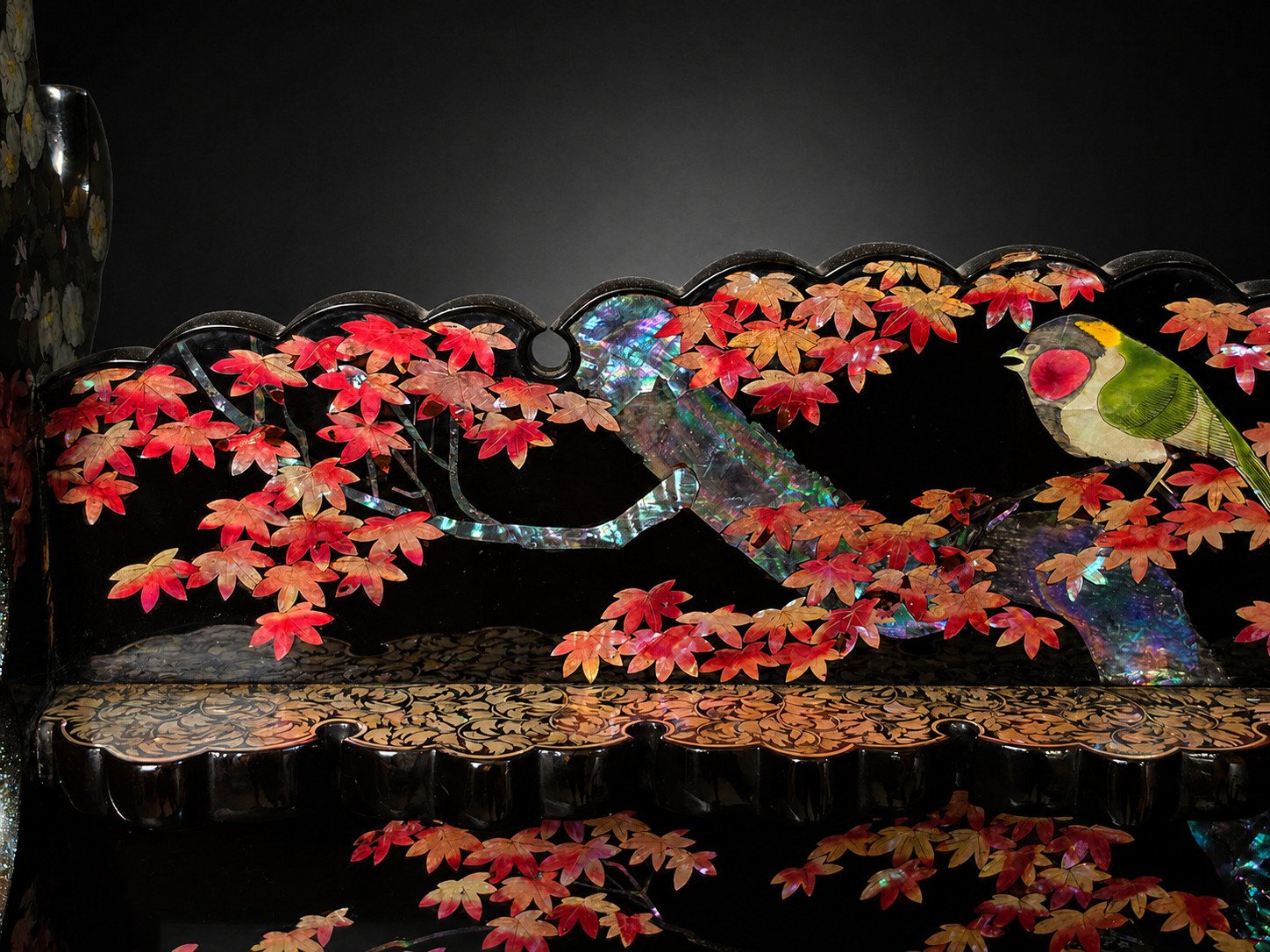
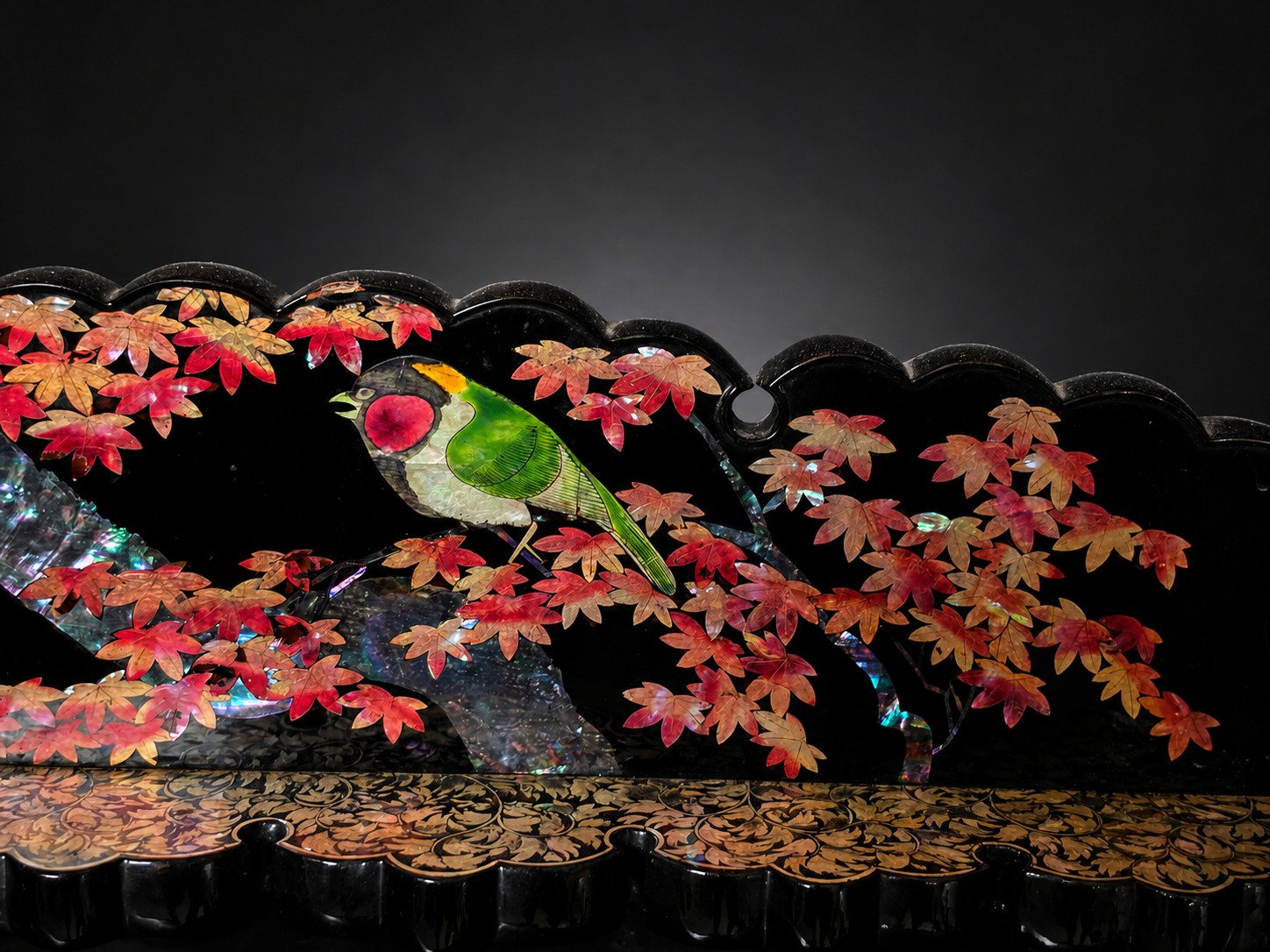
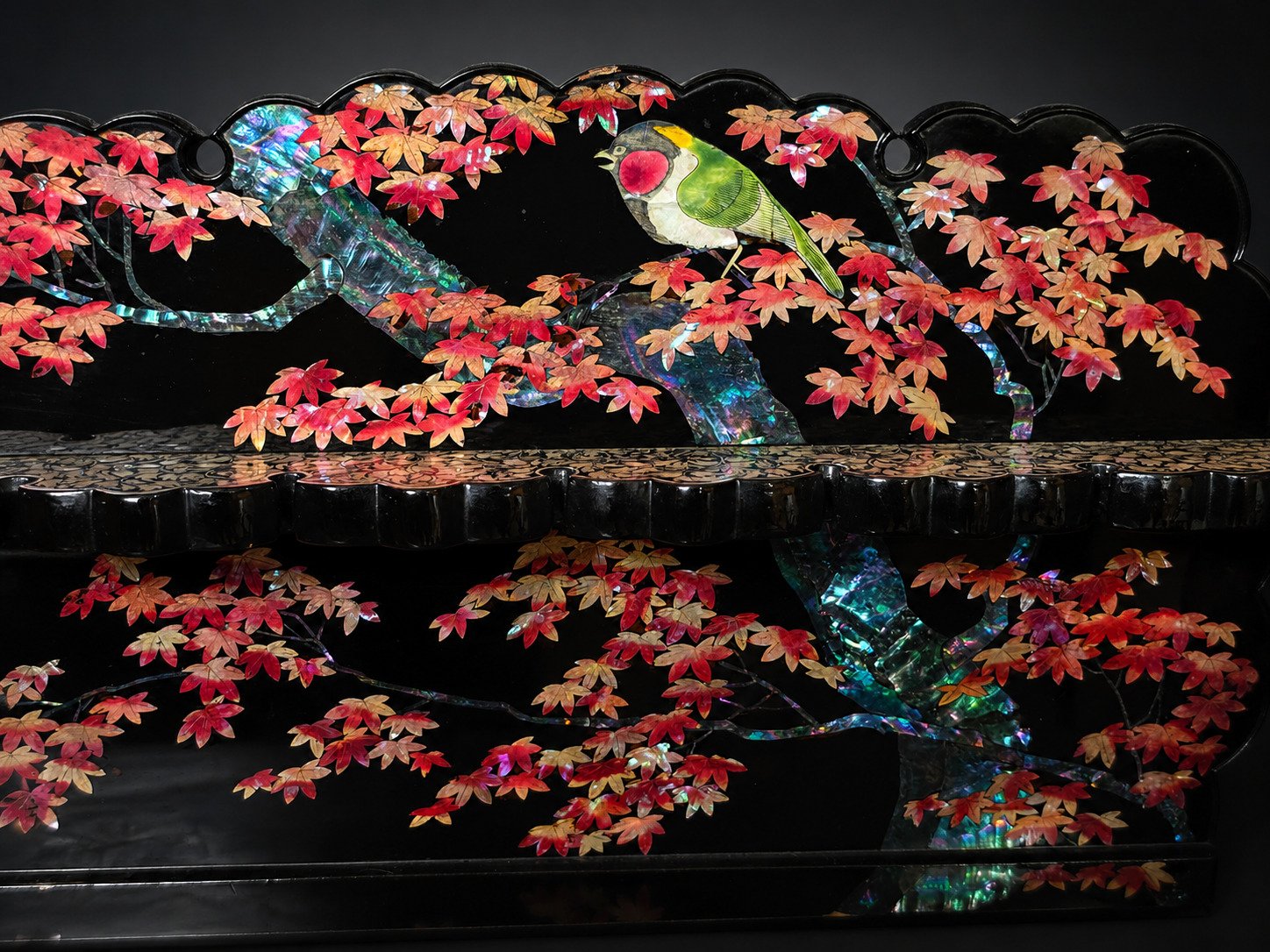
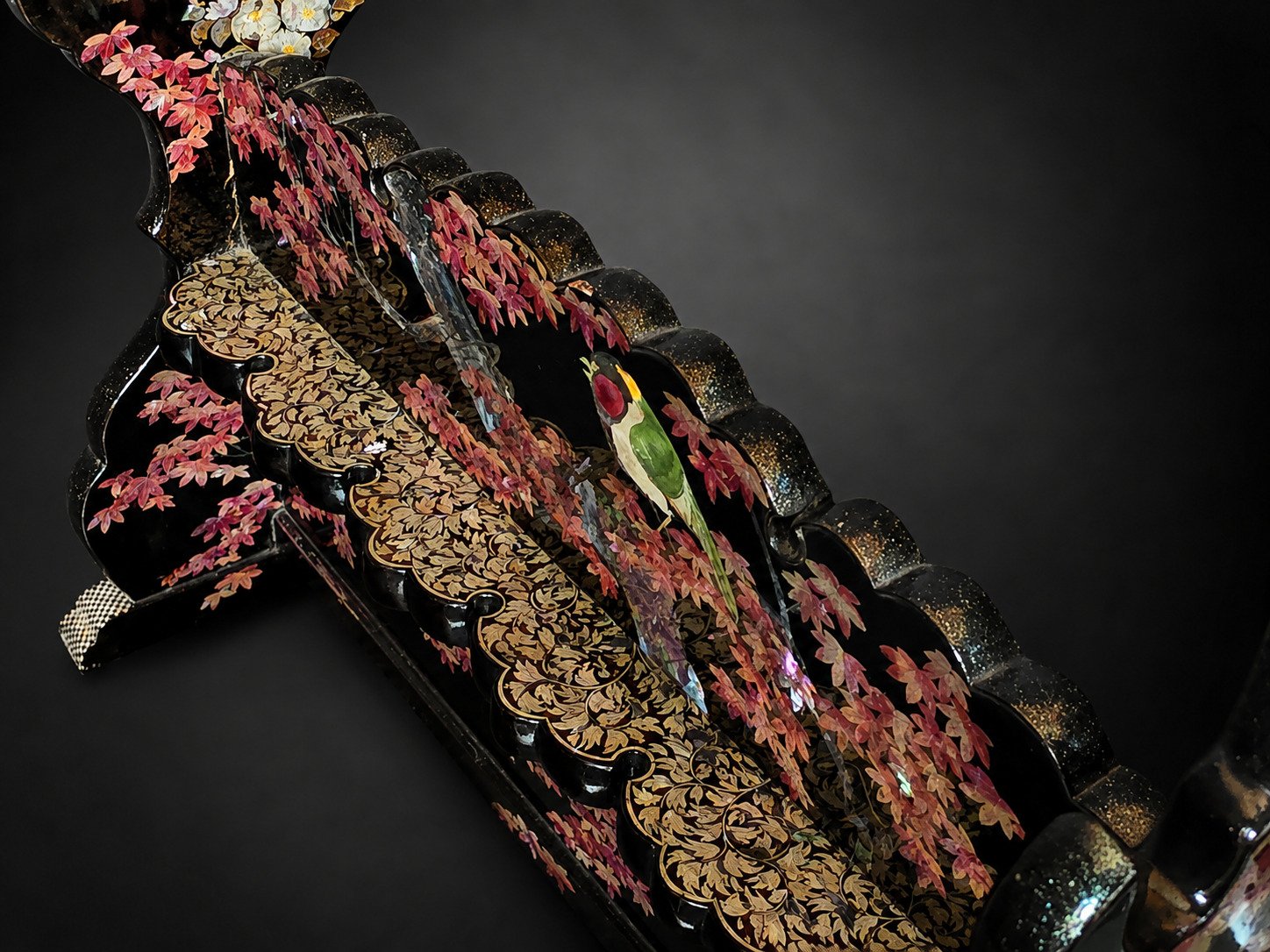
One principal face is dominated by sweeping branches of autumn maple (momiji), with leaves rendered in tones of red, orange and gold.
The branches extend across the horizontal panels and upward along the lateral supports, visually connecting the different structural levels of the stand.
Large sections of iridescent shell form the trunks and branches, producing flashes of blue, green and violet depending on the angle of illumination.
A brightly colored bird appears among the foliage, introducing a naturalistic focal point within the autumn landscape.
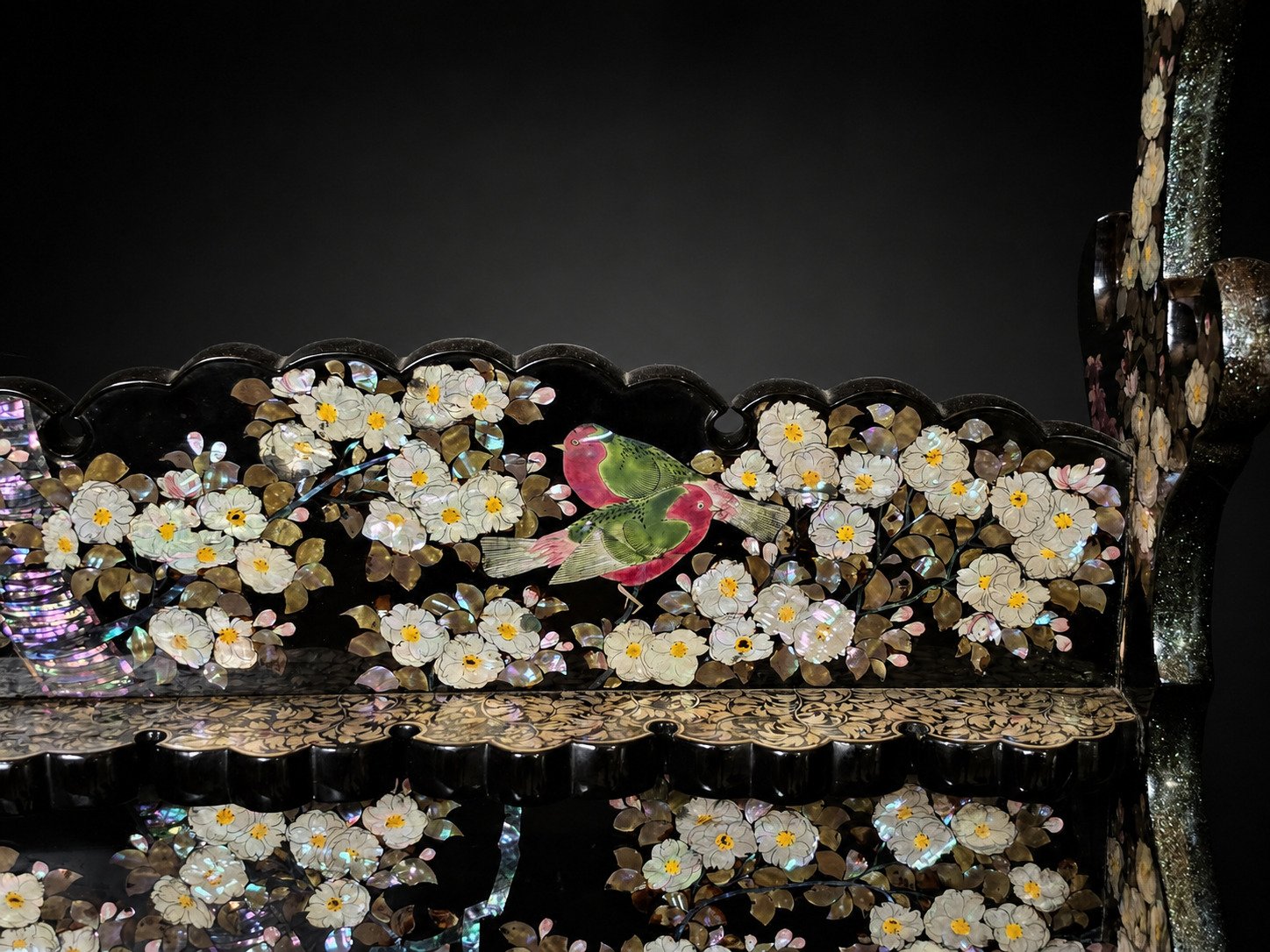
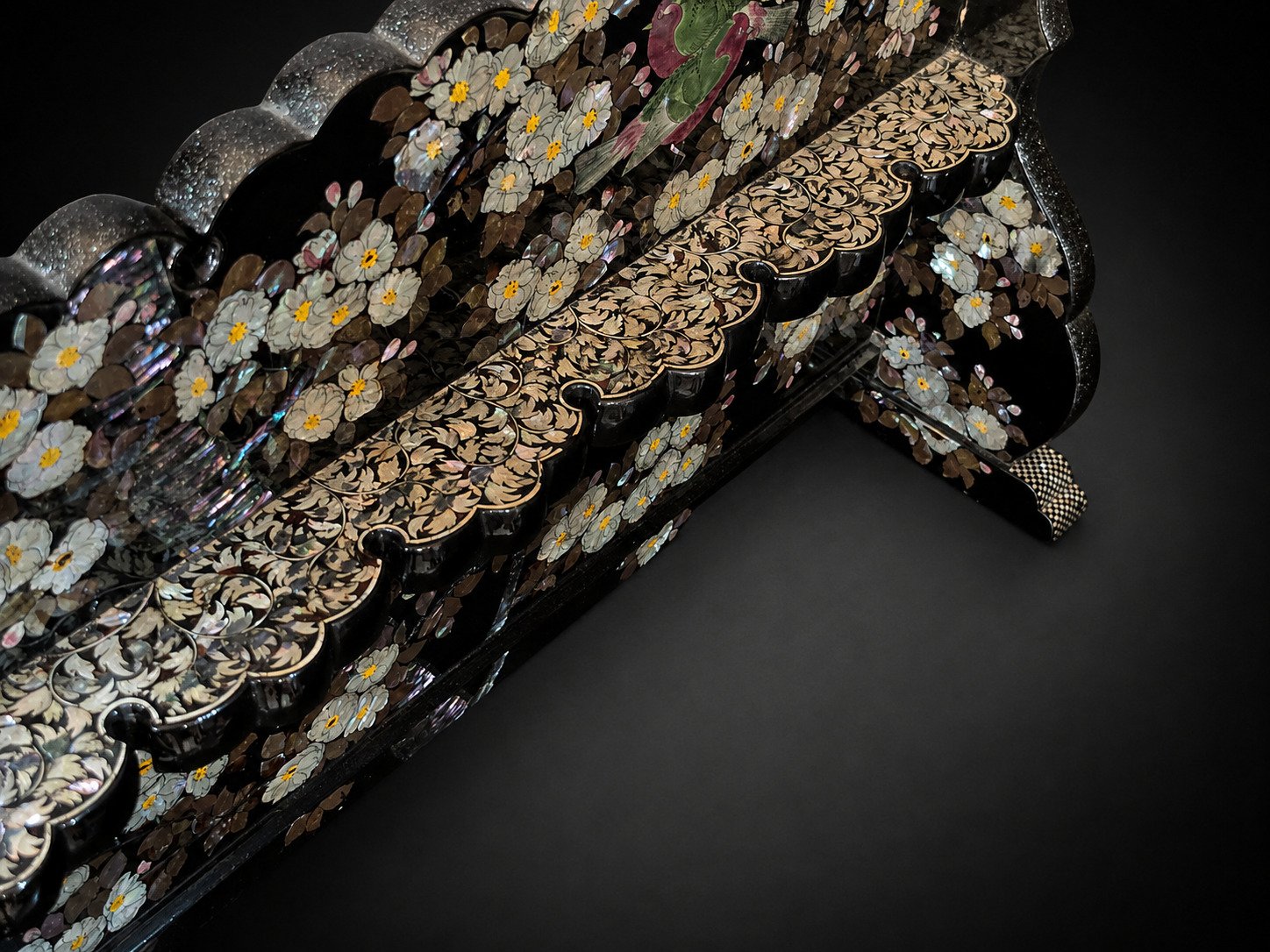
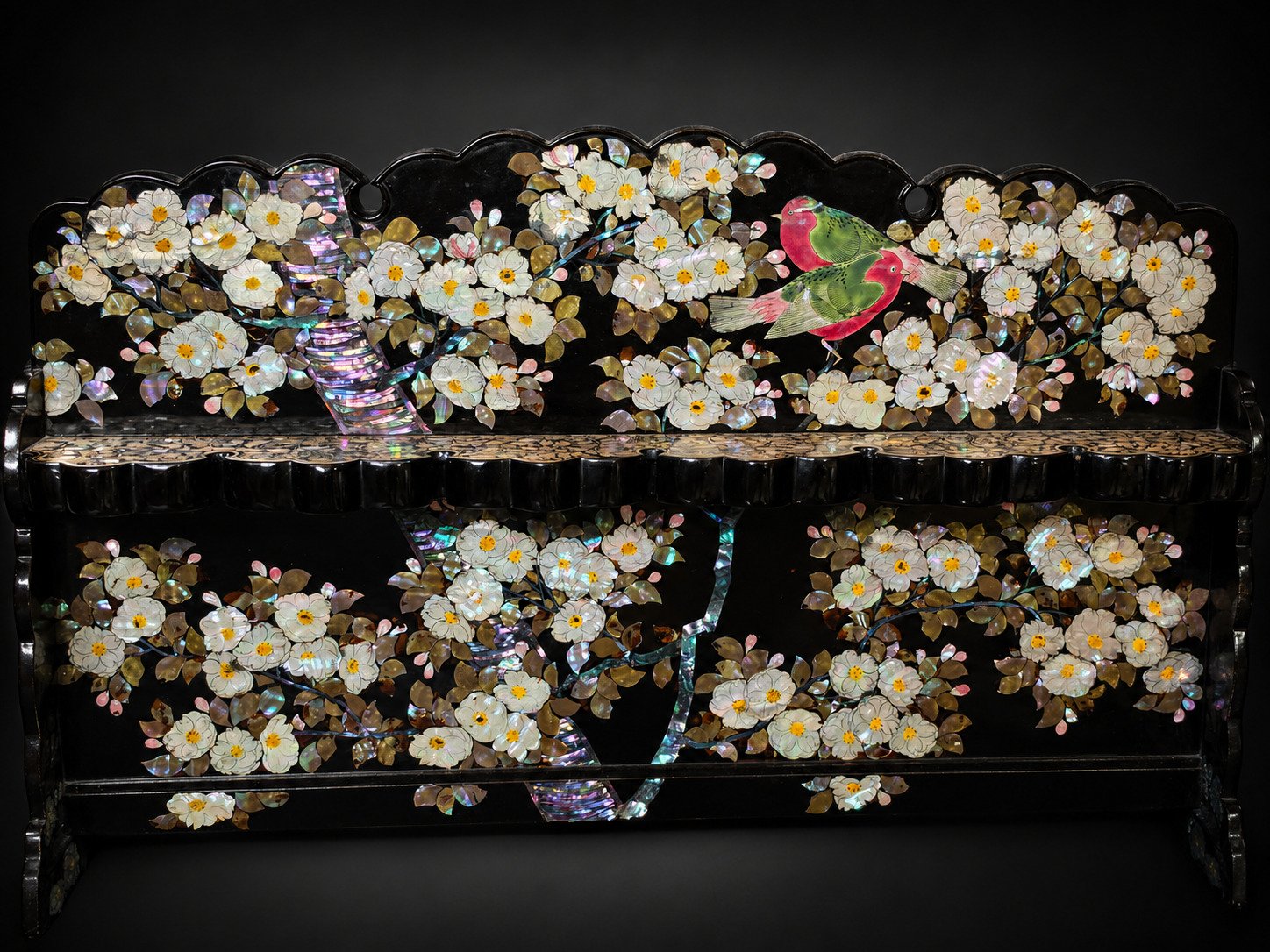
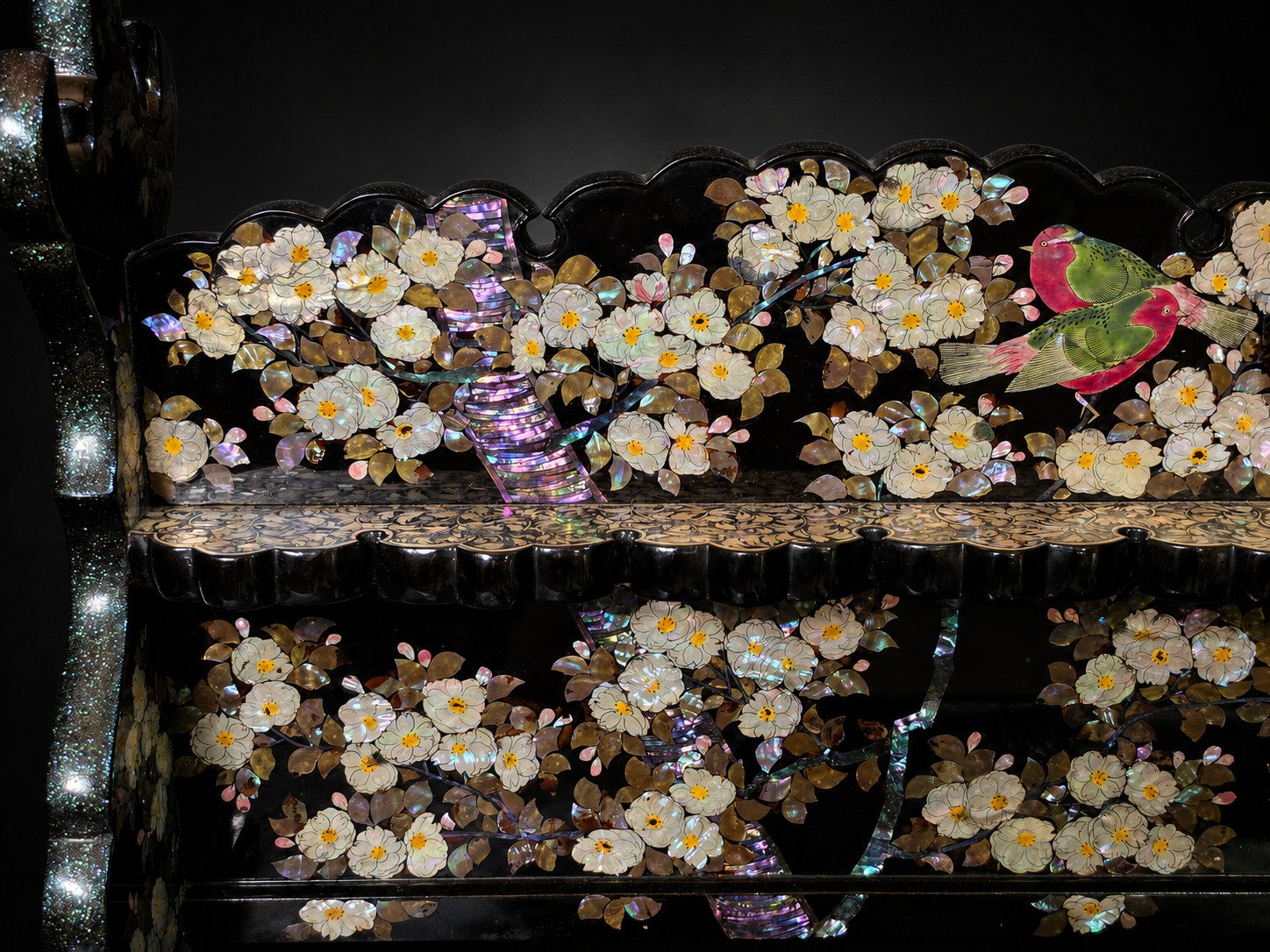
The opposite face presents a markedly different seasonal composition, dominated by dense clusters of white blossoms arranged across twisting branches.
A pair of colorful birds is positioned among the flowers, creating a brighter and more delicate visual atmosphere than the autumn maple scene on the reverse.
The flowers, buds, leaves and branches are assembled from numerous individually shaped pieces of shell, producing a remarkably intricate mosaic against the black lacquer ground.
The use of distinct pictorial compositions on both sides indicates that the stand was intended to be appreciated from multiple viewpoints, rather than simply placed permanently against a wall.
The pictorial decoration is executed principally in raden, the traditional Japanese technique of decorating lacquer with pieces of mother-of-pearl or abalone shell.
The shell has been cut into a wide range of shapes to create flowers, leaves, branches and other pictorial details.
Particularly striking are the larger iridescent shell sections forming tree trunks and structural elements, where the natural colors of the shell produce strong flashes of blue-green, violet and turquoise.
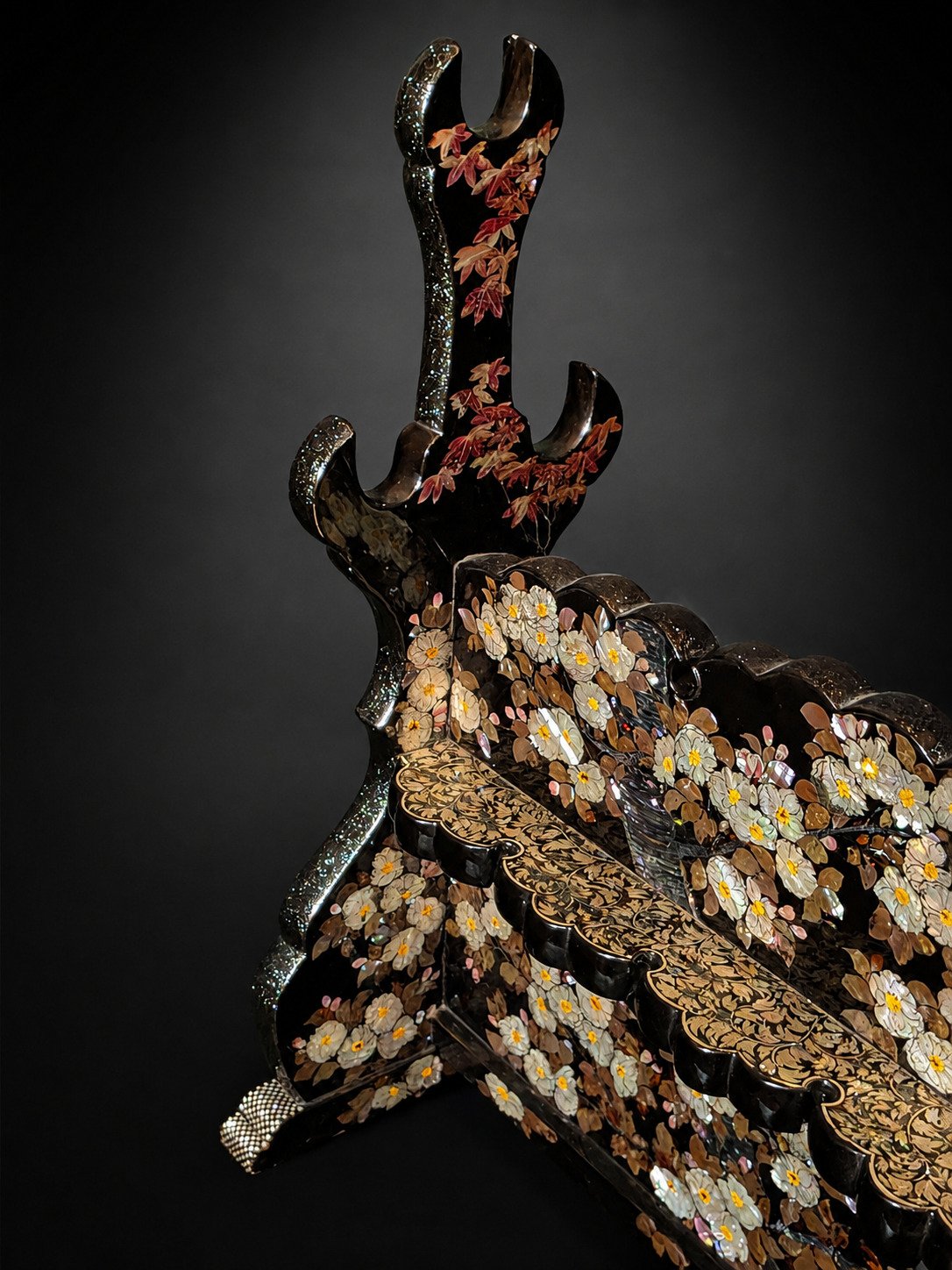
The vertical supports and other structural areas are enriched with a more fragmented aogai-style shell treatment, creating a shimmering mosaic effect distinct from the more pictorial raden panels.
The horizontal sword rests are decorated with dense gold-toned scrolling foliage, arranged within scalloped borders.
This continuous vine-and-leaf ornamentation visually separates the main pictorial registers and introduces an additional decorative layer between the lacquer ground and the raden scenes.
The gold decoration creates a strong contrast with the black lacquer while harmonizing with the warmer tones of the autumn leaves.
Its continuous repetition across the horizontal structure also helps unify the complex decorative program.
The horizontal upper panels are cut with a distinctive scalloped or wave-edged profile, transforming the supporting structure into an important part of the overall decorative composition.
Rather than functioning as simple straight rails, these shaped edges create a rhythmic silhouette that frames the flowering and autumn scenes.
The curved openings and raised side supports give the katana-kake an architectural quality reminiscent of decorative interior furnishings rather than purely utilitarian sword furniture.
The tall side uprights are not left undecorated but are extensively embellished with iridescent shell and additional foliage.
The shimmering shell mosaic extends vertically along the supports, creating changing reflections under direct light and ensuring that the decorative effect continues from the horizontal panels to the highest sword cradles.
This treatment is particularly effective when the object is viewed obliquely, as the shell responds strongly to movement and changing angles of illumination.
The combination of birds, flowering trees and autumn maple leaves belongs to a long tradition of seasonal imagery within Japanese decorative arts.
One face evokes autumn through brilliant red and gold maple foliage, while the reverse creates a lighter composition through abundant white blossoms and paired birds.
This contrast between different seasonal settings gives the piece a poetic character and allows the viewer to enjoy two substantially different visual compositions within the same object.
Such themes were widely appreciated in Japanese lacquer, painting, textiles and metalwork, where birds and changing vegetation often served as expressions of seasonal beauty and refinement.
The density and complexity of the decoration distinguish this katana-kake from ordinary sword stands.
Hundreds of individually cut shell elements were required to create the flowers, leaves, branches, birds and iridescent surfaces, while the lacquer structure itself had to be carefully prepared and finished before the decorative work could be completed.
The combination of multiple techniques across a large and structurally complex object would have required considerable time and specialized craftsmanship.
Although the original patron cannot be established from the object alone, its scale, complexity and lavish materials strongly indicate that it was conceived as a prestigious display piece for an affluent owner.
A katana-kake was designed to support Japanese swords when they were not being worn or stored elsewhere.
In this example, the unusual three-tier construction allows an entire group of blades to be presented together, transforming the sword display into a unified decorative ensemble.
The elaborate lacquer and raden treatment indicates that the stand itself formed part of the presentation of the swords, rather than serving merely as an unobtrusive support.
When equipped with three mounted blades, the combination of lacquer, shell and sword fittings would have created an exceptionally imposing interior display.
The base terminates in projecting feet fitted with patterned decorative surfaces.
These details protect the lower structure while also ensuring that the decorative treatment continues to the lowest visible elements of the stand.
The attention given to the feet reinforces the impression that the katana-kake was intended to be appreciated from every angle.
The katana-kake shows age-related wear consistent with an antique lacquer object of the 19th century, including minor surface marks and evidence of historical use.
The extensive shell and lacquer decoration remains visually striking and retains strong iridescence under direct light.
As with all antique lacquer objects, minor irregularities, wear and historic surface changes should be understood as part of the natural history of the piece.
Please examine the accompanying high-resolution photographs carefully, as they form an important part of the description and provide the best record of its present condition.
The piece combines several features of particular interest to collectors of Japanese lacquerware, samurai culture and sword-related objects: an unusual three-sword configuration, extensive raden decoration, contrasting seasonal imagery and richly embellished structural elements.
The fact that both principal faces carry fully developed pictorial compositions significantly increases its decorative interest.
Rather than presenting a single repeated motif, the stand offers two different visual narratives: autumn maple and birds on one side, and flowering branches with paired birds on the other.
Its combination of functional sword furniture and highly ambitious lacquer decoration makes it an exceptional display object within the wider field of Japanese decorative arts.
An exceptionally elaborate 19th-century Japanese three-tier katana-kake in glossy black lacquer, richly decorated with extensive raden and aogai-style shell inlay. One face depicts a brilliant autumn landscape of red and gold maple leaves with a bird, while the reverse presents dense white blossoms and a pair of colorful birds. Gold-toned foliate decoration frames the principal pictorial panels, while the tall uprights shimmer with fragmented iridescent shell. Measuring 40 × 43 × 19 cm, the stand combines functionality with an extraordinary level of decorative craftsmanship, transforming a sword support into a prestigious work of Japanese lacquer art.

Order above 1.000,00 € gets free shipping.

Secure and hassle-free payment process.

Certificate of authenticity included.

Have questions? Contact us via WhatsApp.
Contact