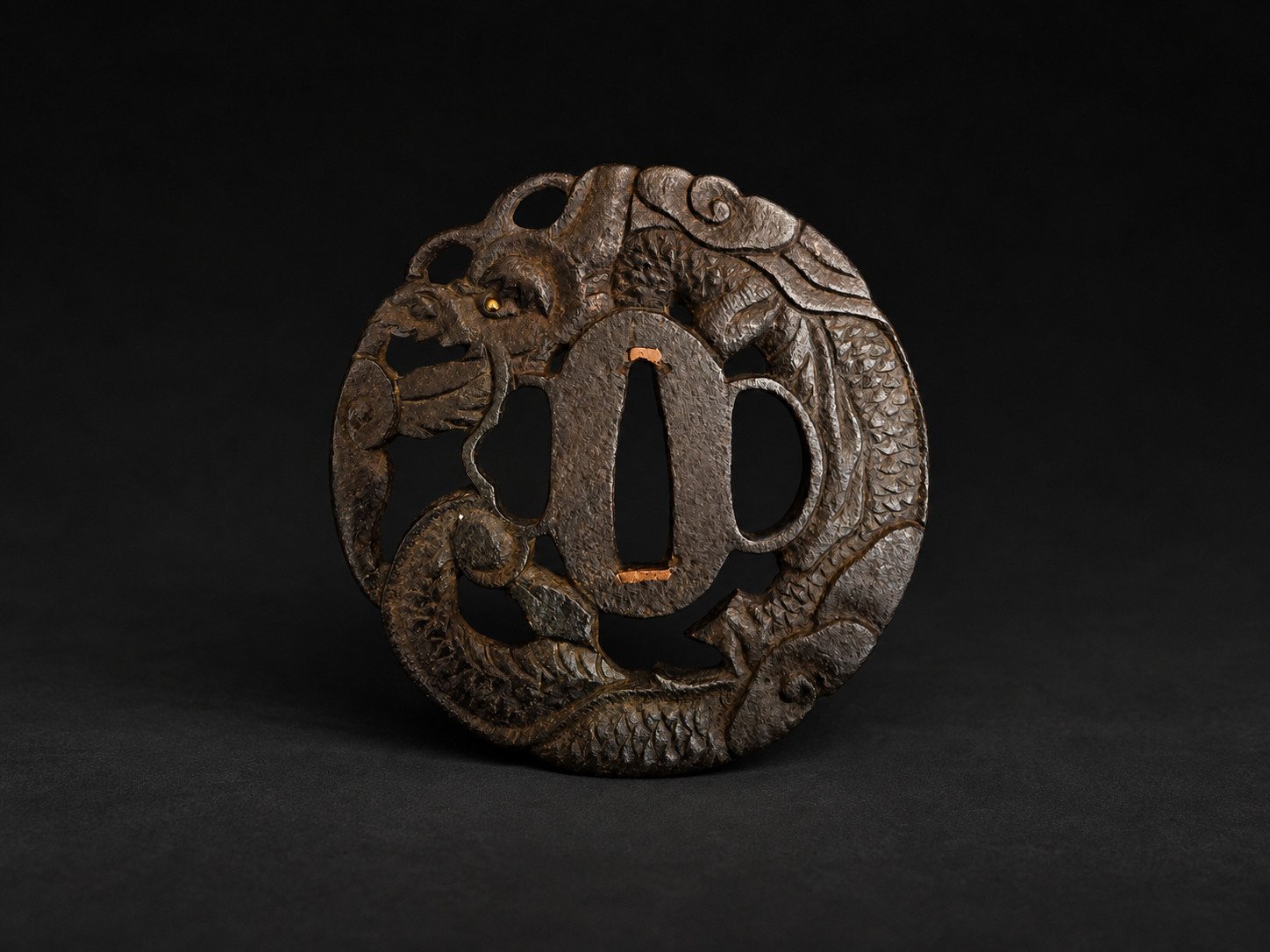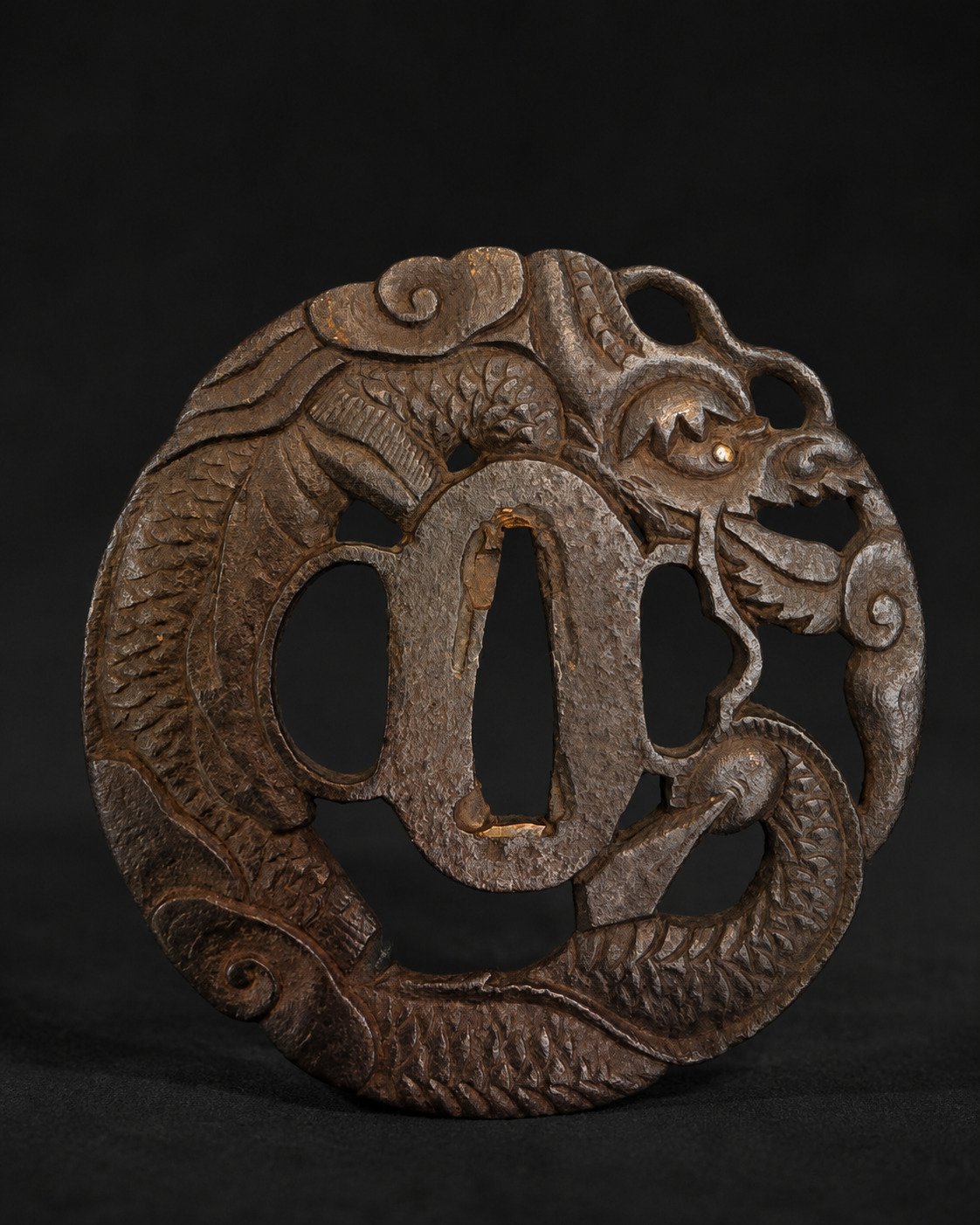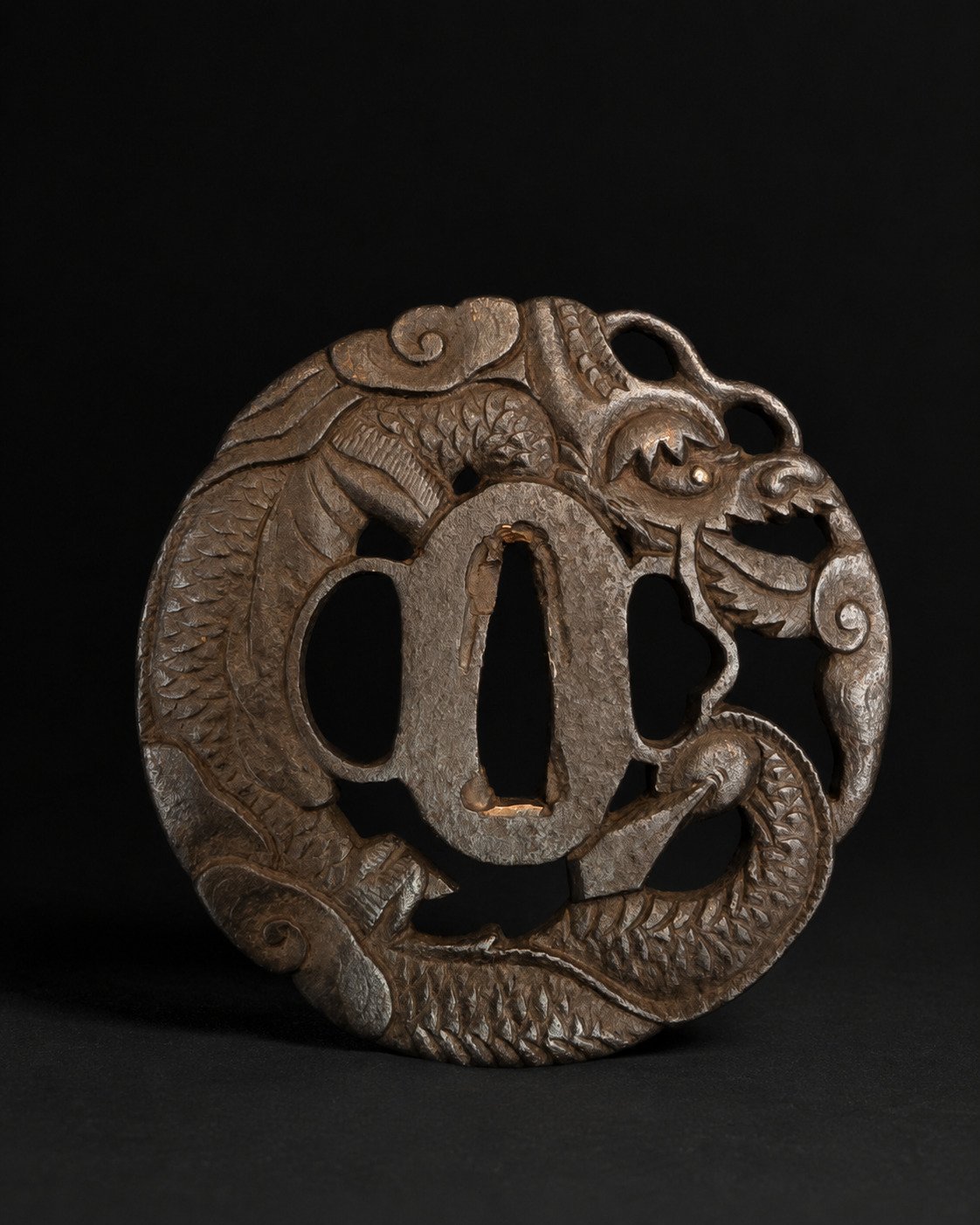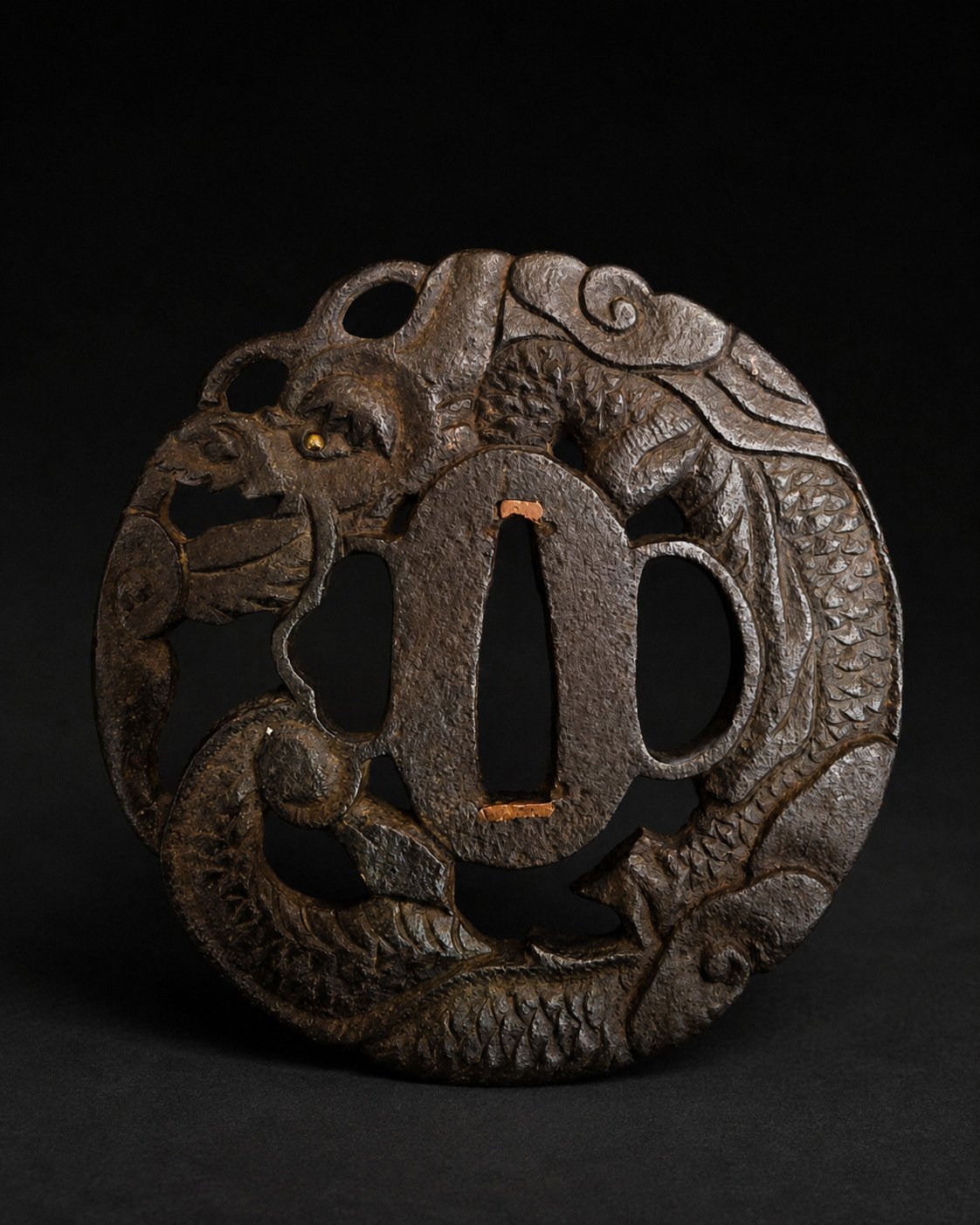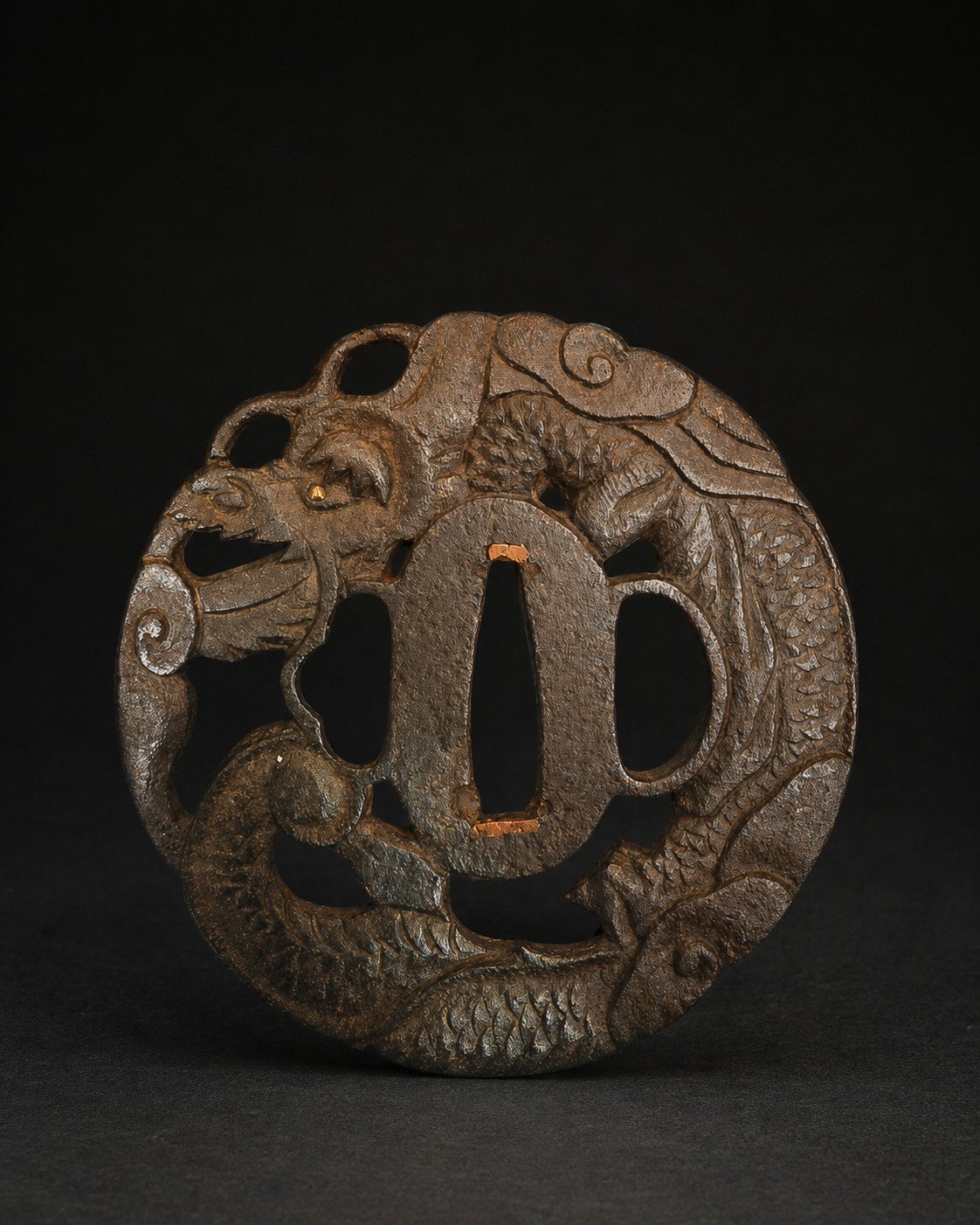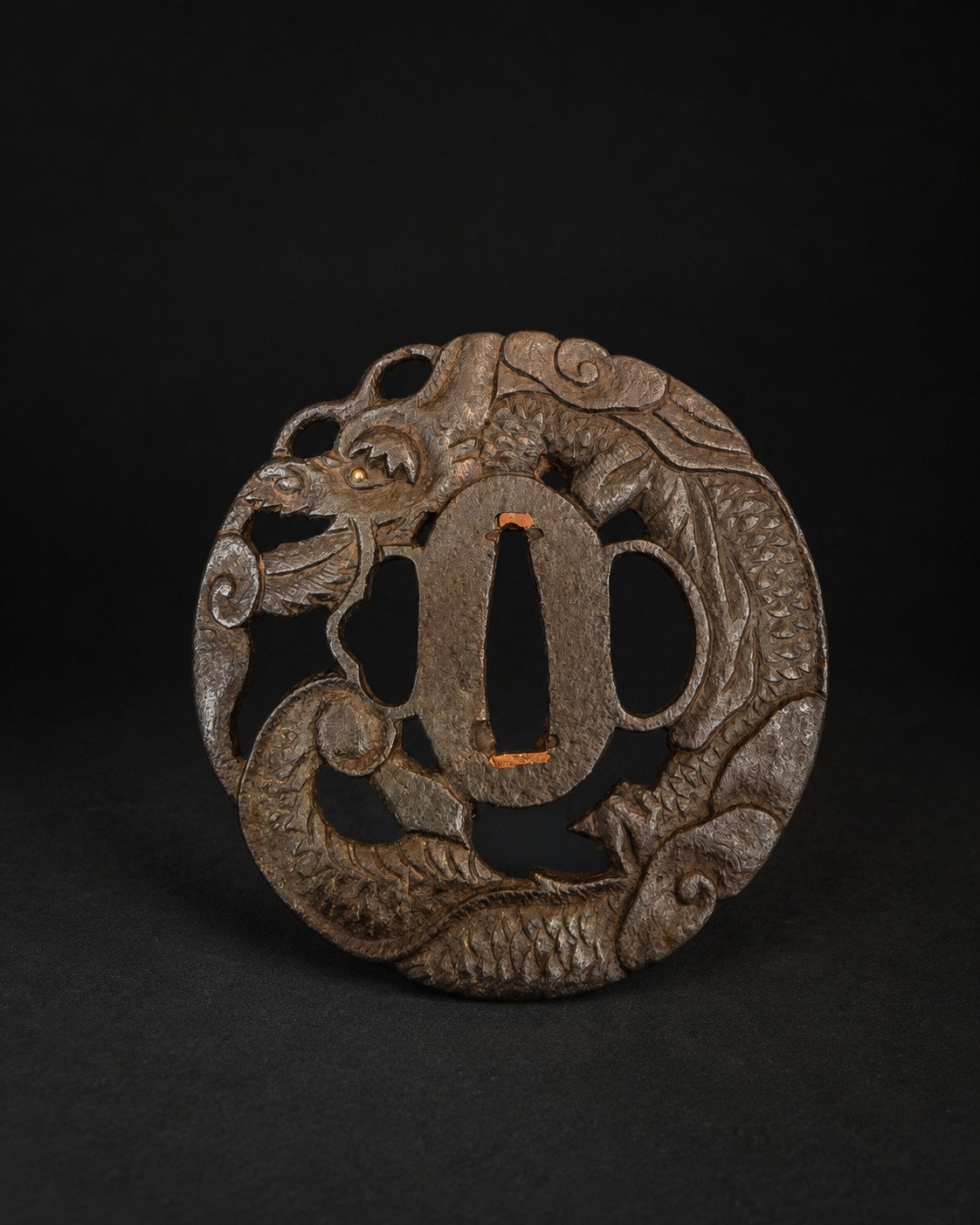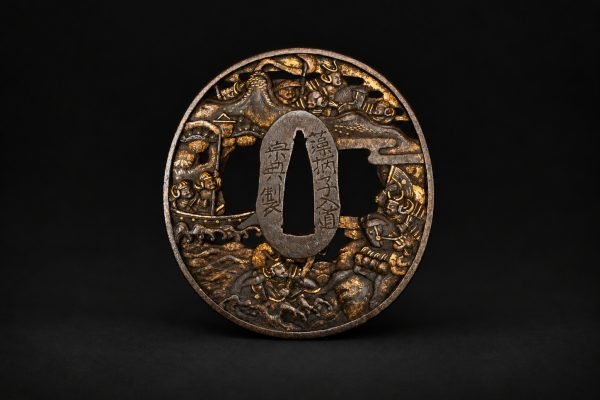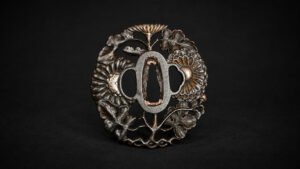
A striking Japanese maru-gata iron tsuba dominated by a powerful coiled dragon (ryū) worked in bold sculptural relief and extensive sukashi openwork.
The dragon winds around almost the entire perimeter of the guard, its sinuous body forming much of the outer composition and nearly encircling the central seppa-dai. The resulting design gives the impression that the creature itself has become the structural framework of the tsuba.
Deeply carved scales, cloud-like forms, open negative spaces and the dark surface of the iron create a highly tactile composition in which the dragon appears to emerge from and disappear back into the surrounding metal.
The principal subject is the dragon (ryū), one of the most enduring supernatural creatures in Japanese art and a motif ultimately derived from older Chinese iconographic traditions.
In Japanese culture, dragons are strongly associated with water, rain, storms, power and wisdom. Unlike the destructive dragons commonly encountered in later Western traditions, East Asian dragons often function as powerful supernatural beings connected with the forces of nature.
These associations made the dragon particularly appropriate for objects connected with the samurai world, where its combination of strength, authority and command over elemental forces carried considerable symbolic weight.
The dragon’s body follows a sweeping circular movement around the tsuba, creating an unusually cohesive design in which figure and structure are almost inseparable.
The head occupies the upper area of the composition and is rendered with considerable expression. The mouth opens to reveal prominent fangs, while the brow, mane and surrounding forms are worked into vigorous scrolling shapes reminiscent of clouds (kumo).
A small metallic element highlights the eye, giving the face a concentrated focal point against the otherwise dark iron surface. Its precise material cannot be determined from the available images.
From the head, the body curves downward around the central opening, continuing along the perimeter of the guard before terminating in a tightly curled spiral tail.
The dragon’s body is covered with repeated rows of small, sharply articulated scales. Their triangular and overlapping forms produce a dense textural rhythm across much of the surface.
This treatment contrasts strongly with the smoother scrolling forms of the mane, clouds and other surrounding elements, helping to distinguish the different anatomical and decorative zones despite the complexity of the composition.
The dark patination of the iron further enhances these differences in texture, particularly where light catches the raised edges of the scales and carved details.
The composition makes extensive use of sukashi, with substantial areas of the original iron plate removed to create open negative spaces between the dragon’s body, head, limbs and surrounding forms.
Rather than functioning as simple decoration applied to a solid plate, the dragon itself forms a significant part of the structural architecture of the tsuba.
This integration of sculpture and openwork gives the piece considerable visual depth. The background becomes visible through the design, emphasizing the winding movement of the dragon and allowing the silhouette of the creature to remain legible despite the density of the carving.
Several scrolling elements surrounding the dragon’s head and upper body resemble stylized cloud forms (kumo).
The combination of dragon and clouds is particularly appropriate within East Asian imagery, reinforcing the creature’s traditional connection with rain, storms and the heavens.
The smooth, curling forms also provide an effective visual contrast with the densely textured scales covering the dragon’s body.
At the centre of the composition is an oval seppa-dai with a comparatively restrained and finely textured iron surface.
The central nakago-ana retains visible copper sekigane at its upper and lower ends. These inserts were traditionally used to adjust the fit of the tsuba to the tang of a particular sword blade.
The presence of these sekigane is an important functional feature, showing that the guard was adapted for actual mounting rather than existing solely as a decorative object.
An auxiliary hitsu-ana is visible beside the seppa-dai and is naturally incorporated into the surrounding openwork.
Such apertures were used to accommodate fittings carried alongside the blade in a complete koshirae, most commonly the kozuka or kogai.
In this example, the irregular outline of the opening merges effectively with the dragon composition rather than interrupting it as an independent geometric element.
The visual character of the tsuba depends almost entirely on the treatment of the tetsuji. There is no need for extensive precious-metal ornamentation: the principal effects are achieved through carving, relief, pierced space and differences in surface texture.
The dragon’s scales, facial features and body possess considerable sculptural presence, while the surrounding open areas prevent the composition from becoming visually heavy.
The result is a guard that is both technically functional and strongly pictorial, transforming the circular format of the tsuba into a continuous representation of a dragon in motion.
No confirmed maker’s signature or mei has been provided for this piece. It should therefore be treated as mumei unless further examination establishes otherwise.
Without a signature or an attribution certificate from an organization such as the NBTHK or NTHK, assigning the tsuba to a specific school or maker would be speculative.
A reliable attribution would require direct examination of the iron, construction, carving technique and surface, ideally followed by submission to an appropriate shinsa.
This tsuba is particularly notable for the degree to which the dragon motif has been integrated into the physical structure of the guard.
Rather than presenting the ryū as a small isolated decoration, the artist has allowed its body to dominate almost the entire circumference, creating a continuous sculptural composition of scales, clouds, open spaces and powerful curves.
The copper sekigane, functional hitsu-ana and deeply worked iron preserve the character of a genuine sword fitting, while the expressive dragon imagery gives the piece considerable decorative and symbolic presence.
A powerful iron sukashi tsuba dominated by a coiled dragon whose body winds around almost the entire perimeter of the guard. Deeply carved scales, expressive facial features, cloud-like scrolls and extensive openwork create a strongly sculptural composition, while the copper sekigane and functional hitsu-ana preserve clear evidence of its original role as a Japanese sword fitting. An impressive example of the dragon motif translated into iron through relief, texture and negative space.

Order above 1.000,00 € gets free shipping.

Secure and hassle-free payment process.

Certificate of authenticity included.

Have questions? Contact us via WhatsApp.
Contact