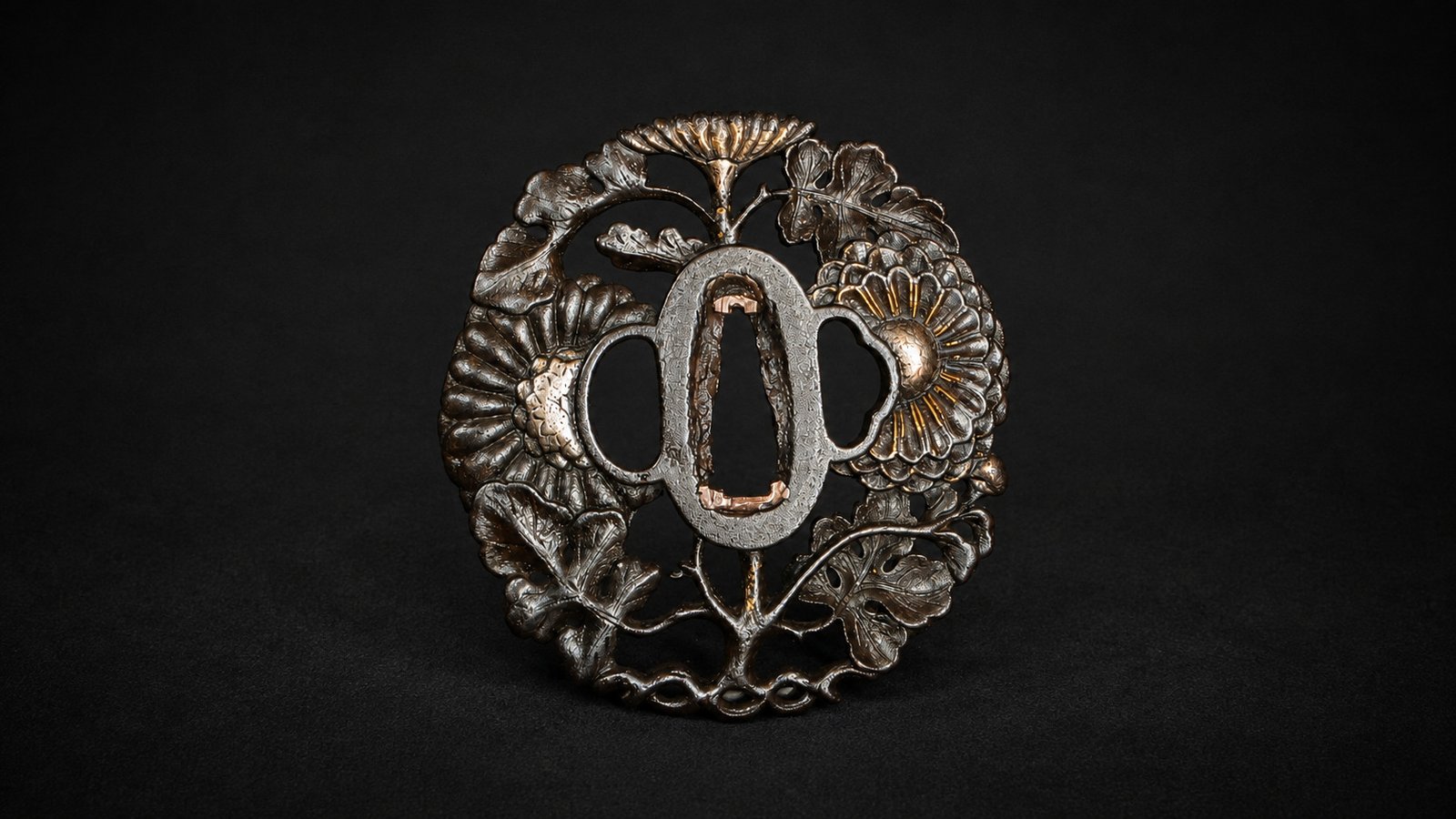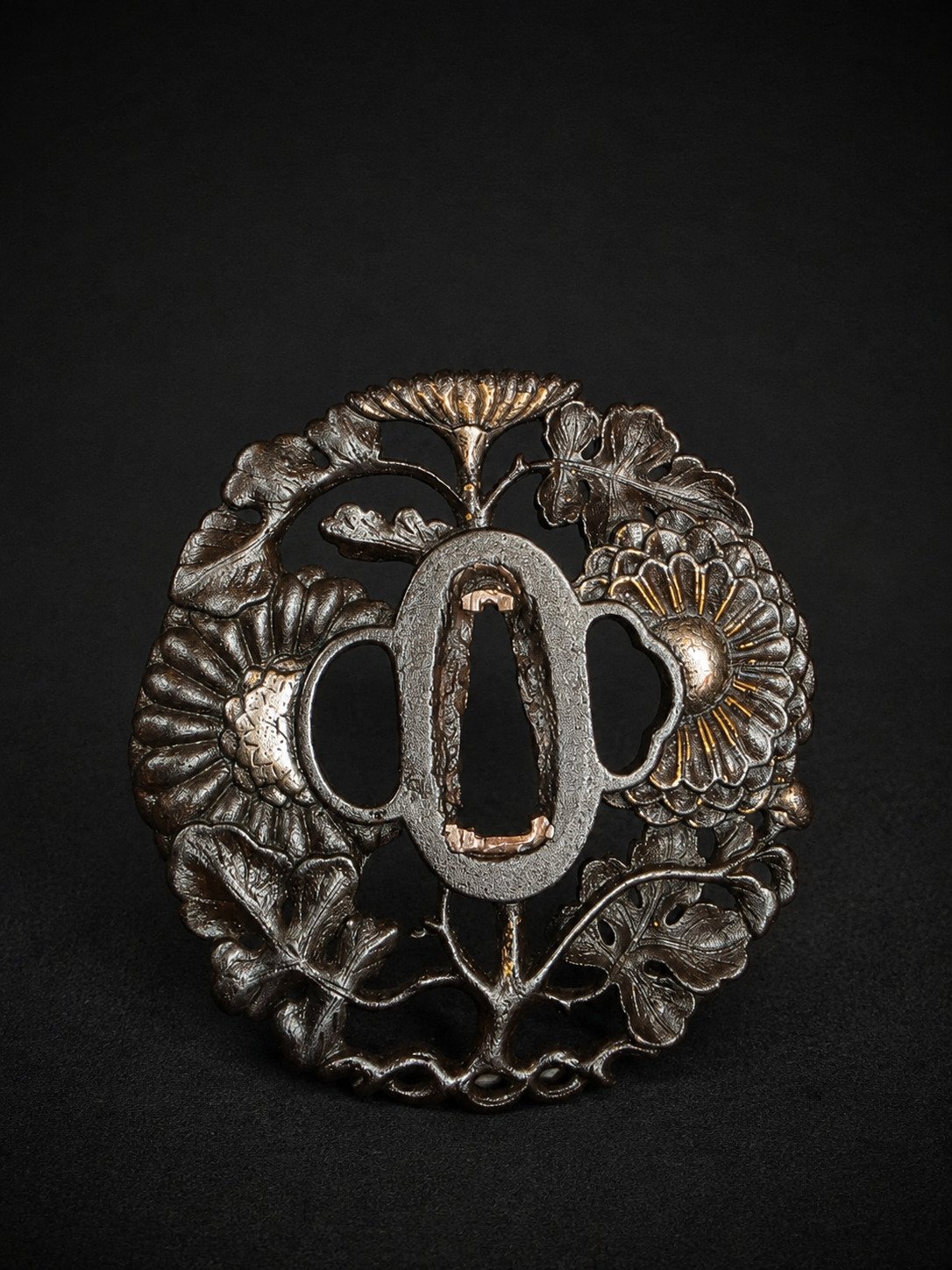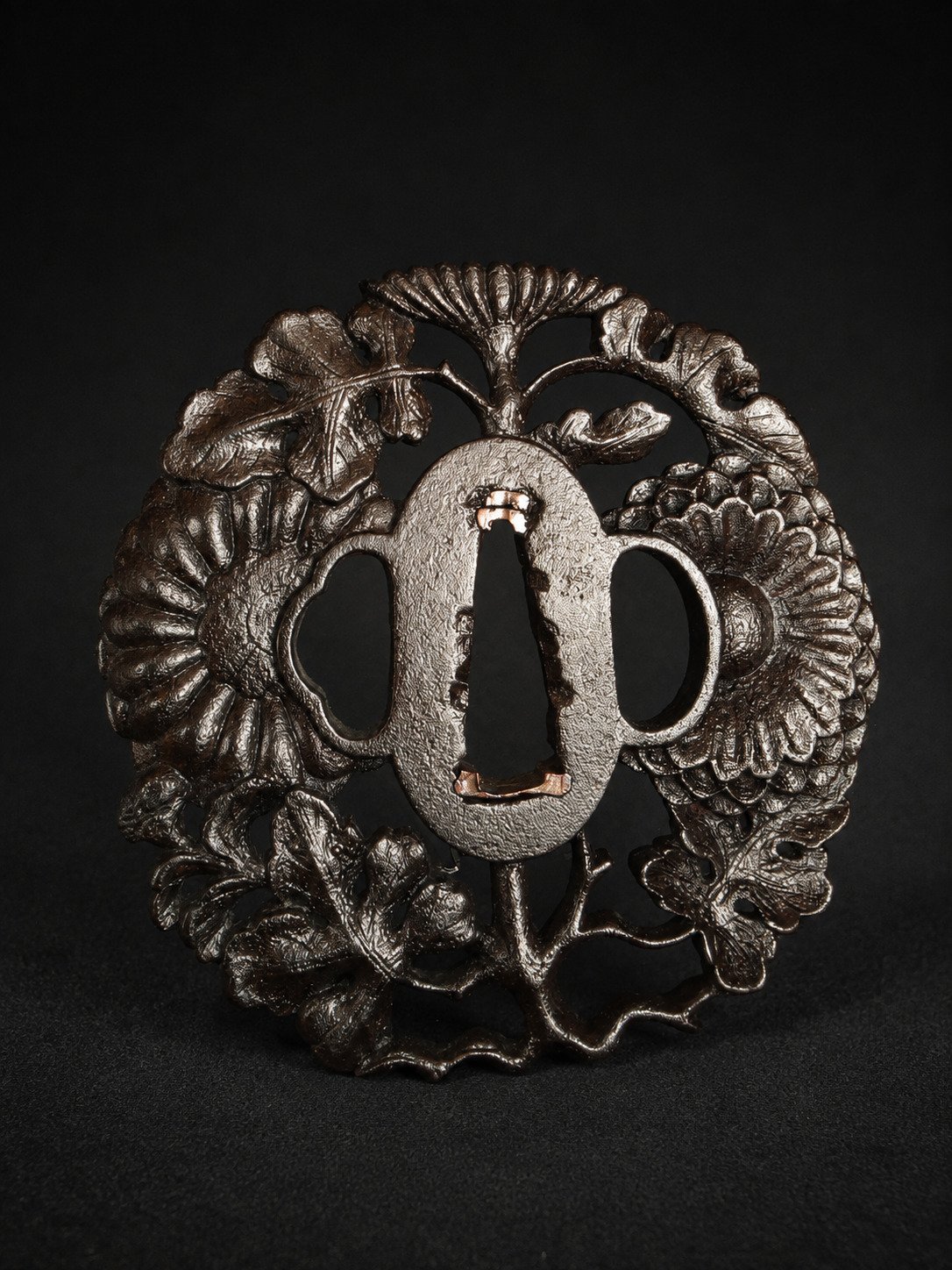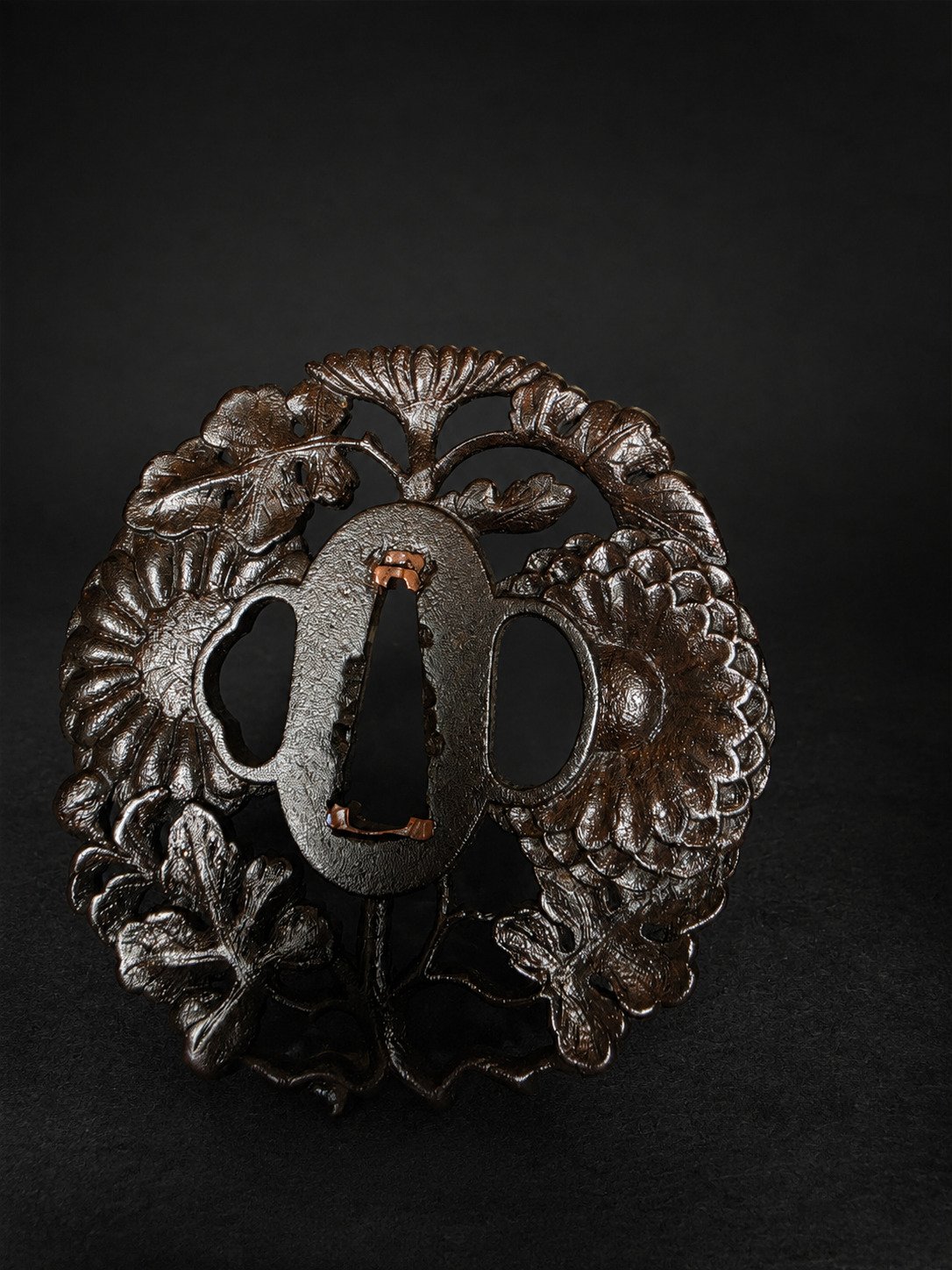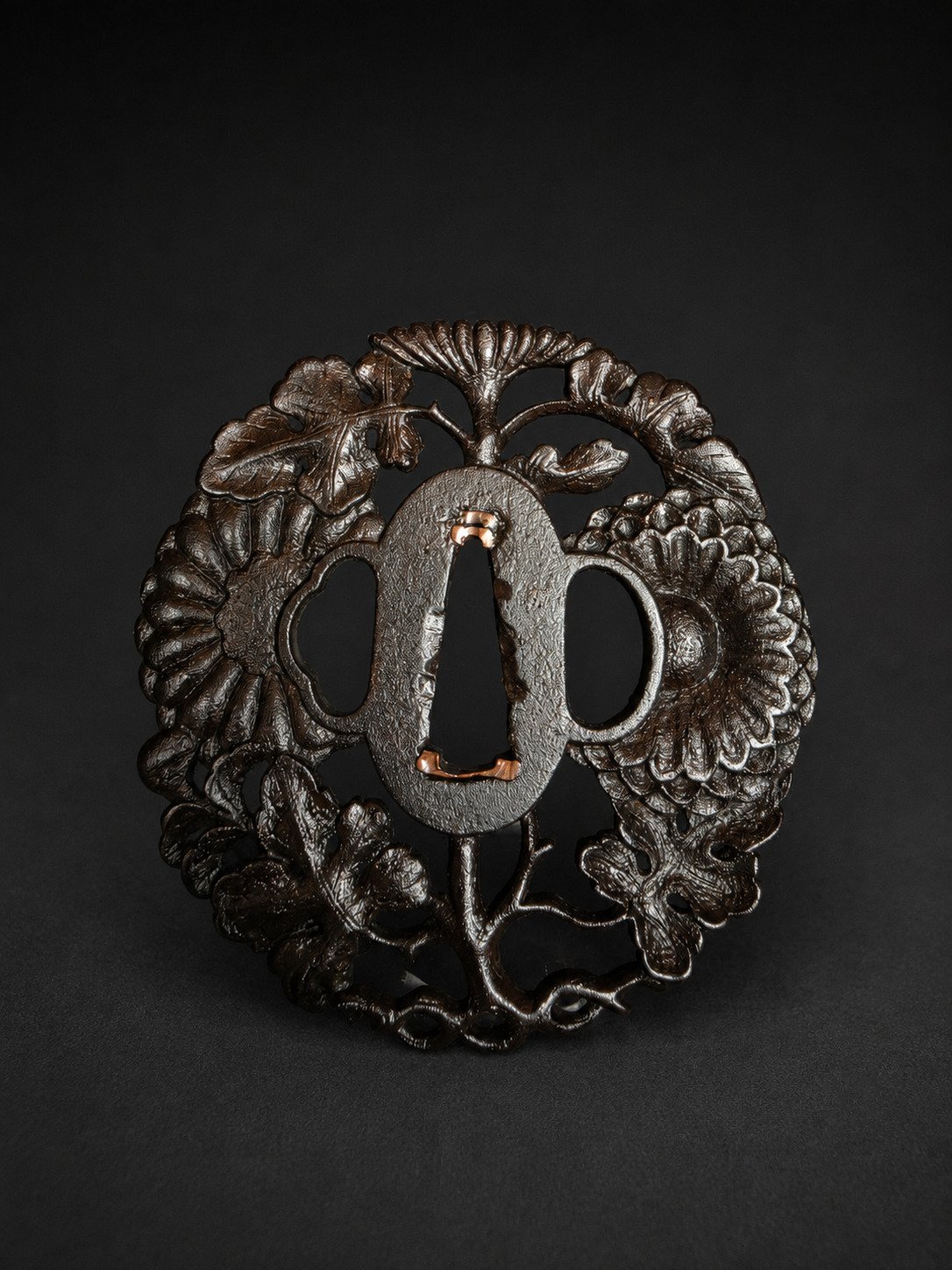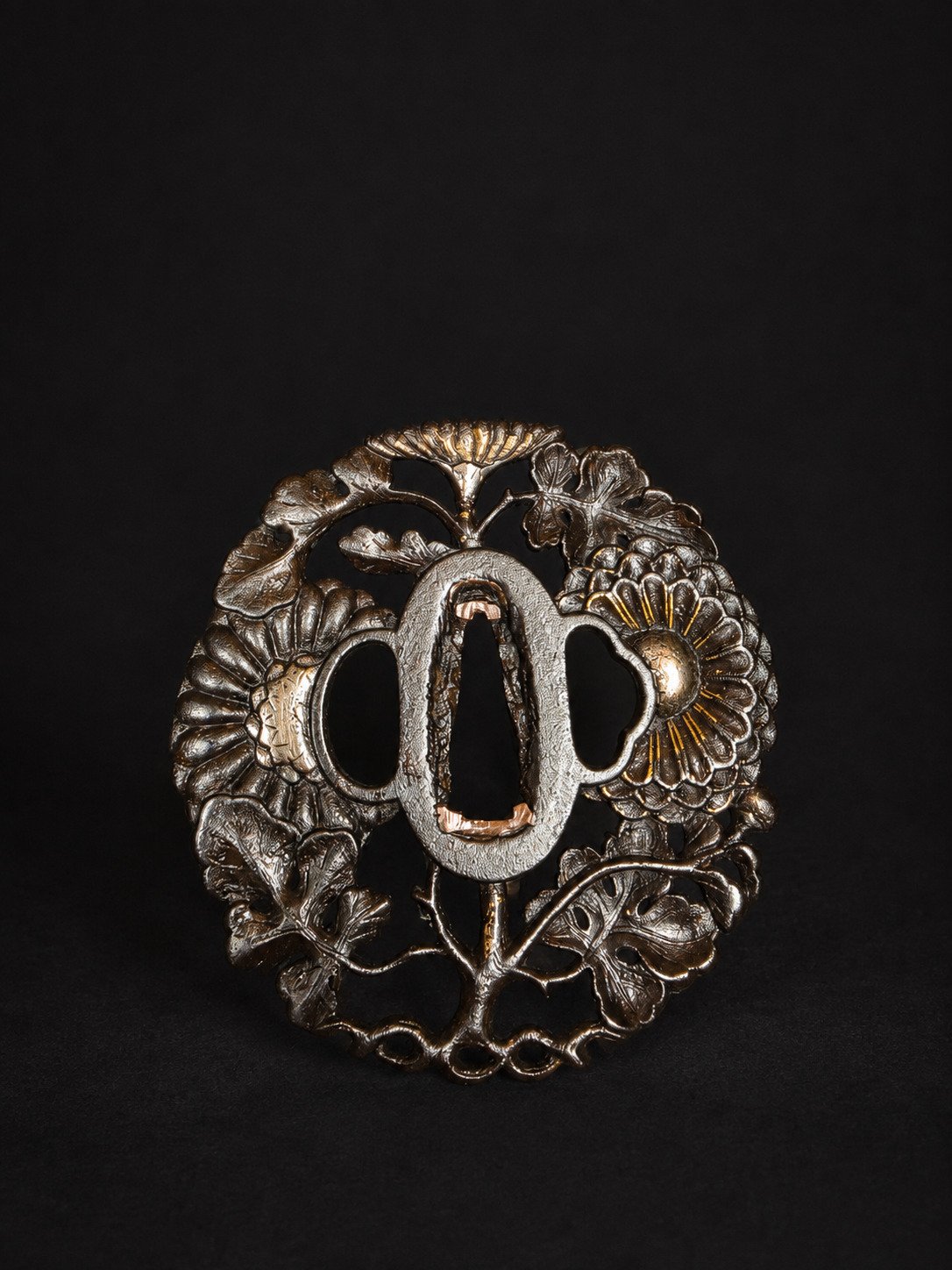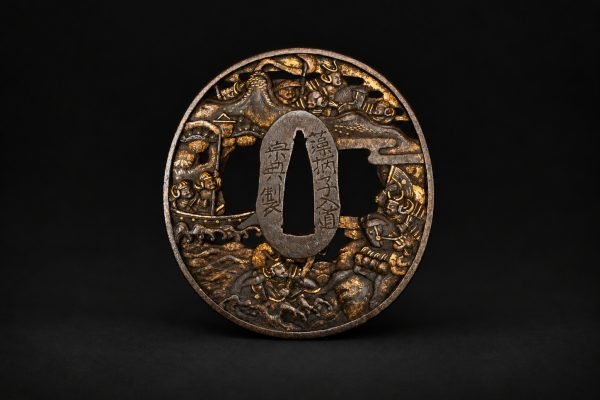
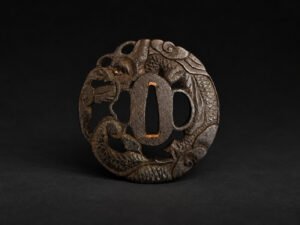
An elegant Japanese maru-gata iron tsuba worked in an unusually dense and sculptural sukashi composition, combining large chrysanthemums (kiku) with branching foliage identified stylistically as kashiwa oak leaves and small acorn-like forms (donguri).
The design occupies almost the entire surface of the guard. Two prominent chrysanthemum blossoms flank the central seppa-dai, while stems, leaves and smaller botanical elements weave continuously around them to form an intricate openwork structure.
Rather than relying on precious-metal decoration, the visual impact of the piece comes from the quality of the iron itself and from the contrast between deeply pierced negative spaces, rounded relief carving and the dark patinated surface.
The two large chrysanthemums (kiku) provide the principal visual anchors of the composition.
Each flower is modelled with strongly articulated petals radiating from a pronounced central disc. The petals are not merely incised into the iron but individually shaped in relief, producing a substantial and highly tactile surface.
The chrysanthemum has a particularly important place in Japanese visual culture and has long been associated with longevity, autumn and refined decorative traditions. Its repeated petals also lend themselves especially well to three-dimensional metal carving.
Surrounding the chrysanthemums is a dense network of branches and broad lobed leaves consistent with representations of kashiwa, the Japanese oak.
Among the foliage appear small rounded forms that can plausibly be read as acorns (donguri), strengthening the autumnal botanical character of the composition.
The oak had strong associations with continuity and endurance in Japanese decorative culture. Kashiwa leaves also became an established heraldic motif, appearing in numerous family crests (kamon).
The identification of the smaller rounded elements as acorns is based on their relationship to the surrounding oak-like foliage and should be understood as an iconographic reading rather than a documented inscription of the subject.
The most striking technical feature is the extensive use of sukashi openwork. Much of the original iron plate has been removed, leaving a complex network of flowers, branches and leaves connected directly to the outer rim and central structure.
This treatment allows light and the background to become part of the design. Against a dark setting, the negative spaces clearly separate the individual botanical elements and emphasize the remarkable density of the composition.
The flowers themselves retain considerably more volume than the connecting branches and foliage, creating a deliberate contrast between open pierced areas and more heavily modelled relief.
The carving demonstrates a strong understanding of volume. The chrysanthemum petals swell outward from the surface, while the leaves are shaped with pronounced ridges, folded edges and incised veins.
Branches move organically through the design rather than following a rigid geometric framework, producing a naturalistic composition despite the structural requirements of the openwork.
The absence of extensive gold, silver or other precious-metal inlay places particular emphasis on the quality of the tetsuji, the carving and the dark surface patina.
The central seppa-dai is oval in form and displays a finely textured, granular iron surface that contrasts with the surrounding sculptural decoration.
At the centre is the nakago-ana, the aperture through which the tang of the sword blade originally passed.
Visible at the upper and lower ends of the nakago-ana are copper sekigane, inserted adjustments traditionally used to modify the fit of a tsuba to a particular sword tang.
The presence of these adjustments is an important functional detail, showing that the guard was fitted for actual mounting on a sword rather than conceived simply as an ornamental object.
On either side of the seppa-dai are two irregularly oval auxiliary openings collectively known as ryō-hitsu.
These openings were traditionally associated with the passage of fittings such as the kozuka and kogai when the tsuba was installed as part of a complete koshirae.
Here they have been incorporated naturally into the botanical composition, their contours merging visually with the surrounding leaves and branches rather than appearing as isolated geometric apertures.
No visible mei or maker’s signature is present in the available views, and the tsuba should therefore be described as mumei (unsigned).
Unsigned iron tsuba are common across numerous Japanese schools and regional traditions, and the absence of a signature does not in itself establish a particular workshop or period.
For this reason, any school attribution must rely principally on workmanship, iron quality, construction, design vocabulary and comparison with authenticated examples.
The combination of dense botanical openwork, substantial iron, deeply modelled relief and an absence of conspicuous precious-metal inlay recalls aspects of several important Japanese iron-tsuba traditions.
In particular, elements may invite comparison with Owari and Kanayama work, both celebrated for strong iron and bold openwork compositions. Certain later regional workshops and traditions influenced by this vocabulary should also remain under consideration.
However, the present piece is unsigned and is not accompanied by an NBTHK or NTHK attribution certificate. These comparisons should therefore be understood only as stylistic references and not as a definitive attribution to Owari, Kanayama, Ko-Mino or any other specific school.
A reliable school and period attribution would require direct specialist examination and, ideally, submission to an appropriate shinsa.
This tsuba is particularly appealing for the way it transforms a botanical subject into a strongly three-dimensional iron composition.
The combination of large sculptural chrysanthemums, densely interwoven foliage, extensive sukashi and surviving functional features such as the copper sekigane gives the piece both decorative richness and clear evidence of its original role as a sword fitting.
Its unsigned status also makes the workmanship itself the principal focus: the quality of the iron, control of negative space and integration of flowers, leaves and functional apertures can be appreciated without relying on a prestigious signature or attribution.
A finely worked mumei iron sukashi tsuba built around two prominent chrysanthemums surrounded by an intricate network of kashiwa-type oak leaves, branches and probable acorns. Deep openwork contrasts with strongly modelled floral relief, while the copper sekigane and integrated ryō-hitsu preserve clear evidence of its functional use as a Japanese sword guard. Although the workmanship invites comparison with important iron sukashi traditions such as Owari and Kanayama, the absence of a signature or authentication paper makes any specific school attribution necessarily provisional.

Order above 1.000,00 € gets free shipping.

Secure and hassle-free payment process.

Certificate of authenticity included.

Have questions? Contact us via WhatsApp.
Contact