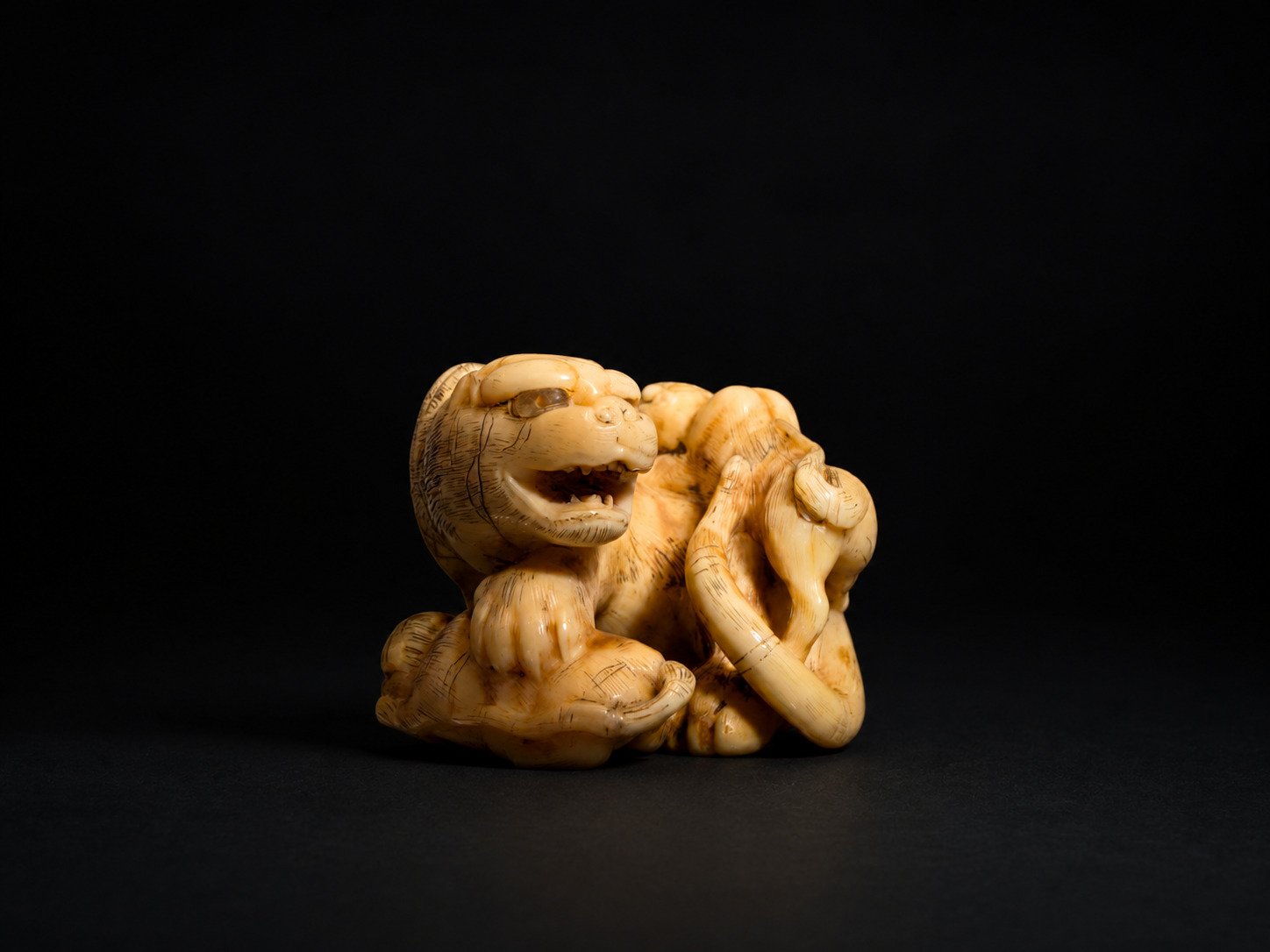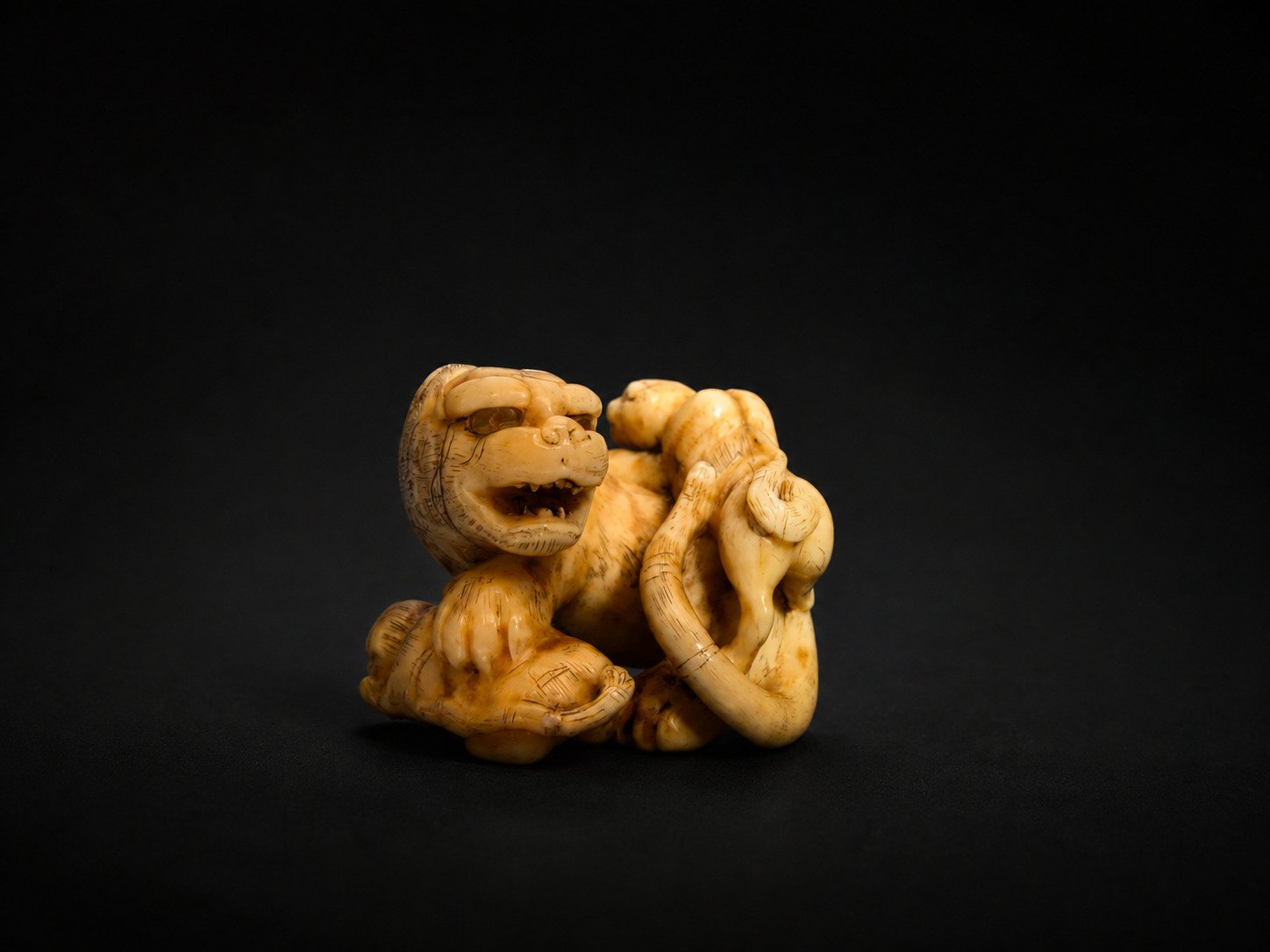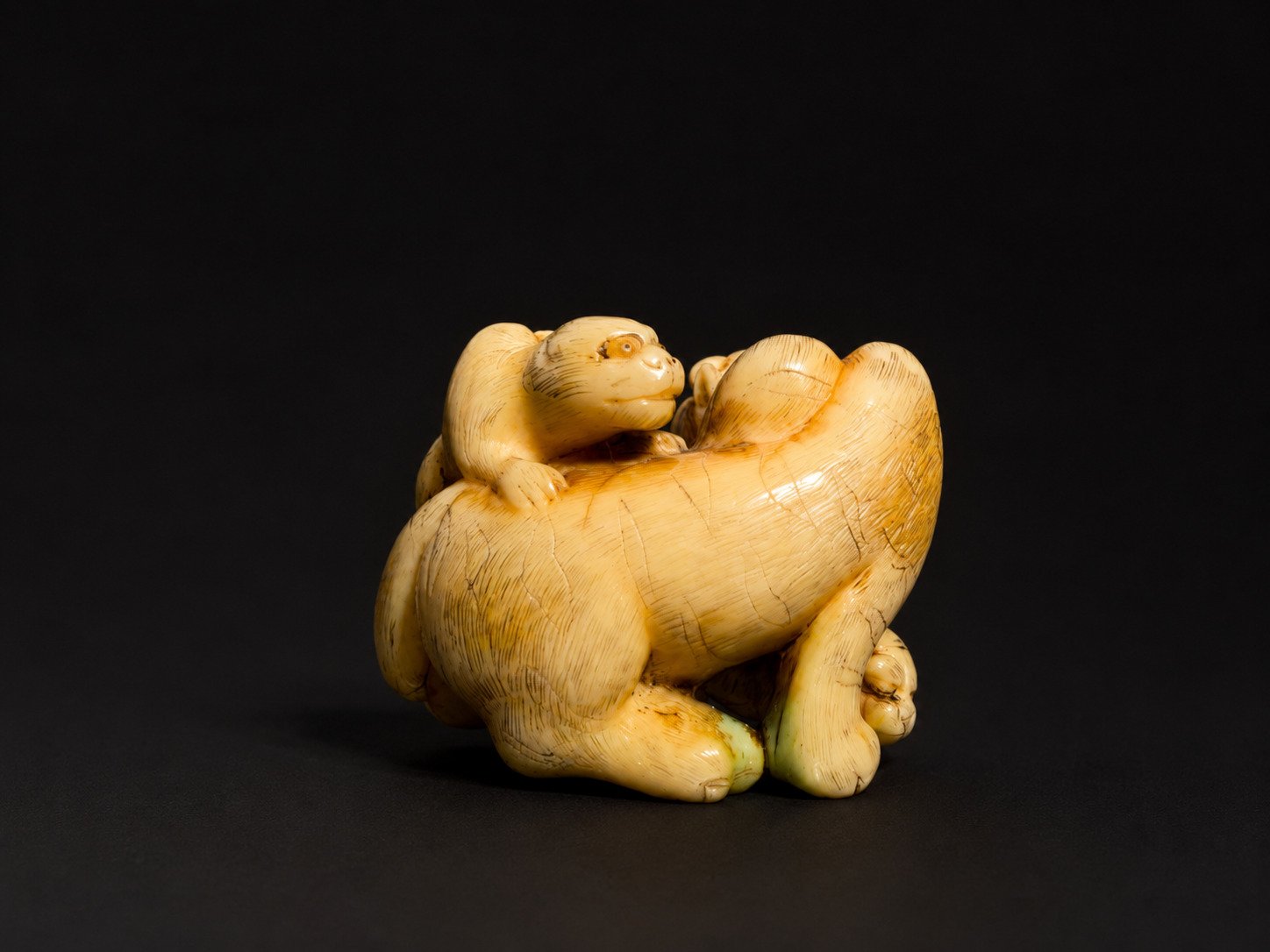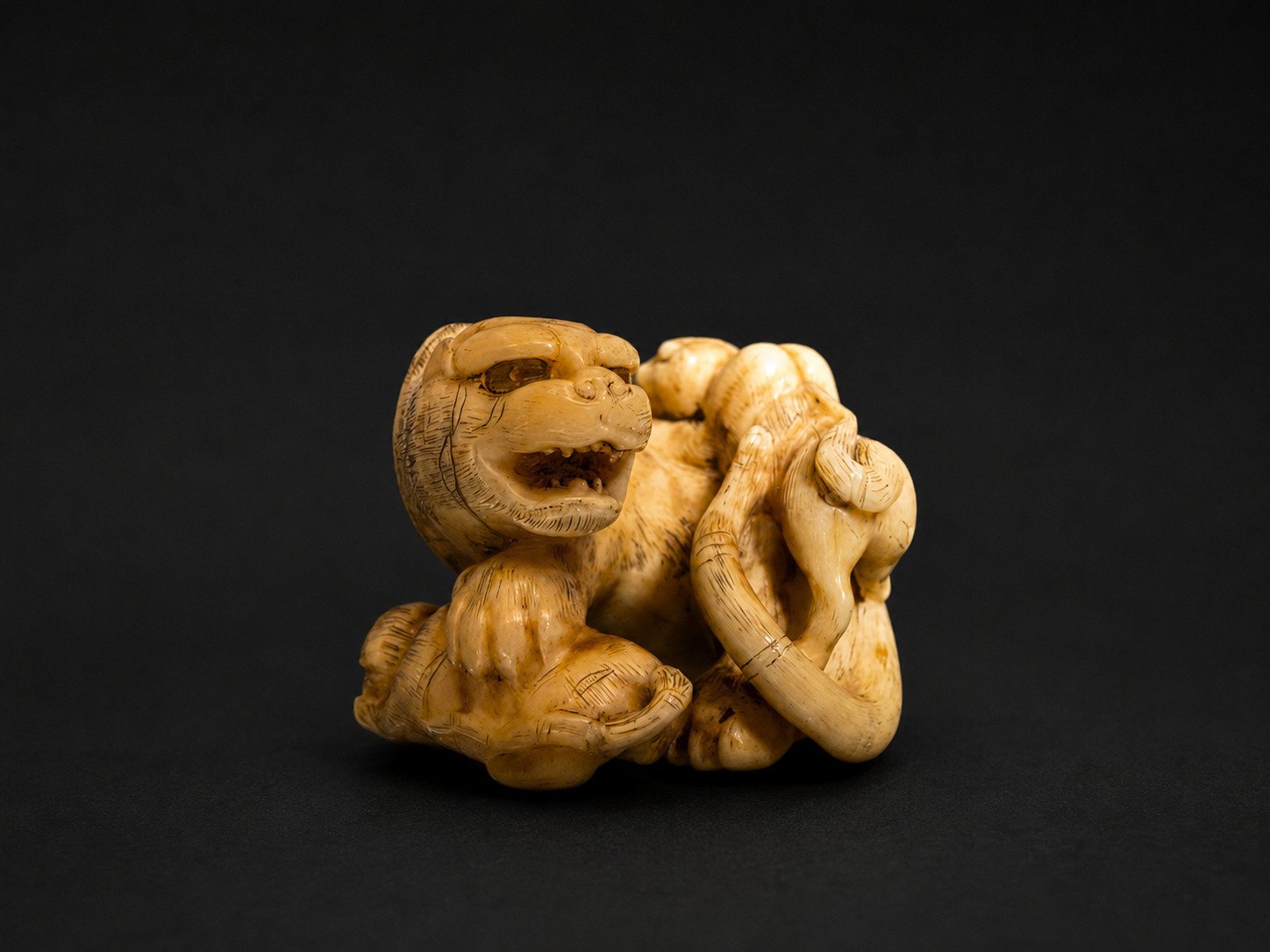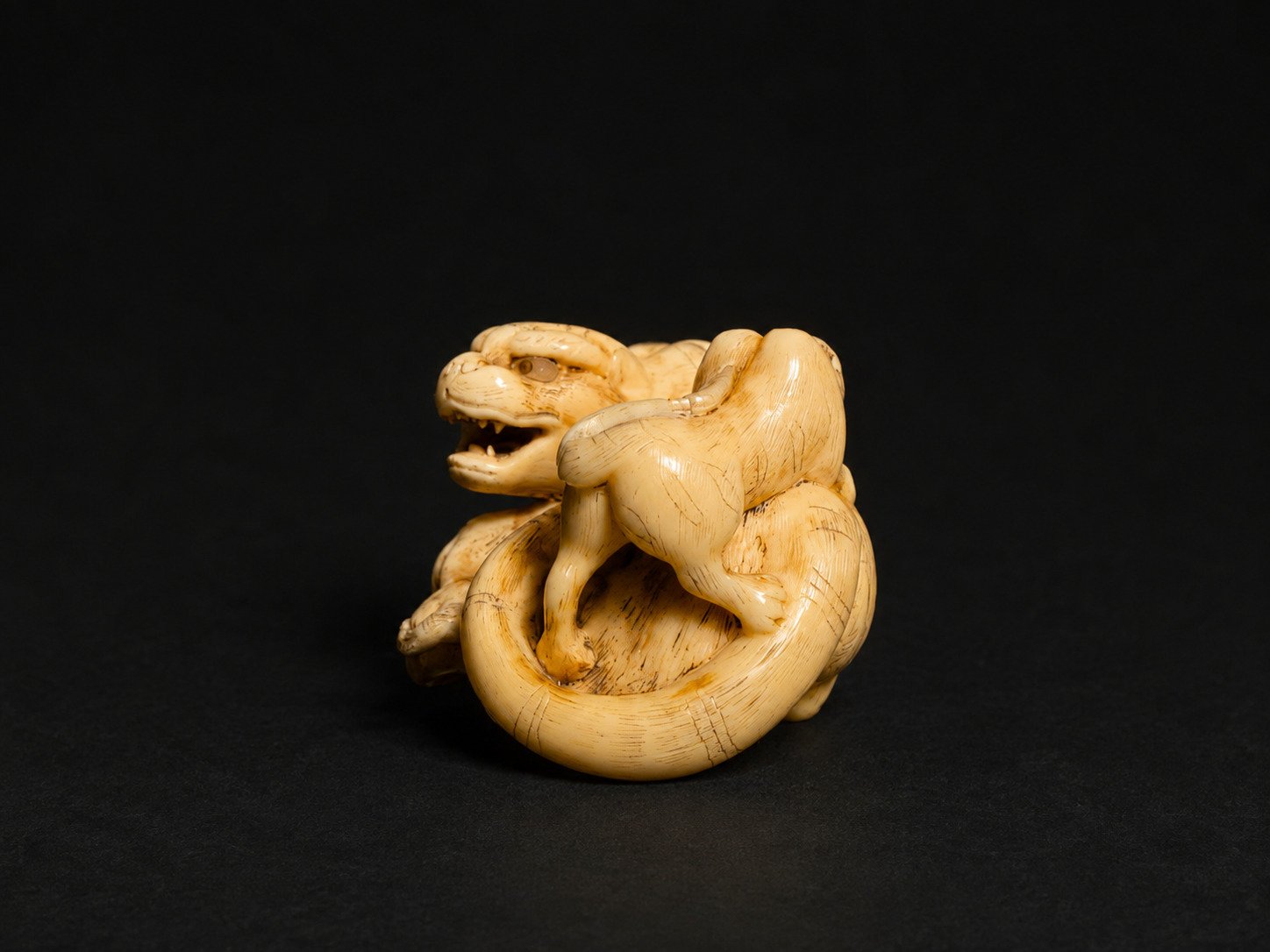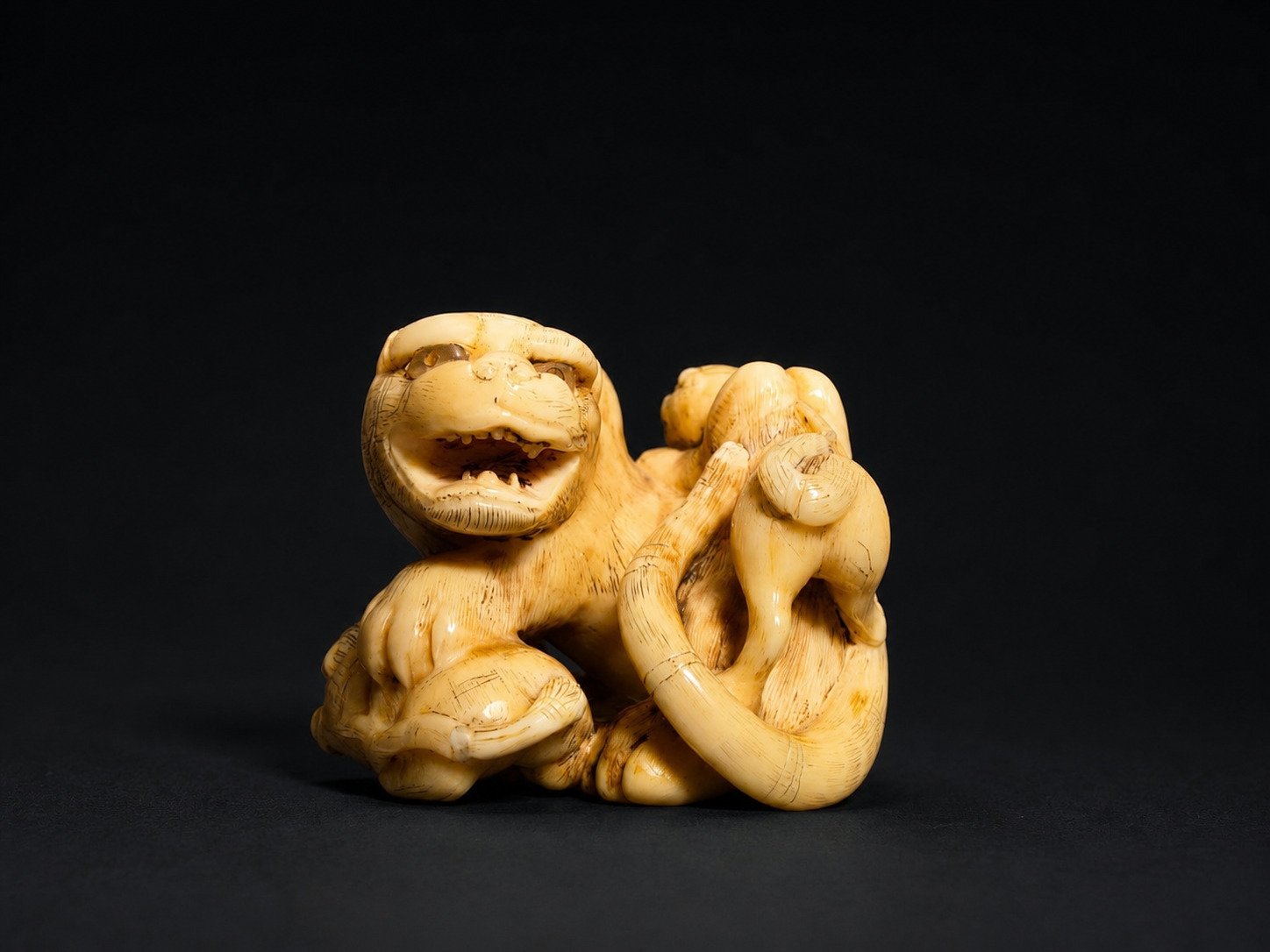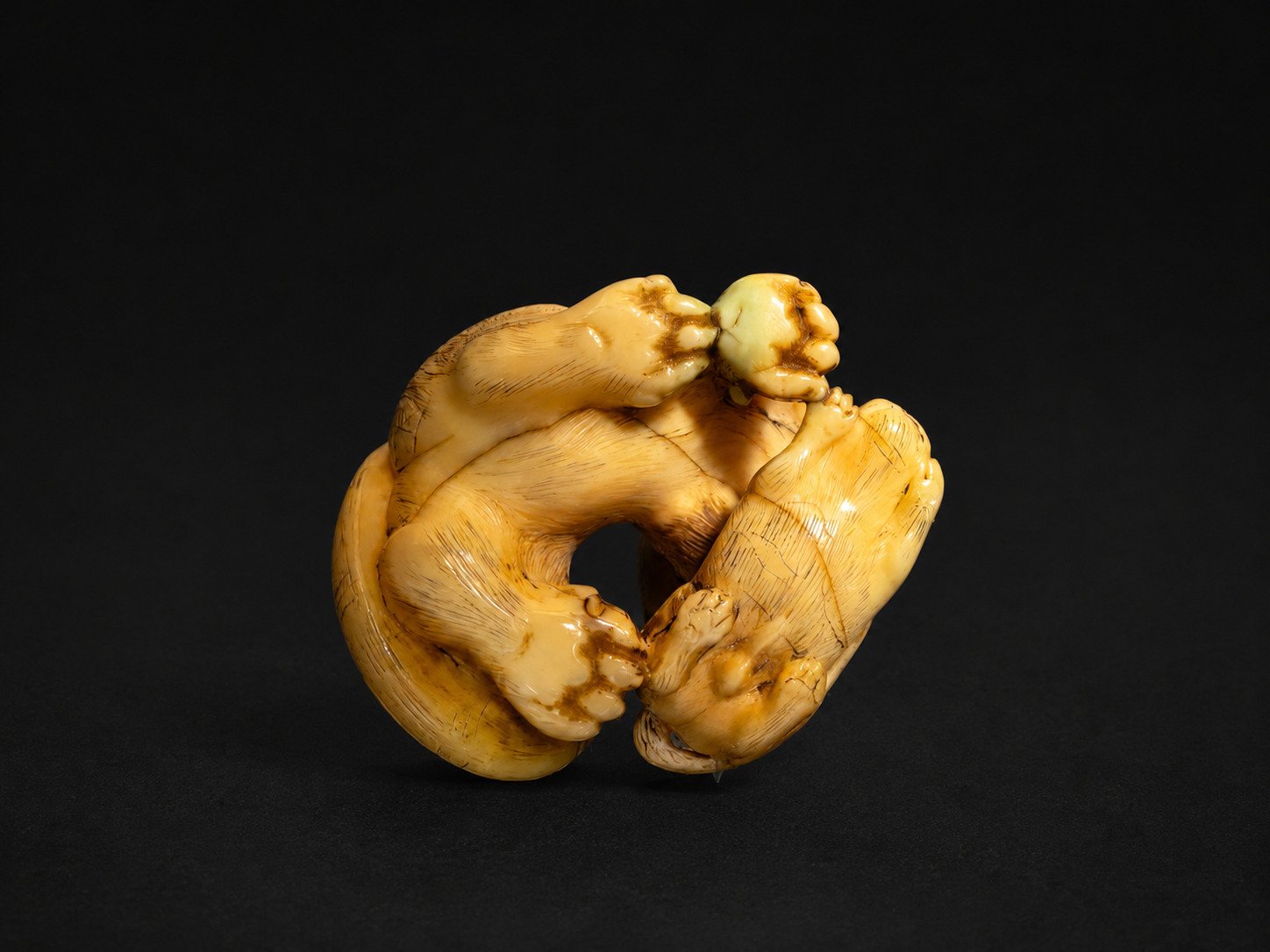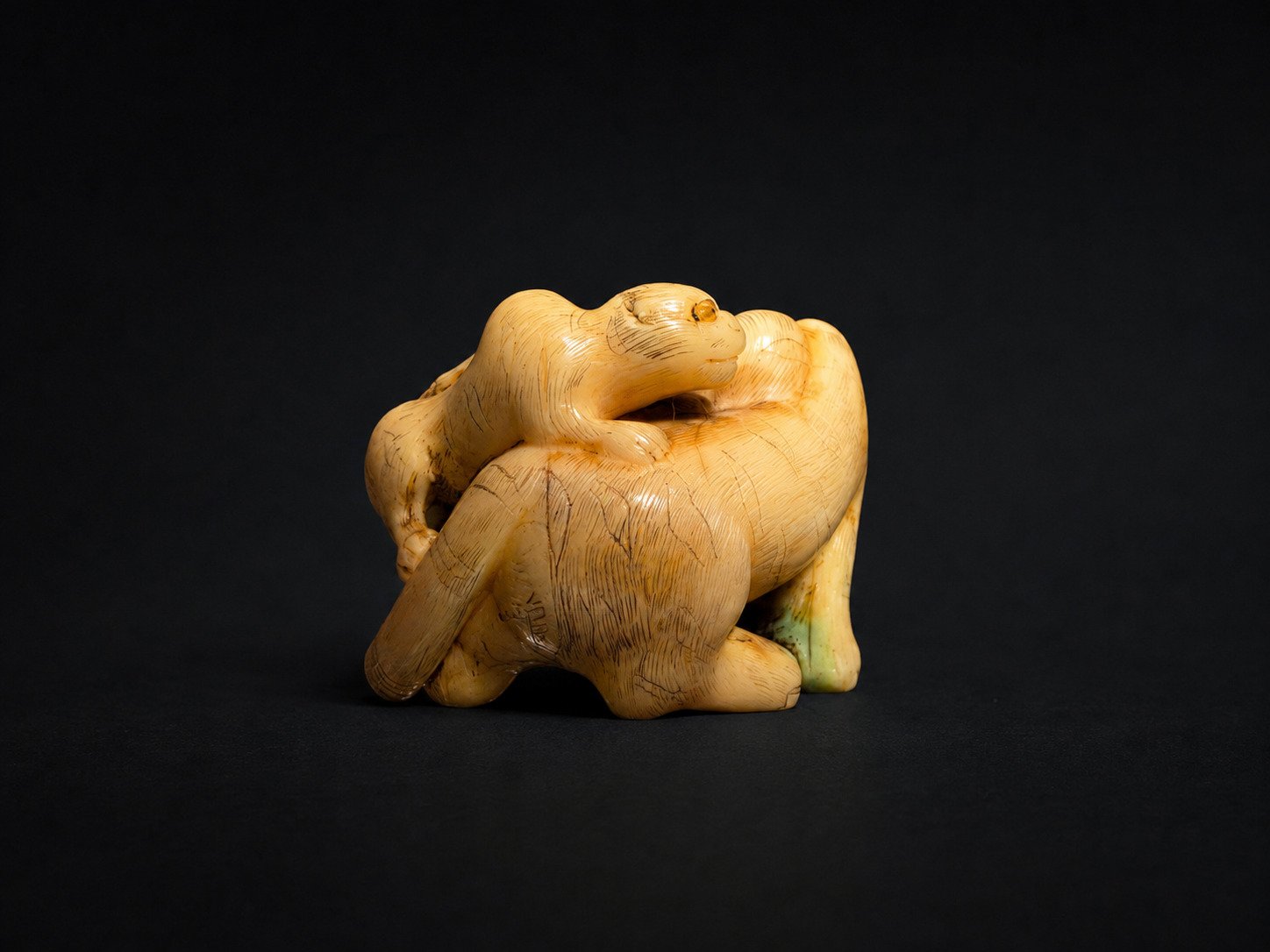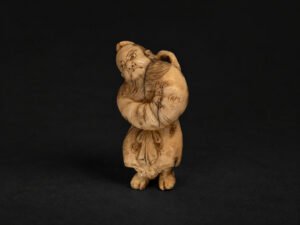
An exceptional Japanese katabori netsuke carved from walrus ivory (seiuchi no kiba), dating to the Edo period and depicting a powerful tora (tiger) curled around itself together with two cubs.
The compact group combines the strength and ferocity traditionally associated with the tiger with an intimate family scene. The adult animal forms the principal sculptural mass, while the two smaller cubs emerge closely around its body, creating a dense and highly tactile composition intended to be appreciated from multiple viewpoints.
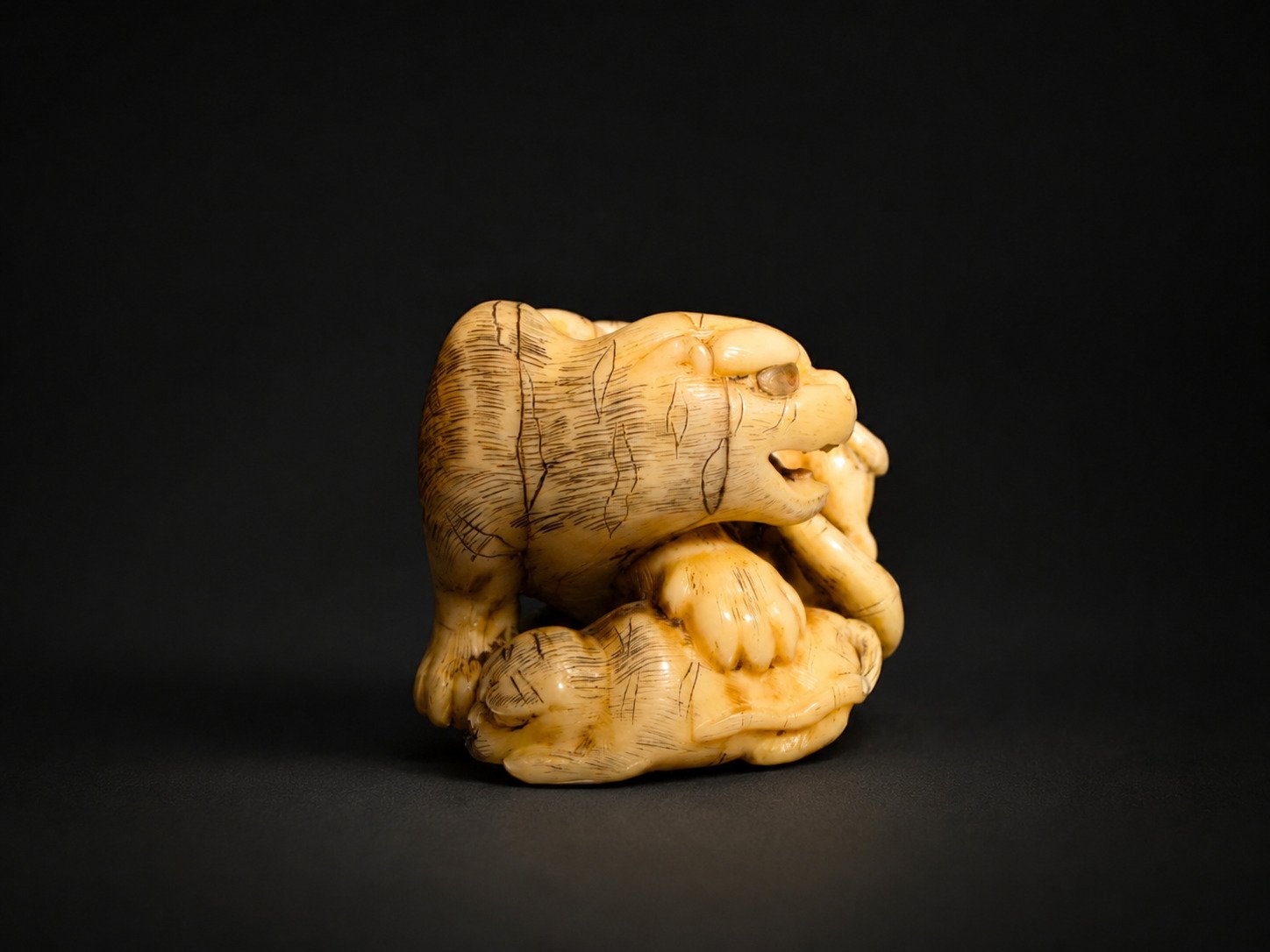
The warm cream to honey-toned surface of the walrus ivory is animated by finely engraved hair details, darker coloration retained within the recesses and the striking contrast of the tiger’s glass-inlaid eyes.
The principal tora dominates the composition, its powerful body curled into a compact circular form. The tail bends back around the hindquarters, helping close the silhouette and visually bind the group together.
The head turns outward toward the viewer with a distinctly fierce expression. The mouth is open in a snarl, revealing individually carved teeth and deeply worked gums, while the strongly furrowed brow intensifies the animal’s alert and threatening character.
The eyes are enhanced with glass inlays, giving the tiger’s gaze a vivid and unusually lifelike quality. Their reflective character provides a strong visual contrast with the warm surface of the walrus ivory and draws immediate attention to the expressive face.
The paws are solidly modelled and firmly integrated into the coiled body, with individual claws clearly defined.
Two smaller tigers are incorporated closely into the adult animal’s body. One cub appears beside the shoulder of the principal tiger, its head emerging from within the compact group, while the second nestles against the larger body.
Their presence softens the aggressive character of the adult tiger and introduces a strong sense of intimacy to the composition. Rather than presenting the tiger purely as a symbol of ferocity, the group combines strength with protection and familial attachment.
The arrangement of the cubs also contributes significantly to the sculptural complexity of the netsuke, with the three bodies interwoven into a single compact volume.
The tiger (tora) occupies an important place in Japanese visual culture despite not being native to the Japanese archipelago. Knowledge of the animal reached Japan through continental Asian art, literature and imported imagery, where the tiger became associated with strength, courage, authority and protection.
In painting, sculpture and decorative arts, Japanese artists developed highly stylised interpretations of the animal, often emphasising powerful paws, expressive faces, dynamic bodies and dramatically patterned coats.
The addition of cubs gives the traditional symbolism another dimension, allowing the tiger to embody not only physical power but also guardianship and the protection of its young.
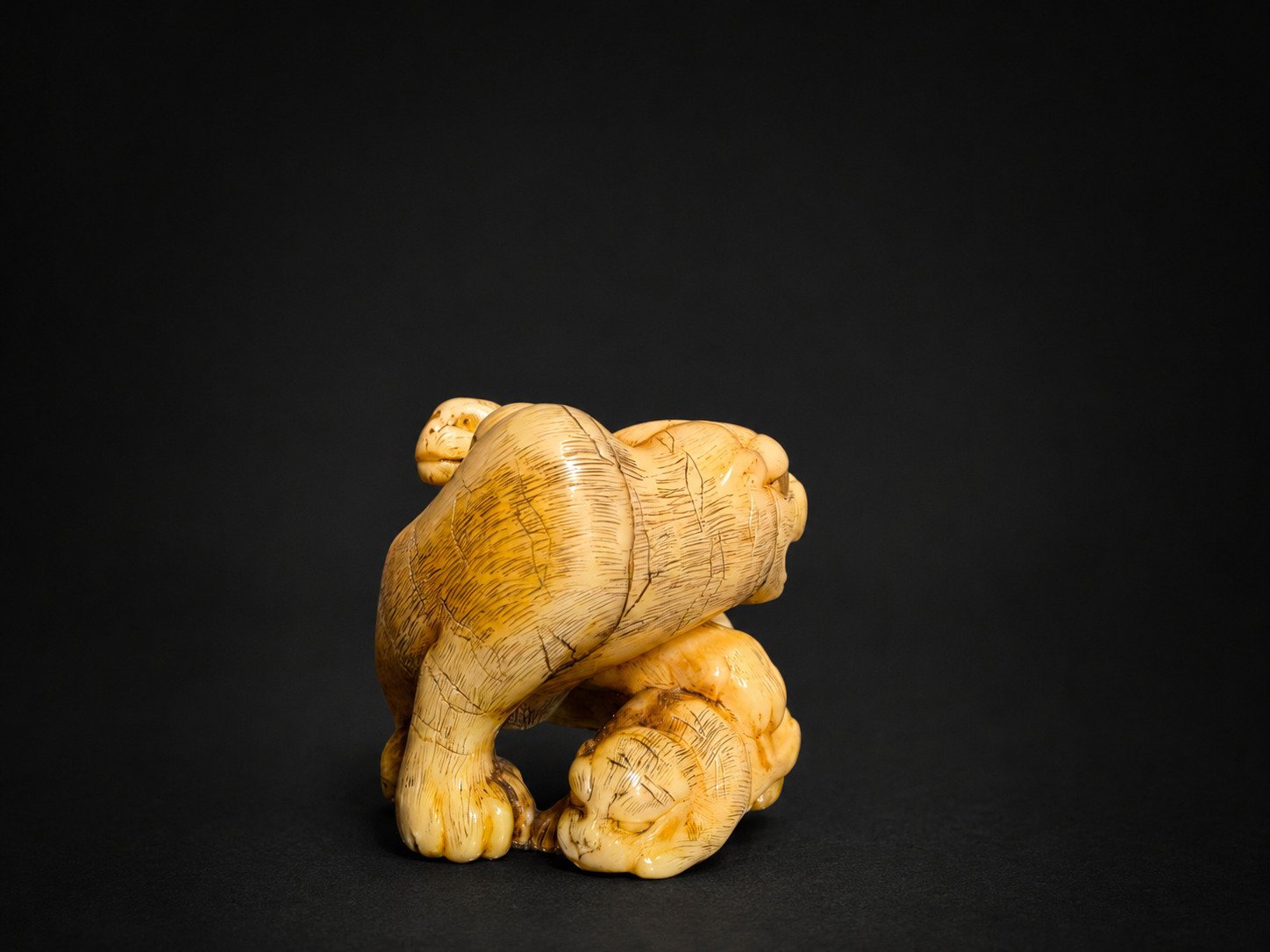
The coat is extensively detailed with fine kebori, or hair-line engraving, creating delicate lines across the mane, back, limbs and haunches.
This finely incised treatment contrasts with the broader polished surfaces of the muzzle, paws, belly and other rounded areas of the body. The alternation between smooth modelling and delicate engraved texture gives the carving considerable visual richness.
Darker coloration retained within the engraved lines further enhances the coat and helps articulate the overlapping forms of the three animals.
The adult tiger forms a tightly curled sculptural structure, with its tail returning toward the body and the two cubs fitted naturally within the remaining spaces.
This closed arrangement creates a compact and almost circular silhouette, a particularly effective solution for netsuke carving because it minimises fragile projecting elements while allowing the object to remain highly sculptural from every angle.
Heads, paws, tail and bodies interlock without losing their individual readability, demonstrating careful control of volume within the small format.
The netsuke is carved from walrus ivory (seiuchi no kiba), displaying warm cream, yellow and honey-toned coloration across the surface.
The material allows both smooth rounded modelling and precise engraved detail, qualities effectively exploited in the treatment of the animals’ bodies and finely worked coats.
Natural tonal variation across the material contributes additional depth to the sculpture and reinforces the contrast between polished surfaces and engraved areas.
A particularly distinctive feature of the carving is the use of glass inlays for the tiger’s eyes.
The reflective quality of the glass immediately animates the face, introducing a striking point of contrast against the matte, warm-toned ivory.
Used selectively, the inlays intensify the animal’s alert expression and reinforce the strongly sculptural treatment of the head.
This combination of carved ivory and contrasting glass demonstrates the carver’s attention to small details capable of transforming the character of the entire composition.
Measuring only 2.9 × 3.8 × 3.2 cm, the netsuke compresses three separate animals into an exceptionally small sculptural space.
The adult tiger, its two cubs, the curved tail, individual paws, facial features and engraved coat are all integrated within a compact volume measuring less than four centimetres across.
This careful concentration of detail is one of the defining qualities of Japanese netsuke carving, where the artist was required to create a complete three-dimensional composition within an object designed to fit naturally in the hand.
This netsuke combines several qualities of particular interest within Japanese animal carving: a three-figure composition, expressive tiger iconography, finely executed kebori, glass-inlaid eyes and a compact sculptural arrangement.
The juxtaposition of the snarling adult tiger with its two closely nestled cubs gives the piece considerable narrative and emotional character, balancing the traditional symbolism of strength and protection with a distinctly intimate family scene.
The technical challenge of integrating three animals within such a small, rounded volume further enhances the sculptural interest of the work and makes the tiger-and-cubs theme particularly appealing within the netsuke repertoire.
The netsuke should be considered in the context of its age and historical use.
The walrus ivory displays attractive natural tonal variation, while the engraved detail, sculptural modelling and glass eye inlays remain important elements of the overall visual character of the piece.
Please examine the detailed photographs carefully, as they form an important part of the description and provide the best record of the preserved surface, carving, inlays and overall condition.
An expressive Edo-period walrus ivory netsuke depicting a powerful tiger curled protectively around two cubs. Finely engraved kebori, vivid glass-inlaid eyes, deeply carved facial features and the tightly integrated three-figure composition combine strength, tenderness and technical refinement within an exceptionally compact sculpture measuring 2.9 × 3.8 × 3.2 cm.

Order above 1.000,00 € gets free shipping.

Secure and hassle-free payment process.

Certificate of authenticity included.

Have questions? Contact us via WhatsApp.
Contact