FREE EXPRESS INTERNATIONAL DELIVERY
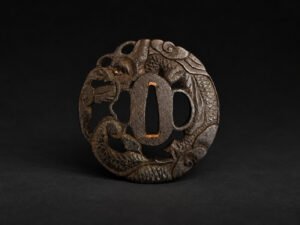
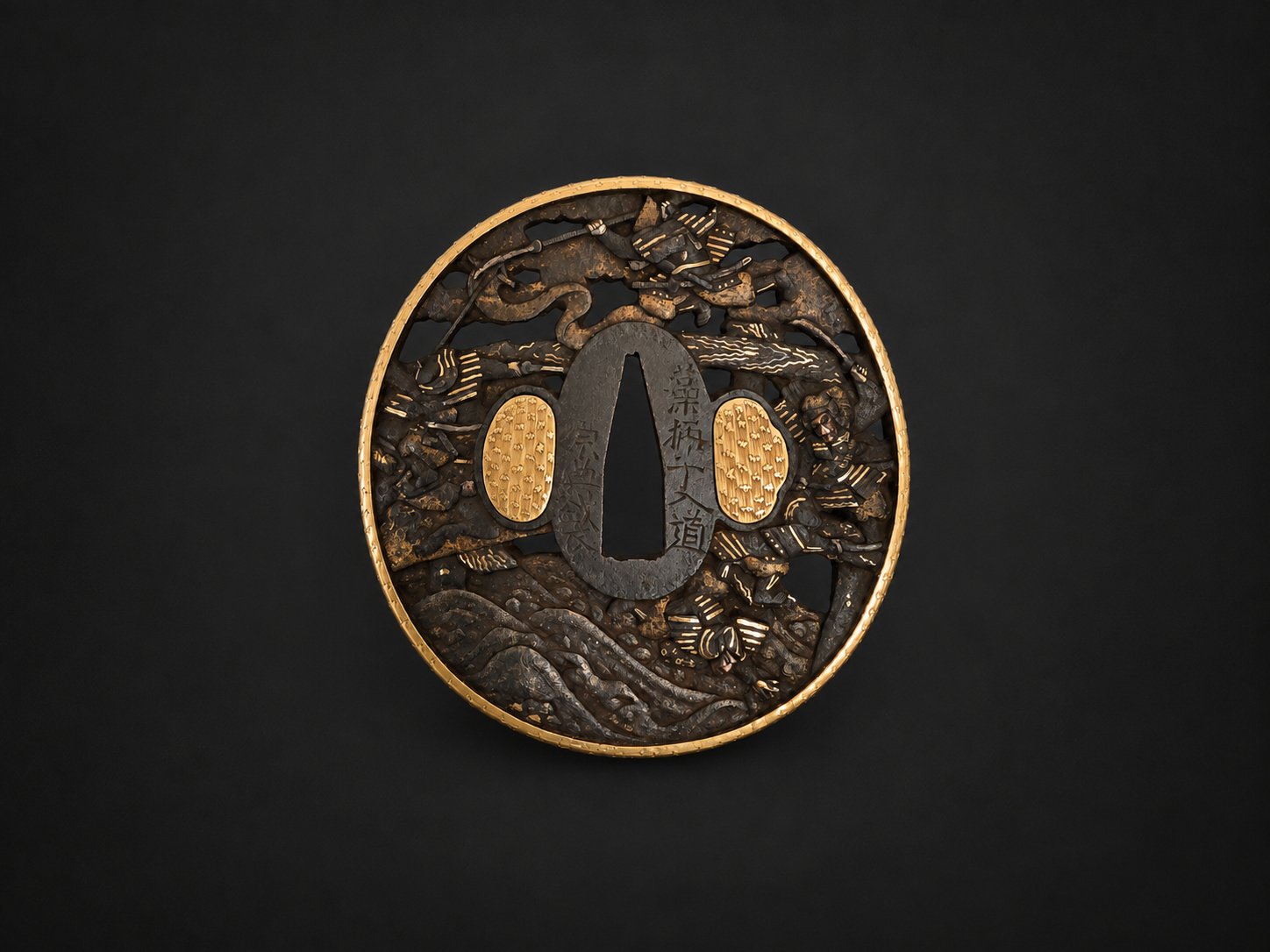
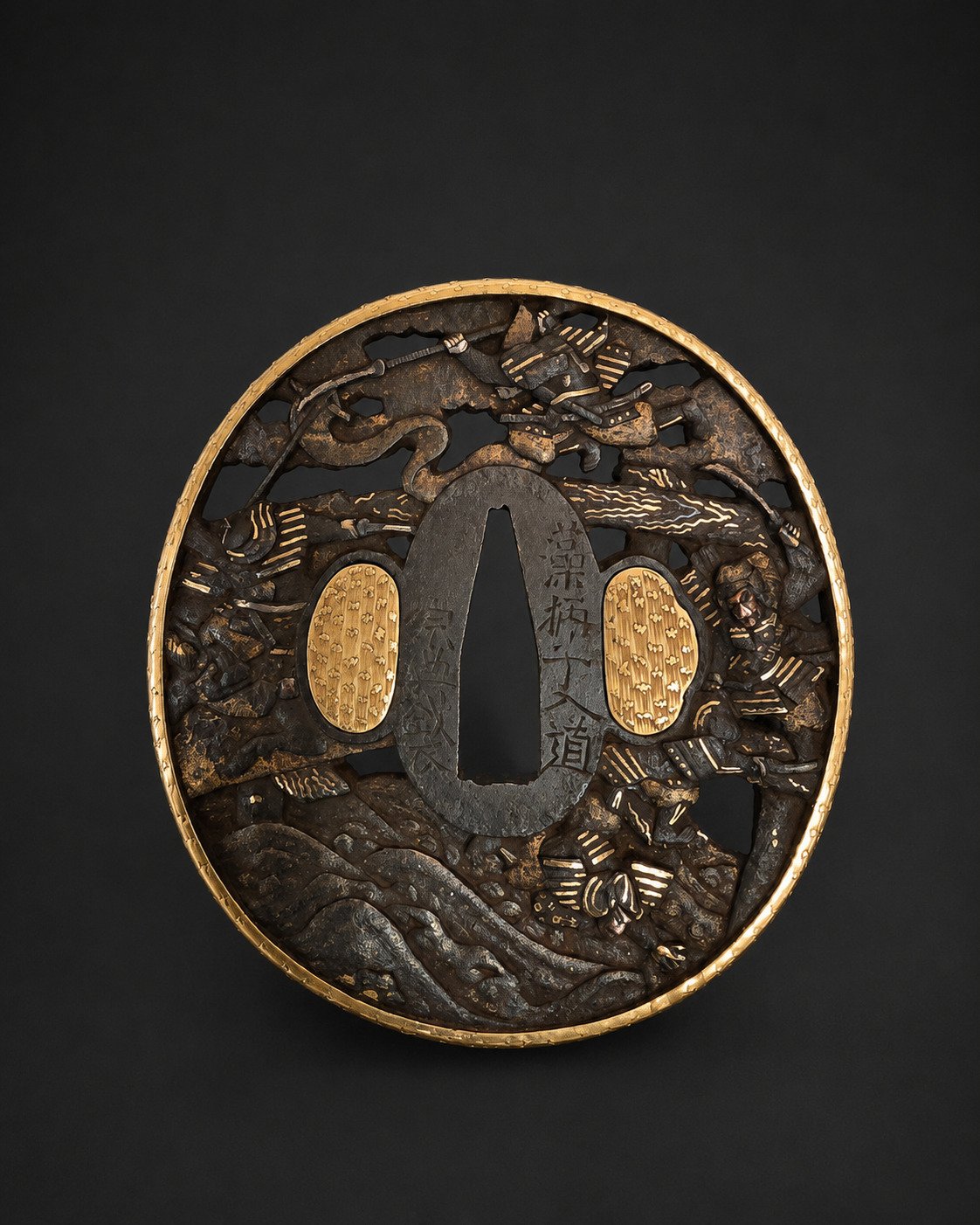
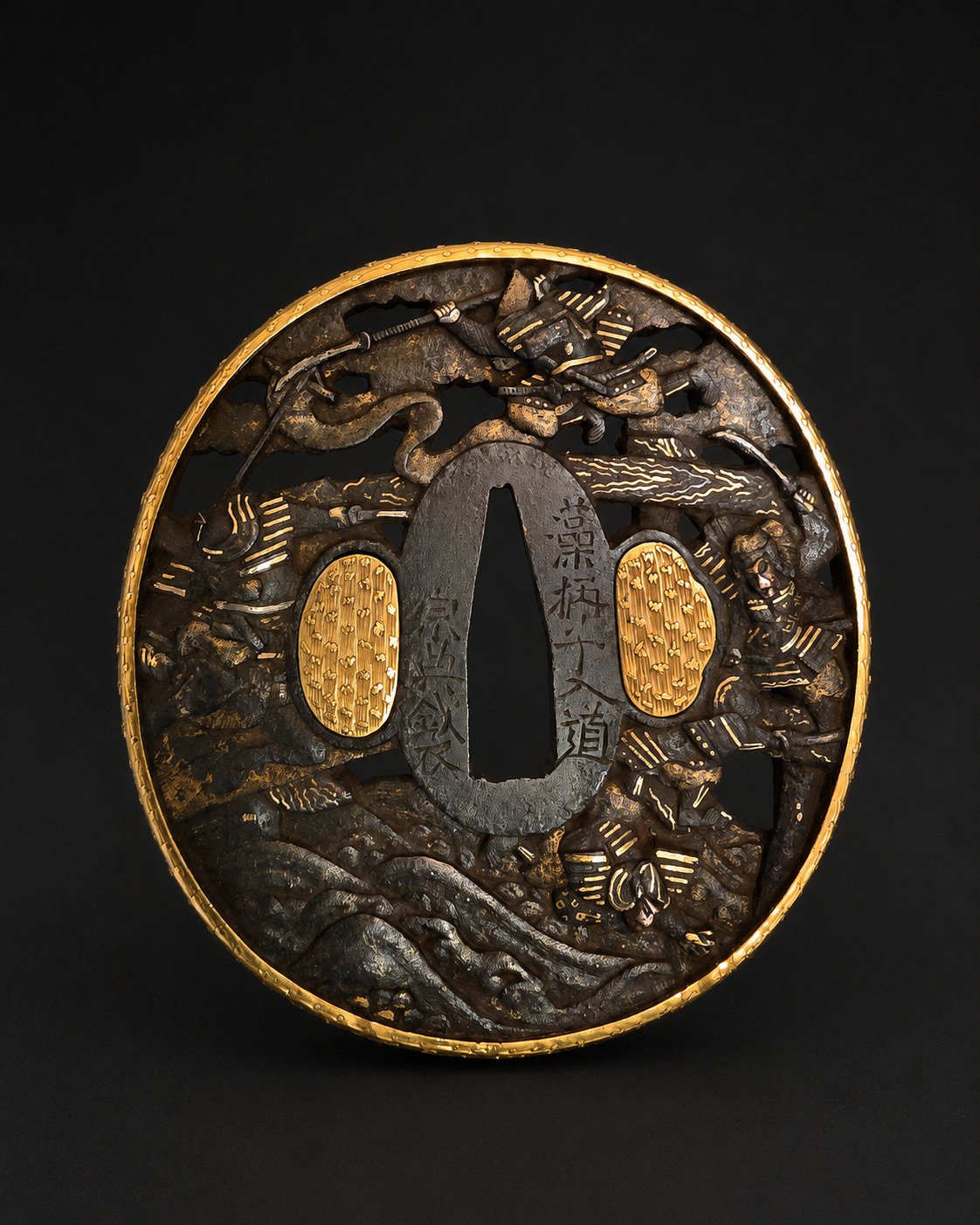
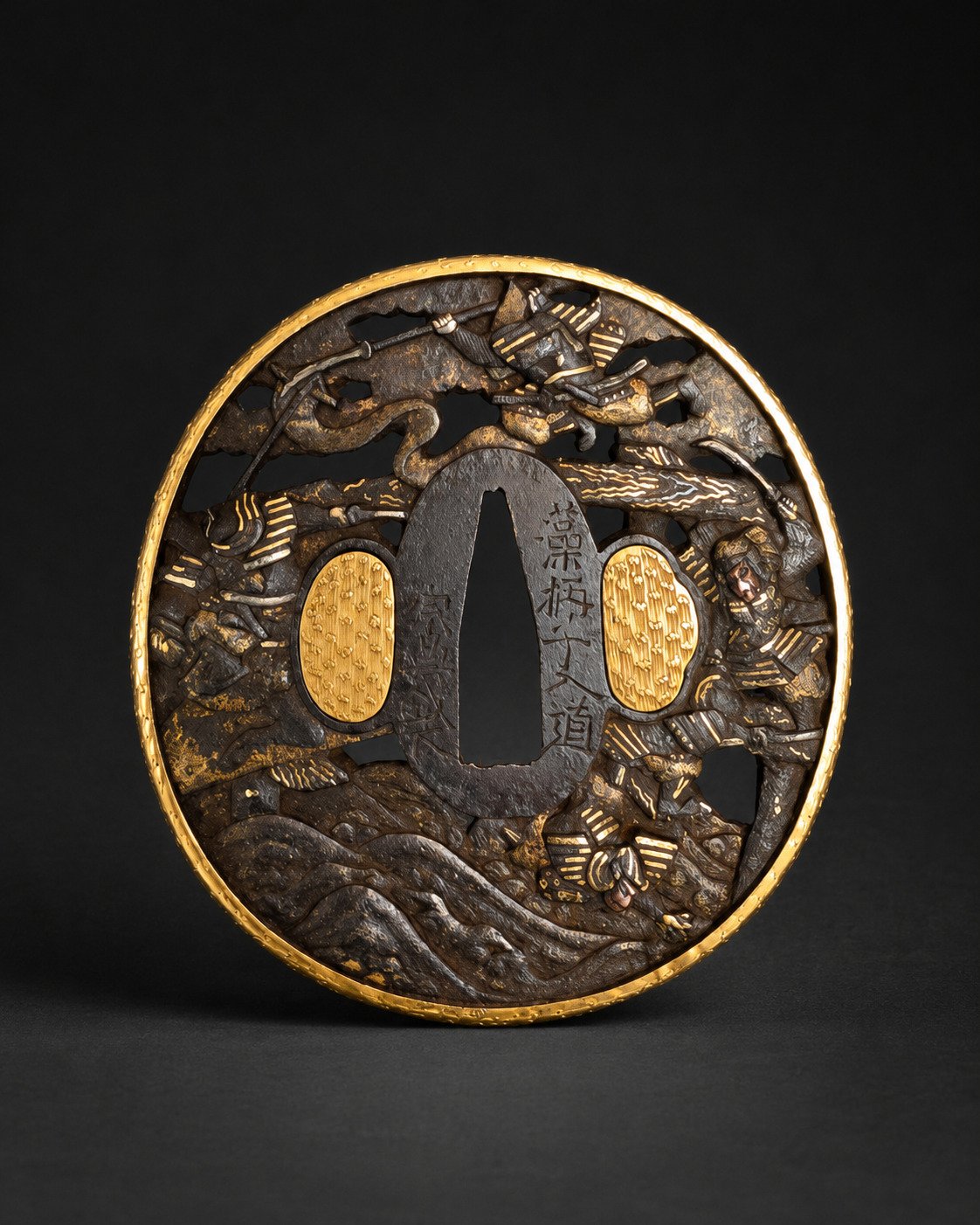
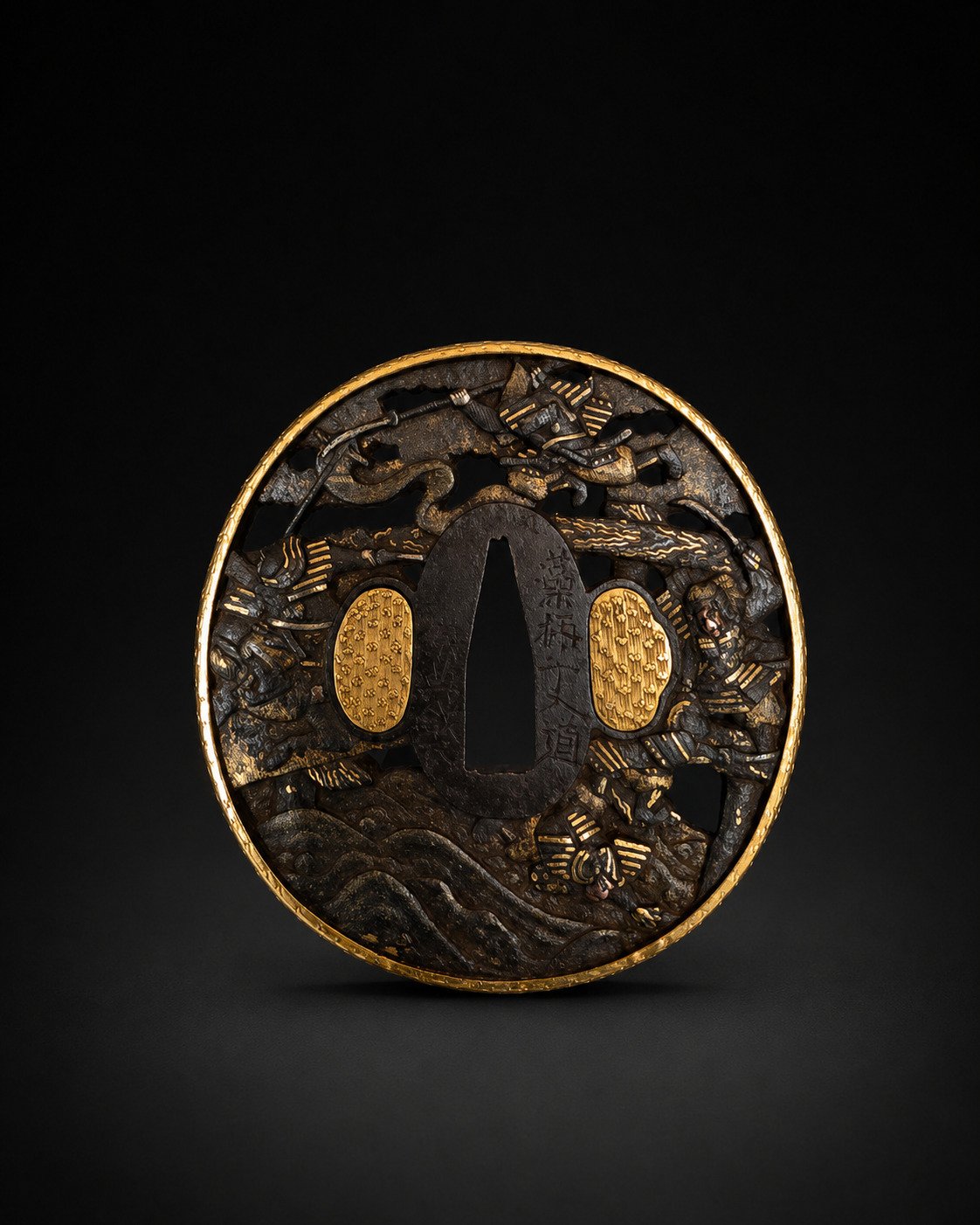
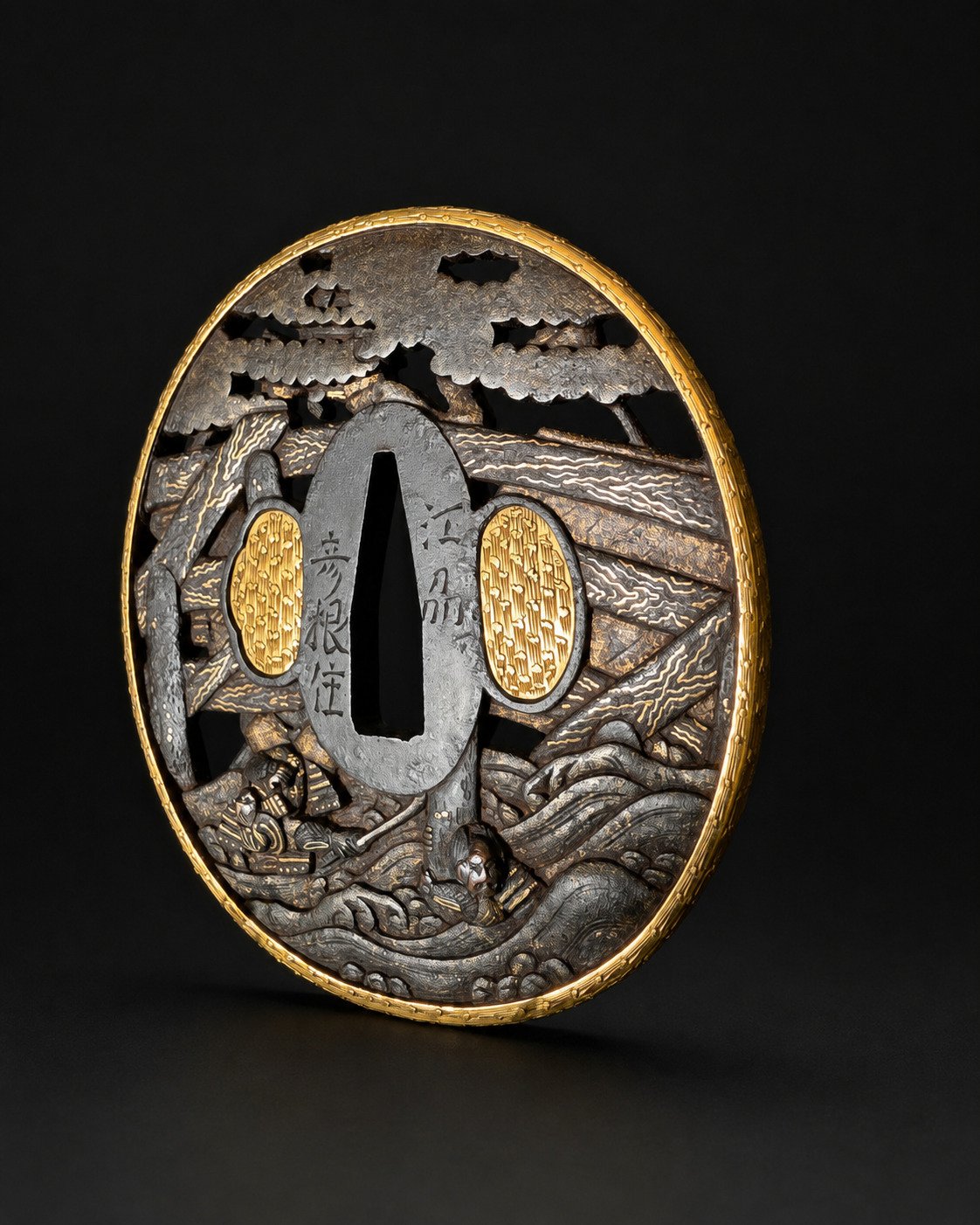
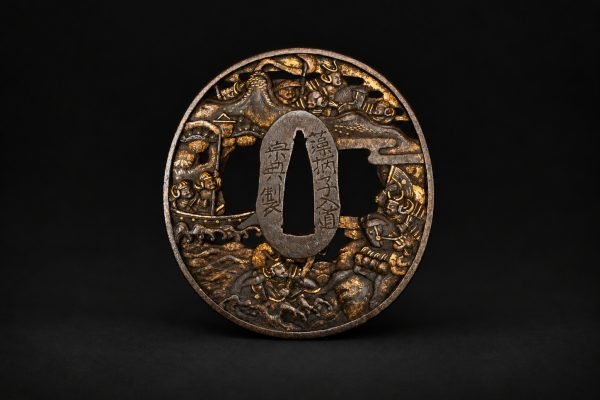
An exceptionally elaborate Japanese iron tsuba depicting a dramatic samurai battle fought beside and upon the water, worked in dense sculptural relief and openwork and enriched with extensive gold, silver and copper nunome-zōgan.
The entire composition is framed by a prominent gilt fukurin fitted around the perimeter of the guard. Its warm golden surface provides a striking visual boundary against the deeply patinated iron and considerably enhances the luxurious character of the piece.
Warriors in full armor, weapons, horses, turbulent water, shoreline elements and clouds are densely arranged around the central seppa-dai, transforming the tsuba into a miniature narrative scene rather than a conventional decorative sword guard.
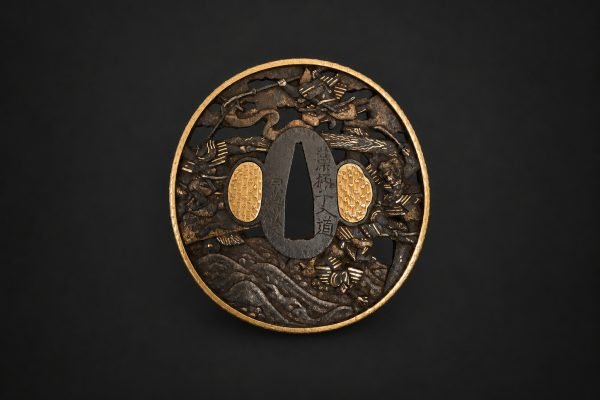
The principal subject is a violent military encounter involving armored samurai fighting in and around a watery landscape.
On the principal face, warriors wearing full gusoku occupy the upper part of the composition, where mounted and dismounted figures appear to clash across the openwork surrounding the seppa-dai.
The lower section is dominated by deeply carved, elongated waves. Their flowing contours establish the maritime setting and provide a powerful contrast with the angular forms of armor, weapons and human figures above.
Fine gold and other colored-metal details highlight sections of the warriors’ armor, clothing and equipment, allowing individual figures to remain legible against the dark iron ground despite the remarkable density of the scene.
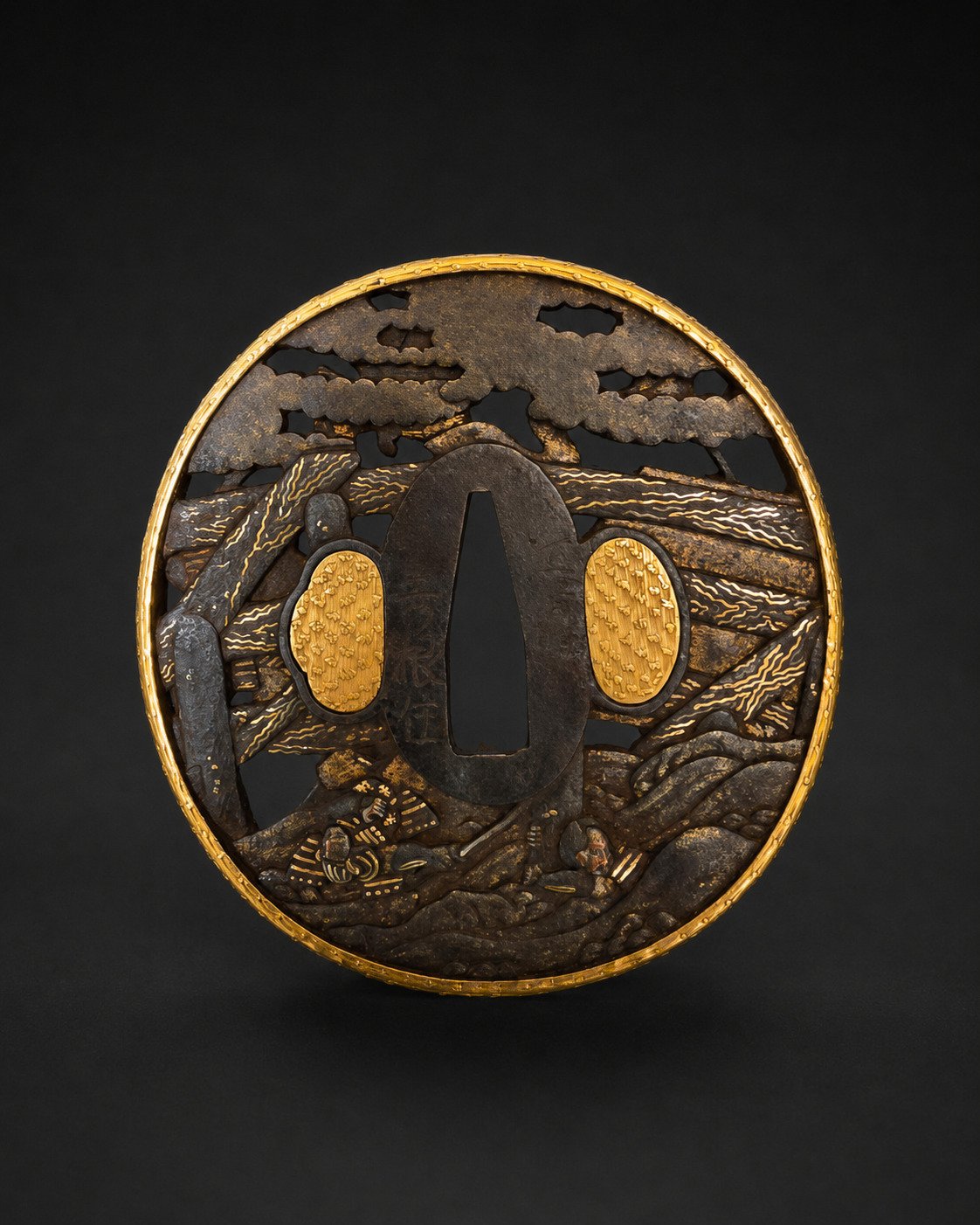
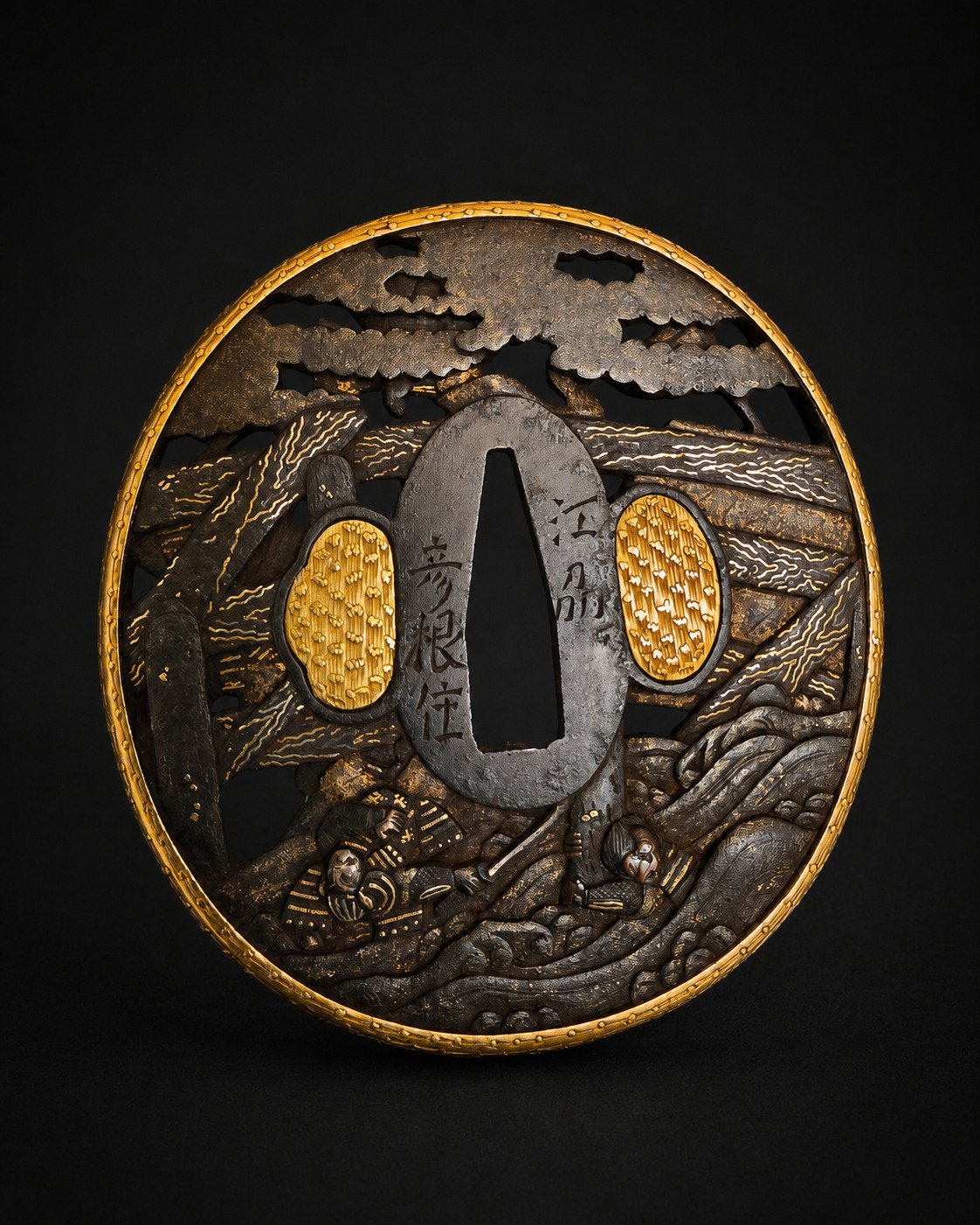
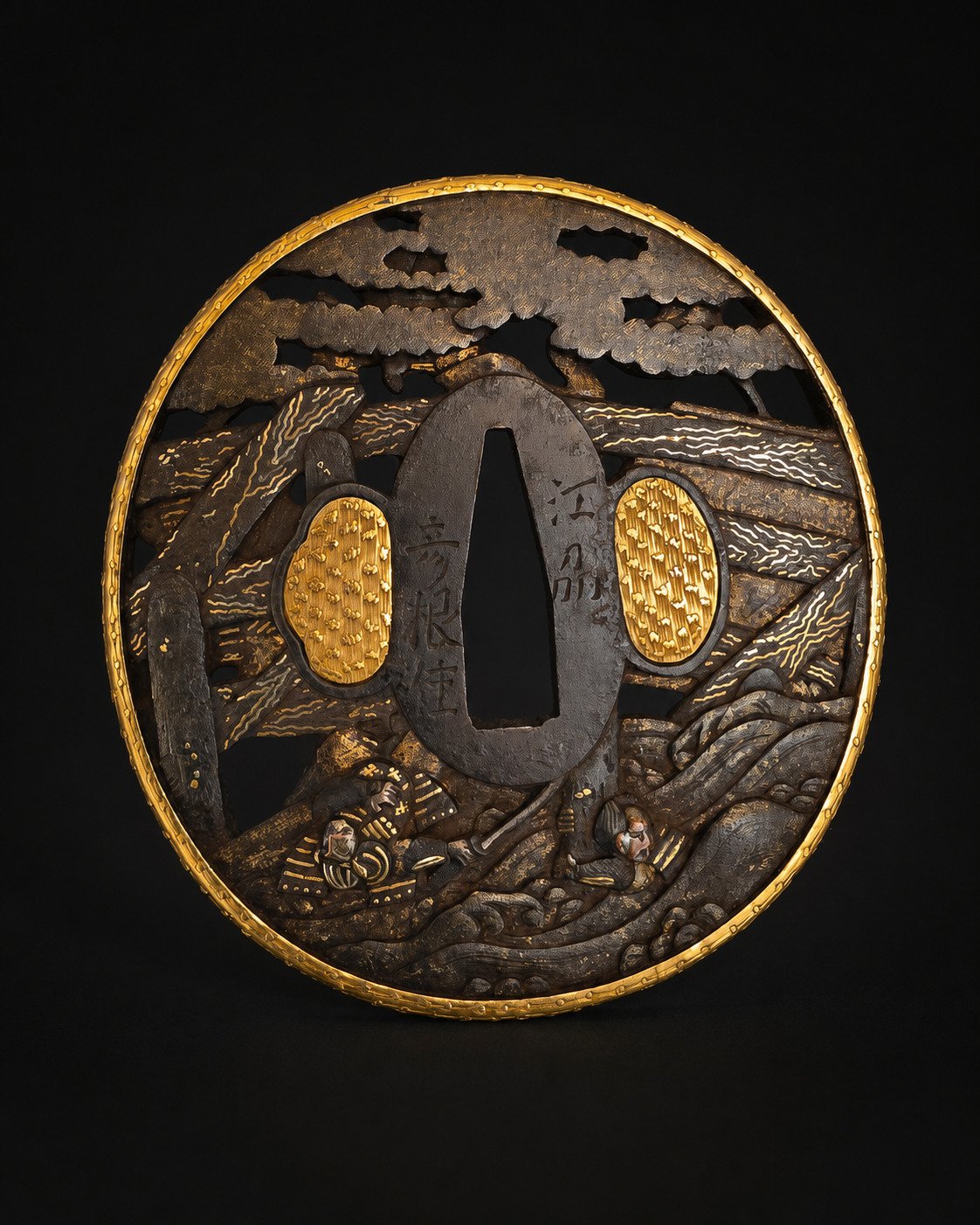
The reverse continues the martial narrative within a coastal landscape.
A prominent pine tree (matsu) rises from the shoreline, its irregular trunk and branches forming an important structural component of the composition. Around it, warriors continue their struggle amid the surf, while openwork cloud forms articulate the upper section.
The combination of armored warriors, turbulent water, shoreline vegetation and open sky gives both sides of the tsuba a continuous narrative character, as though different moments of the same battle unfold around the guard.
Scenes of warriors fighting beside or within the sea are strongly associated with the great military narratives of medieval Japan, particularly the Genpei War between the Minamoto and Taira clans.
Such historical and legendary battle scenes became an important subject within the decorative vocabulary associated with the Hikone Sōten tradition, whose artists frequently depicted densely populated episodes from warrior history in sculptural iron.
The imagery of this particular tsuba is fully compatible with that narrative world. However, no inscription identifying a specific battle has been provided, and it would therefore be inappropriate to identify the scene conclusively as Dan-no-ura, Ichi-no-Tani or another individual episode of the Genpei War.
The dark tetsuji has been extensively carved in relief and pierced with sukashi openings, allowing warriors, landscape elements and weapons to form an interconnected sculptural structure.
The artist uses several levels of depth. Some figures project strongly from the surface, while others are partially concealed behind horses, armor, waves and landscape elements.
The negative spaces created by the openwork are essential to the composition. They allow light to penetrate the otherwise extremely dense design and help separate overlapping figures and objects.
The result is characteristic of a highly pictorial approach to tsuba-making in which iron is treated almost like a miniature sculptural relief.
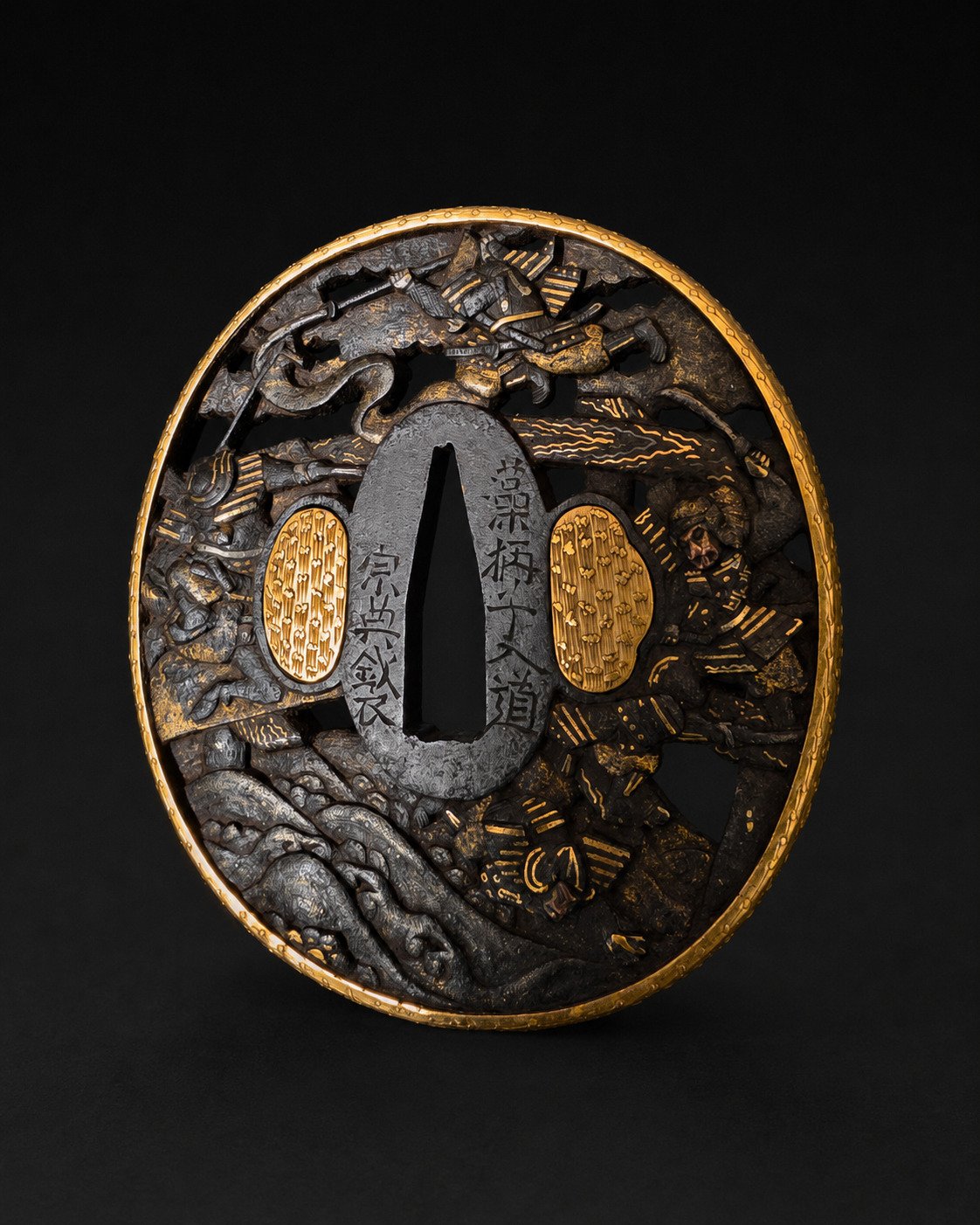
The relief carving is enriched with extensive nunome-zōgan in gold, silver and copper.
Fine lines and small areas of contrasting metal are used selectively across armor plates, garments, weapons and other details. Rather than covering the iron completely, these accents illuminate specific elements against the dark patinated surface.
This contrast is particularly effective on the warriors, where fine bands of gold articulate the construction of helmets, sleeves, cuirasses and other components of samurai armor.
The combination of dark iron, sculptural relief and restrained precious-metal decoration creates the richly layered visual effect traditionally associated with elaborate narrative tosogu.
One of the most distinctive features of the tsuba is the gilt fukurin surrounding its entire perimeter.
A fukurin is a separate metal rim fitted around the outer edge of a tsuba. In this example, its bright golden finish creates a pronounced visual border around the dark central iron composition.
The surface is further enriched with fine punched or granulated detailing, adding texture while reinforcing the luxurious appearance of the guard.
Its uninterrupted golden circumference also visually unifies the exceptionally complex battle scene contained within it.
Flanking the seppa-dai are two large oval areas filled with gilt metal and covered with a dense pattern of tiny raised dots resembling a nanako ground.
Their position corresponds to the usual placement of the hitsu-ana for a kozuka and kogai. They therefore appear to represent closed or filled auxiliary apertures, traditionally described as hitsu-ume, rather than purely decorative reserves applied to an uninterrupted iron plate.
The gilt surfaces provide a dramatic contrast with the surrounding iron and form two bright visual anchors on either side of the nakago-ana.
Without direct examination, the precise composition of the underlying metal and the exact technique used to close the openings should remain unconfirmed.
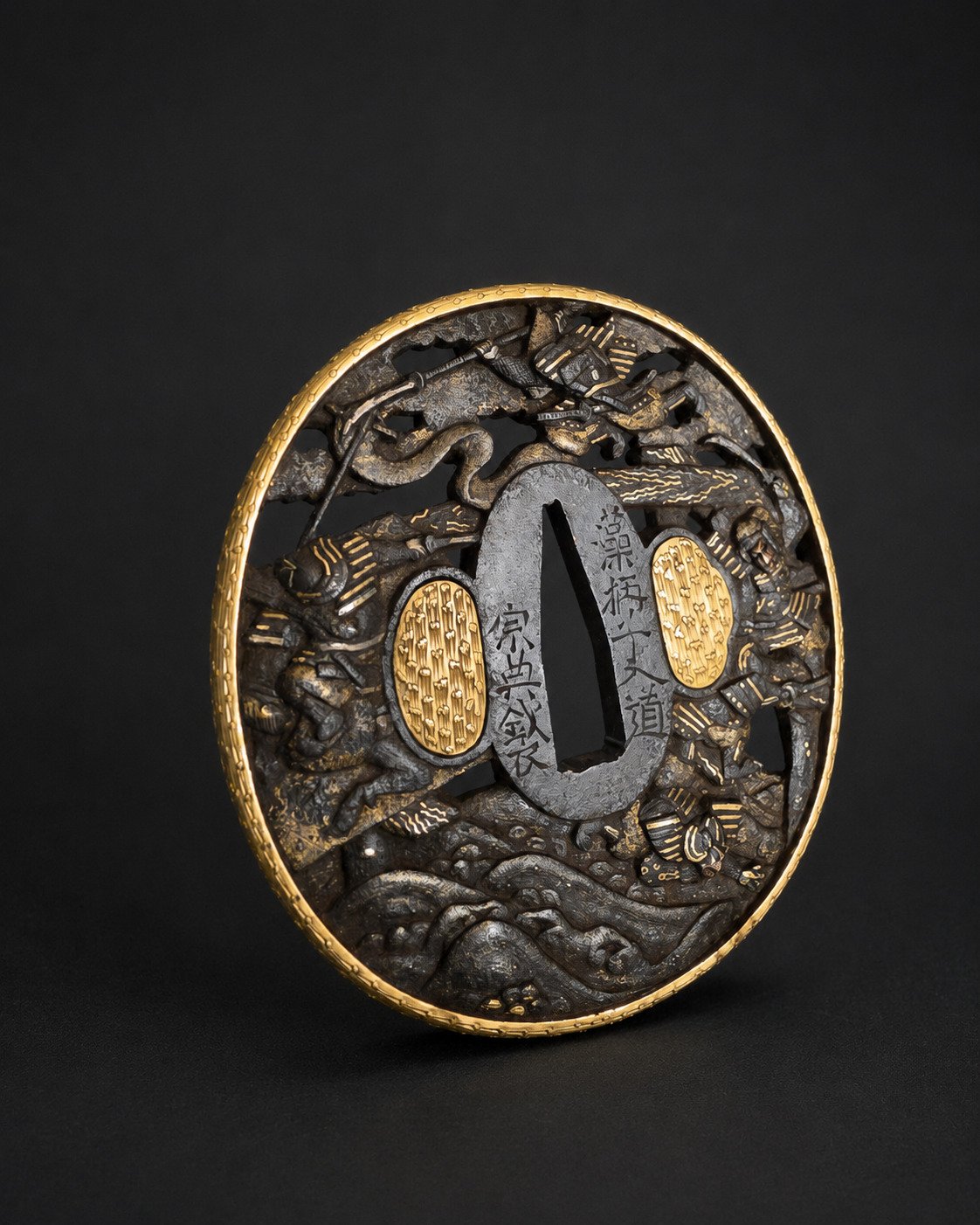
The central seppa-dai is relatively restrained in comparison with the densely worked surrounding scene, providing a visual and functional centre for the composition.
The nakago-ana retains evidence of adjustment for mounting, including visible copper elements associated with fitting the tsuba to the tang of a particular blade.
Such alterations are consistent with the original practical function of the object as part of a mounted Japanese sword.
The tsuba bears the inscription:
藻柄子入道宗典
Sōheishi Nyūdō Sōten
The characters 藻柄子 are conventionally read Sōheishi in connection with the Sōten tradition. The form “Sōgarashi” sometimes encountered in older Western descriptions should not be treated as the preferred reading here.
Sōten is closely associated with Hikone in Ōmi Province and with a tradition of highly elaborate iron tsuba depicting warriors, historical episodes, Chinese figures and densely populated landscapes, frequently enhanced with contrasting metal inlay.
Unless accompanied by an NBTHK or NTHK paper attributing the piece specifically to an individual generation or master, the inscription should be reported accurately without extending the attribution beyond what the available evidence establishes.
The workmanship closely reflects the narrative aesthetic associated with Hikone Sōten: deeply carved iron, extensive openwork, numerous human figures and selective use of gold and other colored metals to emphasize armor and costume.
Unlike more austere iron sukashi traditions based on geometric or highly simplified silhouettes, Sōten-style work often approaches the tsuba as a miniature historical tableau.
This example is especially ambitious in the number of warriors and landscape elements incorporated into its relatively small surface, with the battle continuing across both faces of the guard.
The piece combines several features of particular interest to collectors of Japanese sword fittings: a signed Sōten inscription, complex battle imagery, extensive iron relief and openwork, multimetal nunome-zōgan, gilt hitsu-ume and a complete gilt fukurin.
The elaborate narrative composition invites close examination, with individual warriors, horses, weapons, waves and landscape details emerging progressively from the dark iron surface.
Its combination of martial imagery and luxurious finishing illustrates the transformation of the functional tsuba into a sophisticated work of miniature metal sculpture.
An exceptionally elaborate signed iron tsuba from the Hikone Sōten tradition, depicting an intense samurai battle unfolding across a maritime landscape. Warriors in full armor, horses, waves, clouds and a coastal pine are sculpted in dense relief and openwork and highlighted with gold, silver and copper nunome-zōgan. Two gilt, nanako-textured hitsu-ume flank the central seppa-dai, while a complete gilt fukurin frames the entire composition. Signed Sōheishi Nyūdō Sōten, the piece exemplifies the highly pictorial and technically ambitious character associated with Sōten-style narrative sword fittings.

Order above 1.000,00 € gets free shipping.

Secure and hassle-free payment process.

Certificate of authenticity included.

Have questions? Contact us via WhatsApp.
Contact