September 25, 2026

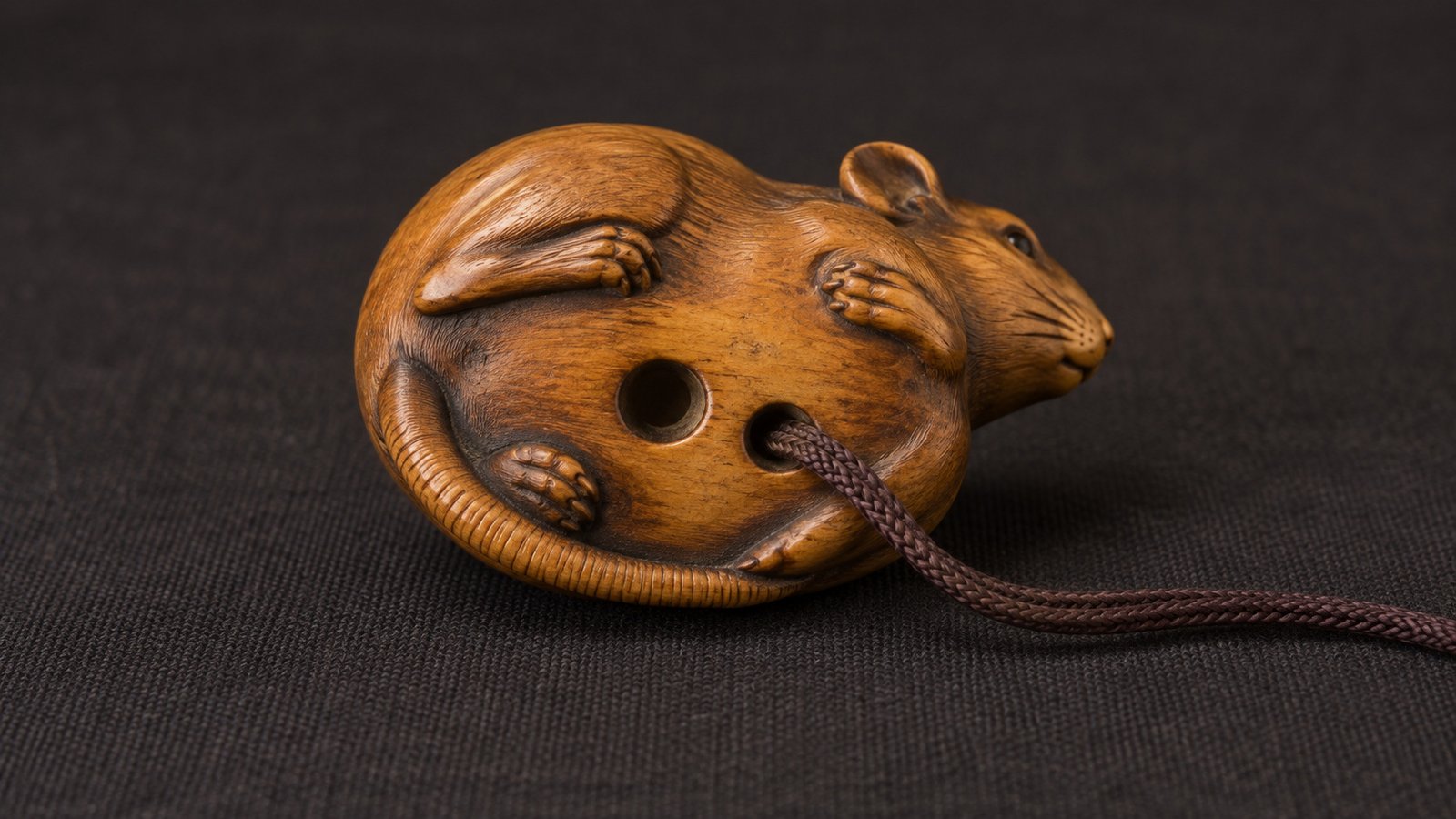
A netsuke can reveal a lively face, an animal’s carefully modelled body or an elaborate scene within a few centimetres. Turn it over, however, and another detail comes into view: the opening through which its cord passed.
These openings are known as himotoshi. They connect the sculpture to its original purpose and invite us to examine how the carver accommodated a practical requirement within a miniature work of art.
Sometimes the cord passes through discreet holes in the underside. In other examples, a space within the composition itself provides the attachment point. Understanding this distinction changes how we look at the complete carving.
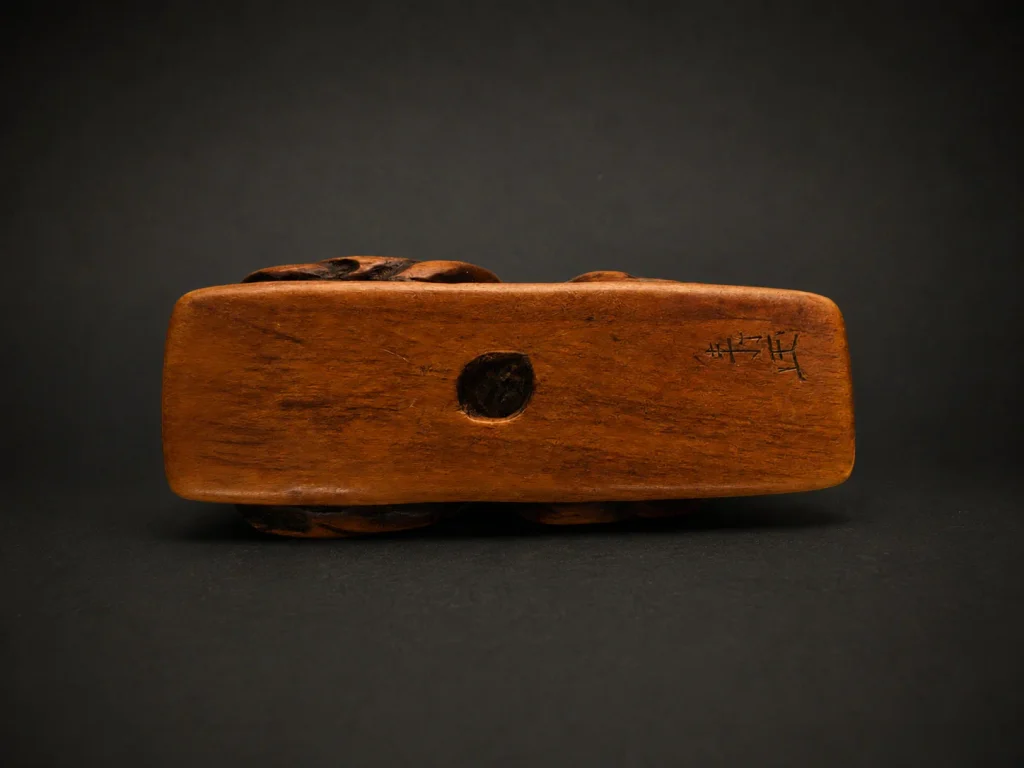
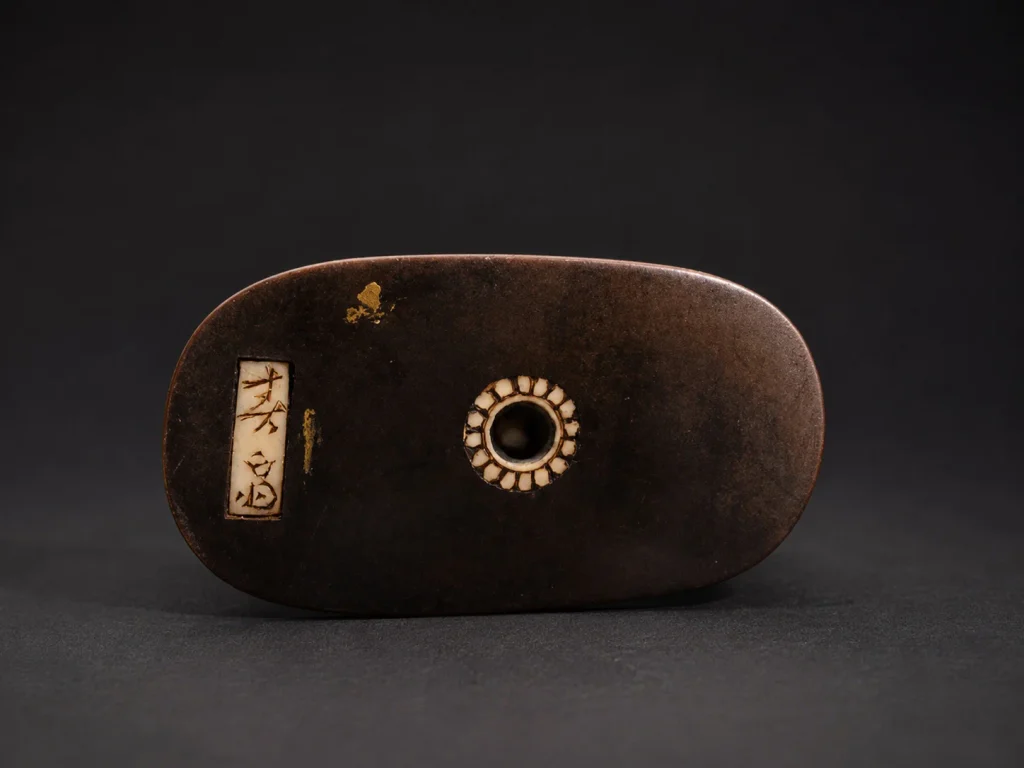
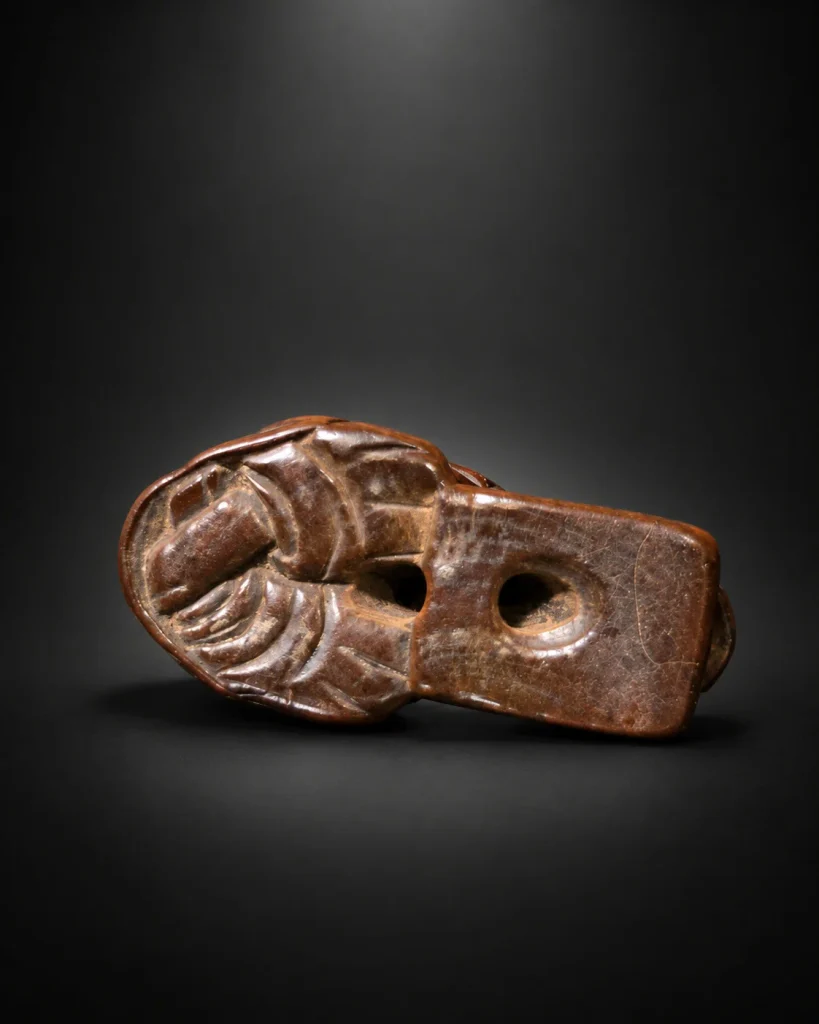
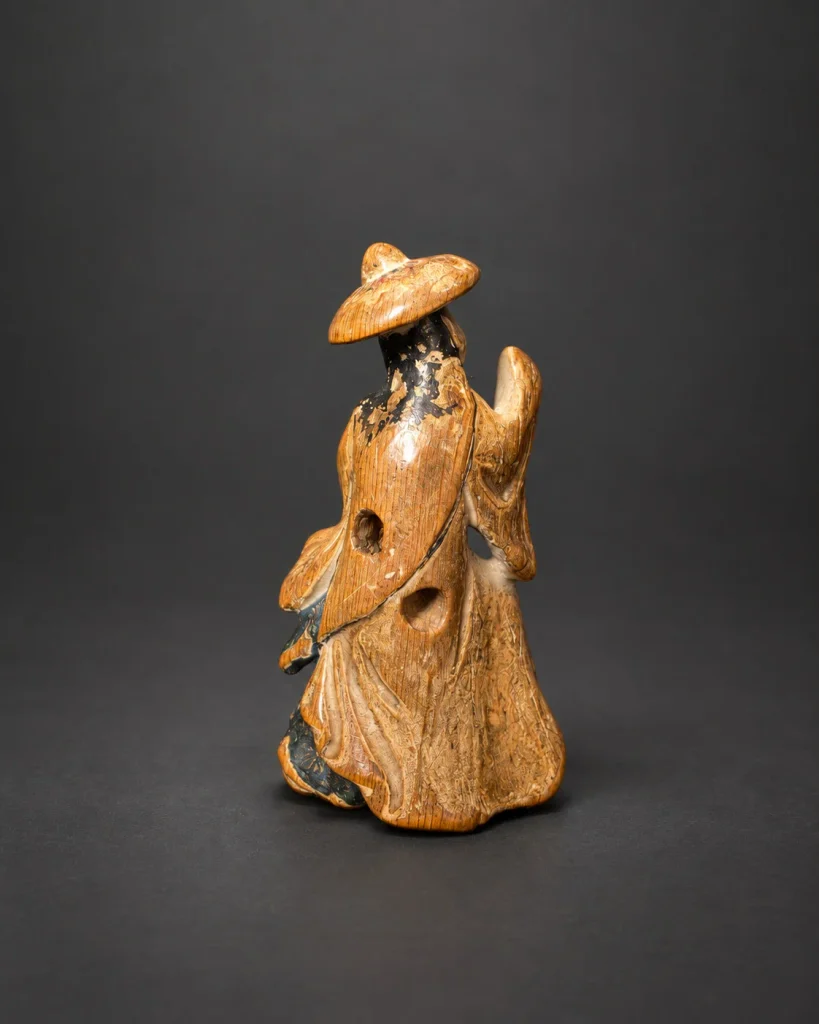
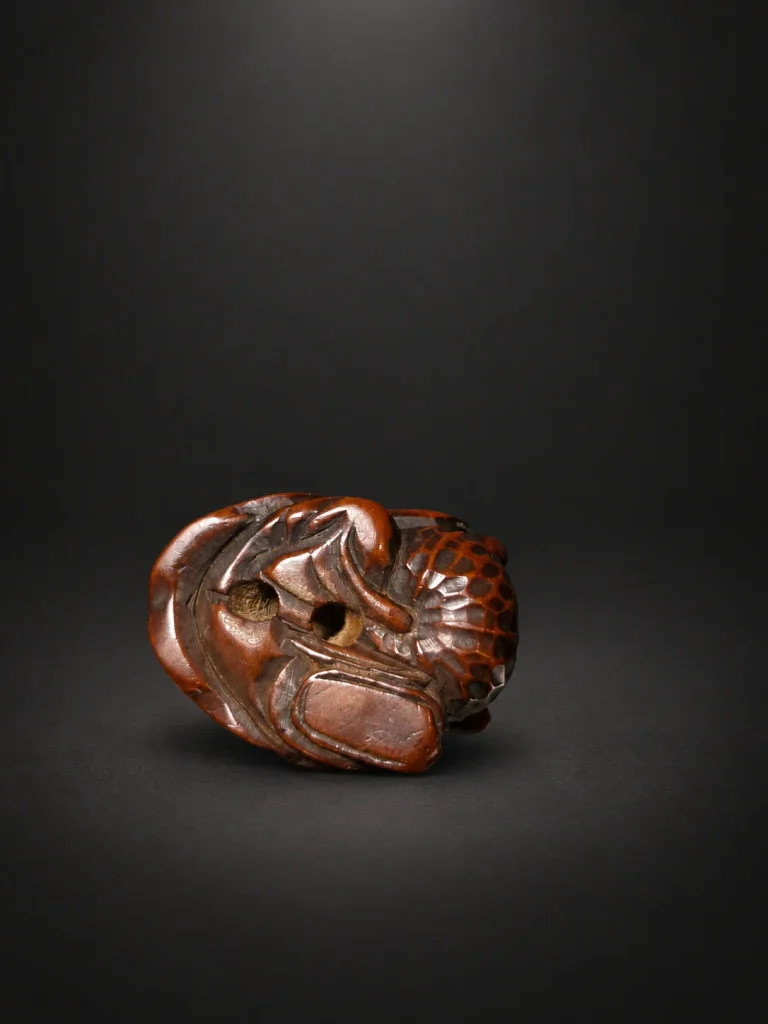
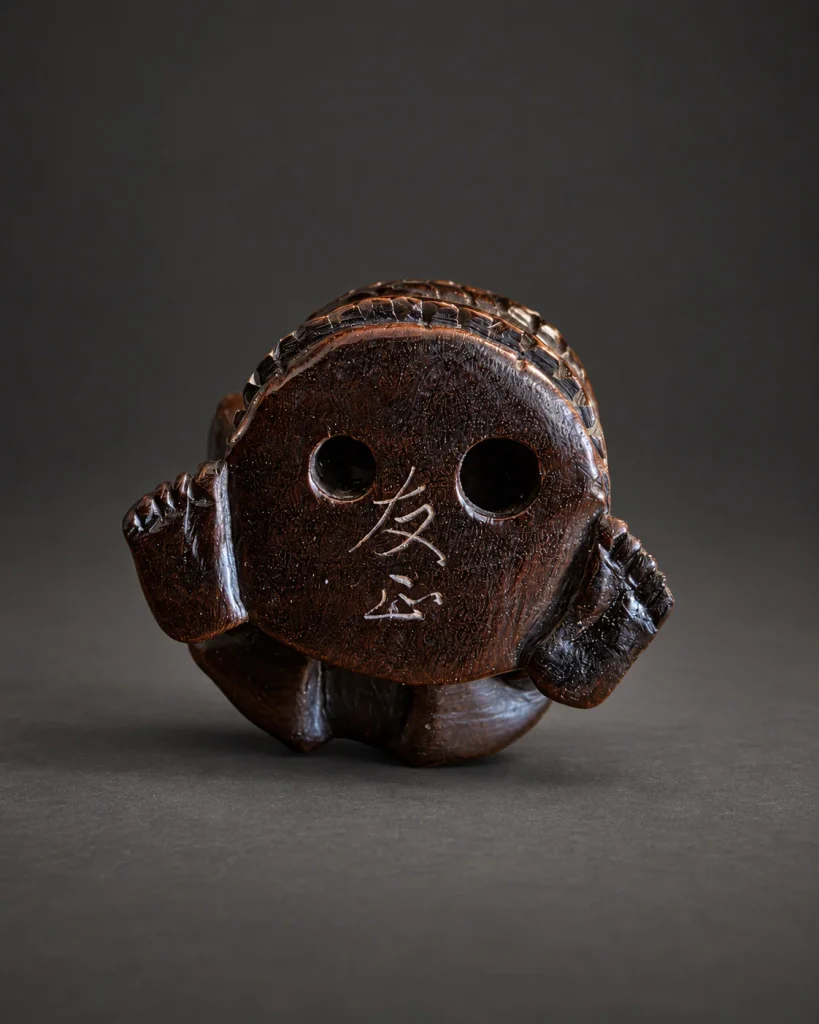
The International Netsuke Society defines himotoshi as apertures made for the passage of a cord. They usually take the form of drilled holes, although openings within the sculpted form can serve the same purpose. These are called natural himotoshi.
Their importance becomes clear when a netsuke is considered as part of a suspended ensemble.
A netsuke acted as a toggle securing a hanging accessory, or sagemono, at the wearer’s obi sash. An inro was one such accessory. The cord connected the container and netsuke, with an ojime bead positioned between them.
The Himotoshi therefore belong to the working structure of the object. Their placement deserves attention alongside the subject, expression and surface detail.
There are two useful starting points when looking for the cord passage: openings cut into the material and openings incorporated into the composition.
| Arrangement | What to look for |
|---|---|
| Carved or drilled himotoshi | Deliberately made apertures, often visible on the reverse or underside. |
| Natural himotoshi | A space within the sculptural design that allows the cord to pass through. |
The word “natural” describes how the opening is incorporated into the form. It does not necessarily mean that the material already contained a hole before carving.
A wooden netsuke of a reclining oni in the British Museum demonstrates this approach clearly. The museum identifies the space between the figure’s outstretched arm and body as a natural opening for the cord.
This is an interesting detail to study because the pose performs two jobs. It establishes the figure’s appearance while providing a route for attachment.
When examining a similar arrangement, look at the space and the material surrounding it together. The opening belongs to the composition rather than sitting apart from it.
On many examples with paired cord holes, one opening is larger than the other.
Collector John Neville Cohen explains that the larger opening can accommodate and conceal the cord knot. In the examples he discusses, the passage between the openings is shaped to allow threading, and the cavity may widen beneath the surface to provide room for the knot.
This helps explain why the two visible apertures may differ. Their dimensions can relate to the way the object was attached.
However, unequal holes should not be treated as a universal rule or a certificate of age. Cohen also notes that modern copies can reproduce this arrangement.
The useful question is how the openings work within the particular carving, rather than whether they match a simple checklist.
Two visible holes are a familiar arrangement, but different netsuke forms require different ways of looking.
The British Museum describes a kagamibuta netsuke as a metal plate set into a bowl-shaped body, with a cord hole at the back. Its construction differs from a solid figure carving with two readily visible apertures.
Natural himotoshi provide another reason to avoid relying on a hole count. The functional opening may be a space around a limb or another element of the design.
Before deciding that a cord passage is missing, examine the complete object and establish how it is constructed.
A productive way to study himotoshi is to begin with the sculpture as a whole, then turn to the attachment.
Where are the openings in relation to the main subject? Are they tucked beneath the body, placed on the back or incorporated into an open space?
Record their position before considering what it might mean. A photograph of the underside is much easier to understand when accompanied by a view of the complete piece.
Consider how the cord passage relates to nearby details.
On a figure, the opening may sit among folds of clothing. On an animal, it may be positioned beneath the body. With natural himotoshi, the shape of the surrounding limbs or other elements becomes especially relevant.
This is a useful exercise in appreciating design: follow the transition from the visible subject to the less obvious attachment area.
A description such as “two unequal openings on the underside” records something visible.
A claim such as “these holes prove the piece was worn in the eighteenth century” goes much further. That conclusion requires evidence beyond the openings themselves.
Keep your notes precise, especially when studying photographs rather than handling the object.
A frontal image can show the subject beautifully while leaving its attachment unclear.
For a more complete view, look for:
For natural himotoshi, the angle matters particularly. A gap that is concealed in one view may become clear when the object is photographed from the side.
If the passage remains uncertain, request another photograph or ask for a description. Avoid inserting tools or forcing a cord through an antique simply to investigate its construction.
When observing the openings, note visible chips, cracks, irregular edges or areas that are difficult to see.
Describe those features directly. For example, “a small chip beside the larger opening” is more informative than an unsupported explanation of how or when it occurred.
Likewise, a smooth edge alone cannot establish a history of use. Condition, workmanship and documentation should be considered together when evaluating an individual object.
Himotoshi encourage us to look beyond the most photogenic view.
They reveal how a miniature sculpture accommodated attachment, whether through a discreet channel or a space integrated into the pose. Studying them brings the underside and reverse into the same conversation as the face, movement and carved detail.
When exploring Japanese netsuke in the Supein Nihonto collection, compare these less obvious views with the principal image. They can help you appreciate the object as a complete design.
Himotoshi are openings through which the attachment cord passes. They may be deliberately cut apertures or spaces incorporated into the sculptural form.
Natural himotoshi use an opening within the design, such as the space between a figure’s arm and body, for the passage of the cord.
A larger opening can provide space to accommodate the cord knot. The arrangement should be considered in relation to the construction of the individual netsuke.
No. Natural openings and the construction of forms such as kagamibuta mean that two separate holes are not always visible.
No. Modern copies can reproduce unequal cord holes. Their size alone cannot establish age or authenticity.
Look for a full view, photographs of the reverse and underside, and a close-up of the openings. An additional side view helps explain natural himotoshi.

CEO of SupeinNihonto, dealer and collector of ancient Japanese art and weapons from Canillo, Andorra.