October 17, 2026
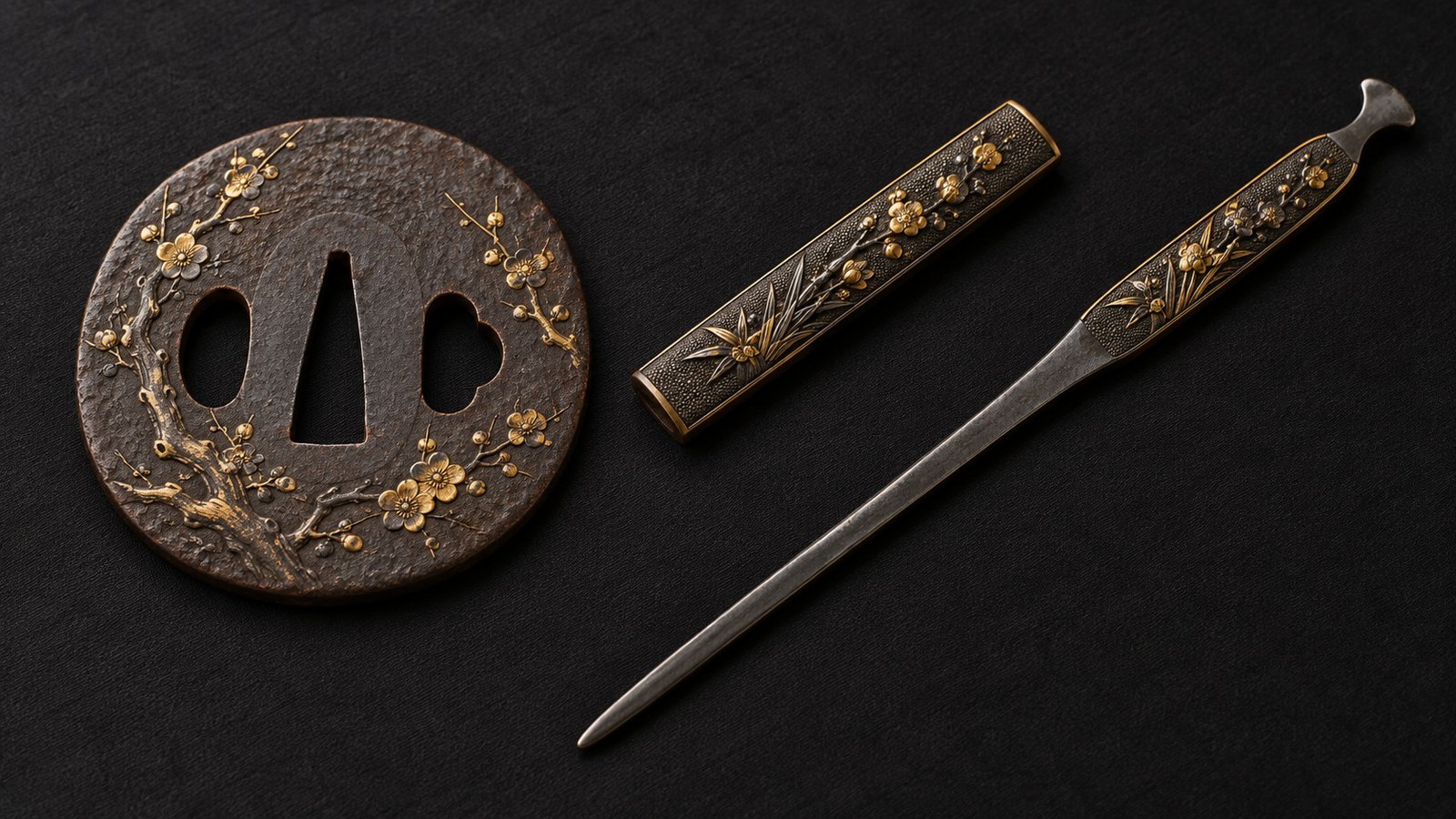
A Japanese sword mounting can contain more than the sword itself. Look closely beside the mouth of certain scabbards and you may notice the decorated handle of a small knife or a slender metal implement.
These accessories are easy to overlook when attention is focused on the blade, but they introduce another scale of craftsmanship: compact surfaces on which metalworkers created remarkably detailed decoration.
The essential distinction is straightforward: a kozuka is the handle of a small accessory knife, while a kogai is a separate, slender implement traditionally described as a hairdressing tool. The Metropolitan Museum of Art identifies both as accessories carried in slots within sword scabbards.
A third term, kogatana, helps complete the picture. Keeping these names separate makes descriptions of Japanese sword mountings much easier to understand.
| Term | What it identifies | Main distinction |
|---|---|---|
| Kozuka | The handle of the small accessory knife | A fitting rather than the blade |
| Kogatana | The small accessory knife blade | The cutting component fitted into the handle |
| Kogai | A slender, skewer-like accessory | A separate implement rather than a knife |
The kozuka and kogatana belong together as parts of a small knife. The kogai is another accessory with a different form and purpose.
This distinction matters when reading a catalogue or buying a detached fitting. A listing for a kozuka may offer the decorated handle alone. It should not be assumed to include a blade.
The British Museum’s collection terminology distinguishes kogatana from kozuka within a documented wakizashi mounting, while the Metropolitan Museum describes kozuka specifically as knife handles.
A kozuka is a compact handle made to receive the blade of a small accessory knife.
Its visible surface can also serve as a miniature decorative panel. When examining one, consider the object from both perspectives: it is a functional component and a piece of metalwork.
A complete accessory knife includes more than the decorated handle. If a blade is present, record it separately rather than treating everything as one attributed object.
For a detached kozuka, useful photographs include the decorated face, reverse, edges and opening. Together, they show more of its construction than a single frontal image.
The Metropolitan Museum of Art describes the kogai as a hairdressing tool forming part of a sword mounting. Its long, slender form differs clearly from the compact handle of a kozuka.
One nineteenth-century example in the museum measures approximately 21.1 centimetres long and combines copper, shakudō, shibuichi, gold and silver.
That example demonstrates how a narrow implement could become a substantial decorative object.
A collector should distinguish its conventional functional description from claims about a particular piece. Describing an object as a kogai does not establish how often it was used, who carried it or whether it has always remained with its present mounting.
In mountings equipped for them, the accessories occupy slots in the saya, or scabbard.
The Metropolitan Museum describes the kogai as carried on the obverse side of a katana scabbard, often opposite a kozuka and its small knife on the reverse. Its collection includes a sixteenth-century kogai documented in this context.
To understand a particular mounting, examine the arrangement as a whole:
If you are unfamiliar with the complete mounting, explore the Japanese koshirae collection to see how fittings belong within a larger ensemble.
An accessory should not be pushed into an unfamiliar slot simply because its size appears suitable. Compatibility requires more than a visual estimate.
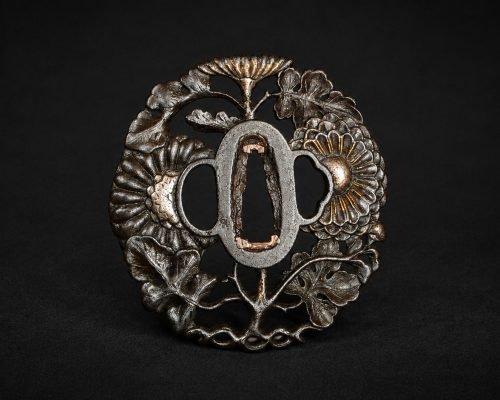
A tsuba’s large central opening accommodates the sword tang. Smaller openings beside it may relate to the accessory knife and kogai.
These accessory openings are known as hitsu-ana. The British Museum identifies a tsuba with both kozuka and kogai openings and distinguishes them from the central blade opening.
This gives a collector a useful way to read the guard as part of a mounting rather than as an isolated ornament.
However, the openings do not prove that the accessories currently accompanying a sword were its original ones. They establish features of the guard’s configuration, not a complete ownership history.
Some surviving openings are plugged. A British Museum example has both accessory openings filled and decorated in gold.
A plugged opening is therefore a detail to investigate and describe, rather than an automatic reason to dismiss a piece.
The limited size of a kozuka or kogai gives decoration a particular intensity. A few centimetres may contain relief carving, contrasting metals and a finely worked ground.
The Metropolitan Museum’s discussion of Gotō fittings describes designs carved in relief against dark shakudō, with gold and silver accents. It also explains nanako: closely arranged punched circles creating a granular surface.
When studying a fitting, look at how the decoration works within its shape. Does the relief remain clear against the background? Are the smallest details carefully resolved? How does the design occupy the available space?
These questions encourage close observation without making an unsupported attribution. A familiar material or technique should not, by itself, be used to assign a maker or school.
Kozuka and kogai can form part of a coordinated group called a mitokoromono.
The Metropolitan Museum defines this as a matching set comprising a kozuka, a kogai and a pair of menuki. Its Gotō collection includes groups arranged in this form.
This creates two rewarding ways to examine the objects: individually and together.
Individually, each fitting has its own construction and decorative treatment. Together, they can reveal how a motif was adapted to different shapes and functions.
For a modern listing, distinguish between a documented matching set and pieces grouped because their decoration looks similar. Related imagery can suggest coherence, but it does not establish a shared maker or continuous history.
Start by establishing exactly what is offered. Then separate visible observations from attribution.
| Check | What to record |
|---|---|
| Object type | Kozuka handle, knife with blade, or kogai |
| Dimensions | Length, width and thickness |
| Construction | Views of edges, openings and reverse |
| Condition | Visible losses, deformation or repairs |
| Decoration | Motif, relief and surface treatment |
| Inscriptions | Clear images and the basis for their interpretation |
| Documentation | Any papers, references or recorded provenance |
A clear description is more useful than a broad claim such as “excellent samurai accessory.”
If a signature or inscription is present, ask what it says and how that reading has been established. Keep identification, maker attribution and dating as separate questions.
Likewise, a fitting’s age should not be inferred from a dark surface alone. Record what can be observed and seek supporting documentation for stronger claims.
Kozuka and kogai broaden the way we look at Japanese swords.
They introduce practical accessories into an ensemble whose materials and decoration can be studied at several scales. The main blade may command attention, yet the small fittings offer a different kind of interest: concentrated metalwork and relationships between objects.
Understanding their names is the first step. Examining their construction, placement and decoration turns those names into something tangible.
When considering a koshirae or a detached fitting, identify each component precisely. A kozuka handle, a kogatana blade and a kogai tell different parts of the mounting’s story.
A kozuka is the handle of a small accessory knife. A kogai is a separate, slender implement traditionally described as a hairdressing tool. Both can be carried in slots within a sword scabbard.
Strictly speaking, kozuka identifies the handle. The small blade fitted into it is called a kogatana. Check a listing carefully to establish whether it includes the blade.
Some tsuba have accessory openings called hitsu-ana associated with the kozuka and kogai. These differ from the central opening for the sword tang.
A mitokoromono is a coordinated set comprising a kozuka, a kogai and a pair of menuki.
No. Similar decoration may suggest a relationship, but a shared maker or original association requires supporting evidence.
Yes. The handle can be examined as a fitting and a piece of metalwork. Its description should make clear whether a kogatana blade is included.
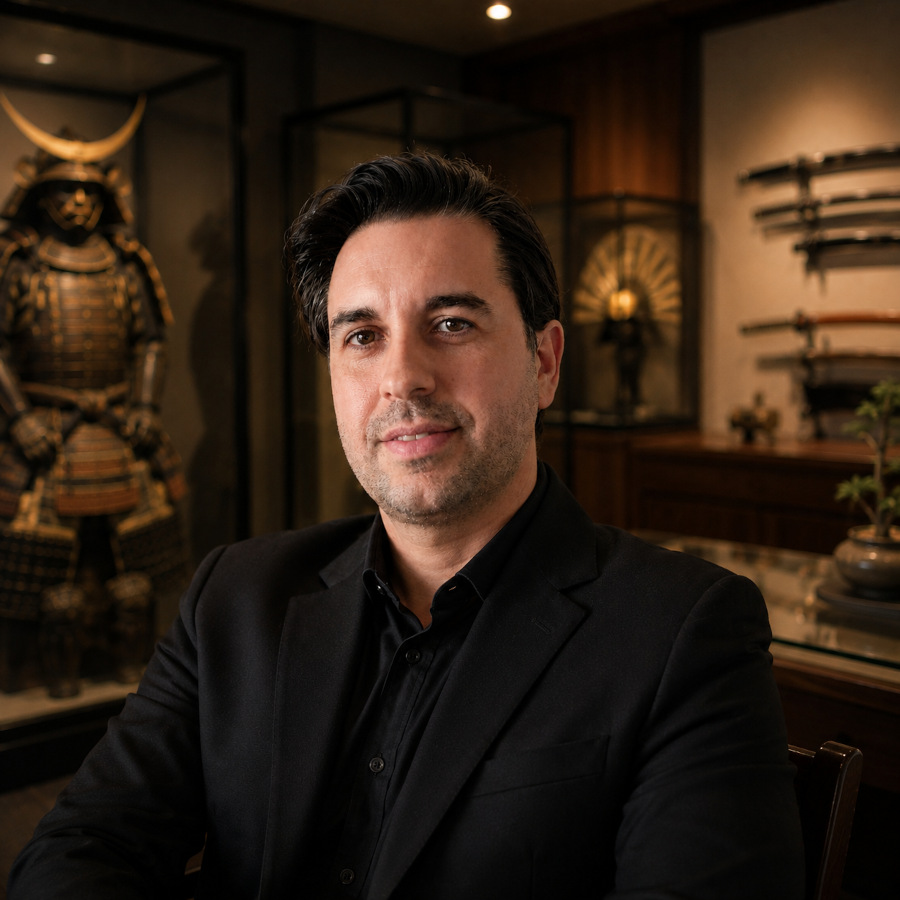
CEO of SupeinNihonto, dealer and collector of ancient Japanese art and weapons from Canillo, Andorra.
Contact