October 17, 2026

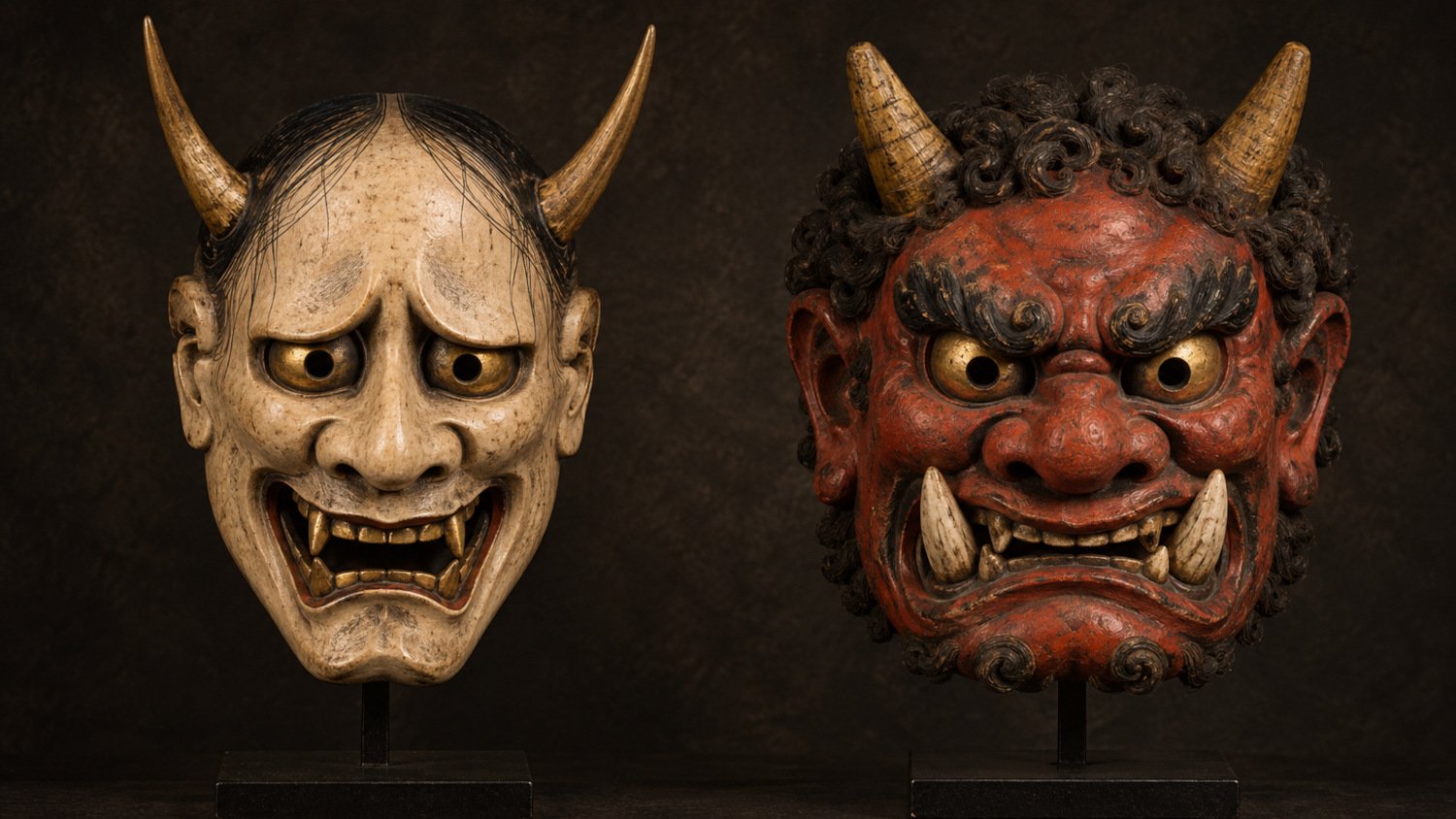
Two horns, exposed fangs and a fierce expression: these features immediately suggest a Japanese demon. Yet they do not always identify the same figure.
The main difference between Hannya and Oni is specificity. Hannya is a particular Noh mask type associated with a woman transformed by jealousy and rage. Oni is a broader term for Japanese demonic beings, whose appearances and roles vary. The British Museum’s collection descriptions make this distinction between the specific theatrical figure and the wider category.
For collectors, understanding that difference helps turn a striking face into a more meaningful subject. It also prevents a common mistake: labelling every horned Japanese mask “Hannya.”
This guide compares the two figures and explains how to approach their identification in masks and smaller objects. For the broader theatrical background, see our introduction to Noh masks and Japanese tradition.
Hannya belongs to the visual language of Noh theatre. Its demonic appearance represents a female character whose jealousy and rage have transformed her.
The Montreal Museum of Fine Arts describes the mask as portraying a woman transformed into a demon through jealous rage. This human origin is central to its meaning: the frightening face expresses an emotional transformation rather than simply presenting an anonymous monster.
That makes Hannya particularly compelling as an artwork. The horns and fangs communicate aggression, but the character’s suffering remains part of the image.
A collector looking only for ferocity may miss this emotional complexity. Hannya is powerful because the face can suggest both a threat and the pain behind it.
Oni is a broader term commonly translated as demon or ogre. It does not identify one fixed face, one theatrical mask or one character.
An oni may appear as a complete figure in a carving, a painted scene or an image of a mask. Its meaning depends on what it is doing and which story surrounds it.
For example, the British Museum holds a wooden netsuke depicting Shōki, the Demon Queller, with an oni. The interaction between the figures establishes the subject more clearly than the demon’s features alone.
Elsewhere, an oni may be presented in an unexpected role. A British Museum hanging scroll depicts an oni dressed as a travelling priest, with a gong suspended from its neck. Such examples show why oni imagery should not be reduced to a single expression of violence.
| Feature | Hannya | Oni |
|---|---|---|
| Meaning | A specific theatrical mask type representing a transformed female character | A broad category of demonic beings |
| Main context | Noh theatre and artworks drawing on its imagery | Stories, paintings, prints, carvings and other forms of Japanese art |
| Identification | Depends on the established mask design and its context | Depends on the figure, attributes, action and surrounding narrative |
| Emotional reading | Jealousy, rage and suffering | Varies according to the particular representation |
| Form | Often encountered as a mask or a miniature representation of one | May appear as a mask, head or complete figure |
These are not two equivalent mask types with a simple male-versus-female distinction. One term names a particular theatrical form; the other covers a much wider field.
A traditional Hannya design commonly combines projecting horns, an open mouth with fangs and sharply defined eyes.
The British Museum describes one example with gilded horns and teeth. These details give the face an immediately supernatural appearance, while its remaining human features keep the transformation visible.
When examining a possible Hannya mask, study the whole face:
Horns and fangs alone are insufficient. They are shared by many demonic representations. The relationship between the features is more useful than any one feature in isolation.
For an uncertain object, “horned demonic mask” can be a sound preliminary description while the precise type is investigated.
A Hannya mask does not need moving facial features to suggest different emotions.
The Second Face Museum of Cultural Masks explains that its example appears angry when viewed straight on and sorrowful when tilted downward. The angle changes how the carved planes, brows and shadows are perceived.
This helps explain why a frontal photograph may communicate only part of the object’s character.
For a closer examination, compare photographs taken from the front and slightly above or below. Use consistent lighting so that the differences remain easy to understand.
The aim is to observe how the carving works. A face that initially seems entirely aggressive may reveal a more troubled expression from another viewpoint.
Colour should be recorded carefully, but it should not determine the identification by itself.
A red surface does not automatically make an object an oni, and a pale surface does not prove that it is Hannya. Likewise, a darkened finish should not be treated as evidence of great age without examining the object more broadly.
Start with the mask’s form and documented context. Then describe its colour, surface decoration and condition as additional observations.
This approach keeps several different questions separate:
What figure is represented? How was the object made? When was it made?
Recognising the subject may help answer the first question. It does not settle the other two.
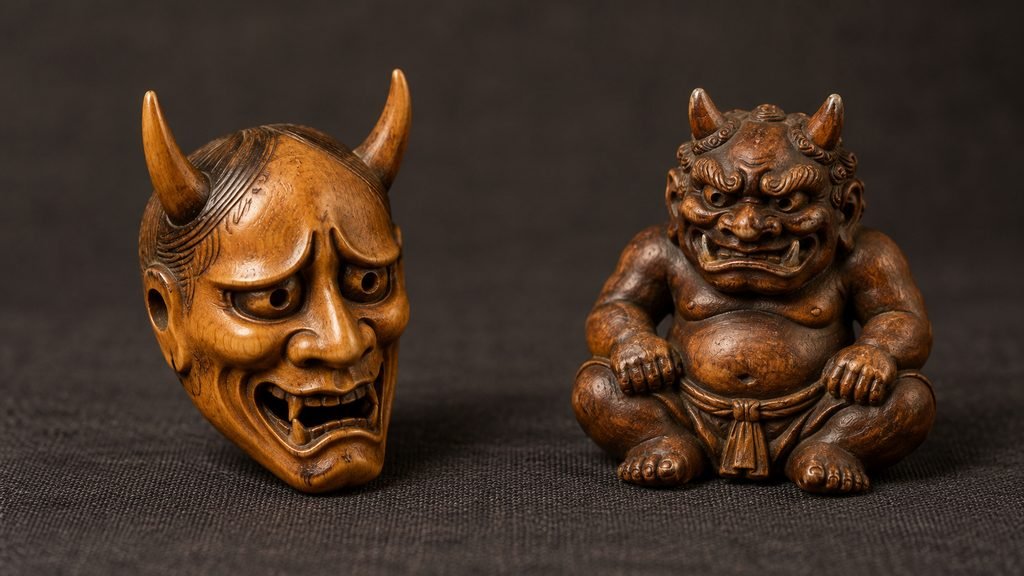
Hannya imagery also appears in objects that were never intended to cover a performer’s face.
The Metropolitan Museum of Art holds an eighteenth-century wooden netsuke of a Hannya Noh mask, measuring approximately 5.1 centimetres high. It translates the theatrical face into a small carved object.
This is an important distinction when describing a collection.
A mask-shaped netsuke represents a mask, but its object type remains netsuke. Its scale, construction and function differ from those of a wearable theatre mask.
For collectors exploring Japanese netsuke, identifying the represented subject is one layer of interpretation. Understanding the object itself is another.
The same principle applies to paintings and prints of masks: the image depicts a theatrical form without becoming a theatrical object.
With oni imagery, the surrounding scene often supplies the strongest clues.
A small horned figure beside Shōki belongs to a different narrative from a demon wearing religious clothing. A face shown on its own may offer fewer clues than a complete figure holding an object or reacting to another character.
Before assigning a specific meaning, ask:
This method is more useful than assuming that every oni image symbolises the same idea.
It also leaves room for humour, narrative and artistic invention within a subject that can initially appear purely frightening.
A modern carving can reproduce a recognisable Hannya design. An older object can also adapt demonic features without closely following a standard theatrical type.
Consequently, identifying Hannya or an oni does not prove the age, maker or original use of an object.
When considering a purchase, request photographs of the front, sides and reverse, together with dimensions and any available documentation. Ask the seller to distinguish a supported attribution from a tentative description.
For a mask, several claims may need separate evidence:
| Claim | Question to clarify |
|---|---|
| Hannya subject | Does the design correspond to the recognised mask type? |
| Period attribution | What supports the proposed date? |
| Maker attribution | How has a signature or inscription been interpreted? |
| Performance history | Is actual theatrical use documented? |
| Condition | Are repairs, losses or surface alterations described? |
This produces a clearer understanding than treating “antique Hannya mask” as one indivisible claim.
Hannya and oni imagery can attract collectors through their immediate visual force. Closer study reveals that similar features may belong to different stories and object types.
Hannya directs attention towards a particular theatrical transformation. Oni invites a broader investigation of the scene, attributes and narrative.
When exploring the Noh masks at Supein Nihonto, consider the named type alongside the carving, expression and available documentation. Understanding the subject helps explain what makes a face distinctive and gives the object a place within a wider collection of Japanese art.
Hannya is a specific Noh mask type associated with a woman transformed by jealousy and rage. Oni is a broader term for Japanese demonic beings and does not refer to one standard mask design.
That description is too broad for precise identification. Hannya has a particular theatrical form and context, while oni imagery covers many different demonic representations.
No. Horns occur in several demonic designs. Identify the complete face and compare it with documented examples rather than relying on horns alone.
Its carved features can create different emotional impressions according to viewing angle and light. A downward tilt can make its expression appear sorrowful rather than purely aggressive.
Yes. Museum collections include miniature Hannya mask netsuke. These are small carved objects representing the theatrical mask, rather than wearable masks.
No. Subject, age and authenticity are separate questions. A recognisable Hannya design can appear on objects made in different periods, including modern carvings.
CEO of SupeinNihonto, dealer and collector of ancient Japanese art and weapons from Canillo, Andorra.