October 17, 2026

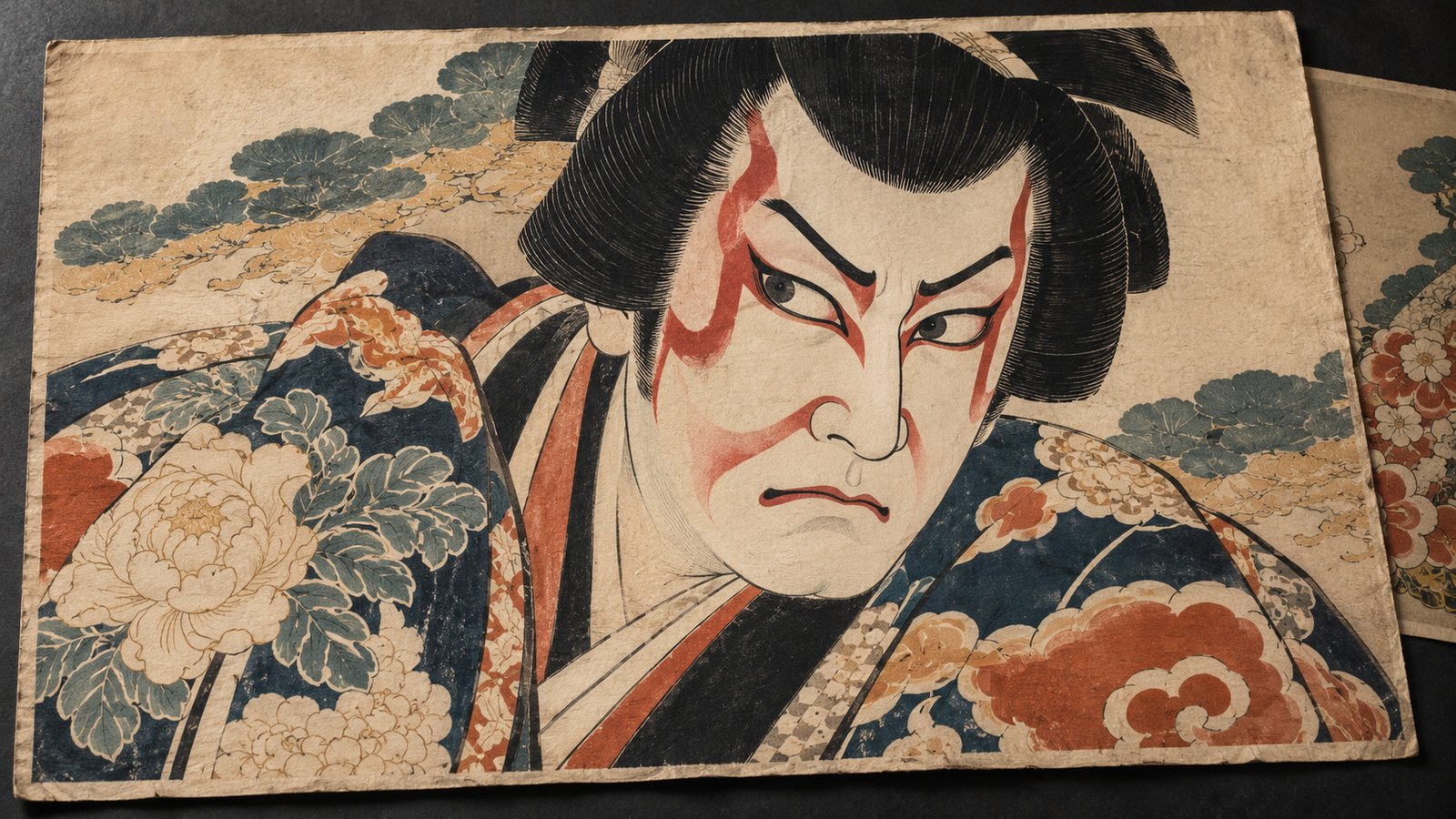
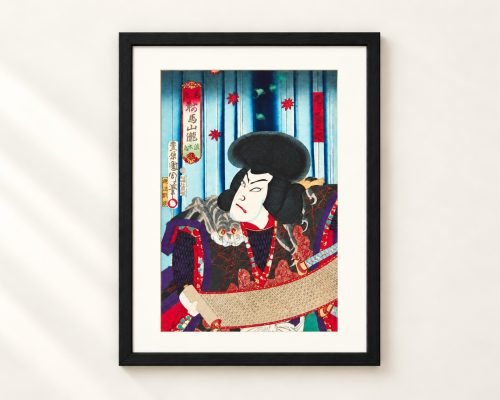
A gripping stare, a patterned robe, a hand concealed inside a sleeve: small details can transform the way we understand a Japanese actor print.
Kabuki actor prints, known as yakusha-e, depict performers whose faces, stage names and celebrated roles were familiar to their audiences. To those viewers, an image could evoke a favourite star, a dramatic confrontation or a memorable performance. Today, those connections are less immediately obvious, but they remain essential to understanding the artwork.
The best starting point is to separate three identities: the artist who designed the print, the actor portrayed and the character being performed. From there, costume, gesture and inscriptions begin to reveal how the image works.
For the wider background to Japanese printmaking, see our guide to ukiyo-e history, artists and Japanese woodblock prints. Here, the focus is on reading the theatrical figures themselves.
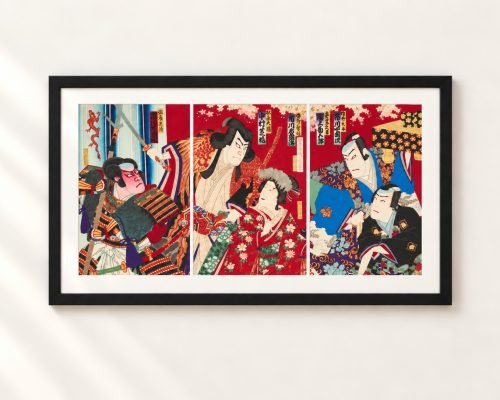
Yakusha-e are images of actors, especially those associated with kabuki theatre. They form a distinctive subject within ukiyo-e, ranging from individual portraits to compositions featuring several performers.
These prints participated in a culture of theatrical celebrity. Audiences followed particular actors, admired their performances and collected their images. The Japan Arts Council describes actor prints as part of the media through which fans engaged with their favourite performers beyond the theatre.
However, an actor print is not necessarily a literal record of a stage performance. Some represent identifiable productions; others place actors in imagined settings, portray them outside a role or commemorate their deaths. The Fitzwilliam Museum’s collection documentation includes both memorial portraits and a posthumous imaginary portrayal of Segawa Kikunojō V.
This distinction matters: recognising an actor does not, by itself, establish that the scene was performed exactly as shown.
Museum descriptions often follow a helpful formula:
Artist — Actor as Character — Play or scene, where identified.
Each element answers a different question.
| Identity | What it tells you |
|---|---|
| Artist | Who designed the image |
| Actor | Which performer is portrayed |
| Character | Whose part the performer is playing |
| Play or production | The theatrical context, when documented |
For example, the Metropolitan Museum of Art holds a print designed by Tōshūsai Sharaku, depicting Morita Kan’ya VIII as a palanquin-bearer in A Medley of Tales of Revenge. Sharaku is the artist; Morita Kan’ya VIII is the actor; the palanquin-bearer is the role.
This approach prevents a common misunderstanding: treating every name attached to a print as either the artist’s signature or the name of a historical figure.
It also helps explain why the same face can appear in very different clothes across several prints. The performer remains recognisable while the character changes.
Names such as Ichikawa Danjūrō VII or Onoe Kikugorō III belong to theatrical traditions in which stage names pass between successive performers.
The Roman numeral used in catalogues distinguishes different holders of the same name. An individual actor could also perform under several names during a career, acquiring a new name through a succession ceremony known as shūmei. These lineages could include adopted successors as well as biological relatives.
For a collector, this has a practical consequence: finding a familiar name is only the beginning of identification. The generation, print date and name used at that point in the actor’s career must fit together.
When researching a print, record the complete identification given by a reliable catalogue rather than shortening it to “Danjūrō” or “Kikugorō.”
Actor portraits could preserve recognisable facial characteristics even beneath costume and theatrical expression.
The Japan Arts Council highlights Matsumoto Kōshirō V’s prominent nose, which artists often emphasised through a profile view. Such features helped audiences recognise the performer alongside the character he portrayed.
When comparing portraits, examine the relationship between the nose, eyes, jaw and mouth. Repeated features may help connect images of the same actor.
Nevertheless, resemblance is supporting evidence rather than a complete identification method. The artist’s style, the role and the expression all affect the face. A museum match or a documented inscription provides firmer ground than visual similarity alone.
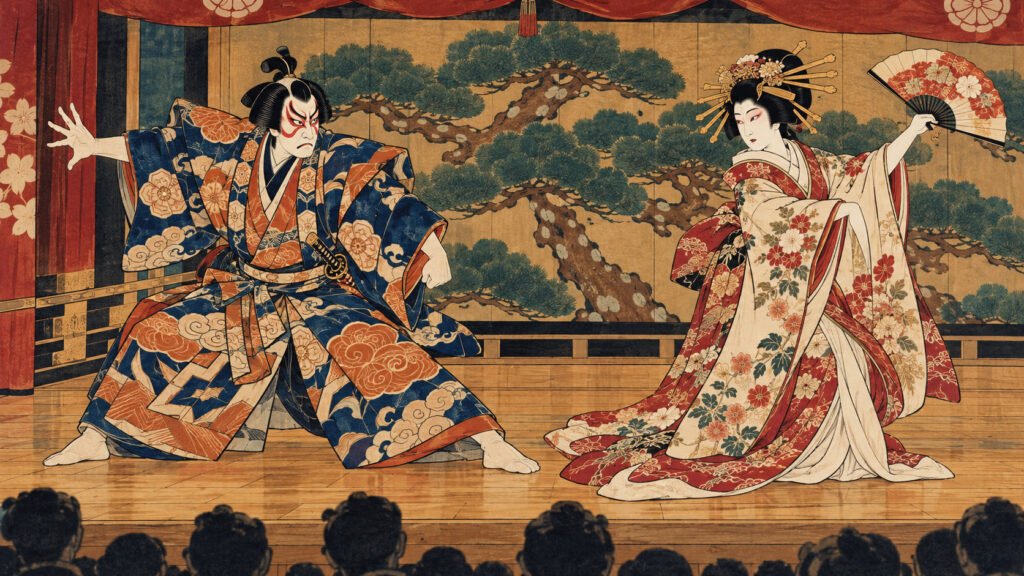
An elegantly dressed female character in a kabuki print may represent an onnagata, a male performer specialising in female roles.
This means that clothing alone cannot determine whether a print portrays a woman outside the theatre or an actor performing a female character. The identity of the performer and the subject of the image need to be considered separately.
A revealing example is Yamamoto Yoshinobu’s portrait of Onoe Kikugorō I at the Metropolitan Museum of Art. The actor appears dressed as a female character, while a hanging picture behind him shows him in a male role. The composition brings two theatrical identities into the same image.
For collectors, this creates a more interesting question than simply “Who is this woman?”: which performer, in which role, is the artist asking us to recognise?
Costume is one of the most useful routes into a theatrical print. Rather than viewing a robe only as decoration, ask how it relates to the character, the scene and the other figures.
A documented example appears in the Fitzwilliam Museum’s discussion of an 1823 Kunisada triptych. Fuwa Banzaemon wears a pattern of lightning among clouds, while his rival Nagoya Sanza wears swallows in the rain. Their costumes correspond to imagery associated with their swords and help distinguish the two rivals in the confrontation.
This is more useful than applying a universal dictionary in which every flower, bird or colour always has one meaning. A motif may have a precise theatrical function in one play and a different significance elsewhere.
When examining clothing, consider:
An interpretation becomes stronger when the pattern, inscriptions and known scene support one another.
A mon, or crest, can provide another clue to a performer’s identity.
In a Kunisada portrait discussed by the Fitzwilliam Museum, the butterfly on Segawa Kikunojō V’s fan identifies the crest associated with the Kikunojō acting lineage. It is therefore more than a decorative insect.
The useful lesson is to look beyond the face. An accessory can carry information that is easy to overlook when viewing a small photograph.
However, a crest associated with a lineage does not necessarily distinguish every individual who belonged to it. Combine it with the stage name, date and documented portrait rather than using it as the sole basis for attribution.
The bold lines seen on some kabuki faces are kumadori, a system of theatrical makeup associated particularly with forceful, stylised roles.
The Japan Arts Council documents several distinct patterns. Sujiguma, with sweeping red lines, is associated with heroes displaying extraordinary strength and intense anger. Kugeare, using indigo-blue lines, is associated with high-ranking villains. Other patterns serve different character types.
These distinctions make makeup useful evidence, but a simple rule such as “red means good, blue means evil” is insufficient. The arrangement of the lines and the specific role matter.
Nor should the absence of bold makeup exclude a print from the kabuki genre. Actor portraiture includes a much wider range of faces and performances than the most immediately recognisable kumadori designs.
A kabuki print can suggest movement through a moment of stillness.
One important performance device is the mie, an emphatic pose in which an actor holds a powerful attitude at a dramatic moment. The tension of the body and the direction of the gaze help concentrate the audience’s attention.
However, not every expressive gesture is a mie. Small actions can also communicate character.
In Sharaku’s portrait of Morita Kan’ya VIII, the Metropolitan Museum of Art explains that the character rubs his hands inside his kimono, a gesture suggesting awareness of an impending evil deed. The meaning lies in the relationship between hands, clothing and expression.
Before looking for a translation, spend a moment following the body:
Where are the hands? What does the figure look towards? Is the torso turning away from another person? Does an object connect the figures?
These observations help turn an attractive portrait into a readable dramatic scene.
For collectors of Japanese arms and armour, this is an especially useful distinction.
A sword-bearing figure may represent a warrior from history or legend, but it may also portray a named actor performing that warrior. The presence of a sword does not resolve the question.
Kabuki performers played historical characters as well as lovers, villains and supernatural figures. The Metropolitan Museum of Art, for example, catalogues a print of Onoe Fujaku III as Kobayakawa Takakage, while explicitly noting that the play has not yet been identified.
That catalogue entry offers a good model for careful interpretation: identify what the evidence supports and leave the remaining question open.
A theatrical image is valuable evidence of how a warrior was represented on stage. Its costume and weapons should not automatically be treated as a literal record of the historical person’s equipment.
You do not need to identify every detail immediately. Work from the broad composition towards the documented particulars.
The aim is to build a connected reading of the image. A costume pattern may suggest a role, a crest may suggest a lineage, and an inscription may clarify the actor. Their agreement is what makes the interpretation convincing.
Kabuki portraits offer several rewarding ways to build a collection: following one performer through different roles, comparing interpretations of a character or studying how artists organise expression and costume.
Even two images of the same actor can encourage different kinds of looking. One may emphasise the face; another may depend on the relationship between several figures.
When exploring Japanese woodblock prints in the Supein Nihonto collection, consider the subject identification alongside the visual composition. Knowing who is represented can deepen the appeal of a print, while clearly stated uncertainties provide useful directions for further research.
The pleasure of studying yakusha-e lies in that gradual recognition: a face becomes a performer, a patterned robe becomes a clue, and a silent sheet of paper begins to suggest the theatre.
Yakusha-e means actor pictures. In ukiyo-e, the term is especially associated with depictions of kabuki performers, including individual portraits and scenes featuring several actors.
Consult a documented catalogue entry that identifies the performer “as” a particular role. Keep both names separate from the artist’s name. Their positions on the print can vary, so placement alone is not a reliable guide.
Male performers known as onnagata specialised in female roles. A print can therefore portray a recognisable male actor in the costume and character of a woman.
They distinguish successive holders of a stage name. They identify the performer’s place in that naming lineage, rather than a print edition or the order of a theatrical role.
No. Kumadori is associated with particular styles and character types. Many actor prints depict performers without its bold facial lines.
No. Some document identifiable productions, while others are imagined portrayals, informal images or memorial portraits. Establishing a particular performance requires supporting documentation.
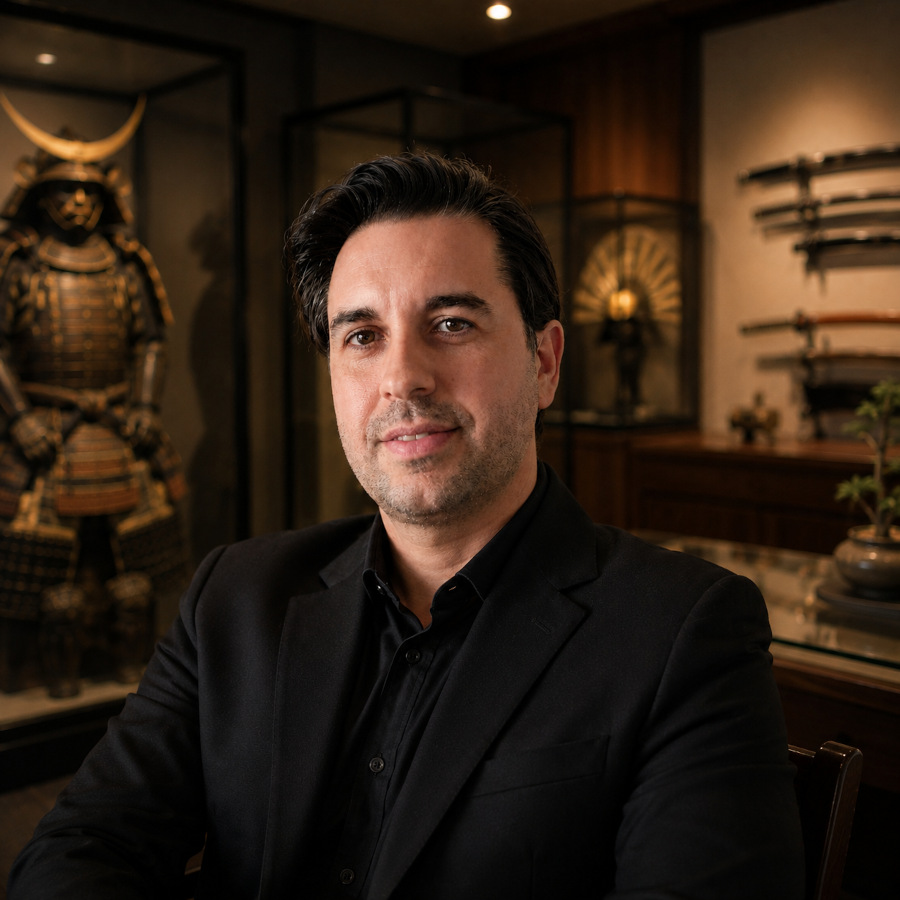
CEO of SupeinNihonto, dealer and collector of ancient Japanese art and weapons from Canillo, Andorra.