

1 in stock
1 in stock
Add to Compare
Add to Wishlist
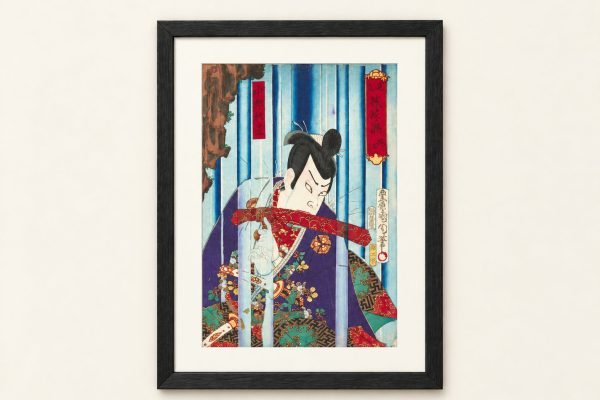
An original Japanese nishiki-e color woodblock print by Utagawa Kuniyoshi (1797–1861), from the celebrated series Wakan Nazorae Genji (和漢准源氏, “Japanese and Chinese Comparisons for the Chapters of Genji”), published by Ise-Yoshi in 1855–1856.
This sheet corresponds to Chapter Twenty-Seven of The Tale of Genji, “Kagaribi” (篝火, “Cressets”). Rather than literally illustrating Murasaki Shikibu’s novel, Kuniyoshi creates a mitate — an imaginative literary and visual comparison — linking the chapter’s association with fire to one of the most famous legends surrounding the ancient prince Yamato Takeru no Mikoto (日本武尊).
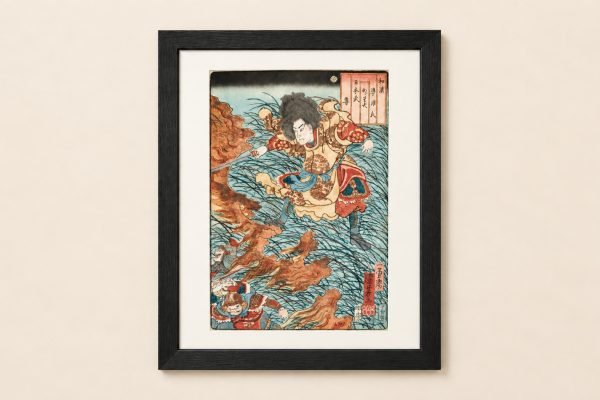
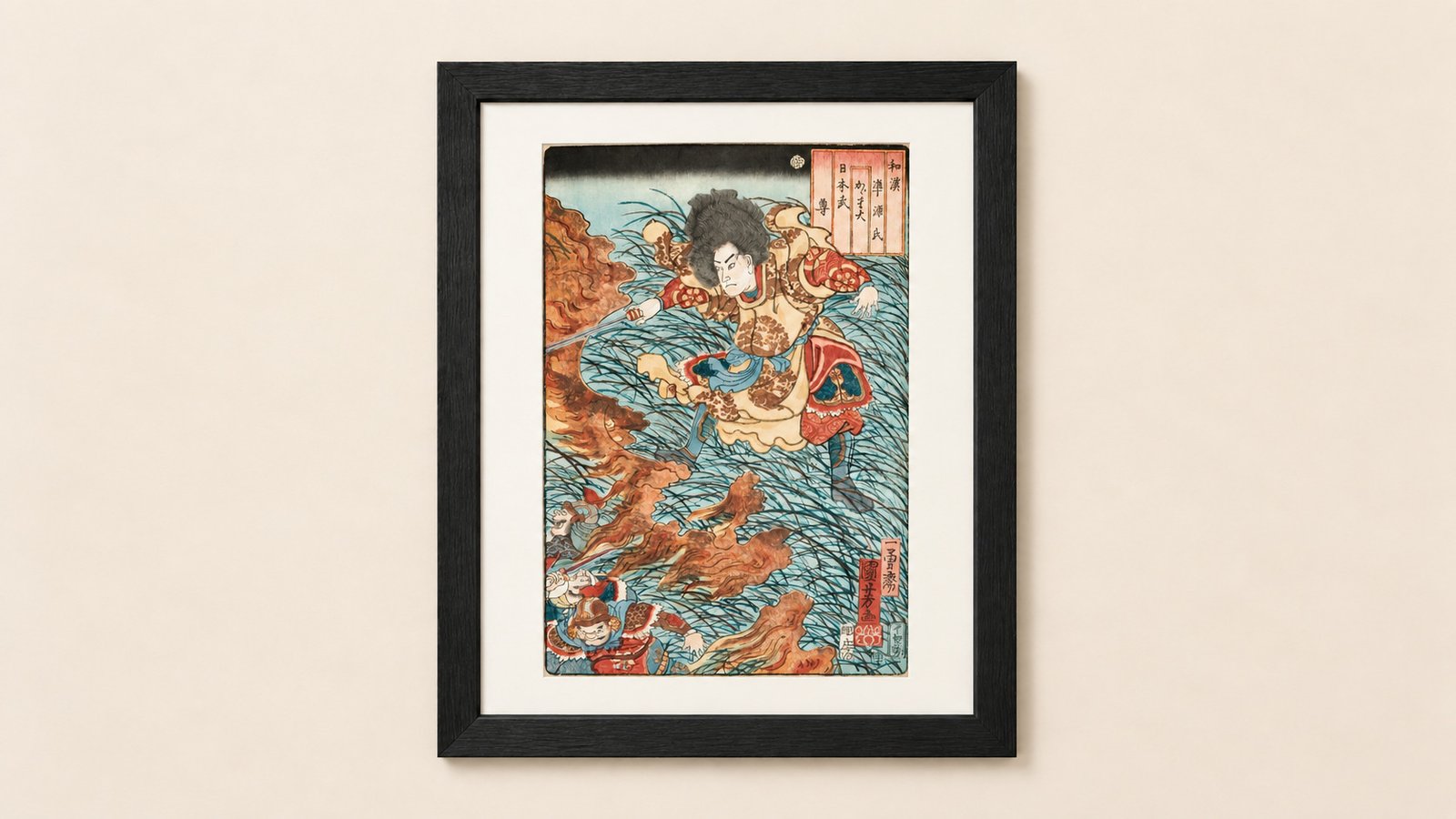
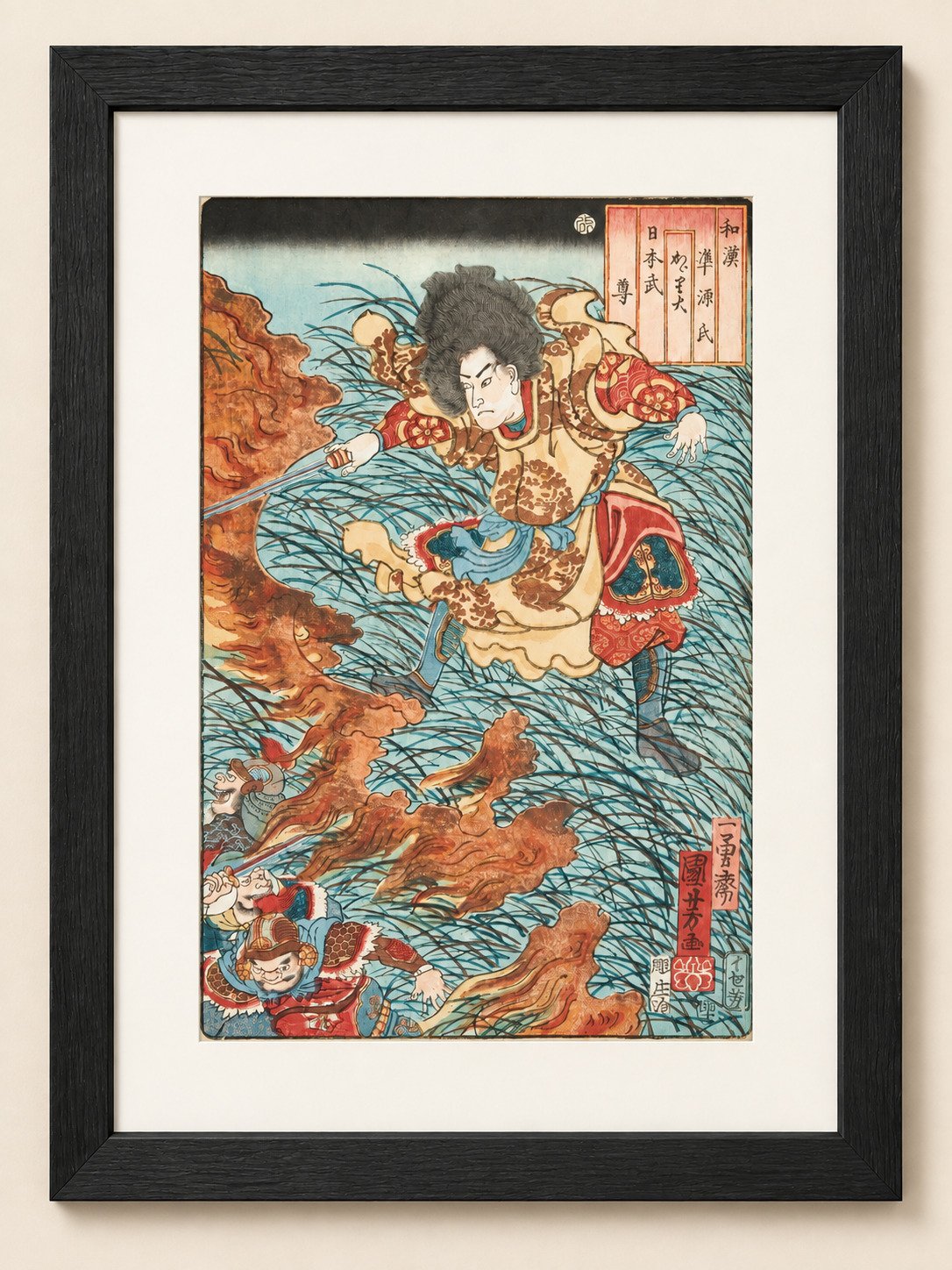
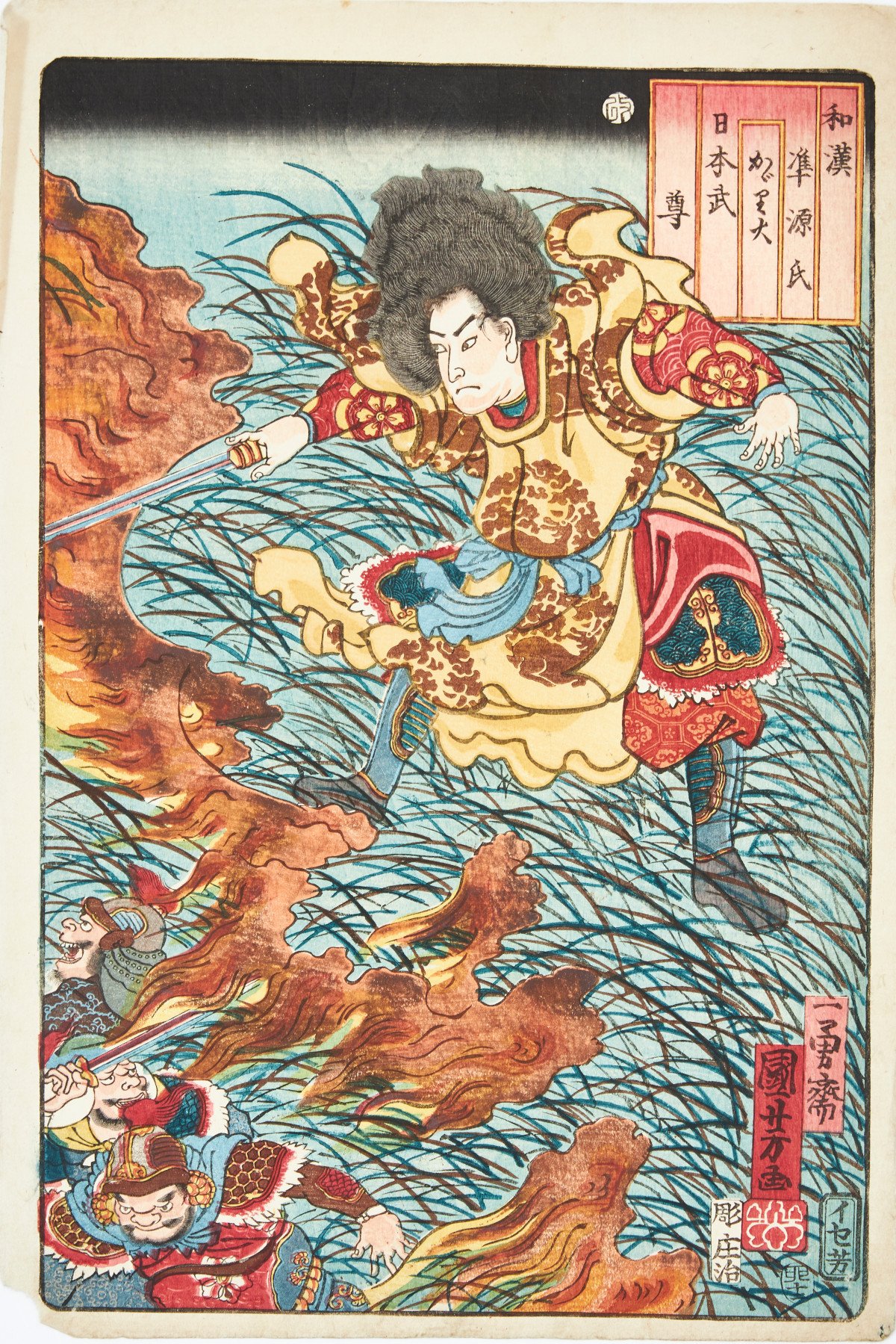
The scene depicts Yamato Takeru trapped within a field of burning grass, using the sacred sword later known as Kusanagi-no-Tsurugi, the “Grass-Cutting Sword,” to cut through the flames and escape his enemies’ trap.
Kuniyoshi transforms the legendary episode into a powerful musha-e composition filled with movement: the prince advances through tall grass with sword drawn while sweeping tongues of flame spread through the landscape and his enemies recoil below.
The ukiyo-e comes individually framed and ready to hang.
Kagaribi (篝火), translated as “Cressets,” is the twenty-seventh chapter of The Tale of Genji.
A kagaribi is an open fire or brazier used for illumination, including the fires traditionally associated with nighttime cormorant fishing.
Kuniyoshi takes this idea of fire and flame as the poetic connection for his mitate. Instead of illustrating the events of the Genji chapter directly, he pairs its title with the dramatic legend of Yamato Takeru escaping from a burning field.
The result is a sophisticated visual comparison in which a literary reference from the refined world of Genji becomes the starting point for an ancient heroic legend.
The print belongs to Kuniyoshi’s important series Wakan Nazorae Genji (和漢准源氏), generally translated as “Japanese and Chinese Comparisons for the Chapters of Genji.”
The series uses the chapters of The Tale of Genji as a literary framework while introducing scenes from Japanese and Chinese history, legend and classical literature.
Rather than producing straightforward illustrations of Murasaki Shikibu’s novel, Kuniyoshi builds visual and literary associations between the chapter titles and famous warriors, legendary heroes and celebrated narratives.
This sheet is catalogued as Robinson S88.27.
Yamato Takeru no Mikoto (日本武尊) is one of the great heroic figures of Japan’s legendary early history.
He appears in both the Kojiki and the Nihon Shoki as a son of Emperor Keikō who was sent on military campaigns to subdue rebellious regions.
Stories surrounding Yamato Takeru combine martial courage, supernatural protection and tragic heroism, making him one of the most enduring warrior figures of Japan’s earliest literary traditions.
Kuniyoshi depicts one of the defining episodes of his eastern campaign: the moment when the prince is trapped in a field deliberately set on fire by his enemies.
According to the legend, Yamato Takeru’s enemies lured him into an open field covered in tall grass and then set the surrounding vegetation ablaze.
Fire spread toward him from all sides, apparently leaving no route of escape.
Kuniyoshi captures the danger at its most dramatic moment. Yamato Takeru stands amid dense grasses and advancing flames, his body leaning forward as he clears a path with his sword.
Below him, hostile figures appear among the burning vegetation, while the curling flames and mass of grasses transform the entire landscape into a scene of movement and danger.
Before beginning his eastern campaign, Yamato Takeru had received the sacred sword Ame-no-Murakumo-no-Tsurugi from the priestess Yamatohime at the Ise Shrine.
When trapped by the fire, he used the sword to cut down the surrounding grass and clear the area around him.
He also used a fire-striker that had been given to him, setting a counterfire and escaping the trap unharmed.
Following this episode, the sword became known as Kusanagi-no-Tsurugi — the “Grass-Cutting Sword.”
Kusanagi-no-Tsurugi occupies an exceptional place in Japanese tradition.
The sword is counted among the Three Sacred Treasures of Japan, together with the sacred mirror and jewel of the imperial regalia.
Its association with Yamato Takeru and the burning-field episode transformed the weapon into far more than a simple sword: it became part of the legendary and sacred history of the Japanese imperial tradition.
For Kuniyoshi, whose work repeatedly explored famous warriors, legendary weapons and moments of supernatural drama, the story offered ideal material for a visually powerful print.
The connection between the Yamato Takeru legend and Chapter Twenty-Seven of The Tale of Genji lies in the idea of fire.
The chapter title Kagaribi refers to open fires or cressets used for illumination. Kuniyoshi transforms this poetic association into an intense warrior scene dominated by burning grass.
This is characteristic of the mitate principle throughout Wakan Nazorae Genji: the connection does not depend on illustrating the novel literally, but on creating an intelligent visual correspondence between the chapter title and another story.
The composition is dominated by dense, sweeping grasses and large tongues of orange-brown flame.
Yamato Takeru occupies the upper center of the image, moving across the field with his sword extended. His elaborate garments and armor contrast with the chaotic environment surrounding him.
The curved grasses create an almost continuous pattern across the background, while the flames cut through them in irregular bands.
This combination gives the scene a strong sense of urgency, as though both the fire and the landscape are moving around the central figure.
Kuniyoshi places Yamato Takeru above the other figures, making him the unquestioned focal point of the composition.
His posture is controlled and purposeful despite the danger around him. Sword in hand, he appears not as a passive victim of the trap, but as a warrior actively creating his own escape.
The contrast between the prince’s concentrated figure and the confusion of the enemies below reinforces the legendary nature of the episode.
The Tale of Genji (Genji Monogatari) was written by the court lady Murasaki Shikibu in the early 11th century.
It is one of the foundational masterpieces of classical Japanese literature and is frequently described as the world’s first novel.
Across its fifty-four chapters, the work explores court life, relationships, social status, beauty, memory, loss and the emotional world of the Heian aristocracy.
Kuniyoshi approaches this literary monument through comparison rather than direct illustration, using individual chapter titles as starting points for historical, literary and legendary associations.
Utagawa Kuniyoshi (1797–1861), born Yoshisaburō in Edo, was the son of a silk dyer and entered the Utagawa school around 1811 as a pupil of Utagawa Toyokuni I.
His breakthrough came with the 1827 series depicting the 108 heroes of the Chinese novel Suikoden, which established him as one of the great designers of musha-e, or warrior prints.
Kuniyoshi became especially celebrated for dramatic scenes of warriors, legendary heroes, supernatural beings, ghosts and monsters, while also producing highly inventive animal imagery.
His work is characterized by bold compositions, dramatic movement and an exceptional ability to translate complex stories into immediately readable visual narratives.
Alongside Hiroshige and Kunisada, Kuniyoshi is regarded as one of the last great masters of ukiyo-e. He died in 1861 after training an important generation of pupils, including Tsukioka Yoshitoshi.
Musha-e are woodblock prints devoted to warriors, battles and legendary heroes.
Kuniyoshi became one of the defining artists of the genre, frequently presenting his subjects in moments of extraordinary danger, supernatural confrontation or heroic action.
The legend of Yamato Takeru was particularly suited to this visual language. A warrior surrounded by flames, wielding one of Japan’s most famous sacred swords, allowed Kuniyoshi to combine movement, legend and dramatic landscape in a single image.
The work is a nishiki-e, or full-color Japanese woodblock print.
This technique required multiple carved woodblocks, with separate blocks prepared for the principal outlines and individual areas of color. Each block had to be printed in precise registration to produce the completed image.
The surviving colors remain an important part of the print’s visual impact, particularly the turquoise-blue background, the warm orange-brown flames and the red, cream and blue details of Yamato Takeru’s costume.
Wakan Nazorae Genji was published by Ise-Yoshi in 1855–1856, during the final years of the Edo period.
The print therefore belongs to the mature phase of Kuniyoshi’s career, when his reputation as one of the great masters of Japanese warrior imagery was firmly established.
Its combination of classical literature, ancient legend, sacred weapon imagery and dramatic musha-e design is characteristic of Kuniyoshi’s ability to bring historical and legendary narratives to life.
This print comes from the collection of Dr. Eugen Milch (1889–1958), an Austrian physician and artist whose life involved extensive travel throughout Europe and Asia.
Milch served as a medical officer during the First World War and traveled widely in the early 1920s on combined study and painting journeys. In 1924 he married the artist Emma Bormann, and the couple visited Sweden that same year. Together with the artist Oskar Bergman, they exhibited several paintings at Liljevalchs in Stockholm.
In 1937, Eugen Milch traveled to China with other Austrian physicians at the invitation of the Chinese government. In 1938 he became superintendent of a hospital in Beihai, China.
Following the Japanese occupation of parts of the southern Chinese coast, including Beihai, the Milch family relocated to Shanghai in 1941.
Eugen later assisted British forces in China and was granted British citizenship. He subsequently traveled to Japan to study the aftermath of the war, and it is considered likely that he acquired the present collection of Japanese woodblock prints during this period.
He died in Hong Kong in 1958. The collection subsequently passed by descent within the family.
This is an original antique Japanese woodblock print (ukiyo-e), not a modern reproduction or later reprint.
Dating from 1855–1856, it is a genuine late Edo-period work preserving the paper, pigments, printing characteristics and natural aging associated with an original Japanese woodblock impression.
As with any work on paper of this age, some light wear is normal and expected. Gentle toning of the paper, occasional small spots or creases, surface soiling and faint handling marks may be present as part of the natural history of a print that has survived for approximately 170 years.
These characteristics are typical of genuine period ukiyo-e and should be understood within the context of the work’s age. Individual condition notes are provided for transparency and do not imply that the print is in poor condition.
The print remains in good overall antique condition.
There is wear consistent with age, some surface soiling and handling creases. The colors remain generally well preserved and retain considerable visual strength.
Please examine the detailed photographs carefully, as they form an important part of the condition description and provide a close view of the paper, colors, margins and surviving surface.
The print is individually framed and sold complete with its frame, ready to hang.
A dynamic original late Edo-period ukiyo-e by Utagawa Kuniyoshi from the 1855–1856 series Wakan Nazorae Genji, pairing Chapter Twenty-Seven of The Tale of Genji, “Kagaribi,” with the legendary escape of Yamato Takeru from a field of burning grass. Sword in hand and surrounded by sweeping flames, the ancient prince uses the weapon later known as Kusanagi-no-Tsurugi to cut himself free from the trap, creating a powerful image of heroic action and one of Japan’s most enduring sacred-sword legends. Published by Ise-Yoshi, catalogued as Robinson S88.27 and preserved with provenance from the collection of Dr. Eugen Milch, this original framed print brings together classical literature, early Japanese legend and Kuniyoshi’s mature mastery of the warrior print.

Order above 1.000,00 € gets free shipping.

Secure and hassle-free payment process.

Certificate of authenticity included.

Have questions? Contact us via WhatsApp.
Contact