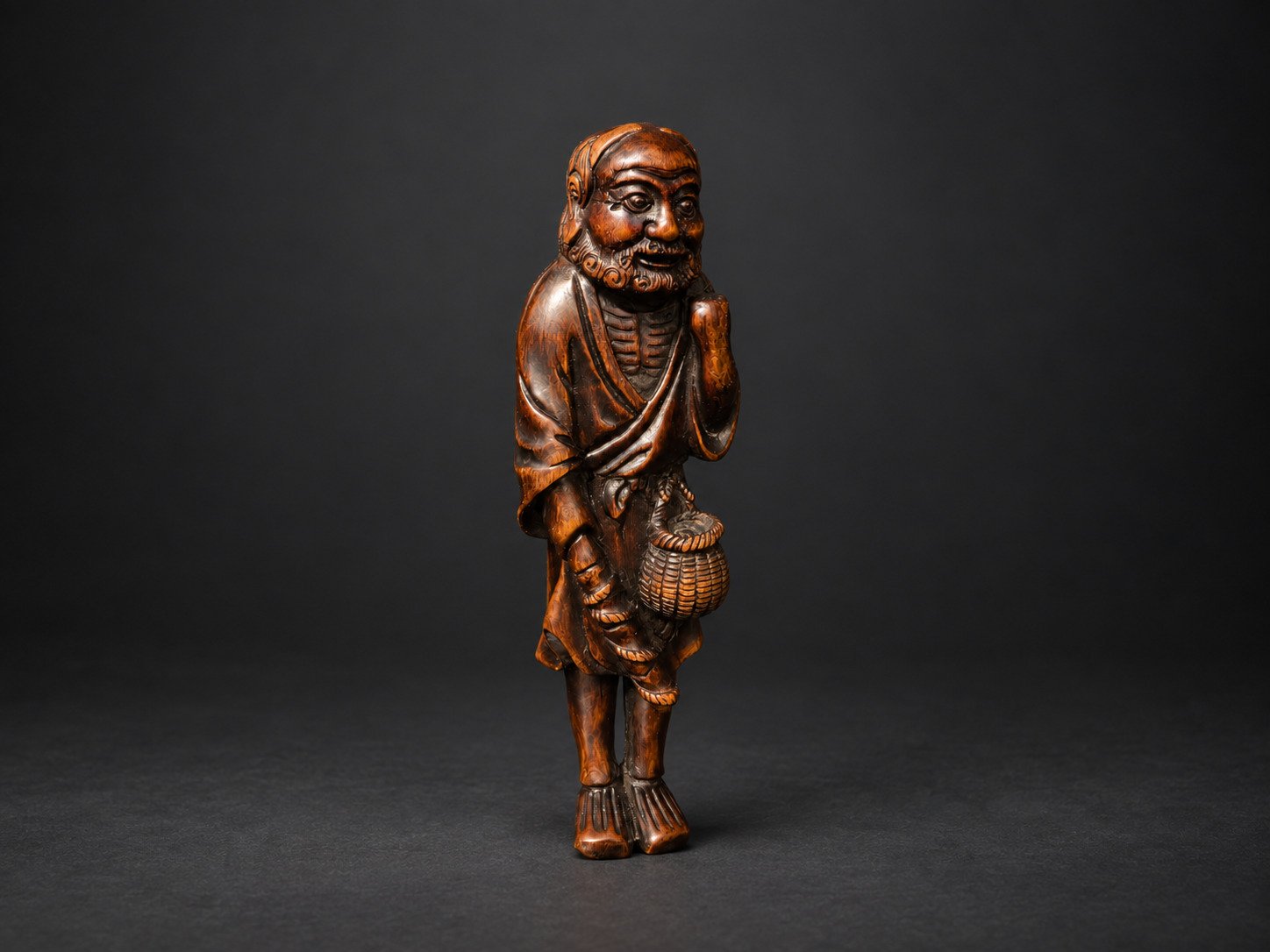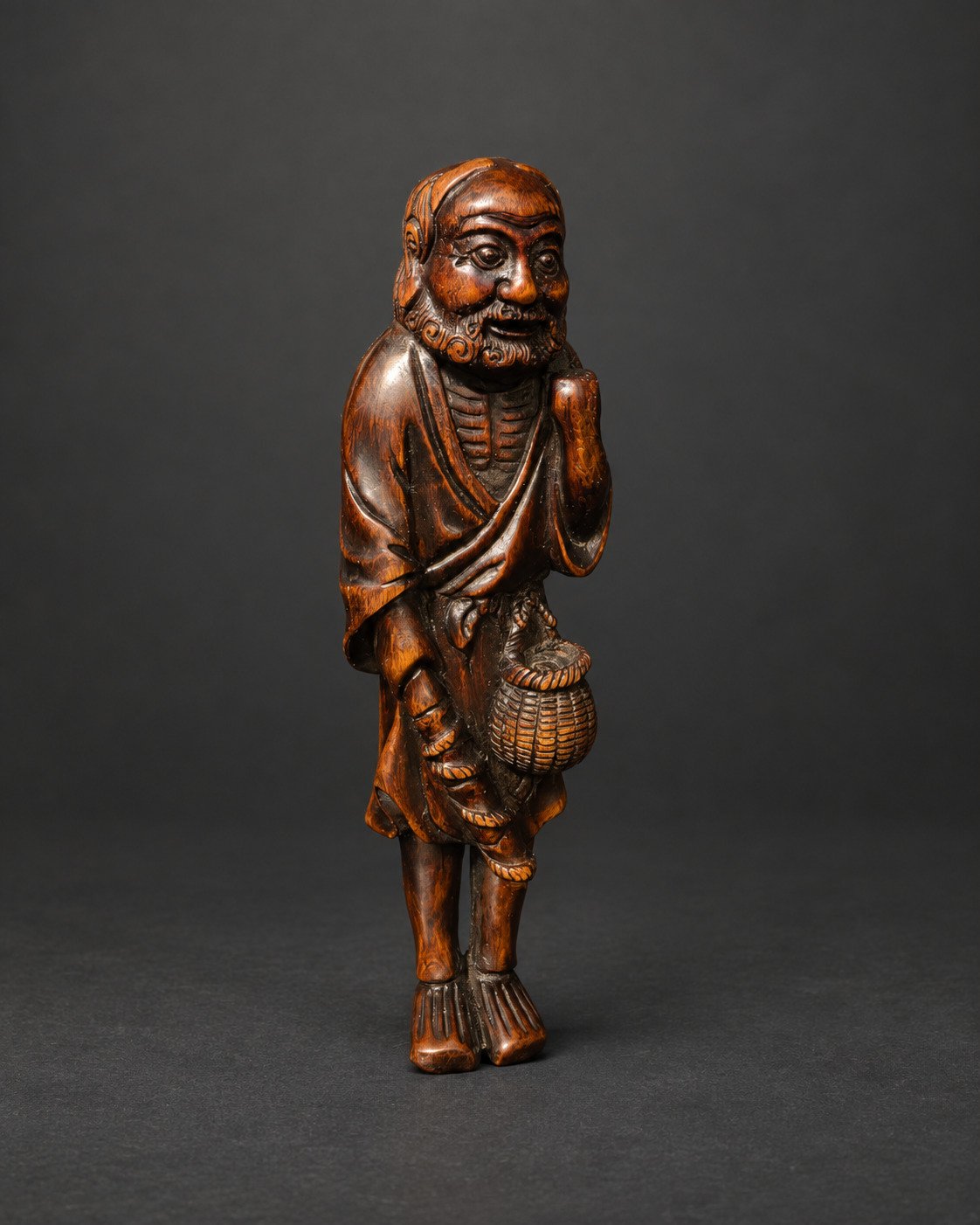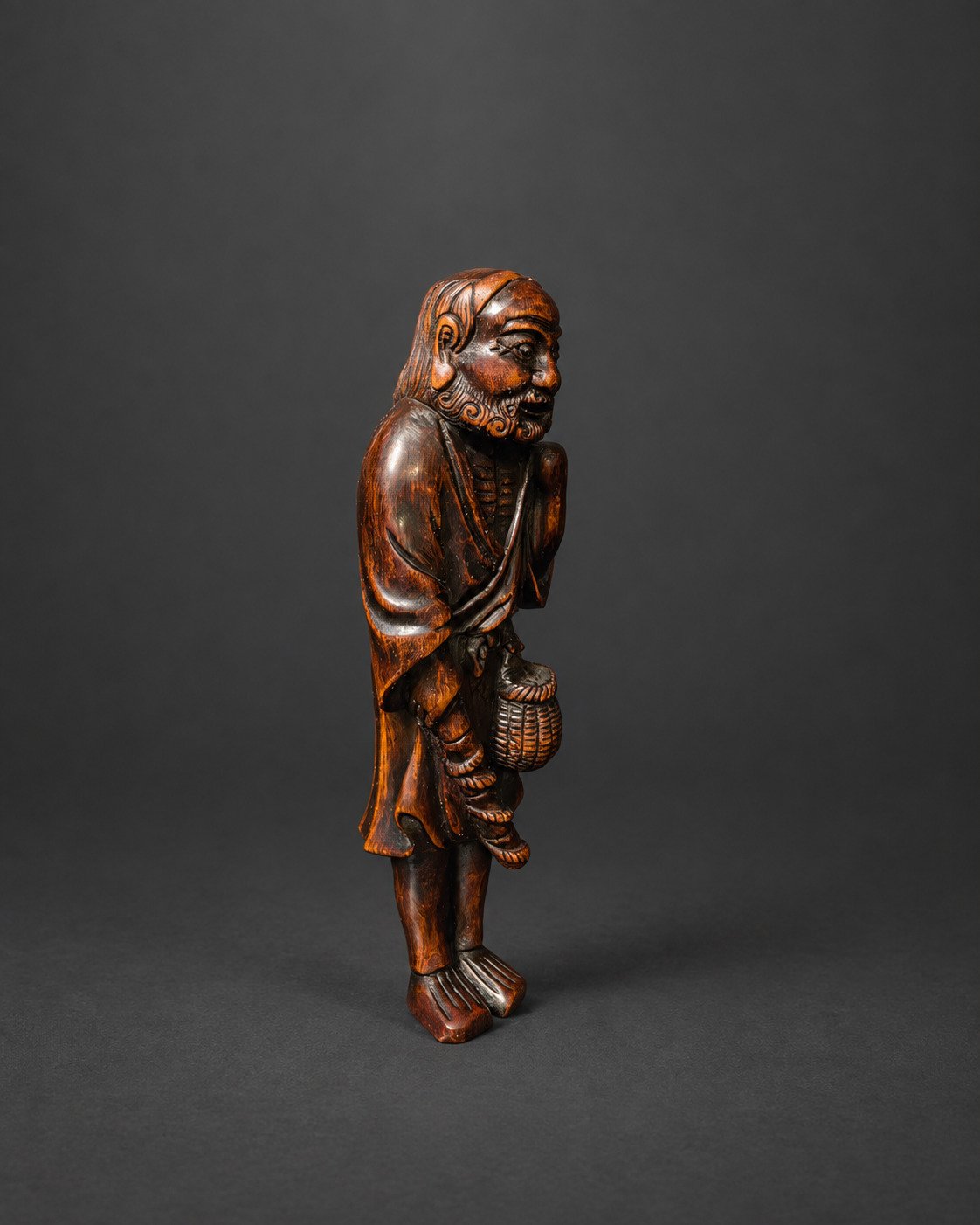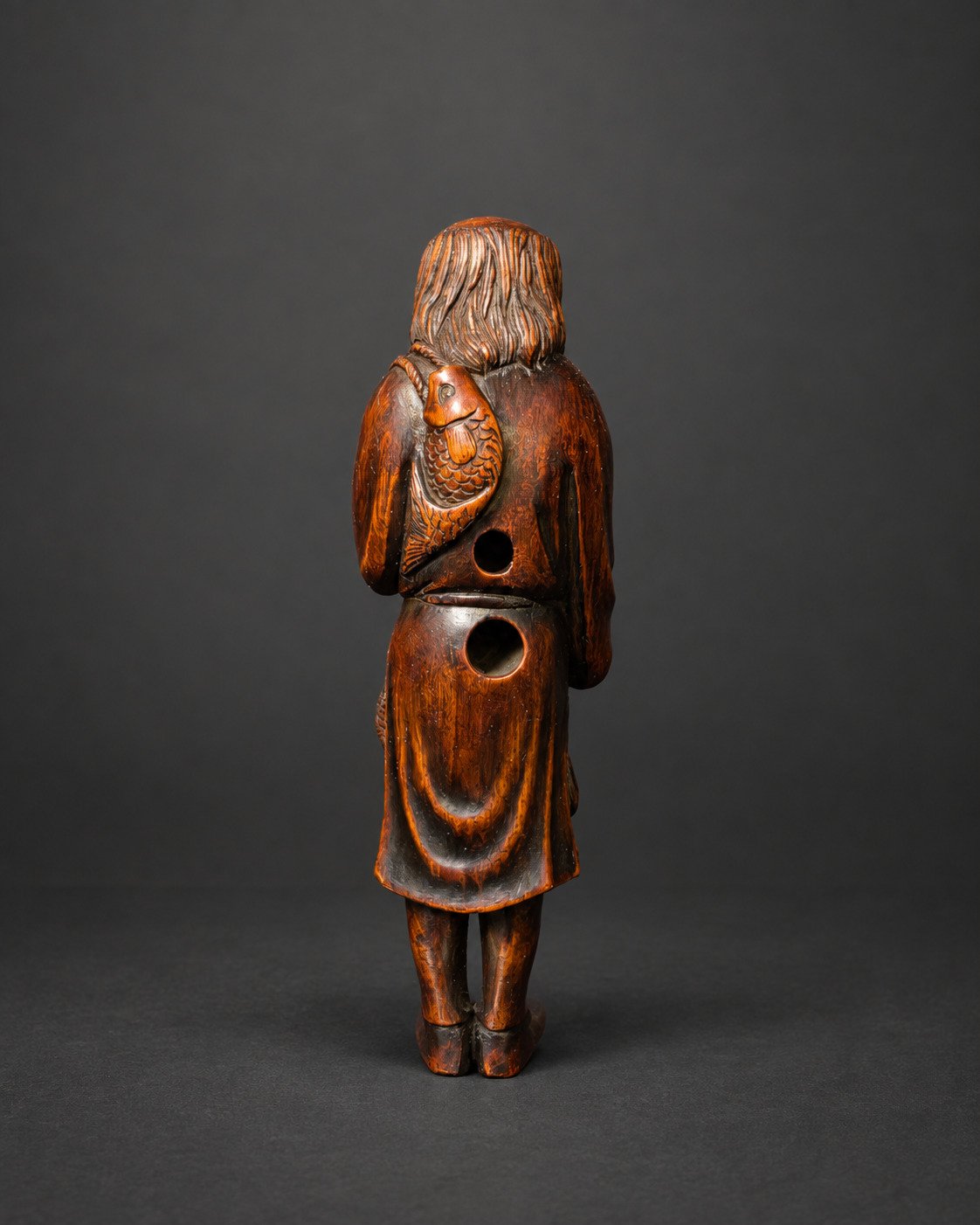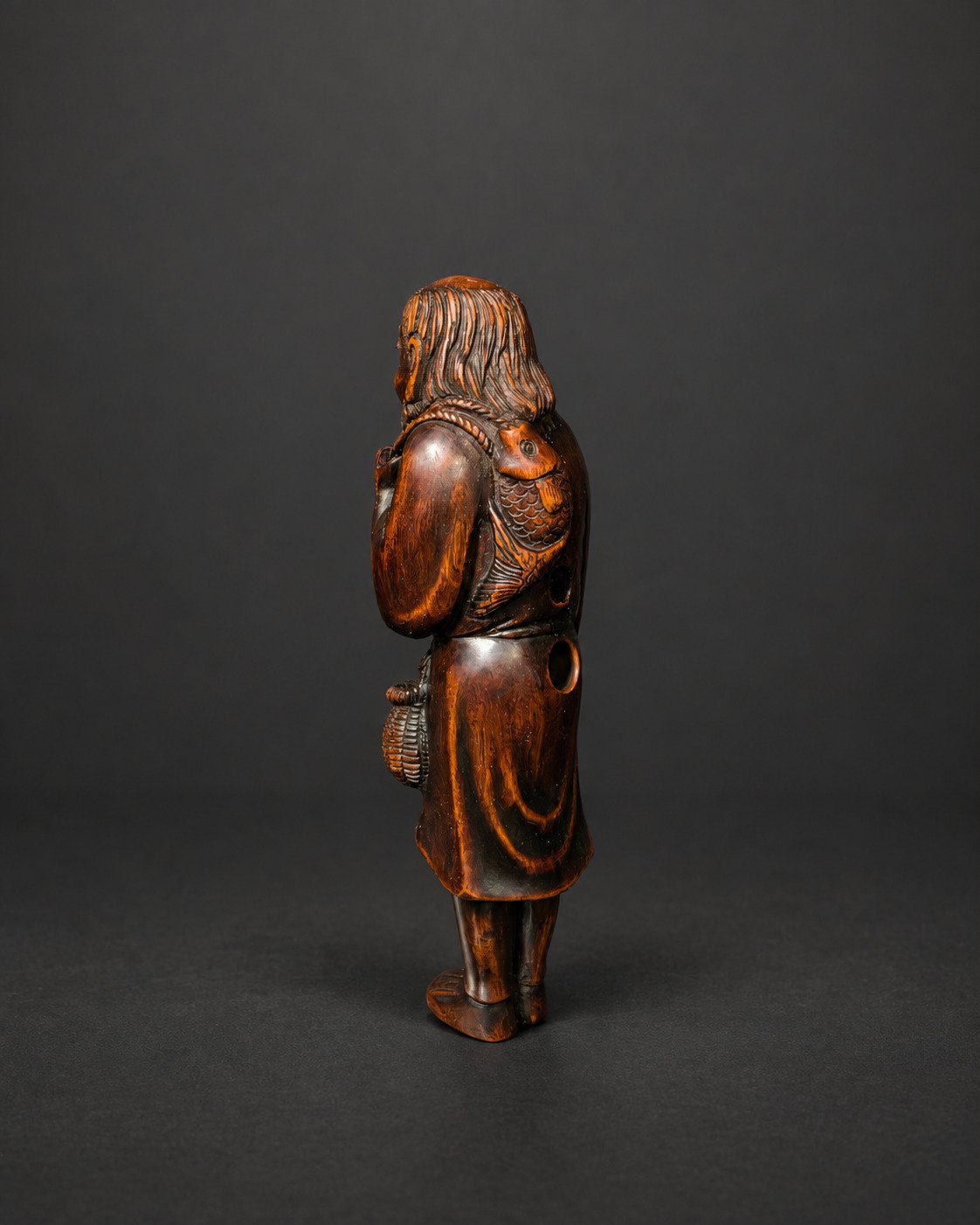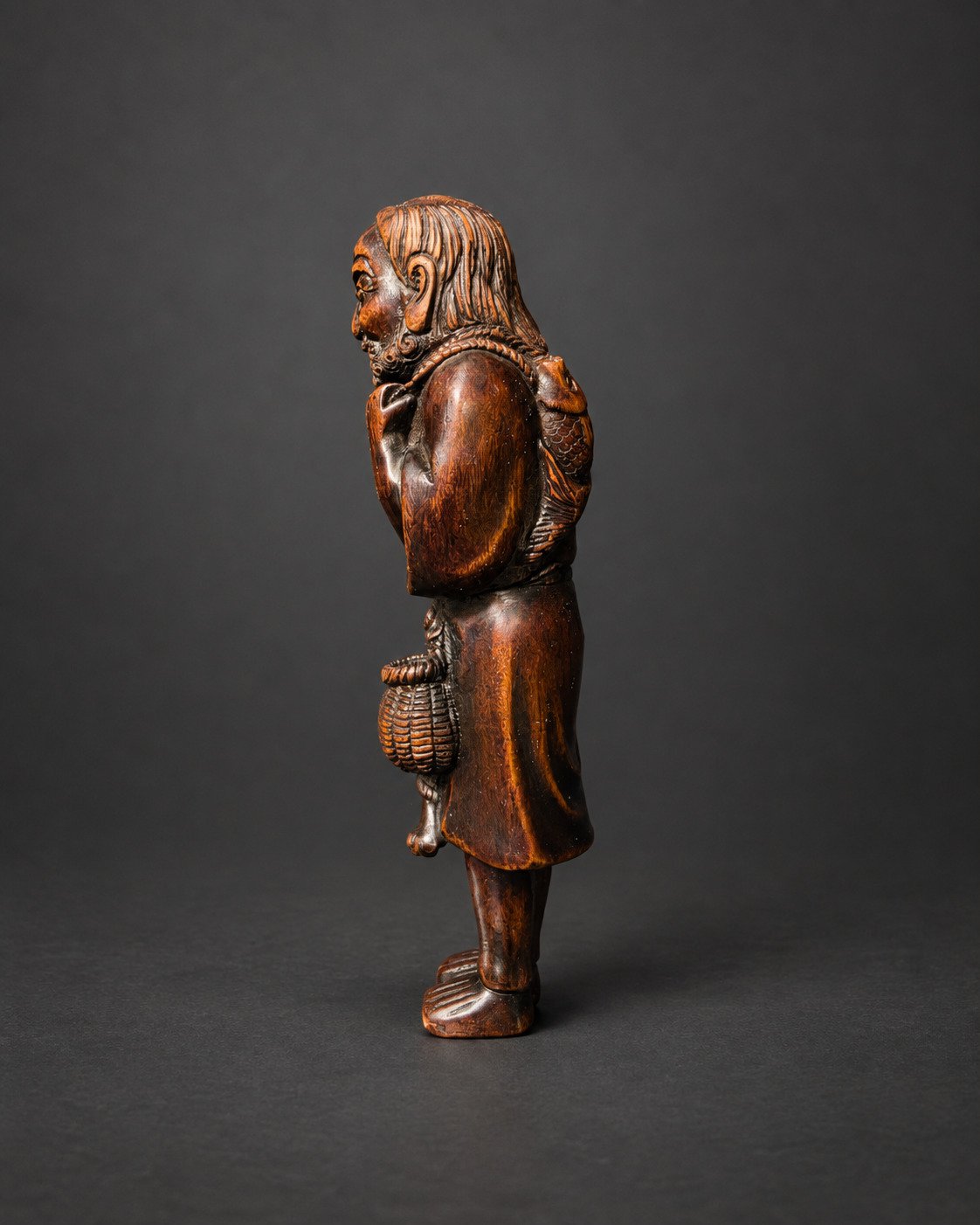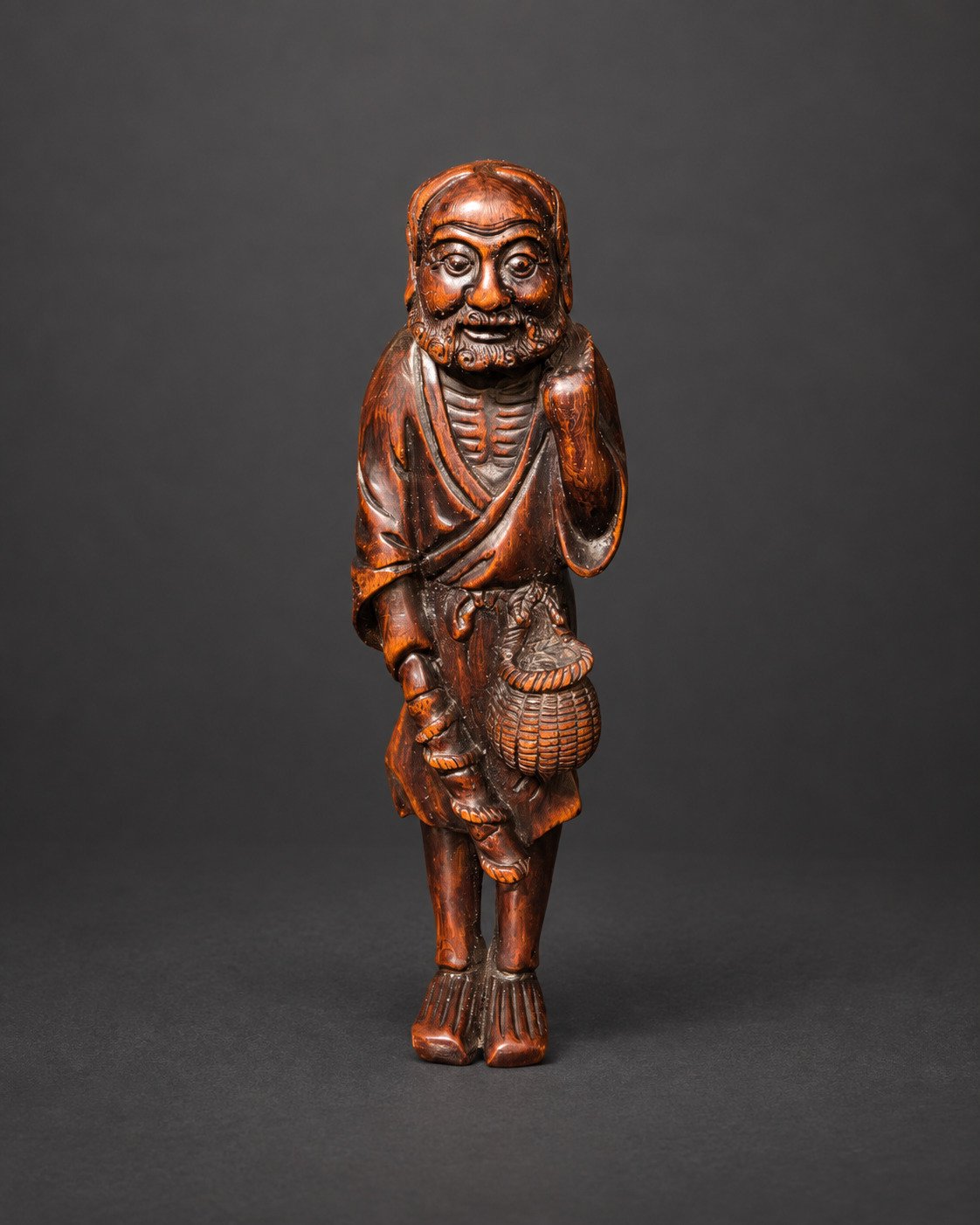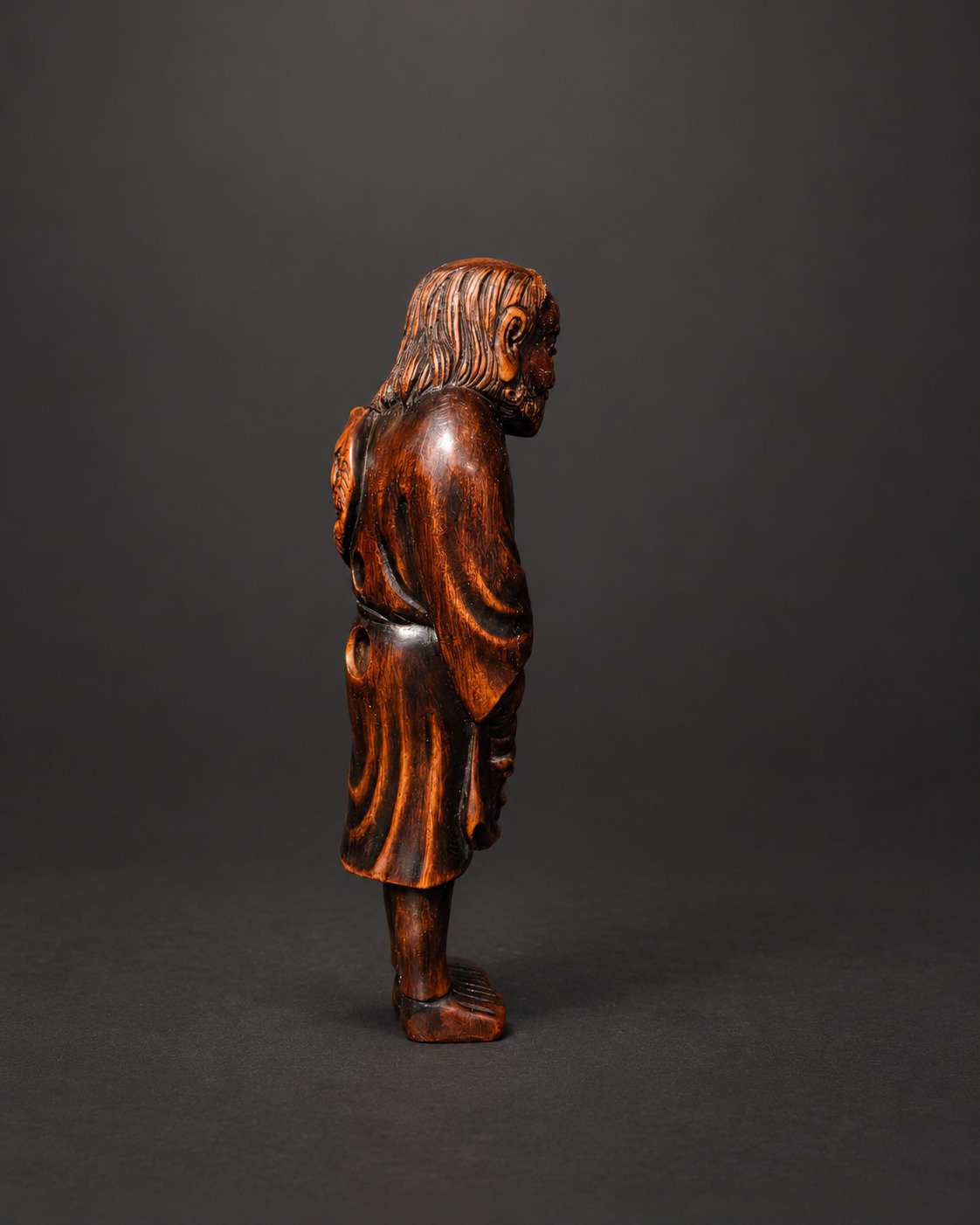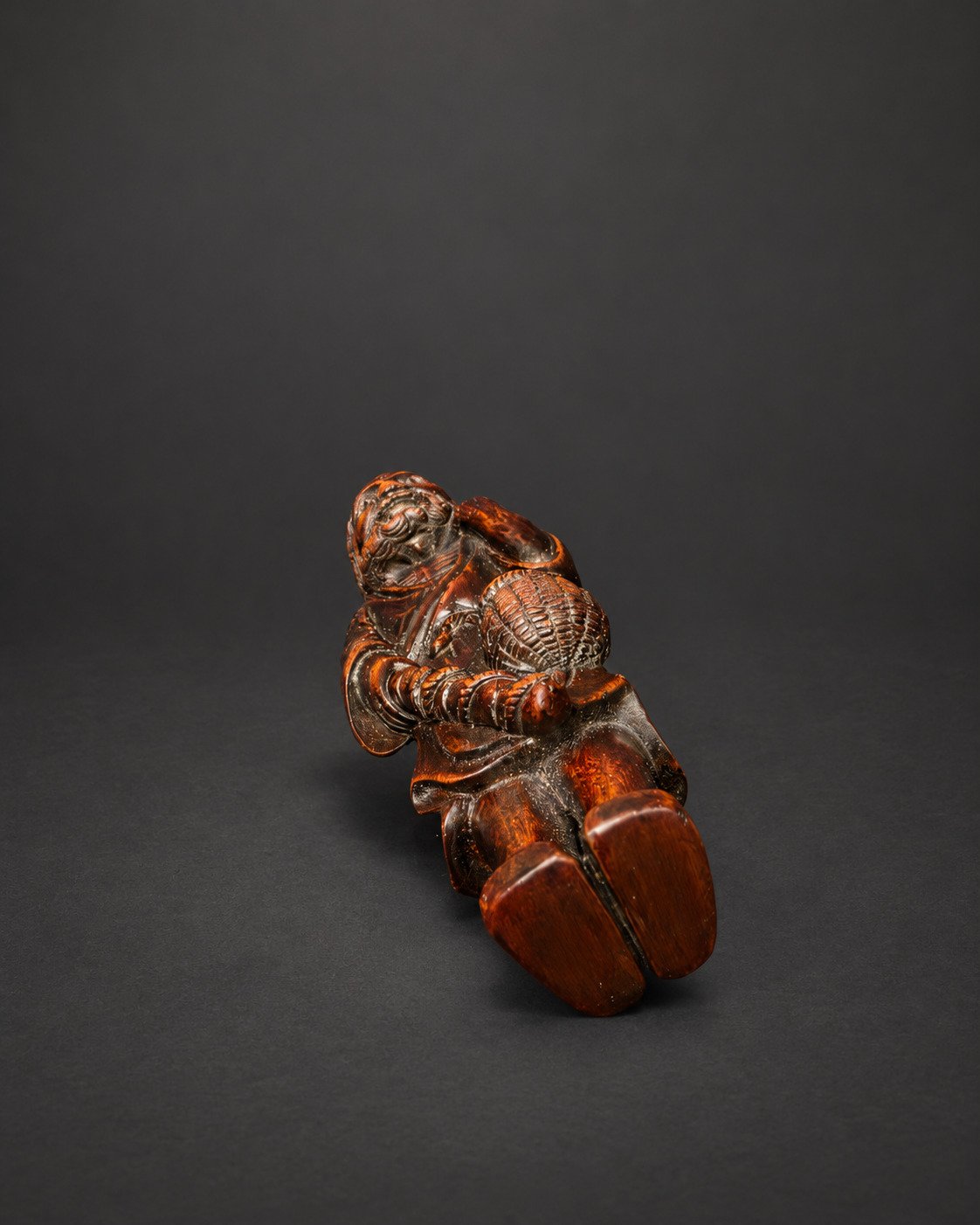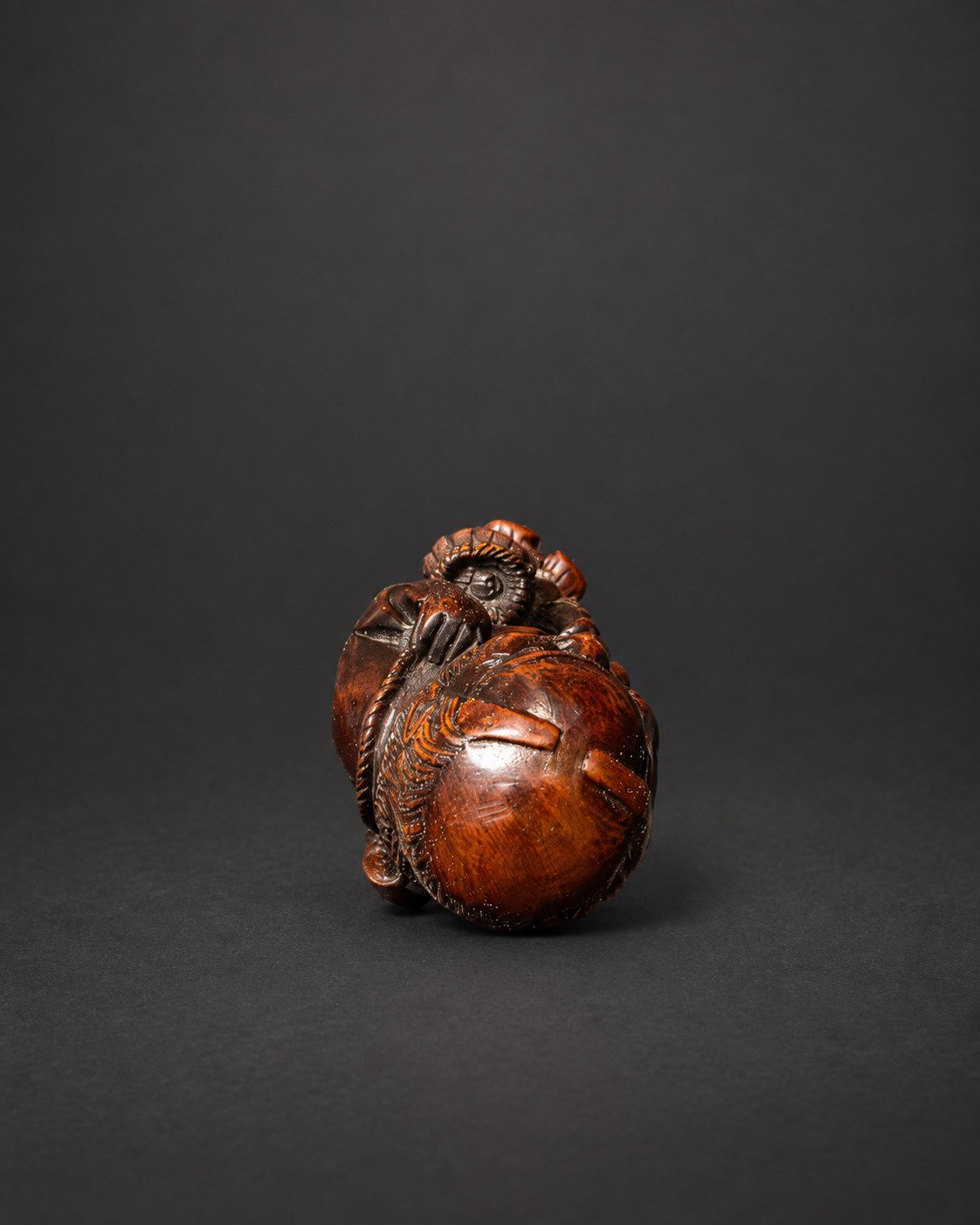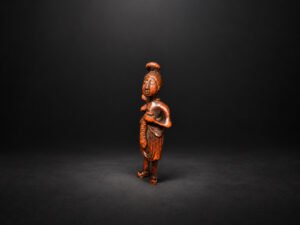
A finely carved antique Japanese wood netsuke depicting an elderly fisherman, thin, bearded, and visibly weathered by a life spent near the water. Standing in a thoughtful pose with one hand raised to his cheek, he wears an open robe that exposes the ribs of his lean torso. Around him are the essential attributes of his occupation: a woven fishing creel hangs at the waist, a coil of fishing line rests at his side, and a carp is carried across his back.
The composition combines a strongly characterized human figure with an unusually rich group of fishing details.
The fisherman’s age and physical austerity are emphasized through the exposed ribs, beard, weathered features, and relaxed but reflective posture.
His horn-inlaid eyes provide a striking contrast to the carved wood and give the old man a particularly lively, penetrating gaze.
The basket weave, fish scales, clothing folds, fishing equipment, and straw sandals are all carefully articulated.
A warm natural patina, developed through age and handling, enhances the depth of the carving and gives the piece a mature surface character.
Two large himotoshi are cut into the back.
The figure is presented as an elderly fisherman whose appearance conveys long experience and physical hardship.
His body is noticeably thin, with the ribs clearly visible beneath the open robe.
The beard frames the lower face and reinforces the impression of age.
Rather than appearing actively engaged in fishing, he is shown in a moment of reflection.
One hand rises toward the cheek in a thoughtful gesture, while the rest of the composition records his occupation through the equipment and fish surrounding him.
This contrast between physical detail and contemplative pose gives the figure much of its character.
The raised hand is one of the most expressive elements of the carving.
Placed against or close to the cheek, it gives the old fisherman a reflective, almost meditative quality.
The gesture draws attention toward the face and the horn-inlaid eyes.
It also creates an asymmetrical rhythm in the upper body, contrasting with the downward movement of the robes, fishing line, basket, and carp.
Rather than representing a dramatic action, the carving captures a quiet moment.
The fisherman seems momentarily absorbed in thought, which gives the figure a strong sense of personality.
The open robe reveals the old man’s thin torso.
His ribs are carved prominently across the chest, emphasizing the physical austerity of the figure.
This detail is not merely decorative.
It contributes directly to the impression of age, endurance, and a life shaped by labor.
The repeated horizontal lines of the ribs create a strong visual contrast with the softer curves of the robe.
Their clear definition also demonstrates the carver’s willingness to emphasize anatomical detail within the compact format of the netsuke.
The fisherman’s beard is one of the most elaborately worked areas of the figure.
Deep curling lines define the facial hair around the cheeks and chin.
These carved locks create texture and frame the face, directing attention toward the eyes, nose, and mouth.
The face itself is strongly characterized rather than idealized.
Its deeply modeled features, prominent beard, and intense gaze contribute to the impression of an elderly man shaped by experience.
The result is a figure with considerable visual personality and narrative presence.
The eyes are inlaid in horn.
This detail gives the fisherman an especially vivid gaze and provides a material contrast with the surrounding carved wood.
The inlays catch the light differently from the wooden surface, helping the eyes remain visually prominent even within the heavily detailed face.
According to the supplied description, this treatment gives the old man a lively and penetrating expression.
The eyes are therefore not merely decorative additions but one of the principal focal points of the carving.
A woven creel hangs at the fisherman’s waist.
Its surface is carefully worked with repeated carved lines that recreate the structure of a basket.
The regular pattern contrasts with the more organic textures of the beard, robes, and fish.
The creel immediately identifies the figure with fishing and adds an important occupational detail to the composition.
Despite its small size, the weave is clearly articulated and remains one of the most technically detailed elements of the netsuke.
The basket also adds volume to the lower half of the carving and helps balance the figure visually.
A carp is slung across the fisherman’s back.
Its body is integrated closely into the figure rather than treated as an independent element.
The scales are clearly carved and contribute another layer of texture to the composition.
The fish provides direct evidence of the fisherman’s activity and serves as one of the most recognizable narrative attributes of the piece.
Its elongated form follows the vertical structure of the standing figure, allowing the carver to incorporate a substantial fish without disrupting the compact overall design.
A coil of fishing line rests at the fisherman’s side.
Together with the creel and carp, this small detail builds a complete visual vocabulary around his occupation.
The inclusion of fishing equipment makes the figure more than a generalized old man.
He is specifically represented through the material tools of his life.
These objects are carefully integrated into the body and clothing, creating a dense but coherent composition.
Each attribute contributes to the narrative without overwhelming the central figure.
The fisherman wears straw sandals.
Their inclusion reinforces the humble and practical character of the figure.
The sandals are carved with enough detail to remain clearly distinguishable at the base of the composition.
They also provide a visual conclusion to the long standing form.
Combined with the open robe, fishing equipment, and weathered body, the footwear strengthens the impression of a working fisherman rather than a formal or courtly figure.
The figure recalls the wandering fisherman-sages of Chinese tradition, particularly the story of Taikōbō, known in China as Jiang Ziya.
According to the tradition referenced in the supplied description, Jiang Ziya waited beside the River Wei, fishing with a straight, baitless hook until a ruler wise enough to recognize his abilities appeared.
King Wen of Zhou eventually encountered him, appointed him as his chief adviser, and, with his assistance, established the Zhou dynasty.
The story later became well known in Japan as an image of patience, wisdom, and hidden talent.
The term taikōbō remains associated in Japanese with an enthusiastic angler.
The present netsuke is not identified by inscription or documentation as Taikōbō himself, but its aged fisherman subject and contemplative character clearly recall this broader fisherman-sage tradition.
The fisherman-sage narrative adds a deeper interpretive dimension to the otherwise everyday subject.
An old fisherman may appear humble or unimportant, yet the associated story emphasizes wisdom and ability concealed beneath an ordinary exterior.
The thoughtful gesture of the figure is particularly compatible with this theme.
Rather than appearing merely occupied with his catch, the fisherman seems inwardly focused.
The combination of age, patience, fishing imagery, and reflection gives the carving a symbolic resonance beyond its immediate occupational subject.
The carving is confident and highly detailed.
The ribs are clearly defined beneath the open robe.
The beard is deeply worked with curling patterns.
The woven basket is carefully structured, and the scales of the carp are individually suggested through repeated carving.
The garments are articulated with long, strong folds that organize the composition around the body.
Despite the density of detail, the piece remains visually coherent.
The carver has used different textures to distinguish skin, hair, clothing, basketry, fish, and footwear without fragmenting the figure.
The wood has developed a rich natural patina through age and handling.
Warm brown and reddish-brown tones vary across the surface.
Raised areas appear smoother and more polished, while the deeper cuts of the beard, clothing, basket, and fish retain darker shadows.
This contrast enhances the sculptural depth of the piece.
The patina is especially important in an object such as a netsuke, which was traditionally handled and worn.
Rather than appearing uniform, the surface records the passage of time through differing degrees of polish and color.
Two large himotoshi, or cord holes, are cut into the back of the netsuke.
These openings are integral to the traditional function of the object.
They allowed a cord to pass through the netsuke so that it could serve as a toggle for objects suspended from the sash.
Their placement on the reverse keeps the principal carved scene uninterrupted when viewed from the front.
The large openings remain an important functional and structural feature of the piece.
Fishing subjects were well suited to netsuke because they could combine recognizable daily-life imagery with humor, character, and traditional literary or legendary associations.
In this example, the old man is presented neither as an anonymous decorative figure nor simply as a fisherman at work.
His lean body, thoughtful pose, expressive eyes, beard, catch, and fishing equipment create a much more specific personality.
The result is a small but highly narrative sculpture that rewards close examination from multiple angles.
At 10 cm high, the carving is relatively tall and slender.
Its narrow width and depth reinforce the standing format while allowing enough space for the basket, carp, fishing line, and robes to be incorporated around the body.
The netsuke is described as an Edo-period, 19th-century carved wood piece.
The surface retains a good natural patina developed through age and handling.
The detailed carving of the beard, ribs, creel, fish scales, garments, and sandals remains clearly legible.
The eyes are inlaid in horn.
Two large himotoshi are cut into the back.
The supplied description does not mention a signature, restoration, repairs, missing elements, or additional documentation.
Prospective buyers should examine all available photographs carefully when assessing exact condition and surface wear.
This antique fisherman netsuke combines strong characterization with an unusually rich group of occupational details.
The thin body and prominently carved ribs immediately establish the old man’s weathered appearance, while the beard and horn-inlaid eyes give the face considerable personality.
The woven creel, fishing line, carp, and straw sandals create a complete narrative around the fisherman’s life.
Its interest is further strengthened by the association with the fisherman-sage tradition represented by Taikōbō, in which patience, wisdom, and hidden ability are embodied by an apparently humble angler.
The confident carving is especially evident in the range of textures: curling beard, exposed ribs, woven basket, fish scales, drapery, and polished skin.
The warm natural patina records age and handling and gives the object the tactile surface character prized in antique netsuke.
For collectors of Edo-period netsuke, fisherman subjects, Japanese folk imagery, or figural wood carving, the piece offers a compelling combination of narrative detail, material character, and expressive carving.
A finely carved 19th-century Edo-period Japanese wood netsuke depicting an elderly fisherman with his catch. Thin and bearded, with his ribs visible through an open robe, he raises one hand thoughtfully to his cheek while carrying a woven creel, a coil of fishing line, and a carp slung across his back. Horn-inlaid eyes give the old man a vivid, penetrating gaze, while the beard, basket weave, fish scales, clothing, and straw sandals are worked with confident detail. A warm natural patina developed through age and handling enriches the carved surface, and two large himotoshi are cut into the back. The figure also recalls the traditional image of the fisherman-sage, associated in Japan with patience, wisdom, and hidden talent.
| Época | Edo |
|---|

Order above 1.000,00 € gets free shipping.

Secure and hassle-free payment process.

Certificate of authenticity included.

Have questions? Contact us via WhatsApp.
Contact