1 in stock
1 in stock
Add to Compare
Add to Wishlist
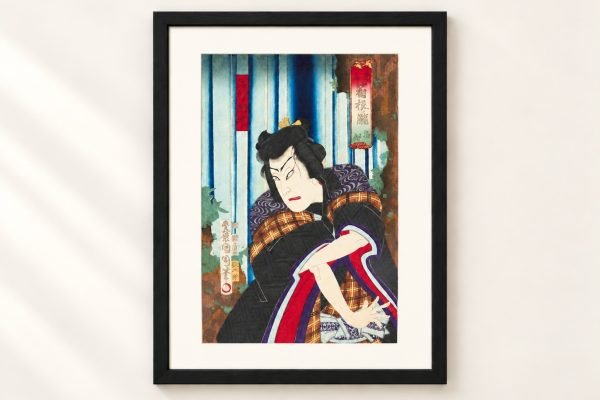
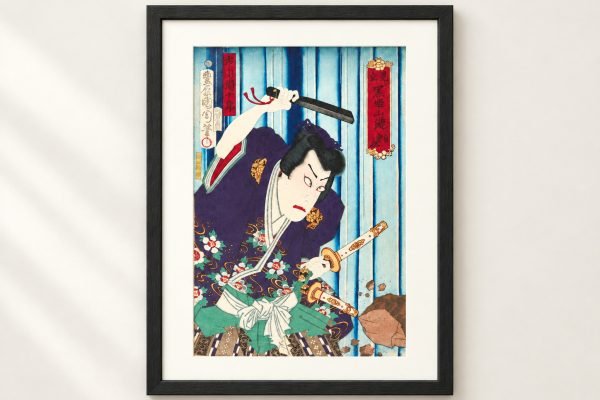
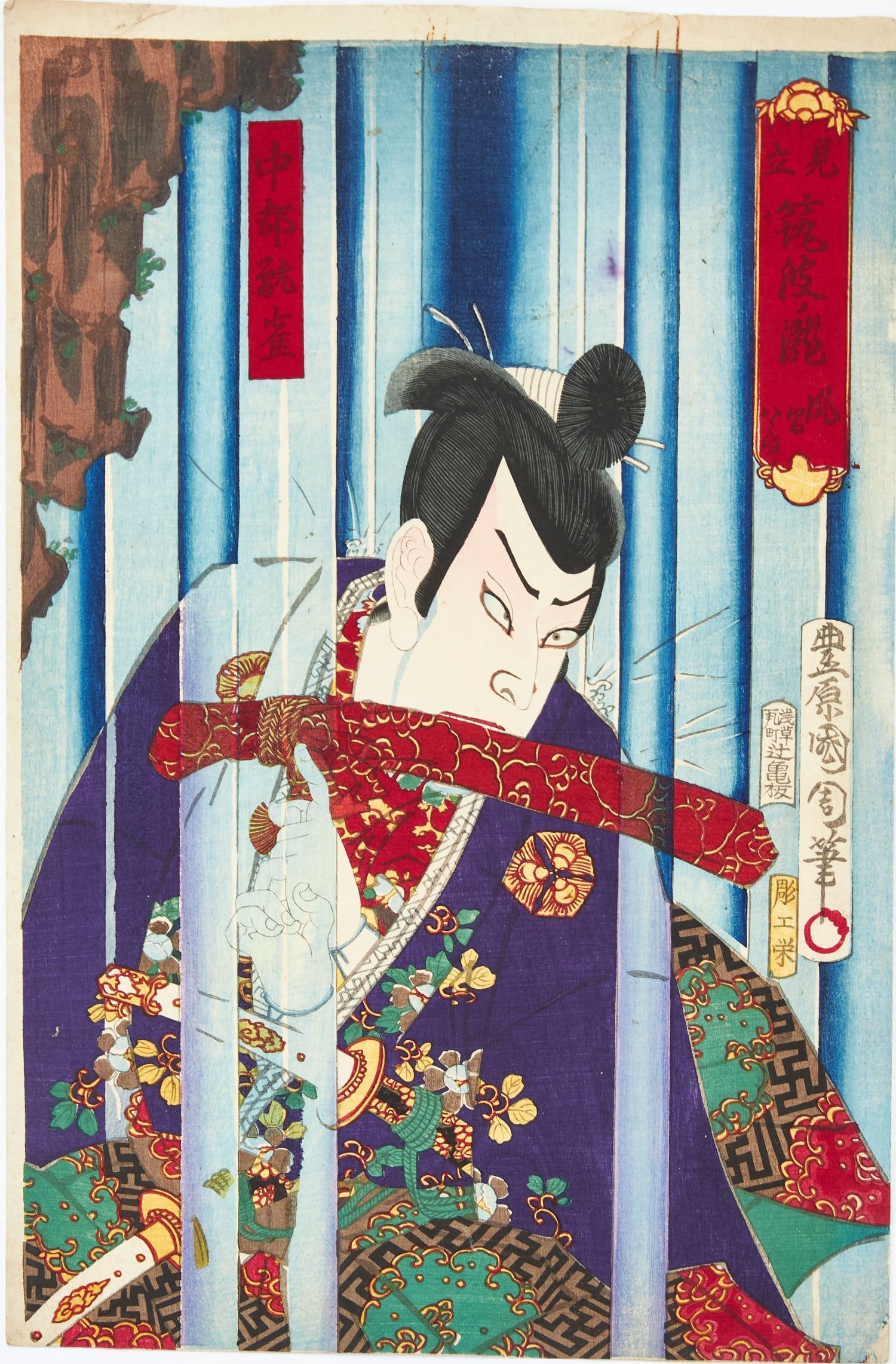
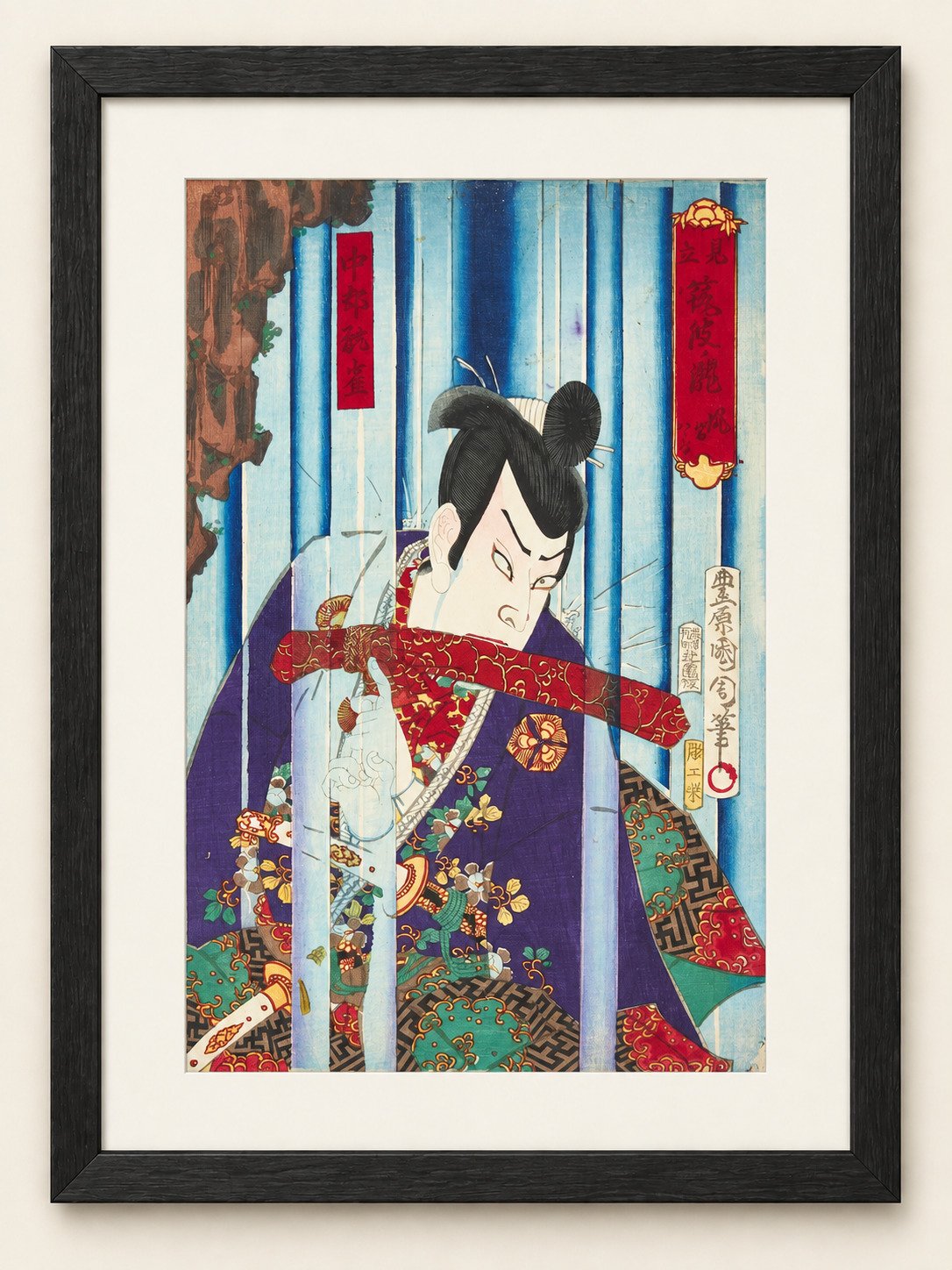
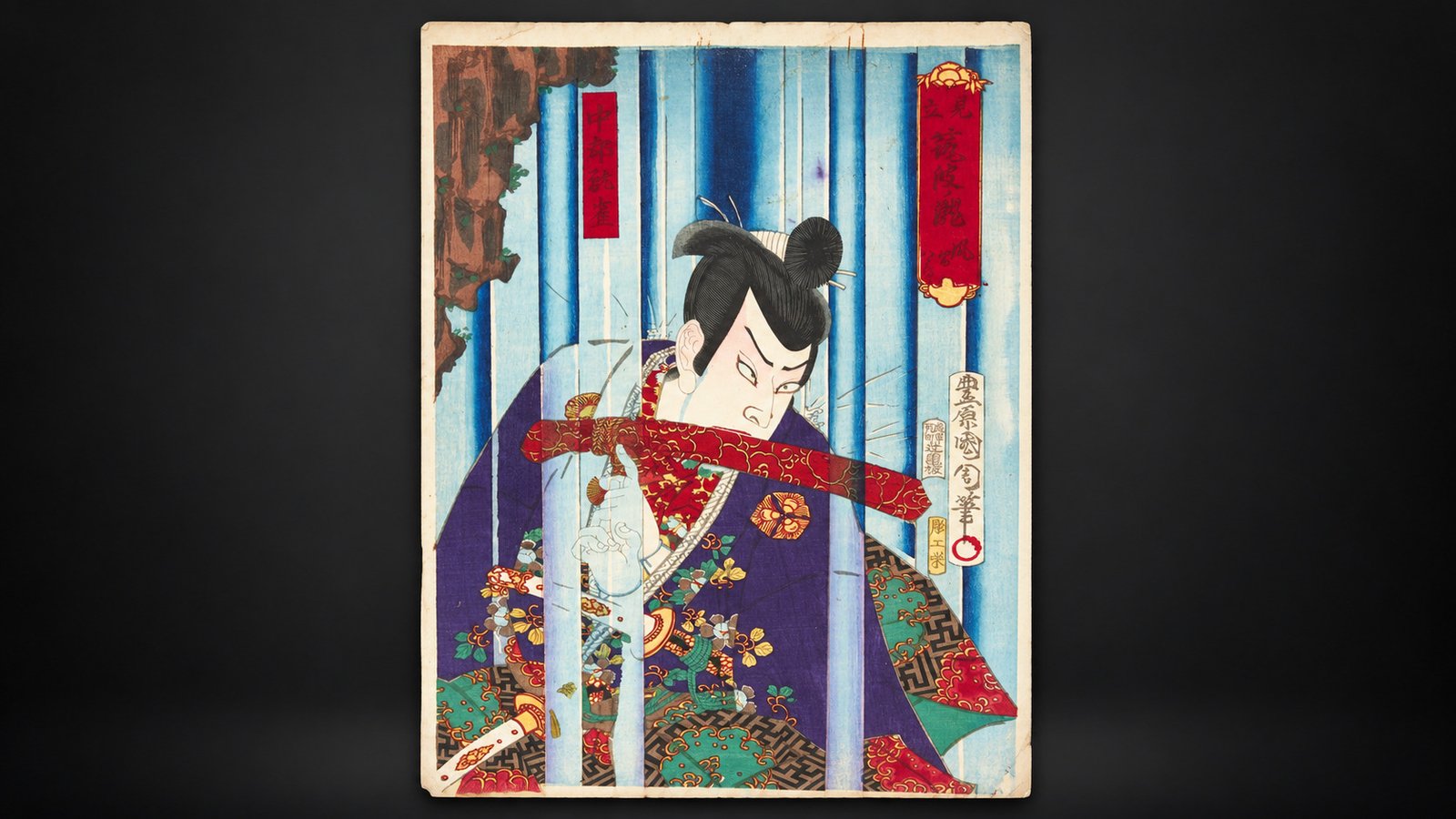
An original Japanese ōban tate-e nishiki-e woodblock print by Toyohara Kunichika (1835–1900), depicting an actor of the Nakamura theatrical family dramatically posed beneath a cascading waterfall.
The actor grips a richly decorated red-and-gold sword sash close to his chest and chin while casting an intense sideways glance. Behind him, powerful vertical bands of blue water descend across the composition beside a jagged brown rock formation, creating a dramatic setting that emphasizes both the actor’s expression and the vivid patterning of his costume.
The print belongs to a mitate-e waterfall series in which actors are presented against a recurring setting of cascading blue water and rocky scenery. It is a highly characteristic example of Kunichika’s late 19th-century yakusha-e, combining theatrical intensity, brilliant color and an exceptionally strong close-up portrayal of a Kabuki actor.
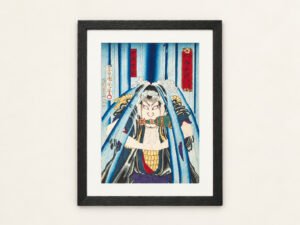
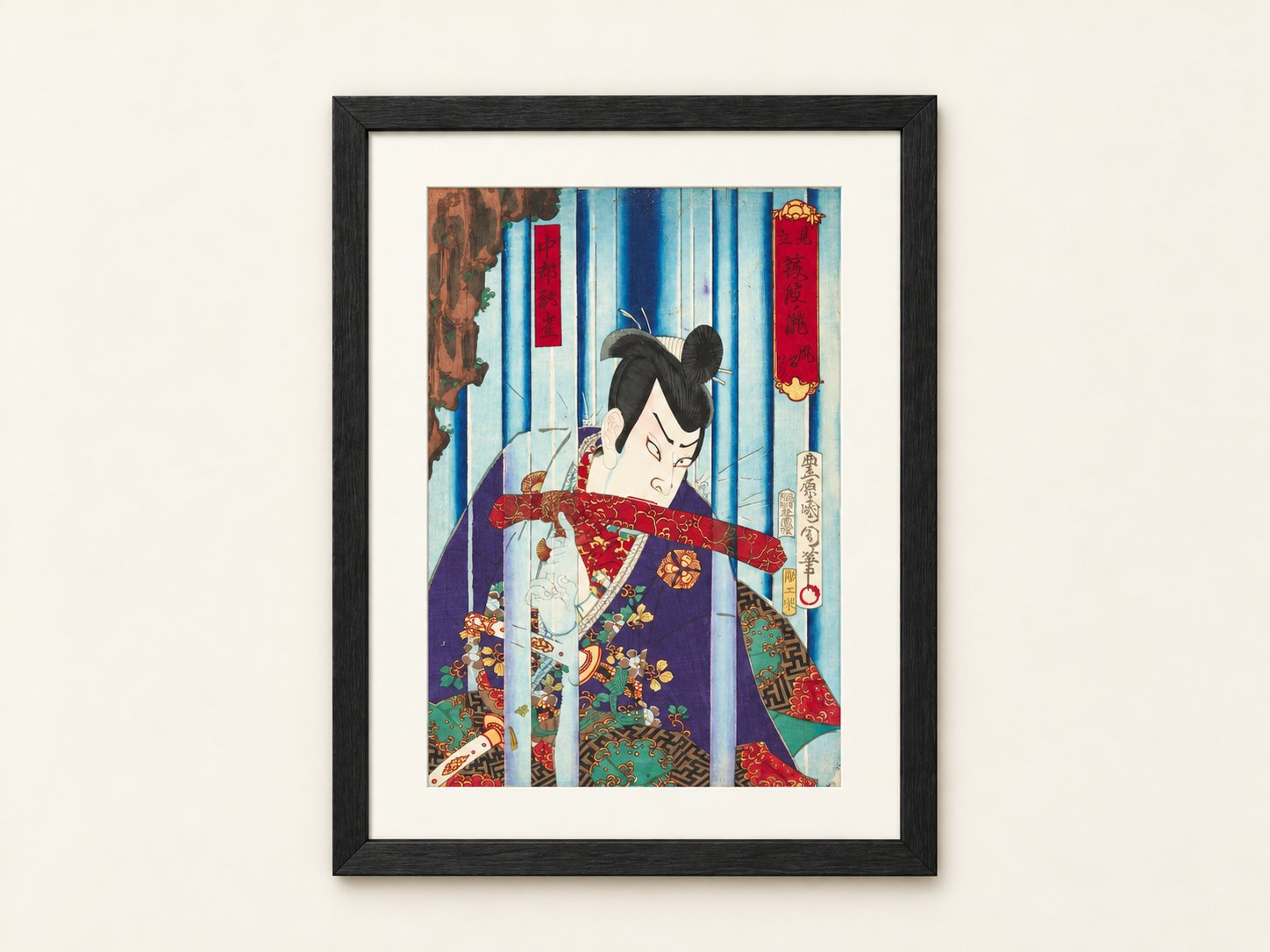
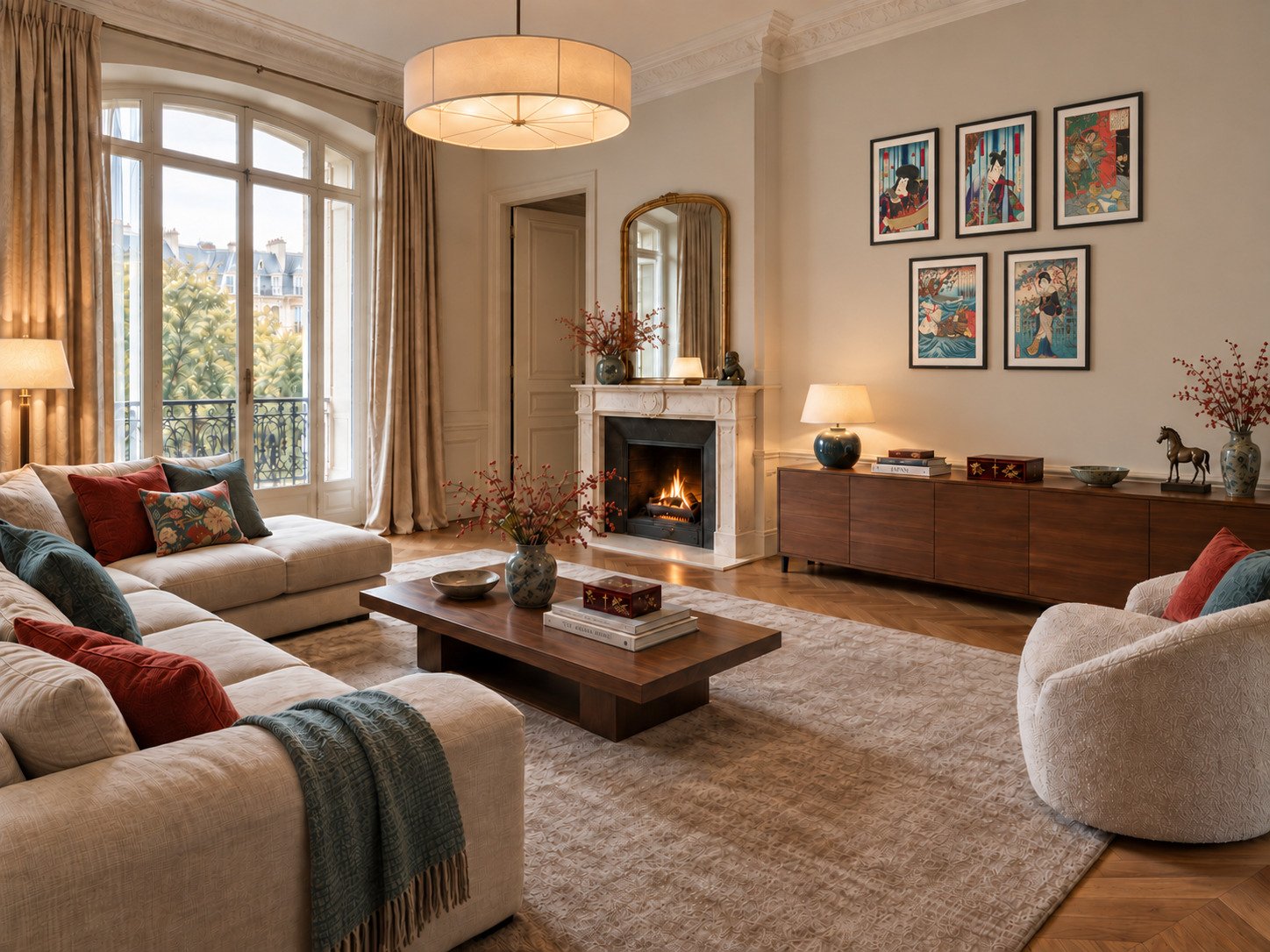
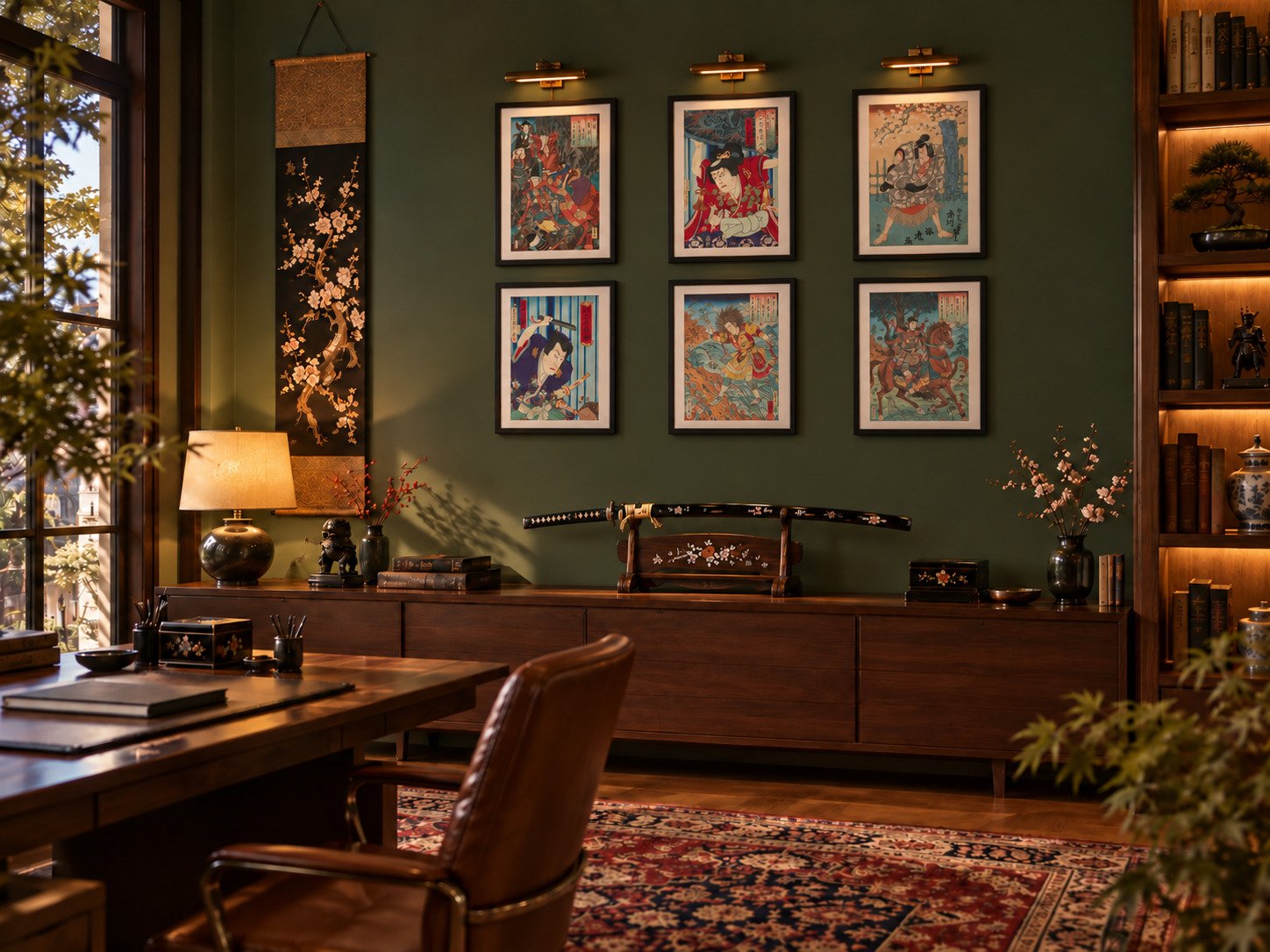
The ukiyo-e comes individually framed and ready to hang.
Toyohara Kunichika (1835–1900), born Ōshima Yasohachi in Edo, became one of the most important Japanese print artists of the late 19th century.
After training within the Utagawa tradition, he became a pupil of Utagawa Kunisada (Toyokuni III), one of the dominant figures of 19th-century ukiyo-e.
Kunichika developed a particularly close relationship with the Kabuki theater. He frequently worked backstage in the theaters of Edo — later Tokyo — sketching leading actors from life and transforming their performances into striking yakusha-e, or actor prints.
His portraits are especially admired for their dramatic facial expressions, bold cropping, powerful color and ability to convey the individual stage presence of celebrated Kabuki performers.
The subject is an actor belonging to the celebrated Nakamura theatrical lineage, one of the major hereditary acting families of Japanese Kabuki.
Kunichika presents the actor at close range, focusing attention on the sharply turned eyes, concentrated expression and controlled movement of the hands.
The actor presses the decorated red-and-gold sword sash close to his chest and chin, creating a strong horizontal element across the composition that contrasts dramatically with the vertical lines of the waterfall behind him.
The background is dominated by broad streams of cascading blue water, rendered as a sequence of vertical bands in varying shades of blue.
At the left edge, a jagged brown rock formation establishes the natural setting, while the falling water surrounds and partially overlaps the actor.
The combination produces an unusually dynamic visual effect: the figure appears almost enclosed by the waterfall, yet the intense expression and richly patterned costume remain the unmistakable focus of the print.
The print belongs to the broad tradition of mitate-e, imagery based on visual, literary or theatrical associations and reinterpretations.
Within this waterfall series, the recurring natural setting creates a shared visual framework for different Kabuki actors and characters.
The contrast between the theatrical figure and the monumental waterfall gives the composition both dramatic force and a slightly imaginative, staged quality characteristic of this type of late ukiyo-e design.
Kunichika was among the artists who enthusiastically adopted the vivid new pigments that became increasingly available in Japan during the Meiji period.
The deep blues of the waterfall and the brilliant red of the sword sash are particularly striking examples of the intense color that became associated with later 19th-century Japanese woodblock printing.
These strong pigments are balanced by the deep purple of the actor’s robe and the intricate green, red, gold and black patterns of the costume, producing a composition of exceptional visual richness.
The actor wears an elaborate Kabuki costume filled with contrasting floral and geometric motifs.
The deep purple ground is covered with richly colored decorative elements, while green panels, floral motifs and repeating geometric patterns create dense areas of visual detail.
Kunichika uses these textile patterns not merely as decoration, but as an important part of the composition, setting the actor apart from the cooler blue waterfall behind him.
Yakusha-e were woodblock prints devoted to Kabuki actors and performances. They were among the most popular forms of ukiyo-e throughout the Edo and Meiji periods and functioned both as works of art and as images celebrating famous performers.
Kunichika became one of the last great specialists in this tradition. His close-up portraits captured actors with a directness and theatrical intensity that distinguished his work during a period when photography was beginning to transform the visual culture of Japan.
This print demonstrates many of the qualities for which his actor portraits are admired: an expressive face, bold composition, saturated color and an immediate sense of theatrical drama.
The print is executed in the traditional ōban tate-e format — the standard vertical format used for many Japanese woodblock prints — and printed as a nishiki-e, or full-color woodblock print.
Nishiki-e production required multiple carved woodblocks, with separate blocks used to apply individual colors in precise registration.
The resulting technique allowed artists such as Kunichika to combine fine black linework with rich layers of color and complex textile patterns.
This print comes from the collection of Dr. Eugen Milch (1889–1958), an Austrian physician and artist whose life included extensive travel throughout Europe and Asia.
Milch served as a medical officer during the First World War and traveled widely during the early 1920s on combined study and painting journeys. In 1924 he married the artist Emma Bormann, and the couple traveled to Sweden, where works were exhibited at Liljevalchs in Stockholm together with the artist Oskar Bergman.
In 1937, Milch traveled to China with other Austrian physicians at the invitation of the Chinese government. He later became superintendent of a hospital in Beihai, China. Following the Japanese occupation of parts of the southern Chinese coast, the family relocated to Shanghai in 1941.
Eugen Milch later assisted British forces in China and was granted British citizenship. He subsequently traveled to Japan to study the aftermath of the war, and it is considered likely that he acquired his collection of Japanese woodblock prints during this period.
He died in Hong Kong in 1958. The collection subsequently passed by descent within the family.
This is an original antique Japanese woodblock print (ukiyo-e), not a modern reproduction or later reprint.
These works are genuine period pieces, and their age forms an essential part of their historical character. Unlike modern prints made to imitate antique ukiyo-e, original impressions preserve the paper, pigments, printing characteristics and natural aging associated with works produced in their own period.
As with any work on paper of this age, some light wear is both normal and expected. Gentle toning of the paper, occasional small spots or creases, and faint handling marks may be present and are consistent with an original print that has survived for well over a century.
These characteristics should be understood as signs of age and authenticity rather than modern manufacturing defects. Any individual condition notes are provided for transparency and do not imply that the work is in poor condition.
The print remains in good general condition.
There are some signs of wear consistent with age, together with light handling creases. These are typical of an original 19th-century Japanese work on paper and do not detract significantly from the overall visual impact of the composition.
Please examine the detailed photographs carefully, as they form an important part of the condition description and show the paper, colors, margins and surviving surface in detail.
The print is individually framed and sold complete with its frame, ready to hang.
A striking original Meiji-period ukiyo-e by Toyohara Kunichika, depicting an actor of the Nakamura theatrical family beneath a dramatic cascade of blue water. The intense sideways gaze, richly patterned costume and vivid red-and-gold sword sash exemplify Kunichika’s powerful approach to the Kabuki actor portrait. Preserved with provenance from the collection of Dr. Eugen Milch and sold framed and ready to hang, this is an engaging example of the late yakusha-e tradition by one of its last major masters.

Order above 1.000,00 € gets free shipping.

Secure and hassle-free payment process.

Certificate of authenticity included.

Have questions? Contact us via WhatsApp.
Contact