


1 in stock
1 in stock
Add to Compare
Add to Wishlist
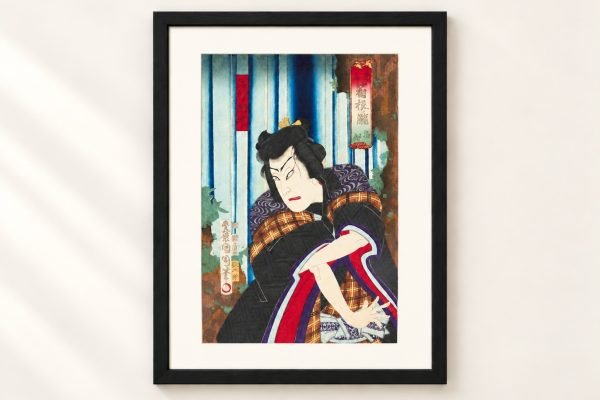
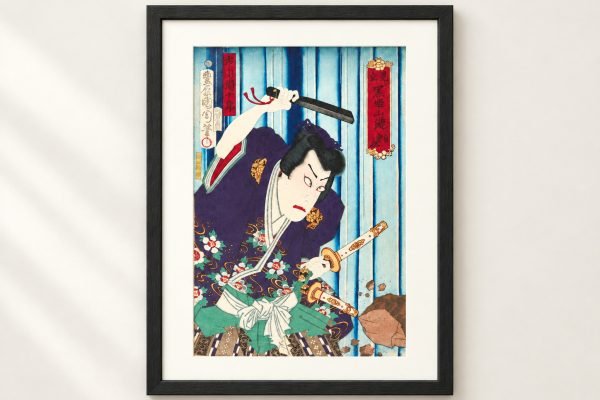
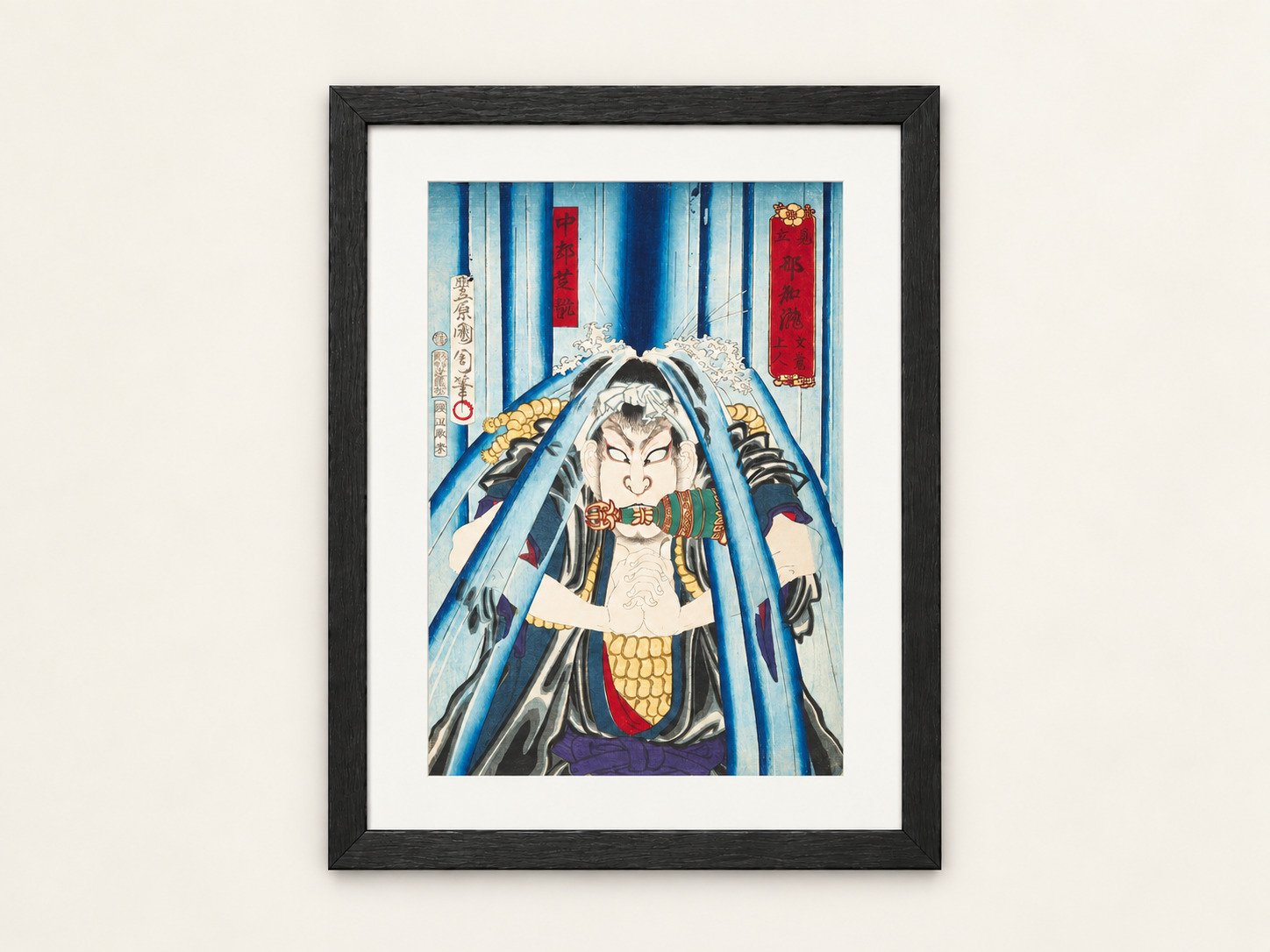
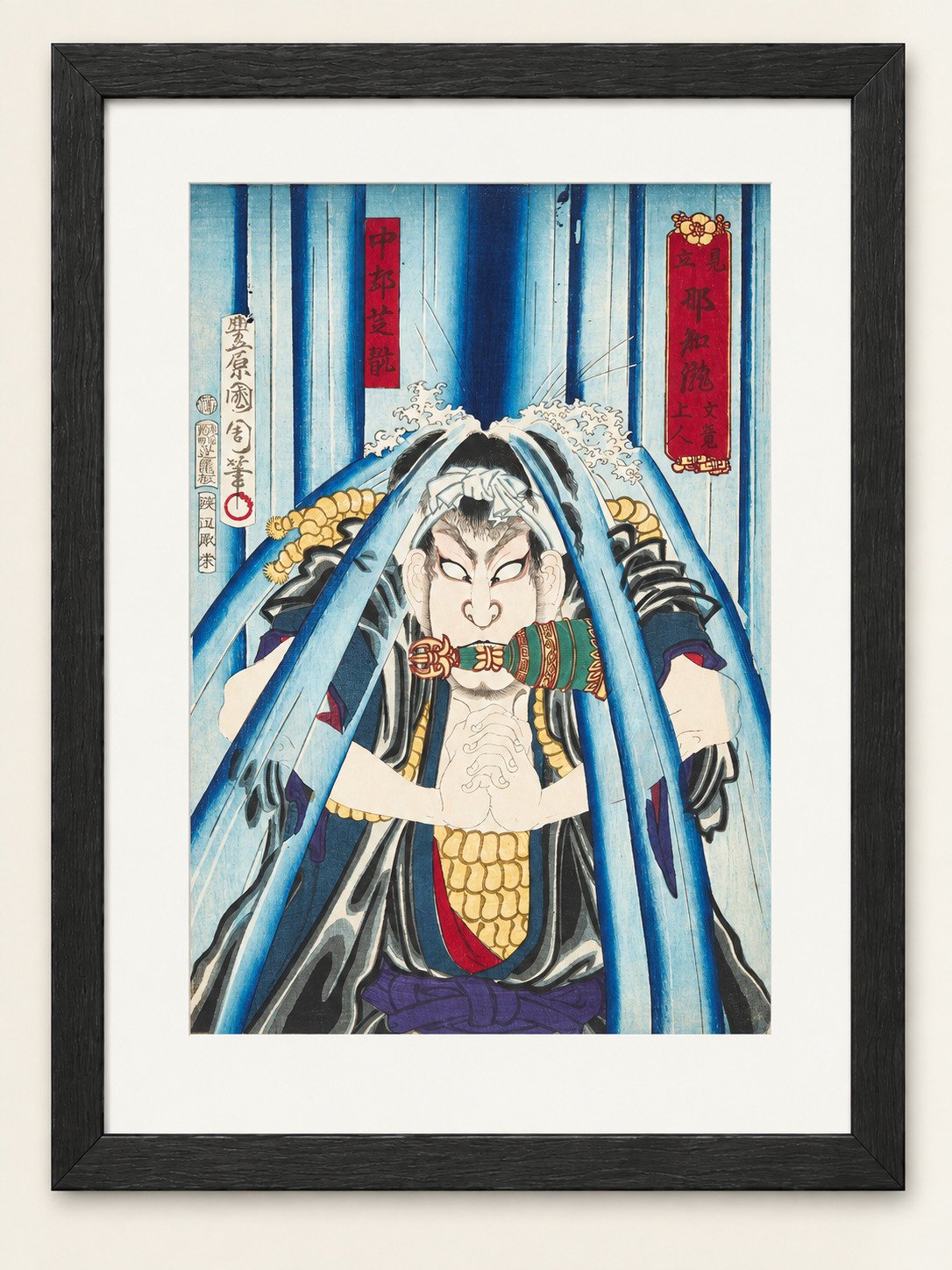
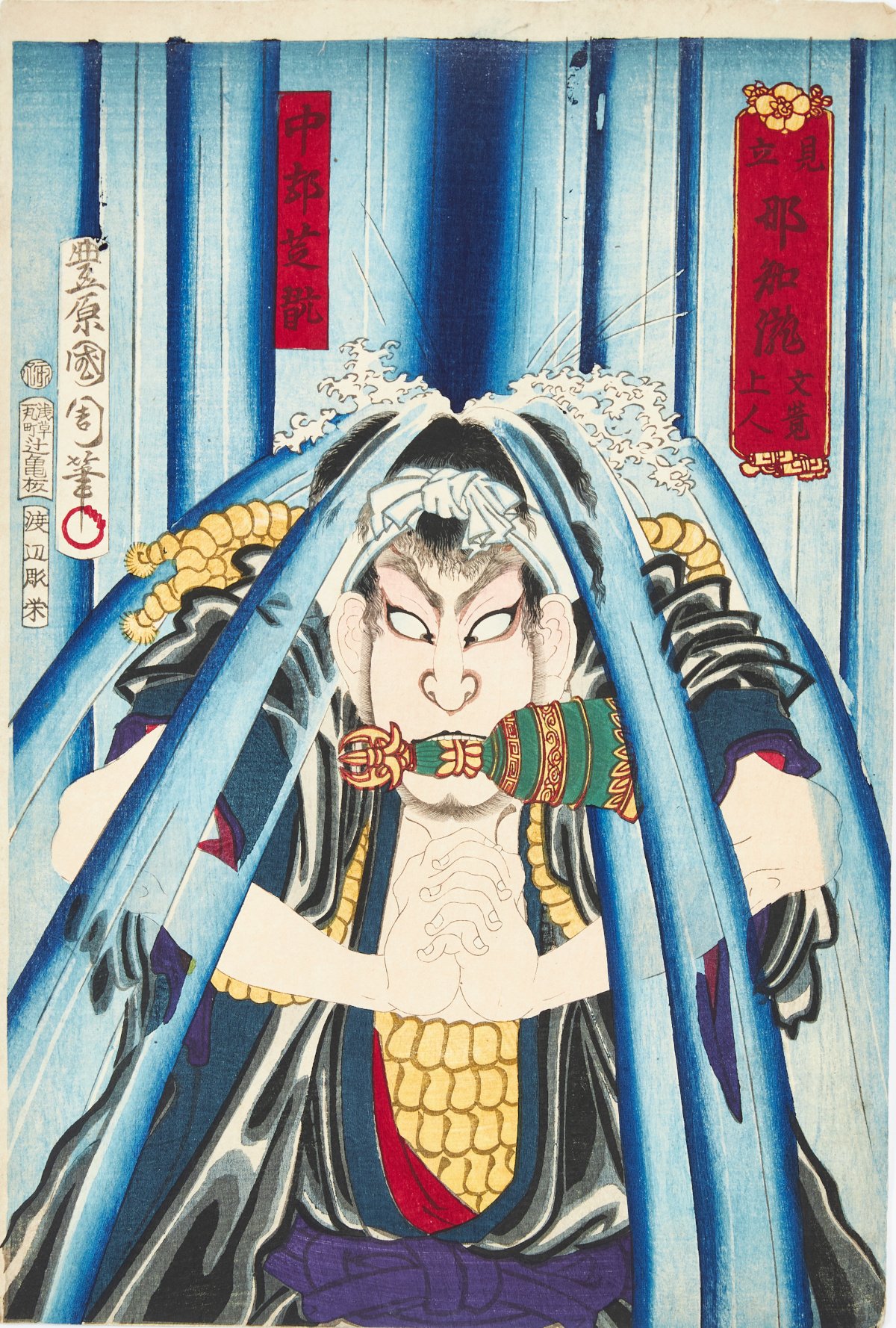
An original Japanese ōban tate-e nishiki-e woodblock print by Toyohara Kunichika (1835–1900), depicting the legendary Buddhist ascetic Mongaku Shōnin performing his famous waterfall austerity at Nachi.
The composition is dominated by powerful streams of saturated blue water pouring directly over the actor’s head and shoulders. He stands beneath the waterfall with his hands clasped in prayer, a ritual object held between his teeth, dressed in the dark robes and large golden prayer beads of an ascetic monk.
The title cartouche explicitly identifies the role as Mongaku Shōnin, making this a particularly dramatic example of Kunichika’s yakusha-e: a Kabuki actor portrait transformed into a scene of religious endurance, repentance and supernatural legend.
The ukiyo-e comes individually framed and ready to hang.
The subject is Mongaku Shōnin, one of the most dramatic religious figures to enter Japanese historical legend and theatrical culture.
Before taking Buddhist vows, Mongaku was known as Endō Morito, a samurai associated with the Watanabe clan. According to the traditional story, Morito became obsessed with Kesa Gozen, a married woman, and planned to kill her husband.
Kesa attempted to prevent the murder by taking her husband’s place. Morito, unaware of the substitution, killed her instead. Overcome with remorse, he abandoned his former life and entered the Buddhist priesthood under the name Mongaku.
Mongaku’s repentance became closely associated with an extreme form of ascetic waterfall practice known as takigyō.
According to legend, he subjected himself to the freezing waters of Nachi Waterfall, in present-day Wakayama Prefecture, continuing his austerities until he was close to death.
The scene became one of the defining images of Mongaku’s legend. In traditional accounts, supernatural intervention ultimately saves him, with figures associated with Fudō Myōō coming to his aid.
Kunichika turns this moment into an intensely theatrical image: the falling water almost consumes the figure, while the actor’s rigid posture and clasped hands communicate determination, suffering and spiritual discipline.
Nachi no Taki, or Nachi Waterfall, is one of Japan’s most celebrated sacred waterfalls and forms part of the religious landscape of the Kumano region.
In this print, the waterfall is not simply a background. It dominates the entire composition through broad vertical bands of deep and pale blue, surrounding the actor and visually pressing down upon him.
The water passes over the head and shoulders and divides the figure into sections, reinforcing the sense that Mongaku is physically immersed in the force of the cascade.
Kunichika presents the actor at close range, concentrating attention on the face, prayer gesture and dramatic costume.
The expression is severe and intensely focused. The hands are clasped tightly in front of the chest, while a ritual object is held horizontally between the teeth.
The actor wears dark ascetic robes contrasted with prominent golden prayer beads, while the powerful blue water passes over and around his body.
The result combines the recognizable language of a Kabuki performance with the legendary image of a monk enduring severe religious austerity.
Toyohara Kunichika (1835–1900), born Ōshima Yasohachi in Edo, became one of the leading Japanese print artists of the late 19th century.
After training within the Utagawa tradition, he became a pupil of Utagawa Kunisada (Toyokuni III), one of the most influential ukiyo-e artists of his generation.
Kunichika developed an exceptionally close relationship with the Kabuki theater. He frequently worked backstage in the theaters of Edo and later Tokyo, sketching prominent actors from life and translating their performances into highly expressive yakusha-e.
His work is distinguished by bold compositions, close-up faces, strong expressions and vivid color, qualities that made his actor portraits particularly suited to the dramatic world of Kabuki.
Kunichika worked during a period of rapid change in Japanese printmaking, when newly available imported pigments allowed artists to achieve increasingly saturated colors.
The intense blue of the waterfall is one of the most immediately striking aspects of this print. Different shades are layered and juxtaposed to create the sensation of constantly falling water.
The brilliance of the blue is balanced by the black and gray robes, flesh tones, golden beads and smaller areas of red and green, producing a highly controlled yet visually powerful composition.
Yakusha-e were woodblock prints depicting Kabuki actors, roles and performances. They formed one of the most important and popular branches of ukiyo-e throughout the Edo and Meiji periods.
Rather than simply recording an actor’s appearance, artists often emphasized recognizable stage expressions, gestures and costumes, allowing viewers to identify both performer and role.
Kunichika became one of the last major masters to specialize extensively in this tradition during the period in which photography was beginning to challenge the woodblock portrait as a medium for representing contemporary actors.
The composition belongs to the Mitate Nachi no Taki waterfall imagery associated with Kunichika’s theatrical designs.
The use of the monumental waterfall provides a common visual framework while allowing individual actors and legendary characters to occupy the central role.
Here, the combination is especially effective because the waterfall is essential to Mongaku’s story rather than simply decorative scenery. The natural setting and theatrical subject become inseparable.
The work is printed in the traditional ōban tate-e format, the large vertical format commonly used for Japanese actor prints.
It is a nishiki-e, or full-color woodblock print, produced using multiple carved woodblocks to apply individual colors in careful registration.
This technically demanding process allowed Kunichika to combine fine linework, dramatic facial detail and large areas of saturated color within a single composition.
This print comes from the collection of Dr. Eugen Milch (1889–1958), an Austrian physician and artist whose life involved extensive travel through Europe and Asia.
Milch served as a medical officer during the First World War and traveled widely in the early 1920s on combined study and painting journeys. In 1924 he married the artist Emma Bormann, and the couple traveled to Sweden that same year. Together with artist Oskar Bergman, they exhibited several paintings at Liljevalchs in Stockholm.
In 1937, Eugen Milch traveled to China with other Austrian physicians at the invitation of the Chinese government. In 1938 he became superintendent of a hospital in Beihai, China.
Following the Japanese occupation of parts of the southern Chinese coast, including Beihai, the Milch family relocated to Shanghai in 1941.
Eugen later assisted British forces in China and was granted British citizenship. He subsequently traveled to Japan to study the aftermath of the war, and it is considered likely that he acquired the present collection of Japanese woodblock prints during this period.
He died in Hong Kong in 1958. The collection subsequently passed by descent within the family.
This is an original antique Japanese woodblock print (ukiyo-e), not a modern reproduction or later reprint.
It is a genuine period work, retaining the materials, printing characteristics and natural aging associated with an original Japanese woodblock print rather than a newly produced image made to imitate an antique.
As with works on paper of this age, some light wear is normal and expected. Gentle toning, occasional small spots or creases, and faint handling marks may occur as part of the natural history of an antique print that has survived for well over a century.
These characteristics are typical of genuine period ukiyo-e and should be understood in the context of the print’s age. Individual condition notes are provided for transparency and do not imply that the work is in poor condition.
The print remains in good general condition.
There are some signs of wear consistent with age, together with light handling creases. These are appropriate for an original 19th-century Japanese work on paper and do not significantly diminish the visual impact of the composition.
Please examine the detailed photographs carefully, as they form an important part of the description and provide a close view of the paper, pigments, margins and surviving surface.
The print is individually framed and sold complete with its frame, ready to hang.
A dramatic original Meiji-period ukiyo-e by Toyohara Kunichika, depicting the actor in the role of Mongaku Shōnin enduring his legendary waterfall austerity at Nachi. The cascading saturated blue water, tightly clasped hands, golden prayer beads and intense expression create a powerful image of religious discipline translated through the theatrical language of Kabuki. With provenance from the collection of Dr. Eugen Milch and sold framed and ready to hang, the print is a compelling example of Kunichika’s late yakusha-e and his ability to combine legendary narrative, actor portraiture and bold Meiji color into a single composition.

Order above 1.000,00 € gets free shipping.

Secure and hassle-free payment process.

Certificate of authenticity included.

Have questions? Contact us via WhatsApp.
Contact