

1 in stock
1 in stock
Add to Compare
Add to Wishlist
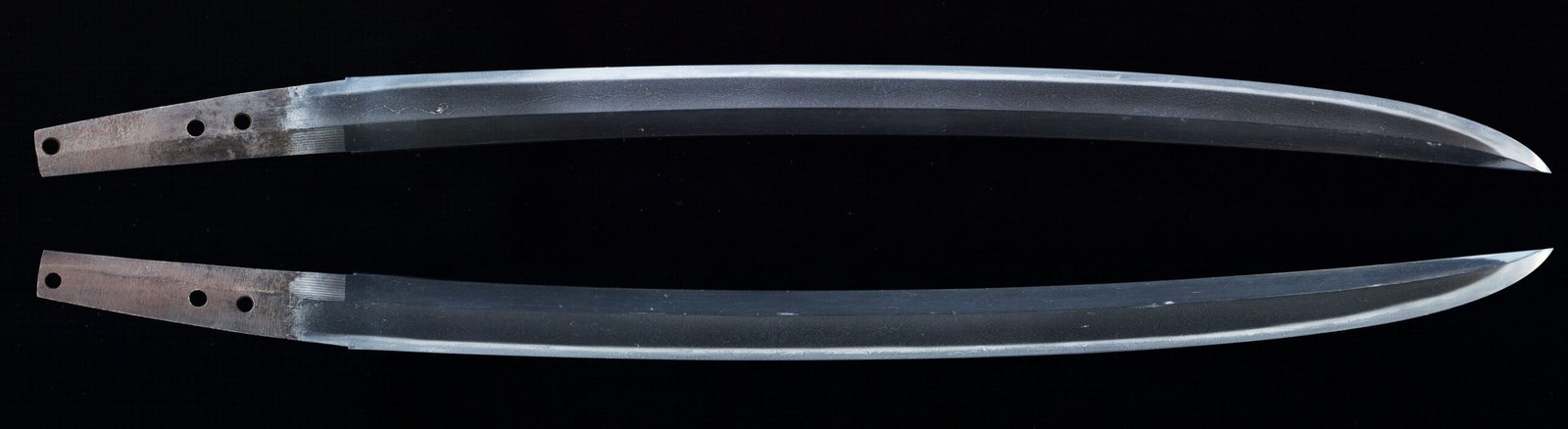
An exceptional early Muromachi-period Japanese sword attributed to the Tegai school (手掻派) of Yamato Province, one of the classical traditions of Yamato-den. Dating to approximately the Shōchō era (1428–1429), the blade belongs firmly to the Koto period and represents a refined example of the austere, functional and technically distinctive swordmaking tradition that developed around Nara.
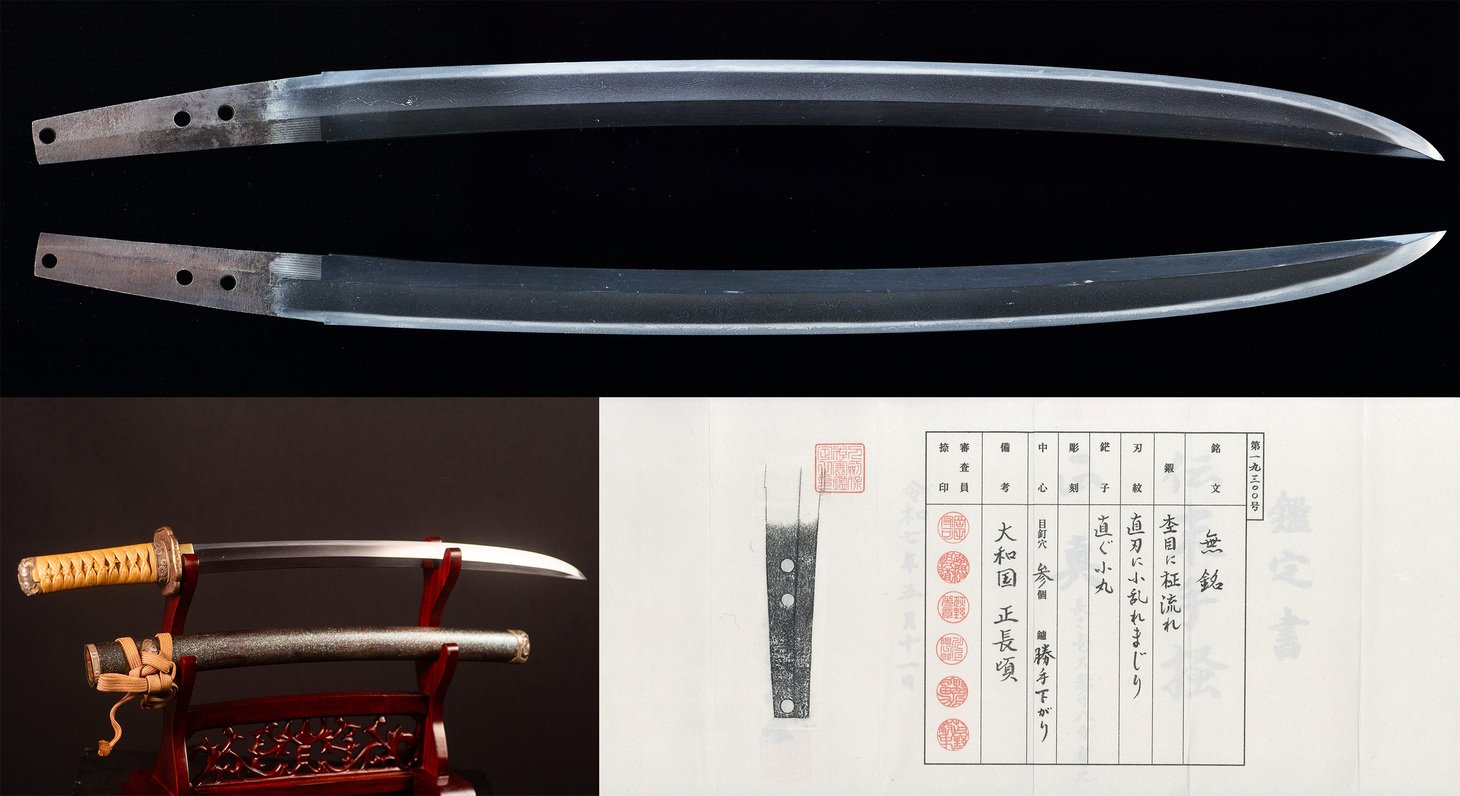
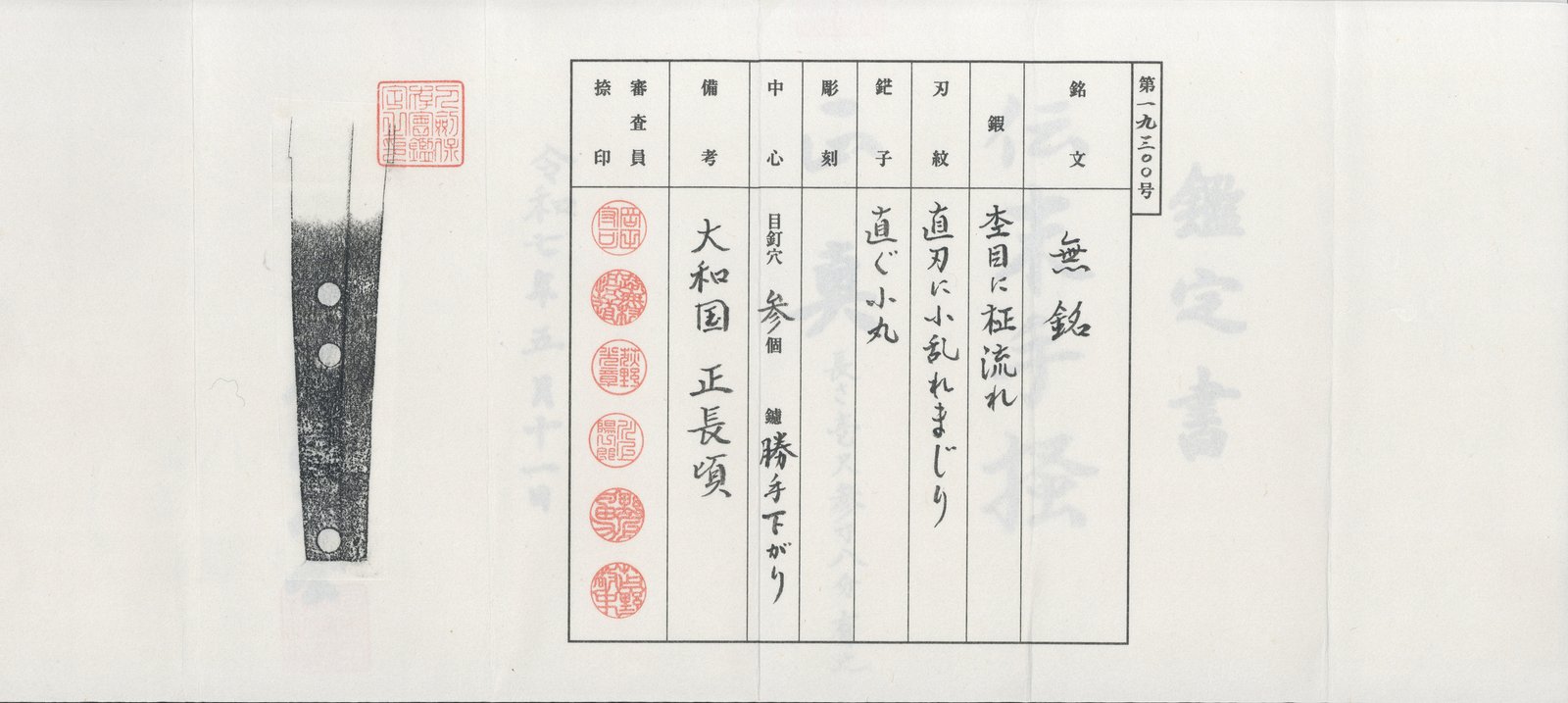
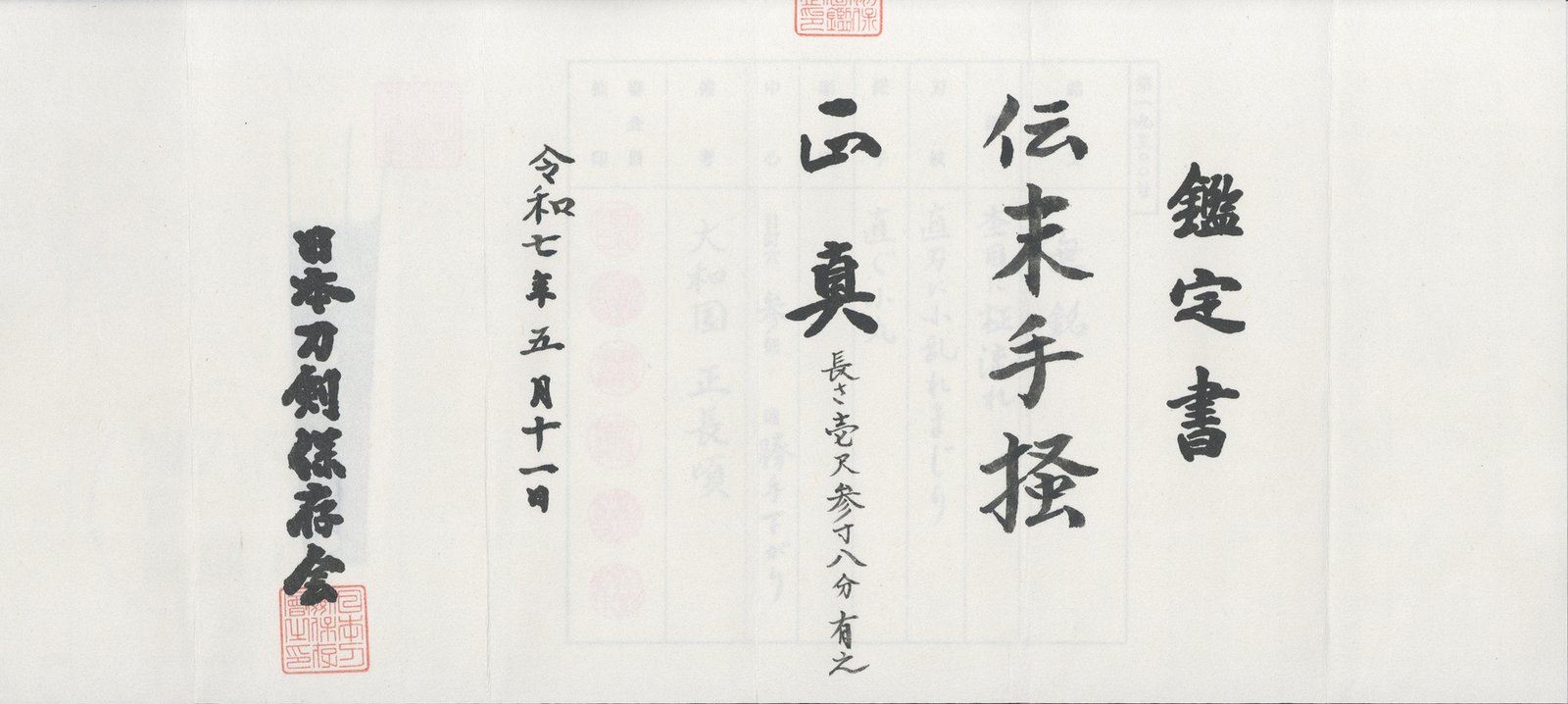
The blade is mumei, with no surviving signature, but is accompanied by a kanteisho issued in May 2025 by the Nihon Touken Hozon Kai, attributing the work to the Tegai school and dating it to the Shōchō era with a verdict of shōshin.
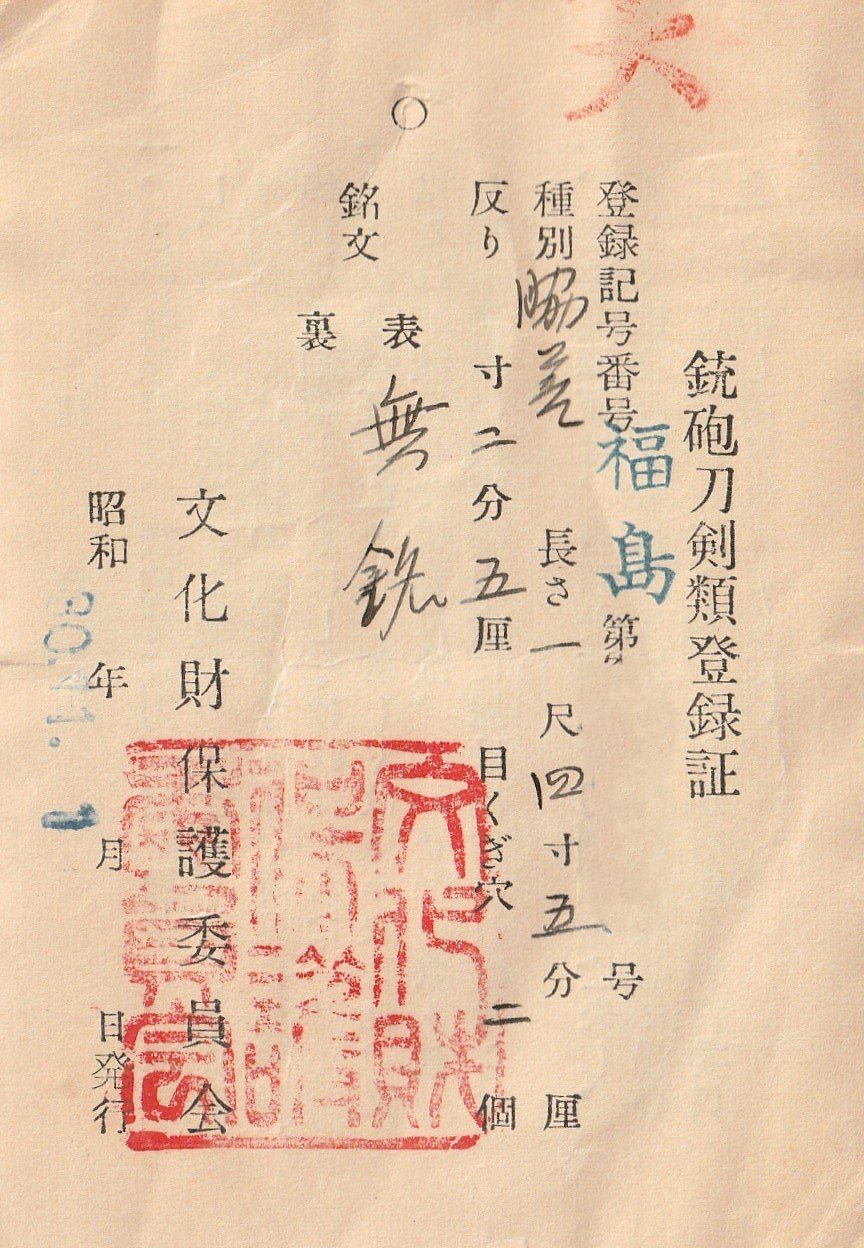
It is also accompanied by its original Jūhō Tōken Rui Tōrokushō, issued by Fukushima Prefecture in January 1955, giving the sword an especially early documented registration history within Japan.
With a recorded nagasa of approximately 41.8 cm, the blade sits directly at the boundary between a long tantō and a short wakizashi, a highly practical format historically suited to use as a secondary sidearm.
The blade is attributed to the Tegai school of Yamato Province.
Tegai formed part of the broader classical Yamato-den tradition and was historically associated with the Nara region.
The school developed within the cultural environment surrounding the great temples and warrior-monastic institutions of ancient Yamato, and its swordsmiths became known for blades characterised by strong construction, disciplined geometry and restrained but highly functional temper patterns.
The present attribution places the sword within one of the established classical Yamato lineages and gives the blade a particularly strong historical identity.
The accompanying kanteisho dates the sword to approximately the Shōchō era, 1428–1429.
This places it in the early Muromachi period and firmly within the Koto era of Japanese swordmaking.
Blades from this period retain the structural and stylistic characteristics of medieval Japanese swords produced for actual warrior use.
The attribution is therefore significant not only in terms of school, but also because it situates the piece within a clearly defined historical moment more than five and a half centuries ago.
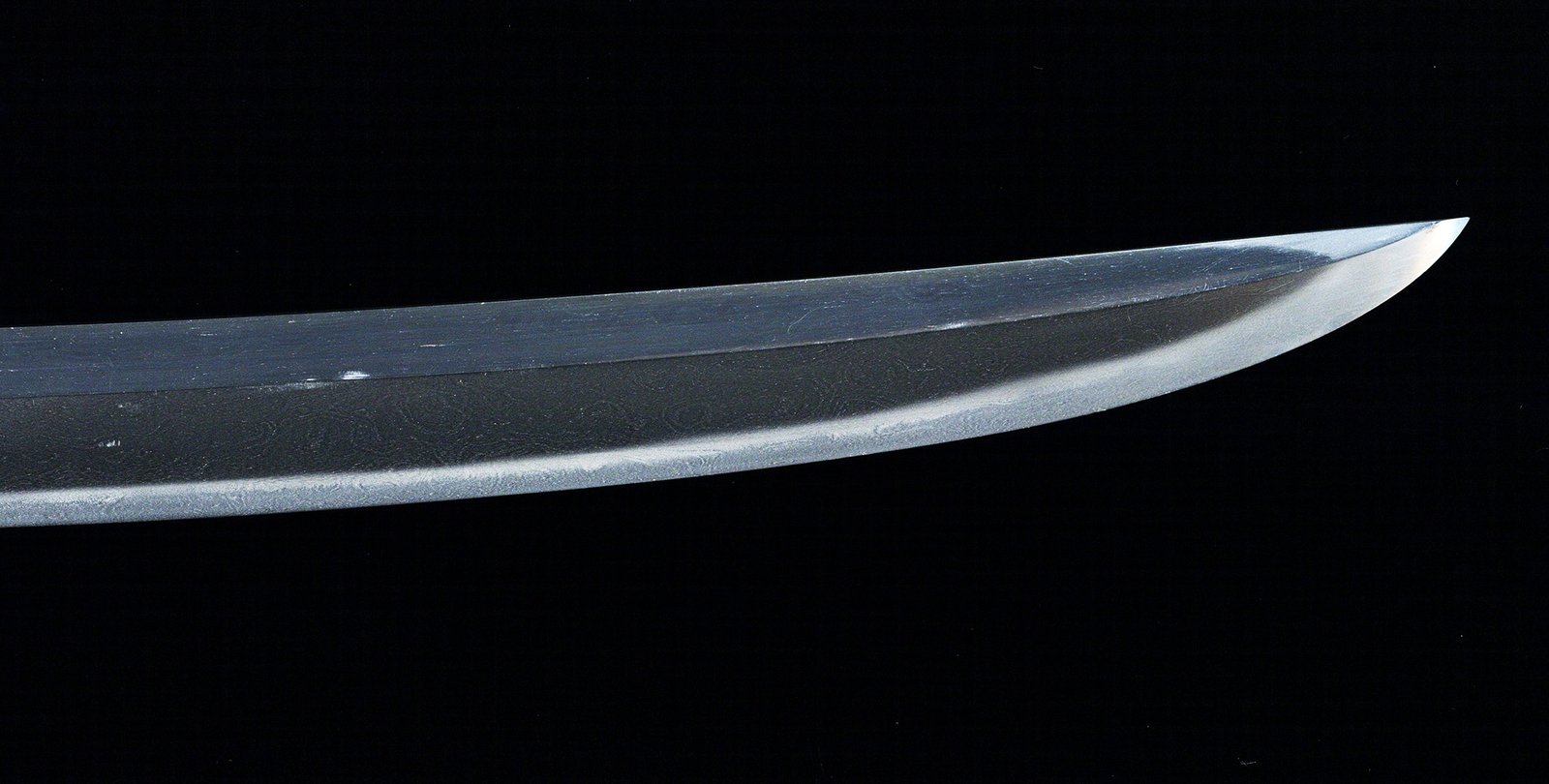
The blade presents a compact yet powerful profile appropriate to a long tantō or short wakizashi.
Its recorded nagasa is approximately 41.8 cm, corresponding to 1 shaku 3 sun 8 bu.
The proportions are particularly interesting because they place the sword directly between two conventional classifications.
In practical terms, such a blade could function as a substantial secondary weapon while retaining the compactness expected from shorter sidearms.
The curvature is restrained, giving the sword an elegant and purposeful profile.
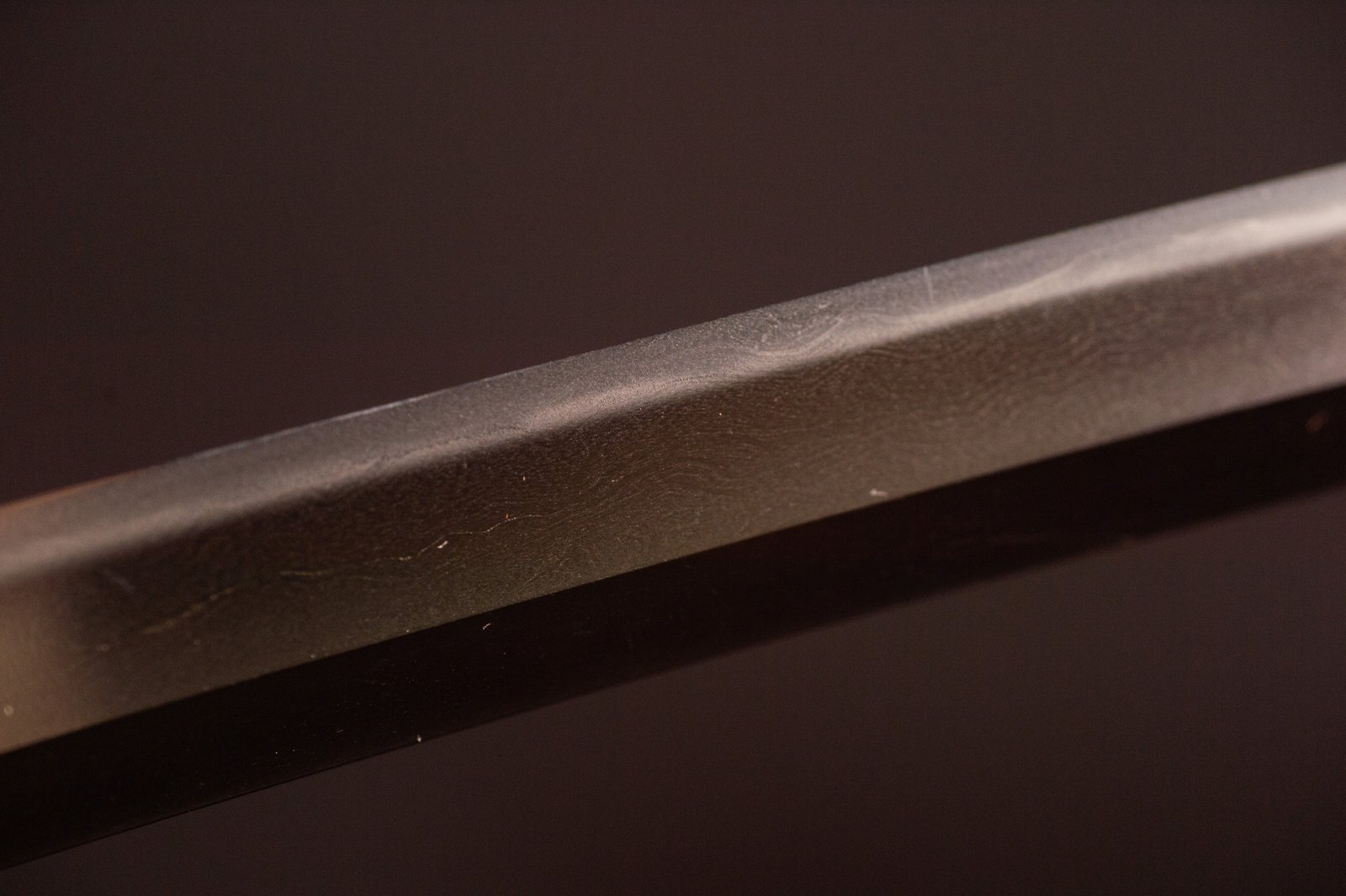
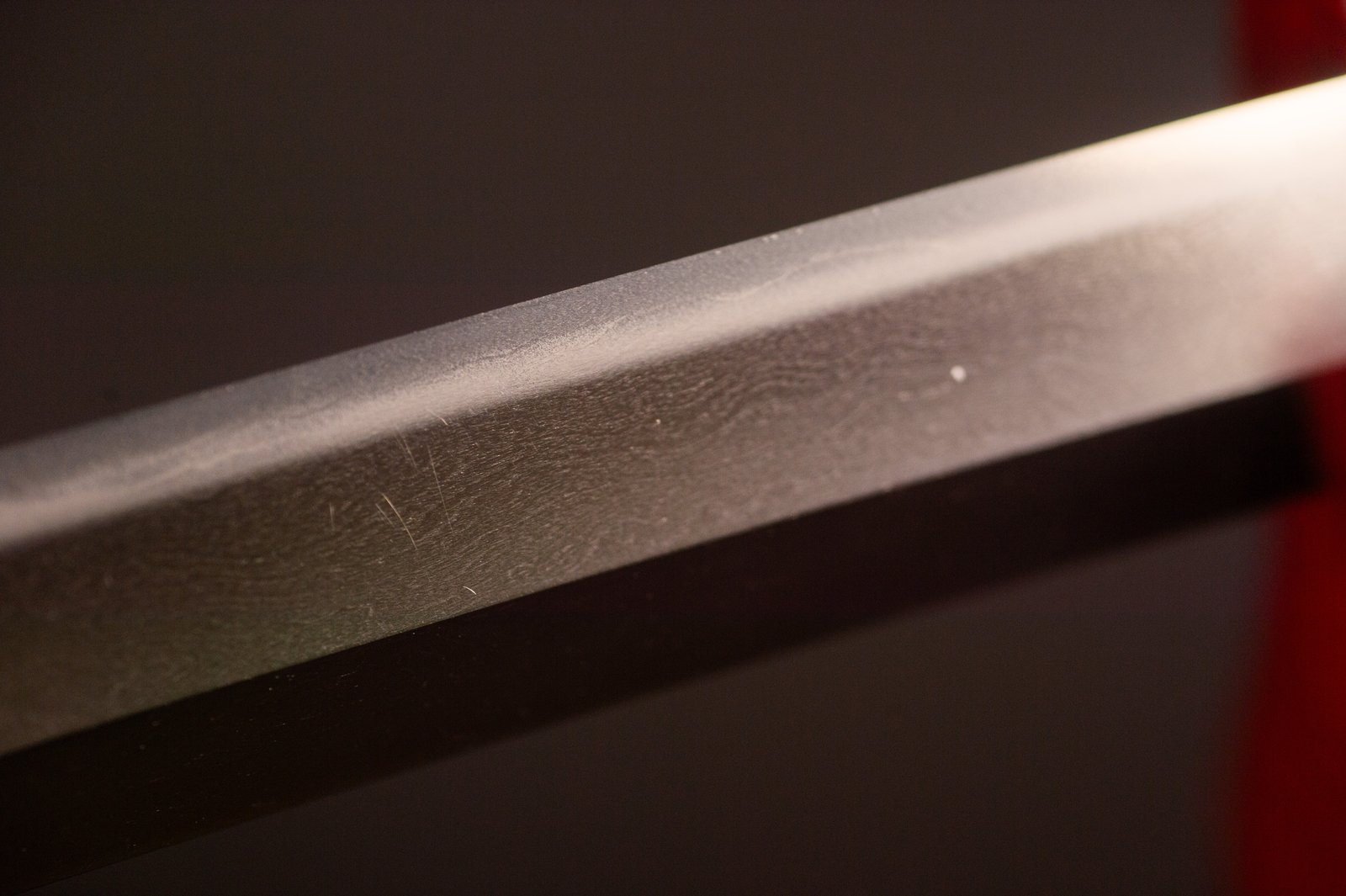
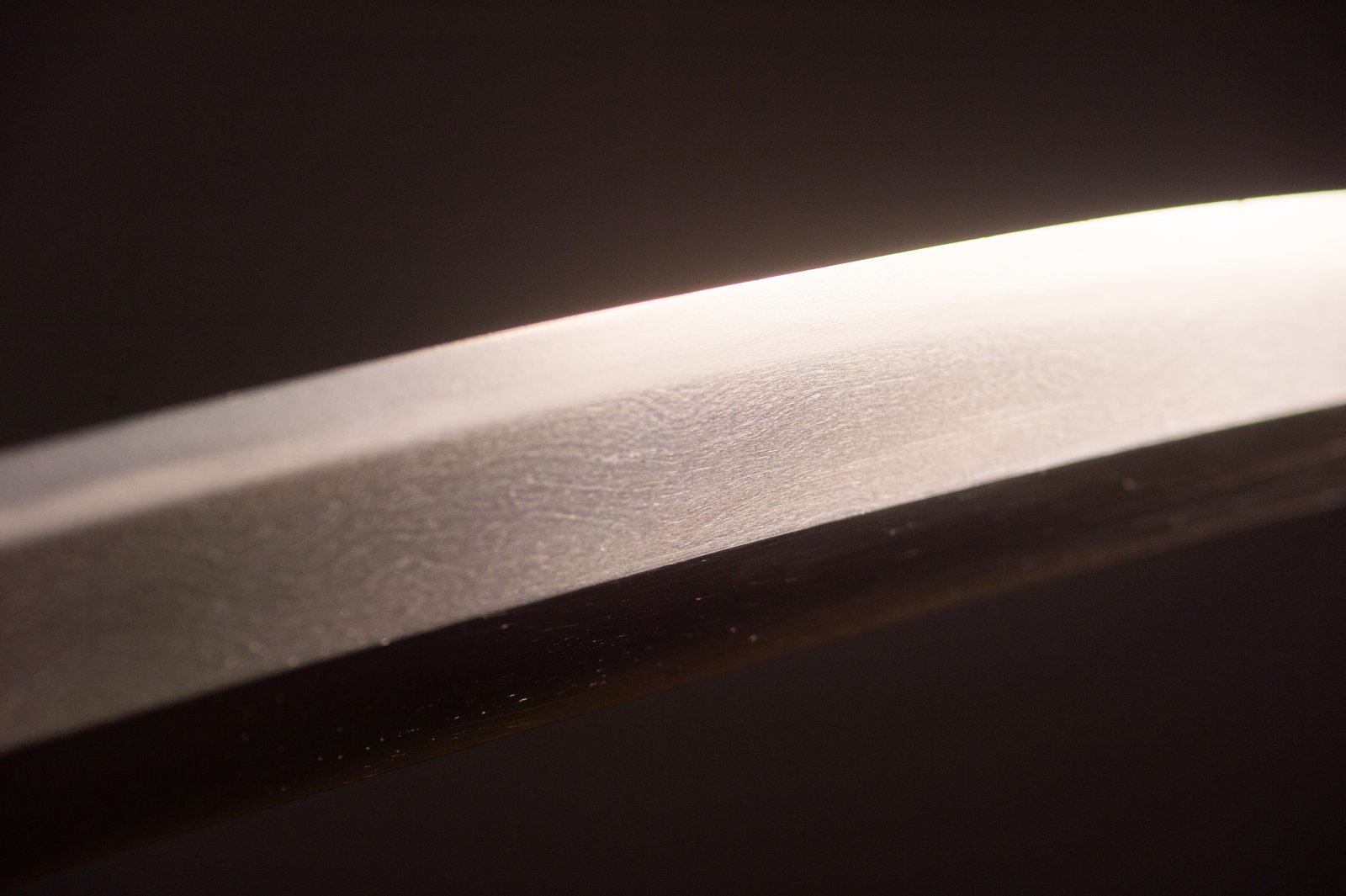
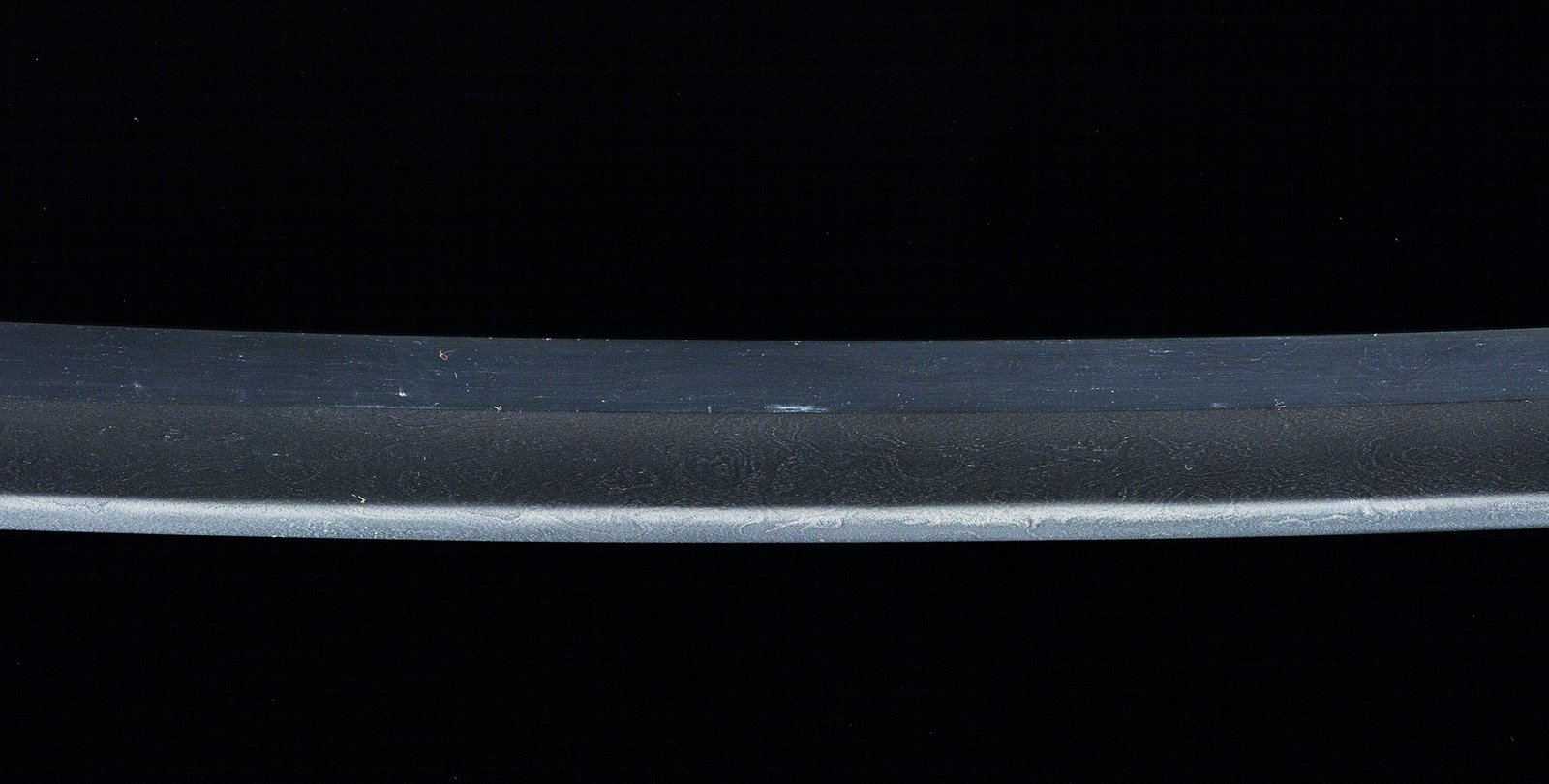
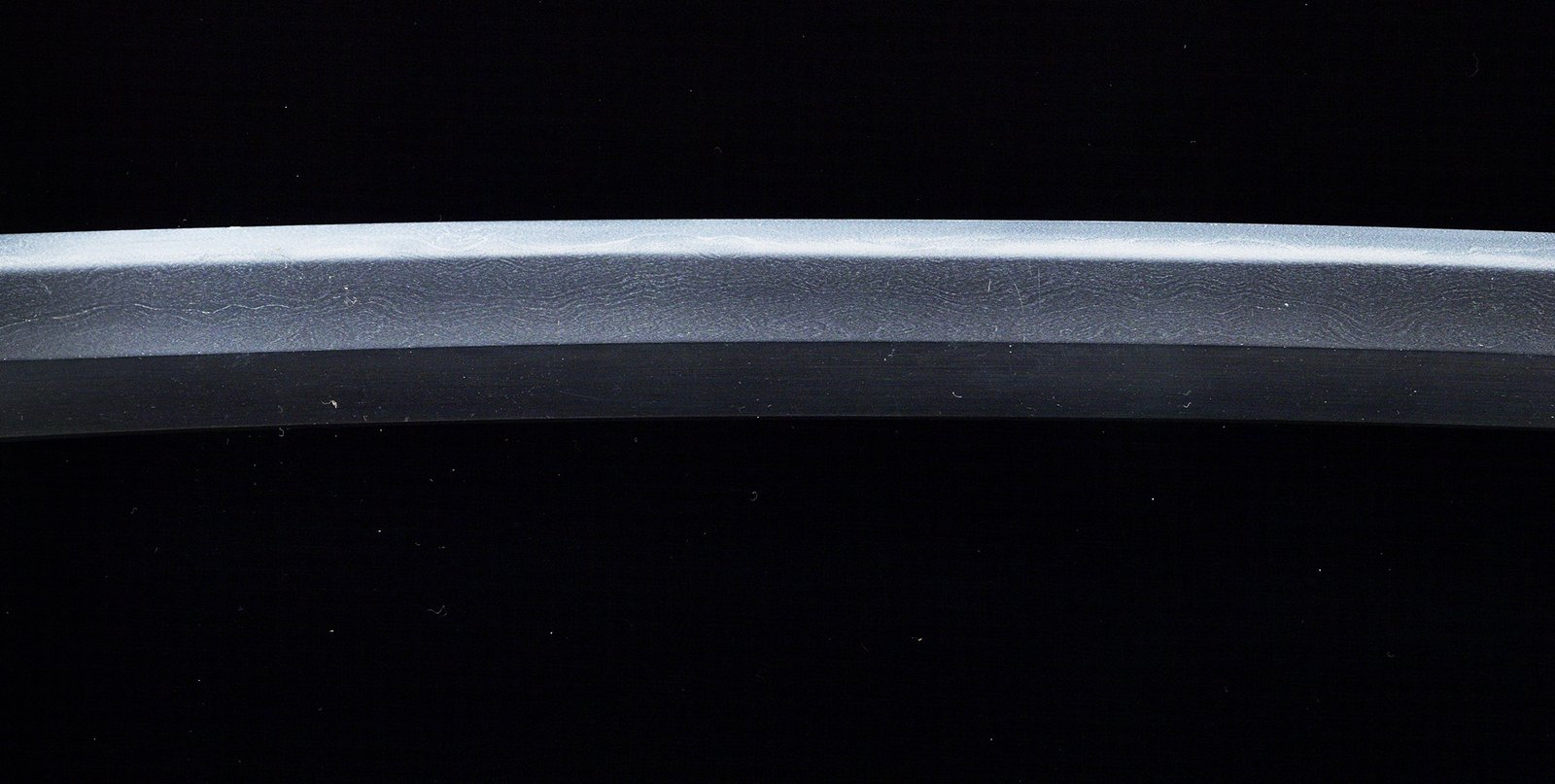
The kanteisho describes the hada as itame with masame-nagare.
This combination is highly characteristic of Yamato-related work.
The itame grain creates a gently flowing wood-like structure, while the longitudinal masame elements introduce straighter lines running through the steel.
The resulting surface has a disciplined and traditional appearance, reflecting the forging characteristics historically associated with Yamato-den.
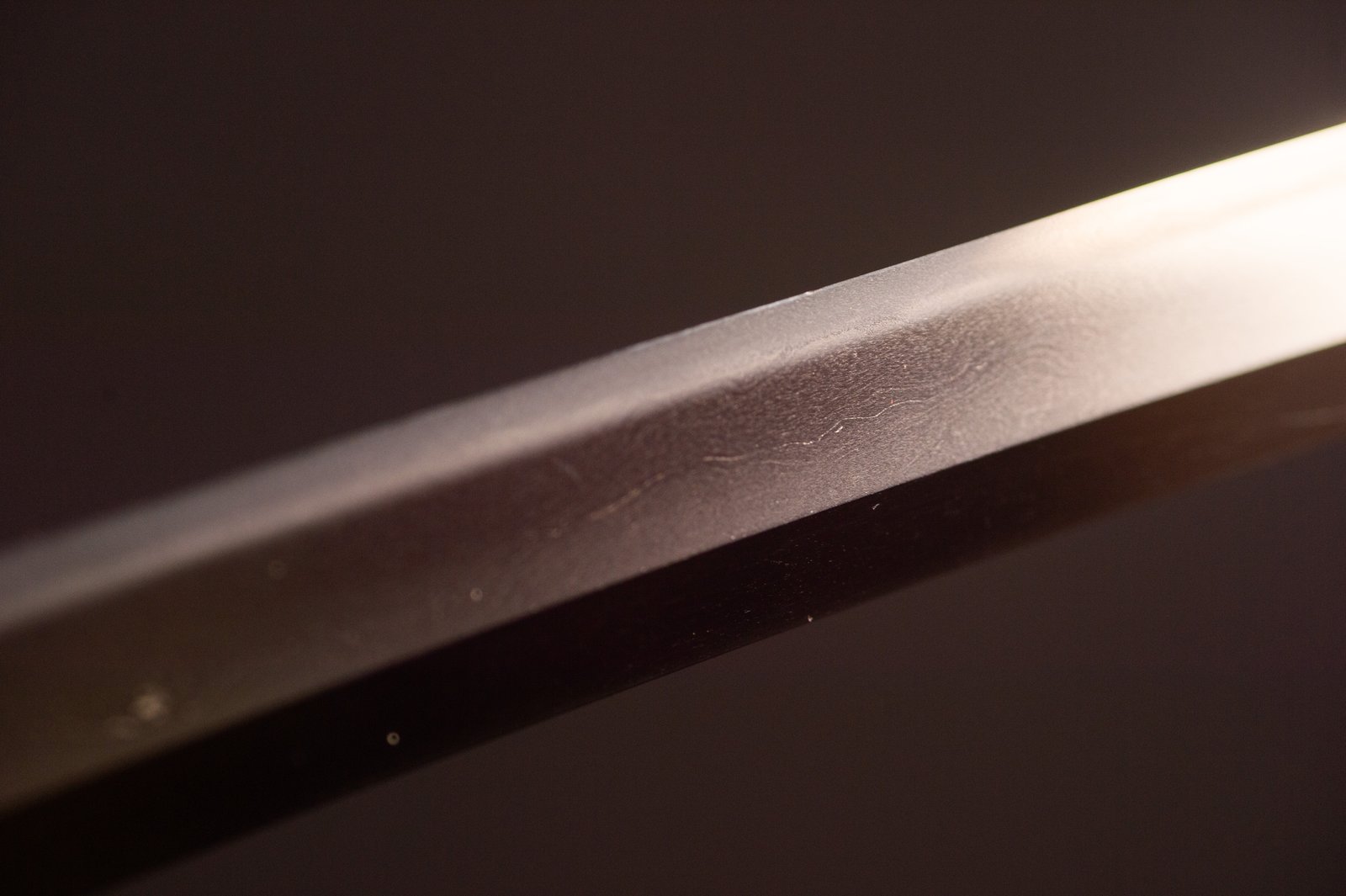
The temper line is described as suguha with a small admixture of midare.
The principal structure is therefore straight and restrained, consistent with the conservative aesthetic traditionally associated with Yamato blades.
Small irregularities within the line introduce subtle movement without disturbing the overall disciplined character.
This combination of controlled suguha and restrained midare gives the blade a quiet sophistication rather than relying on highly flamboyant temper activity.
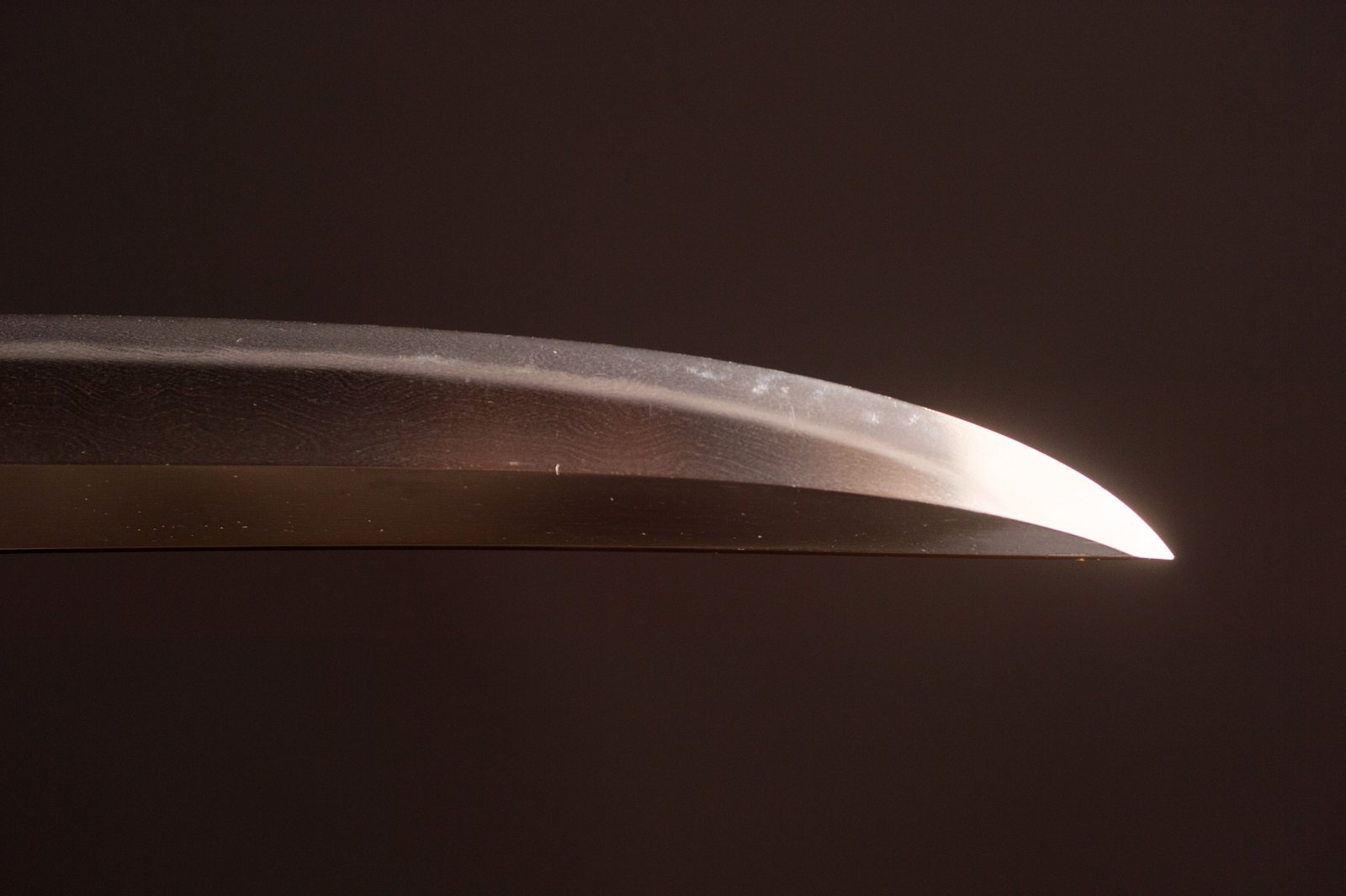
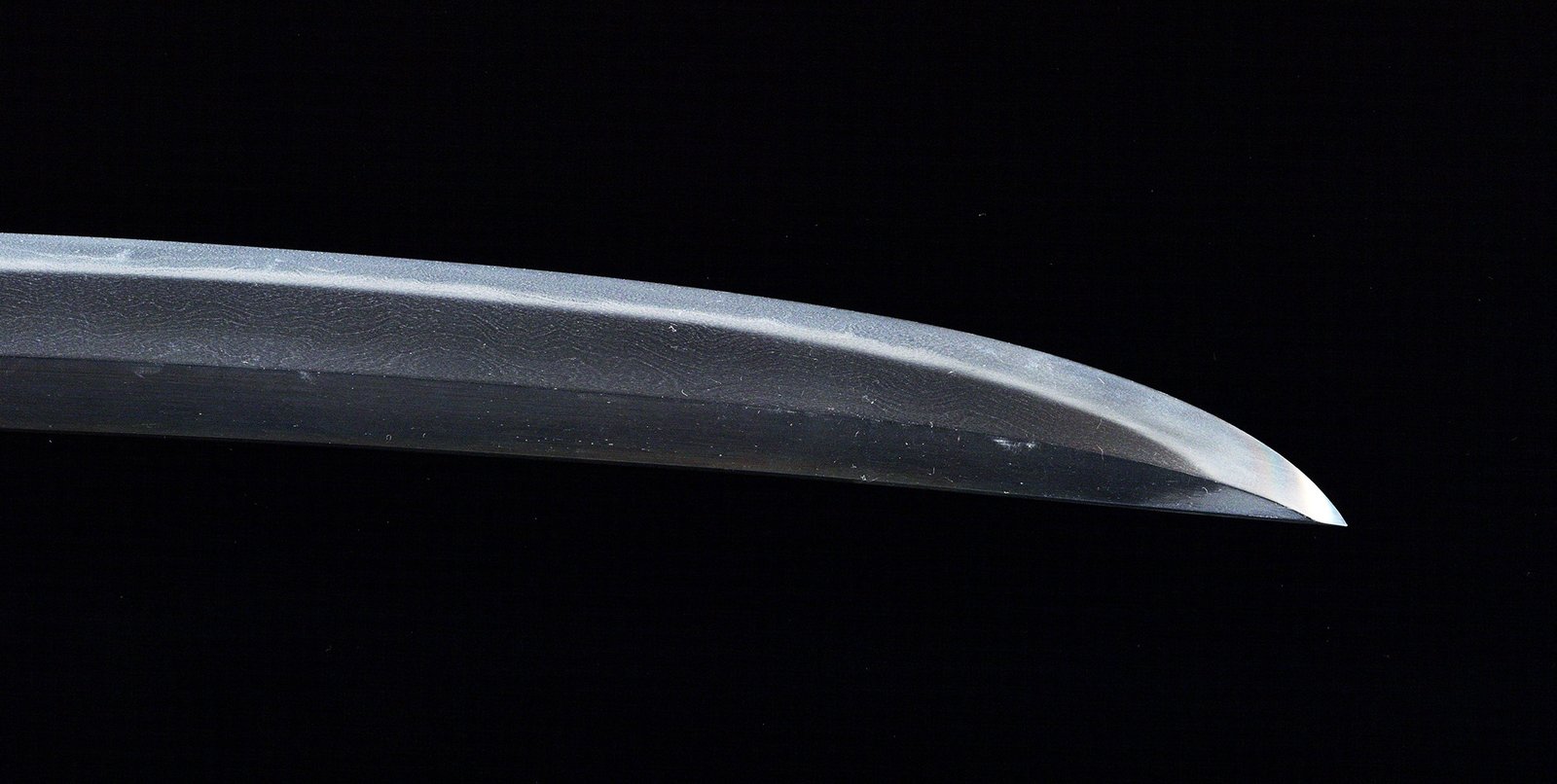
The boshi is described as straight with a small rounded turn-back.
This restrained continuation of the temper line into the point complements the overall Yamato-style character of the blade.
Its compact return reinforces the controlled and functional nature of the sword’s heat treatment.
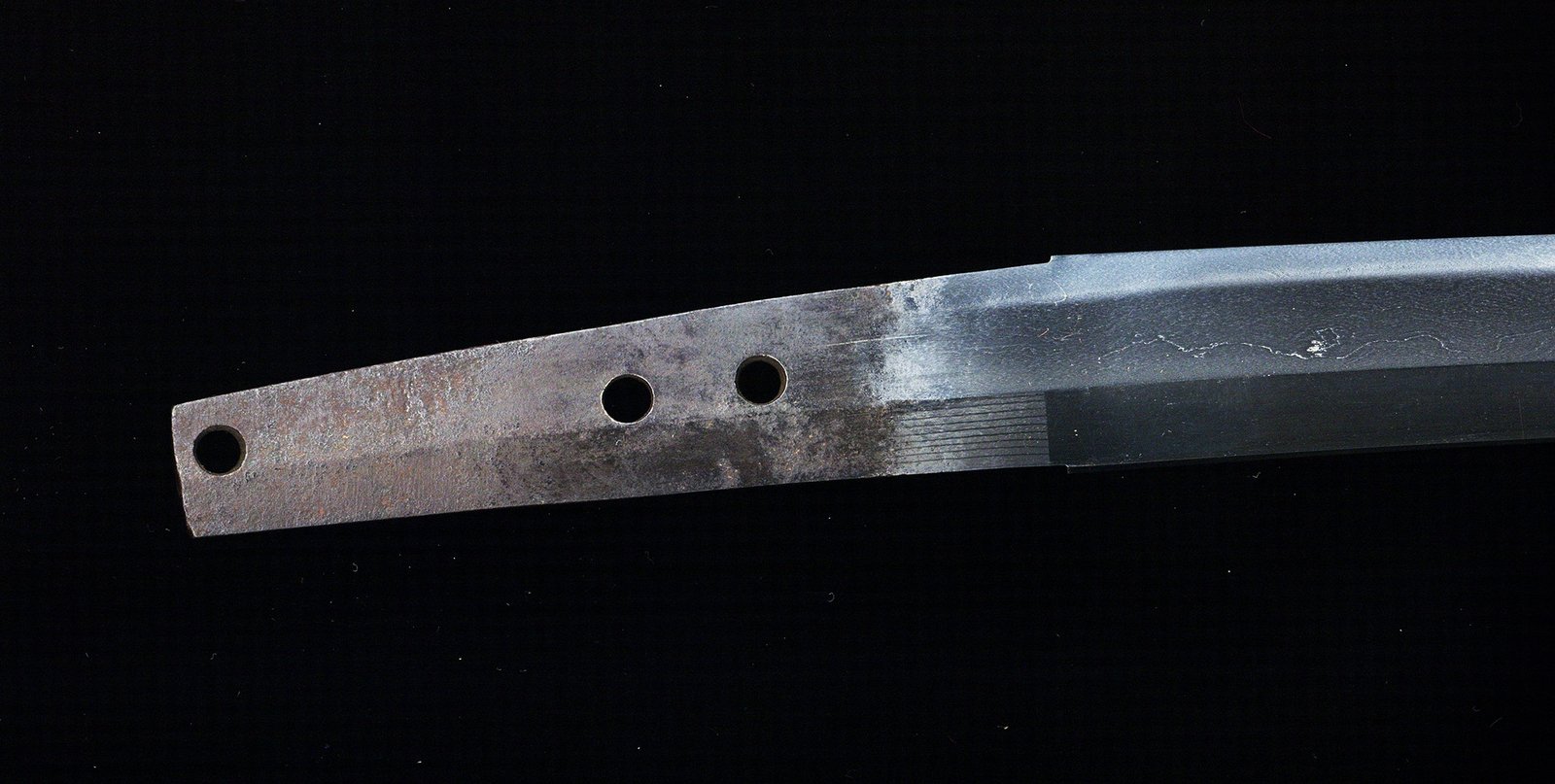
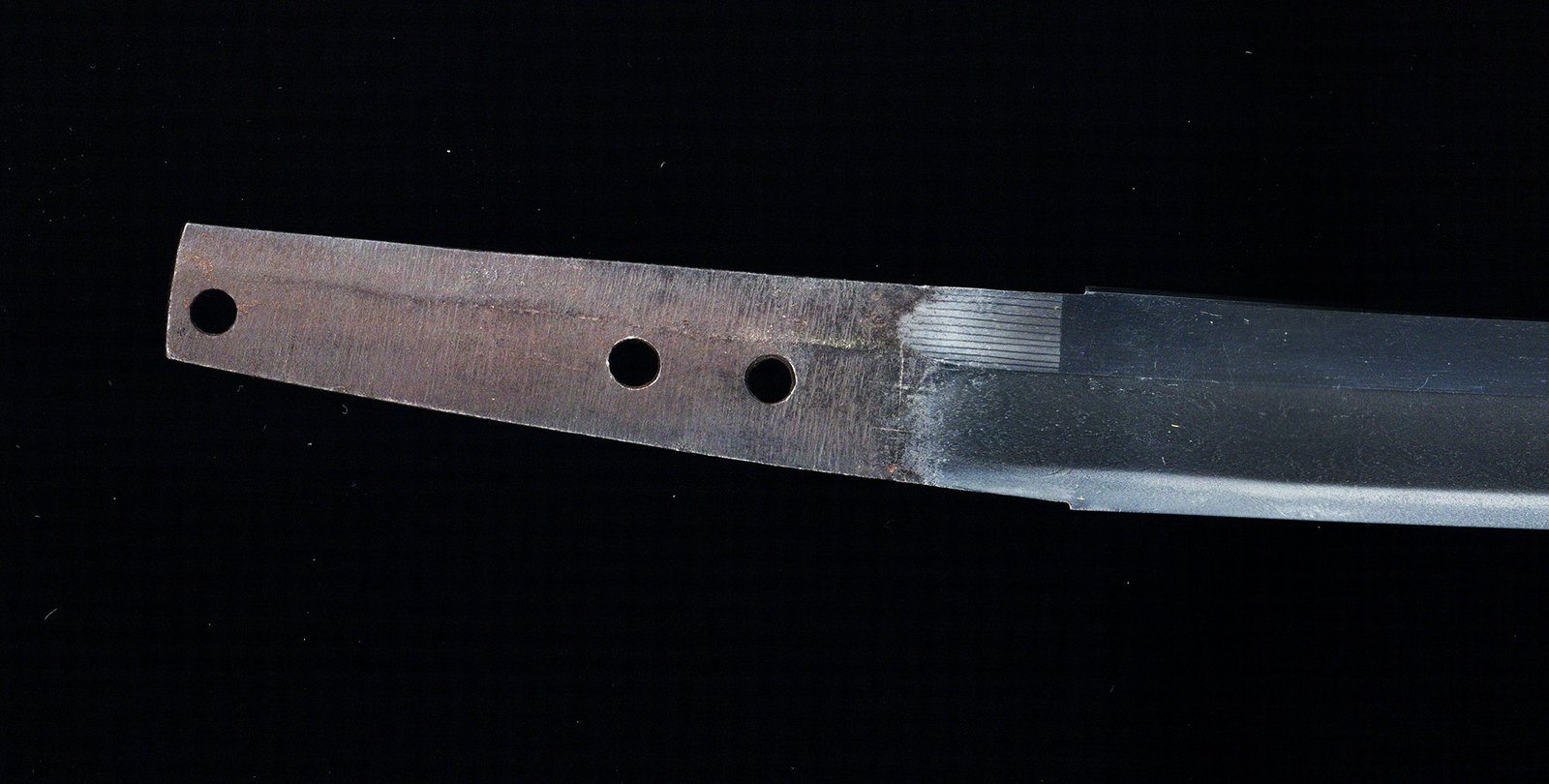
The nakago is unsigned and preserves a naturally aged surface consistent with an antique Japanese sword.
It retains three mekugi-ana, reflecting changes in mounting over the course of its long history.
The file marks are described as katte-sagari.
The tang should be preserved exactly in its present state, as its patina and historical surface form an essential part of the blade’s age and authenticity.
The absence of a signature does not diminish the historical significance of the blade.
Many early Japanese swords survive today in mumei condition, particularly where tangs have been altered, shortened or remounted over centuries of use.
In such cases, attribution is based upon the blade’s physical characteristics, including shape, construction, grain, temper pattern and other stylistic features.
The present sword has been attributed by kantei to the Tegai school of Yamato Province and dated to the Shōchō era.
The sword is accompanied by a kanteisho issued in May 2025 by the Nihon Touken Hozon Kai.
The document attributes the blade to the Tegai school and dates it to approximately the Shōchō era.
The recorded verdict is shōshin.
This modern appraisal provides important documentary support for the school attribution and historical dating of the piece.
The sword is also accompanied by its original Japanese Jūhō Tōken Rui Tōrokushō.
The registration was issued by Fukushima Prefecture in January 1955.
This is a notably early registration date, only a few years after the post-war Japanese sword registration system was introduced.
The survival of such an early torokusho gives the sword an important additional layer of documented modern Japanese provenance.
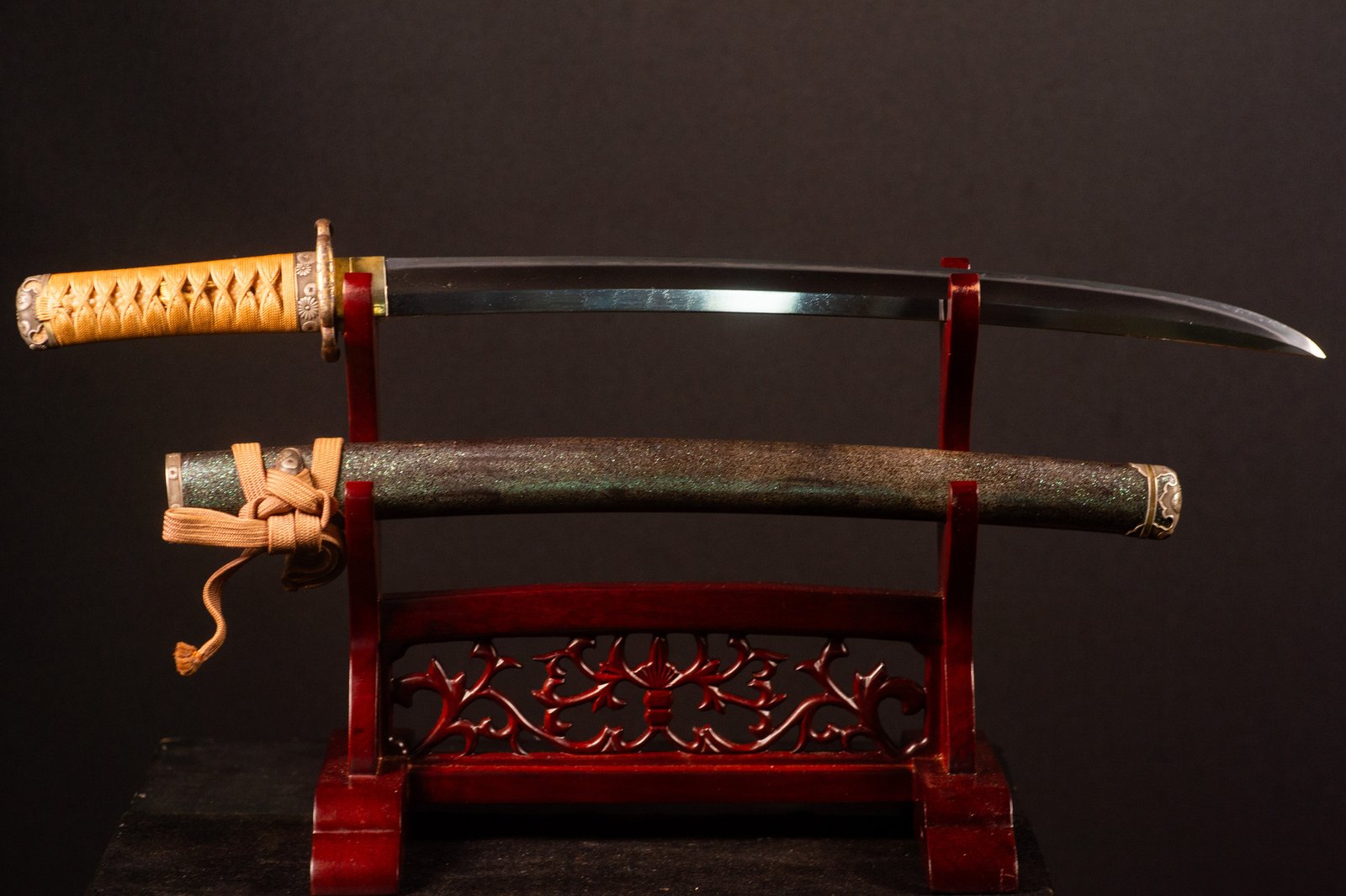
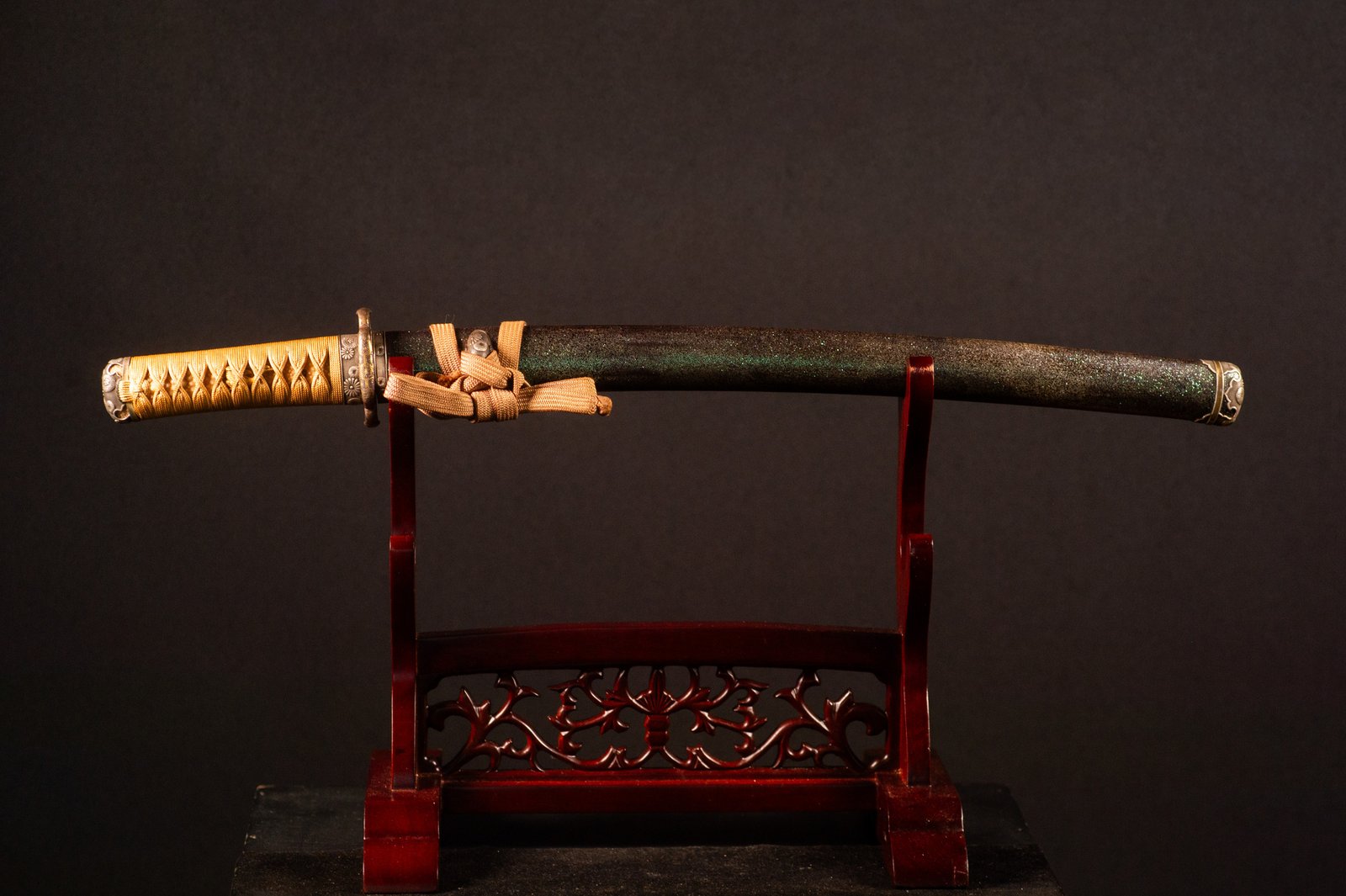
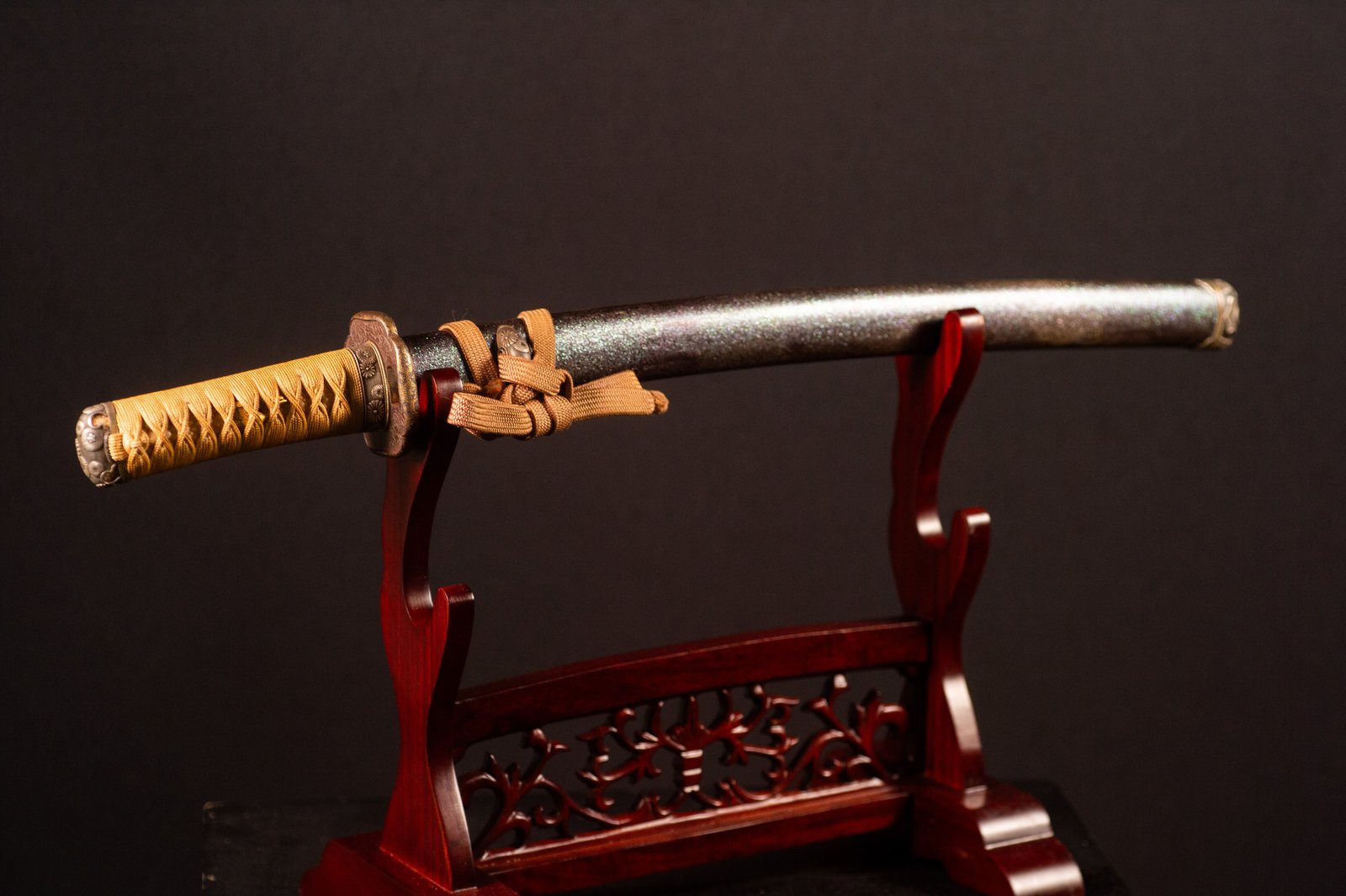
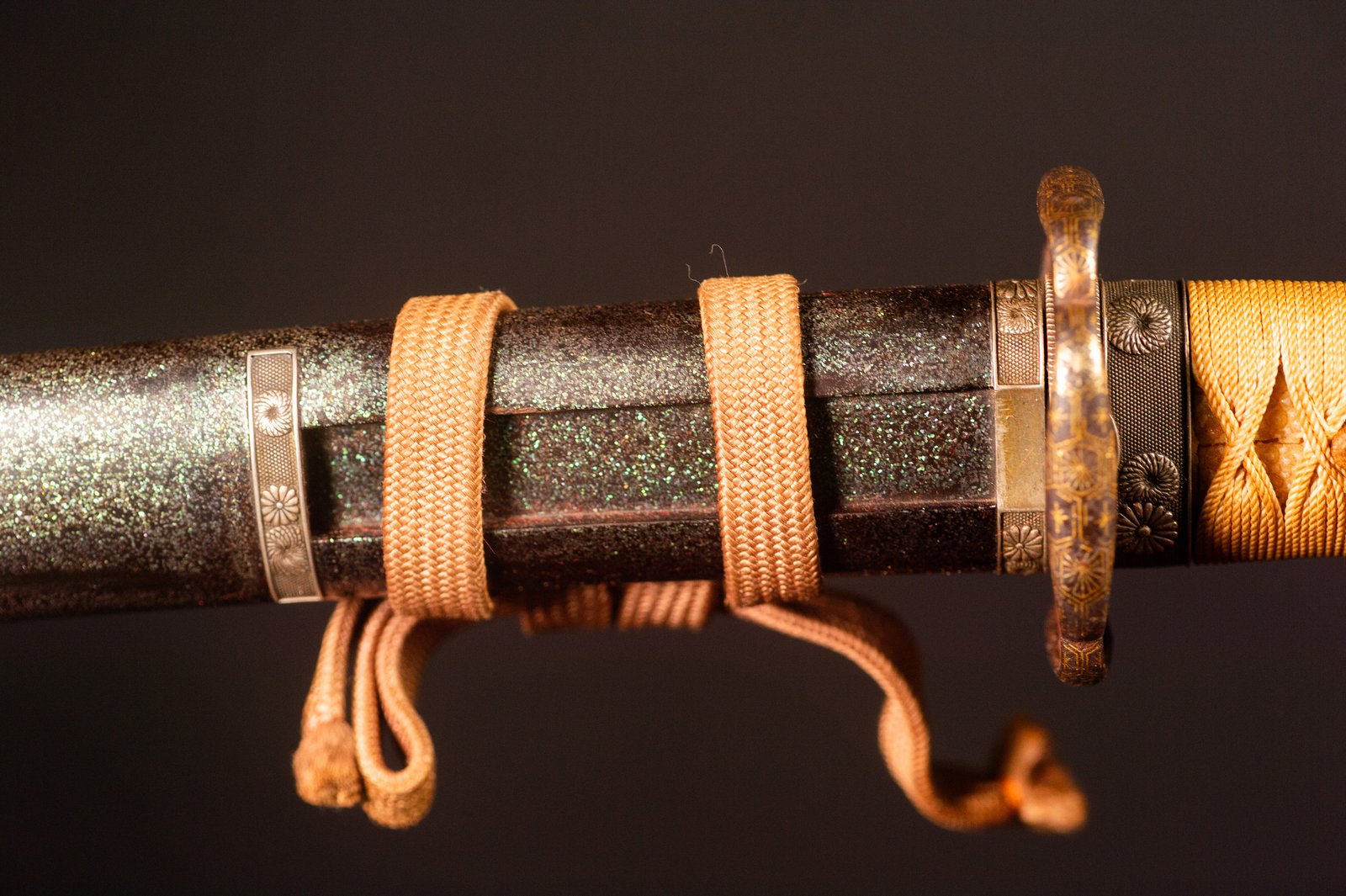
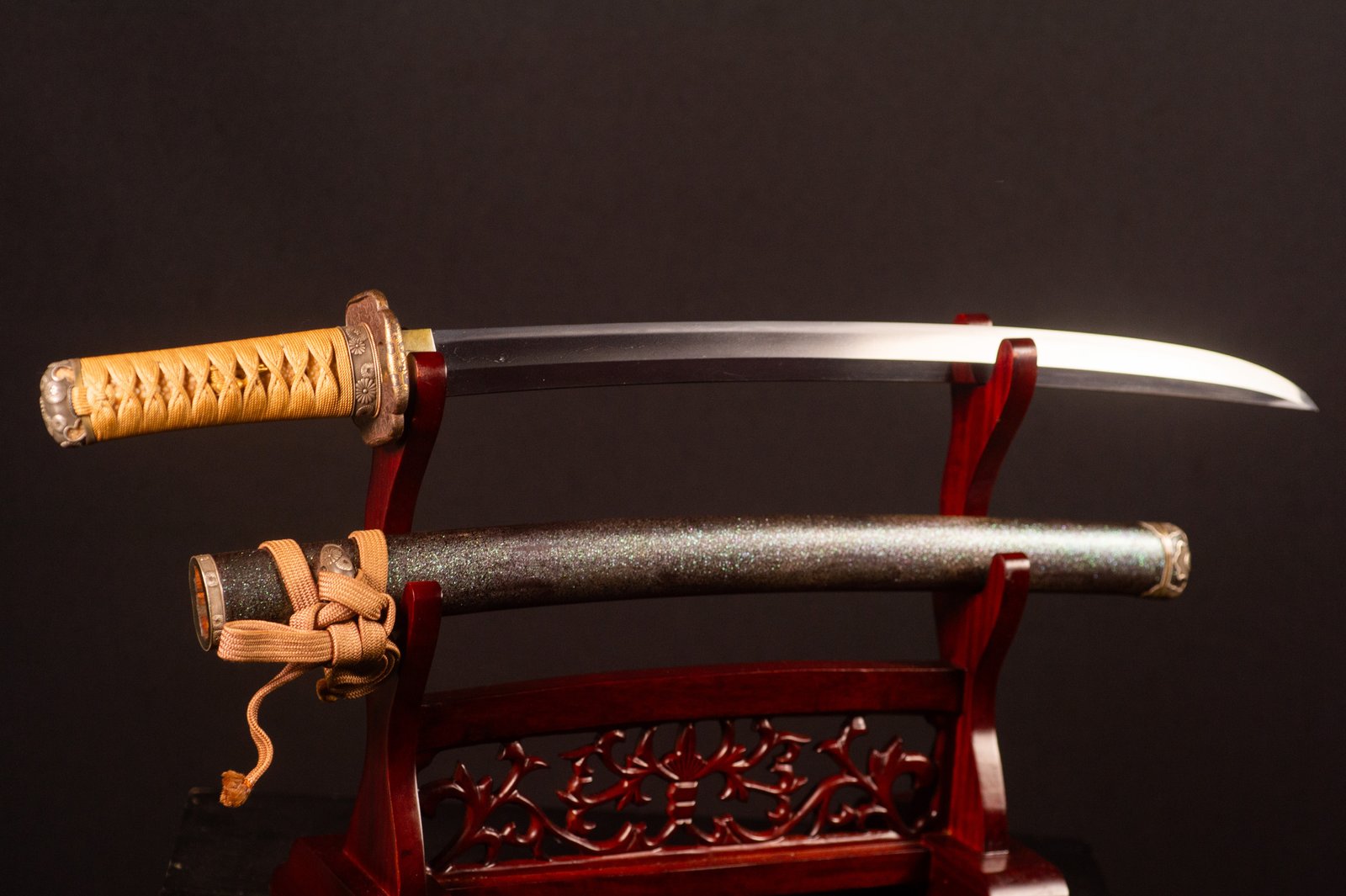
The blade is mounted in an elegant and visually coherent koshirae of above-average quality.
The decorative programme combines warm gold textile, silver fittings, dark lacquer and subtle green iridescence in a refined and highly balanced composition.
The entire mounting follows a consistent floral and geometric vocabulary, creating a particularly sophisticated presentation.
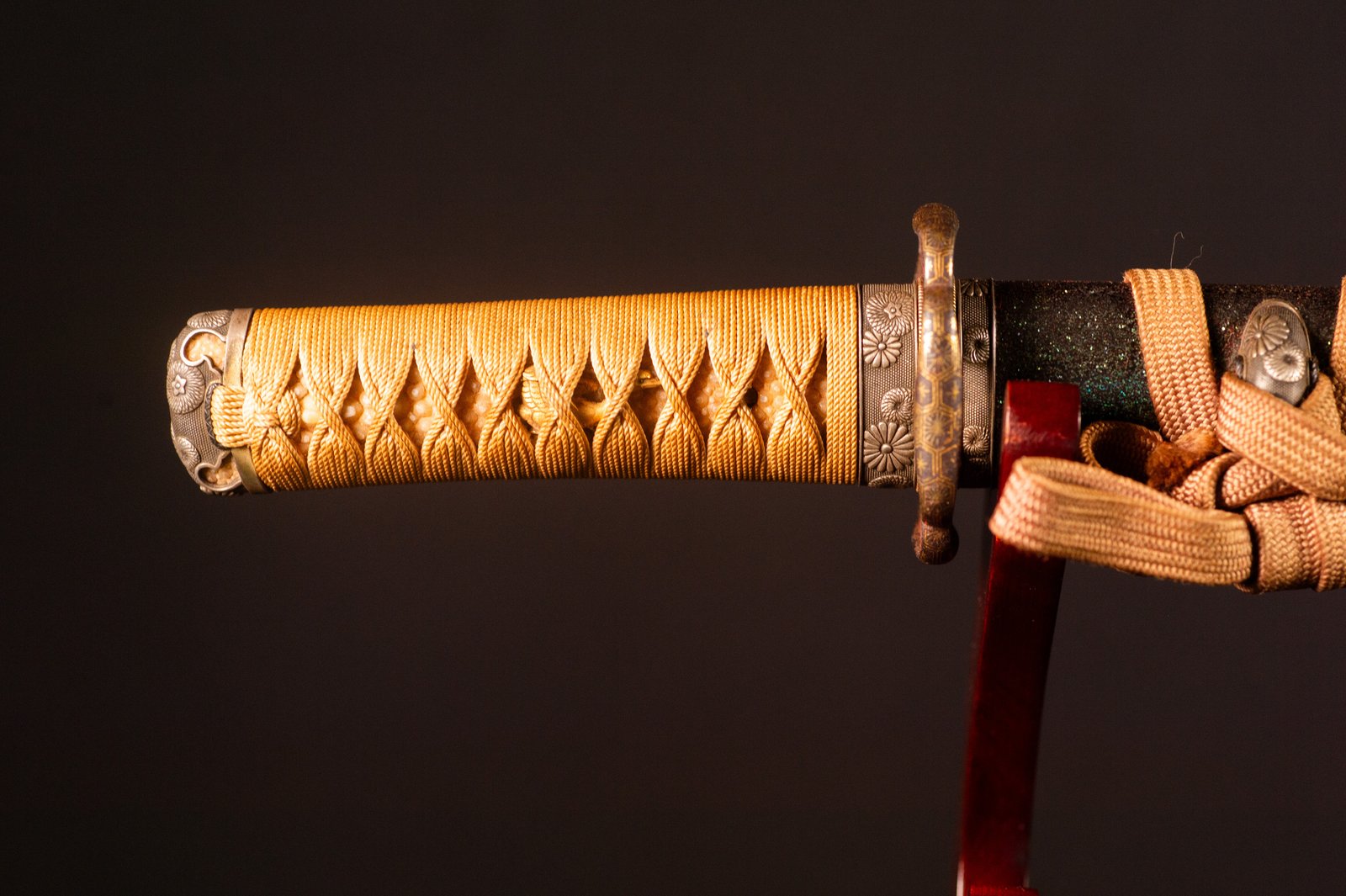
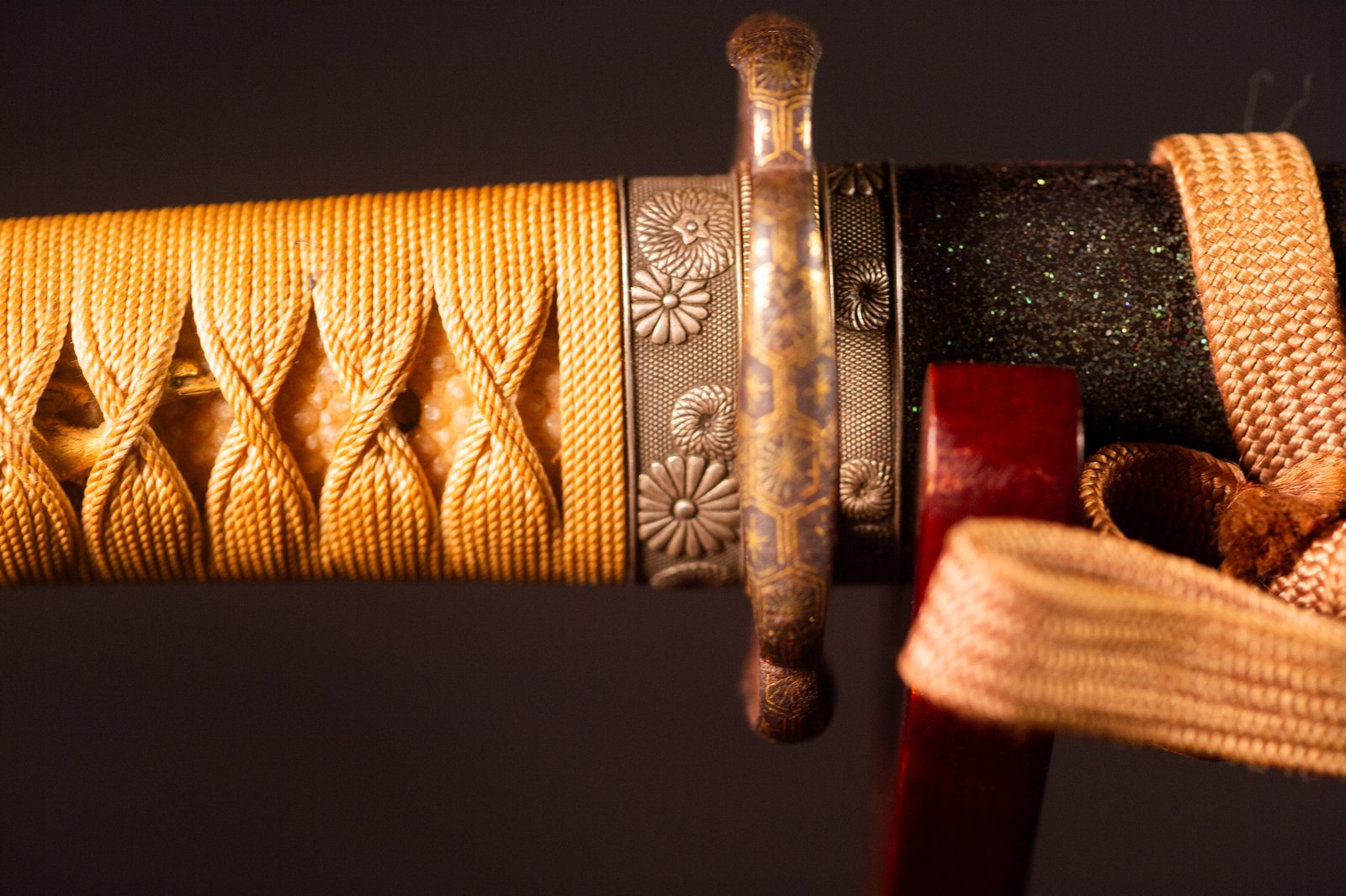
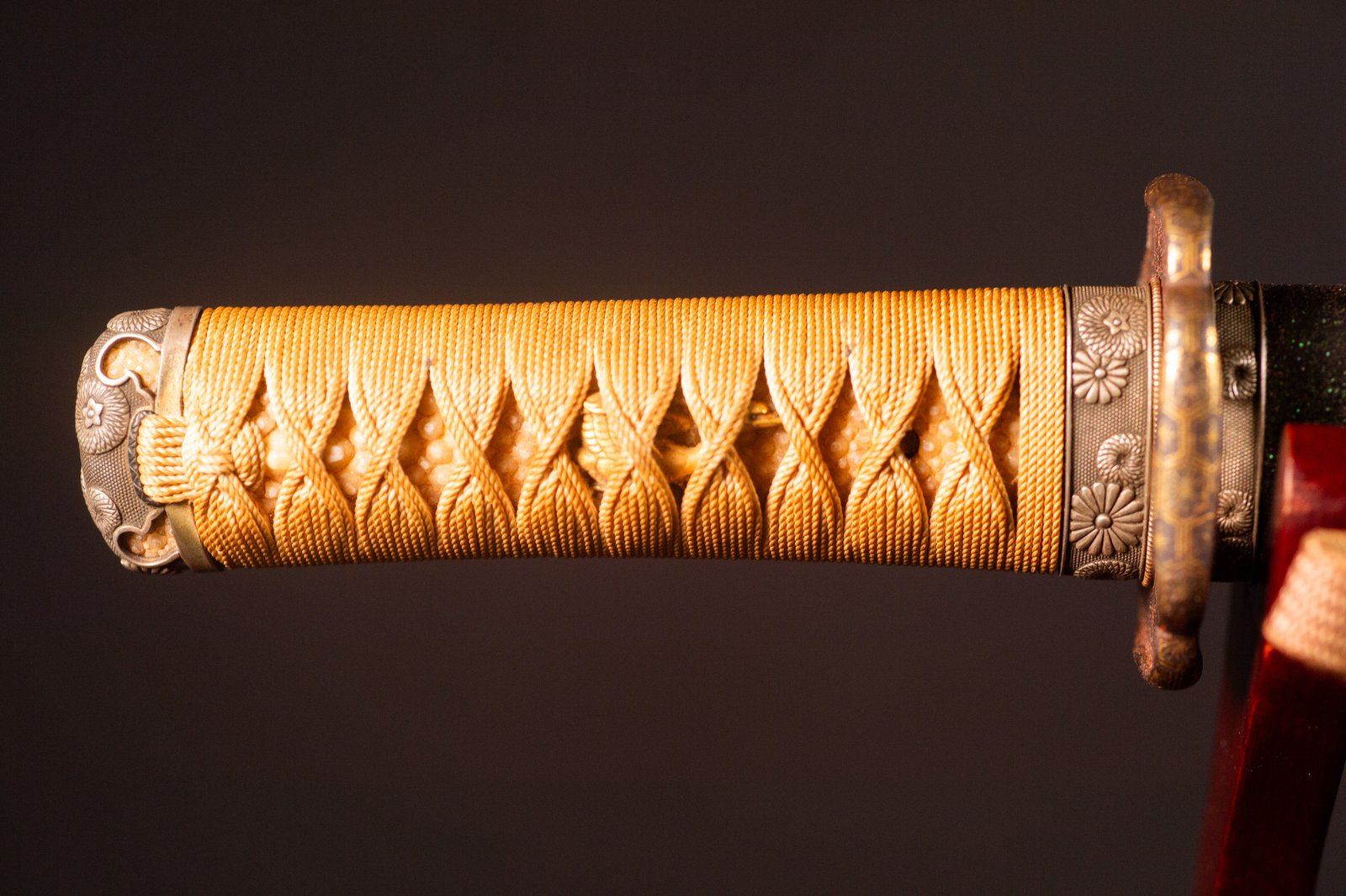
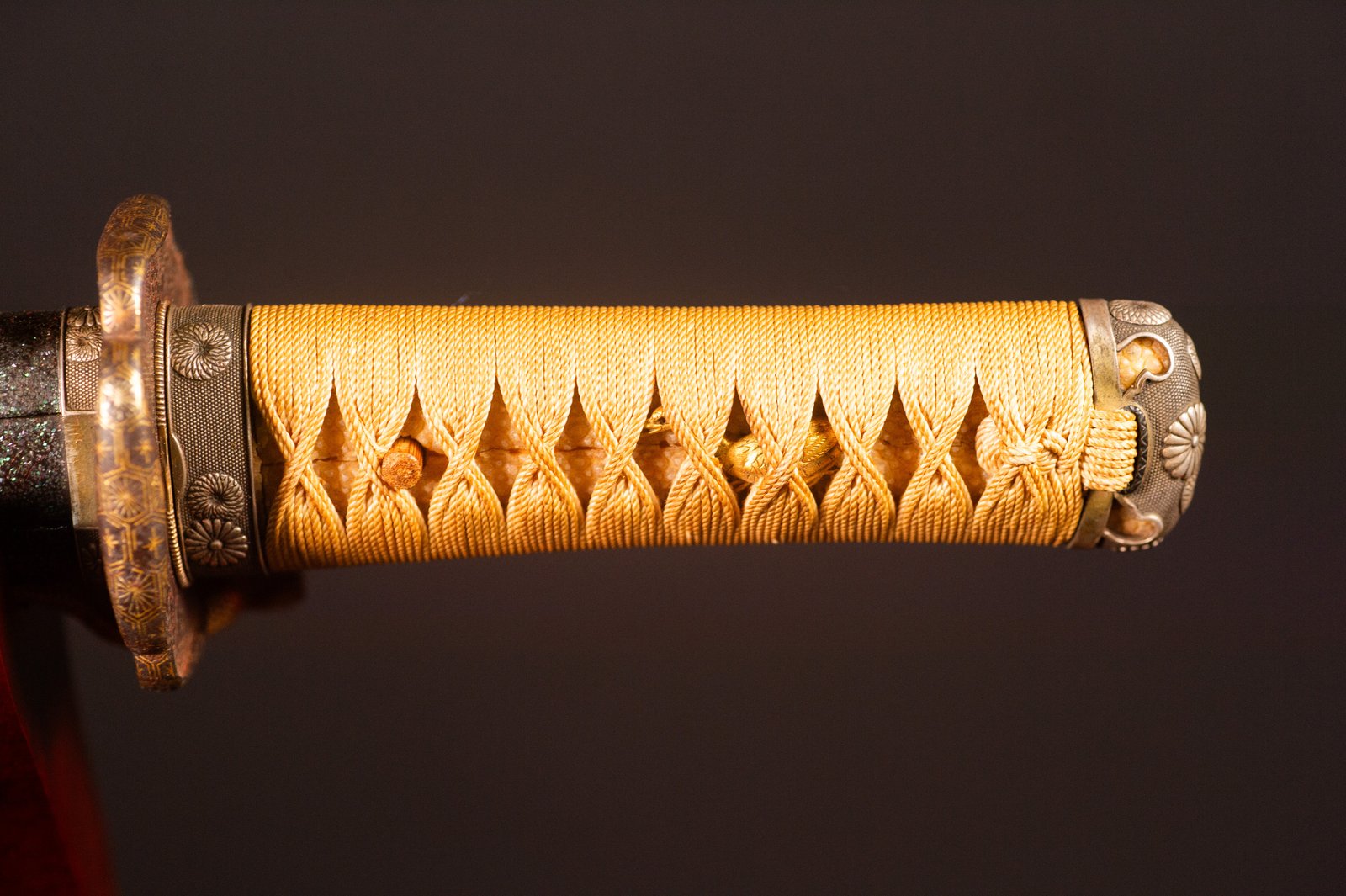
The tsuka is wrapped in warm gold-tan ito over pale samegawa.
The tightly executed wrapping creates a series of regular diamond-shaped openings that reveal the lighter ray skin beneath.
The combination of pale same and golden wrapping gives the handle an unusually luminous appearance compared with the darker colours more commonly encountered on Japanese sword mountings.
The condition remains visually attractive and well integrated with the rest of the koshirae.
Gold-toned menuki are visible through the openings of the tsuka-ito.
Their warm metallic finish complements the golden wrapping while adding subtle sculptural detail to the handle.
Rather than dominating the composition, they appear discreetly between the alternating diamonds of the wrapping.
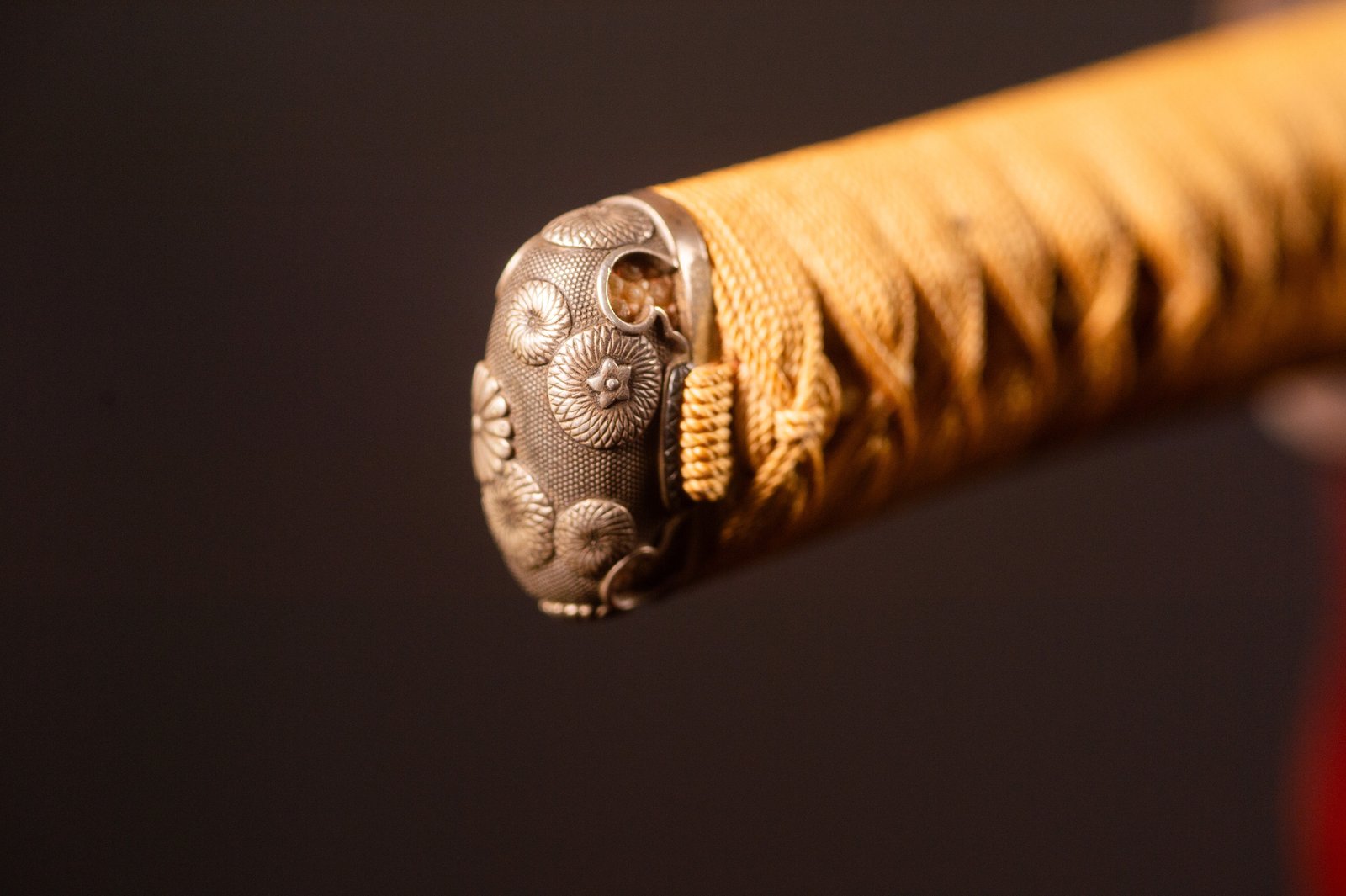
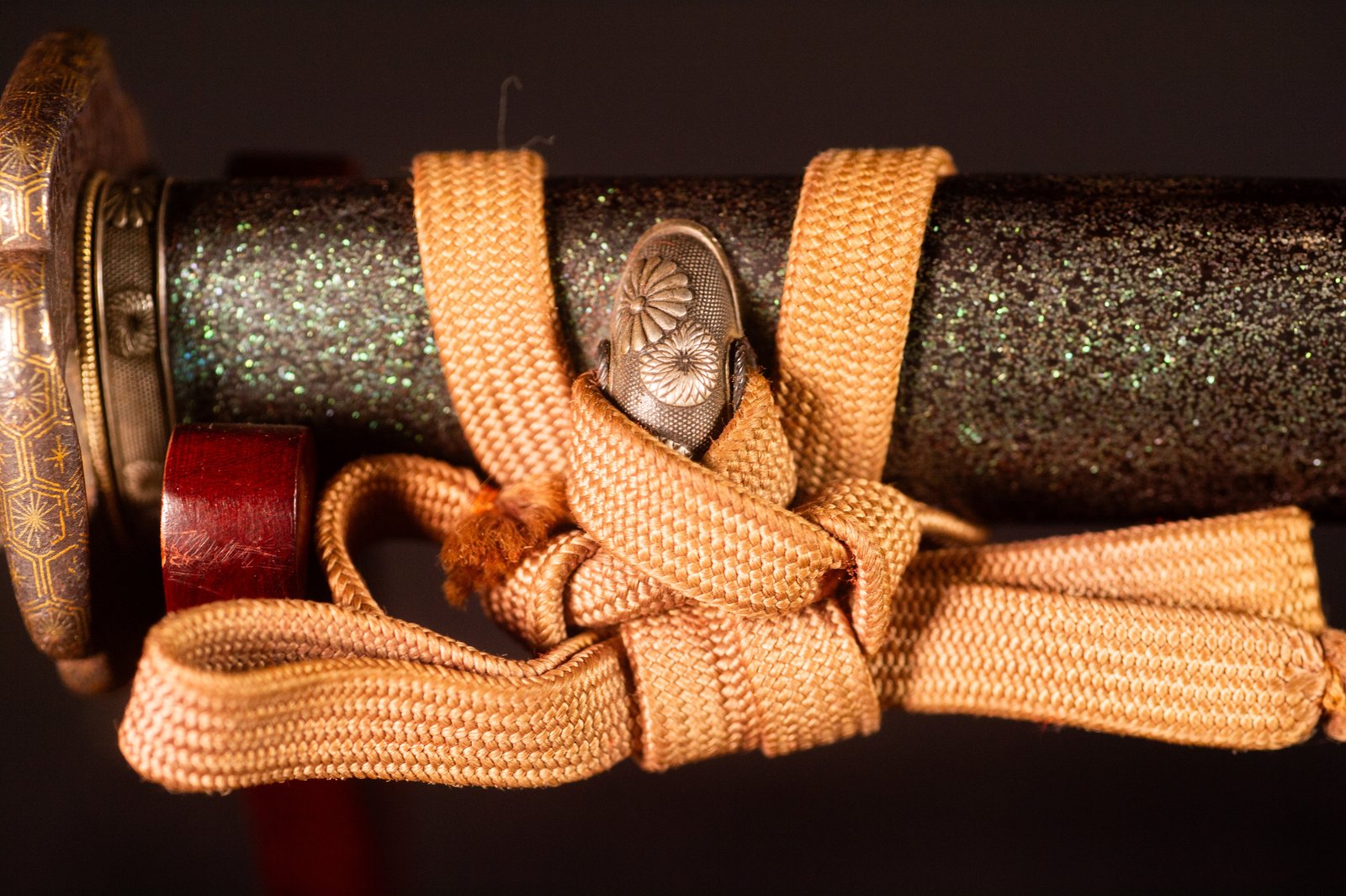
The matched fuchi and kashira are executed in silver-toned metal and decorated with finely modelled chrysanthemum motifs over a textured nanako ground.
The repeated floral medallions create a sophisticated decorative rhythm.
The chrysanthemum is one of the most enduring motifs in Japanese decorative arts and lends the mounting an elegant, formal character.
The matching execution of both fittings reinforces the coherence of the entire ensemble.
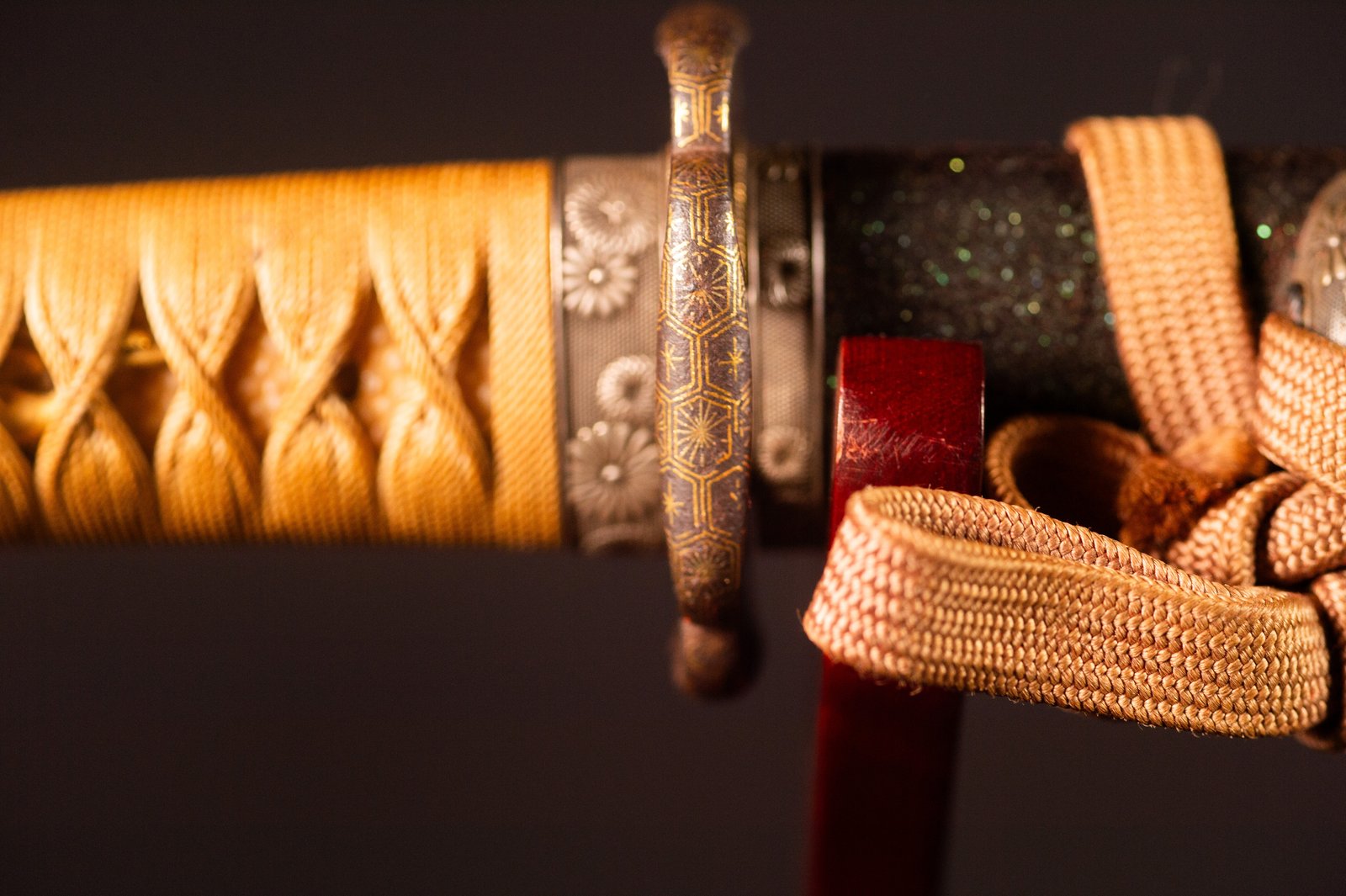
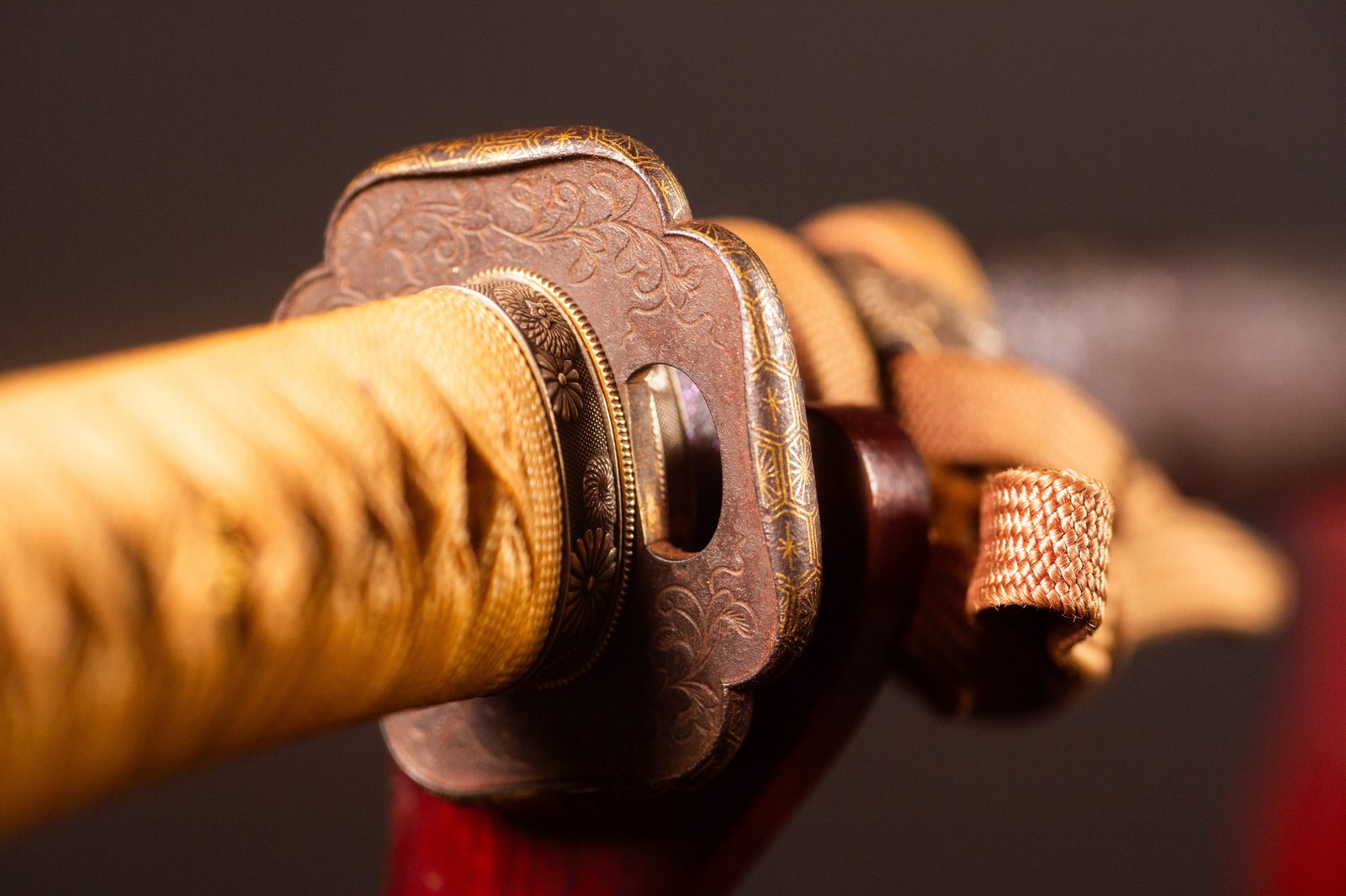
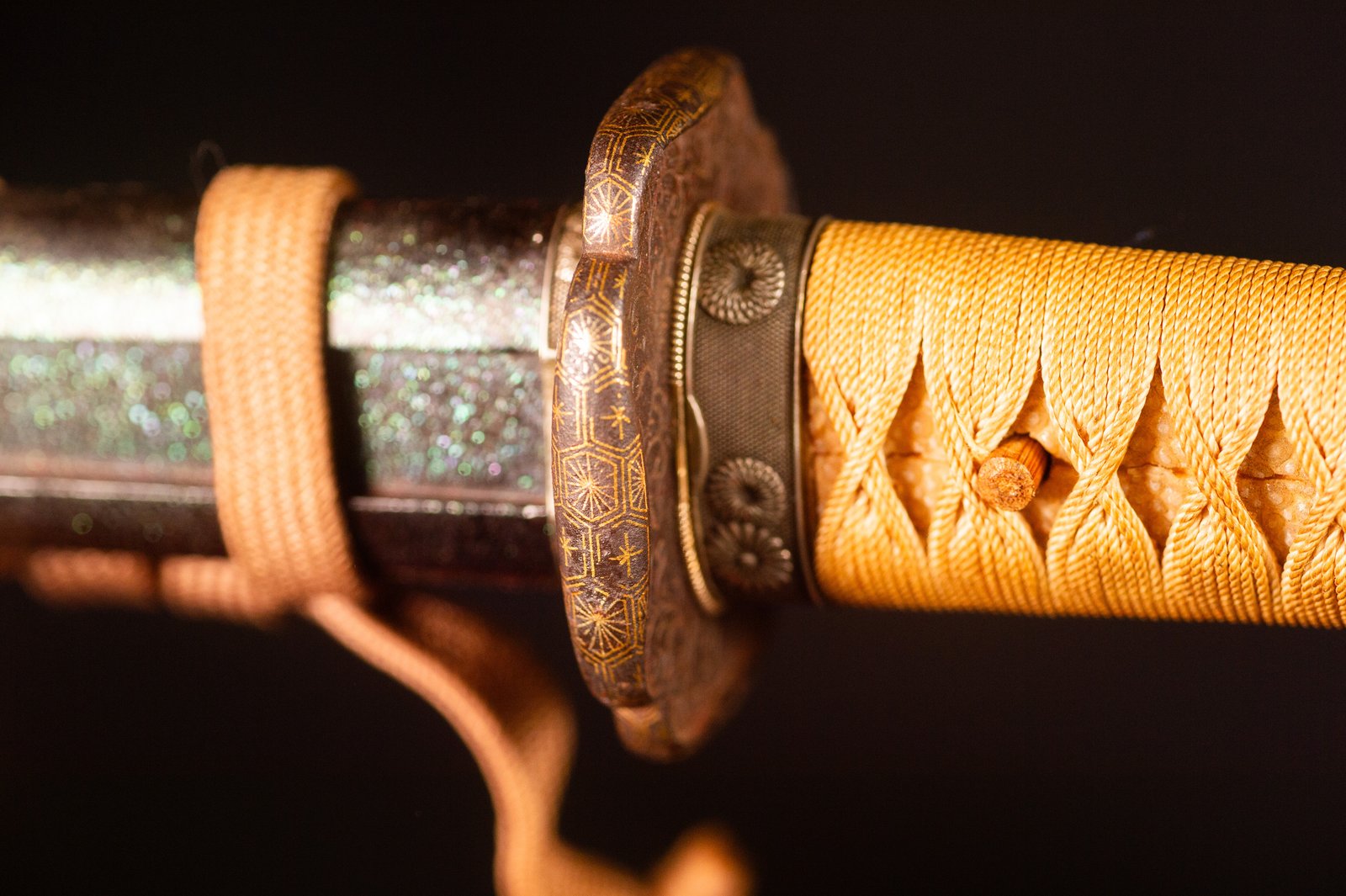
The tsuba is formed in iron in a rounded mokko-inspired shape.
Its surface is decorated with delicate gold nunome-zōgan arranged in a repeating geometric pattern.
The principal motif resembles interlocking hexagonal kikkō forms combined with radiating star-like or floral accents.
The contrast between the aged iron surface and the fine gold inlay is particularly effective.
The decoration is restrained enough to retain the martial character of the iron guard while still providing considerable visual refinement.
The gold decoration on the tsuba is executed in a style associated with nunome-zōgan, in which fine precious-metal inlay is applied to a prepared iron surface.
The technique allows extremely delicate lines and geometric forms to be created while preserving the dark visual character of the underlying iron.
On this guard, the repeating geometric structure creates a sophisticated textile-like effect that harmonises exceptionally well with the fine wrapping and floral silver fittings.
The saya is one of the most visually distinctive elements of the mounting.
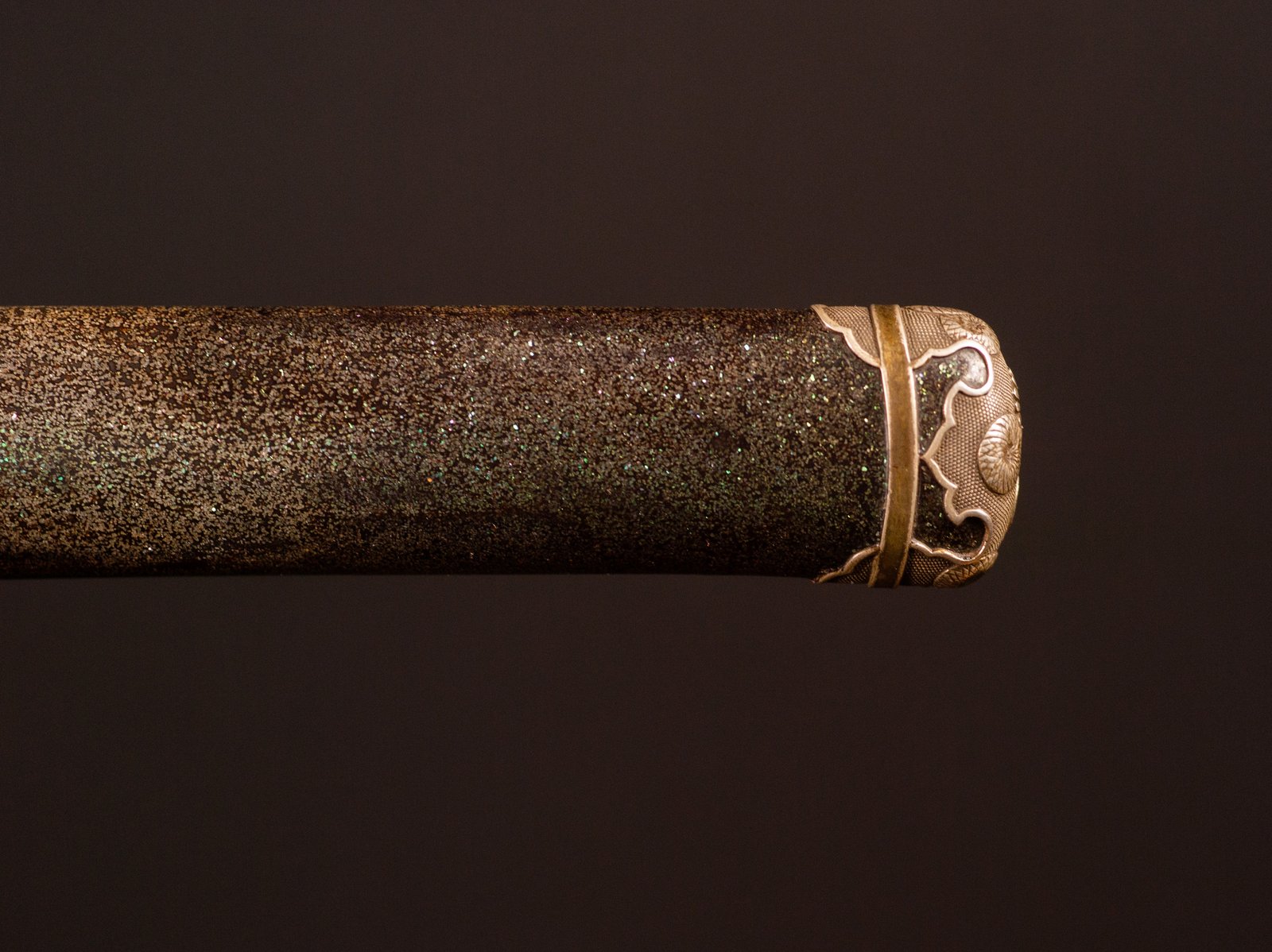
Its dark lacquered surface incorporates a striking green-black speckled finish with metallic inclusions that reflect green, violet and gold tones depending on the direction of the light.
The effect is reminiscent of a night sky scattered with fine points of colour.
This type of kawari-nuri finish gives the otherwise restrained mounting a rich but sophisticated visual depth.
The decoration remains elegant rather than ostentatious and provides an exceptional contrast with the warm gold ito of the handle.
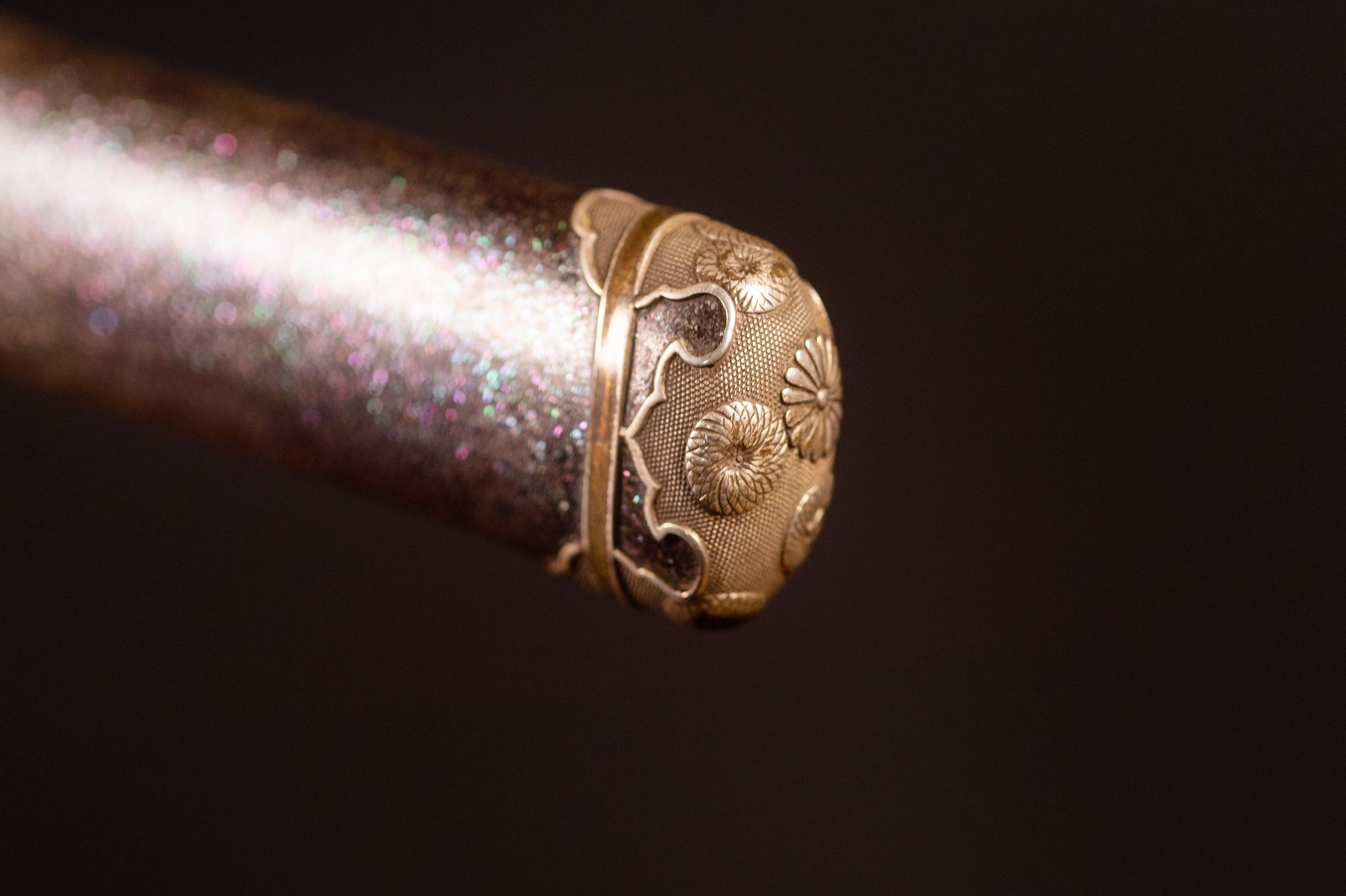
The kojiri continues the silver decorative programme of the handle fittings.
It is decorated with floral motifs and pierced scrollwork that echo the chrysanthemum ornament of the fuchi-kashira.
This continuity from the handle to the end of the scabbard creates a strong sense of unity across the entire mounting.
The silver-toned fitting also provides a clean visual termination to the dark, iridescent lacquer of the saya.
The saya is fitted with a braided cord in a warm tone closely matching the colour of the tsuka-ito.
The sageo is tied in traditional fashion around the mounting.
Its restrained colour contributes to the highly coherent palette of the ensemble, linking the handle wrapping visually with the scabbard.
The blade remains in a condition in which its overall geometry and principal characteristics can be clearly appreciated.
Its hada, temper structure and overall profile remain visible and suitable for study.
The nakago retains its natural historical patina and three mekugi-ana.
The koshirae remains visually coherent, with the gold-toned wrapping, pale samegawa, floral silver fittings, iron tsuba with gold inlay and distinctive iridescent lacquered saya forming a particularly attractive ensemble.
As expected from a sword dating to the early Muromachi period and its later historical mounting, natural signs of age and use should be understood as part of the object’s history.
This sword combines several qualities that make it particularly attractive to collectors of early Japanese blades.
Foremost is its attribution to the Tegai school of Yamato Province, placing the blade within one of the classical traditions of medieval Japanese swordmaking.
Its dating to approximately 1428–1429 places it securely within the early Muromachi period and the historic Koto era.
At approximately 41.8 cm, its unusual length also gives the sword a particularly interesting physical identity, positioned between a long tantō and short wakizashi.
The blade’s itame and masame-nagare structure, restrained suguha and characteristic Yamato-style construction reinforce the coherence of the attribution.
Its documentary history is another important strength.
The 2025 kanteisho provides a modern attribution to Tegai and a Shōchō-era dating, while the original Fukushima torokusho from January 1955 represents an unusually early example of post-war Japanese registration.
The koshirae adds another independent layer of interest.
Its silver floral fittings, warm gold wrapping, pale ray skin, iron mokko-form tsuba with delicate gold nunome-zōgan, and distinctive green-black iridescent kawari-nuri saya create one of the most visually elegant presentations for a sword of this compact format.
A refined and historically significant early Muromachi-period Japanese sword attributed to the Tegai school of Yamato Province, dating to approximately the Shōchō era of 1428–1429. Combining a genuine Koto blade, characteristic Yamato-den workmanship, modern kanteisho, exceptionally early 1955 Japanese registration and a highly coherent koshirae with silver floral fittings, gold nunome-zōgan tsuba and iridescent kawari-nuri saya, this piece offers an outstanding balance of historical depth, documentary interest and visual sophistication.
| Época | Edo |
|---|

Order above 1.000,00 € gets free shipping.

Secure and hassle-free payment process.

Certificate of authenticity included.

Have questions? Contact us via WhatsApp.
Contact