

1 in stock
1 in stock
Add to Compare
Add to Wishlist
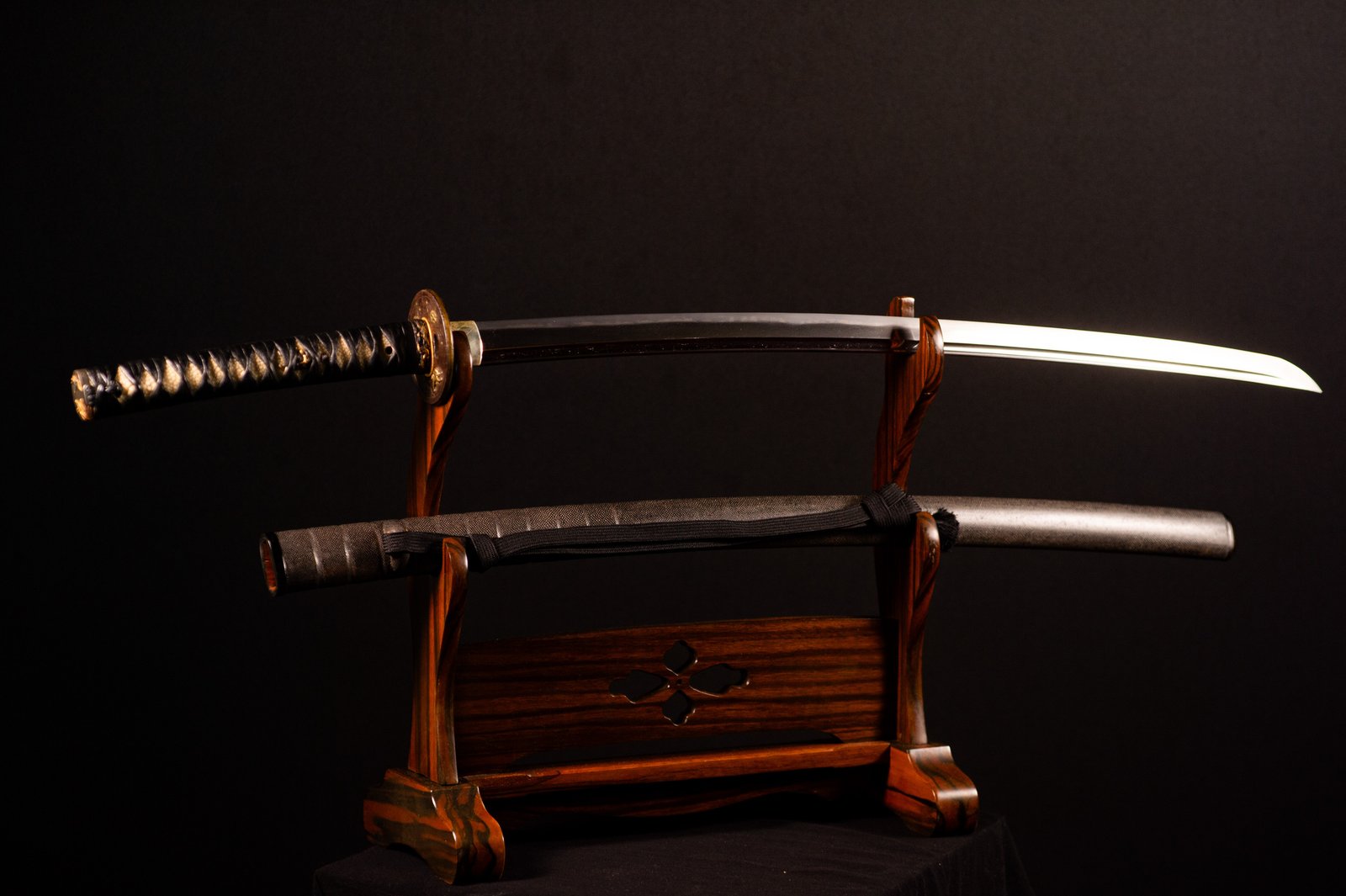
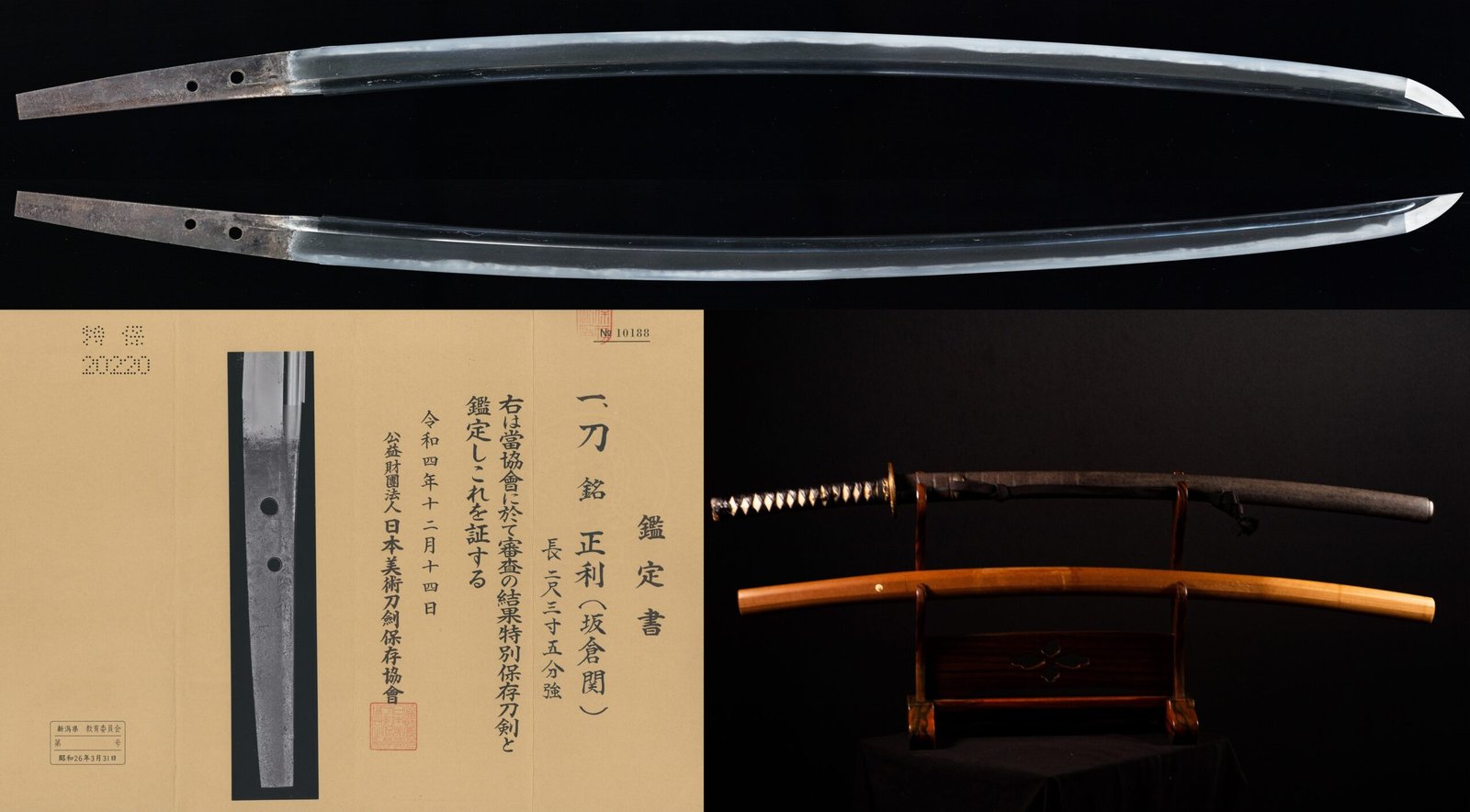
An exceptional Japanese katana signed 正利 – Masatoshi, attributed to the Sakakura Seki school, a distinctive branch of the Mino tradition active during the late Muromachi period. Dating to approximately 1532–1558, the blade represents the practical and highly effective swordmaking tradition for which the Seki smiths became renowned, combining strong steel, refined forging and an active temper pattern.
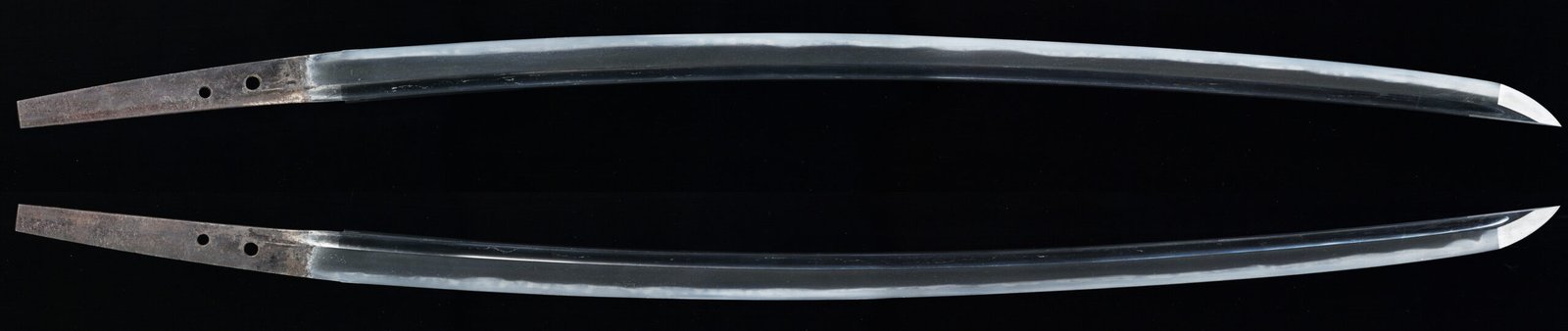
The blade has a substantial nagasa of approximately 71.2 cm — 2 shaku 3 sun 5 bu strong — giving it the proportions and visual presence of a full-length battlefield katana.
Its finely worked ko-itame hada, clear and active nioi-guchi, classical kissaki and gently returning boshi demonstrate the disciplined workmanship associated with high-quality Mino blades.
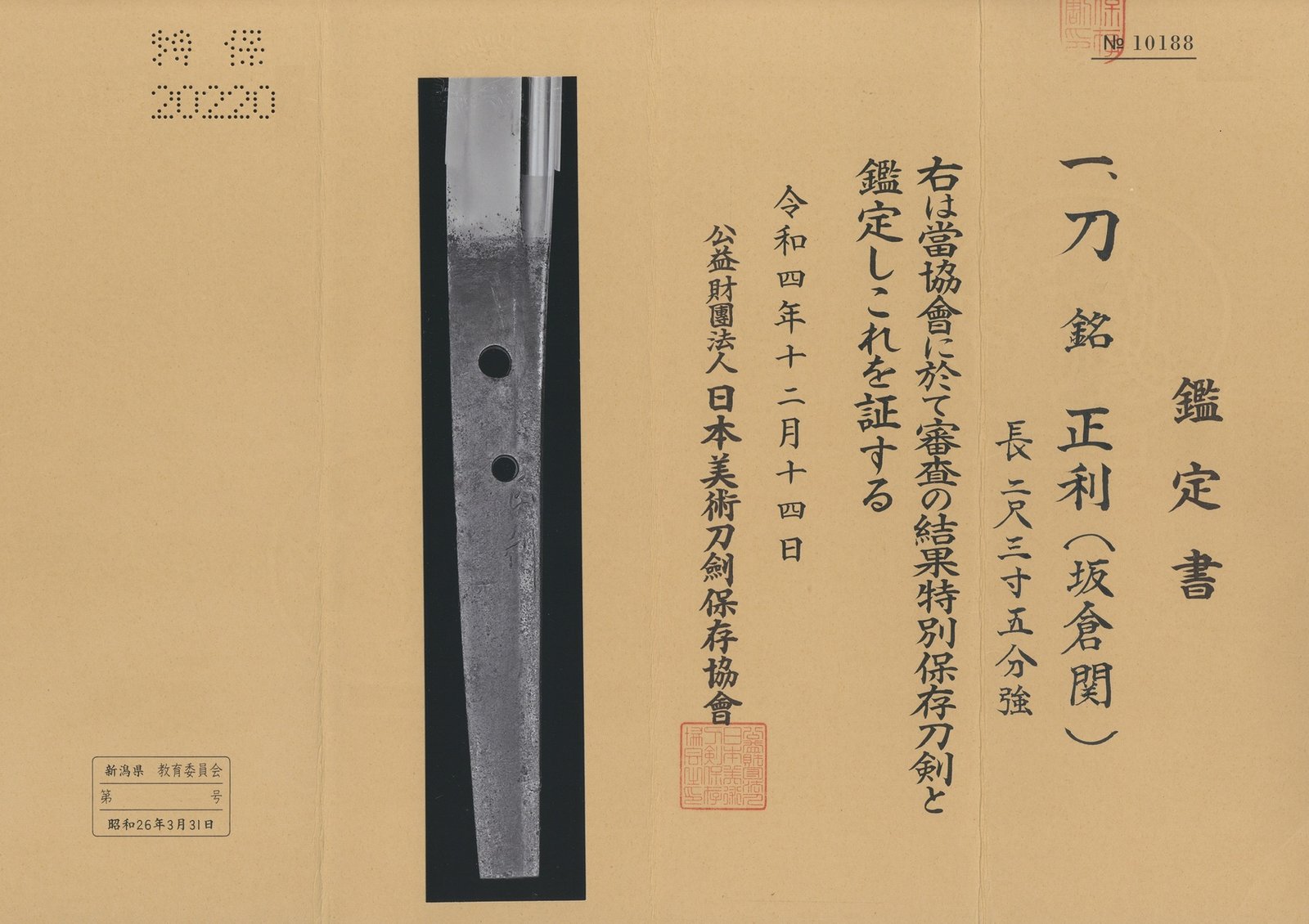
The sword is particularly important for its documentation. It is accompanied by a NBTHK Tokubetsu Hozon Tōken certificate issued in December 2022, authenticating the signature and recognising the blade within the prestigious Tokubetsu Hozon category.
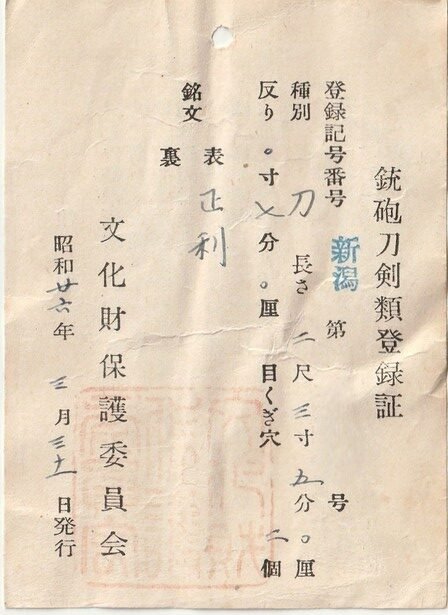
Also included is its original Japanese torokusho, issued by Niigata Prefecture in 1951, providing documented post-war provenance extending back more than seventy years.
The blade is completed by a coherent traditional koshirae retaining period fittings decorated with auspicious and martial imagery, including Daikokuten, dragons, birds, floral motifs and a shishi. A dedicated natural-wood shirasaya is also included for long-term preservation of the blade.
The blade is signed Masatoshi 正利, a smith associated with the Sakakura Seki school of the Mino tradition.
Masatoshi was the son of Sakakura Masayoshi and worked not in Seki itself, but in the nearby settlement of Sakakura, situated along the road facing the Kiso River.
This geographical distinction gave rise to the designation Sakakura Seki, identifying a group of smiths related to the broader Seki tradition but sufficiently distinct to be recognised as their own branch.
The Seki schools became renowned during the Muromachi period for producing reliable and effective swords intended for practical use during an era of almost continuous military conflict.
Masatoshi’s work belongs to this environment, but Japanese sources distinguish him from the broader mass of Seki production and describe his workmanship as having developed ahead of many mainstream Seki smiths of his generation.
One particularly interesting aspect of Masatoshi’s work is the visual and technical relationship with the famous Muramasa school of Ise.
The character 正 in Masatoshi’s signature has been noted for its resemblance to the form used by Muramasa smiths.
A degree of technical exchange between the two traditions is generally accepted, reflecting the close geographical and professional connections that existed between regional swordmaking communities.
The gunome-midare patterns encountered in Masatoshi’s nioi-deki work reinforce this comparison.
This relationship should not be interpreted as identifying Masatoshi as a Muramasa smith, but rather as evidence of the broader technical exchange that characterised sword production in central Japan during the late Muromachi period.
The blade bears the signature:
正利
Masatoshi
The signature identifies the smith whose work is associated with the Sakakura Seki branch of the Mino tradition.
The authenticity of the signature has been examined and accepted by the NBTHK, which issued the blade its current Tokubetsu Hozon Tōken certification.
For the collector, this represents an important distinction: the attribution is not merely based on stylistic comparison but is supported by contemporary Japanese specialist certification.
The blade has a nagasa of approximately 71.2 cm, traditionally recorded as 2 shaku 3 sun 5 bu strong.
This substantial length places the sword firmly within the full-sized katana category.
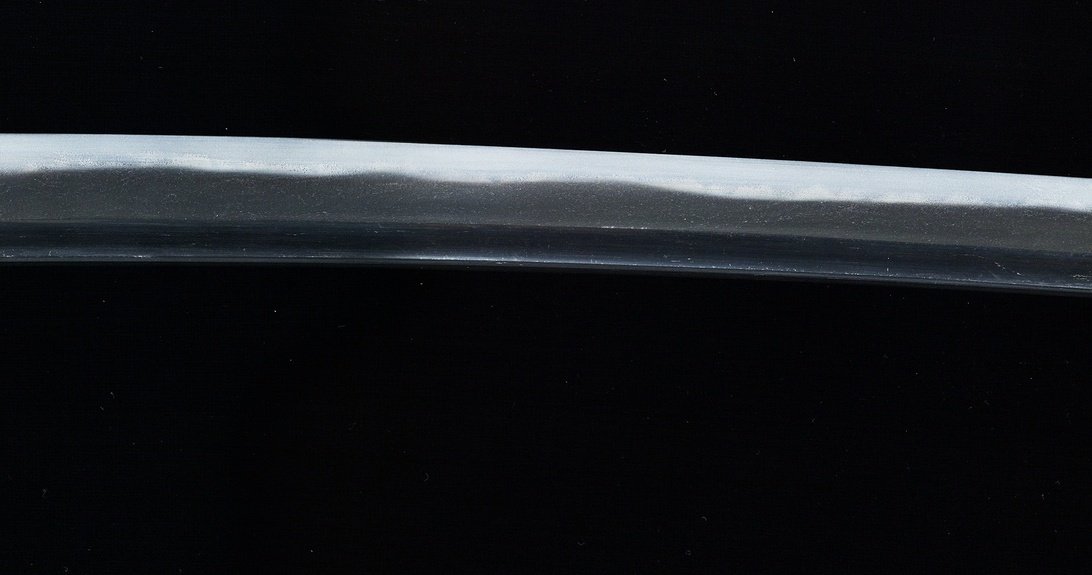
The blade possesses a well-balanced sori, giving the overall sugata an elegant curvature without compromising its powerful martial character.
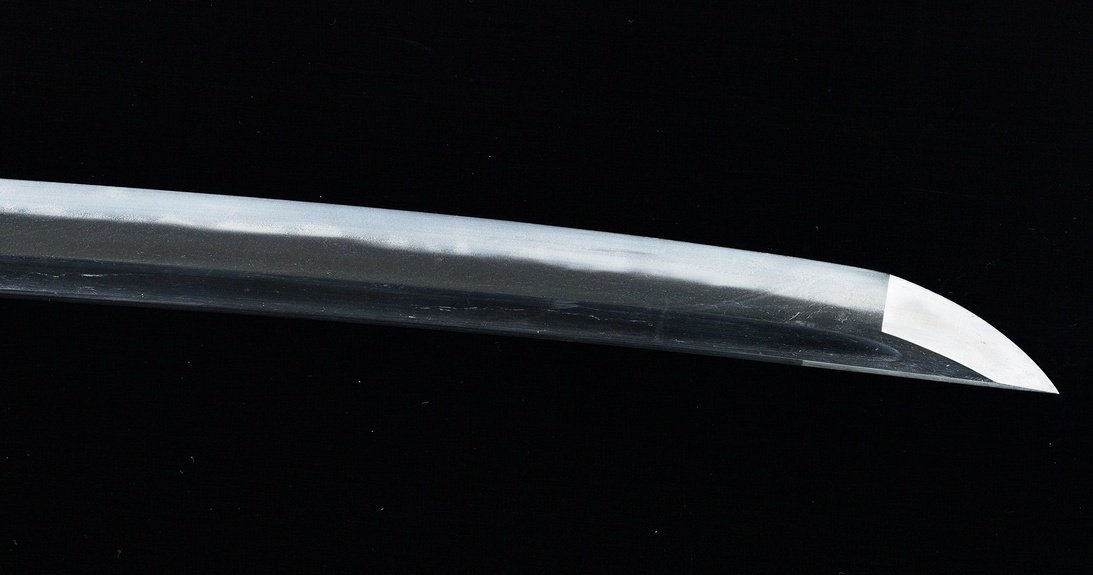
The kissaki is classically proportioned and remains free from visible chips or major damage.
The overall geometry presents the disciplined and functional silhouette expected from a serious fighting sword of the late Muromachi period.
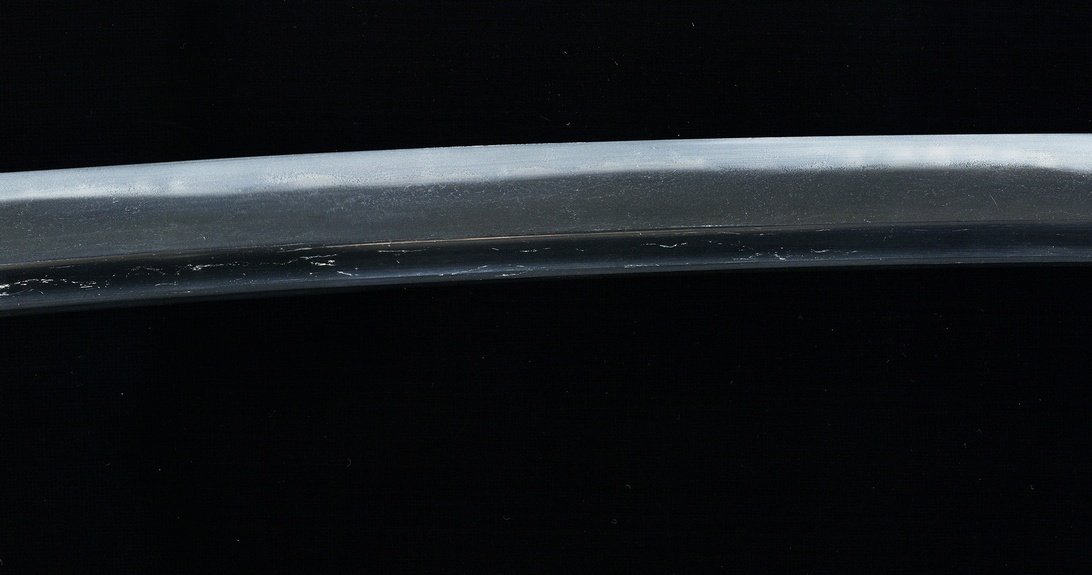
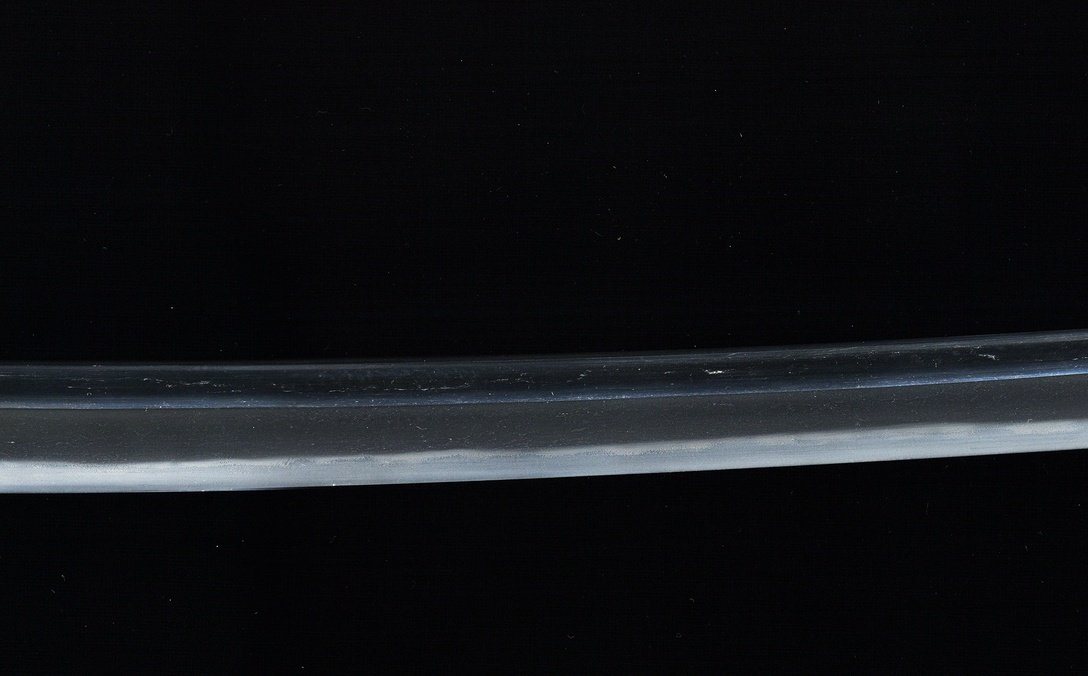
The forging pattern is described as a fine and dense ko-itame hada.
The grain is compact and carefully worked, creating a refined steel surface rather than an overly coarse or visually exaggerated pattern.
This tightly controlled forging is consistent with the reputation of the Mino tradition for producing strong, dependable blades while still maintaining a high standard of craftsmanship.
The subtle texture becomes most apparent under directional lighting, where the structure of the steel can be appreciated across the polished surface.
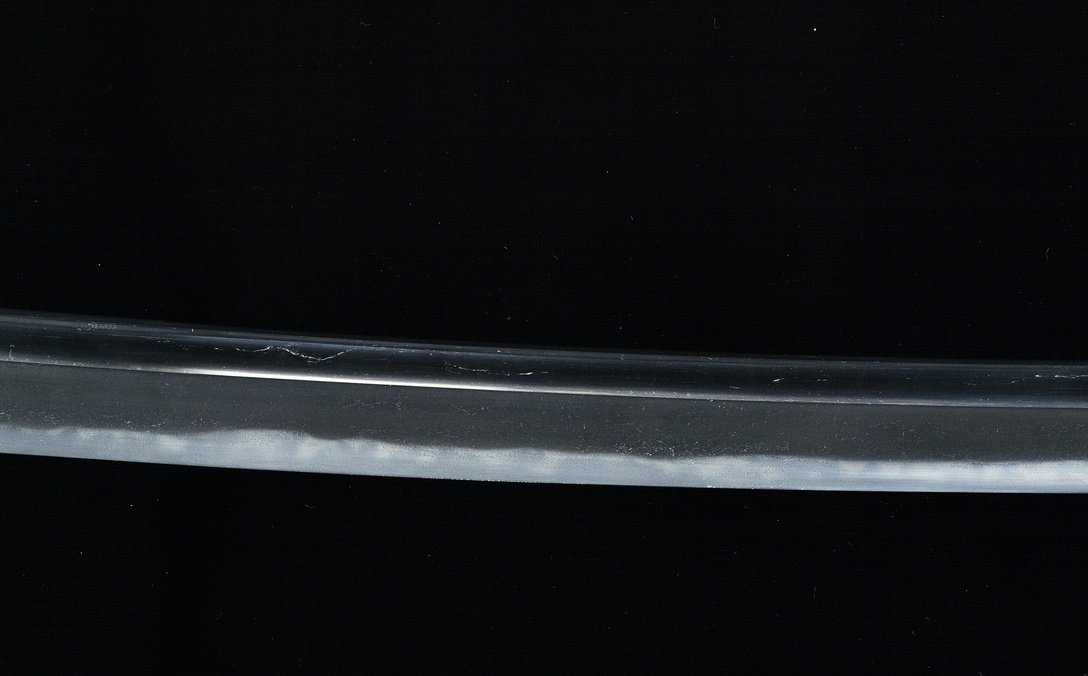
The blade presents a clear and active hamon with a well-defined nioi-guchi.
Masatoshi’s work is associated with nioi-deki tempering and dynamic gunome-midare, characteristics that connect his work both to the Mino tradition and to the technical influences shared with neighbouring schools.
The temper line provides visual movement across the blade without overwhelming the disciplined overall geometry.
Its activity contributes substantially to the character of the sword and represents one of the principal areas of appreciation when examining the blade under suitable lighting.
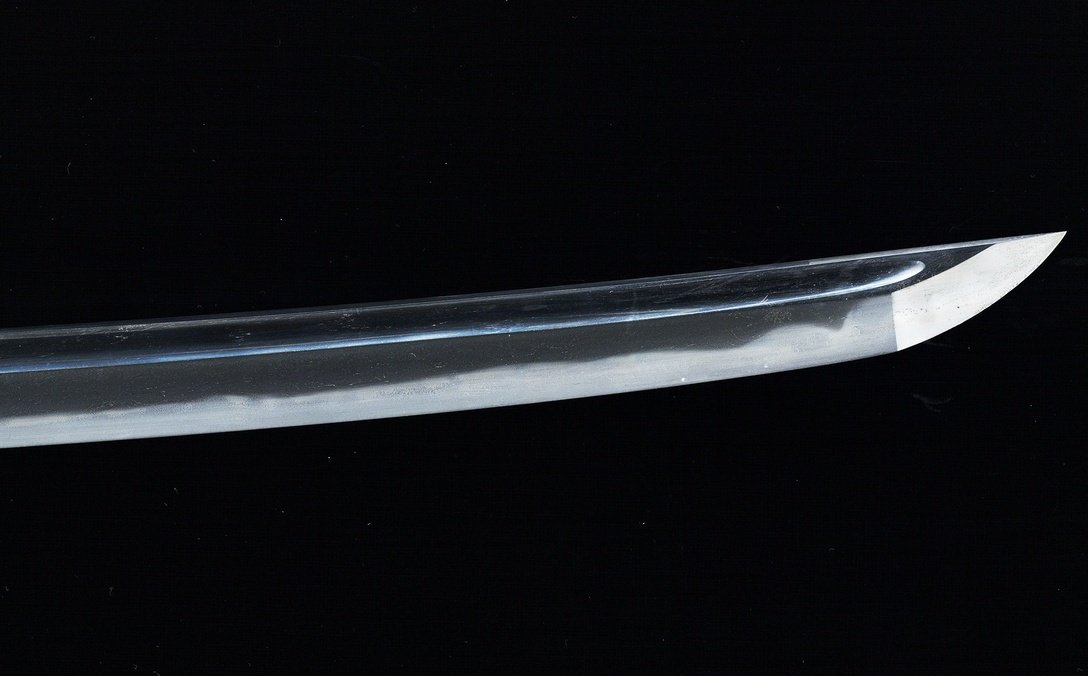
The kissaki maintains classical proportions and forms a balanced conclusion to the overall sugata.
The hamon continues into the point to form the boshi, which returns in a gentle curve.
This controlled return gives the point a restrained and elegant character consistent with the disciplined workmanship visible throughout the rest of the blade.
The absence of visible chips or major damage around the point further contributes to the overall integrity of the sword.
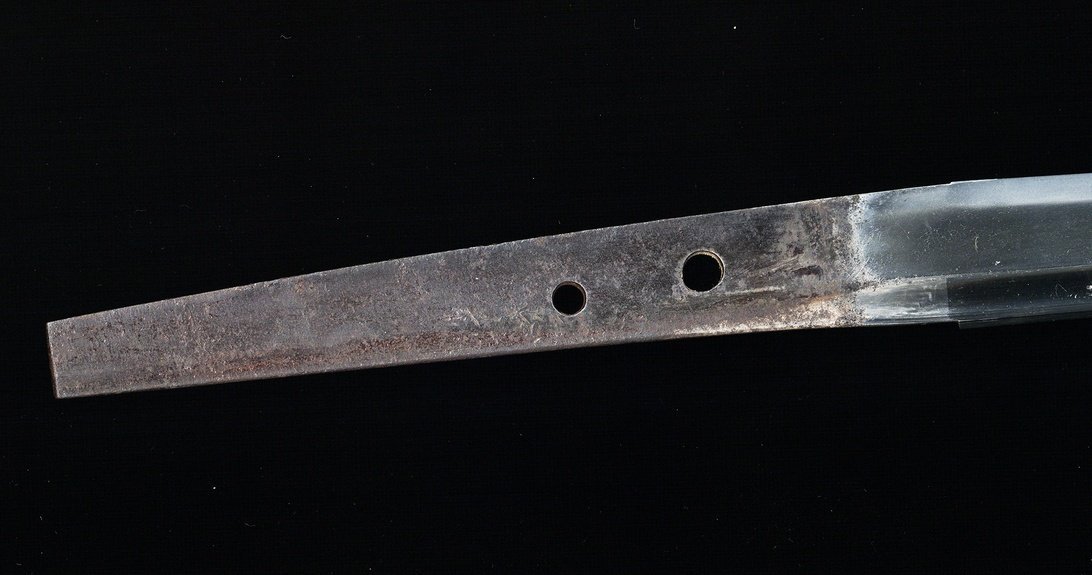
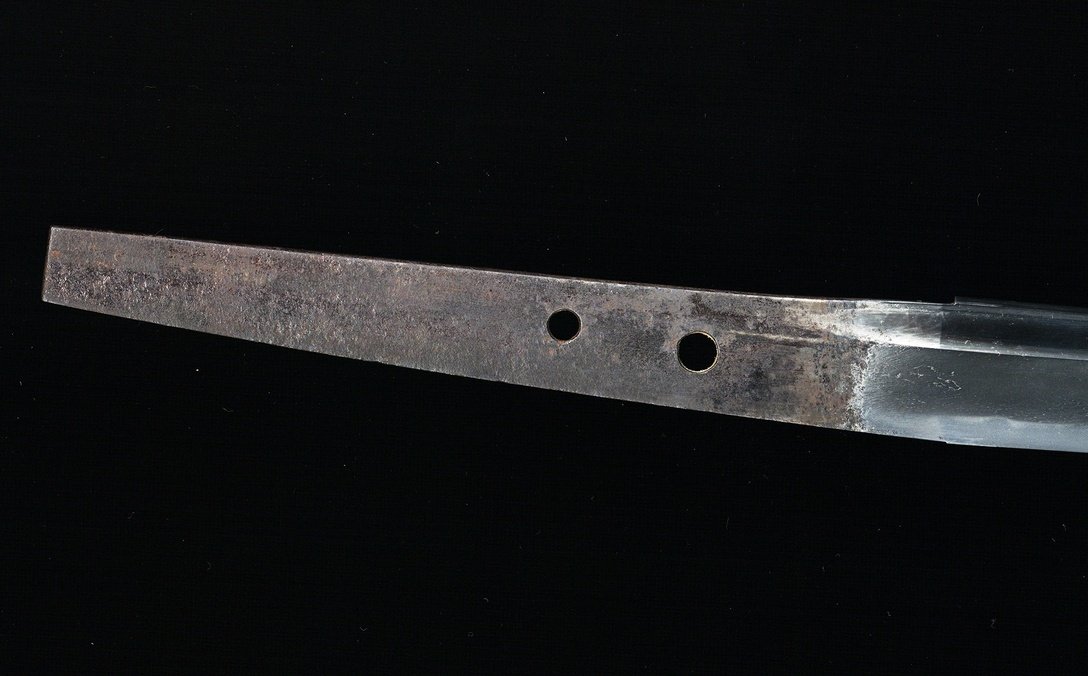
The nakago retains a dark and even historical patina consistent with the age of the blade.
It displays two mekugi-ana, documenting changes in mounting during the sword’s long history.
The aged surface should be regarded as an essential part of the blade’s historical integrity and should not be cleaned or altered.
The preservation of the signed nakago, together with its established patina, provides one of the most direct physical connections with the sword’s manufacture during the Muromachi period.
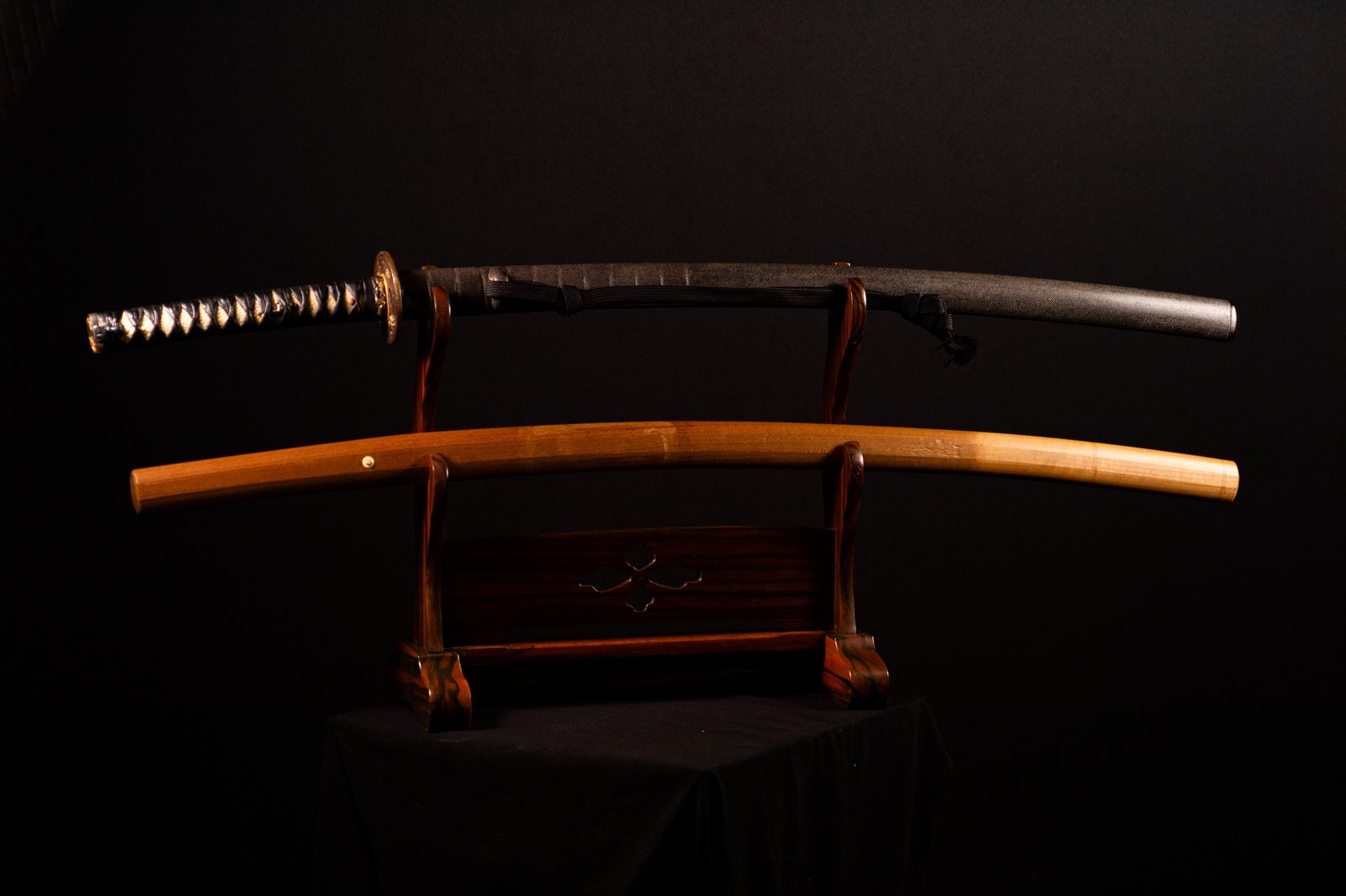
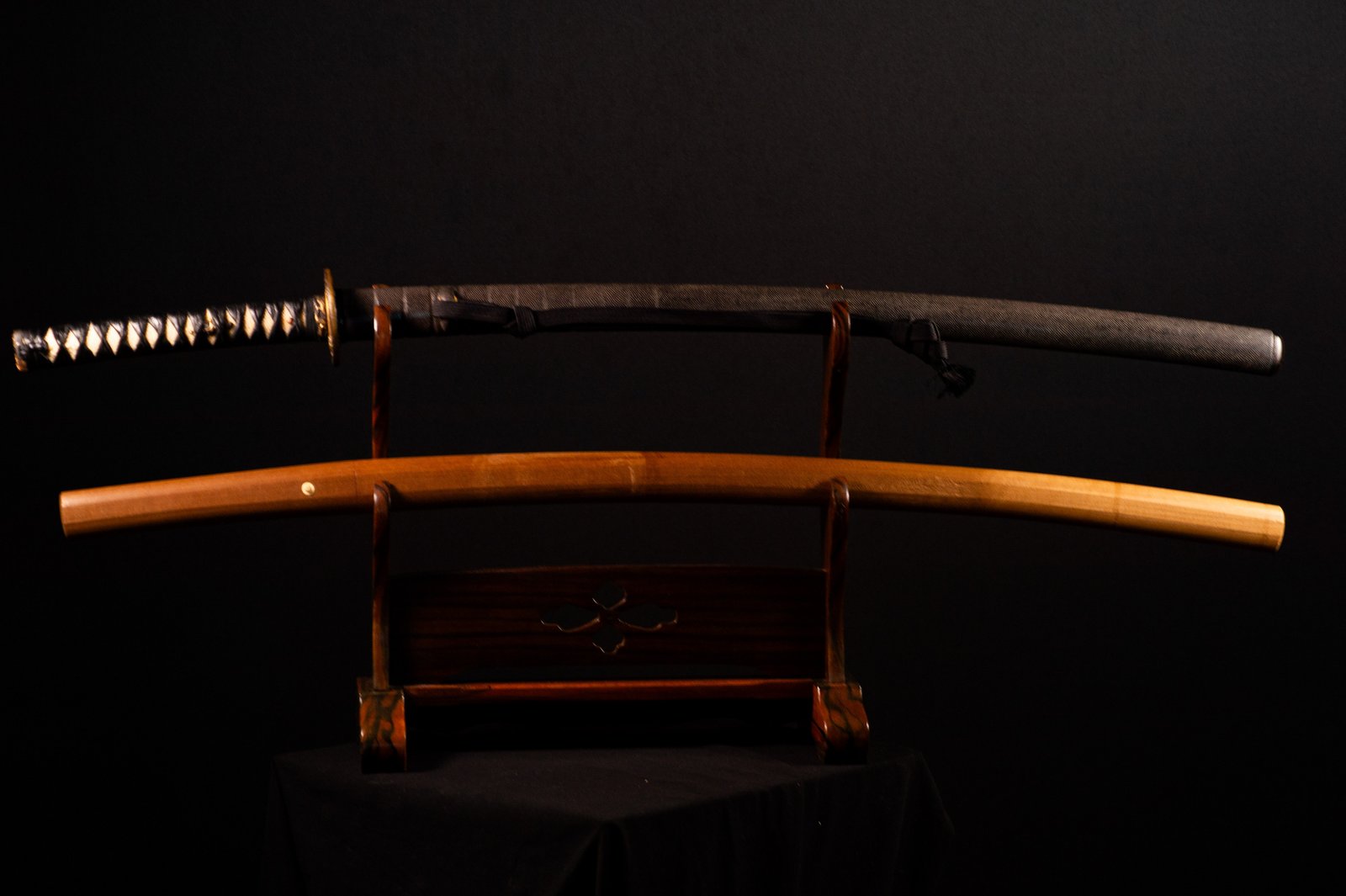
The katana is accompanied by a coherent traditional koshirae retaining period fittings.
Rather than presenting unrelated decorative elements, the mounting combines auspicious, religious and martial imagery characteristic of Japanese sword furniture.
Dark metal surfaces, gilt highlights, black wrapping and the textured saya create a sophisticated visual composition that complements the historical character of the blade.
The quality and variety of the fittings give the mounting significant independent interest in addition to its function as the traditional presentation of the sword.
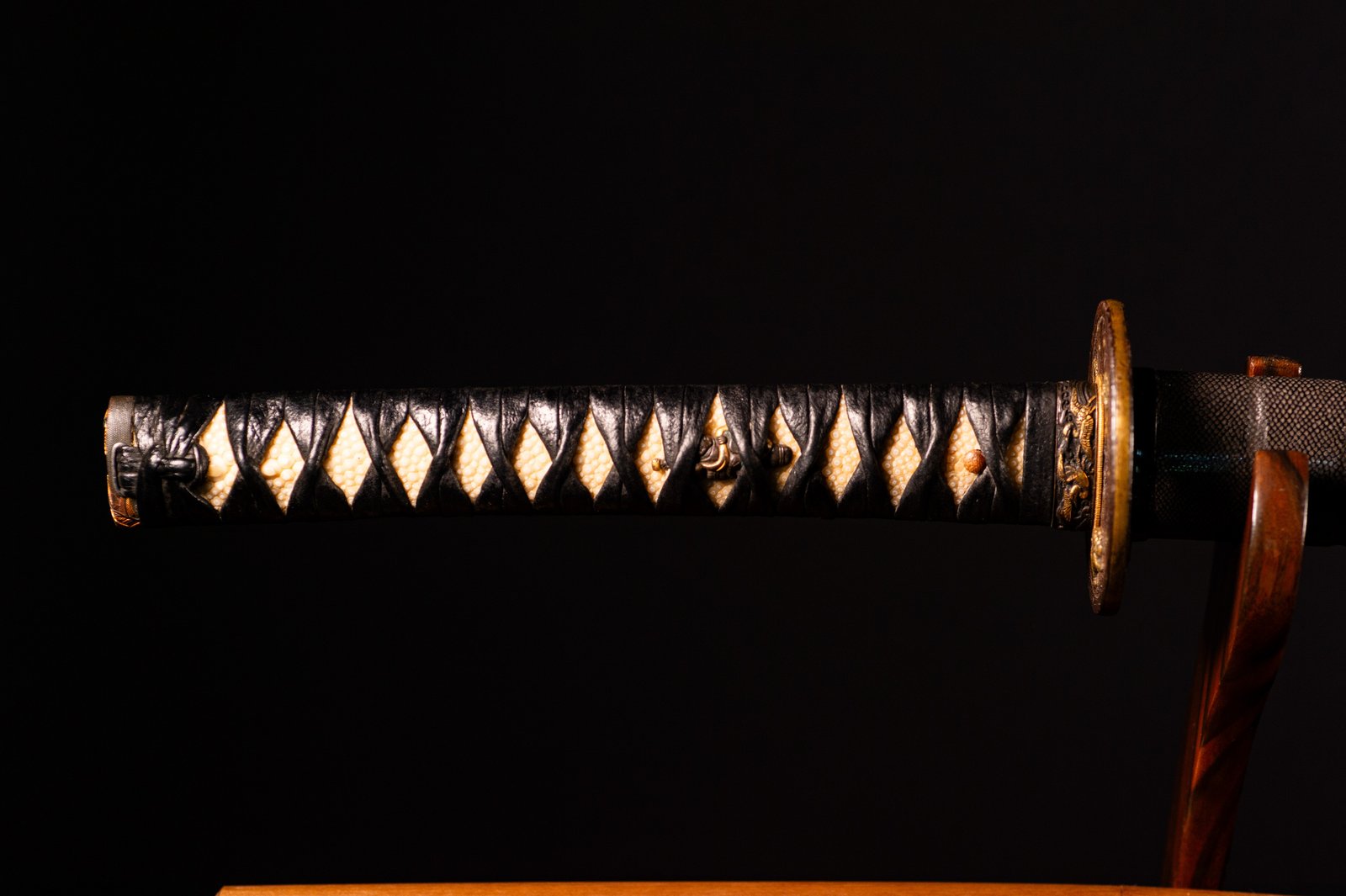
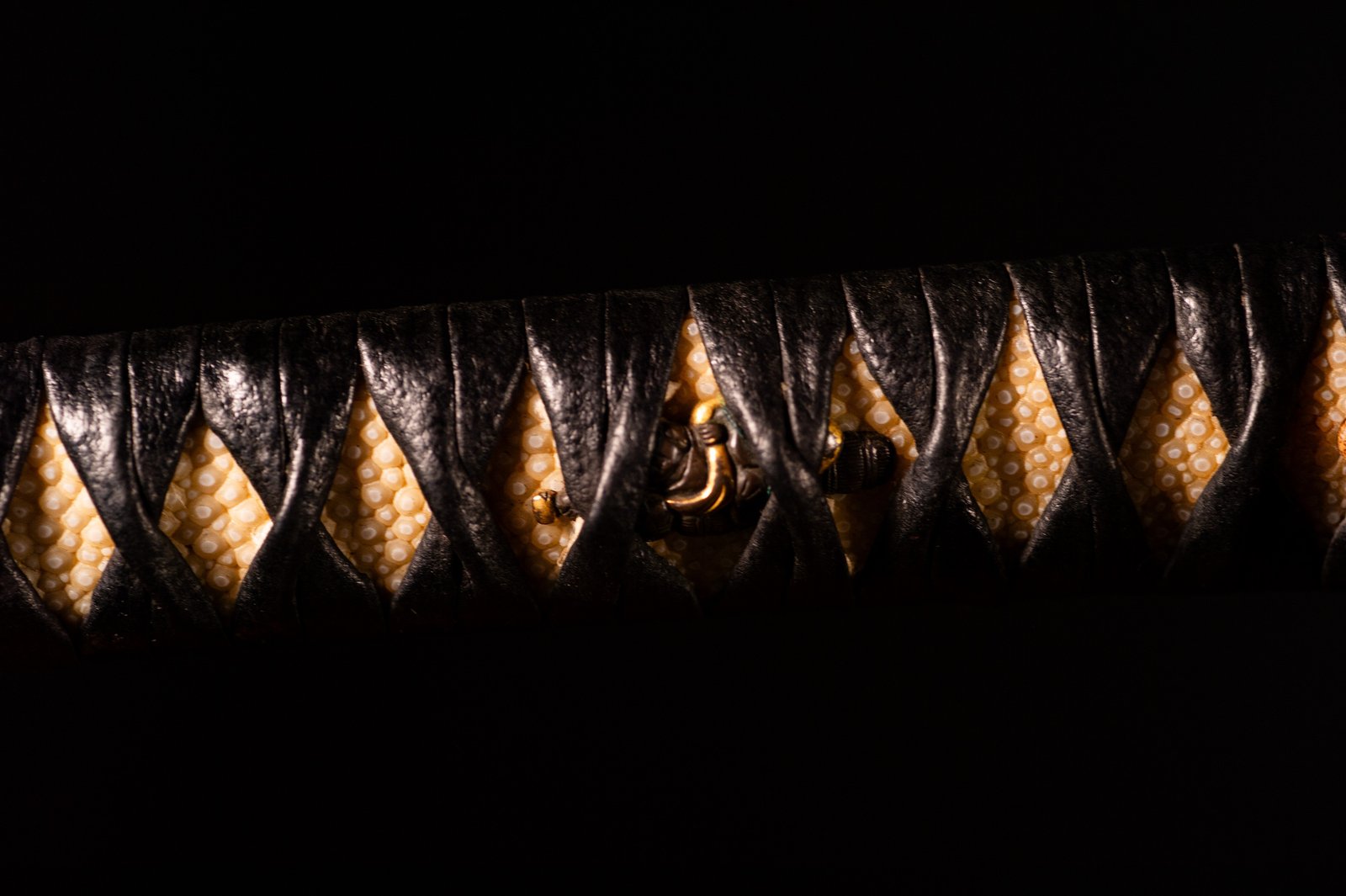
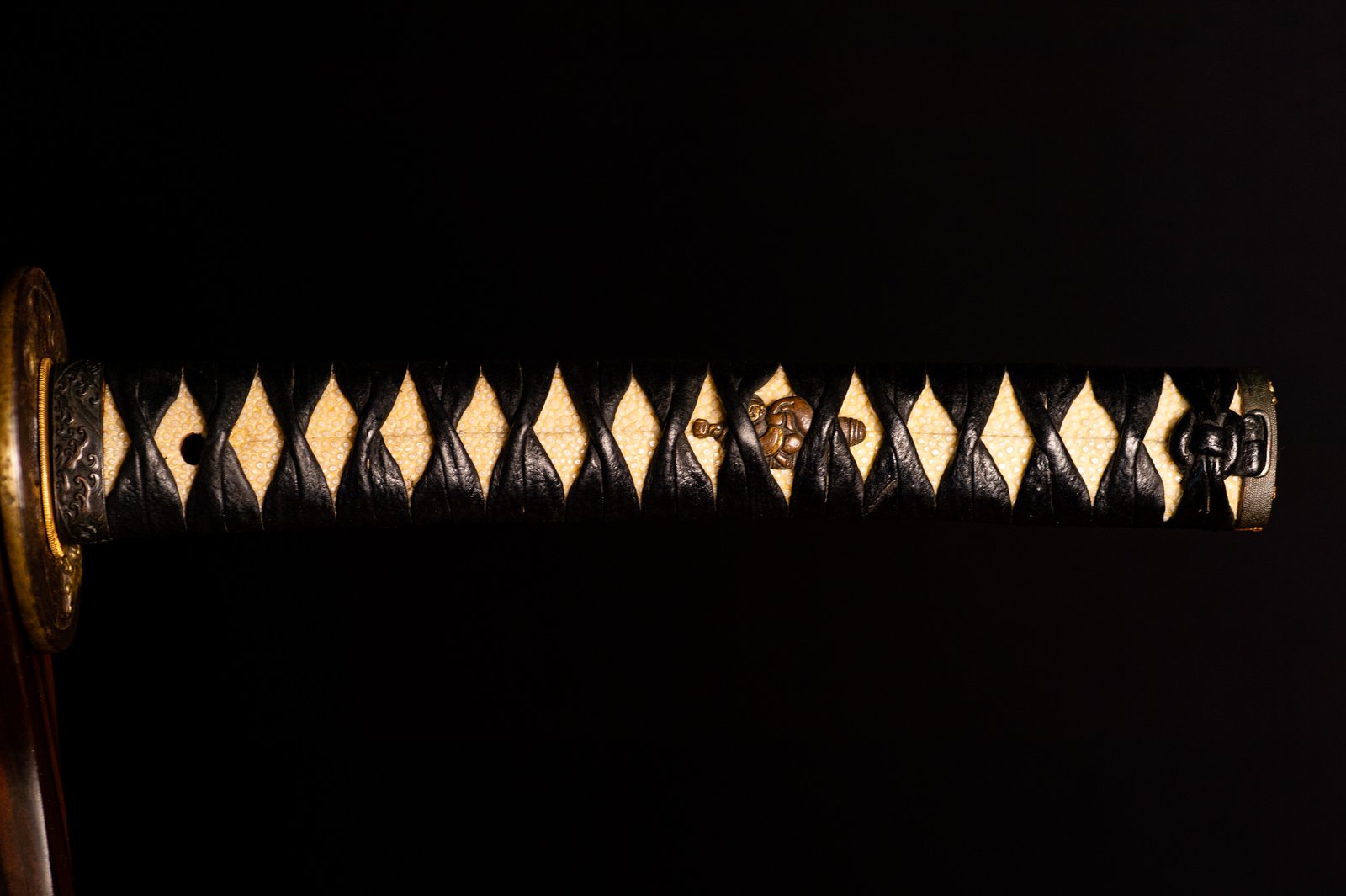
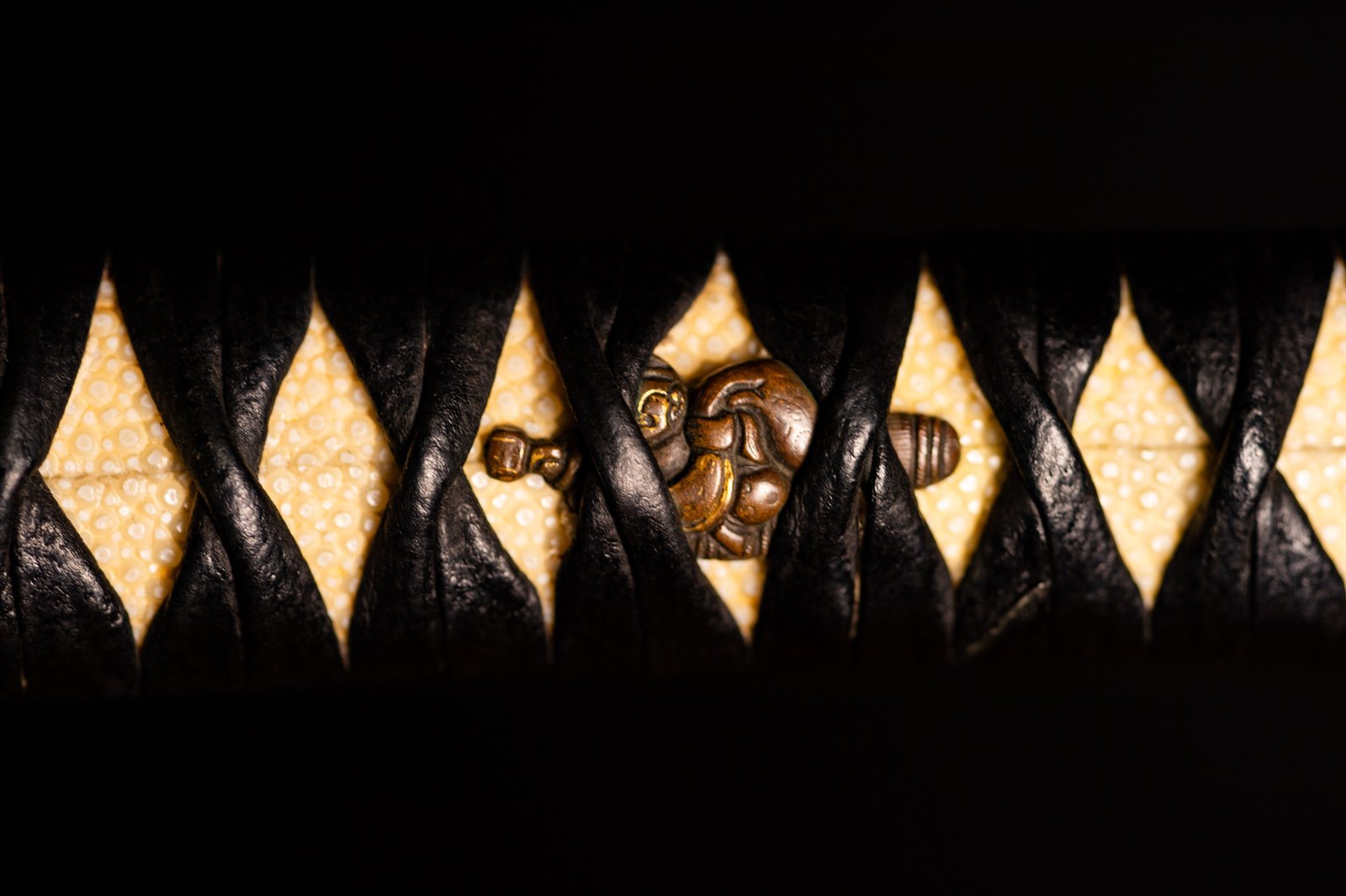
The tsuka is wrapped in black ito over pale samegawa using a traditional diamond-pattern arrangement.
The contrast between the dark wrapping and the pale ray skin produces a classic and elegant appearance.
The wrapping remains in good overall condition and provides a visually restrained foundation for the more elaborate metal fittings.
Through the diamond-shaped openings, the decorative menuki remain visible.
The menuki depict Daikokuten, one of the Shichifukujin, the Seven Lucky Gods of Japan.
Daikokuten is traditionally identified by his magical mallet and treasure sack and is associated with prosperity, fortune and abundance.
His presence on the handle introduces a strong auspicious element to the mounting.
The figures are positioned beneath the black wrapping and appear through the openings in the tsuka-ito, creating subtle decorative points along the handle.
The fuchi carries a decorative motif of a dragon amid waves.
The dragon is one of the most important symbolic creatures in Japanese art, traditionally associated with power, protection, water and supernatural authority.
The combination of dragon and waves creates an especially appropriate motif for sword furniture, balancing martial power with natural dynamism.
The decoration is worked against the darker metal surface, creating depth and contrast near the base of the handle.
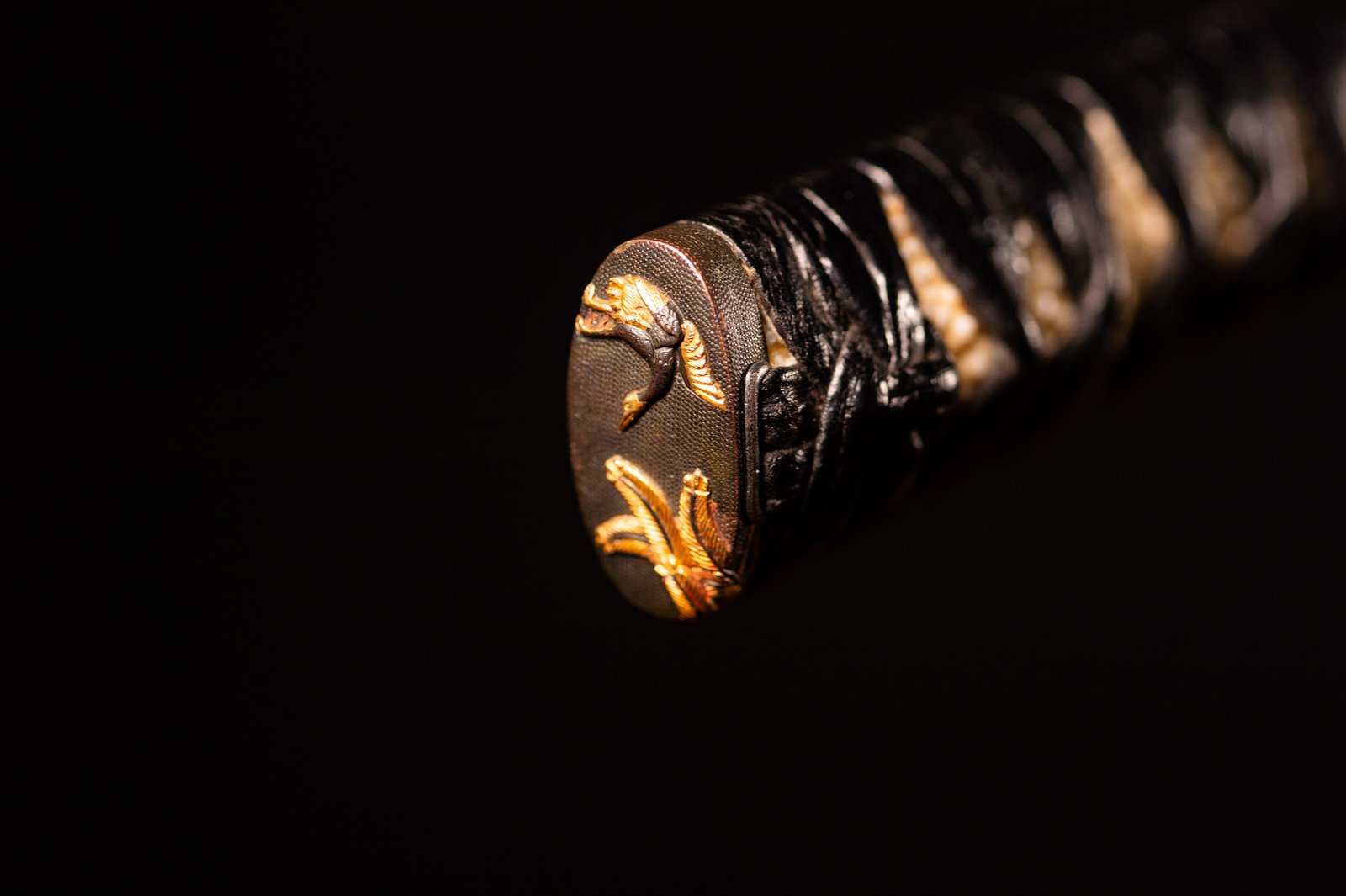
The kashira is decorated with a bird rendered in gilt relief.
The golden highlights stand out clearly against the darker metal ground, adding an elegant point of colour at the end of the handle.
The treatment is refined rather than excessive, allowing the detail to reward close examination without visually dominating the rest of the mounting.
Together with the other fittings, the kashira contributes to the richly varied iconography of the koshirae.
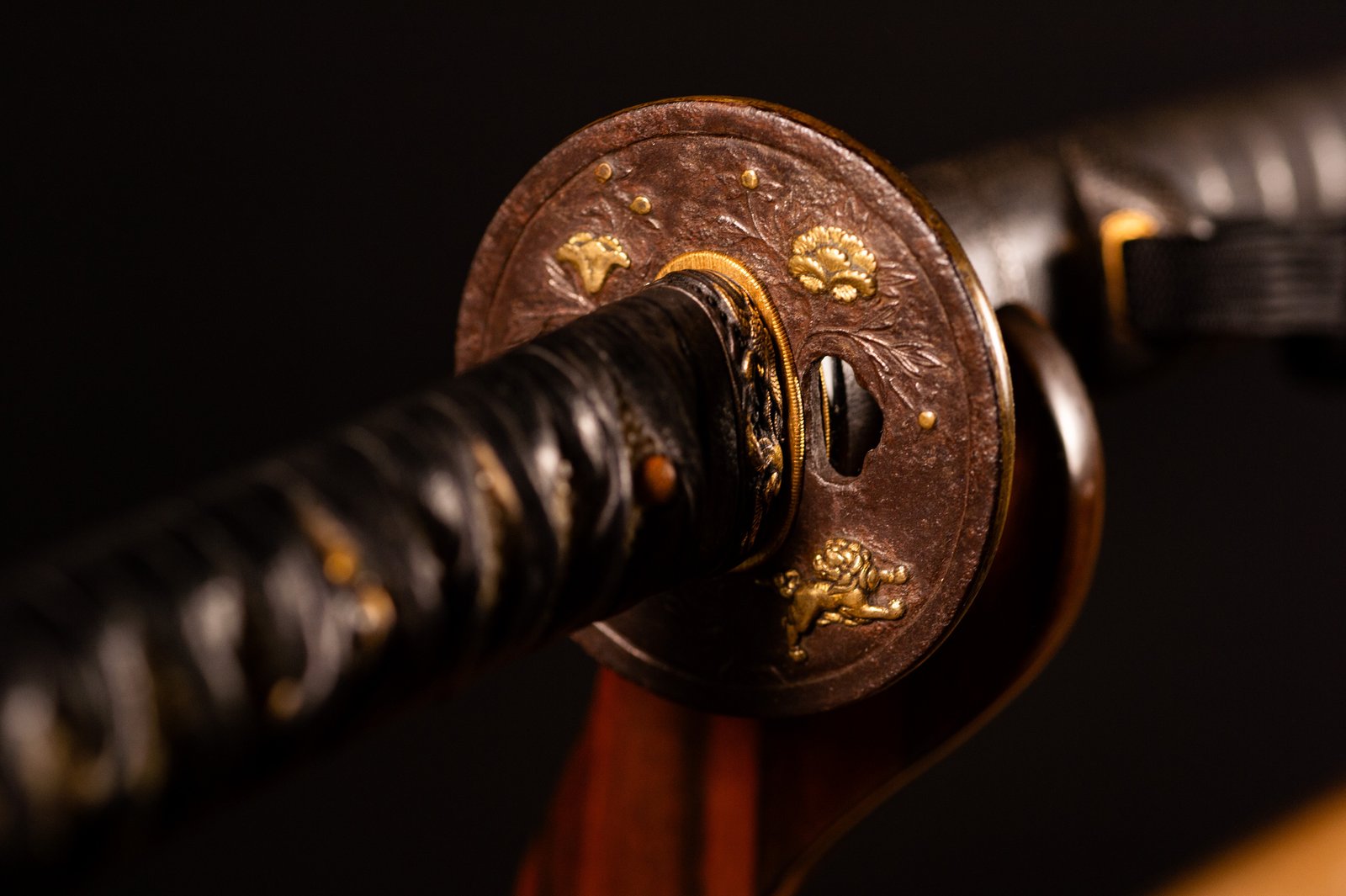
The tsuba is circular and constructed from iron.
Its surface is decorated with gilt inlay incorporating floral motifs and a shishi.
The shishi, or guardian lion, is traditionally associated with protection and spiritual authority and appears frequently in Japanese decorative arts.
The combination of aged iron and gold creates a restrained but visually rich contrast, while the floral ornament softens the martial character of the guardian-lion imagery.
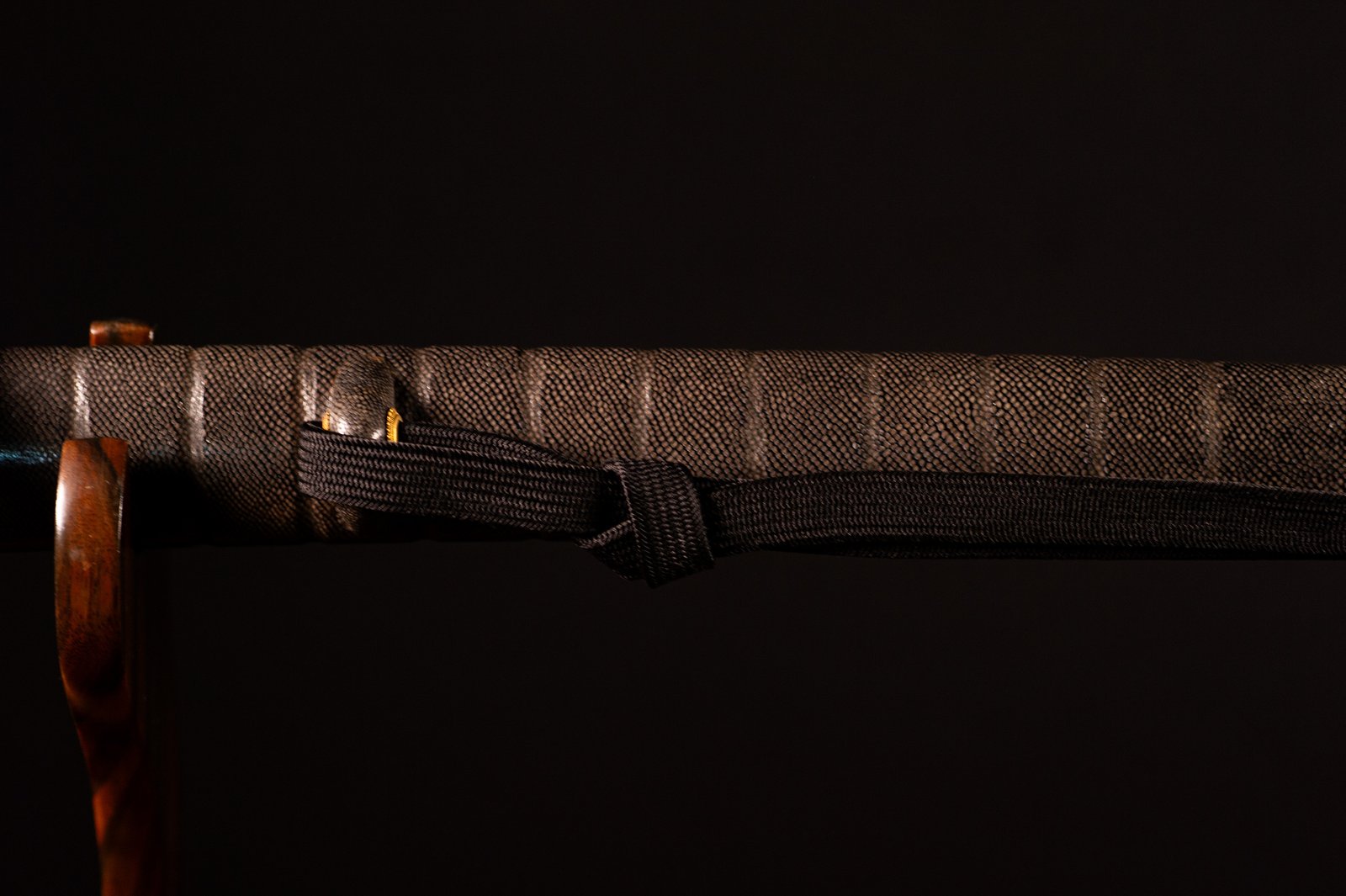
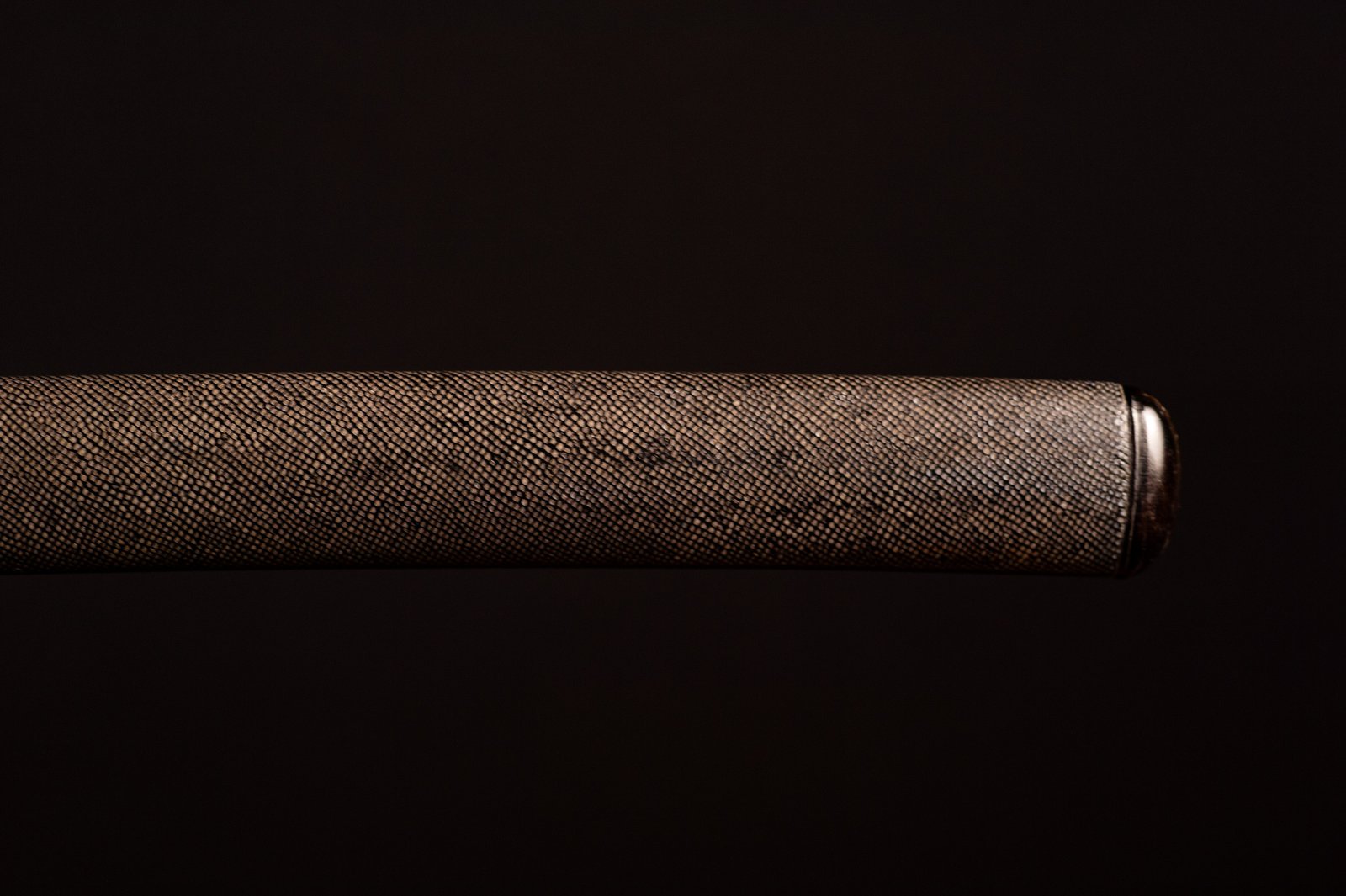
The saya is particularly distinctive and is covered in finely textured same.
This surface treatment gives the scabbard an unusual tactile and visual character compared with conventional lacquered examples.
The fine-grained texture remains understated and elegant, allowing the entire mounting to retain a formal appearance.
The saya includes its kurikata and is completed by a black braided sageo.
Also included with the sword is its corresponding shirasaya.
The shirasaya is made from unfinished natural wood and is specifically intended for the safe preservation of the blade when it is not mounted in its decorative koshirae.
It includes its own mekugi and allows the blade to be stored in a neutral environment without prolonged contact with the more complex materials of the formal mounting.
For a blade of this quality and certification, the presence of a dedicated shirasaya is a significant practical advantage for long-term conservation.
The blade is accompanied by a NBTHK Tokubetsu Hozon Tōken certificate issued in December 2022.
The Nihon Bijutsu Tōken Hozon Kyōkai is the principal Japanese organisation devoted to the study and preservation of traditionally manufactured Japanese art swords.
The Tokubetsu Hozon classification represents a significant level within the NBTHK certification system and is awarded to blades recognised as particularly worthy of preservation.
In the present case, the certification authenticates the signature Masatoshi 正利 and provides specialist recognition of the historical and artistic importance of the blade.
This significantly strengthens the sword’s appeal for advanced collectors.
The blade is also accompanied by its original Japanese torokusho registration certificate.
This document was issued by Niigata Prefecture in 1951.
Its early date is particularly significant, placing the sword within Japan’s post-war registration system from its initial years.
The survival of this documentation establishes a documented Japanese provenance extending back more than seven decades.
Combined with the modern NBTHK Tokubetsu Hozon certification, it provides an exceptionally useful documentary history for the blade.
The blade remains in a condition that allows its principal characteristics to be appreciated, including its fine ko-itame hada, active nioi-guchi, classical kissaki and gently returning boshi.
No visible chips or major damage are present on the cutting edge or point.
The nakago preserves its dark historical patina and two mekugi-ana.
The koshirae remains coherent and visually attractive, with its black wrapping, pale samegawa, gilt fittings, iron tsuba and finely textured saya presenting a strongly traditional appearance.
Natural signs of age and historical use are consistent with the period and should be understood as part of the sword’s long history.
This katana combines several qualities that make it particularly significant for the advanced collector: a signed late-Muromachi blade, a distinctive Sakakura Seki attribution, substantial dimensions, Tokubetsu Hozon certification, unusually early post-war Japanese registration, complete traditional mounting and a dedicated shirasaya.
The Sakakura Seki attribution gives the sword particular historical interest. While belonging to the broader Mino tradition, the Sakakura group occupied its own geographical and technical position outside the main Seki centre.
Masatoshi’s relationship with the work of neighbouring traditions, including the technical affinities noted with Muramasa, further distinguishes his work from more anonymous Seki production of the period.
The blade itself retains the practical qualities for which late-Muromachi Mino swords were renowned: substantial proportions, compact and well-forged steel, an effective temper line and a classical functional geometry.
Most importantly, the sword’s identity is supported by NBTHK Tokubetsu Hozon certification, which authenticates the signature and places the blade within a high level of recognised Japanese preservation status.
The original 1951 Niigata torokusho adds an exceptional documentary dimension. Few swords on the international market retain registration material from such an early phase of Japan’s post-war sword preservation system.
The accompanying koshirae adds considerable visual and historical value. Daikokuten menuki, dragon-and-wave fuchi, gilt bird kashira, iron tsuba with shishi and floral decoration, and the unusual same-covered saya create a sophisticated and strongly traditional ensemble.
Finally, the presence of the matching shirasaya allows the blade to be preserved correctly while retaining the complete decorative mounting for display.
An important and exceptionally well-documented late-Muromachi katana by Masatoshi of the Sakakura Seki school. Combining a substantial 71.2 cm signed blade, refined ko-itame steel, active nioi-based tempering, NBTHK Tokubetsu Hozon certification, original 1951 Japanese registration, complete period koshirae and dedicated shirasaya, this sword represents a highly attractive opportunity for serious collectors seeking a historically significant and fully documented example of the Mino tradition.
| Época | Edo |
|---|

Order above 1.000,00 € gets free shipping.

Secure and hassle-free payment process.

Certificate of authenticity included.

Have questions? Contact us via WhatsApp.
Contact