1 in stock
1 in stock
Add to Compare
Add to Wishlist
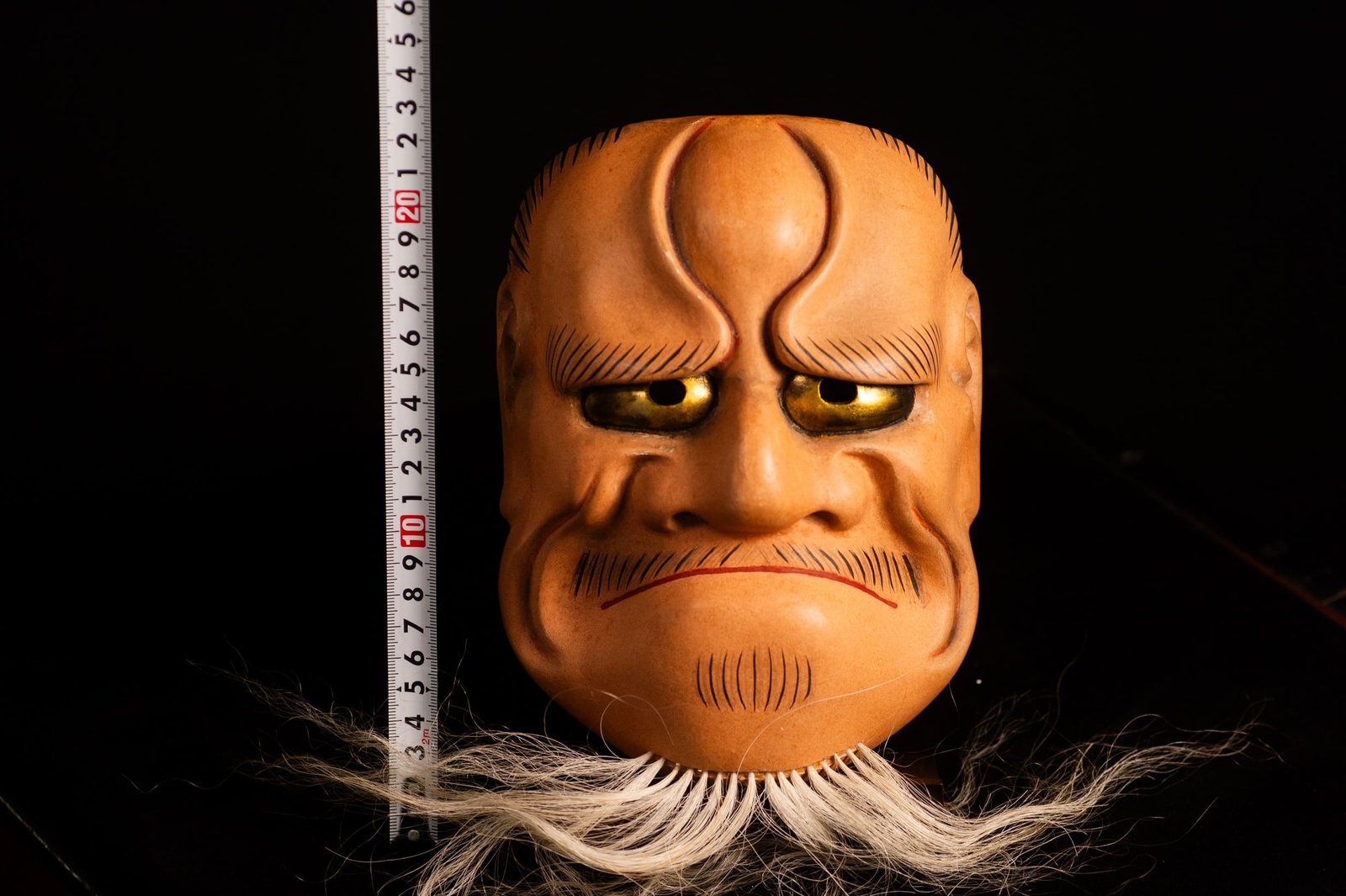
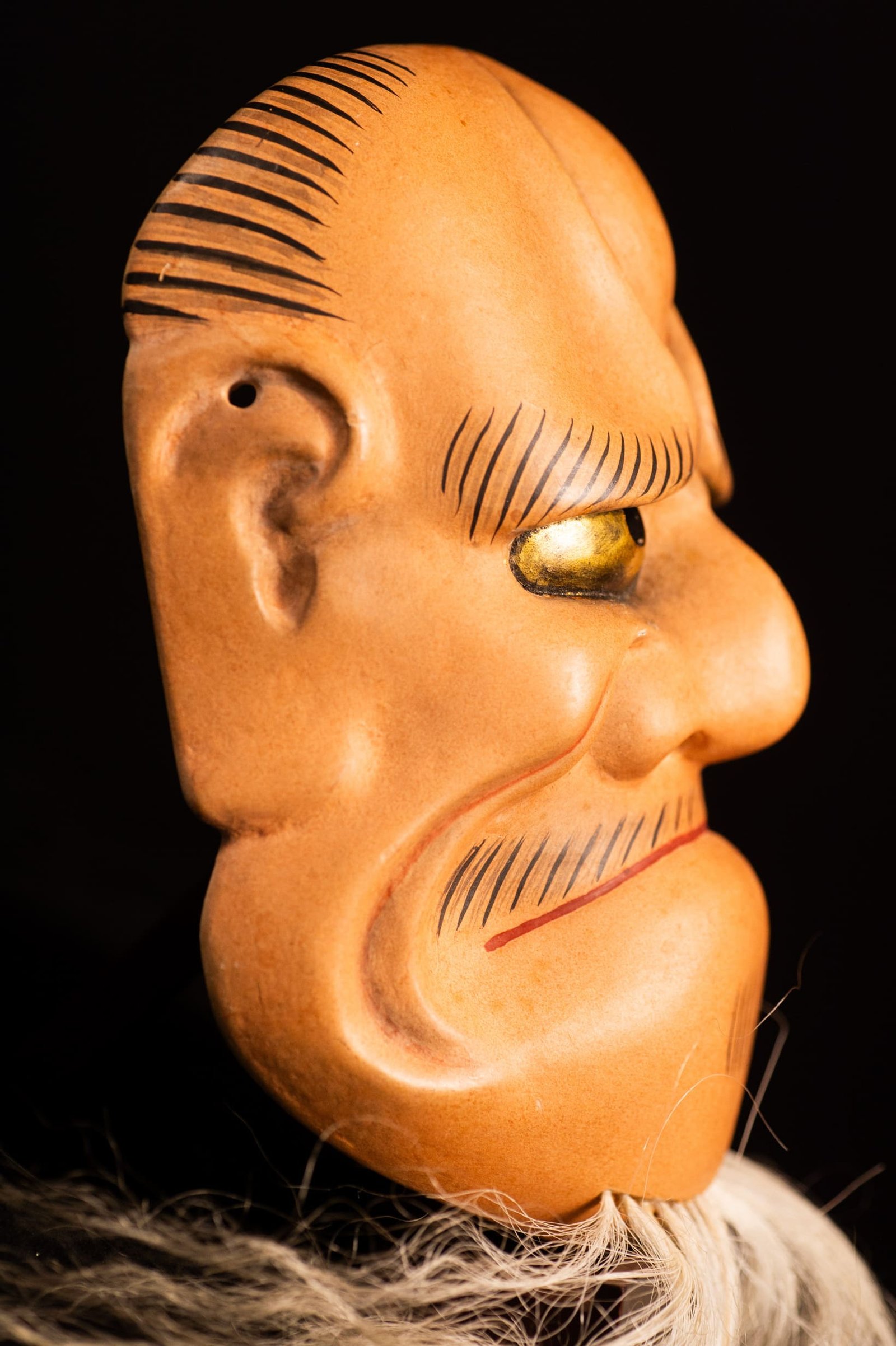
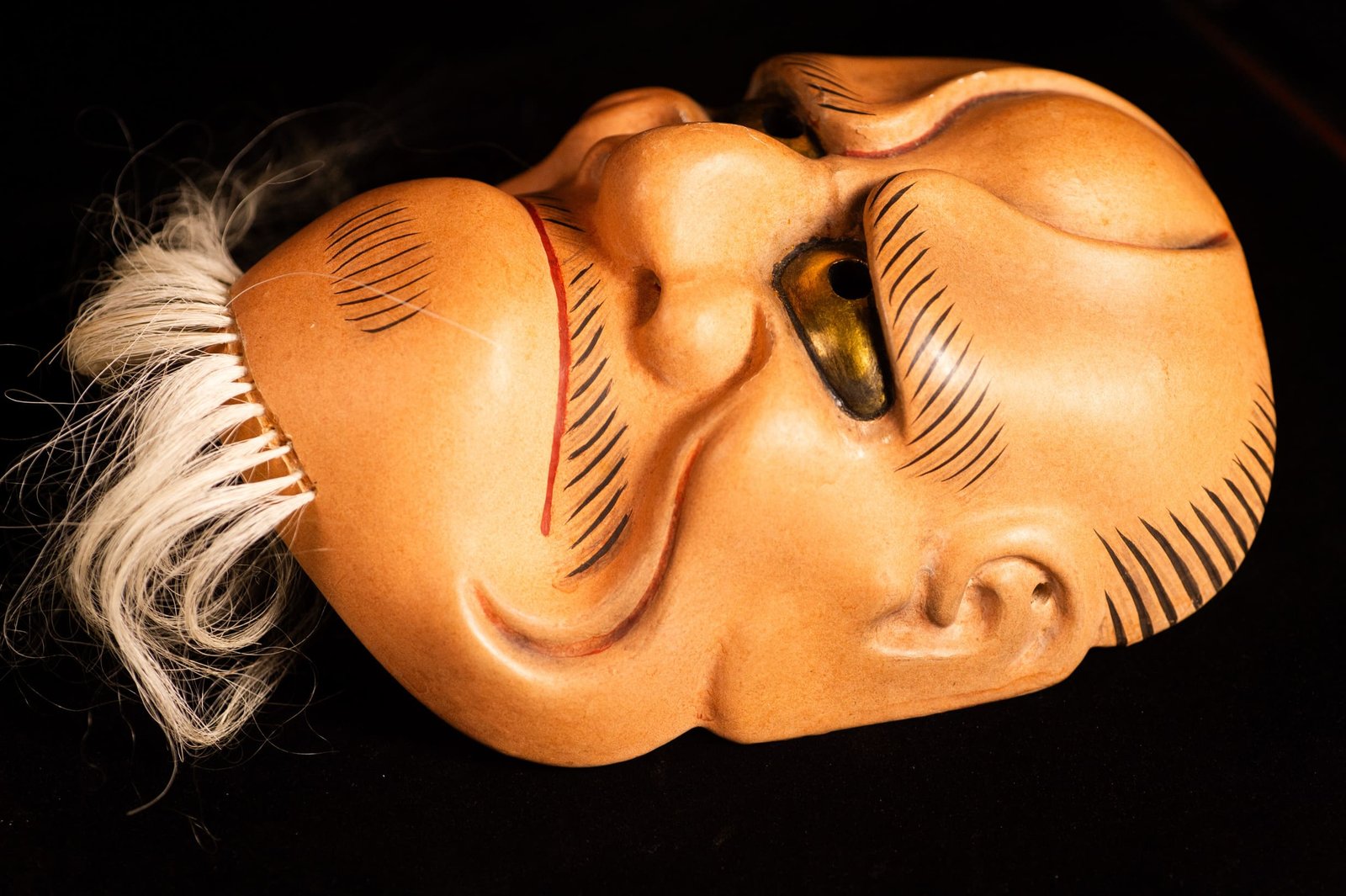
An imposing antique Japanese wooden mask representing Washibana Akujo, a distinctive member of the Akujo family of fierce aged male masks used within the theatrical and spiritual world of Noh. The name may be understood as the “eagle-nosed fierce old man,” referring to the mask’s exceptionally strong, narrow and aquiline nose.
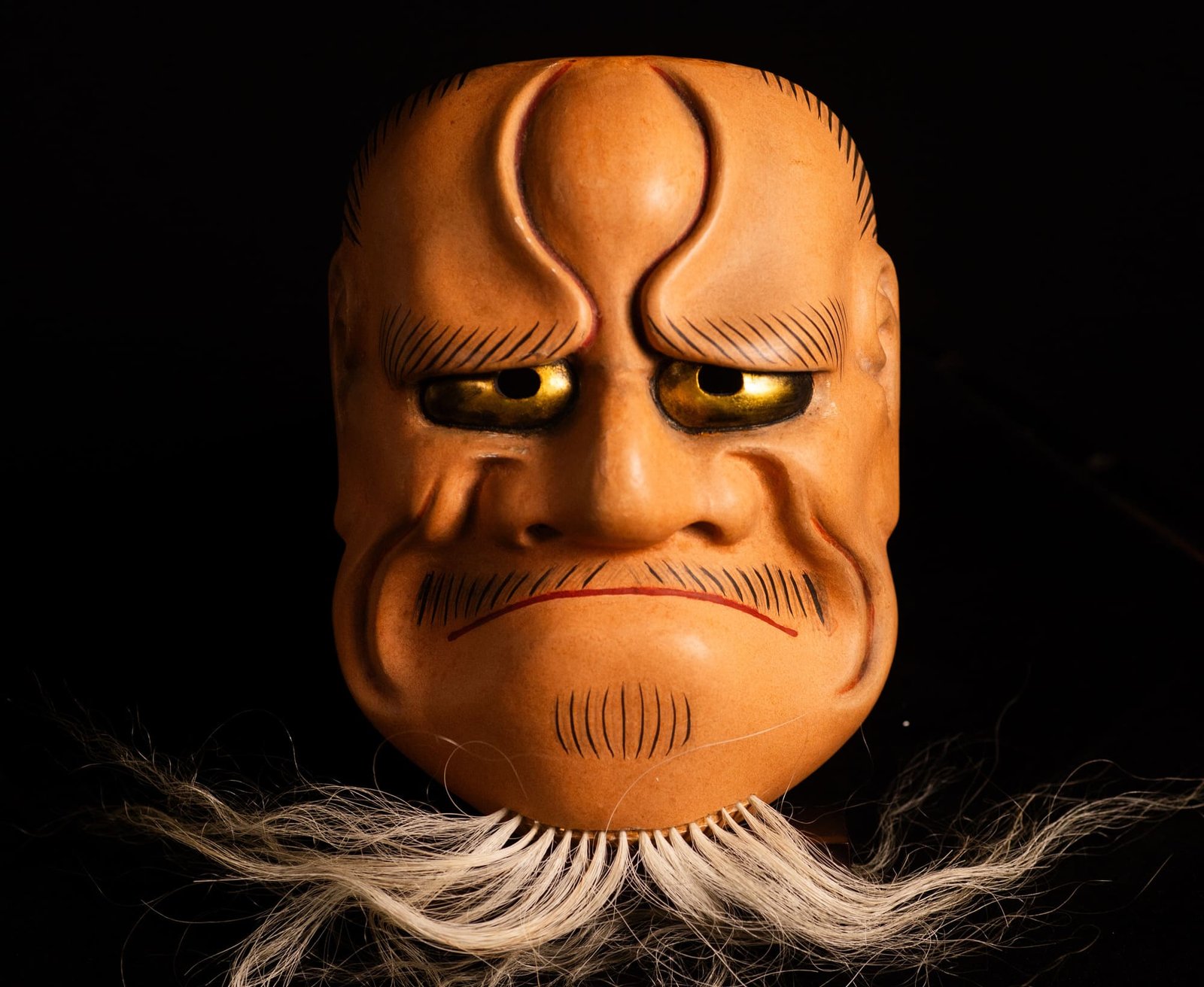
Carved at approximately life size, the mask combines the authority of an aged male face with an unmistakably supernatural presence. Inserted gilt-metal eyes, a continuous ridge extending from the forehead toward the cheeks, a firmly closed downturned mouth and a long flowing beard of white-grey natural fibre create the image of a dignified yet formidable divine or spectral elder.
The expression is severe without being chaotic. Rather than presenting uncontrolled anger, the mask communicates restrained power, spiritual authority and the accumulated force of great age.
Washibana Akujo masks could be used for figures whose dignity and elevated status were inseparable from their intimidating appearance. The character may therefore evoke an aged god, supernatural elder or spectral presence whose force inspires reverence as much as fear.
Washibana Akujo is a variant within the broader Akujo family of masks.
The word akujo may be translated literally as “evil old man,” but the term should not necessarily be interpreted as a statement of moral wickedness.
Within the visual language of Noh masks, aku may convey fierceness, extraordinary force, spiritual intensity and an awe-inspiring presence.
The addition of washibana, meaning “eagle nose,” identifies the most distinctive physical feature of this particular type.
The long, narrow and sharply aquiline nose gives the mask an immediately recognizable profile and contributes greatly to its impression of dignity, severity and supernatural authority.
Washibana Akujo is therefore not simply a portrait of an elderly man. It is a theatrical transformation of old age into an image of concentrated divine or spectral power.
Akujo masks belong to the broad category of aged male masks used to represent formidable elders, divine figures and supernatural beings.
Unlike masks depicting gentle or contemplative old men, Akujo types emphasize force, authority and a sense of danger.
Their age does not imply frailty.
Instead, the deeply modelled features, intense eyes and firmly controlled mouths suggest that great age has accumulated into spiritual and physical power.
Different variants within the Akujo family can be distinguished by the treatment of the forehead, nose, eyes, mouth, facial hair and overall proportions.
Washibana Akujo is especially recognizable because of its eagle-like nose and elongated, dignified facial structure.
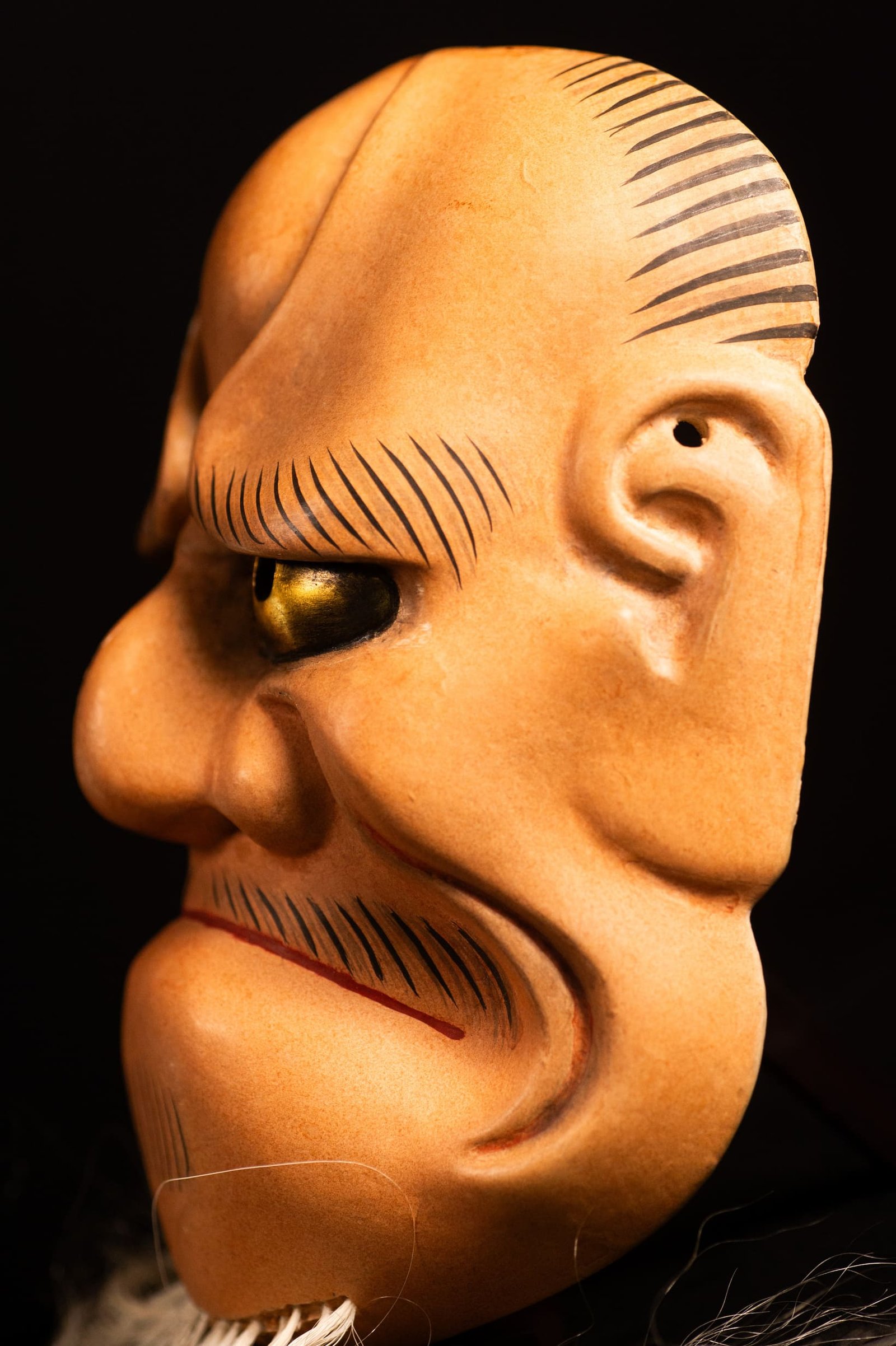
The defining feature of the mask is its strong, slender aquiline nose.
The nose projects prominently from the centre of the face and descends in a narrow curved profile resembling the beak of an eagle.
This feature gives the mask its name and establishes its identity even when viewed from the side.
The narrow bridge begins high between the eyes and continues downward in a controlled, elegant curve.
Unlike the broad and rounded noses found on more comic or energetic mask types, the Washibana Akujo nose appears sharp, severe and aristocratic.
Its form contributes to the dignity of the character while reinforcing the impression that the figure belongs to a world beyond ordinary human experience.
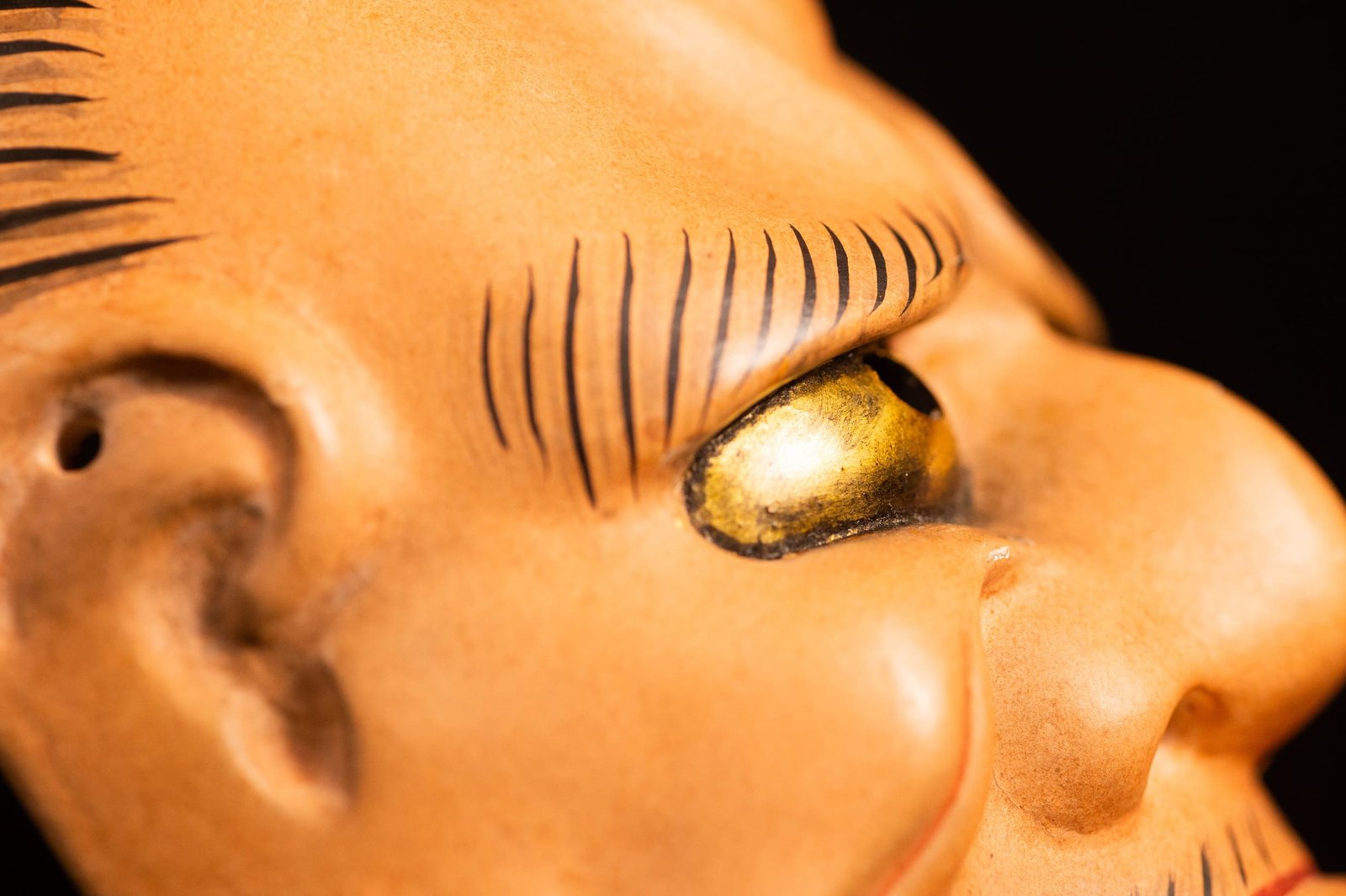
From an oblique angle, the depth and curvature of the nose become especially prominent.
The strongly projecting profile would have interacted dramatically with stage lighting, casting shadows across the cheeks and mouth as the actor moved.
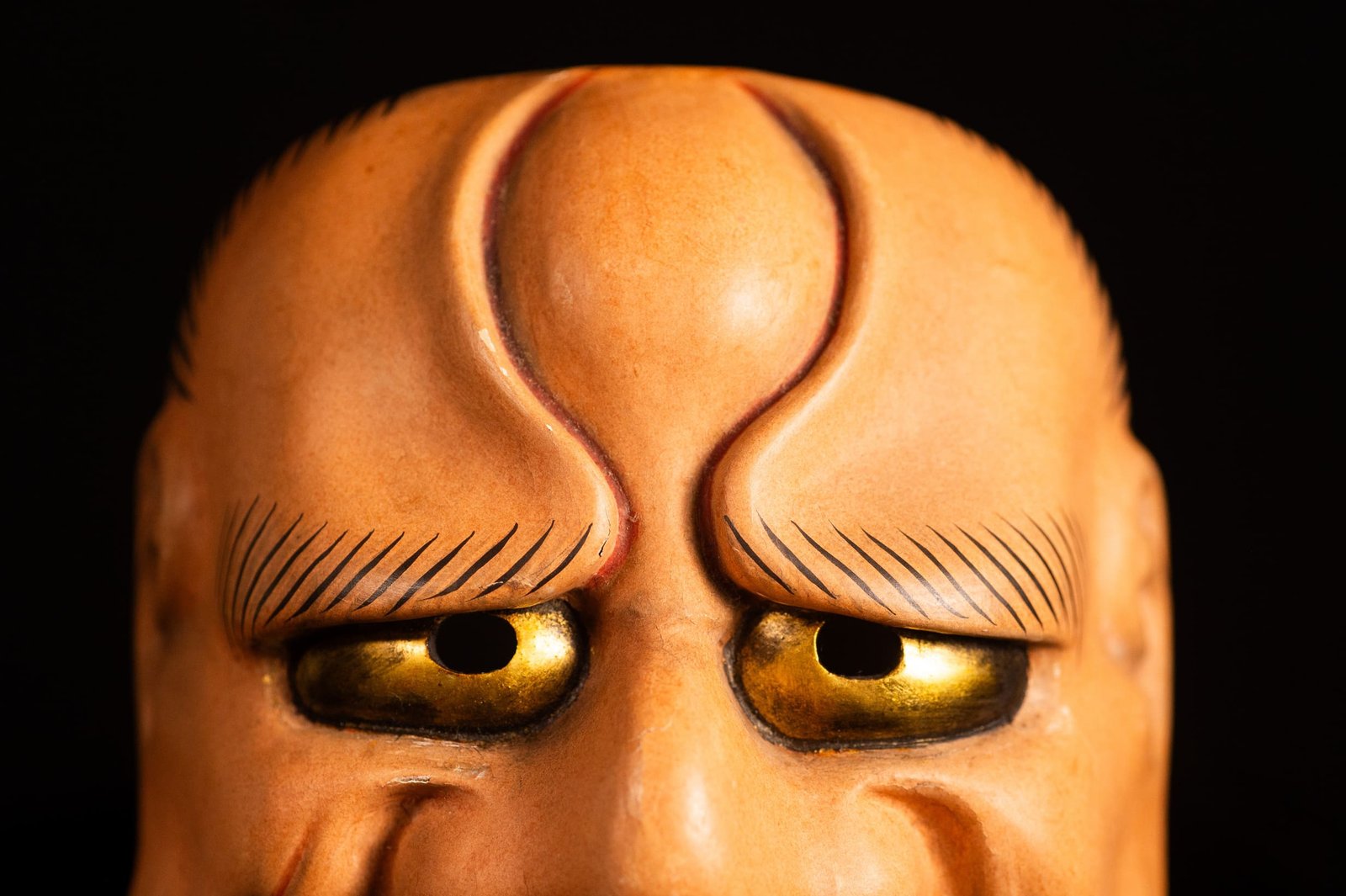
A continuous carved ridge extends from the forehead downward toward the cheeks.
This sculptural treatment unifies the upper and lower parts of the face and gives the expression a powerful structural rhythm.
The forehead appears compressed by deeply modelled contours, which descend around the eyes and continue toward the cheek area.
These ridges strengthen the impression of age while also creating a supernatural facial architecture.
They do not merely imitate natural wrinkles.
Instead, they transform the marks of age into broad sculptural lines that direct the viewer’s attention from the forehead toward the eyes, nose and mouth.
Under changing light, the raised ridges and deep recesses create alternating areas of brightness and shadow.
This allows the expression to appear more severe, distant or spiritually charged depending on the viewing angle.
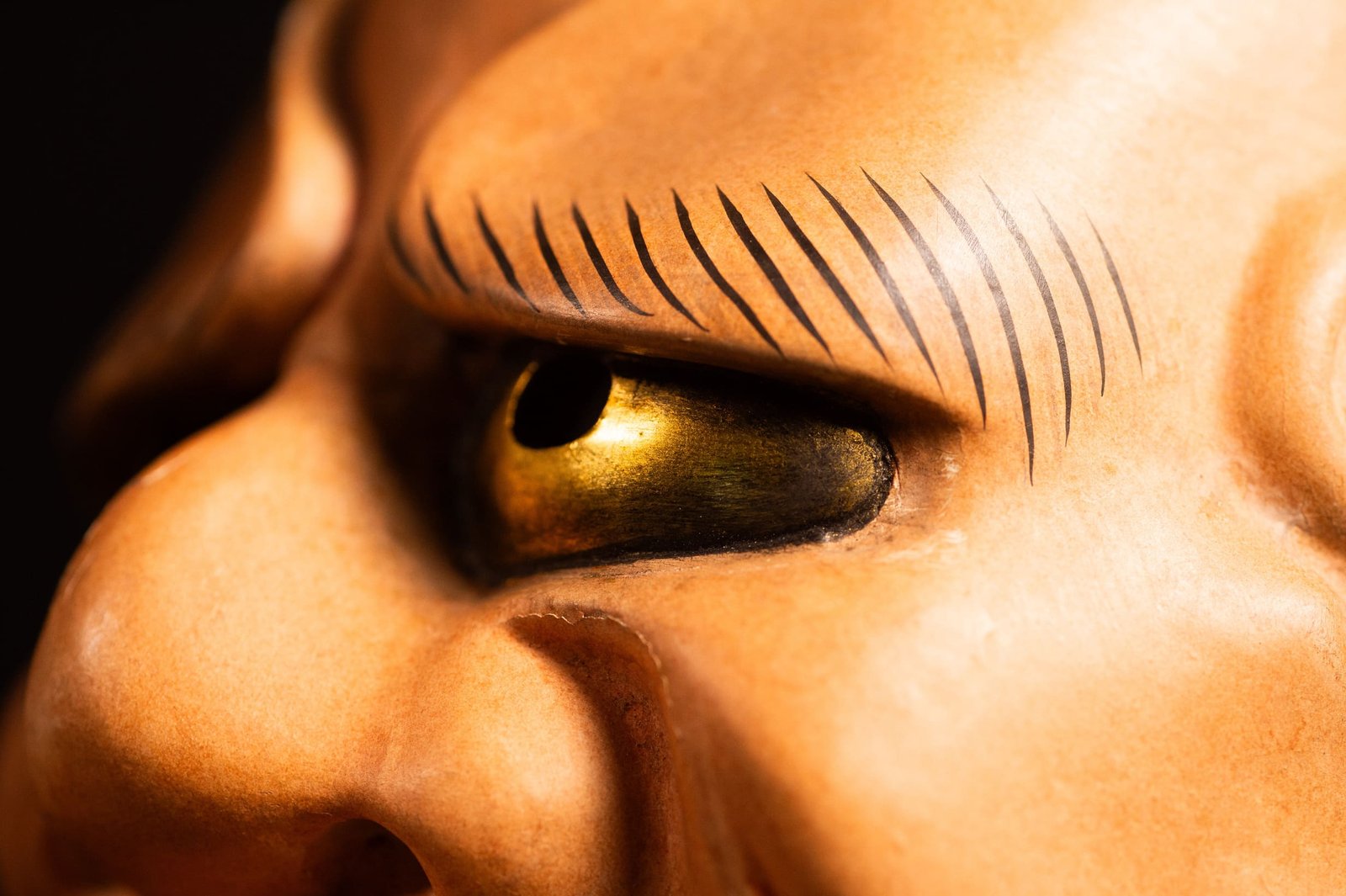
The mask is fitted with inserted gilt-metal eyes.
These reflective elements create a strong contrast with the carved wooden face and give the gaze an unmistakably supernatural quality.
Unlike eyes formed entirely from painted wood, metal eyes respond directly to changes in illumination.
Under theatrical lighting, the gilt surfaces could catch and reflect flashes of light as the actor moved.
This effect would have made the eyes appear momentarily animated, strengthening the impression that the represented being possessed an independent spiritual presence.
The inserted construction also gives the eyes a material distinction from the surrounding face.
They appear less like ordinary human eyes and more like luminous points of divine or spectral consciousness.
The gaze is intense but controlled, corresponding to the mask’s broader combination of dignity and formidable power.
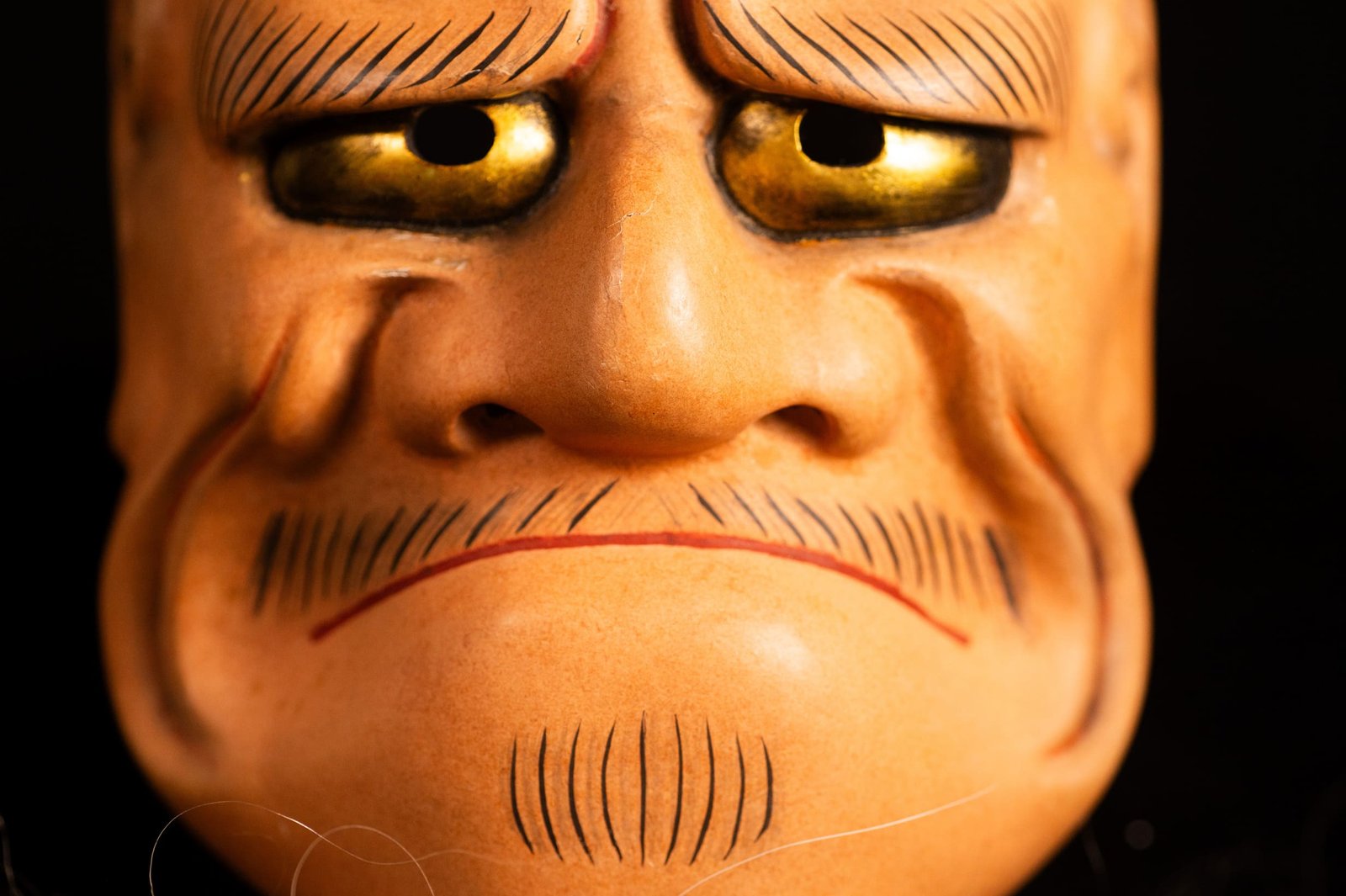
The expression of Washibana Akujo is concentrated within the relationship between the metallic eyes, aquiline nose and closed mouth.
The eyes appear alert and penetrating, while the long nose directs the viewer’s attention downward toward the compressed lips.
This creates a vertical visual structure that gives the face authority and solemnity.
The mask does not depend on an open mouth or exaggerated movement to communicate power.
Its strength lies in restraint.
The fixed gaze and tightly controlled lower face suggest a being whose force is contained rather than openly displayed.
Small changes in the angle of the mask would nevertheless alter the perceived expression.
When tilted slightly upward, the face could appear more elevated, distant or divine.
When lowered, the eyes would fall into deeper shadow, making the figure appear more severe, spectral or threatening.
The mouth is firmly closed and curves downward at the corners.
This restrained expression communicates seriousness, authority and contained force.
Rather than shouting, laughing or revealing teeth, the mask presents a being whose power is expressed through control.
The downward curve contributes to the severity of the face and balances the long descending line of the aquiline nose.
A fine red line is visible within the closed mouth.
This subtle touch of colour separates the lips and gives the mouth greater visual definition without disturbing the overall restraint of the expression.
The red interior line also introduces a small but effective chromatic contrast against the aged wooden surface and the pale beard.
Its delicacy is particularly important.
A broader red mouth would have made the expression more dramatic or aggressive, whereas the narrow line preserves the dignity of the character.
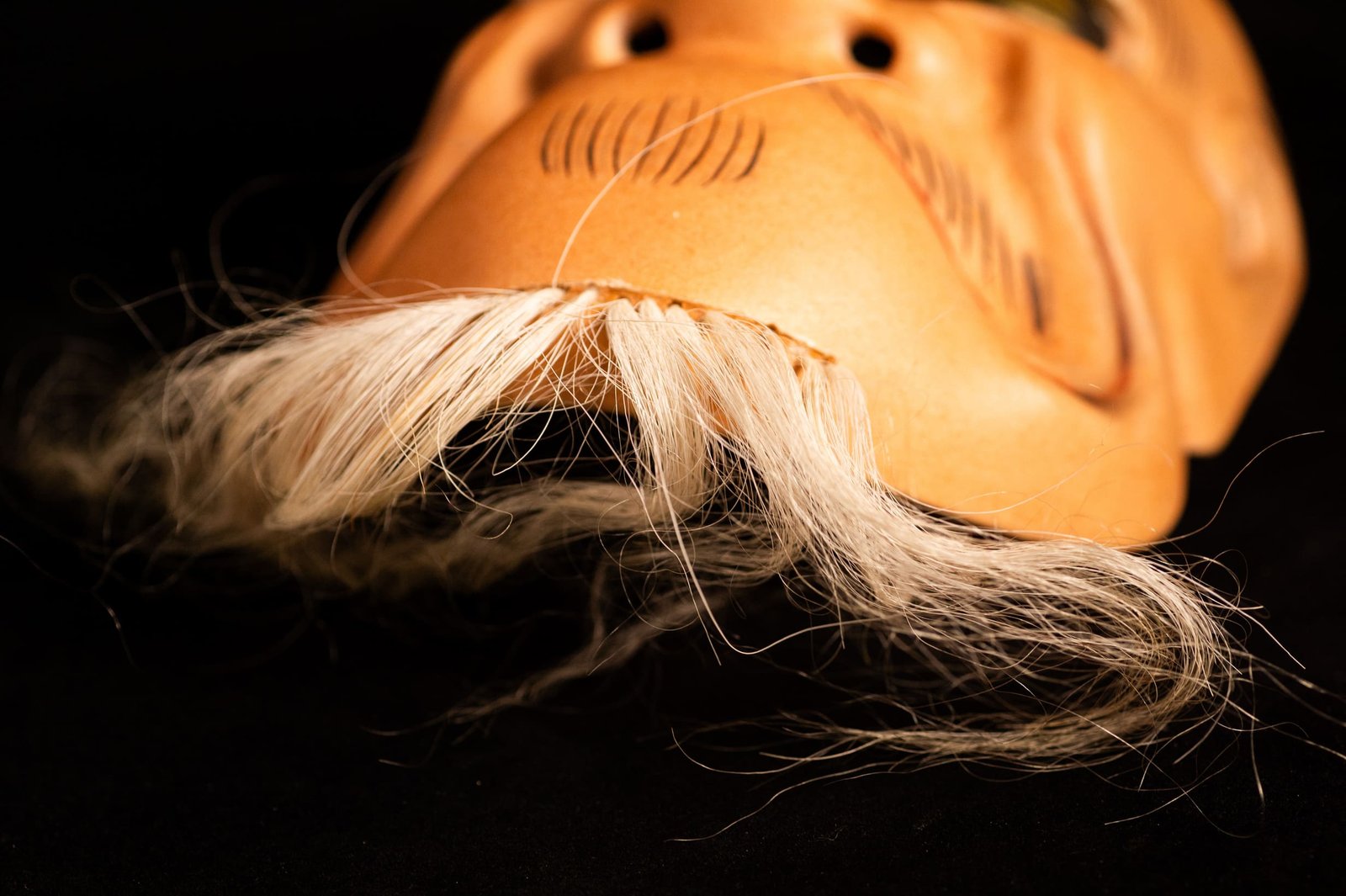
A long moustache of white-grey natural fibre extends from the area above the mouth.
The fibres flow outward and downward, following the elongated structure of the face.
Unlike painted facial hair, the attached moustache introduces actual movement and texture.
During a performance, even subtle movements by the actor could cause the fibres to shift.
This would have added a living quality to the otherwise fixed expression.
The pale colour of the moustache emphasizes the great age of the character and contrasts with the metallic eyes and carved wooden surface.
It also frames the closed mouth, making the controlled expression appear even more concentrated.
A long flowing beard of white-grey natural fibre is attached beneath the chin.
The beard is a major visual component of the mask and reinforces the identity of an ancient male figure.
Its length extends the face vertically and gives the mask a commanding presence beyond the boundaries of the carved wood.
The irregular natural fibres create texture and movement, softening the severe sculptural lines of the forehead, nose and cheeks.
At the same time, the beard contributes to the supernatural character of the figure.
Its flowing form may suggest extreme age, wisdom, spiritual status or existence beyond the limits of ordinary human life.
As an organic material, the beard may display natural variation and age-related irregularity.
These characteristics are consistent with the antique nature of the object and should not be compared with the uniform appearance of newly manufactured decorative masks.
Washibana Akujo is used for figures who combine dignity with an intimidating presence.
The character does not represent simple cruelty or uncontrolled rage.
Instead, the mask embodies the authority of an aged being whose experience, spiritual status or supernatural nature commands respect.
The slender eagle-like nose gives the face refinement and severity.
The metallic eyes add spiritual intensity, while the tightly closed mouth suggests discipline and restraint.
The long white-grey beard communicates age and elevated status.
Together, these features create a figure who may be understood as divine, spectral or otherwise removed from ordinary humanity.
The mask’s power comes from this tension between dignity and menace.
It is neither entirely benevolent nor purely terrifying, but capable of communicating the complex presence of an ancient supernatural elder.
The mask type could be used for dignified but formidable divine or spectral old men.
In Noh theatre, supernatural characters often appear with layered identities.
A figure may initially present itself in a human form before revealing its true identity as a spirit, ghost, deity or other extraordinary being.
Masks such as Washibana Akujo allow the performer to communicate this separation from ordinary human life immediately.
The metallic eyes and exaggerated aquiline nose signal that the represented figure cannot be understood as a naturalistic portrait.
The long beard and deeply carved features suggest great age, while the controlled expression preserves the dignity appropriate to a divine or spiritually elevated presence.
The supplied identification does not associate this particular mask with one named play, deity or historical character.
It should therefore be presented as a Washibana Akujo mask type suitable for divine or spectral aged figures rather than attributed to a specific role without further documentation.
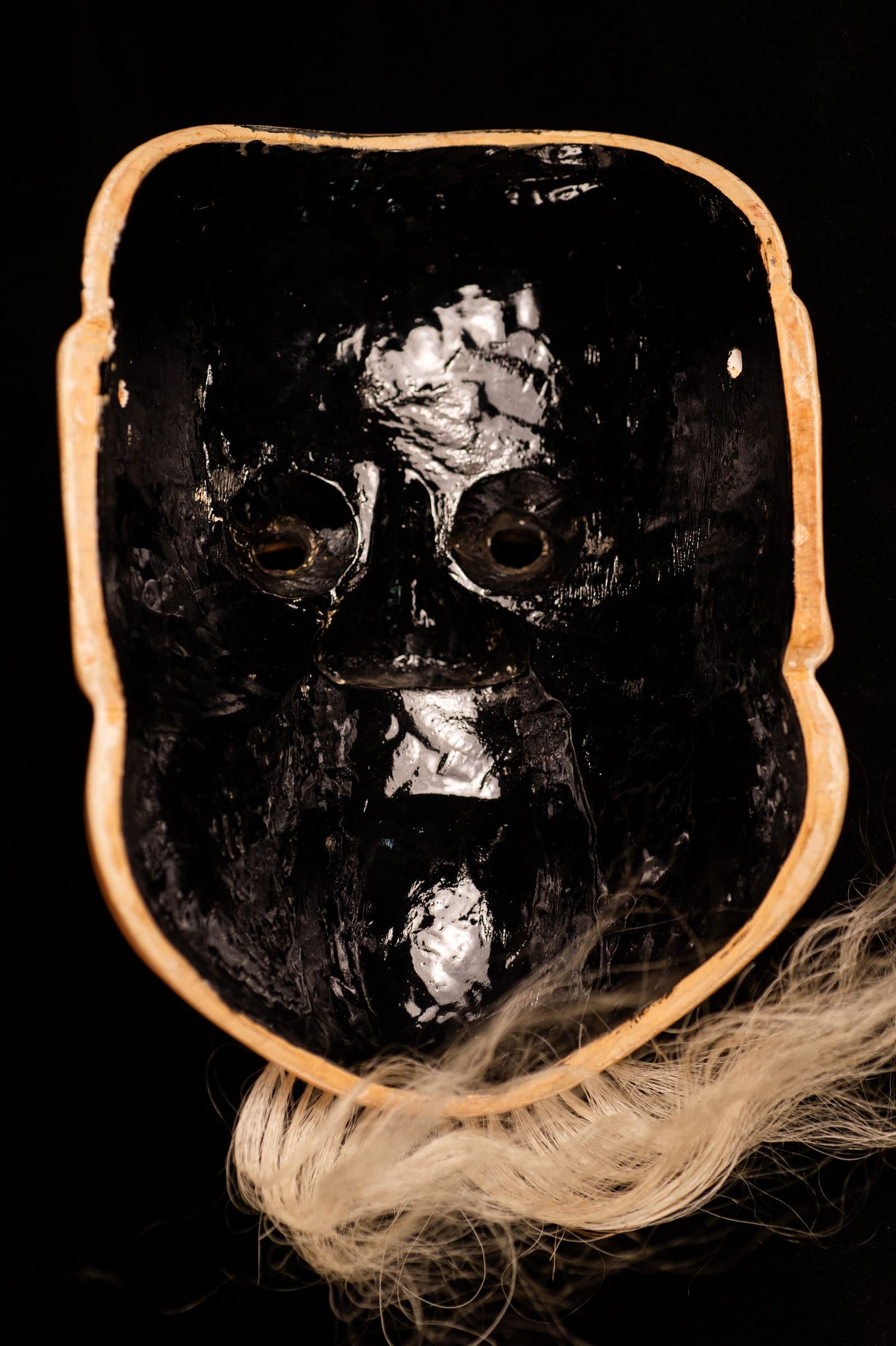
The mask is carved from wood as a complete three-dimensional form.
The sculptor established the character through the careful relationship between projecting and recessed areas.
The forehead and cheeks are shaped by continuous ridges, the eyes are deeply set around inserted metal elements, the nose projects strongly and the mouth is tightly controlled.
These features demonstrate that the mask was conceived to be viewed under movement and directional light.
Its expression does not depend solely on frontal presentation.
From the side, the aquiline nose dominates the profile.
From a three-quarter angle, the ridge carving and cheek structure become more visible.
From the front, the metallic eyes, downturned mouth and flowing beard establish the complete identity of the character.
The carved form and attached natural fibres work together as a unified theatrical object.
Masks have occupied an essential place in Japanese religious rituals, festivals and theatre for centuries.
Within Noh, the mask does more than conceal the face of the performer.
It allows the actor to embody a particular human type, historical figure, ghost, spirit, deity or supernatural presence.
The performer’s individual identity recedes while the identity represented by the mask becomes dominant.
This transformation is achieved through the combined effect of the mask, costume, movement, music, chant and stage lighting.
Because the expression of the mask is fixed, the actor must use subtle changes in posture and head angle to alter the audience’s perception of the face.
A slight upward movement may illuminate the eyes and soften the mouth.
A downward movement can deepen the shadows, making the same mask appear more severe, sorrowful or threatening.
The strongly carved ridges, projecting nose and metallic eyes of Washibana Akujo are especially suited to these changes.
Japanese masking traditions developed through a long relationship between religious ceremony, local festivals and theatrical performance.
Within Japan’s indigenous religious traditions, spiritual or divine beings are often referred to as kami.
Kami may be associated with places, ancestors, natural forces, protective powers or extraordinary spiritual presences.
Traditional masking could symbolize transformation, embodiment or possession.
By wearing a mask, the performer temporarily ceased to appear as an ordinary individual and became the visible representation of the character or spiritual presence embodied by the mask.
This broader cultural context is relevant to the formidable supernatural appearance of Washibana Akujo.
However, the supplied description does not identify this particular mask as a representation of a specific named kami.
It should therefore be understood as a Noh mask type used for dignified divine or spectral elders rather than assigned to a particular deity without documentary evidence.
The mask is carved at a 1:1 or life-size scale, corresponding to the proportions of a wearable theatrical mask.
Its long nose, inserted metallic eyes and flowing beard give it a strong physical presence when displayed.
The profile is especially important and should remain visible within any exhibition arrangement.
A frontal display emphasizes the severe symmetry of the eyes, ridge carving and downturned mouth.
A slightly angled presentation reveals the depth of the aquiline nose and the sculptural transitions across the cheeks.
The mask should be supported without applying pressure to the nose, beard, moustache, edges or any original fastening points.
Direct sunlight, excessive humidity, very dry conditions and sudden environmental changes should be avoided.
The natural fibres and gilt-metal eyes should not be cleaned with abrasive products or exposed to unnecessary handling.
The mask is described as antique.
No detailed conservation, restoration or condition report has been supplied.
As an antique theatrical object combining carved wood, inserted metal elements and natural fibres, it may display age-related variations, wear or irregularities across these different materials.
The long moustache and beard should be handled with particular care because natural fibres can become fragile over time.
No precise date, carver, workshop attribution, inscription, documented performance history or individual provenance has been supplied.
The description is based on the identification provided as a Washibana Akujo mask and on the stated physical characteristics of the object.
Prospective buyers should examine all available photographs carefully when assessing its condition.
This antique Washibana Akujo mask is distinguished by the exceptional strength of its profile and the restrained intensity of its expression.
The slender aquiline nose immediately separates the mask from broader-faced or more animated Akujo variants.
Its eagle-like form creates a dignified and severe silhouette that remains visually powerful from both frontal and lateral viewpoints.
The inserted gilt-metal eyes introduce a reflective supernatural quality, while the continuous forehead-to-cheek ridge carving gives the face a coherent sculptural structure.
The firmly closed downturned mouth contributes a sense of contained force, and the fine red interior line provides a subtle but effective point of colour.
The long white-grey moustache and beard add movement, texture and a compelling impression of great age.
Together, these features create the image of a formidable elder whose power is expressed through authority and restraint rather than overt aggression.
For collectors of Noh theatre, Japanese masks, religious art and carved wooden sculpture, the piece offers a distinctive combination of theatrical function, spiritual meaning and strong sculptural presence.
An imposing antique Japanese Noh mask representing Washibana Akujo, the “eagle-nosed fierce old man” and a distinctive variant within the Akujo family. Carved from wood at life size, the mask is defined by its strong, slender aquiline nose, inserted gilt-metal eyes, continuous forehead-to-cheek ridge carving and firmly closed downturned mouth with a fine red interior line. A long flowing moustache and beard of white-grey natural fibre complete the image of a dignified yet formidable divine or spectral elder. With its commanding profile, restrained expression and rich combination of carved wood, reflective metal and organic fibre, the mask is a powerful example of Japanese theatrical sculpture and an exceptional object for a collection of Noh masks, Asian art or ritual material culture.
| Época | Edo |
|---|

Order above 1.000,00 € gets free shipping.

Secure and hassle-free payment process.

Certificate of authenticity included.

Have questions? Contact us via WhatsApp.
Contact