FREE EXPRESS INTERNATIONAL DELIVERY
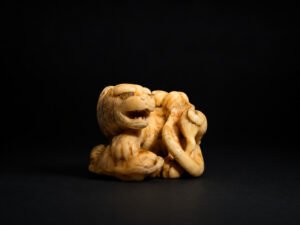
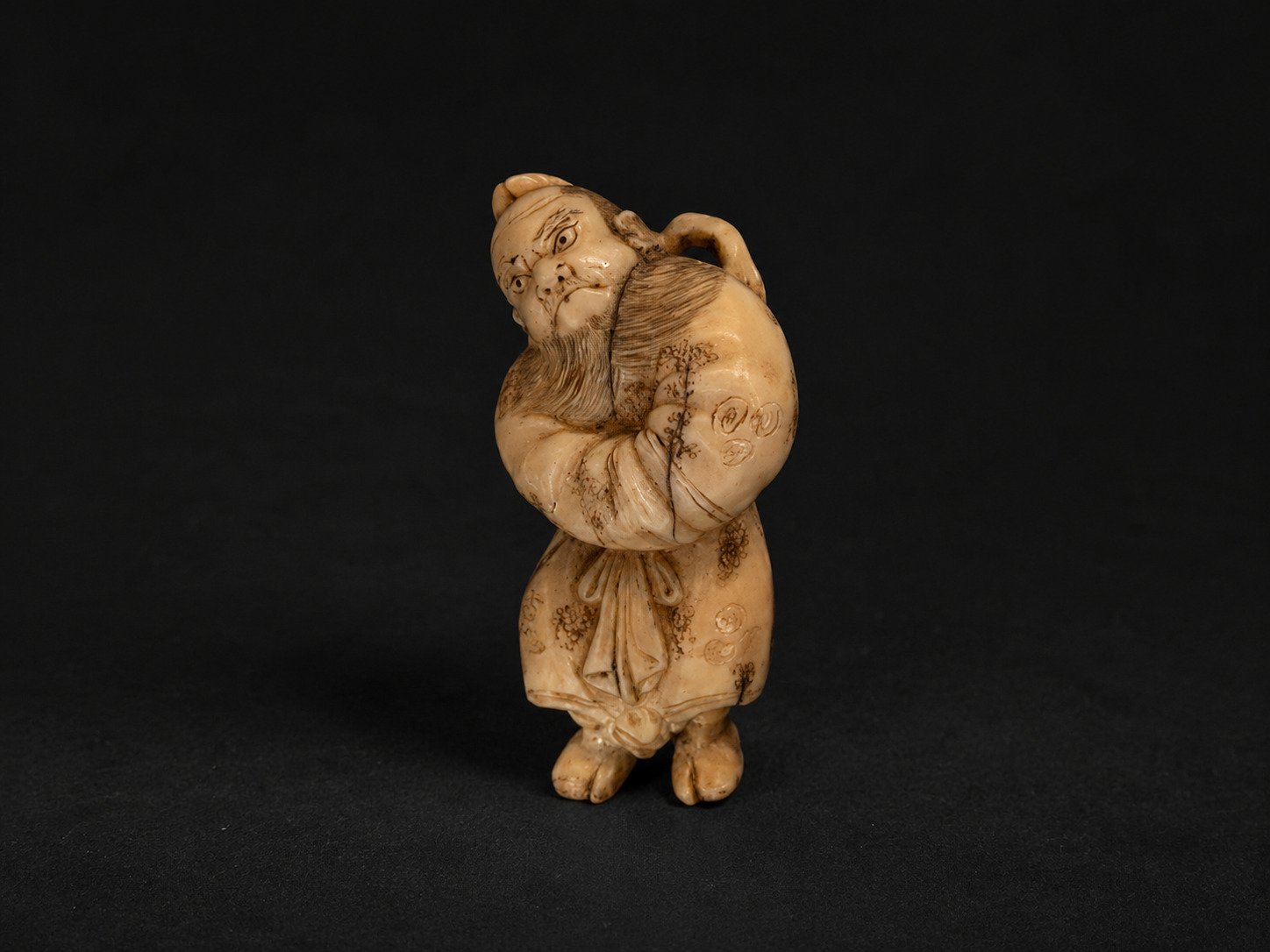
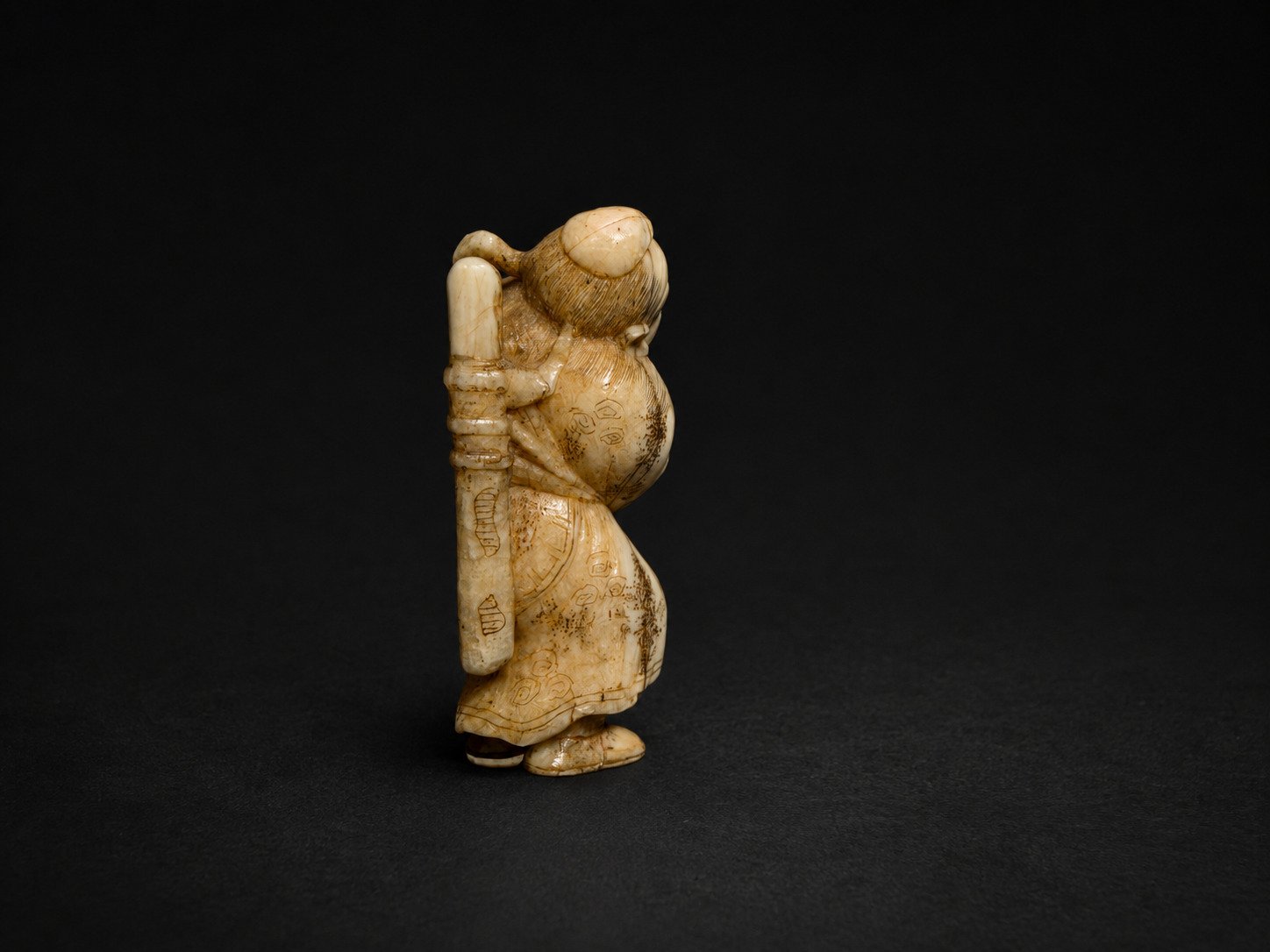
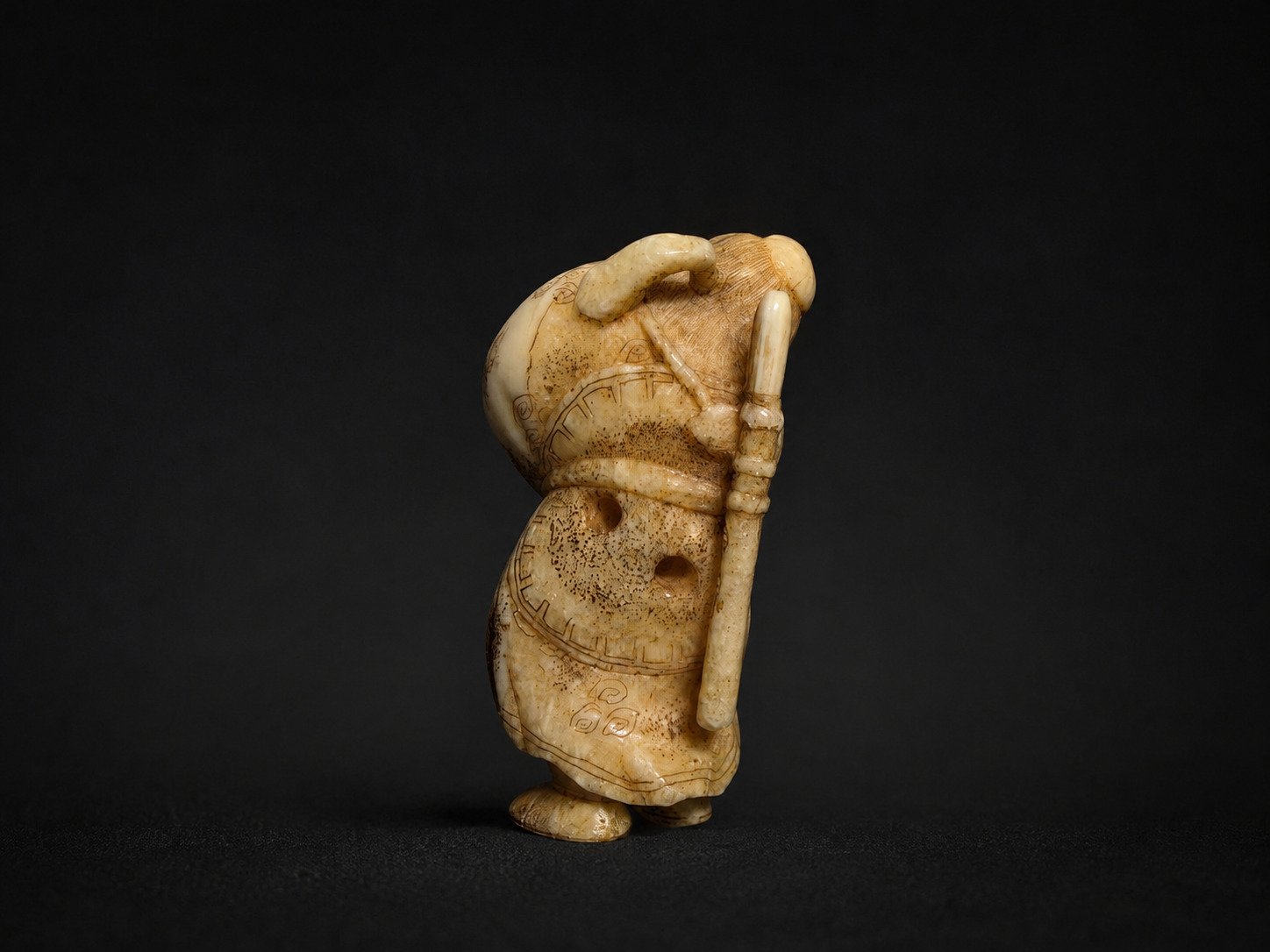
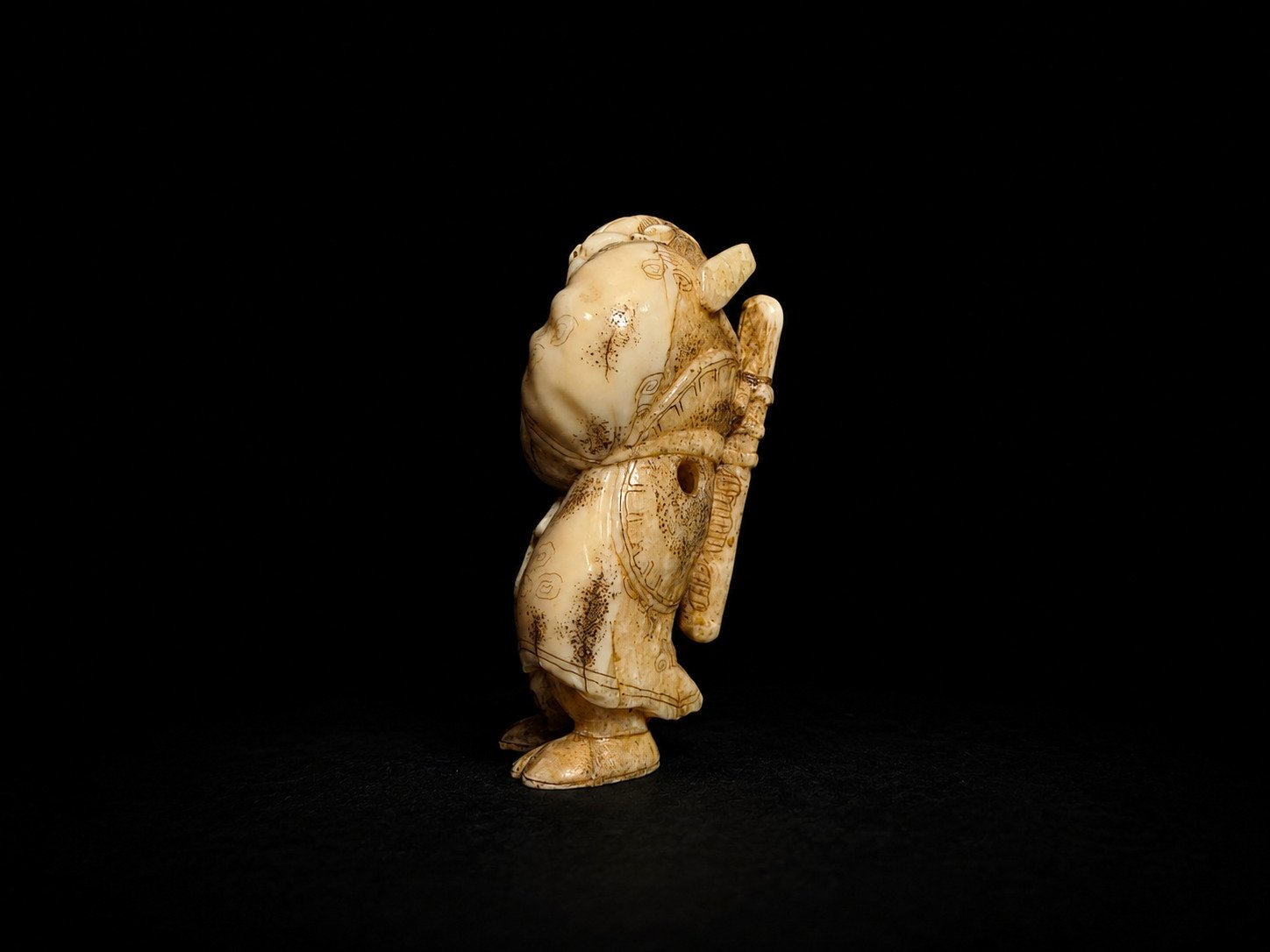
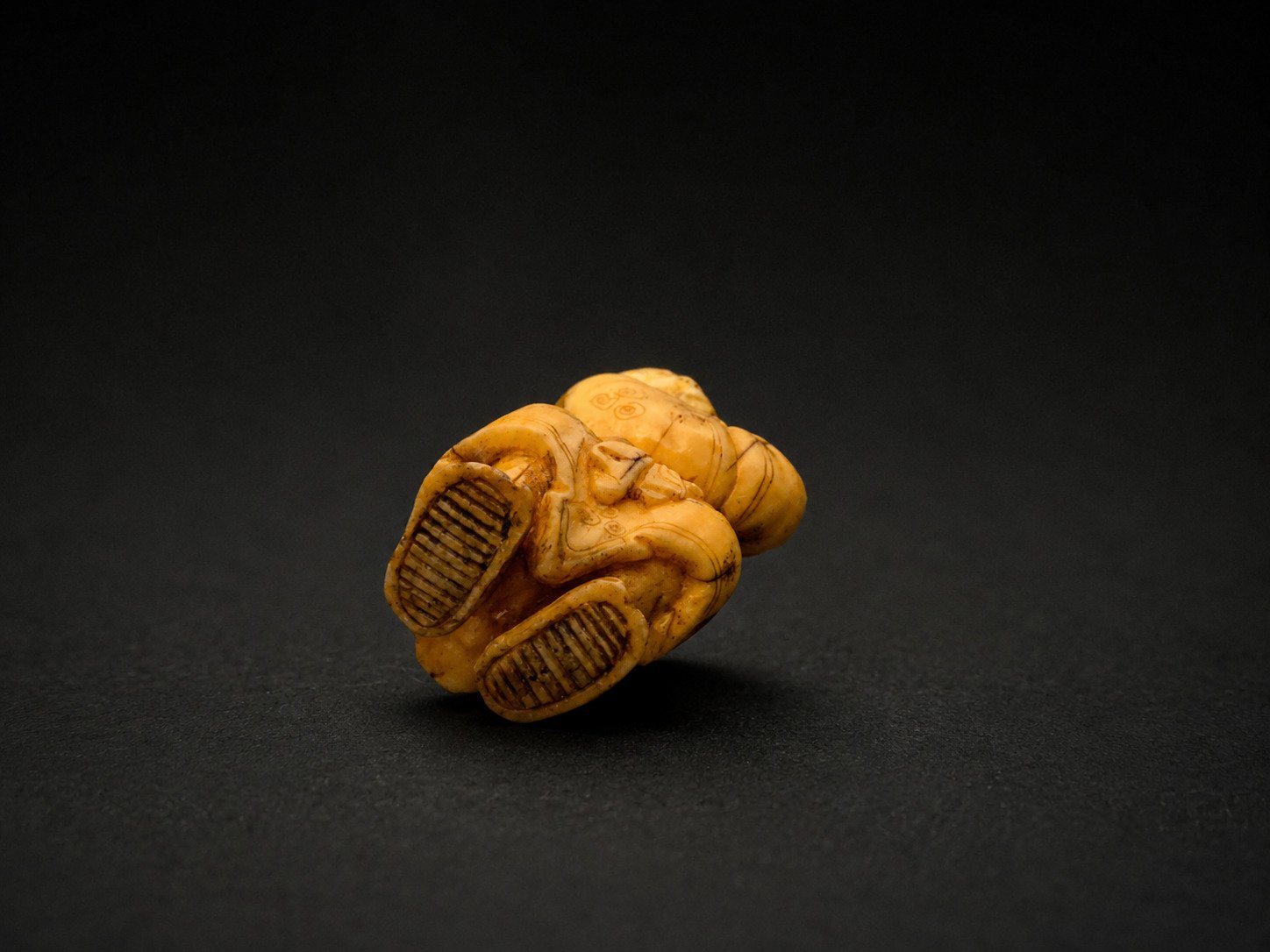
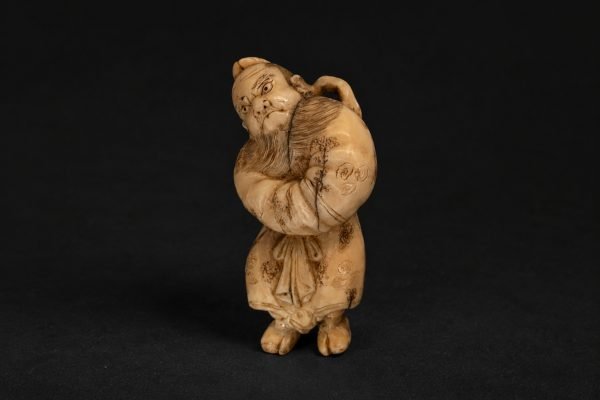
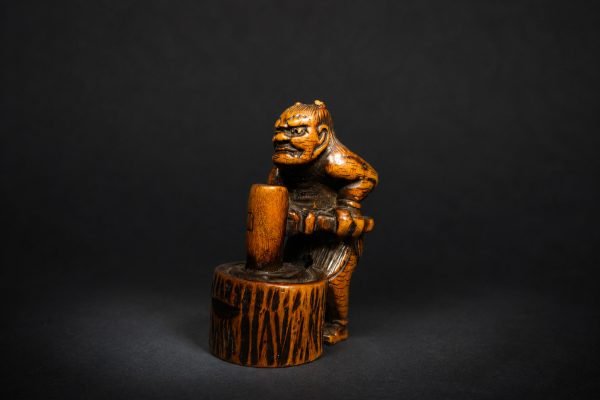
An expressive Japanese katabori netsuke carved from walrus ivory (seiuchi no kiba), dating to the Edo period and depicting Shoki (鍾馗), the celebrated Demon Queller of Sino-Japanese folklore.
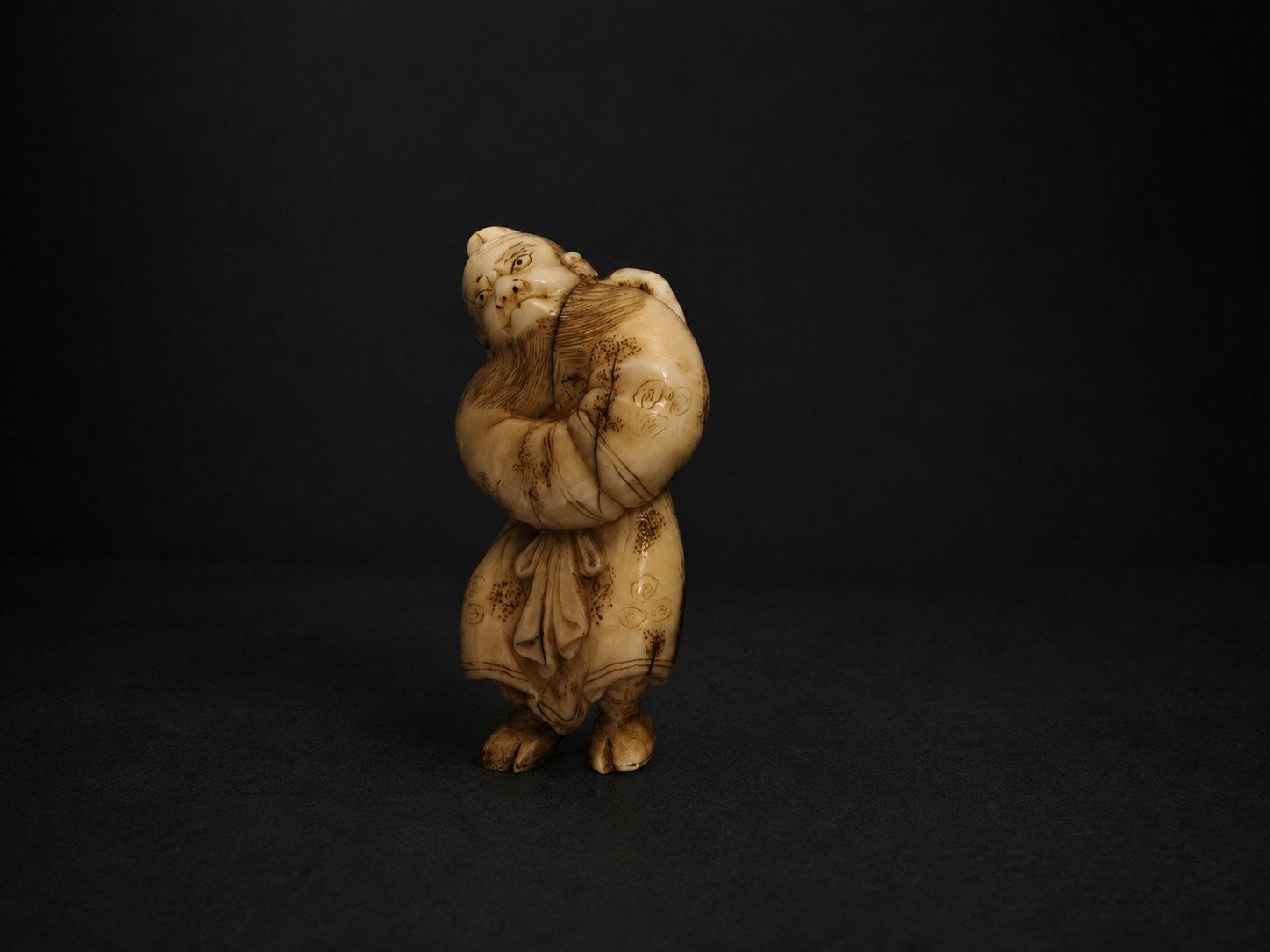
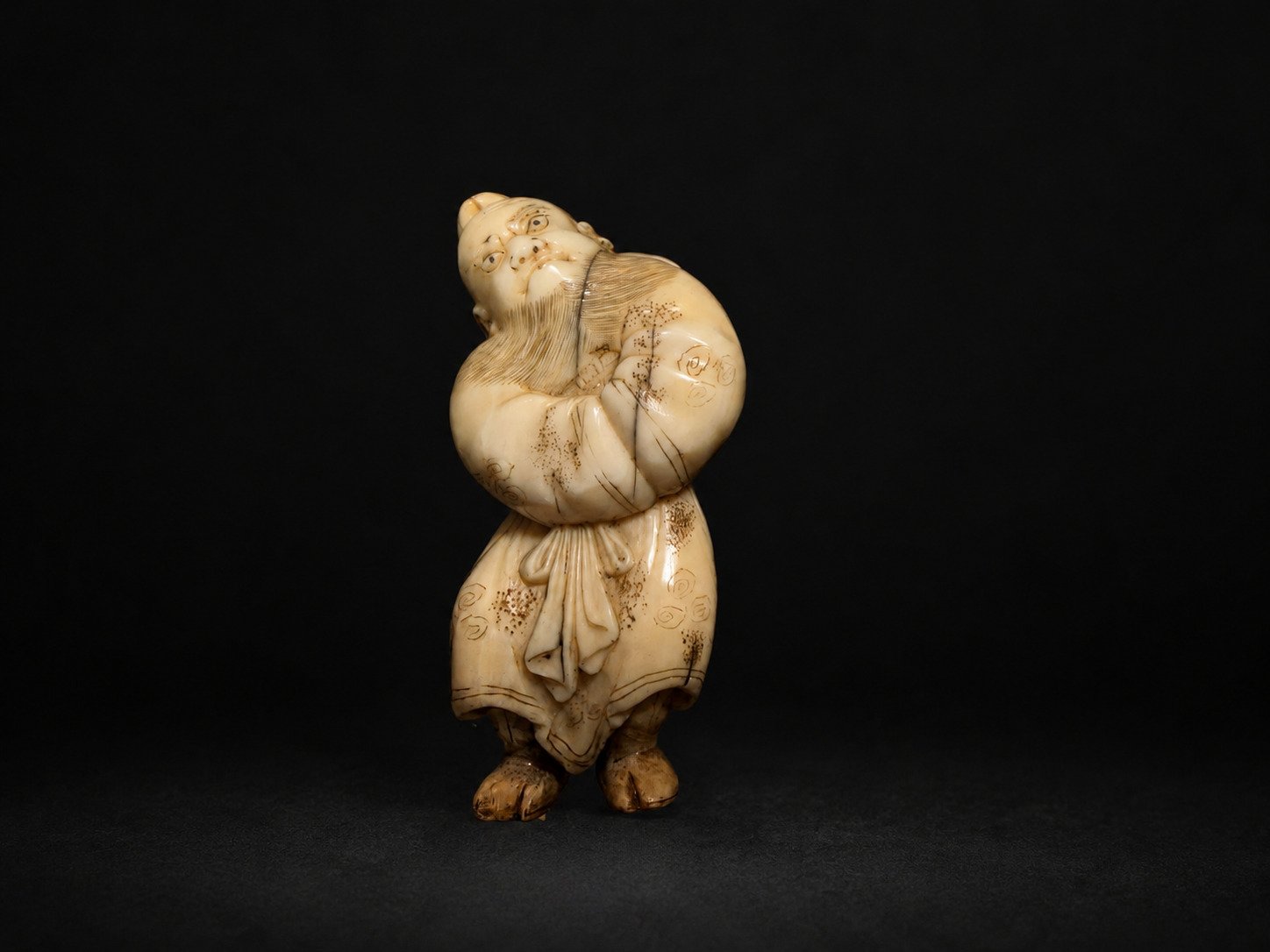
Shoki is represented according to his distinctive traditional iconography: a stern, alert expression, prominent eyes, a long unruly beard and moustache, a closely fitted cap and the robes of a Chinese scholar-official. Held close against his body is his characteristic sword (ken), the weapon inseparably associated with his role as vanquisher of demons and malevolent spirits.
The carving combines broad, smoothly polished volumes with extremely fine linear engraving. The warm cream-toned material shows natural veining, darker mottling and a surface patina associated with prolonged handling and age, giving the figure considerable visual depth.
Shoki, known as Zhong Kui in Chinese tradition, became one of the most recognisable protective figures in Japanese art. He was traditionally regarded as a powerful defender against demons, evil influences and illness.
His image became particularly popular in Japan as an apotropaic figure and was historically associated with Tango no Sekku, the Boys’ Day festival celebrated on the fifth day of the fifth month. Images and figures of Shoki were displayed with the intention of protecting children and encouraging strength and resilience.
Within netsuke carving, his dramatic facial features, voluminous robes, beard and sword provided artists with a particularly expressive subject, allowing both character and movement to be condensed into a very small sculptural format.
The face is one of the strongest elements of the carving. Shoki’s large eyes are directed sharply upward and to the side, creating the impression that he has suddenly noticed the presence of a demon or other supernatural adversary.
The deeply furrowed brow, pronounced nose and tightly modelled features reinforce his famously fierce and vigilant character.
His long moustache and beard are rendered through numerous fine engraved lines, contrasting with the broad polished surfaces of the cheeks and forehead. This combination of smooth modelling and delicate incision gives the face a particularly vivid presence.
Shoki’s long, unkempt beard is one of his most immediately recognisable attributes. Here it falls heavily across the chest in finely engraved strands, creating texture without disrupting the compact silhouette of the figure.
The hair and beard are treated with closely spaced linear carving, producing a strong contrast with the smooth surface of the face and robes.
A closely fitted cap covers the head, completing the traditional scholar-official appearance inherited from the Chinese iconography of Zhong Kui.
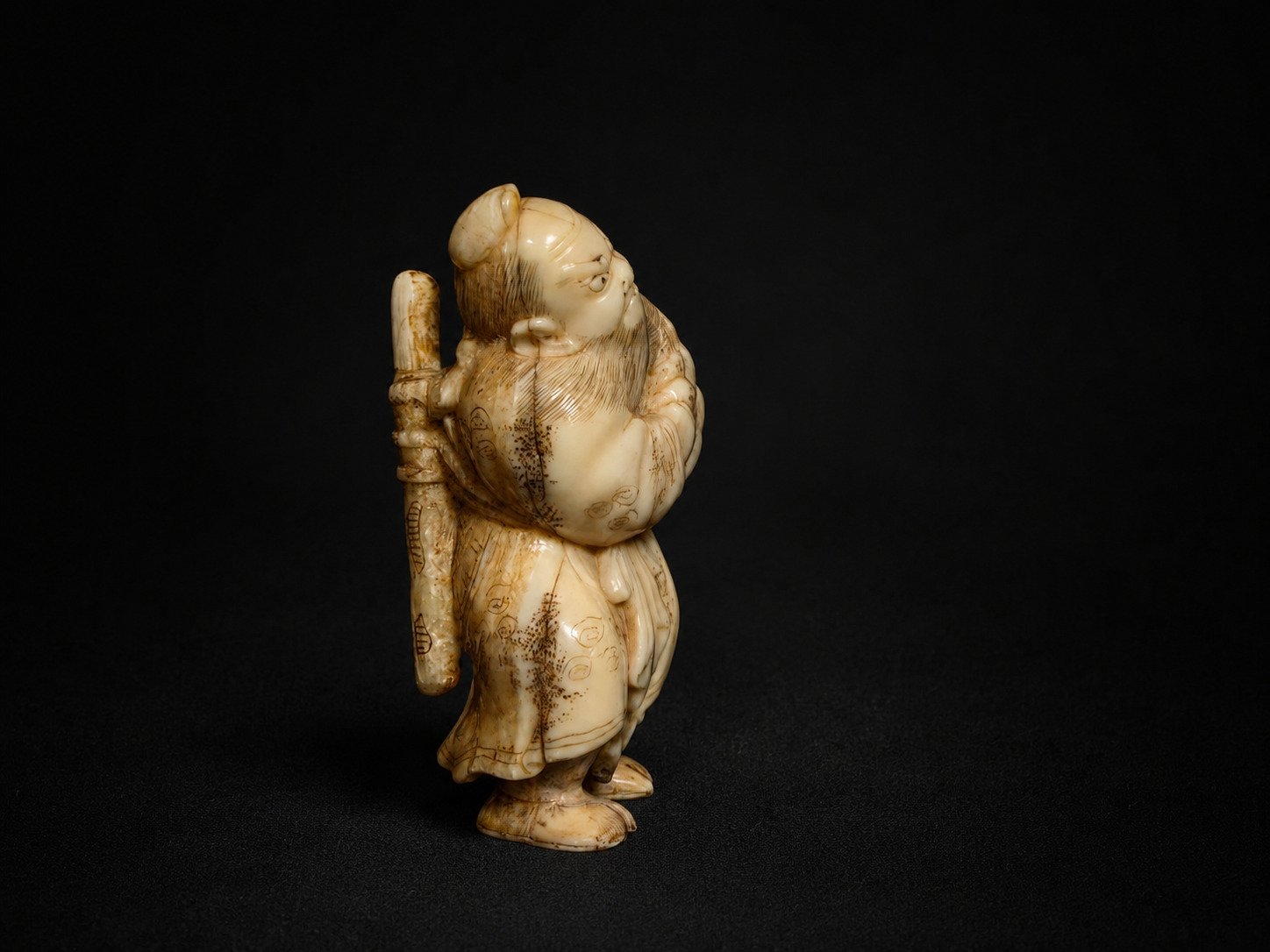
Held tightly alongside the body is Shoki’s sword (ken), his defining martial attribute and the weapon with which he is traditionally represented confronting demons.
The sword is integrated closely into the compact composition rather than projecting freely from the figure, an effective solution for a functional netsuke where fragile extensions would have been undesirable.
Ringed and incised details articulate the hilt and associated elements, allowing the weapon to remain clearly readable despite its close integration with the robes and body.
Shoki wears the flowing garments traditionally associated with a Chinese scholar-official. The broad sleeves envelop much of the body and contribute significantly to the rounded, asymmetrical silhouette of the sculpture.
The robes are decorated with a combination of finely incised folds and small ornamental motifs, including recurring circular and spiral designs distributed across the surface.
These delicate engraved details enliven the large polished areas of the garment without overwhelming the overall sculptural form.
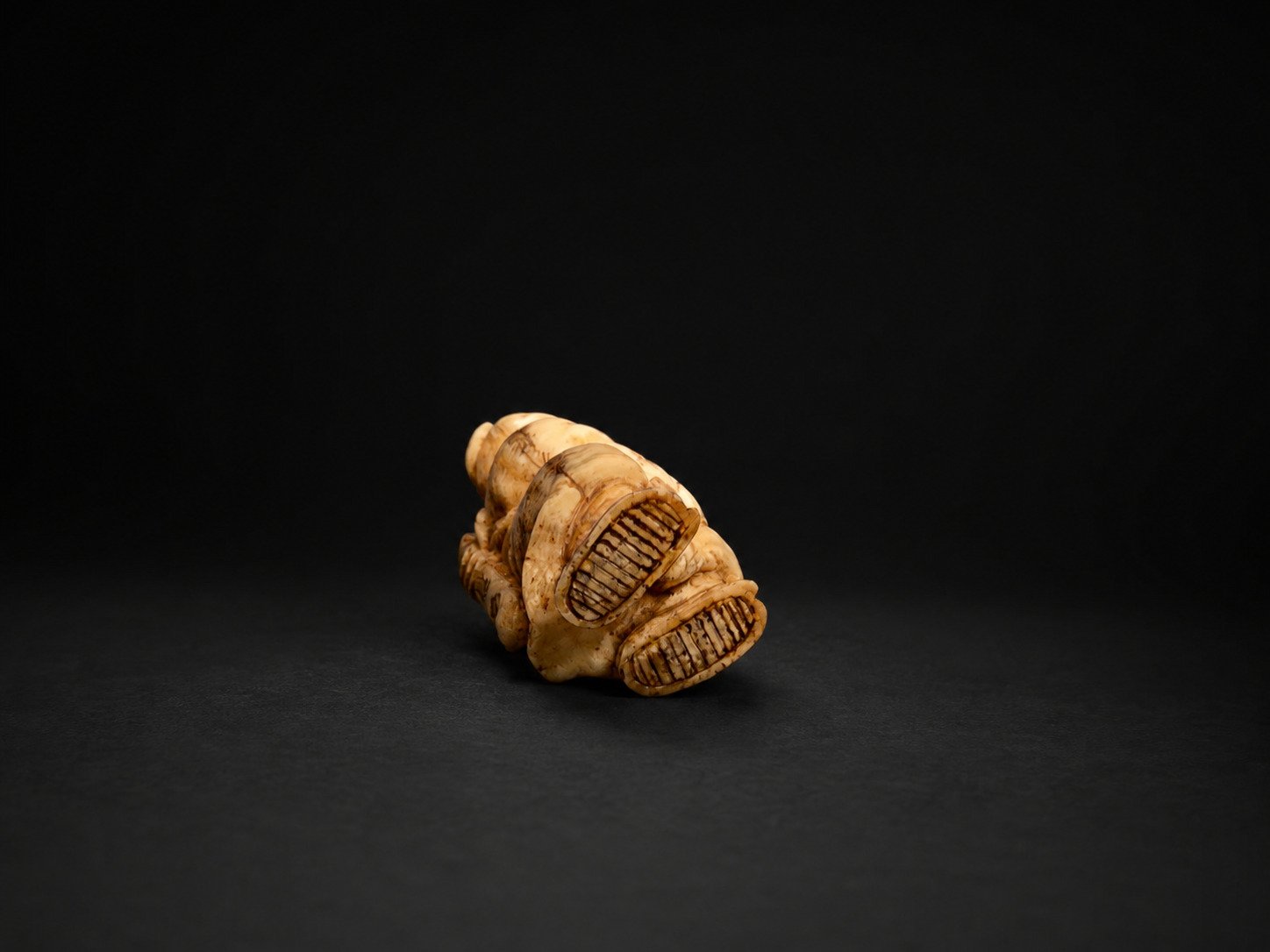
The figure is conceived as a compact standing composition without a separate base. The substantial upper body, broad sleeves and closely held sword create a deliberately asymmetric silhouette, balanced by the firmly planted feet below.
The feet are robustly carved and sufficiently broad to visually support the mass above them, while the bent and gathered robes direct the eye vertically through the composition.
This balance between compactness and movement is particularly suited to the functional nature of netsuke, preserving a strong three-dimensional presence while avoiding unnecessarily fragile projections.
The piece is carved from material identified as consistent with walrus tusk, or walrus ivory (seiuchi no kiba).
The material displays a warm cream-ivory coloration together with visible tonal variation, veining and darker mottled areas. These natural characteristics contribute to the visual complexity of the surface and interact effectively with the finely engraved decoration.
The carving exploits both qualities of the material: broad polished planes for the face, sleeves and body, and precise incised lines for the hair, beard, folds and ornamental details.
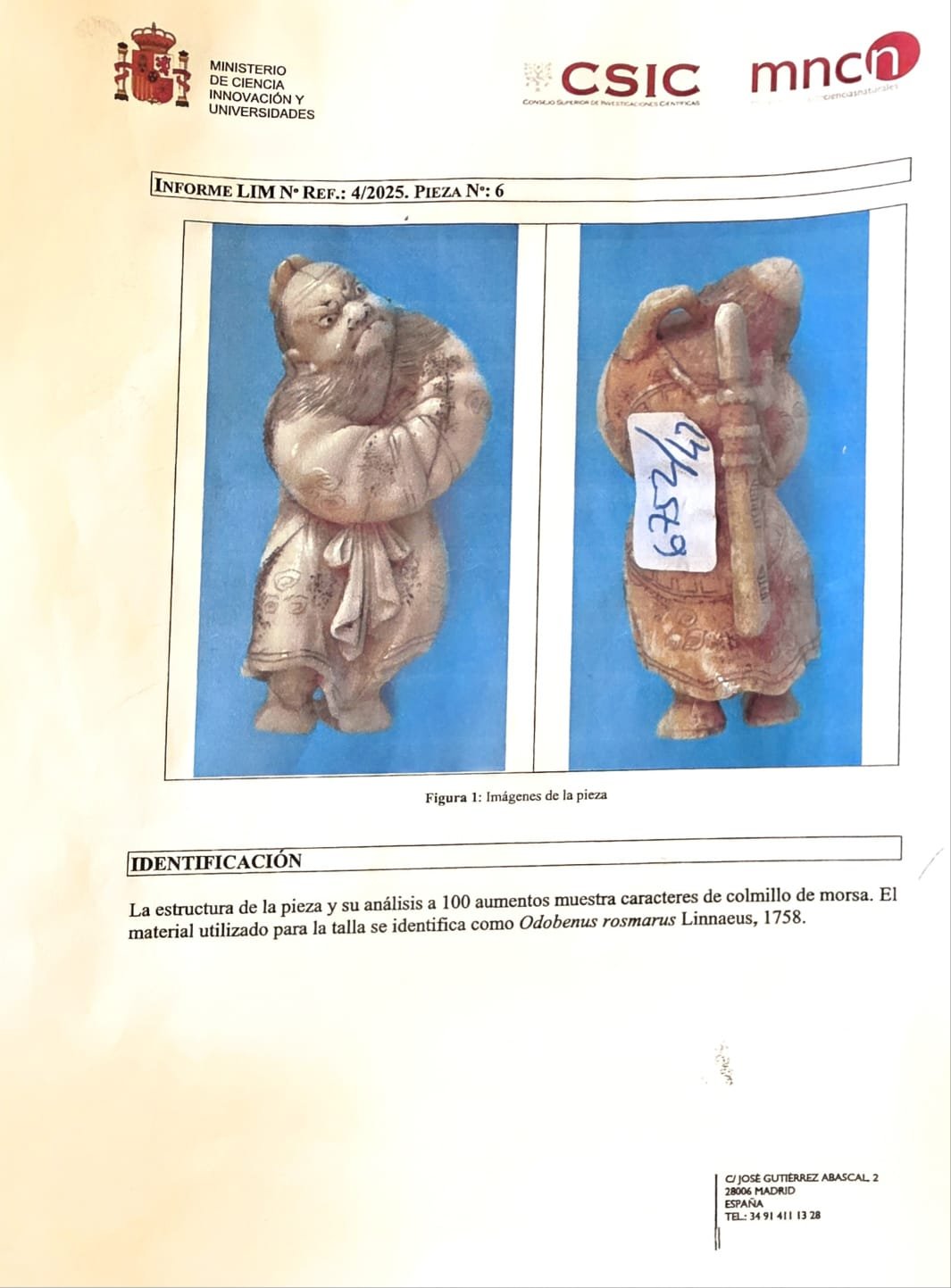
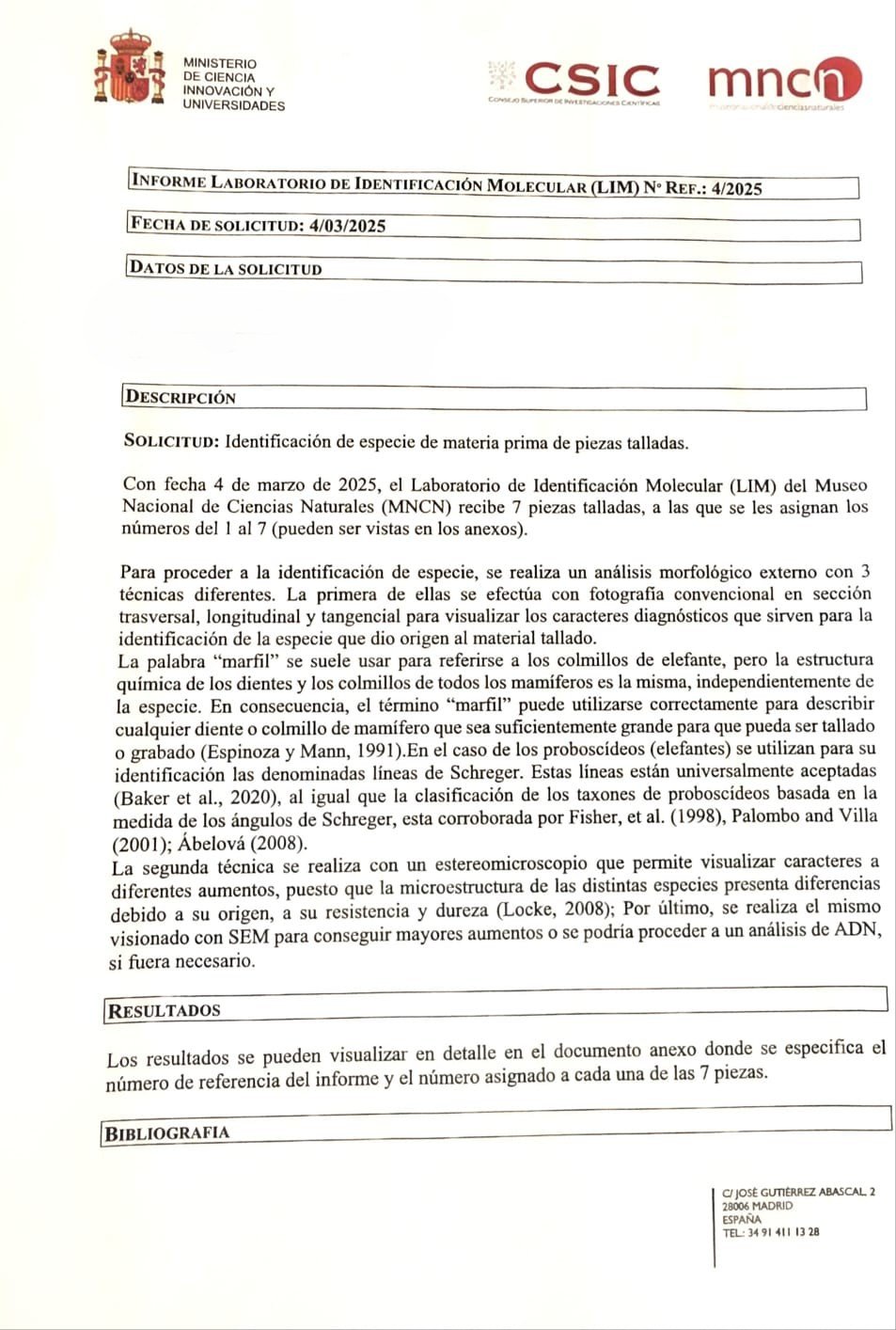
The material attribution is supported by an associated laboratory examination from LIM, CSIC/MNCN, reference 4/2025.
According to the laboratory documentation, the analysis corresponding to Piece No. 6 identified characteristics consistent with walrus tusk.
This analytical information provides documentary support for describing the carving as walrus ivory while retaining the terminology and degree of certainty stated in the laboratory findings.
This netsuke brings together several characteristics of particular interest to collectors of Japanese figurative carving: the iconic figure of Shoki, a strongly expressive face, finely engraved beard and robes, an integrated sword and a compact sculptural composition.
The contrast between Shoki’s fierce upward gaze and the rounded mass of his robes gives the carving considerable personality. Fine incised decoration rewards close inspection, while the broad polished surfaces preserve the tactile quality expected from a functional netsuke.
The accompanying laboratory examination supporting the identification of the material as consistent with walrus tusk adds an important documentary element to the piece.
An expressive Edo-period walrus ivory netsuke depicting Shoki, the legendary Demon Queller, with his fierce sidelong gaze, flowing beard, scholar-official robes and characteristic sword. Broad polished surfaces contrast with finely engraved hair, textile decoration and robe folds, while an associated LIM, CSIC/MNCN laboratory examination identifies the material characteristics of Piece No. 6 as consistent with walrus tusk.

Order above 1.000,00 € gets free shipping.

Secure and hassle-free payment process.

Certificate of authenticity included.

Have questions? Contact us via WhatsApp.
Contact