1 in stock
1 in stock
Add to Compare
Add to Wishlist
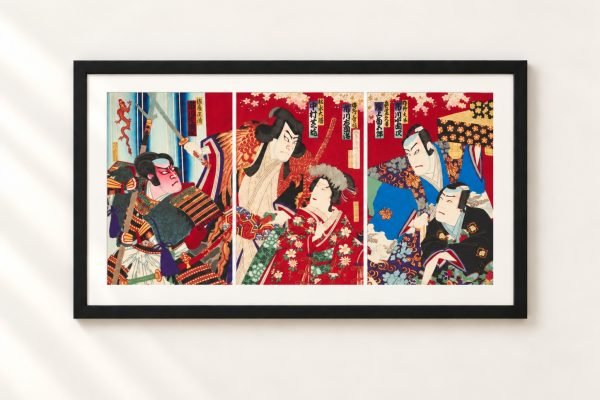
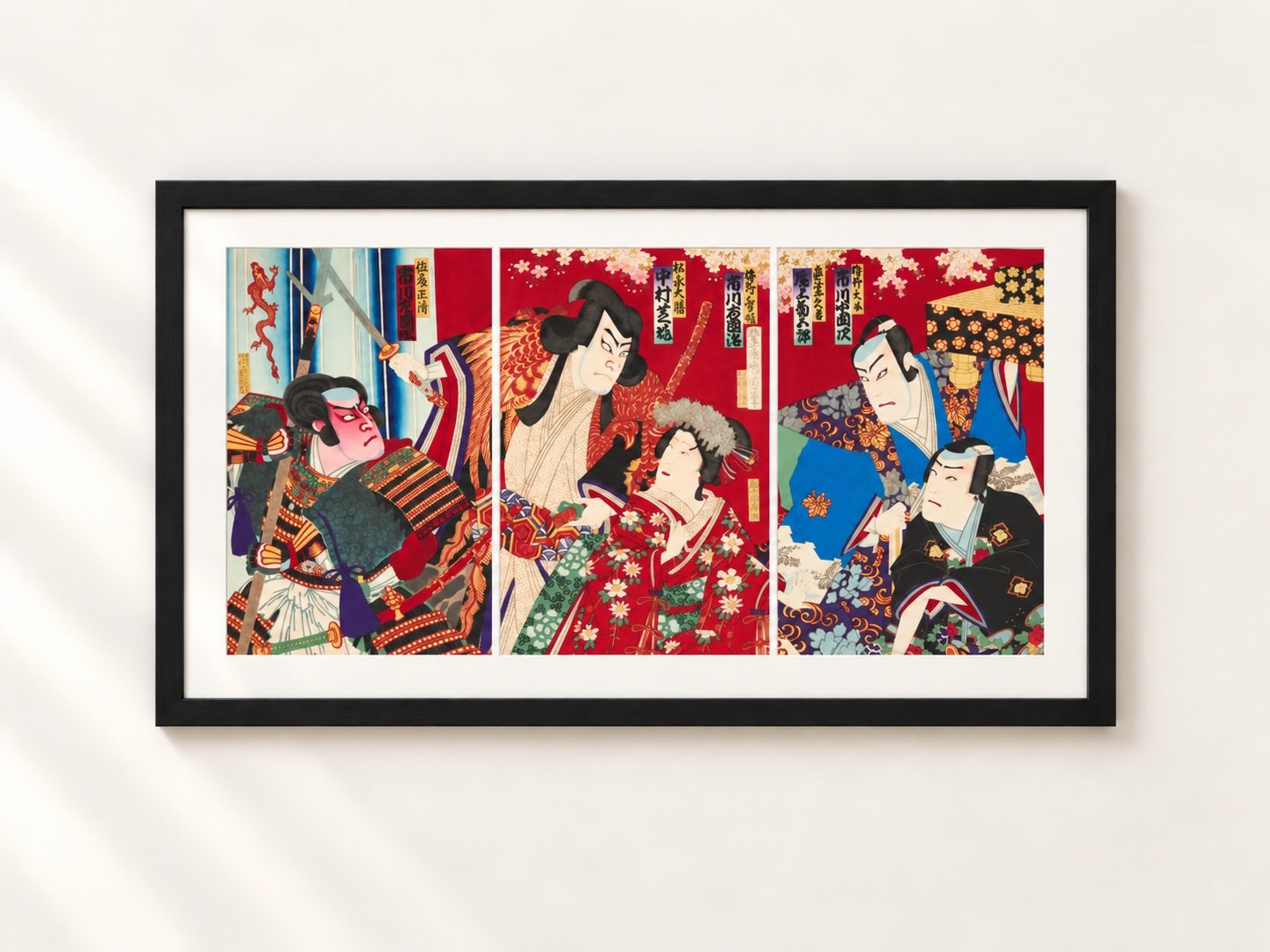
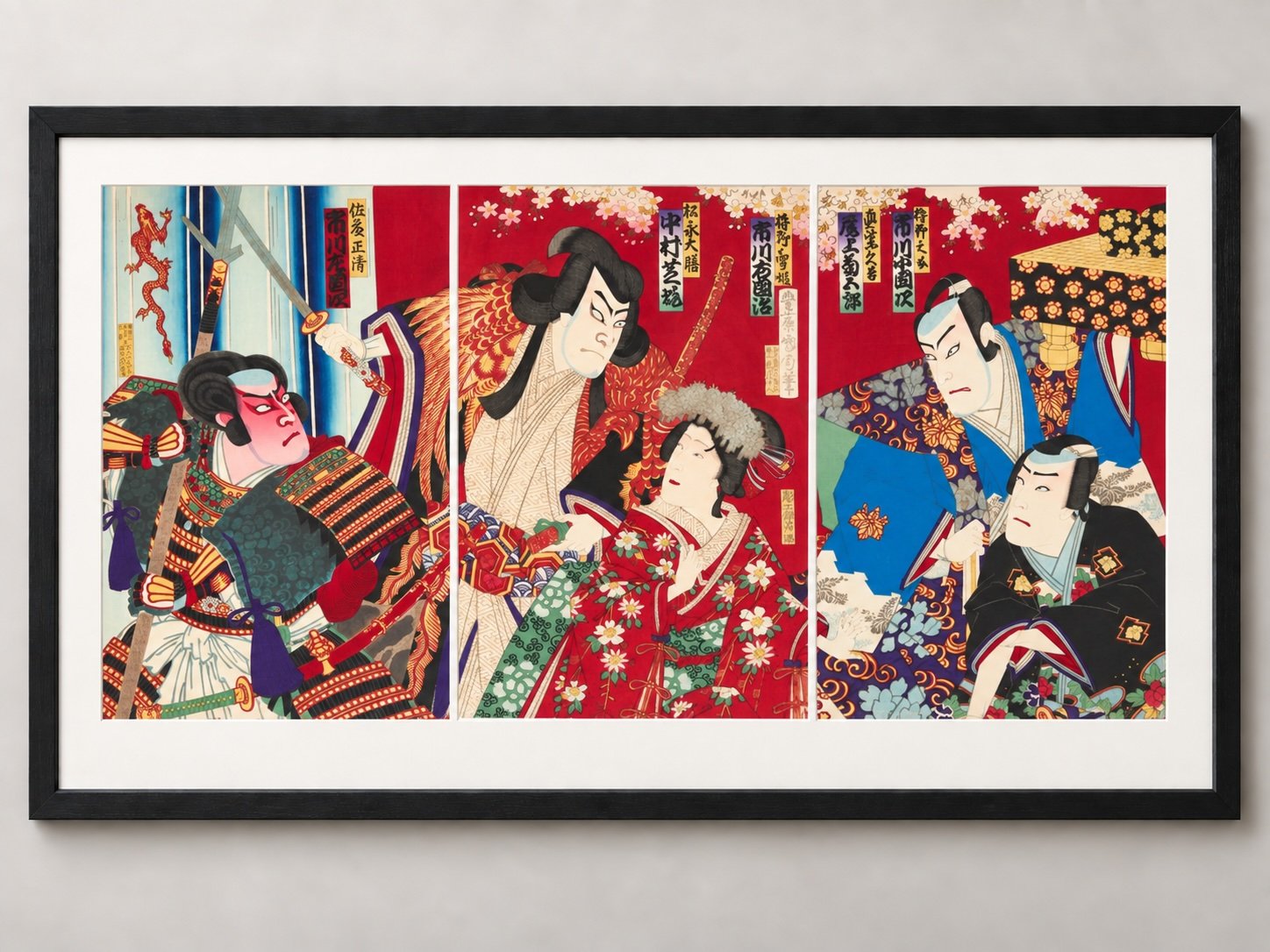
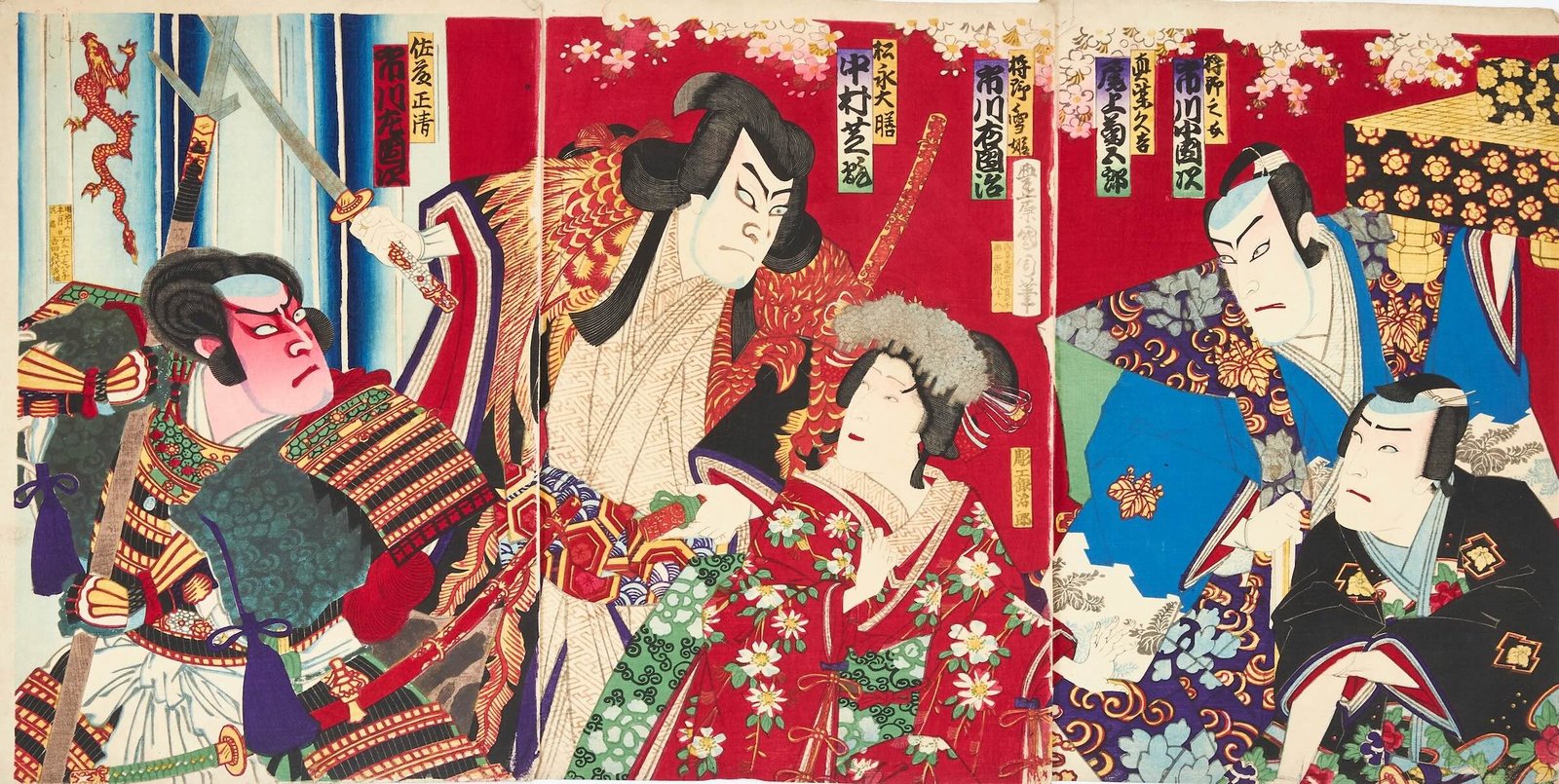
An original antique Japanese colour woodblock print triptych by Toyohara Kunichika (1835–1900), illustrating a dramatic scene from Gion Sairei Shinkōki, one of the celebrated historical dramas of the kabuki and jōruri repertory. Dated 1883, the complete three-sheet composition measures approximately 37.3 × 73.4 cm overall. The triptych brings together Kunichika’s great strengths as an actor-print designer: forceful theatrical expression, elaborate costume, brilliant Meiji-era colour and a densely staged ensemble composition.
Against a vivid red theatrical ground, multiple figures occupy the three connected sheets in a tightly structured dramatic scene.
The left panel is dominated by an armed warrior in elaborate armour and vivid red facial makeup, with drawn swords rising behind him.
The central sheet introduces a standing male figure in richly patterned robes beside a female figure dressed in red floral garments, framed by blossoming cherry branches.
The right panel continues the action with two male actors in strongly contrasting blue and black costumes.
Across the three sheets, Kunichika creates a continuous theatrical panorama in which gesture, costume, colour and expression carry the narrative.
The triptych illustrates a scene from Gion Sairei Shinkōki, a kabuki and jōruri drama set during Japan’s Sengoku period.
The story centres on political betrayal, loyalty, imprisonment and supernatural rescue.
At the heart of the plot is the treacherous retainer Matsunaga Daizen.
According to the drama, Daizen assassinates the shogun Ashikaga Yoshiteru and seizes control.
He then imprisons the shogun’s mother at the top of the Kinkakuji, Kyoto’s celebrated Golden Pavilion.
The story combines political intrigue with one of the most famous supernatural episodes in the kabuki repertoire.
Among Daizen’s prisoners is Princess Yuki, granddaughter of the great painter Sesshū.
Her artistic lineage is essential to the drama.
Daizen attempts to force her to paint a dragon on the ceiling of the temple.
When she refuses, she is bound to a cherry tree.
The image of Yuki restrained beneath falling cherry blossoms became one of the most memorable visual moments associated with the play.
It combines beauty, danger and emotional tension in a scene ideally suited to the exaggerated colour and gesture of kabuki.
The best-known episode in the drama occurs while Princess Yuki remains bound to the tree.
Unable to use her hands, she gathers fallen cherry blossom petals with her foot.
Using them, she traces the shape of a rat on the ground.
Through the supernatural power of her inherited artistic gift, the drawn rat comes to life.
The creature gnaws through the ropes binding her and allows her to escape.
The scene transforms artistic creation itself into an instrument of rescue.
It is one of the most striking examples in kabuki of supernatural intervention arising directly from artistic talent.
The story of Princess Yuki gives unusual importance to the act of painting.
Her identity as the granddaughter of Sesshū is not simply biographical background within the play.
Her artistic inheritance becomes the means through which she is saved.
The animated rat represents the idea that an image can cross the boundary between representation and reality.
For audiences, the scene offered both spectacle and a powerful affirmation of artistic lineage.
It was therefore a particularly appropriate subject for woodblock artists, whose own work depended upon transforming drawn images into reproducible visual form.
Matsunaga Daizen is the principal antagonist of the drama.
He is portrayed as a treacherous retainer responsible for the assassination of the shogun Ashikaga Yoshiteru.
His seizure of power drives the action of the play.
By imprisoning members of the shogun’s household and attempting to control Princess Yuki, Daizen becomes the force against which loyalty and resistance are defined.
The drama ultimately contrasts his ambition and betrayal with the loyalty of those who seek to avenge the murdered shogun.
The loyal commander Kinoshita Tōkichi eventually defeats Daizen and avenges the shogun’s death.
His intervention brings the story toward its resolution and completes Princess Yuki’s rescue.
Within the drama, Tōkichi represents political and personal loyalty in opposition to Daizen’s treachery.
The conflict between the two sides provides the larger historical framework within which the famous Kinkakuji episode unfolds.
The Kinkakuji episode became one of the most frequently staged and illustrated sections of Gion Sairei Shinkōki.
Its appeal lies in the combination of several themes central to kabuki.
Political intrigue provides the larger dramatic structure.
Filial and political loyalty establish the emotional stakes.
Princess Yuki’s imprisonment creates personal danger.
The supernatural rat adds visual spectacle and magical intervention.
Cherry blossoms contribute beauty and symbolism while intensifying the contrast between the elegance of the setting and the violence of the situation.
For an artist specialising in actor portraiture such as Kunichika, the scene offered exceptionally rich visual possibilities.
Kunichika designed the work as a continuous triptych rather than three independent actor portraits.
The three vertical sheets work together to form one broad horizontal scene.
Figures overlap visually from one panel to the next.
Costumes, weapons, flowering branches and the strong red background create continuity across the composition.
The left sheet introduces martial energy through the armoured warrior and raised swords.
The centre becomes the emotional core of the scene through the interaction between the standing actor and the richly dressed female figure.
The right sheet continues the theatrical tension through two additional performers in vivid costume.
The result is dense, energetic and unmistakably theatrical.
One of the most immediate visual features of the triptych is its intense red background.
The strong red field unifies the three sheets.
It also creates a dramatic stage-like atmosphere against which the actors and costumes appear with exceptional clarity.
The colour is characteristic of the brilliant palette associated with many Meiji-period prints.
Black hair, blue robes, green armour, pale faces and white cherry blossoms all become more striking against the saturated red.
The background therefore functions not simply as decoration but as one of the principal structural elements of the composition.
Cherry blossoms extend across the upper area of the central and right sections of the triptych.
Their pale flowers form a delicate contrast with the powerful red ground.
Within the story, cherry blossoms are directly connected with Princess Yuki’s supernatural rescue.
The petals she gathers become the material from which she draws the rat that comes to life.
Their presence therefore carries narrative significance in addition to decorative beauty.
The blossoms introduce softness and fragility into an image otherwise filled with weapons, armour and dramatic confrontation.
The left section of the triptych is dominated by a warrior in richly detailed armour.
His face is rendered with intense red theatrical makeup.
Several weapons rise around the figure, reinforcing the military atmosphere of the scene.
The armour is constructed through repeated bands of orange, black, green and red.
These dense patterns contrast strongly with the vertical blue-and-white section behind him.
The pose, facial expression and complexity of the armour immediately establish a sense of confrontation and danger.
At the centre of the triptych, a female-role figure appears dressed in elaborate red robes densely patterned with flowers.
The costume is among the richest areas of the composition.
Red, green, white and pale floral motifs combine with the large decorative headdress.
Her position beneath the cherry blossoms links her visually with the central Princess Yuki episode described in the drama.
The elegant costume and controlled expression contrast with the more aggressive postures of the surrounding male figures.
This opposition between beauty and danger is central to the visual impact of the composition.
Kunichika was exceptionally skilled at using costume as part of dramatic storytelling.
Across the triptych, almost every major figure is distinguished by a different combination of pattern and colour.
Armour on the left produces a dense geometric rhythm.
The central male figure wears pale patterned robes beneath a flamboyant red-and-gold outer garment.
The female figure is covered in floral decoration.
On the right, brilliant blue contrasts with a darker black robe decorated with floral and geometric motifs.
This variety allows each actor to remain individually recognisable while preserving the visual unity of the complete scene.
Toyohara Kunichika became particularly celebrated for yakusha-e, woodblock prints depicting kabuki actors.
Actor prints had long been one of the central genres of ukiyo-e.
They allowed theatre audiences to collect images of celebrated performers in famous roles and dramatic scenes.
Kunichika carried this tradition into the Meiji period.
Rather than presenting actors simply as static portraits, he frequently placed them within highly charged theatrical moments.
The present triptych demonstrates this approach particularly well.
Expression, costume, movement and relationships between the figures recreate the intensity of performance within a printed image.
Toyohara Kunichika (1835–1900) was born Ōshima Yasohachi in the Kyōbashi district of Tokyo.
As a boy of around eleven, he began studying under the painter Chikanobu.
At approximately thirteen, he became an apprentice to Utagawa Kunisada, one of the leading print designers of nineteenth-century Japan.
Kunichika’s artist name combines characters associated with both teachers.
The name itself reflects the artistic lineage through which his career developed.
Kunisada’s influence would remain particularly important in Kunichika’s approach to kabuki actor portraiture.
Utagawa Kunisada was one of the most prolific and successful ukiyo-e artists of the nineteenth century.
His actor prints helped define the visual language of kabuki portraiture.
Kunichika absorbed from him a taste for bold composition, elaborate costume and forceful theatrical gesture.
He later developed these elements in his own distinctive Meiji-era style.
The dramatic close-ups, rich textiles and powerful expressions that characterise Kunichika’s mature work all have roots in this Utagawa tradition.
Kunichika spent long hours backstage in kabuki theatres.
He sketched actors directly in order to capture their physical mannerisms, expressions and poses with greater accuracy.
This direct contact with performers distinguished much of his work.
His prints do not merely reproduce theatrical costume.
They attempt to convey the personality and stage presence of specific actors.
In multi-figure works such as this triptych, that familiarity also allowed him to differentiate individual performers while keeping the entire group dramatically coherent.
Kunichika became known for his bold use of newly imported German aniline dyes.
These synthetic pigments produced stronger and more brilliant colours than many earlier traditional pigments.
Rich reds and dark purple-blues became particularly characteristic of his later work.
The present triptych demonstrates the visual possibilities of this palette.
The intense red background dominates the image.
Brilliant blue clothing, deep black, green armour, gold, orange and white all create strong chromatic contrasts.
These colours give the triptych the vivid brightness associated with Meiji-period print culture.
Kunichika’s career crossed one of the most important transitions in Japanese visual culture.
He trained within the older Edo-period ukiyo-e system but continued working well into the Meiji era.
During his lifetime, photography and Western artistic techniques increasingly challenged the traditional woodblock print.
Kunichika nevertheless remained closely committed to kabuki and actor portraiture.
His work therefore preserves many qualities of the older ukiyo-e world while simultaneously incorporating the brighter pigments and changing tastes of Meiji Japan.
In 1867, Kunichika received a government commission connected with the Paris World Exhibition.
This occurred at a moment when Japanese art was attracting growing international attention.
The commission reflects the reputation Kunichika had already established during his lifetime.
He ranked among Tokyo’s prominent print designers and continued to produce ambitious theatre imagery throughout the later nineteenth century.
Kunichika’s personal life became nearly as famous as his prints.
Contemporary accounts describe him as a heavy drinker and a frequent visitor to the pleasure quarters.
He also claimed to have moved house more than one hundred times.
These anecdotes contributed to his reputation as a colourful and unconventional figure.
Whatever the instability of his private life, his artistic career remained remarkably focused on the theatre and on the performers who dominated Tokyo’s kabuki stages.
The triptych was produced through traditional Japanese colour woodblock printing.
Each section required multiple carved blocks.
A key block established the principal outlines.
Additional blocks supplied separate colours and patterns.
The complexity of the costumes visible across the triptych required extremely careful printing.
Red grounds, blue robes, green armour, floral patterns, pale faces, black hair and the delicate cherry blossoms all depended on the precise registration of successive impressions.
The finished work demonstrates the collaborative skill of designer, carver and printer.
The complete work measures approximately 37.3 × 73.4 cm overall.
Three vertically oriented sheets combine to create the broad horizontal composition.
This format allowed Kunichika to construct a theatrical scene far more expansive than a single-sheet actor portrait.
Multiple figures could interact across the image.
Weapons and costume could extend into adjoining panels.
Cherry blossoms could cross the upper register.
The result has a panoramic quality particularly well suited to representing the complexity of a kabuki stage scene.
This is an original antique Japanese woodblock print triptych, not a modern reproduction or later reprint.
Its age forms an essential part of its historical character.
Original Japanese prints of this period have survived generations of ownership, handling, storage and display.
Some gentle toning, small marks, occasional spots, light creasing or handling traces are normal in antique works on paper.
Such features are consistent with authentic nineteenth-century prints and should be considered part of the history of the object rather than compared with the appearance of a newly produced reproduction.
The triptych comes from the collection of Dr. Eugen Milch (1889–1958), an Austrian physician and artist.
During the First World War, Milch served as a medical officer.
In the early 1920s, he travelled through Europe on a journey that combined study with painting.
In 1924, he married Emma Bormann.
The couple travelled to Sweden that same year.
Together with the artist Oskar Bergman, they exhibited several paintings at Liljevalchs in Stockholm.
In 1937, Eugen Milch travelled to China with other Austrian physicians at the invitation of the Chinese government.
His wife joined him two years later.
Although the original appointment did not develop as planned, Milch became superintendent of a hospital in Beihai in 1938.
His life in East Asia combined medical work with a continuing interest in travel, culture and art.
In 1941, Japanese forces occupied parts of the southern Chinese coast, including Beihai.
The Milch family managed to relocate to Shanghai.
During their years in China, Eugen and Emma separated.
Eugen later assisted British forces in China.
For this service, he received British citizenship.
His life therefore intersected with major political and military events in East Asia during the first half of the twentieth century.
Continuing his travels, Eugen Milch later visited Japan to study the aftermath of the war.
According to the provenance associated with the collection, it is likely that he acquired the present group of Japanese woodblock prints during this period.
He died in Hong Kong in 1958.
The collection subsequently passed by descent within the family.
This provenance adds a further historical dimension to the triptych, linking an 1883 kabuki print with the international life of a twentieth-century physician, artist, traveller and collector.
The three sheets are not attached to one another.
The work shows age-related wear and handling creases along the upper edges of the sheets.
The colours remain in good condition.
As with any antique work on paper, some gentle toning, occasional marks or minor creasing may naturally be present.
These characteristics are consistent with the age and history of an original nineteenth-century Japanese woodblock print.
The condition information is provided for transparency and should not be understood as suggesting that the work is in poor condition.
The product photography presents the triptych in a wide black frame with a light mount, allowing the complete three-sheet composition to be viewed as one continuous panoramic image.
The dark frame complements the saturated red, black and blue tones of the work without competing with the original composition.
Please refer to the individual product details for the precise sale presentation and framing arrangement.
This triptych brings together several of the elements that define Toyohara Kunichika’s importance within late ukiyo-e.
It is an ambitious multi-figure kabuki composition by an artist who was considered one of the leading actor-print designers of his generation.
The subject comes from one of the best-known dramatic episodes in Gion Sairei Shinkōki, combining political betrayal, loyalty, artistic lineage, supernatural intervention and theatrical spectacle.
Visually, the work is equally powerful.
The saturated red background unifies all three sheets.
Armour, swords, floral robes, cherry blossoms and intensely patterned costumes create a dense field of colour and detail.
The contrast between the martial figures and the elegant central female-role figure captures the mixture of violence and beauty that makes the Kinkakuji episode so memorable.
Dated 1883, the work also belongs firmly to Kunichika’s Meiji-period production, when his use of strong aniline reds and dark blue-purple tones gave his prints a distinctive modern intensity while preserving the conventions of traditional kabuki portraiture.
The documented provenance from the collection of Dr. Eugen Milch adds another historical layer.
As an original nineteenth-century Japanese theatre triptych, the work combines kabuki history, late ukiyo-e, actor portraiture, Meiji colour printing and substantial decorative presence.
An original antique Japanese colour woodblock triptych by Toyohara Kunichika (1835–1900), illustrating a dramatic scene from Gion Sairei Shinkōki. Dated 1883 and measuring approximately 37.3 × 73.4 cm overall, the three-sheet composition reflects Kunichika’s celebrated mastery of kabuki actor portraiture through forceful expression, elaborate costume, vivid Meiji-era colour and tightly organised theatrical interaction. The drama centres on the treacherous Matsunaga Daizen, Princess Yuki and the loyal Kinoshita Tōkichi, with the celebrated Kinkakuji episode in which Yuki uses fallen cherry blossoms to draw a rat that miraculously comes to life and frees her from her bonds. The triptych is dominated by brilliant red, richly patterned costume, armour, weapons and flowering cherry branches, giving the scene exceptional theatrical presence. From the collection of Dr. Eugen Milch (1889–1958), subsequently by descent within the family. The three sheets remain unattached and show age-related wear and handling creases along the upper edges, while the colours remain in good condition. Original antique Japanese woodblock print, not a modern reproduction or reprint.

Order above 1.000,00 € gets free shipping.

Secure and hassle-free payment process.

Certificate of authenticity included.

Have questions? Contact us via WhatsApp.
Contact